
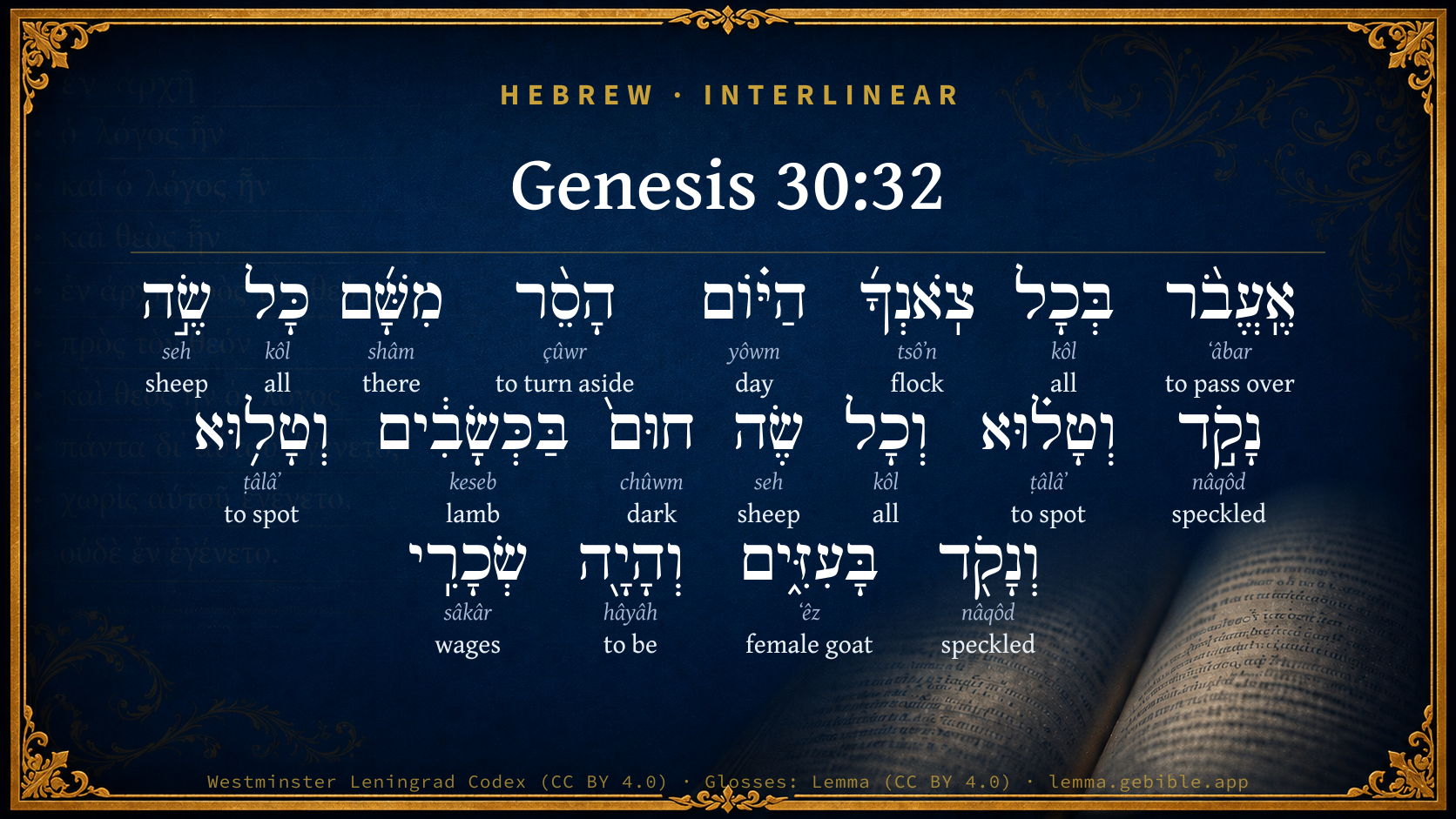
Genesis 30:32

Hebrew (Westminster Leningrad Codex) Genesis 30:32 appears in the Hebrew Old Testament. The text above is from the Westminster Leningrad Codex. Each word links to its Strong’s number, a concise gloss, and parsing drawn from the Open Scriptures Hebrew Bible morphology. Click any word for its full Brown-Driver-Briggs (BDB) entry.
Download image
Cite this verse

Genesis 30:32 (World English Bible). Public Domain. Lemma interlinear Bible study tool, https://lemma.gebible.app/v/genesis/30/32.

Show BibTeX & RIS
BibTeX
RIS
English Translation
I will pass through all your flock today, removing from there every speckled and spotted one, and every black one among the sheep, and the spotted and speckled among the goats. This will be my hire.
World English Bible · Public Domain
Highlights
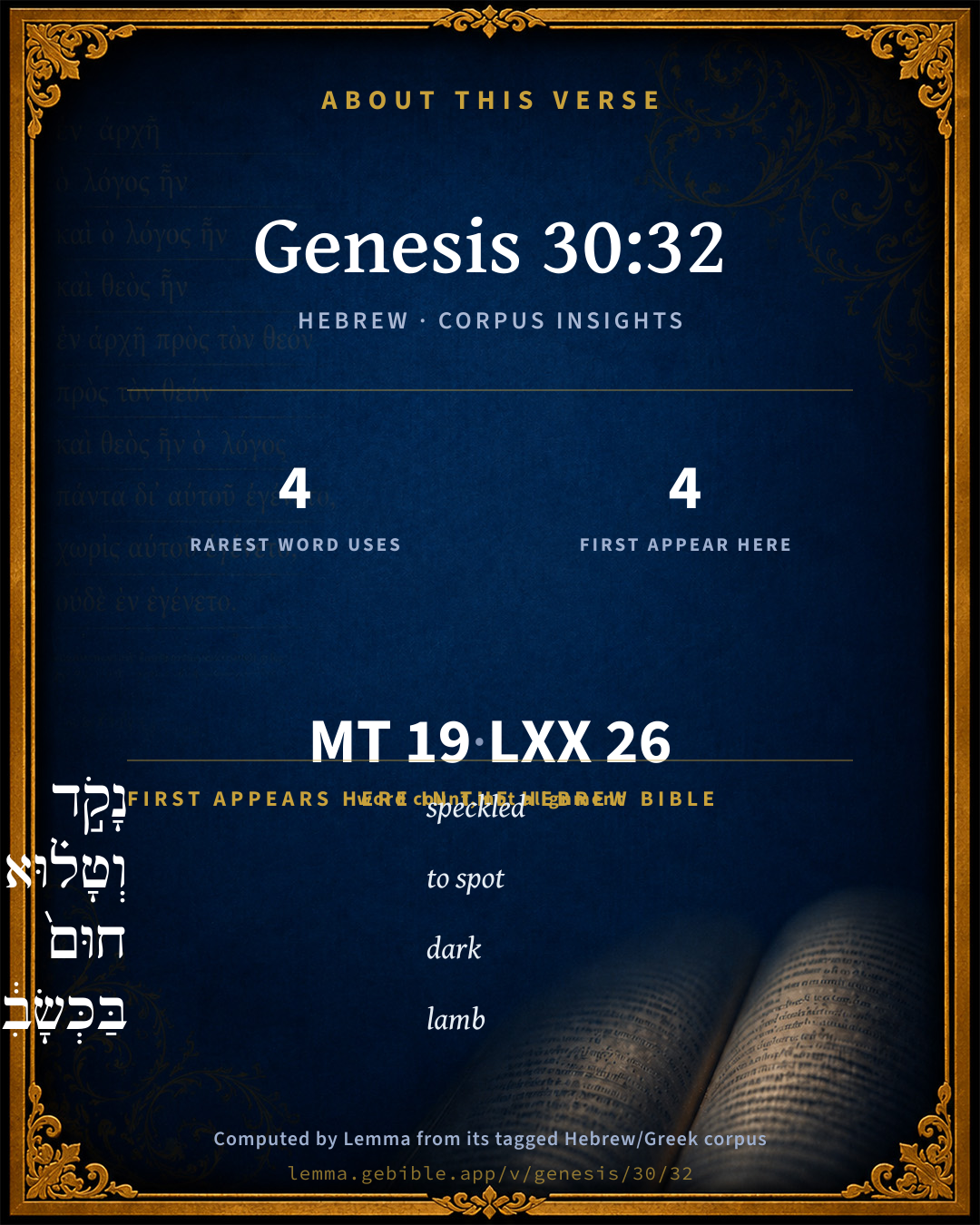
  • 4 first appearances in the Hebrew Bible
Full analysis ↓
Download a study sheet

One document with this verse’s original text, its word-by-word gloss line, the meaning frame, cross-references with their text, attributed commentary, and full source and license credits — printable, and it pastes into notes with its structure intact.

This verse Autodidact and up

Study sheet (.html) Plain text (.txt)

A passage Seminary Student

Up to 50 verses in one chapter. A passage sheet keeps up to 6 commentary sources and 12 cross-references per verse, in the order this page ranks them, and says so on the sheet whenever that leaves anything out. Ask for a single verse and you get the Autodidact verse sheet above.

Everything on this page stays free to read, with no account — the sheet is a download of what is already on screen, not access to it.

Want to remove ads? Support Godless Engineer
Compare translations 3

The same verse in 3 English versions, stacked beneath the original-language interlinear above. Click any original word for its lexicon entry.

Each is an independent rendering of the whole verse — the interlinear is not word-aligned to these translations.

Highlighted words mark where these versions differ — a whole-verse word diff, not a word-by-word alignment.

  • World English Bible Public Domain
    I will pass through all your flock today, removing from there every speckled and spotted one, and every black one among the sheep, and the spotted and speckled among the goats. This will be my hire.
  • King James Version Public Domain
    I will pass through all thy flock to day, removing from thence all the speckled and spotted cattle, and all the brown cattle among the sheep, and the spotted and speckled among the goats: and of such shall be my hire.
  • unfoldingWord Literal Text CC BY-SA 4.0
    I will pass through all your flock today to remove from there every speckled and spotted lamb and every dark-colored lamb among the sheep, and the spotted and speckled among the goats. And that will be my wages.

unfoldingWord Literal Text — © unfoldingWord, licensed CC BY-SA 4.0. Word-aligned USFM3 via Door43 (git.door43.org/unfoldingWord/en_ult).

Versions to compare (up to 4)

3 of 4 selected

Show all 18 translations

Every available English version of this verse, each an independent rendering of the whole verse.

  • World English Bible Public Domain
    I will pass through all your flock today, removing from there every speckled and spotted one, and every black one among the sheep, and the spotted and speckled among the goats. This will be my hire.
  • Berean Standard Bible Public Domain
    Let me go through all your flocks today and remove from them every speckled or spotted sheep, every dark-colored lamb, and every spotted or speckled goat. These will be my wages.
  • Majority Standard Bible Public Domain
    Let me go through all your flocks today and remove from them every speckled or spotted sheep, every dark-colored lamb, and every spotted or speckled goat. These will be my wages.
  • King James Version Public Domain
    I will pass through all thy flock to day, removing from thence all the speckled and spotted cattle, and all the brown cattle among the sheep, and the spotted and speckled among the goats: and of such shall be my hire.
  • American Standard Version (1901) Public Domain
    I will pass through all thy flock to-day, removing from thence every speckled and spotted one, and every black one among the sheep, and the spotted and speckled among the goats: and `of such' shall be my hire.
  • Revised Version (1885) Public Domain
    I will pass through all thy flock today, removing from thence every speckled and spotted one, and every black one among the sheep, and the spotted and speckled among the goats: and of such shall be my hire.
  • Geneva Bible (1599) Public Domain
    I wil passe through all thy flockes this day, and separate from them all the sheepe with litle spots and great spots, and al blacke lambes among the sheepe, and the great spotted, and litle spotted among the goates: and it shalbe my wages.
  • Douay-Rheims (1899) Public Domain
    Go round through all thy flocks, and separate all the sheep of divers colours, and speckled: and all that is brown and spotted, and of divers colours, as well among the sheep, as among the goats, shall be my wages.
  • Young's Literal Translation Public Domain
    I pass through all thy flock to-day to turn aside from thence every sheep speckled and spotted, and every brown sheep among the lambs, and speckled and spotted among the goats -- and it hath been my hire;
  • Literal Standard Version CC BY-SA 4.0
    I pass through all your flock today to turn aside every speckled and spotted sheep from there, and every brown sheep among the lambs, and speckled and spotted among the goats—and it has been my hire;
  • Unlocked Literal Bible CC BY-SA 4.0
    Let me walk through all your flock today, removing from it every speckled and spotted sheep, and every black one among the sheep, and the spotted and speckled among the goats. These will be my wages.
  • unfoldingWord Literal Text CC BY-SA 4.0
    I will pass through all your flock today to remove from there every speckled and spotted lamb and every dark-colored lamb among the sheep, and the spotted and speckled among the goats. And that will be my wages.
  • Darby Bible Public Domain
    I will pass through all thy flock to-day, to remove thence all the speckled and spotted sheep, and all the brown lambs, and the spotted and speckled among the goats; and [that] shall be my hire.
  • World Messianic Bible Public Domain
    I will pass through all your flock today, removing from there every speckled and spotted one, and every black one among the sheep, and the spotted and speckled among the goats. This will be my hire.
  • Webster's Bible Public Domain
    I will pass through all thy flock to-day, removing from thence all the speckled and spotted cattle, and all the brown cattle among the sheep, and the spotted and speckled among the goats: and of such shall be my hire.
  • Free Bible Version CC BY-SA 4.0
    Let me go through your flocks today and take all the sheep that are speckled or spotted, and all the dark ones, as well as all the speckled and spotted goats. They'll be my wages.
  • Bible in Basic English Public Domain
    Let me go through all your flock today, taking out from among them all the sheep which are marked or coloured or black, and all the marked or coloured goats: these will be my payment.
  • JPS Tanakh (1917) Public Domain
    I will pass through all thy flock to-day, removing from thence every speckled and spotted one, and every dark one among the sheep, and the spotted and speckled among the goats; and of such shall be my hire.

Literal Standard Version (2020), Covenant Press — licensed CC BY-SA 4.0. Text via the HelloAO Bible API (eBible.org). Unlocked Literal Bible (unfoldingWord) — licensed CC BY-SA 4.0. Text via the HelloAO Bible API (eBible.org). unfoldingWord Literal Text — © unfoldingWord, licensed CC BY-SA 4.0. Word-aligned USFM3 via Door43 (git.door43.org/unfoldingWord/en_ult). Free Bible Version, Dr. Jonathan Gallagher — licensed CC BY-SA 4.0. Text via the HelloAO Bible API (eBible.org).

Word by word

More ways to search: Search by grammar → Find every occurrence → Compare this word →

Practice this passage: Drill this verse → Learn its vocabulary →

חוּם֙
chûwm
H2345
“dark”
Adjective, Adjective, Masculine, Singular, Absolute
Part of Speech
Adjective
Type
Adjective
Gender
Masculine
Number
Singular
State
Absolute
Full BDB Definition

Origin: from an unused root meaning to be warm

TWOT: 625a

dark colour, darkened, dark brown or black
  1. אֶֽעֱבֹ֨ר ʻâbar H5674 “to pass over” Verb, Qal, Imperfect, 1st Person, Common, Singular
  2. בְּכָל kôl H3605 “in/at · all of” Preposition + Noun, Common, Masculine, Singular, Construct
  3. צֹֽאנְךָ֜ tsôʼn H6629 “flock · your” Noun, Common, Both, Singular, Construct + Suffix, Personal, 2nd Person, Masculine, Singular
  4. הַיּ֗וֹם yôwm H3117 “the · day” Particle, Definite Article + Noun, Common, Masculine, Singular, Absolute
  5. הָסֵ֨ר çûwr H5493 “to turn aside” Verb, Hiphil, Infinitive Absolute
  6. מִשָּׁ֜ם shâm H8033 “from · there” Preposition + Adverb
  7. כָּל kôl H3605 “all of” Noun, Common, Masculine, Singular, Construct
  8. שֶׂ֣ה seh H7716 “sheep” Noun, Common, Both, Singular, Absolute
  9. נָקֹ֣ד nâqôd H5348 “speckled” Adjective, Adjective, Masculine, Singular, Absolute
  10. וְטָל֗וּא ṭâlâʼ H2921 “and · spotted” Conjunction + Verb, Qal, Participle Passive, Masculine, Singular, Absolute
  11. וְכָל kôl H3605 “and · all of” Conjunction + Noun, Common, Masculine, Singular, Construct
  12. שֶׂה seh H7716 “sheep” Noun, Common, Both, Singular, Absolute
  13. בַּכְּשָׂבִ֔ים keseb H3775 “in/at the · lambs” Preposition, Determined + Noun, Common, Masculine, Plural, Absolute
  14. וְטָל֥וּא ṭâlâʼ H2921 “and · spotted” Conjunction + Verb, Qal, Participle Passive, Masculine, Singular, Absolute
  15. וְנָקֹ֖ד nâqôd H5348 “and · speckled” Conjunction + Adjective, Adjective, Masculine, Singular, Absolute
  16. בָּעִזִּ֑ים ʻêz H5795 “in/at the · female goats” Preposition, Determined + Noun, Common, Feminine, Plural, Absolute
  17. וְהָיָ֖ה hâyâh H1961 “and · to be” Conjunction + Verb, Qal, Sequential Perfect, 3rd Person, Masculine, Singular
  18. שְׂכָרִֽי sâkâr H7939 “wages · my” Noun, Common, Masculine, Singular, Construct + Suffix, Personal, 1st Person, Common, Singular

About this verse

These counts appear in no published source. They are computed here, from the morphology-tagged text and Lemma’s own curated glosses. What Lemma adds →

19
words
14
distinct lemmas
Pentateuch
section

Notable vocabulary

The rarest word here is חוּם֙ dark H2345 — appearing just 4 times in the whole Hebrew Bible.

First appearance in Scripture

These words make their first canonical appearance in the Hebrew Bible here:

  • נָקֹ֣ד speckled H5348
  • וְטָל֗וּא to spot H2921
  • חוּם֙ dark H2345
  • בַּכְּשָׂבִ֔ים lamb H3775

Shared distinctive vocabulary

חוּם֙ dark H2345 occurs in 4 verses of the Hebrew Bible. Also found in:

Grammatical profile

  • 5 verbs
  • 10 nouns
  • 3 adjectives
  • 1 adverb

Verb forms

  • אֶֽעֱבֹ֨ר Qal · Imperfect
  • הָסֵ֨ר Hiphil · Infinitive Absolute
  • וְטָל֗וּא Qal · Participle Passive
  • וְטָל֥וּא Qal · Participle Passive
  • וְהָיָ֖ה Qal · Sequential Perfect

Repetition

Words recur within this verse — often emphatic in Hebrew:

  • בְּכָל all H3605 ×3
  • שֶׂ֣ה sheep H7716 ×2
  • נָקֹ֣ד speckled H5348 ×2
  • וְטָל֗וּא to spot H2921 ×2

Hebrew & Septuagint length

In English translation the verse runs 36 words from the Hebrew and 31 from the Septuagint (LXX English) — closely comparable.

A rough comparison of the two English renderings, which tokenize alike — not a word-level alignment.

Word counts can differ between the Hebrew and the Greek without any difference in meaning — e.g. the Hebrew direct-object marker אֵת has no separate Greek word, and Greek often adds the article ὁ.

In the original languages it is 19 Hebrew tokens and 26 Greek tokens — but the two are counted differently (Hebrew bundles its prefixes and suffixes into one token; the Greek is in lemma form), so that isn’t a like-for-like length.

Cross-references

3

Topical passages linked to Genesis 30:32 in the Treasury of Scripture Knowledge — connected by theme and wording, ordered by reader-vote popularity; previews shown in the World English Bible.

  • Genesis 31:8 If he said this, 'The speckled will be your wages,' then all the flock bore speckled. If he said this, 'The streaked will be your wages,' then all the flock bore streaked.
  • Genesis 31:10 It happened at the time that the flock conceive, that I lifted up my eyes, and saw in a dream, and behold, the male goats which leaped on the flock were streaked, speckled, and grizzled.
  • Genesis 30:35 That day, he removed the male goats that were streaked and spotted, and all the female goats that were speckled and spotted, every one that had white in it, and all the black ones among the sheep, and gave them into the hand of his sons.

Cross-references courtesy of OpenBible.info (CC BY 4.0).

Hebrew and Greek witnesses Masoretic Hebrew ↔ Greek Septuagint

The same verse in the two great witnesses to the Old Testament, shown verse-for-verse.

These are two independent witnesses, not word-aligned to each other, and the Septuagint is shown in lemma (dictionary) form.

Hebrew Genesis 30:32 Masoretic · Westminster Leningrad Codex

אֶֽעֱבֹ֨ר בְּכָל צֹֽאנְךָ֜ הַיּ֗וֹם הָסֵ֨ר מִשָּׁ֜ם כָּל שֶׂ֣ה נָקֹ֣ד וְטָל֗וּא וְכָל שֶׂה חוּם֙ בַּכְּשָׂבִ֔ים וְטָל֥וּא וְנָקֹ֖ד בָּעִזִּ֑ים וְהָיָ֖ה שְׂכָרִֽי

I will pass through all your flock today, removing from there every speckled and spotted one, and every black one among the sheep, and the spotted and speckled among the goats. This will be my hire.

World English Bible · Public Domain

Greek LXX Genesis 30:32 Septuagint · lemma form

παραἔρχομαι πᾶς ὁ πρόβατον σύ σήμερον καί διαχωρίζω ἐκεῖθεν πᾶς πρόβατον φαιός ἐν ὁ ἀρνός καί πᾶς διάλευκος καί ῥαντός ἐν ὁ αἴξ εἰμί ἐγώ μισθός

Let all your sheep pass by today, and separate thence every grey sheep among the rams, and every one that is speckled and spotted among the goats—this shall be my reward.

LXX2012 (modern English Septuagint) · Public Domain

On this verse, The Pulpit Commentary discusses the Septuagint’s reading. Read the note in Commentary ↓

Hebrew: Westminster Leningrad Codex (CC BY 4.0). Greek: Septuagint (public domain); English from LXX2012 (modern English Septuagint) (Public Domain). How the Septuagint differs from the Hebrew →

Targum (Aramaic paraphrase)

2

The Targum is the ancient Jewish Aramaic paraphrase of the Hebrew Scriptures — an interpretive translation, not the Hebrew text itself. Onkelos (literal) and Pseudo-Jonathan (expansive) render the Torah, and Jonathan the Prophets. Coverage is partial: where no permissively-licensed English translation exists for a verse, only the Aramaic is shown. This is verse-level text, not a word-by-word alignment to the Hebrew.

  1. Targum Onkelos Torah (Genesis–Deuteronomy)
    אֶעְבַּר בְּכָל עָנָךְ יוֹמָא דֵּין הַעֲדֵי (נ''י אַעְדִּי) מִתַּמָּן כָּל אִמָּר נְמוֹר וּרְקוֹעַ וְכָל אִמָּר שְׁחוּם בְּאִמְרַיָא וּרְקוֹעַ וּנְמוֹר בְּעִזַיָא וִיהֵי אַגְרִי

    (no public-domain English translation for this verse)

    Targum Onkelos — Aramaic: “Onkelos Genesis” (public domain); “Onkelos Exodus” (public domain); “Onkelos Leviticus” (public domain); “Onkelos Numbers” (public domain); “Onkelos Deuteronomy” (public domain). English: “Sefaria Community Translation” (CC0 1.0 (public-domain dedication)); “J.W. Etheridge. The Targums of Onkelos and Jonathan Ben Uzziel on the Pentateuch. London: Longmans, Green, 1862” (public domain). Text via Sefaria.

  2. Targum Pseudo-Jonathan Torah (Genesis–Deuteronomy)
    אֲעִיבַר בְּכָל עָנָךְ יוֹמָא דֵין אַעֲדִי מִתַּמָן כָּל אִימַר נְמוֹר וּקְרוֹחַ וְכָל אִימַר לָחוּשׁ בְּאִימְרַיָא וּקְרוֹחַ וּנְמוֹר בְּעִזַיָא וִיהֵי אַגְרֵי

    I will pass through thy whole flock today, and will set apart every lamb streaked and spotted, and every black lamb among the lambs, and spotted and streaked among the goats, and they shall be my wages.

    Targum Pseudo-Jonathan — Aramaic: “Targum Jonathan on Genesis” (public domain); “Targum Jonathan on Exodus” (public domain); “Targum Jonathan on Leviticus” (public domain); “Targum Jonathan on Numbers” (public domain); “Targum Jonathan on Deuteronomy” (public domain). English: “The Targum of Jonathan ben Uzziel, trans. J. W. Etheridge, London, 1862” (public domain). Text via Sefaria.

Commentary

Notes on Genesis 30:32 from classic Christian and Jewish commentators (each source and its license shown beneath its notes). The classic Christian expositions comment on the surrounding passage and are grouped to its opening verse, so a note may address several verses; the Jewish commentaries on the Tanakh (Rashi and others) are per-verse, so they appear only where the commentator wrote on this verse.

Lemma curates 59 commentaries, every one of them public domain or Creative Commons licensed, each selected and text-cleaned for this edition rather than reprinted as found. About our sources →

Trapp's Complete Commentary

John Trapp

Gen 30:32 I will pass through all thy flock to day, removing from thence all the speckled and spotted cattle, and all the brown cattle among the sheep, and the spotted and speckled among the goats: and [of such] shall be my hire.

Ver. 32. And of such shall be my hire.] As white and black sheep were most set by in Mesopotamia, so were the variously coloured in Palestine, Jacob’s country; whence the shepherds there are called Nochudim ,{ Amo 1:1} that is, keepers of spotted cattle. This might be a reason why Jacob desires to be paid in such; and, perhaps, had learned that skill there which he used in the following verses.

John Trapp, A Commentary or Exposition upon All the Books of the Old and New Testament (1647–1656) — public domain. Text from a community e-Sword module.

Joseph Benson's Commentary

Gen 30:32. Removing all the speckled and spotted — He does not mean, that those cattle which were already speckled and spotted, &c., should be given him; for that does not agree with what went before: Thou shalt not give me any thing, that is, I will take nothing that is now thine. Besides, it would have been no wonder if those that were spotted already should bring forth others like themselves. But the sense is, that he would separate all the spotted sheep and goats, and then, out of those which were of one colour, would have all that should fall hereafter of the before-mentioned variety. Jacob desired to make a clear bargain, about which they might have no disputes. Had they agreed for a particular number of cattle every year, there might have been room for cavil and suspicions; for if any of the flock had by accident been lost, they might have differed whether Jacob’s or Laban’s were the lost cattle. But, to prevent all possible disputes, “Let me,” says Jacob, “have all the speckled and spotted cattle, and then, whenever you have a mind to look into my stock, my integrity will come before your face,” or be conspicuous, which is the meaning of the next verse.

Joseph Benson's Commentary on the Old and New Testaments (1811–1818) — public domain. Text from a community e-Sword module.

Tyndale Open Study Notes

Tyndale Open Resources

30:32 As Abraham had done with Lot (13:9), Jacob gave Laban what he valued most. White sheep were more common and more valuable than dark or multicolored sheep; as a man of faith, Jacob was willing to take the rejects (cp. 1 Cor 1:26).

Tyndale Open Study Notes — © Tyndale Open Resources, licensed CC BY-SA 4.0. Text via the HelloAO Bible API.

Geneva Bible (1599)

Geneva Bible translators

Or, rid.

Or, separate thou.

That which shall hereafter be thus spotted.

Geneva Bible (1599) marginal notes — public domain. Text via Bolls.life.

Jamieson, Fausset & Brown

Robert Jamieson, A. R. Fausset & David Brown

I will pass through all thy flock to-day--Eastern sheep being generally white, the goats black, and spotted or speckled ones comparatively few and rare, Jacob proposed to remove all existing ones of that description from the flock, and to be content with what might appear at the next lambing time. The proposal seemed so much in favor of Laban, that he at once agreed to it. But Jacob has been accused of taking advantage of his uncle, and though it is difficult to exculpate him from practising some degree of dissimulation, he was only availing himself of the results of his great skill and experience in the breeding of cattle. But it is evident from the next chapter (Gen 31:5-13) that there was something miraculous and that the means he had employed had been suggested by a divine intimation.

Jamieson, Fausset & Brown — Commentary Critical and Explanatory on the Whole Bible (1871) — public domain (CC PDM 1.0). Text via the HelloAO Bible API.

Adam Clarke's Commentary

Verse 32. I will pass through all thy flock] צאן tson, implying, as we have before seen, all smaller cattle, such as sheep, goats, c.

All the speckled and spotted cattle] שה seh, which we translate cattle, signifies the young either of sheep or goats, what we call a lamb or a kid. Speckled, נקד nakod, signifies interspersed with variously coloured spots.

Spotted] טלוא talu, spotted with large spot either of the same or different colours, from טלא tala, to patch, to make party-coloured or patch-work see Eze 16:16. I have never seen such sheep as are here described but in the islands of Zetland. There I have seen the most beautiful brown, or fine chocolate colour among the sheep; and several of the ring-streaked, spotted, speckled, and piebald among the same; and some of the latter description I have brought over, and can exhibit a specimen of Jacob's flock brought from the North Seas, feeding in Middlesex.

And all the brown] חום chum. I should rather suppose this to signify a lively brown, as the root signifies to be warm or hot.

Adam Clarke's Commentary on the Bible (1810–1826) — public domain. Text from a community e-Sword/MySword module.

Ellicott's Commentary for English Readers

(32) The speckled and spotted cattle (sheep).—In the East sheep are generally white, and goats black or brown. Jacob, therefore, proposes that all such shall belong to Laban, but that the parti-coloured should be his hire. By “speckled” are meant those sheep and goats that had small spots upon their coats, and by “spotted,” those that had large patches of another colour. Besides these, Jacob is to have all “brown cattle,” that is, sheep, for the word “cattle” is usually now confined to kine, which was not the case 200 years ago. This translation is taken from Rashi, but the word usually signifies black. Philippsohn says that black sheep are seldom seen in the East, but that sheep of a blackish-red colour are common. In Gen_30:35 we have another word, “ring-straked,” that is, having the colours in stripes. This is never the case with sheep, but goats often have their coats thus definitely marked.

A Bible Commentary for English Readers, edited by Charles John Ellicott (1878–1897) — public domain. Text from a community e-Sword module.

The Cambridge Bible for Schools and Colleges

gen. ed. J. J. S. Perowne

32. I will pass, &c.] Jacob’s proposal to Laban is that he should serve for a wage, to be given, not in money, but in animals. The sheep in Syria are nearly always white, and the goats black; cf. Son_4:1. Jacob asks that his wage should consist of the sheep that were not white and the goats that were not black. Laban’s flocks would be, according to this arrangement, the great mass of the animals. To Jacob’s share would fall the exceptions, the spotted and black among the sheep, the spotted and speckled among the goats.

The Cambridge Bible for Schools and Colleges (gen. ed. J. J. S. Perowne; Cambridge University Press, 1878–1918) — public domain. Text from a community e-Sword module.

John Gill's Exposition

And he set three days' journey between himself and Jacob,.... Not three days' journey for a man, but for cattle; this distance there was between the place where Laban and his sons kept the spotted, speckled, and brown cattle, and that in which Jacob kept the flock only consisting of white sheep; and this was done, that the flocks might not be mixed, and that there might be no opportunity to take any of the spotted ones, and that they might not stray into Jacob's flock; or lest any of his seeing them might bring forth the like, such precaution was used:

and Jacob fed the rest of Laban's flock; those that remained after the spotted, speckled, and brown were taken out; and Jacob having none but white sheep, there was no great likelihood, according to the course of nature, of his having much for his hire; since he was only to have the spotted, speckled, and brown ones that came from them, and generally like begets like; and, according to the Jewish writers (p), those that were committed to his care were old and barren, and sick, and infirm, that so he might have no profit from them.

(p) Bereshit Rabba, sect. 73. fol. 64. 1. Targum Jon. & Jarchi in loc.

John Gill's Exposition of the Whole Bible (1746–1763) — public domain (CC PDM 1.0). Text via the HelloAO Bible API.

Haydock's Catholic Bible Commentary

Speckled; from those which are all of one colour. Those which should be of the former description must belong to Jacob, while all the black and the white should be Laban’s. --- Brown, or of a dull mixture of white and black. --- Spotted, having large patches of either colour. --- Divers, little spots variegating the fleece. (Menochius) --- The original is extremely obscure. Jacob asks only for the worst; the speckled sheep and goats, also the black sheep and the white goats, ver. 35. (Bochart.) (Calmet)

George Leo Haydock (1774–1849), Haydock's Catholic Family Bible and Commentary, 1859 edition — public domain. Excludes Psalms (Douay-Rheims chapter numbering differs from Protestant) and Deuterocanonical books (Catholic canon only).

Matthew Poole's English Annotations

Speckled and spotted cattle, which may seem to be thus distinguished; speckled with little spots, and spotted with greater spots or stains, both of diverse colours from the rest of the body. Or, the speckled may be the same with the ring-straked, by comparing this with Gen 30:35.

All the brown cattle; or black, or dark-coloured; for the Hebrew word signifies also great heat which produceth such a colour.

Of such shall be my hire; or, then shall be my hire; and for then, as is frequent in Scripture. The sense is: Then, when the speckled, and spotted, and brown are separated, and none but white remaining, my hire shall be out of those white ones, and that in such manner as is expressed in Gen 30:33, all the white young ones shall be thine, and the speckled, and spotted, and brown which shall be brought forth by those white ones shall be mine.

Matthew Poole's English Annotations on the Holy Bible (1683–1685) — public domain. Text from a community e-Sword/MySword module.

Whedon's Commentary on the Bible

Daniel D. Whedon

32. Brown cattle among the sheep… spotted and speckled among the goats — The Syrian sheep are said to be usually all white, and the goats black or brown. This seems to have been the case with Laban’s flocks, so that Jacob’s proposition would leave Laban with by far the larger proportion of the flocks and their probable increase.

Daniel D. Whedon (gen. ed.), Commentary on the Old and New Testaments (1874–1909) — public domain. Text from a community e-Sword module.

The Pulpit Commentary

I will pass through all thy flock today, wrongly rendered parelqetw panta tabata sou (LXX), gyra per omnes greges tuos (Vulgate) as if Jacob proposed that the separation of the flocks should be effected by Laban, and not by himselfremoving from thence not remove thou, as if the verb were imperative (Rosenm Murphy, Kalisch), but "to remove," the verb being in the inf. (Keil; cf. Ewald, "Hebrews Synt.," all the speckled and spotted cattle, and all the brown cattle among the sheep, and the spotted and speckled among the goats. Since in Oriental countries sheep are commonly white and goats black, the number of speckled and spotted animals (i.e. sheep with little spots and largo patches of black, and goats with little or large points of white, in their hair) would be unusually small. And of such shall be my hirei.e. the dark-spotted or entirely black sheep and white or white-speckled goats were to be Jacob"s reward (Knobel, Delitzsch, Keil, Lunge), which was to be subsequently increased by whatever speckled animals might appear among the one-colored flocks; but it seems more probable that Jacob only claimed the latter, and, both to make the bargain more attractive to Laban and to show that he wanted nothing from Laban but only what God might be pleased in accordance with this arrangement to bestow, he suggested that the flocks and herds should be purged of all such speckled and spotted animals to begin with (Tuch, Baumgarten, Kurtz, Rosenm Kalisch, Candlish; Murphy, "Speaker"s Commentary," Clarke, Bush).

The Pulpit Commentary (1880–1919), ed. H.D.M. Spence-Jones & Joseph S. Exell — public domain. Text from a community e-Sword module.

Rashi

Rabbi Shlomo Yitzchaki (Rashi)

נקוד SPECKLED — marked with small specks like dots old French pointure; English points.

וטלוא AND SPOTTED — The word has the same meaning as טלאים “patches” — wide spots.

חום BROWN — dark, somewhat reddish, old French rouge. In the language of the Mishna (Bava Batra 5:6): “If he sells it as reddish-dark coloured (שחמתית) and it is found to be white”—a statement made in reference to grain.

והיה שכרי AND THEY SHALL BE MY HIRE — those which from now on will be born speckled and spotted among the goats and the brownish ones amongst the sheep shall belong to me. Those that are at present such set them apart and place them in charge of your sons, so that you may not be able to say to me about those that will be born in the future spotted and speckled and brownish. “These were there originally”. And a further reason why these should be set apart is, in order that you may not be able to say to me, “Because of the male animals that are speckled and spotted the females will give birth from now onwards to offspring of their own kind” (i.e., speckled etc.).

Rashi on the Tanakh — English translations: “The Judaica Press complete Tanach with Rashi, translated by A. J. Rosenberg” (CC BY 4.0); “Pentateuch with Rashi's commentary by M. Rosenbaum and A.M. Silbermann, 1929-1934” (public domain); “The Metsudah Tanach series, Lakewood, N.J” (CC BY 4.0); and “The Book of Joshua, Metsudah Publications, 1997” (CC BY 4.0). Text via Sefaria.

Ramban (Nachmanides)

Rabbi Moshe ben Nachman (Ramban / Nachmanides)

SPECKLED AND SPOTTED. This means speckled or spotted. And every ‘chum’ among the sheep — commentators have explained chum as meaning “black,” since blackness comes from heat (cham). But this does not appear to me to be correct since most sheep are black, particularly in the eastern countries where it is warm, and if so, all sheep would then belong to Jacob.The correct interpretation is the rendition of Onkelos, namely, that chum is reddish or brownish, called rouge in Old French, and so did Rashi explain it. Chum would then be from the root; the light of ‘hachamah’ (the sun), since it is like the sun which is somewhat red.

AND OF SUCH SHALL BE MY HIRE. Rashi comments: “Those which from now on will be born speckled and spotted among the goats, and the brownish ones amongst the sheep shall belong to me.” And so also is the opinion of Rabbi Abraham ibn Ezra. The meaning of the expression, every one among the flock speckled and spotted, is that it refers to the he-goats; and the spotted and speckled among the goats refers to the she-goats, just as Scripture said, And he removed that day the he-goats … and all the she-goats. And the meaning of the expression, every one that had white in it, is that it refers to those mentioned, [namely, the spotted and the speckled among the he-goats and the she-goats], and all the brownish among the sheep. [Thus, according to Rashi and Ibn Ezra, Jacob’s hire was to be all spotted and speckled he-goats and she-goats that will henceforth be born, and also the reddish ones among the sheep, but not the spotted and speckled among the sheep.]In my opinion, all the spotted and speckled among the sheep, as well as all brownish ones, were to be Jacob’s hire since he did not make among his sticks any with a brownish color, in which case he caused himself the loss of his hire from among the sheep, which are the best of the flock. Similarly, in his dream, he was shown the rams which went up on the flocks were ringstraked, speckled, there being no brownish ones among them. And the meaning of the verse before us is: removing from there every one of the flock speckled and spotted and all brownish ones among the sheep, and removing the spotted and the speckled among the goats, and they shall be my hire, namely, the three colors among the sheep — speckled, spotted, and brownish — and two among the goats — spotted and speckled. And he further said, So shall my righteousness answer for me in time to come, that everyone that is not speckled and spotted among the goats, and all brownish among the sheep, that shall be accounted stolen with me.

Ramban (Nachmanides) on the Tanakh — English translation: “Commentary on the Torah by Ramban (Nachmanides). Translated and annotated by Charles B. Chavel. New York, Shilo Pub. House, 1971-1976” (CC BY 4.0). Text via Sefaria.

Radak

Rabbi David Kimhi (Radak)

אעבור, I will check in passing together with you.

הסר, the word is either in the infinitive, or an instruction by Yaakov to Lavan to remove these animals so that he would not be able to say at a later stage that they had been part of his flock which had been overlooked in their joint count of them, and that it was these mother sheep which had given birth to the lambs with the skin patterns Yaakov had chosen to be his wages.

כל שה נקוד וטלוא, of the תישים, i.e. the males, whereas of the goats the female are meant. As the Torah says וטלוד ונקוד בעזים. The reason why the תישים have not been spelled out by name is that both had understood that they were meant without their having to spell this out. In the story narrative (verse 35) they have been mentioned specifically. The reason Yaakov used the term שה was that this term includes both the males and the females of the species. (compare Ezekiel 34,20 בין שה בריה ובין שה רזה) Another verse referring to the word שה as clearly both male and female is found in Leviticus 22,27 ושור או שה אותו ואת בנו.

נקד, displaying white spots among the black or yellowish ones.

וטלוא, a reference to larger patches, as per Joshua 9,5. We encounter this expression in this sense also in Shabbat 114, i.e. טלאי על גבי טלאי.

חום, black The word has this meaning in Arabic when one refers to the colour of the head and throat of the sheep.

והיה שכרי, any animals born in the flock henceforth displaying these skin patterns will be my wages.

Radak on the Tanakh — English translations: “Sefaria Community Translation” (CC0 1.0 (public-domain dedication)); “Eliyahu Munk, HaChut Hameshulash” (CC BY 4.0); “Rabbi Mike Feuer, Jerusalem Anthology” (CC BY 4.0); and “R. David Kimhi on the first book of Psalms, Translated by R.G. Finch, London, 1919” (public domain). Text via Sefaria.

Lesson kit

Teaching starters — assembled from the data on this page, not authored interpretation. Every prompt links to the verse data it draws on. Edit before teaching.

Genesis, in the Pentateuch, opens this verse with 19 words (14 distinct Hebrew lemmas). Its most distinctive word is chûwm (“dark”). A historical commentator’s framing appears above. Read the whole chapter for the surrounding context.

Discussion questions

  1. How does “dark” (chûwm) shape what this verse is saying?
  2. 4 words here appear for the first time in Scripture. What is being introduced at this debut?
  3. Genesis 30:33 shares the word «dark» with this verse. How do the two illuminate each other?
  4. “all” occurs 3× in this one verse. What is the effect of the repetition?
  5. These translations render this verse differently; the difference is in the English rendering, not the original. What questions does that raise?
  6. The verb «אֶֽעֱבֹ֨ר» is Qal Imperfect. How does its form color the action?
  7. Reading how Trapp's Complete Commentary and Joseph Benson's Commentary read this verse, where do the two commentators agree and where do they part?

Things to notice

Reading settings

Reading text

Shown beneath each verse's original-language words.

Old Testament
Old Testament edition

Read the OT as the Masoretic Hebrew (MT) or the Greek Septuagint (LXX).

English shown for the Greek Septuagint (in the Hebrew ↔ Greek comparison).

Comparing translations? Open the Compare panel on any verse page to stack up to four side by side.