
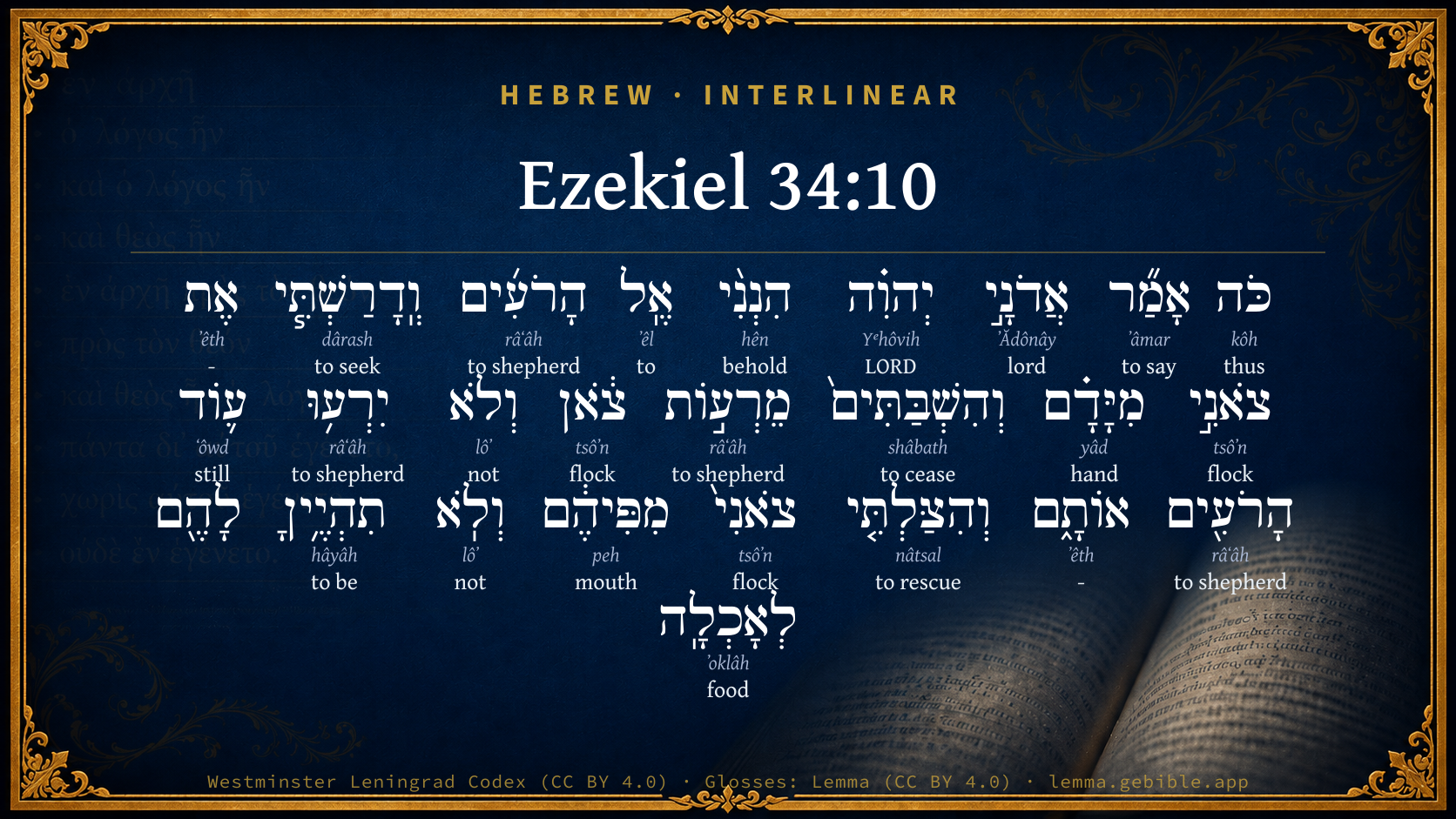
Ezekiel 34:10

Hebrew (Westminster Leningrad Codex) Ezekiel 34:10 appears in the Hebrew Old Testament. The text above is from the Westminster Leningrad Codex. Each word links to its Strong’s number, a concise gloss, and parsing drawn from the Open Scriptures Hebrew Bible morphology. Click any word for its full Brown-Driver-Briggs (BDB) entry.
Download image
Cite this verse

Ezekiel 34:10 (World English Bible). Public Domain. Lemma interlinear Bible study tool, https://lemma.gebible.app/v/ezekiel/34/10.

Show BibTeX & RIS
BibTeX
RIS
English Translation
Thus says the Lord Yahweh: Behold, I am against the shepherds; and I will require my sheep at their hand, and cause them to cease from feeding the sheep; neither shall the shepherds feed themselves any more; and I will deliver my sheep from their mouth, that they may not be food for them.
World English Bible · Public Domain
Download a study sheet

One document with this verse’s original text, its word-by-word gloss line, the meaning frame, cross-references with their text, attributed commentary, and full source and license credits — printable, and it pastes into notes with its structure intact.

This verse Autodidact and up

Study sheet (.html) Plain text (.txt)

A passage Seminary Student

Up to 50 verses in one chapter. A passage sheet keeps up to 6 commentary sources and 12 cross-references per verse, in the order this page ranks them, and says so on the sheet whenever that leaves anything out. Ask for a single verse and you get the Autodidact verse sheet above.

Everything on this page stays free to read, with no account — the sheet is a download of what is already on screen, not access to it.

Want to remove ads? Support Godless Engineer
Compare translations 3

The same verse in 3 English versions, stacked beneath the original-language interlinear above. Click any original word for its lexicon entry.

Each is an independent rendering of the whole verse — the interlinear is not word-aligned to these translations.

Highlighted words mark where these versions differ — a whole-verse word diff, not a word-by-word alignment.

  • World English Bible Public Domain
    Thus says the Lord Yahweh: Behold, I am against the shepherds; and I will require my sheep at their hand, and cause them to cease from feeding the sheep; neither shall the shepherds feed themselves any more; and I will deliver my sheep from their mouth, that they may not be food for them.
  • King James Version Public Domain
    Thus saith the Lord GOD; Behold, I am against the shepherds; and I will require my flock at their hand, and cause them to cease from feeding the flock; neither shall the shepherds feed themselves any more; for I will deliver my flock from their mouth, that they may not be meat for them.
  • unfoldingWord Literal Text CC BY-SA 4.0
    The Lord Yahweh says this: Behold! I am against the shepherds, and I will require my flock from their hand. Then I will dismiss them from shepherding the flock; neither will the shepherds any longer shepherd themselves since I will take away my flock from their mouths, so that my flock will no longer be food for them.

unfoldingWord Literal Text — © unfoldingWord, licensed CC BY-SA 4.0. Word-aligned USFM3 via Door43 (git.door43.org/unfoldingWord/en_ult).

Versions to compare (up to 4)

3 of 4 selected

Show all 18 translations

Every available English version of this verse, each an independent rendering of the whole verse.

  • World English Bible Public Domain
    Thus says the Lord Yahweh: Behold, I am against the shepherds; and I will require my sheep at their hand, and cause them to cease from feeding the sheep; neither shall the shepherds feed themselves any more; and I will deliver my sheep from their mouth, that they may not be food for them.
  • Berean Standard Bible Public Domain
    This is what the Lord GOD says: ‘Behold, I am against the shepherds, and I will demand from them My flock and remove them from tending the flock, so that they can no longer feed themselves. For I will deliver My flock from their mouths, and it will no longer be food for them.’
  • Majority Standard Bible Public Domain
    This is what the Lord GOD says: ‘Behold, I am against the shepherds, and I will demand from them My flock and remove them from tending the flock, so that they can no longer feed themselves. For I will deliver My flock from their mouths, and it will no longer be food for them.’
  • King James Version Public Domain
    Thus saith the Lord GOD; Behold, I am against the shepherds; and I will require my flock at their hand, and cause them to cease from feeding the flock; neither shall the shepherds feed themselves any more; for I will deliver my flock from their mouth, that they may not be meat for them.
  • American Standard Version (1901) Public Domain
    Thus saith the Lord Jehovah: Behold, I am against the shepherds; and I will require my sheep at their hand, and cause them to cease from feeding the sheep; neither shall the shepherds feed themselves any more; and I will deliver my sheep from their mouth, that they may not be food for them.
  • Revised Version (1885) Public Domain
    Thus saith the Lord GOD: Behold, I am against the shepherds; and I will require my sheep at their hand, and cause them to cease from feeding the sheep; neither shall the shepherds feed themselves any more; and I will deliver my sheep from their mouth, that they may not be meat for them.
  • Geneva Bible (1599) Public Domain
    Thus saieth the Lord God, Behold, I come against the shepherds, and will require my sheepe at their hands, and cause them to cease from feeding the sheepe: neither shall the shepherds feede them selues any more: for I wil deliuer my sheepe from their mouthes, and they shall no more deuoure them.
  • Douay-Rheims (1899) Public Domain
    Thus saith the Lord God: Behold I myself come upon the shepherds, I will require my hock at their hand, and I will cause them to cease from feeding the flock any more, neither shall the shepherds feed themselves any more: and I will deliver my flock from their mouth, and it shall no more be meat for them.
  • Young's Literal Translation Public Domain
    Thus said the Lord Jehovah: Lo, I `am' against the shepherds, And have required My flock from their hand, And caused them to cease from feeding the flock, And no more do the shepherds feed themselves, And I have delivered My flock from their mouth, And they are not to them for food.
  • Literal Standard Version CC BY-SA 4.0
    Thus said Lord YHWH: Behold, I [am] against the shepherds, || And have required My flock from their hand, || And caused them to cease from feeding the flock, || And the shepherds feed themselves no more, || And I have delivered My flock from their mouth, || And they are not for food to them.
  • Unlocked Literal Bible CC BY-SA 4.0
    The Lord Yahweh says this: Behold! I am against the shepherds, and I will require my flock from their hand. Then I will dismiss them from shepherding the flock; neither will the shepherds any longer shepherd themselves since I will take away my flock from their mouths, so that my flock will no longer be food for them.
  • unfoldingWord Literal Text CC BY-SA 4.0
    The Lord Yahweh says this: Behold! I am against the shepherds, and I will require my flock from their hand. Then I will dismiss them from shepherding the flock; neither will the shepherds any longer shepherd themselves since I will take away my flock from their mouths, so that my flock will no longer be food for them.
  • Darby Bible Public Domain
    Thus saith the Lord Jehovah: Behold, I am against the shepherds; and I will require my sheep at their hand, and cause them to cease from feeding the flock: that the shepherds may feed themselves no more; and I will deliver my sheep from their mouth, that they may not be food for them.
  • World Messianic Bible Public Domain
    The Lord GOD says: “Behold, I am against the shepherds. I will require my sheep at their hand, and cause them to cease from feeding the sheep. The shepherds won’t feed themselves any more. I will deliver my sheep from their mouth, that they may not be food for them.”
  • Webster's Bible Public Domain
    Thus saith the Lord GOD; Behold, I am against the shepherds; and I will require my flock at their hand, and cause them to cease from feeding the flock; neither shall the shepherds feed themselves any more; for I will deliver my flock from their mouth, that they may not be food for them.
  • Free Bible Version CC BY-SA 4.0
    This is what the Lord God says: Watch out, because I'm condemning the shepherds, and I will take my sheep back and stop them from looking after the sheep so they won't be able to feed themselves anymore. I will take away my sheep from them, and I won't let them eat the sheep anymore.
  • Bible in Basic English Public Domain
    This is what the Lord has said: See I am against the keepers of the flock, and I will make search and see what they have done with my sheep, and will let them be keepers of my sheep no longer; and the keepers will no longer get food for themselves; I will take my sheep out of their mouths so that they may not be food for them.
  • JPS Tanakh (1917) Public Domain
    Thus saith the Lord GOD: Behold, I am against the shepherds; and I will require My sheep at their hand, and cause them to cease from feeding the sheep; neither shall the shepherds feed themselves any more; and I will deliver My sheep from their mouth, that they may not be food for them.

Literal Standard Version (2020), Covenant Press — licensed CC BY-SA 4.0. Text via the HelloAO Bible API (eBible.org). Unlocked Literal Bible (unfoldingWord) — licensed CC BY-SA 4.0. Text via the HelloAO Bible API (eBible.org). unfoldingWord Literal Text — © unfoldingWord, licensed CC BY-SA 4.0. Word-aligned USFM3 via Door43 (git.door43.org/unfoldingWord/en_ult). Free Bible Version, Dr. Jonathan Gallagher — licensed CC BY-SA 4.0. Text via the HelloAO Bible API (eBible.org).

Word by word

More ways to search: Search by grammar → Find every occurrence → Compare this word →

Practice this passage: Drill this verse → Learn its vocabulary →

לְאָכְלָֽה
ʼoklâh
H402
“to/for · food”
Preposition + Noun, Common, Feminine, Singular, Absolute
Part of Speech
Preposition + Noun
Type
Common
Gender
Feminine
Number
Singular
State
Absolute
Full BDB Definition

Origin: from H401

TWOT: 85b

food - food, eating - object of devouring, consuming - by wild beasts (figurative) - in fire - of judgment (figurative)
  1. כֹּה kôh H3541 “thus” Adverb
  2. אָמַ֞ר ʼâmar H559 “to say” Verb, Qal, Perfect, 3rd Person, Masculine, Singular
  3. אֲדֹנָ֣י ʼĂdônây H136 “Lord · my” Noun, Common, Masculine, Plural, Construct + Suffix, Personal, 1st Person, Common, Singular
  4. יְהוִ֗ה Yᵉhôvih H3069 “LORD” Noun, Proper
  5. הִנְנִ֨י hên H2005 “behold · me” Particle, Demonstrative + Suffix, Personal, 1st Person, Common, Singular
  6. אֶֽל ʼêl H413 “to” Preposition
  7. הָרֹעִ֜ים râʻâh H7462 “the · shepherding” Particle, Definite Article + Verb, Qal, Participle Active, Masculine, Plural, Absolute
  8. וְֽדָרַשְׁתִּ֧י dârash H1875 “and · to seek” Conjunction + Verb, Qal, Sequential Perfect, 1st Person, Common, Singular
  9. אֶת ʼêth H853 “-” Particle, Direct Object
  10. צֹאנִ֣י tsôʼn H6629 “flock · my” Noun, Common, Both, Singular, Construct + Suffix, Personal, 1st Person, Common, Singular
  11. מִיָּדָ֗ם yâd H3027 “from · hand · their” Preposition + Noun, Common, Both, Singular, Construct + Suffix, Personal, 3rd Person, Masculine, Plural
  12. וְהִשְׁבַּתִּים֙ shâbath H7673 “and · to cease · them” Conjunction + Verb, Hiphil, Sequential Perfect, 1st Person, Common, Singular + Suffix, Personal, 3rd Person, Masculine, Plural
  13. מֵרְע֣וֹת râʻâh H7462 “from · to shepherd” Preposition + Verb, Qal, Infinitive Construct
  14. צֹ֔אן tsôʼn H6629 “flock” Noun, Common, Both, Singular, Absolute
  15. וְלֹא lôʼ H3808 “and · not” Conjunction + Particle, Negative
  16. יִרְע֥וּ râʻâh H7462 “to shepherd” Verb, Qal, Imperfect, 3rd Person, Masculine, Plural
  17. ע֛וֹד ʻôwd H5750 “still” Adverb
  18. הָרֹעִ֖ים râʻâh H7462 “the · shepherding” Particle, Definite Article + Verb, Qal, Participle Active, Masculine, Plural, Absolute
  19. אוֹתָ֑ם ʼêth H853 “- · them” Particle, Direct Object + Suffix, Personal, 3rd Person, Masculine, Plural
  20. וְהִצַּלְתִּ֤י nâtsal H5337 “and · to rescue” Conjunction + Verb, Hiphil, Sequential Perfect, 1st Person, Common, Singular
  21. צֹאנִי֙ tsôʼn H6629 “flock · my” Noun, Common, Both, Singular, Construct + Suffix, Personal, 1st Person, Common, Singular
  22. מִפִּיהֶ֔ם peh H6310 “from · mouth · their” Preposition + Noun, Common, Masculine, Singular, Construct + Suffix, Personal, 3rd Person, Masculine, Plural
  23. וְלֹֽא lôʼ H3808 “and · not” Conjunction + Particle, Negative
  24. תִהְיֶ֥יןָ hâyâh H1961 “to be” Verb, Qal, Imperfect, 3rd Person, Feminine, Plural

About this verse

These counts appear in no published source. They are computed here, from the morphology-tagged text and Lemma’s own curated glosses. What Lemma adds →

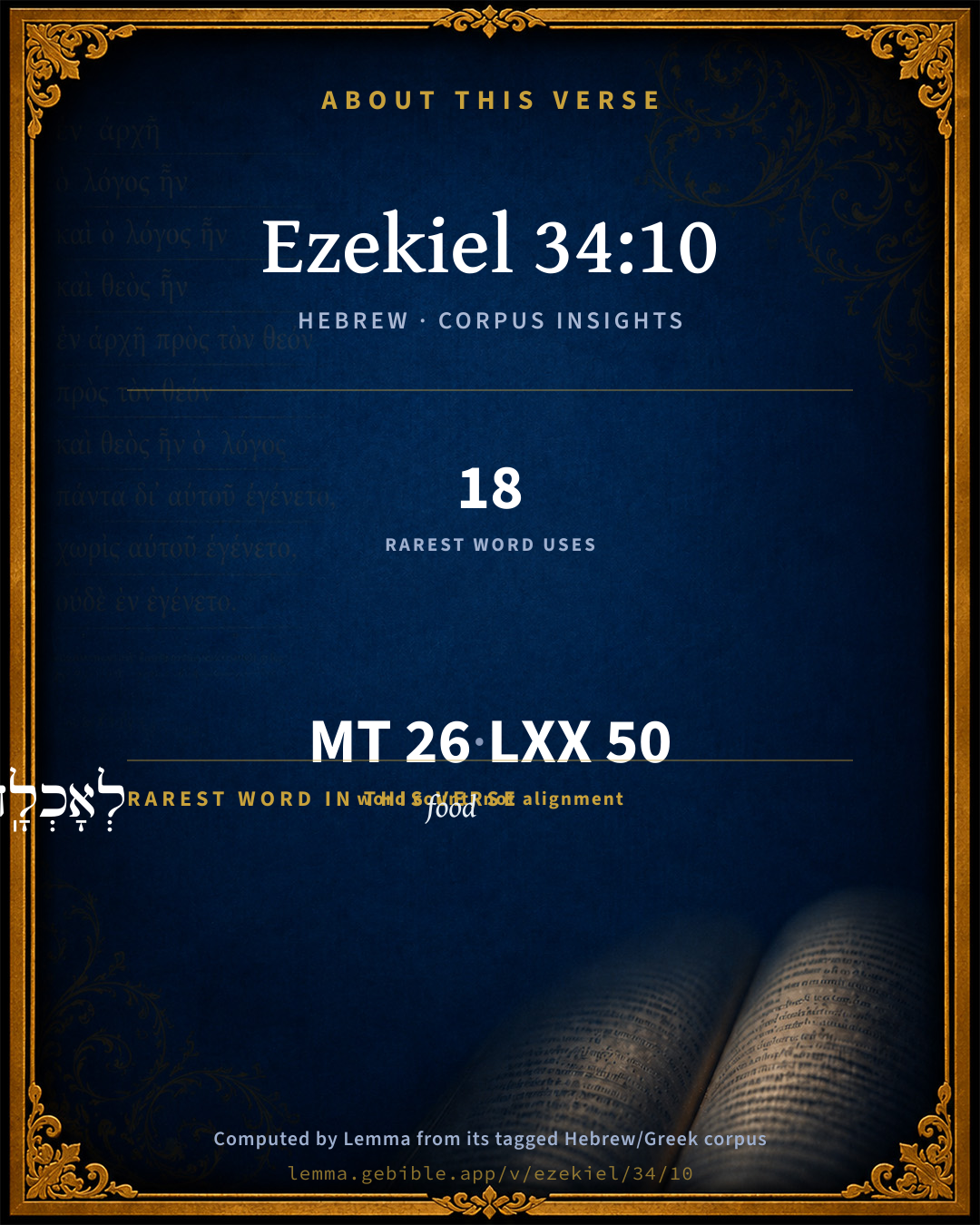
26
words
18
distinct lemmas
Prophets
section

Notable vocabulary

The rarest word here is לְאָכְלָֽה food H402 — appearing just 18 times in the whole Hebrew Bible.

Shared distinctive vocabulary

לְאָכְלָֽה food H402 occurs in 18 verses of the Hebrew Bible. Also found in:

Grammatical profile

  • 9 verbs
  • 8 nouns
  • 2 prepositions
  • 2 adverbs
  • 5 particles

Verb forms

  • אָמַ֞ר Qal · Perfect
  • הָרֹעִ֜ים Qal · Participle Active
  • וְֽדָרַשְׁתִּ֧י Qal · Sequential Perfect
  • וְהִשְׁבַּתִּים֙ Hiphil · Sequential Perfect
  • מֵרְע֣וֹת Qal · Infinitive Construct
  • יִרְע֥וּ Qal · Imperfect
  • הָרֹעִ֖ים Qal · Participle Active
  • וְהִצַּלְתִּ֤י Hiphil · Sequential Perfect
  • תִהְיֶ֥יןָ Qal · Imperfect

Repetition

Words recur within this verse — often emphatic in Hebrew:

  • הָרֹעִ֜ים to shepherd H7462 ×4
  • צֹאנִ֣י flock H6629 ×3
  • וְלֹא not H3808 ×2

Hebrew & Septuagint length

In English translation the verse runs 54 words from the Hebrew and 59 from the Septuagint (LXX English) — closely comparable.

A rough comparison of the two English renderings, which tokenize alike — not a word-level alignment.

Word counts can differ between the Hebrew and the Greek without any difference in meaning — e.g. the Hebrew direct-object marker אֵת has no separate Greek word, and Greek often adds the article ὁ.

In the original languages it is 26 Hebrew tokens and 50 Greek tokens — but the two are counted differently (Hebrew bundles its prefixes and suffixes into one token; the Greek is in lemma form), so that isn’t a like-for-like length.

Cross-references

24

Topical passages linked to Ezekiel 34:10 in the Treasury of Scripture Knowledge — connected by theme and wording, ordered by reader-vote popularity; previews shown in the World English Bible.

  • Ezekiel 34:2 Son of man, prophesy against the shepherds of Israel, prophesy, and tell them, even to the shepherds, Thus says the Lord Yahweh: Woe to the shepherds of Israel who feed themselves! Shouldn't the shepherds feed the sheep?
  • Zechariah 10:3 My anger is kindled against the shepherds, And I will punish the male goats; For Yahweh of Hosts has visited his flock, the house of Judah, And will make them as his horse in the battle that he is proud of.
  • Jeremiah 21:13 Behold, I am against you, O inhabitant of the valley, [and] of the rock of the plain, says Yahweh; you that say, Who shall come down against us? or who shall enter into our habitations?
  • Ezekiel 13:8 Therefore thus says the Lord Yahweh: Because you have spoken falsehood, and seen lies, therefore, behold, I am against you, says the Lord Yahweh.
  • Psalms 23:5 You prepare a table before me in the presence of my enemies. You anoint my head with oil. My cup runs over.
  • Psalms 72:12–14 For he will deliver the needy when he cries; The poor, who has no helper.
  • Jeremiah 52:24–27 The captain of the guard took Seraiah the chief priest, and Zephaniah the second priest, and the three keepers of the threshold:
  • Ezekiel 3:18 When I tell the wicked, You shall surely die; and you give him no warning, nor speak to warn the wicked from his wicked way, to save his life; the same wicked man shall die in his iniquity; but his blood will I require at your hand.
  • Ezekiel 34:8 As I live, says the Lord Yahweh, surely because my sheep became a prey, and my sheep became food to all the animals of the field, because there was no shepherd, neither did my shepherds search for my sheep, but the shepherds fed themselves, and didn't feed my sheep;
  • Nahum 2:13 "Behold, I am against you," says Yahweh of Hosts, "and I will burn her chariots in the smoke, and the sword will devour your young lions; and I will cut off your prey from the earth, and the voice of your messengers will no longer be heard."
  • Hebrews 13:17 Obey your leaders and submit to them, for they watch on behalf of your souls, as those who will give account, that they may do this with joy, and not with groaning, for that would be unprofitable for you.
  • 1 Samuel 2:29–36 Why kick you at my sacrifice and at my offering, which I have commanded in [my] habitation, and honor your sons above me, to make yourselves fat with the best of all the offerings of Israel my people?
  • Psalms 102:19–20 For he has looked down from the height of his sanctuary. From heaven, Yahweh saw the earth;
  • Jeremiah 13:18–20 Say you to the king and to the queen-mother, Humble yourselves, sit down; for your headdresses are come down, even the crown of your glory.
  • Jeremiah 39:6 Then the king of Babylon killed the sons of Zedekiah in Riblah before his eyes: also the king of Babylon killed all the nobles of Judah.
  • Jeremiah 50:31 Behold, I am against you, you proud one, says the Lord, Yahweh of Hosts; for your day is come, the time that I will visit you.
  • Jeremiah 52:9–11 Then they took the king, and carried him up to the king of Babylon to Riblah in the land of Hamath; and he gave judgment on him.
  • Ezekiel 3:20 Again, when a righteous man does turn from his righteousness, and commit iniquity, and I lay a stumbling block before him, he shall die: because you have not given him warning, he shall die in his sin, and his righteous deeds which he has done shall not be remembered; but his blood will I require at your hand.
  • Ezekiel 5:8 therefore thus says the Lord Yahweh: Behold, I, even I, am against you; and I will execute judgments in the midst of you in the sight of the nations.
  • Ezekiel 21:3 and tell the land of Israel, Thus says Yahweh: Behold, I am against you, and will draw forth my sword out of its sheath, and will cut off from you the righteous and the wicked.
  • Ezekiel 33:6–8 But if the watchman sees the sword come, and doesn't blow the trumpet, and the people aren't warned, and the sword comes, and take any person from among them; he is taken away in his iniquity, but his blood will I require at the watchman's hand.
  • Ezekiel 34:22 therefore will I save my flock, and they shall no more be a prey; and I will judge between sheep and sheep.
  • Ezekiel 35:3 and tell it, Thus says the Lord Yahweh: Behold, I am against you, Mount Seir, and I will stretch out my hand against you, and I will make you a desolation and an astonishment.
  • 1 Peter 3:12 For the eyes of the Lord are on the righteous, And his ears open to their prayer; But the face of the Lord is against those who do evil."

Cross-references courtesy of OpenBible.info (CC BY 4.0).

Hebrew and Greek witnesses Masoretic Hebrew ↔ Greek Septuagint

The same verse in the two great witnesses to the Old Testament, shown verse-for-verse.

These are two independent witnesses, not word-aligned to each other, and the Septuagint is shown in lemma (dictionary) form.

Hebrew Ezekiel 34:10 Masoretic · Westminster Leningrad Codex

כֹּה אָמַ֞ר אֲדֹנָ֣י יְהוִ֗ה הִנְנִ֨י אֶֽל הָרֹעִ֜ים וְֽדָרַשְׁתִּ֧י אֶת צֹאנִ֣י מִיָּדָ֗ם וְהִשְׁבַּתִּים֙ מֵרְע֣וֹת צֹ֔אן וְלֹא יִרְע֥וּ ע֛וֹד הָרֹעִ֖ים אוֹתָ֑ם וְהִצַּלְתִּ֤י צֹאנִי֙ מִפִּיהֶ֔ם וְלֹֽא תִהְיֶ֥יןָ לָהֶ֖ם לְאָכְלָֽה

Thus says the Lord Yahweh: Behold, I am against the shepherds; and I will require my sheep at their hand, and cause them to cease from feeding the sheep; neither shall the shepherds feed themselves any more; and I will deliver my sheep from their mouth, that they may not be food for them.

World English Bible · Public Domain

Greek LXX Ezekiel 34:10 Septuagint · lemma form

ὅδε λέγω κύριος κύριος ἰδού ἐγώ ἐπί ὁ ποιμήν καί ἐκζητέω ὁ πρόβατον ἐγώ ἐκ ὁ χείρ αὐτός καί ἀποστρέφω αὐτός ὁ μή ποιμαίνω ὁ πρόβατον ἐγώ καί οὐ βόσκω ἔτι ὁ ποιμήν αὐτός καί ἐκαἱρέω ὁ πρόβατον ἐγώ ἐκ ὁ στόμα αὐτός καί οὐ εἰμί αὐτός ἔτι εἰς κατάβρωμα

thus says the Lord God, Behold, I am against the shepherds; and I will require my sheep at their hands, and will turn them back that they shall not feed my sheep, and the shepherds shall no longer feed them; and I will deliver my sheep out of their mouth, and they shall no longer be meat for them.

LXX2012 (modern English Septuagint) · Public Domain

Hebrew: Westminster Leningrad Codex (CC BY 4.0). Greek: Septuagint (public domain); English from LXX2012 (modern English Septuagint) (Public Domain). How the Septuagint differs from the Hebrew →

Targum (Aramaic paraphrase)

1

The Targum is the ancient Jewish Aramaic paraphrase of the Hebrew Scriptures — an interpretive translation, not the Hebrew text itself. Onkelos (literal) and Pseudo-Jonathan (expansive) render the Torah, and Jonathan the Prophets. Coverage is partial: where no permissively-licensed English translation exists for a verse, only the Aramaic is shown. This is verse-level text, not a word-by-word alignment to the Hebrew.

  1. Targum Jonathan Prophets (Joshua–Malachi)
    כִּדְנַן אֲמַר יְיָ אֱלֹהִים הָא אֲנָא שְׁלַח רוּגְזִי עַל פַּרְנָסַיָא וְאֶתְבַּע יַת עַמִי מִידֵיהוֹן וַאֲבַטְלִינוּן מִלְפַרְנָסָא עַמָא וְלָא יְפַרְנְסוּן עוֹד פַרְנָסַיָא נַפְּשֵׁיהוֹן וֶאֱשֵׁיזֵיב עַמִי מִידֵיהוֹן וְלָא יִתְמַסְרוּן בִּידֵיהוֹן לְאִשְׁתֵּיצָאָה:

    (no public-domain English translation for this verse)

    Targum Jonathan — Aramaic: “Mikraot Gedolot” (public domain). English: “Sefaria Community Translation” (CC0 1.0 (public-domain dedication)); “London "Chaldee Paraphrase," 1871” (public domain). Text via Sefaria.

Commentary

Notes on Ezekiel 34:10 from classic Christian and Jewish commentators (each source and its license shown beneath its notes). The classic Christian expositions comment on the surrounding passage and are grouped to its opening verse, so a note may address several verses; the Jewish commentaries on the Tanakh (Rashi and others) are per-verse, so they appear only where the commentator wrote on this verse.

Lemma curates 59 commentaries, every one of them public domain or Creative Commons licensed, each selected and text-cleaned for this edition rather than reprinted as found. About our sources →

Trapp's Complete Commentary

John Trapp

Eze 34:10 Thus saith the Lord GOD; Behold, I [am] against the shepherds; and I will require my flock at their hand, and cause them to cease from feeding the flock; neither shall the shepherds feed themselves any more; for I will deliver my flock from their mouth, that they may not be meat for them.

Ver. 10. Behold, I am against the shepherds.] Heb., Lo, I against, - by an angry aposiopesis. {a}

And cause them to cease from feeding the flock.] They shall be officiperdae, quondams, laid aside like broken vessels, as have been some kings of this land in their several generations - one of recent remembrance - Popish bishops not a few, Bonner and others, outed and deprived.

{a} A rhetorical artifice, in which the speaker comes to a sudden halt, as if unable or unwilling to proceed.

John Trapp, A Commentary or Exposition upon All the Books of the Old and New Testament (1647–1656) — public domain. Text from a community e-Sword module.

Joseph Benson's Commentary

Eze 34:10. Thus saith the Lord, Behold, I am against the shepherds — They have made me their enemy by their negligence and abuse of their power, and I will appear and act as such. They have been enemies to my sheep, though pretending to be their shepherds; I will be an open enemy to them; and will require my flock at their hands — I will require a severe account from their kings and princes, their priests and prophets, of the damage my people have sustained through their ill management; and I will deprive them of the honour, pre-eminence, and advantage of which they have made such an ill use.

Joseph Benson's Commentary on the Old and New Testaments (1811–1818) — public domain. Text from a community e-Sword module.

Geneva Bible (1599)

Geneva Bible translators

By destroying the covetous hirelings, and restoring true shepherds, whereof we have a sign so oft as God sendeth true preachers, who both by doctrine and life labor to feed his sheep in the pleasant pastures of his word.

Geneva Bible (1599) marginal notes — public domain. Text via Bolls.life.

Jamieson, Fausset & Brown

Robert Jamieson, A. R. Fausset & David Brown

I will require my flock-- (Heb 13:17), rather, "I require," &c., for God already had begun to do so, punishing Zedekiah and the other princes severely (Jer 52:10).

Jamieson, Fausset & Brown — Commentary Critical and Explanatory on the Whole Bible (1871) — public domain (CC PDM 1.0). Text via the HelloAO Bible API.

Adam Clarke's Commentary

Verse 10. I will - cause them to cease from feeding the flock] God, in this country, unpriested a whole hierarchy who fed not the flock, but ruled them with force and cruelty; and he raised up a new set of shepherds better qualified, both by sound doctrine and learning, to feed the flock. Let these be faithful, lest God cause them to cease, and raise up other feeders.

Adam Clarke's Commentary on the Bible (1810–1826) — public domain. Text from a community e-Sword/MySword module.

John Gill's Exposition

For thus saith the Lord God,.... Since the shepherds are so negligent, careless, and cruel:

behold, I, even I, will both search my sheep, and seek them out; as he did the Jews, in all countries where they were, so his elect in all places where they are: he is the omniscient God, and knows them that are his, and can call his own sheep by name; he knows the places where they are; for he has fixed the bounds of their habitation, and was delighting himself in the habitable parts of the earth, where he knew they would be, even before the world was; he knows the time of finding them, which he himself has fixed, and which is a time of love, and a time of life; and he can distinguish them, notwithstanding the filth they have contracted by their sins and transgressions, and from the crowd they are among: and he is the omnipotent God, that can take them out of what hands soever they may be, or in whatsoever state and condition they are; though in the hands of Satan, in the paws of that devouring lion, and in a pit wherein is no water, in a horrible pit, the mire and clay: he that says this is the owner and proprietor of them; and that is the reason why he searches and seeks them out; and which he repeats for the confirmation of it, and to show the vehemence of his affection towards them, and how bent he is upon it, and how eager and resolute in his pursuit after them: he searches for his chosen people among the ruins of Adam's fall, in whom they fell as others; among the men of the world, where they are; among the dust of the earth, where his lost piece of silver and those pearls lie; among the mountains of sin or self-righteousness, where these sheep are wandering; and he never leaves off seeking and searching till he has found them: and what moves him to it is not their nature, for they are no better than others; nor their numbers, for they are few; but his love to them, the relation he stands in to them as their shepherd, his interest and property in them, his covenant on their account, and also his own glory.

John Gill's Exposition of the Whole Bible (1746–1763) — public domain (CC PDM 1.0). Text via the HelloAO Bible API.

Haydock's Catholic Bible Commentary

Cease. Both the leaders and the people were led into captivity.

George Leo Haydock (1774–1849), Haydock's Catholic Family Bible and Commentary, 1859 edition — public domain. Excludes Psalms (Douay-Rheims chapter numbering differs from Protestant) and Deuterocanonical books (Catholic canon only).

Matthew Poole's English Annotations

I am against; they have provoked me to displeasure to be their enemy, and I will appear and act so. They are enemies to my sheep, yet pretended to be shepherds, I will be an open enemy to them.

The shepherds; to Zedekiah, his princes, the priests, and prophets, all the ruling part in Jerusalem.

I will require my flock; I will require both account first, and next by severe punishing, as Zedekiah, his children, &c, found. Cause them to cease from feeding the flock; turn them out of my service, that honorable employment; so was the king and princes of Judah turned out of all by the king of Babylon, by whom God made good this his word. Feed themselves any more; their profit ceased with the ceasing of their authority, and they could no more milk, fleece, or slay the flock, when it was taken out of their hand.

I will deliver my flock; they should have delivered them out of the hands of violence; since they did not, I will deliver, save, and rescue this flock which is mine.

From their mouth: this speaks that those shepherds had been lions, or bears, or wolves, more than shepherds, and therefore out of their mouths, not hands, God will deliver.

That they may not be meat for them; so the flock shall no more be devoured by them.

Matthew Poole's English Annotations on the Holy Bible (1683–1685) — public domain. Text from a community e-Sword/MySword module.

Rashi

Rabbi Shlomo Yitzchaki (Rashi)

and the shepherds will no longer shepherd themselves [Heb. אוֹתָם,] themselves.

Rashi on the Tanakh — English translations: “The Judaica Press complete Tanach with Rashi, translated by A. J. Rosenberg” (CC BY 4.0); “Pentateuch with Rashi's commentary by M. Rosenbaum and A.M. Silbermann, 1929-1934” (public domain); “The Metsudah Tanach series, Lakewood, N.J” (CC BY 4.0); and “The Book of Joshua, Metsudah Publications, 1997” (CC BY 4.0). Text via Sefaria.

Lesson kit

Teaching starters — assembled from the data on this page, not authored interpretation. Every prompt links to the verse data it draws on. Edit before teaching.

Ezekiel, in the Prophets, opens this verse with 26 words (18 distinct Hebrew lemmas). Its most distinctive word is ʼoklâh (“food”). A historical commentator’s framing appears above. Read the whole chapter for the surrounding context.

Discussion questions

  1. What does “food” (ʼoklâh) contribute to the verse as a whole?
  2. How does Genesis 1:29, which shares the word «food», read alongside this verse?
  3. What does the repetition of “to shepherd” (4× in this one verse) do in this verse?
  4. The translations on this page render this verse differently — a whole-verse word diff, not a word-by-word alignment. What might account for the different wordings?
  5. «אָמַ֞ר» is a Qal Perfect verb. How does that grammatical form shape the action described?
  6. Compare how Trapp's Complete Commentary and Joseph Benson's Commentary read this verse. Where do they agree or differ?

Things to notice

Reading settings

Reading text

Shown beneath each verse's original-language words.

Old Testament
Old Testament edition

Read the OT as the Masoretic Hebrew (MT) or the Greek Septuagint (LXX).

English shown for the Greek Septuagint (in the Hebrew ↔ Greek comparison).

Comparing translations? Open the Compare panel on any verse page to stack up to four side by side.