Genesis 32:5

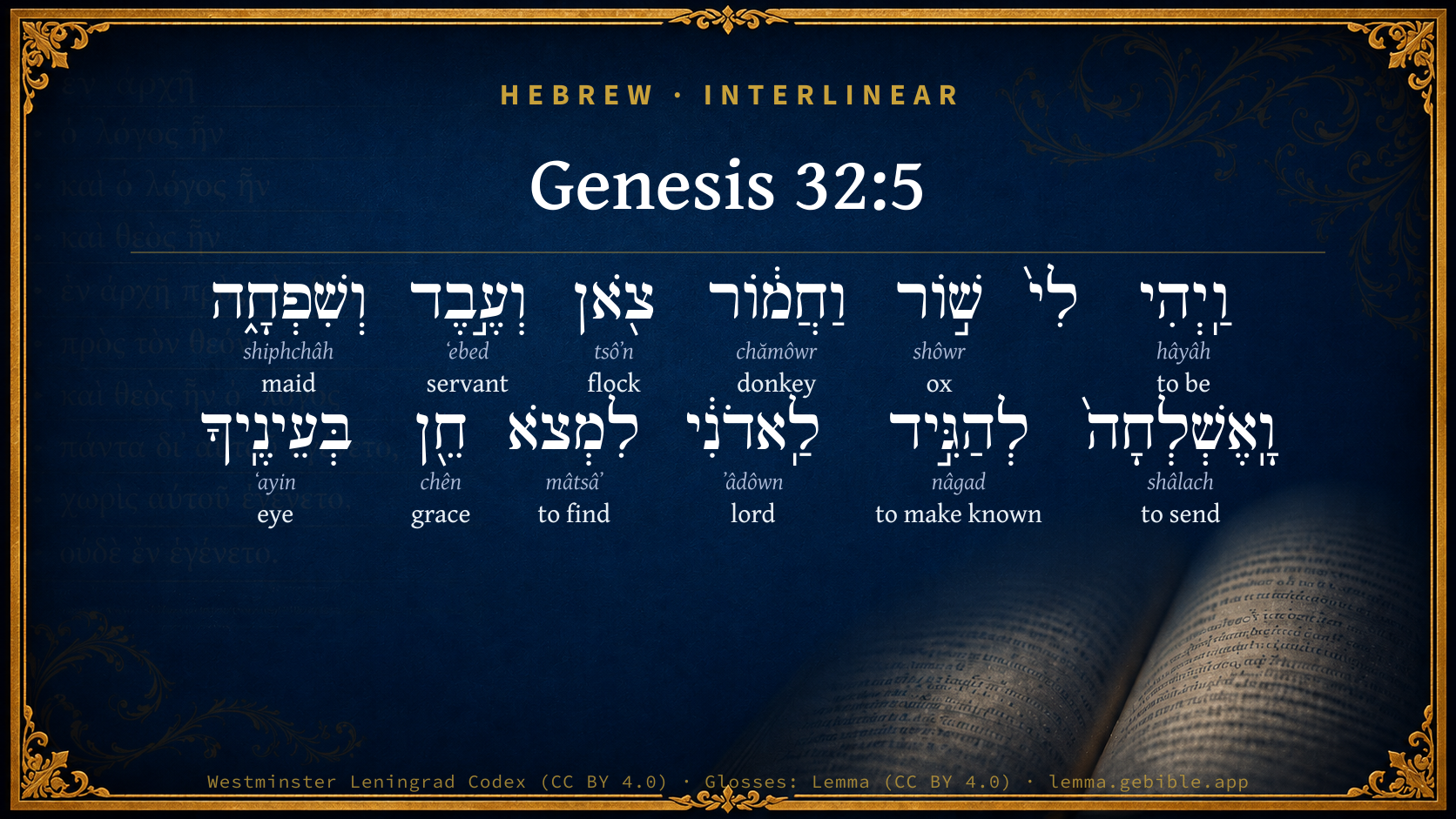
Hebrew (Westminster Leningrad Codex) Genesis 32:5 appears in the Hebrew Old Testament. The text above is from the Westminster Leningrad Codex. Each word links to its Strong’s number, a concise gloss, and parsing drawn from the Open Scriptures Hebrew Bible morphology. Click any word for its full Brown-Driver-Briggs (BDB) entry.
Download image
Cite this verse

Genesis 32:5 (World English Bible). Public Domain. Lemma interlinear Bible study tool, https://lemma.gebible.app/v/genesis/32/5.

Show BibTeX & RIS
BibTeX
RIS
English Translation
I have oxen, donkeys, flocks, men-servants, and maid-servants. I have sent to tell my lord, that I may find favor in your sight.'"
World English Bible · Public Domain
Highlights
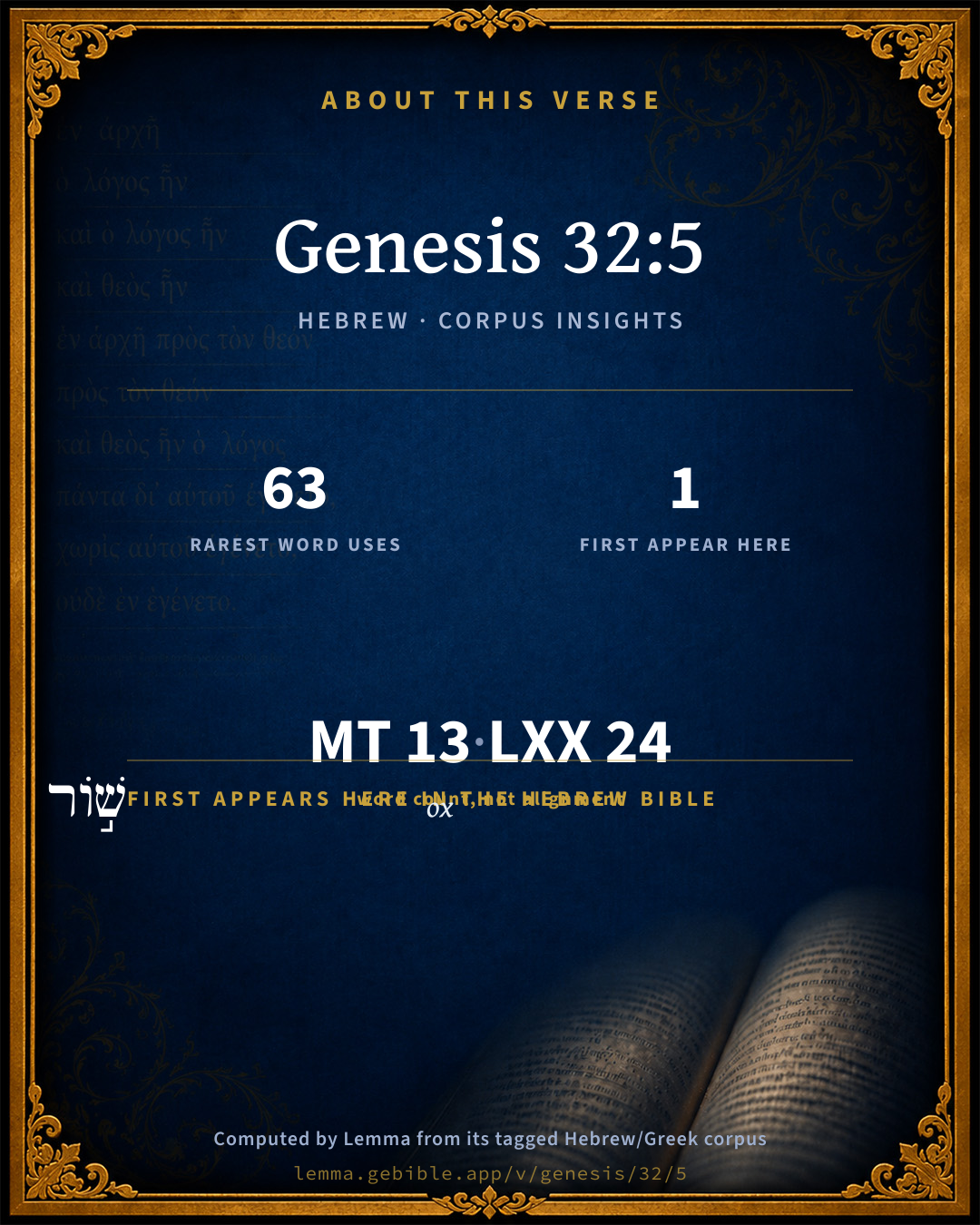
  • 1 first appearance in the Hebrew Bible
Full analysis ↓
Download a study sheet

One document with this verse’s original text, its word-by-word gloss line, the meaning frame, cross-references with their text, attributed commentary, and full source and license credits — printable, and it pastes into notes with its structure intact.

This verse Autodidact and up

Study sheet (.html) Plain text (.txt)

A passage Seminary Student

Up to 50 verses in one chapter. A passage sheet keeps up to 6 commentary sources and 12 cross-references per verse, in the order this page ranks them, and says so on the sheet whenever that leaves anything out. Ask for a single verse and you get the Autodidact verse sheet above.

Everything on this page stays free to read, with no account — the sheet is a download of what is already on screen, not access to it.

Want to remove ads? Support Godless Engineer
Compare translations 3

The same verse in 3 English versions, stacked beneath the original-language interlinear above. Click any original word for its lexicon entry.

Each is an independent rendering of the whole verse — the interlinear is not word-aligned to these translations.

Highlighted words mark where these versions differ — a whole-verse word diff, not a word-by-word alignment.

  • World English Bible Public Domain
    I have oxen, donkeys, flocks, men-servants, and maid-servants. I have sent to tell my lord, that I may find favor in your sight.'"
  • King James Version Public Domain
    And I have oxen, and asses, flocks, and menservants, and womenservants: and I have sent to tell my lord, that I may find grace in thy sight.
  • unfoldingWord Literal Text CC BY-SA 4.0
    And I have cattle and donkey, flock, and menservant and maidservant. And I have sent to speak with my lord, so that I will find favor in your eyes.”’”

unfoldingWord Literal Text — © unfoldingWord, licensed CC BY-SA 4.0. Word-aligned USFM3 via Door43 (git.door43.org/unfoldingWord/en_ult).

Versions to compare (up to 4)

3 of 4 selected

Show all 18 translations

Every available English version of this verse, each an independent rendering of the whole verse.

  • World English Bible Public Domain
    I have oxen, donkeys, flocks, men-servants, and maid-servants. I have sent to tell my lord, that I may find favor in your sight.'"
  • Berean Standard Bible Public Domain
    I have oxen, donkeys, flocks, menservants, and maidservants. I have sent this message to inform my master, so that I may find favor in your sight.’”
  • Majority Standard Bible Public Domain
    I have oxen, donkeys, flocks, menservants, and maidservants. I have sent this message to inform my master, so that I may find favor in your sight.’”
  • King James Version Public Domain
    And I have oxen, and asses, flocks, and menservants, and womenservants: and I have sent to tell my lord, that I may find grace in thy sight.
  • American Standard Version (1901) Public Domain
    and I have oxen, and asses, `and' flocks, and men-servants, and maid-servants: and I have sent to tell my lord, that I may find favor in thy sight.
  • Revised Version (1885) Public Domain
    and I have oxen, and asses and flocks, and menservants ard maidservants: and I have sent to tell my lord, that I may find grace in thy sight.
  • Geneva Bible (1599) Public Domain
    I haue beeues also and Asses, sheepe, and men seruantes, and women seruantes, and haue sent to shew my lord, that I may find grace in thy sight.
  • Douay-Rheims (1899) Public Domain
    I have oxen, and asses, and sheep, and menservants, and womenservants: and now I send a message to my lord, that I may find favor in thy sight.
  • Young's Literal Translation Public Domain
    and I have ox, and ass, flock, and man-servant, and maid-servant, and I send to declare to my lord, to find grace in his eyes.'
  • Literal Standard Version CC BY-SA 4.0
    and I have ox, and donkey, flock, and manservant, and maidservant, and I send to declare to my lord, to find grace in his eyes.”
  • Unlocked Literal Bible CC BY-SA 4.0
    I have oxen, donkeys, and flocks, male servants, and female servants. I have sent this message to my master, so that I may find favor in your eyes.'”
  • unfoldingWord Literal Text CC BY-SA 4.0
    And I have cattle and donkey, flock, and menservant and maidservant. And I have sent to speak with my lord, so that I will find favor in your eyes.”’”
  • Darby Bible Public Domain
    and I have oxen, and asses, sheep, and bondmen, and bondwomen; and I have sent to tell my lord, that I may find favour in thine eyes.
  • World Messianic Bible Public Domain
    I have cattle, donkeys, flocks, male servants, and female servants. I have sent to tell my lord, that I may find favor in your sight.’”
  • Webster's Bible Public Domain
    And I have oxen, and asses, flocks, and men-servants, and women-servants: and I have sent to tell my lord, that I may find grace in thy sight.
  • Free Bible Version CC BY-SA 4.0
    and I have cattle and donkeys and sheep and goats, and male and female slaves. I've sent these messengers to explain this to you my lord, hoping you'll be pleased to see me.”
  • Bible in Basic English Public Domain
    And I have oxen and asses and flocks and men-servants and women-servants: and I have sent to give my lord news of these things so that I may have grace in his eyes.
  • JPS Tanakh (1917) Public Domain
    (32-6) And I have oxen, and asses and flocks, and men-servants and maid-servants; and I have sent to tell my lord, that I may find favour in thy sight.'

Literal Standard Version (2020), Covenant Press — licensed CC BY-SA 4.0. Text via the HelloAO Bible API (eBible.org). Unlocked Literal Bible (unfoldingWord) — licensed CC BY-SA 4.0. Text via the HelloAO Bible API (eBible.org). unfoldingWord Literal Text — © unfoldingWord, licensed CC BY-SA 4.0. Word-aligned USFM3 via Door43 (git.door43.org/unfoldingWord/en_ult). Free Bible Version, Dr. Jonathan Gallagher — licensed CC BY-SA 4.0. Text via the HelloAO Bible API (eBible.org).

Word by word

More ways to search: Search by grammar → Find every occurrence → Compare this word →

Practice this passage: Drill this verse → Learn its vocabulary →

וְשִׁפְחָ֑ה
shiphchâh
H8198
“and · maid”
Conjunction + Noun, Common, Feminine, Singular, Absolute
Part of Speech
Conjunction + Noun
Type
Common
Gender
Feminine
Number
Singular
State
Absolute
Full BDB Definition

Origin: from the same as H8207 ">H8207 )

TWOT: None

maid, maid-servant, slavegirl - maid, maid-servant (as belonging to a mistress) - of address, speaker, humility (figuratively)
  1. וַֽיְהִי hâyâh H1961 “and · to be” Conjunction + Verb, Qal, Sequential Imperfect, 3rd Person, Masculine, Singular
  2. שׁ֣וֹר shôwr H7794 “ox” Noun, Common, Masculine, Singular, Absolute
  3. וַחֲמ֔וֹר chămôwr H2543 “and · donkey” Conjunction + Noun, Common, Both, Singular, Absolute
  4. צֹ֖אן tsôʼn H6629 “flock” Noun, Common, Both, Singular, Absolute
  5. וְעֶ֣בֶד ʻebed H5650 “and · servant” Conjunction + Noun, Common, Masculine, Singular, Absolute
  6. וָֽאֶשְׁלְחָה֙ shâlach H7971 “and · to send” Conjunction + Verb, Qal, Sequential Imperfect, 1st Person, Common, Singular + Suffix, h
  7. לְהַגִּ֣יד nâgad H5046 “to make known” Preposition + Verb, Hiphil, Infinitive Construct
  8. לַֽאדֹנִ֔י ʼâdôwn H113 “to/for · lord · my” Preposition + Noun, Common, Masculine, Singular, Construct + Suffix, Personal, 1st Person, Common, Singular
  9. לִמְצֹא mâtsâʼ H4672 “to find” Preposition + Verb, Qal, Infinitive Construct
  10. חֵ֖ן chên H2580 “grace” Noun, Common, Masculine, Singular, Absolute
  11. בְּעֵינֶֽיךָ ʻayin H5869 “in/at · eyes · your” Preposition + Noun, Common, Both, Dual, Construct + Suffix, Personal, 2nd Person, Masculine, Singular

About this verse

These counts appear in no published source. They are computed here, from the morphology-tagged text and Lemma’s own curated glosses. What Lemma adds →

13
words
12
distinct lemmas
Pentateuch
section

First appearance in Scripture

This word makes its first canonical appearance in the Hebrew Bible here:

Grammatical profile

  • 4 verbs
  • 8 nouns
  • 1 preposition

Verb forms

  • וַֽיְהִי Qal · Sequential Imperfect
  • וָֽאֶשְׁלְחָה֙ Qal · Sequential Imperfect
  • לְהַגִּ֣יד Hiphil · Infinitive Construct
  • לִמְצֹא Qal · Infinitive Construct

Hebrew & Septuagint length

In English translation the verse runs 23 words from the Hebrew and 32 from the Septuagint (LXX English) — closely comparable.

A rough comparison of the two English renderings, which tokenize alike — not a word-level alignment.

Word counts can differ between the Hebrew and the Greek without any difference in meaning — e.g. the Hebrew direct-object marker אֵת has no separate Greek word, and Greek often adds the article ὁ.

In the original languages it is 13 Hebrew tokens and 24 Greek tokens — but the two are counted differently (Hebrew bundles its prefixes and suffixes into one token; the Greek is in lemma form), so that isn’t a like-for-like length.

Cross-references

10

Topical passages linked to Genesis 32:5 in the Treasury of Scripture Knowledge — connected by theme and wording, ordered by reader-vote popularity; previews shown in the World English Bible.

  • Genesis 33:8 Esau said, "What do you mean by all this company which I met?" Jacob said, "To find favor in the sight of my lord."
  • Genesis 33:15 Esau said, "Let me now leave with you some of the folk who are with me." He said, "Why? Let me find favor in the sight of my lord."
  • Genesis 30:43–31:1 The man increased exceedingly, and had large flocks, maid-servants and men-servants, and camels and donkeys.
  • Genesis 31:16 For all the riches which God has taken away from our father, that is ours and our children's. Now then, whatever God has said to you, do."
  • Genesis 33:11 Please take the gift that I brought to you; because God has dealt graciously with me, and because I have enough." He urged him, and he took it.
  • Genesis 47:25 They said, "You have saved our lives! Let us find favor in the sight of my lord, and we will be Pharaoh's servants."
  • Ruth 2:2 Ruth the Moabitess said to Naomi, Let me now go to the field, and glean among the ears of grain after him in whose sight I shall find favor. She said to her, Go, my daughter.
  • 2 Samuel 16:4 Then said the king to Ziba, Behold, all that pertains to Mephibosheth is yours. Ziba said, I do obeisance; let me find favor in your sight, my lord, O king.
  • Job 6:22 Did I say, 'Give to me?' Or, 'Offer a present for me from your substance?'
  • 1 Samuel 1:18 She said, Let your handmaid find favor in your sight. So the woman went her way, and ate; and her facial expression wasn't sad any more.

Cross-references courtesy of OpenBible.info (CC BY 4.0).

Hebrew and Greek witnesses Masoretic Hebrew ↔ Greek Septuagint

The same verse in the two great witnesses to the Old Testament, shown verse-for-verse.

These are two independent witnesses, not word-aligned to each other, and the Septuagint is shown in lemma (dictionary) form.

Hebrew Genesis 32:5 Masoretic · Westminster Leningrad Codex

וַֽיְהִי לִי֙ שׁ֣וֹר וַחֲמ֔וֹר צֹ֖אן וְעֶ֣בֶד וְשִׁפְחָ֑ה וָֽאֶשְׁלְחָה֙ לְהַגִּ֣יד לַֽאדֹנִ֔י לִמְצֹא חֵ֖ן בְּעֵינֶֽיךָ

I have oxen, donkeys, flocks, men-servants, and maid-servants. I have sent to tell my lord, that I may find favor in your sight.'"

World English Bible · Public Domain

Greek LXX Genesis 32:5 Septuagint · lemma form

καί ἐντέλλομαι αὐτός λέγω οὕτως εἶπον ὁ κύριος ἐγώ ησαυ οὕτως λέγω ὁ παῖς σύ ἰακώβ μετά λαβαν παραοἰκέω καί χρονίζω ἕως ὁ νῦν

And there were born to me oxen, and asses, and sheep, and menservants and women-servants; and I sent to tell my lord Esau, that your servant might find grace in your sight.

LXX2012 (modern English Septuagint) · Public Domain

Hebrew: Westminster Leningrad Codex (CC BY 4.0). Greek: Septuagint (public domain); English from LXX2012 (modern English Septuagint) (Public Domain). How the Septuagint differs from the Hebrew →

Targum (Aramaic paraphrase)

2

The Targum is the ancient Jewish Aramaic paraphrase of the Hebrew Scriptures — an interpretive translation, not the Hebrew text itself. Onkelos (literal) and Pseudo-Jonathan (expansive) render the Torah, and Jonathan the Prophets. Coverage is partial: where no permissively-licensed English translation exists for a verse, only the Aramaic is shown. This is verse-level text, not a word-by-word alignment to the Hebrew.

  1. Targum Onkelos Torah (Genesis–Deuteronomy)
    וּפַקִּיד יָתְהוֹן לְמֵימָר כְּדֵין תֵּימְרוּן לְרִבּוֹנִי לְעֵשָׂו כִּדְנַן אֲמַר עַבְדָּךְ יַעֲקֹב עִם לָבָן דָּרִית וְאוֹחָרִית עַד כְּעָן

    (no public-domain English translation for this verse)

    Targum Onkelos — Aramaic: “Onkelos Genesis” (public domain); “Onkelos Exodus” (public domain); “Onkelos Leviticus” (public domain); “Onkelos Numbers” (public domain); “Onkelos Deuteronomy” (public domain). English: “Sefaria Community Translation” (CC0 1.0 (public-domain dedication)); “J.W. Etheridge. The Targums of Onkelos and Jonathan Ben Uzziel on the Pentateuch. London: Longmans, Green, 1862” (public domain). Text via Sefaria.

  2. Targum Pseudo-Jonathan Torah (Genesis–Deuteronomy)
    וּפְקִיד יַתְהוֹם לְמֵימַר כְּדֵין תֵּימְרוּן לְרִיבּוֹנִי לְעֵשָו כִּדְנַן אָמַר עַבְדָךְ יַעֲקב עִם לָבָן אִיתּוֹתָבִית וְאִשְׁתְּהָיַית עַד כְּדוֹן

    and instructed them to say, Thus shall you speak to my lord Esau: Thus saith thy servant Jakob, With Laban have I dwelt, and have tarried until now.

    Targum Pseudo-Jonathan — Aramaic: “Targum Jonathan on Genesis” (public domain); “Targum Jonathan on Exodus” (public domain); “Targum Jonathan on Leviticus” (public domain); “Targum Jonathan on Numbers” (public domain); “Targum Jonathan on Deuteronomy” (public domain). English: “The Targum of Jonathan ben Uzziel, trans. J. W. Etheridge, London, 1862” (public domain). Text via Sefaria.

Commentary

Notes on Genesis 32:5 from classic Christian and Jewish commentators (each source and its license shown beneath its notes). The classic Christian expositions comment on the surrounding passage and are grouped to its opening verse, so a note may address several verses; the Jewish commentaries on the Tanakh (Rashi and others) are per-verse, so they appear only where the commentator wrote on this verse.

Lemma curates 59 commentaries, every one of them public domain or Creative Commons licensed, each selected and text-cleaned for this edition rather than reprinted as found. About our sources →

Trapp's Complete Commentary

John Trapp

Gen 32:5 And I have oxen, and asses, flocks, and menservants, and womenservants: and I have sent to tell my lord, that I may find grace in thy sight.

Ver. 5. And I have oxen, and asses, &c.] This Jacob mentioneth in his message, that Esau might not think that he sought to him for any need; but only for his favour. And this was something, to a man of Esau’s make; for such like not to hear of, or be haunted with, their poor kindred. {Luk 15:30} "This thy son," saith he, that felt no want: he saith not, This my brother: he would not own him, because in poverty. {a}

{a} "Aφιλον το δυστυχες. Et cum fortuna statque caditque fides.

John Trapp, A Commentary or Exposition upon All the Books of the Old and New Testament (1647–1656) — public domain. Text from a community e-Sword module.

Joseph Benson's Commentary

Gen 32:5. I have sent to tell my lord — This message of Jacob shows great prudence in him; for had he returned into Canaan without informing his brother, and making him acquainted with the substance he had brought with him from Haran, Esau, who lived at a distance from his father Isaac, probably would have thought, when he came to take possession of Isaac’s property on his death, that Jacob had obtained all his substance from his father, to Esau’s prejudice, which might have created an irreconcilable misunderstanding between them.

Joseph Benson's Commentary on the Old and New Testaments (1811–1818) — public domain. Text from a community e-Sword module.

John Calvin's Commentaries

5. I have oxen. Jacob does not proclaim his riches for the sake of boasting, but that by this method Esau might be inclined to humanity. For it would have been exceedingly disgraceful, cruelly to drive away one who had been enriched, by the favor of God, in a distant land. Besides, he cuts off occasion of future emulation: for if he had come empty and famishing, Esau might conceive fresh indignation against him, through fear of the expense which might be entailed on himself. Therefore Jacob declares, that he does not come for the purpose of consuming his father’s substance, nor of being made rich by his brother’s ruin: as if he had said, “Let thy earthly inheritance be secure; thy claim shall not be injured by me; only suffer me to live.” By this example we are taught in what way we are to cultivate peace with the wicked. The Lord does not indeed forbid us to defend our own right, so far as our adversaries allow; but we must rather recede from that right, than originate contention by our own fault.

John Calvin's Commentaries (1540-1563) — public domain. Text from the Calvin Translation Society English edition (1840s-50s) via the Christian Classics Ethereal Library (ccel.org). Calvin's coverage is partial (roughly two-thirds of the Bible); uncommented books and verses are honest gaps, never fabricated. The 19th-century editor's footnotes and remarks are omitted so the notes are faithfully Calvin's own voice.

The Cambridge Bible for Schools and Colleges

gen. ed. J. J. S. Perowne

5. find grace] Cf. Gen_18:3, Gen_33:8; Gen_33:15, Gen_34:11, Gen_47:25. Jacob hopes to be reconciled and desires to propitiate his brother. He has not forgotten his brother’s threats (Gen_27:41).

The Cambridge Bible for Schools and Colleges (gen. ed. J. J. S. Perowne; Cambridge University Press, 1878–1918) — public domain. Text from a community e-Sword module.

John Gill's Exposition

And I have oxen, and asses, flocks, and menservants, and womenservants,.... This he would have said, lest he should think he was come to ask anything of him, and put himself and his family upon him; and lest he should treat him with contempt, as a poor mean beggarly creature, and be ashamed of the relation he stood in to him:

and I have sent to tell my lord; of his coming, and of his state and circumstances:

that I may find grace in thy sight; share in his good will, which was all he wanted, and that friendship, harmony, and brotherly love, might subsist between them, which he was very desirous of.

John Gill's Exposition of the Whole Bible (1746–1763) — public domain (CC PDM 1.0). Text via the HelloAO Bible API.

Matthew Poole's English Annotations

Yet in my exile God hath blessed me with a competency of worldly goods, and therefore I am not likely to be either a burden to thee, or a disgrace to our family.

And I have sent to tell my lord, to acquaint him with my coming, and with the state of my affairs, that I may obtain pardon for my former errors, and thy favour and friendship for the future.

Matthew Poole's English Annotations on the Holy Bible (1683–1685) — public domain. Text from a community e-Sword/MySword module.

Rashi

Rabbi Shlomo Yitzchaki (Rashi)

גרתי I HAVE SOJOURNED — I have become neither a prince nor other person of importance but merely a sojourner. It is not worth your while to hate me on account of the blessing of your father who blessed me (27:29) “Be master over thy brethren”, for it has not been fulfilled in me (Tanchuma Yashan 1:8:5). Another explanation: the word גרתי has the numerical value of 613 - תרי״ג - it is as much as to say, “Though I have sojourned with Laban, the wicked, I have observed the תרי״ג מצות, the 613 Divine Commandments, and I have learned naught of his evil ways.

Rashi on the Tanakh — English translations: “The Judaica Press complete Tanach with Rashi, translated by A. J. Rosenberg” (CC BY 4.0); “Pentateuch with Rashi's commentary by M. Rosenbaum and A.M. Silbermann, 1929-1934” (public domain); “The Metsudah Tanach series, Lakewood, N.J” (CC BY 4.0); and “The Book of Joshua, Metsudah Publications, 1997” (CC BY 4.0). Text via Sefaria.

Ramban (Nachmanides)

Rabbi Moshe ben Nachman (Ramban / Nachmanides)

THUS SHALL YE SAY UNTO MY LORD ESAU: THUS SAITH THY SERVANT JACOB. He commanded them that they should say “to my lord Esau we belong,” or “we were sent to him,” and to say to him, Thus saith thy servant Jacob: I have sojourned with Laban. A similar example in this section is the verse: When Esau my brother meeteth thee, and asketh thee, saying, Whose art thou? It may be that in their presence Jacob called Esau “my lord Esau” in order to caution them not to mention Esau in any other but a respectful way even when not in his presence, inasmuch as their lord calls him “my lord.”Know that this respect which Jacob showed for his brother by fearfully saying “my lord” and “thy servant” was due to it being the custom of the younger brother to give recognition and respect to the firstborn as if he were his father, just as the Torah also hints to us on this matter: in the expression, ve’eth imecha (“honor thy father ‘and’ thy mother“), our Rabbis said: “This includes your oldest brother!” “This includes your oldest brother.” Now Jacob had taken his birthright and his blessing, for which Esau hated him, and now he is acting towards Esau as if the effect of that sale was nil as far as he was concerned, and he is conducting himself towards him as to a firstborn and father in order to remove the hatred from his heart.

Ramban (Nachmanides) on the Tanakh — English translation: “Commentary on the Torah by Ramban (Nachmanides). Translated and annotated by Charles B. Chavel. New York, Shilo Pub. House, 1971-1976” (CC BY 4.0). Text via Sefaria.

Radak

Rabbi David Kimhi (Radak)

ויצו אותם לאמור. He commanded them to use precisely the words Yaakov instructed them to use in the following verse, i.e. כה תאמרו “you shall say precisely these words!” This is clear from the fact that Yaakov charged his messengers to say to Esau: “thus say to my lord Esau. He should have said only: “thus say to Esau when you meet him, etc.”

Radak on the Tanakh — English translations: “Sefaria Community Translation” (CC0 1.0 (public-domain dedication)); “Eliyahu Munk, HaChut Hameshulash” (CC BY 4.0); “Rabbi Mike Feuer, Jerusalem Anthology” (CC BY 4.0); and “R. David Kimhi on the first book of Psalms, Translated by R.G. Finch, London, 1919” (public domain). Text via Sefaria.

Lesson kit

Teaching starters — assembled from the data on this page, not authored interpretation. Every prompt links to the verse data it draws on. Edit before teaching.

Genesis, in the Pentateuch, opens this verse with 13 words (12 distinct Hebrew lemmas). Its most distinctive word is shiphchâh (“maid”). A historical commentator’s framing appears above. Read the whole chapter for the surrounding context.

Discussion questions

  1. What does “maid” (shiphchâh) contribute to the verse as a whole?
  2. The word “ox” first appears here in Scripture. What is being introduced at this debut?
  3. Genesis 33:8 shares this passage’s theme. How do the two illuminate each other?
  4. These translations render this verse differently. What is at stake in choosing one wording over another?
  5. The verb «וַֽיְהִי» is Qal Sequential Imperfect. How does its form color the action?
  6. Reading how Trapp's Complete Commentary and Joseph Benson's Commentary read this verse, where do the two commentators agree and where do they part?

Things to notice

Reading settings

Reading text

Shown beneath each verse's original-language words.

Old Testament
Old Testament edition

Read the OT as the Masoretic Hebrew (MT) or the Greek Septuagint (LXX).

English shown for the Greek Septuagint (in the Hebrew ↔ Greek comparison).

Comparing translations? Open the Compare panel on any verse page to stack up to four side by side.