
Psalms 107:41

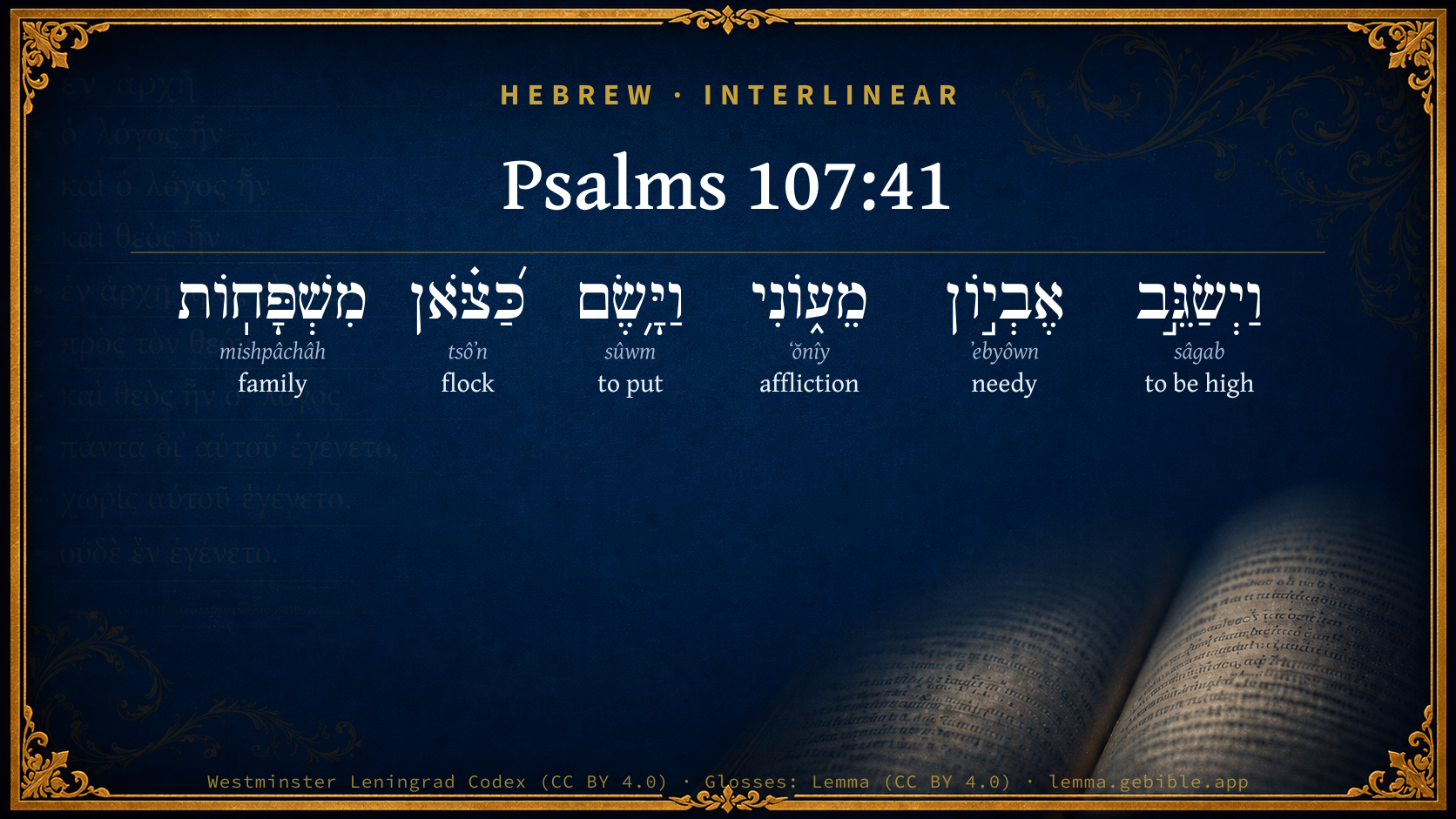
Hebrew (Westminster Leningrad Codex) Psalms 107:41 appears in the Hebrew Old Testament. The text above is from the Westminster Leningrad Codex. Each word links to its Strong’s number, a concise gloss, and parsing drawn from the Open Scriptures Hebrew Bible morphology. Click any word for its full Brown-Driver-Briggs (BDB) entry.
Download image
Cite this verse

Psalms 107:41 (World English Bible). Public Domain. Lemma interlinear Bible study tool, https://lemma.gebible.app/v/psalms/107/41.

Show BibTeX & RIS
BibTeX
RIS
English Translation
Yet he lifts the needy out of their affliction, And increases their families like a flock.
World English Bible · Public Domain
Download a study sheet

One document with this verse’s original text, its word-by-word gloss line, the meaning frame, cross-references with their text, attributed commentary, and full source and license credits — printable, and it pastes into notes with its structure intact.

This verse Autodidact and up

Study sheet (.html) Plain text (.txt)

A passage Seminary Student

Up to 50 verses in one chapter. A passage sheet keeps up to 6 commentary sources and 12 cross-references per verse, in the order this page ranks them, and says so on the sheet whenever that leaves anything out. Ask for a single verse and you get the Autodidact verse sheet above.

Everything on this page stays free to read, with no account — the sheet is a download of what is already on screen, not access to it.

Want to remove ads? Support Godless Engineer
Compare translations 3

The same verse in 3 English versions, stacked beneath the original-language interlinear above. Click any original word for its lexicon entry.

Each is an independent rendering of the whole verse — the interlinear is not word-aligned to these translations.

Highlighted words mark where these versions differ — a whole-verse word diff, not a word-by-word alignment.

  • World English Bible Public Domain
    Yet he lifts the needy out of their affliction, And increases their families like a flock.
  • King James Version Public Domain
    Yet setteth he the poor on high from affliction, and maketh him families like a flock.
  • unfoldingWord Literal Text CC BY-SA 4.0
    But he raises up the needy from affliction and establishes families like a flock.

unfoldingWord Literal Text — © unfoldingWord, licensed CC BY-SA 4.0. Word-aligned USFM3 via Door43 (git.door43.org/unfoldingWord/en_ult).

Versions to compare (up to 4)

3 of 4 selected

Show all 18 translations

Every available English version of this verse, each an independent rendering of the whole verse.

  • World English Bible Public Domain
    Yet he lifts the needy out of their affliction, And increases their families like a flock.
  • Berean Standard Bible Public Domain
    But He lifts the needy from affliction and increases their families like flocks.
  • Majority Standard Bible Public Domain
    But He lifts the needy from affliction and increases their families like flocks.
  • King James Version Public Domain
    Yet setteth he the poor on high from affliction, and maketh him families like a flock.
  • American Standard Version (1901) Public Domain
    Yet setteth he the needy on high from affliction, And maketh `him' families like a flock.
  • Revised Version (1885) Public Domain
    Yet setteth he the needy on high from affliction, and maketh him families like a flock.
  • Geneva Bible (1599) Public Domain
    Yet he raiseth vp the poore out of miserie, and maketh him families like a flocke of sheepe.
  • Douay-Rheims (1899) Public Domain
    And he helped the poor out of poverty: and made him families like a flock of sheep.
  • Young's Literal Translation Public Domain
    And setteth on high the needy from affliction, And placeth families as a flock.
  • Literal Standard Version CC BY-SA 4.0
    And sets the needy on high from affliction, || And places families as a flock.
  • Unlocked Literal Bible CC BY-SA 4.0
    But he protects the needy from affliction and cares for his families like a flock.
  • unfoldingWord Literal Text CC BY-SA 4.0
    But he raises up the needy from affliction and establishes families like a flock.
  • Darby Bible Public Domain
    But he secureth the needy one on high from affliction, and maketh [him] families like flocks.
  • World Messianic Bible Public Domain
    Yet he lifts the needy out of their affliction, and increases their families like a flock.
  • Webster's Bible Public Domain
    Yet he setteth the poor on high from affliction, and maketh him families like a flock.
  • Free Bible Version CC BY-SA 4.0
    But he lifts the poor out of their troubles, and makes their families as big as flocks.
  • Bible in Basic English Public Domain
    But he puts the poor man on high from his troubles, and gives him families like a flock.
  • JPS Tanakh (1917) Public Domain
    Yet setteth He the needy on high from affliction, and maketh his families like a flock.

Literal Standard Version (2020), Covenant Press — licensed CC BY-SA 4.0. Text via the HelloAO Bible API (eBible.org). Unlocked Literal Bible (unfoldingWord) — licensed CC BY-SA 4.0. Text via the HelloAO Bible API (eBible.org). unfoldingWord Literal Text — © unfoldingWord, licensed CC BY-SA 4.0. Word-aligned USFM3 via Door43 (git.door43.org/unfoldingWord/en_ult). Free Bible Version, Dr. Jonathan Gallagher — licensed CC BY-SA 4.0. Text via the HelloAO Bible API (eBible.org).

Word by word

More ways to search: Search by grammar → Find every occurrence → Compare this word →

Practice this passage: Drill this verse → Learn its vocabulary →

וַיְשַׂגֵּ֣ב
sâgab
H7682
“and · to be high”
Conjunction + Verb, Piel, Sequential Imperfect, 3rd Person, Masculine, Singular
Part of Speech
Conjunction + Verb
Stem
Piel
Form
Sequential Imperfect
Person
3rd Person
Gender
Masculine
Number
Singular
Full BDB Definition

Origin: a primitive root

TWOT: 2234

to be high, be inaccessibly high - (Qal) - to be (too) high (for capture) - to be high (of prosperity) - (Niphal) - to be high - to be set on high, be (safely) set on high - to be exalted (of God) - (Piel) - to set on high, set (securely) on high - to exalt, exalt (in effective hostility) - (Pual) to be set (securely) on high - (Hiphil) to act exaltedly
  1. אֶבְי֣וֹן ʼebyôwn H34 “needy” Adjective, Adjective, Masculine, Singular, Absolute
  2. מֵע֑וֹנִי ʻŏnîy H6040 “from · affliction” Preposition + Noun, Common, Masculine, Singular, Absolute
  3. וַיָּ֥שֶׂם sûwm H7760 “and · to put” Conjunction + Verb, Qal, Sequential Imperfect, 3rd Person, Masculine, Singular
  4. כַּ֝צֹּ֗אן tsôʼn H6629 “like/as the · flock” Preposition, Determined + Noun, Common, Both, Singular, Absolute
  5. מִשְׁפָּחֽוֹת mishpâchâh H4940 “families” Noun, Common, Feminine, Plural, Absolute

About this verse

These counts appear in no published source. They are computed here, from the morphology-tagged text and Lemma’s own curated glosses. What Lemma adds →

6
words
6
distinct lemmas
Wisdom
section

Notable vocabulary

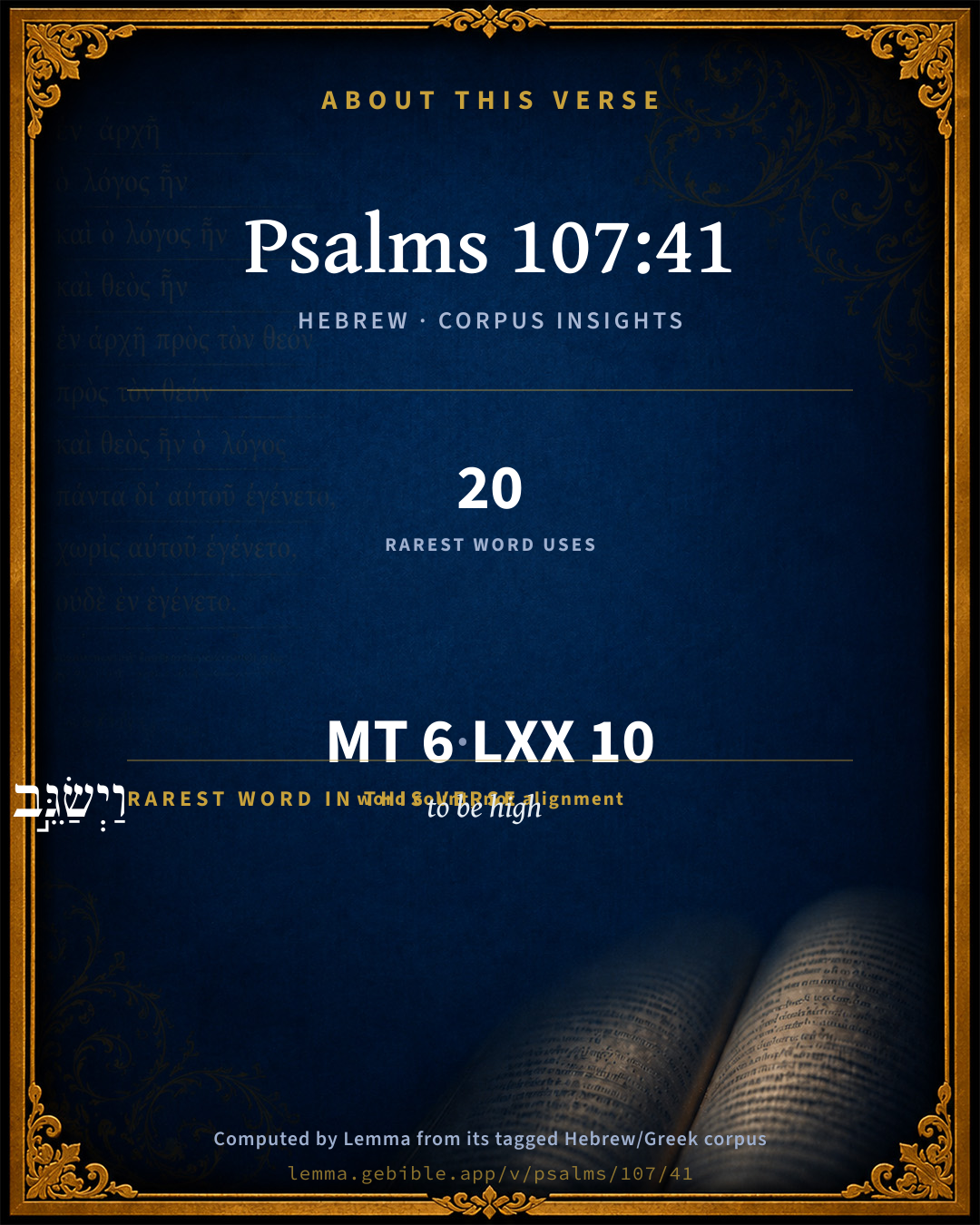
The rarest word here is וַיְשַׂגֵּ֣ב to be high H7682 — appearing just 20 times in the whole Hebrew Bible.

Shared distinctive vocabulary

וַיְשַׂגֵּ֣ב to be high H7682 occurs in 20 verses of the Hebrew Bible. Also found in:

Grammatical profile

  • 2 verbs
  • 3 nouns
  • 1 adjective

Verb forms

  • וַיְשַׂגֵּ֣ב Piel · Sequential Imperfect
  • וַיָּ֥שֶׂם Qal · Sequential Imperfect

Hebrew & Septuagint length

In English translation the verse runs 16 words from the Hebrew and 15 from the Septuagint (LXX English) — closely comparable.

A rough comparison of the two English renderings, which tokenize alike — not a word-level alignment.

Word counts can differ between the Hebrew and the Greek without any difference in meaning — e.g. the Hebrew direct-object marker אֵת has no separate Greek word, and Greek often adds the article ὁ.

In the original languages it is 6 Hebrew tokens and 10 Greek tokens — but the two are counted differently (Hebrew bundles its prefixes and suffixes into one token; the Greek is in lemma form), so that isn’t a like-for-like length.

Cross-references

19

Topical passages linked to Psalms 107:41 in the Treasury of Scripture Knowledge — connected by theme and wording, ordered by reader-vote popularity; previews shown in the World English Bible.

  • 1 Samuel 2:8 He raises up the poor out of the dust, He lifts up the needy from the dunghill, To make them sit with princes, Inherit the throne of glory: For the pillars of the earth are Yahweh's, He has set the world on them.
  • Job 21:11 They send forth their little ones like a flock. Their children dance.
  • 1 Samuel 2:21 Yahweh visited Hannah, and she conceived, and bore three sons and two daughters. The child Samuel grew before Yahweh.
  • Esther 8:15–17 Mordecai went forth from the presence of the king in royal clothing of blue and white, and with a great crown of gold, and with a robe of fine linen and purple: and the city of Shushan shouted and was glad.
  • Job 8:7 Though your beginning was small, Yet your latter end would greatly increase.
  • Psalms 78:52 But he led forth his own people like sheep, And guided them in the wilderness like a flock.
  • Isaiah 49:20–22 The children of your bereavement shall yet say in your ears, The place is too small for me; give place to me that I may dwell.
  • Ruth 4:14–17 The women said to Naomi, Blessed be Yahweh, who has not left you this day without a near kinsman; and let his name be famous in Israel.
  • Job 11:15–19 Surely then shall you lift up your face without spot; Yes, you shall be steadfast, and shall not fear:
  • Job 42:10–12 Yahweh turned the captivity of Job, when he prayed for his friends. Yahweh gave Job twice as much as he had before.
  • James 5:11 Behold, we call them blessed who endured. You have heard of the patience of Job, and have seen the Lord in the outcome, and how the Lord is full of compassion and mercy.
  • Genesis 23:5–7 The children of Heth answered Abraham, saying to him,
  • Genesis 48:11 Israel said to Joseph, "I didn't think I would see your face, and, behold, God has let me see your seed also."
  • Job 5:11 So that he sets up on high those who are low, Those who mourn are exalted to safety.
  • Job 42:16 After this Job lived one hundred forty years, and saw his sons, and his sons' sons, to four generations.
  • Psalms 113:7–9 He raises up the poor out of the dust. Lifts up the needy from the ash heap;
  • Psalms 128:6 Yes, may you see your children's children. Peace be upon Israel.
  • Proverbs 17:6 Children's children are the crown of old men; The glory of children are their parents.
  • Jeremiah 52:31–34 It happened in the seven and thirtieth year of the captivity of Jehoiachin king of Judah, in the twelfth month, in the five and twentieth day of the month, that Evilmerodach king of Babylon, in the [first] year of his reign, lifted up the head of Jehoiachin king of Judah, and brought him forth out of prison;

Cross-references courtesy of OpenBible.info (CC BY 4.0).

Hebrew and Greek witnesses Masoretic Hebrew ↔ Greek Septuagint

The same verse in the two great witnesses to the Old Testament, shown verse-for-verse.

You’re reading Greek Psalm 106 (Hebrew Psalm 107). The Septuagint counts the superscription, so verse numbers can differ from the Hebrew — chapter-level alignment, not verse-by-verse. Numbering follows Rahlfs.

These are two independent witnesses, not word-aligned to each other, and the Septuagint is shown in lemma (dictionary) form.

Hebrew Psalms 107:41 Masoretic · Westminster Leningrad Codex

וַיְשַׂגֵּ֣ב אֶבְי֣וֹן מֵע֑וֹנִי וַיָּ֥שֶׂם כַּ֝צֹּ֗אן מִשְׁפָּחֽוֹת

Yet he lifts the needy out of their affliction, And increases their families like a flock.

World English Bible · Public Domain

Greek LXX Greek Psalm 106:41 Septuagint · lemma form

καί βοηθέω πένης ἐκ πτωχεία καί τίθημι ὡς πρόβατον πατριά

But he helps the poor out of poverty, and makes him families as a flock.

LXX2012 (modern English Septuagint) · Public Domain

Hebrew: Westminster Leningrad Codex (CC BY 4.0). Greek: Septuagint (public domain); English from LXX2012 (modern English Septuagint) (Public Domain). How the Septuagint differs from the Hebrew →

Commentary

Notes on Psalms 107:41 from classic Christian and Jewish commentators (each source and its license shown beneath its notes). The classic Christian expositions comment on the surrounding passage and are grouped to its opening verse, so a note may address several verses; the Jewish commentaries on the Tanakh (Rashi and others) are per-verse, so they appear only where the commentator wrote on this verse.

Lemma curates 59 commentaries, every one of them public domain or Creative Commons licensed, each selected and text-cleaned for this edition rather than reprinted as found. About our sources →

Trapp's Complete Commentary

John Trapp

Psa 107:41 Yet setteth he the poor on high from affliction, and maketh [him] families like a flock.

Ver. 41. Yet setteth he the poor] The godly poor, as he did David.

And maketh him families like a flock] Of sheep, which multiply exceedingly in a short time.

John Trapp, A Commentary or Exposition upon All the Books of the Old and New Testament (1647–1656) — public domain. Text from a community e-Sword module.

J. A. Alexander on Psalms

Joseph Addison Alexander

41. (Psa 107:41) And has raised the poor from affliction, and made like a flock families. The first verb suggests the twofold idea of elevation from a wretched state, and security from future danger. For its ordinary sense, see above, on Psa 20:1; Psa 91:14. The last clause simply means, he has increased the people who were so reduced in strength and numbers.

Joseph Addison Alexander, The Psalms Translated and Explained (1850) — public domain. Text from a community e-Sword module.

Tyndale Open Study Notes

Tyndale Open Resources

107:41 The large families of the poor are evidence of God’s blessing.

Tyndale Open Study Notes — © Tyndale Open Resources, licensed CC BY-SA 4.0. Text via the HelloAO Bible API.

Adam Clarke's Commentary

Verse 41. Yet setteth he the poor on high] This probably refers to the case of the Israelites and their restoration from captivity. But these are incidents which frequently occur, and mark the superintendence of a benign Providence, and the hand of a just God; and are applicable to a multitude of cases.

Adam Clarke's Commentary on the Bible (1810–1826) — public domain. Text from a community e-Sword/MySword module.

Ellicott's Commentary for English Readers

(41) Like a flock.—This figure of a rapid increase of population is also borrowed from Job_21:11.

A Bible Commentary for English Readers, edited by Charles John Ellicott (1878–1897) — public domain. Text from a community e-Sword module.

The Cambridge Bible for Schools and Colleges

gen. ed. J. J. S. Perowne

41. And he set the needy on high from affliction,

And made him families like a flock.

There is no change of subject. The Psalmist is following the fortunes of those whom Jehovah has blessed with prosperity. Temporary reverses may happen to them, but He will not fail them in their need. Psa_107:39 is virtually the protasis to Psa_107:40, and the construction of Psa_107:40 is somewhat awkward, because it is a verbatim quotation from Job_12:21 a, 24 b, which the Psalmist has adopted without alteration. The princes are any tyrannous oppressors; God humbles their pride and confounds their counsels. The Psalmist probably has in mind the troubles of the returned exiles, and intends his words to encourage their faith. [The construction would however be simplified by placing Psa_107:40 before Psa_107:39 (see above p. 638), thus: He poureth contempt upon princes … and they are diminished and brought low … and he setteth &c. He humbles the proud and exalts the humble.]

like a flock] i.e. numerous. Cp. Job_21:11; Eze_36:37-38.

The P.B.V. of Psa_107:40, “Though he suffer them to be evil intreated through tyrants, and let them wander out of the way in the wilderness,” comes from Coverdale, who derived it apparently from the Zürich Bible[63] (Introd. p. lxxiii). The Heb. however cannot bear this meaning.

[63] So er sy lasst durch die tyrannen beraubet und geschediget werden: so er sy durch die öden ort, da kein weg ist, härumb fürt.

The Cambridge Bible for Schools and Colleges (gen. ed. J. J. S. Perowne; Cambridge University Press, 1878–1918) — public domain. Text from a community e-Sword module.

Albert Barnes' Notes on the Bible

Yet setteth he the poor on high from affliction - Margin, “after.” The sense is not materially different. The idea is, that while he thus humbles princes, bringing them down from their lofty position, he has respect to the poor in their condition of suffering and trial, and raises them from that depressed state, and gives them prosperity. Thus he orders the circumstances of people, and shows his sovereignty.

And maketh him families like flock - Numerous as a flock. Large families were accounted a blessing among the Hebrews. See the notes at Psa 107:38.

Albert Barnes' Notes on the Bible (1834–1885) — public domain. Text from a community e-Sword/MySword module.

Matthew Poole's English Annotations

Yet setteth he the poor on high: and whilst he bringeth down great potentates, at the same time he advanceth those who were obscure and contemptible. Like a flock, which increase very much in a little time.

Matthew Poole's English Annotations on the Holy Bible (1683–1685) — public domain. Text from a community e-Sword/MySword module.

The Treasury of David

Charles H. Spurgeon

Ver. 41. He setteth the poor on high from affliction. How high? Above the reach of the curse, which shall never touch him; above the power of Satan, which shall never ruin him; above the reigning influence of sin, which "shall not have dominion over him"; above the possibility of being banished from his presence, for "Israel shall be saved in the Lord with an everlasting salvation." This is the way God sets his people on high, instructing them in the mysteries of his word, and giving them to partake the joys that are contained therein. Joseph Irons, 1786-1852.

Psalms 107:42*

Charles H. Spurgeon's The Treasury of David (1869–1885) — public domain. Psalms only. Text from a community e-Sword/MySword module.

Whedon's Commentary on the Bible

Daniel D. Whedon

41. Like a flock—Meaning numerous and merry. See Job_21:11

Daniel D. Whedon (gen. ed.), Commentary on the Old and New Testaments (1874–1909) — public domain. Text from a community e-Sword module.

The Pulpit Commentary

Yet setteth he the poor on high from affliction. Even in such dread calamities, when a whole nation is punished, God"s providence protects the poor and needy not of course in all, but still in very many, eases. The mower"s scythe passes over the humblest flowers. And maketh him families like a flock. (Job_21:11) Those whom God thus preserves he collects into "families," and looks after as carefully as a shepherd looks after his sheep.

The Pulpit Commentary (1880–1919), ed. H.D.M. Spence-Jones & Joseph S. Exell — public domain. Text from a community e-Sword module.

unfoldingWord translationNotes

Door43 World Missions Community

But he

"But Yahweh"

the needy

This refers to needy people. AT: "needy people" or "poor people" (See: Nominal Adjectives)

cares for his families like a flock

Here David compares how Yahweh cares for his people to how a shepherd cares for his sheep. Possible meanings are 1) "makes the number of people in their families increase like flocks" or 2) "takes care of them like a shepherd cares for his sheep" (See: Simile)

The upright

This refers to people who live in an upright way. AT: "Upright people" or "People who do what is right" (See: Nominal Adjectives)

all wickedness

Here wicked people are referred to as "wickedness." AT: "all wicked people" (See: Metonymy)

shuts its mouth

This means to not say anything in response. AT: "has nothing to say against Yahweh in reply" (See: Idiom)

take note of these things

This means to think about these things. AT: "think about these things" or "remember these things" (See: Idiom)

meditate on Yahweh's acts of covenant faithfulness

The abstract noun "faithfulness" can be translated with an adjective. AT: "meditate on the things that Yahweh has done that show that he is faithful to his covenant" (See: Abstract Nouns)

translationWords

afflicted

family

flocks

righteous

joy

evil

wise

meditate

Yahweh

covenant faithfulness

unfoldingWord translationNotes — © Distant Shores Media and the Door43 World Missions Community, licensed CC BY-SA 4.0. Source: git.door43.org/Door43/en_tn.

Rashi

Rabbi Shlomo Yitzchaki (Rashi)

and made him families like flocks He made [for] the needy the families of his children as numerous as flocks.

Rashi on the Tanakh — English translations: “The Judaica Press complete Tanach with Rashi, translated by A. J. Rosenberg” (CC BY 4.0); “Pentateuch with Rashi's commentary by M. Rosenbaum and A.M. Silbermann, 1929-1934” (public domain); “The Metsudah Tanach series, Lakewood, N.J” (CC BY 4.0); and “The Book of Joshua, Metsudah Publications, 1997” (CC BY 4.0). Text via Sefaria.

Lesson kit

Teaching starters — assembled from the data on this page, not authored interpretation. Every prompt links to the verse data it draws on. Edit before teaching.

Psalms, in the Wisdom, opens this verse with 6 words (6 distinct Hebrew lemmas). Its most distinctive word is sâgab (“to be high”). A historical commentator’s framing appears above. Read the whole chapter for the surrounding context.

Discussion questions

  1. What does “to be high” (sâgab) contribute to the verse as a whole?
  2. How does Deuteronomy 2:36, which shares the word «to be high», read alongside this verse?
  3. The translations on this page render this verse differently — a whole-verse word diff, not a word-by-word alignment. What might account for the different wordings?
  4. «וַיְשַׂגֵּ֣ב» is a Piel Sequential Imperfect verb. How does that grammatical form shape the action described?
  5. Compare how Trapp's Complete Commentary and J. A. Alexander on Psalms read this verse. Where do they agree or differ?

Things to notice

Reading settings

Reading text

Shown beneath each verse's original-language words.

Old Testament
Old Testament edition

Read the OT as the Masoretic Hebrew (MT) or the Greek Septuagint (LXX).

English shown for the Greek Septuagint (in the Hebrew ↔ Greek comparison).

Comparing translations? Open the Compare panel on any verse page to stack up to four side by side.