Genesis 29:8

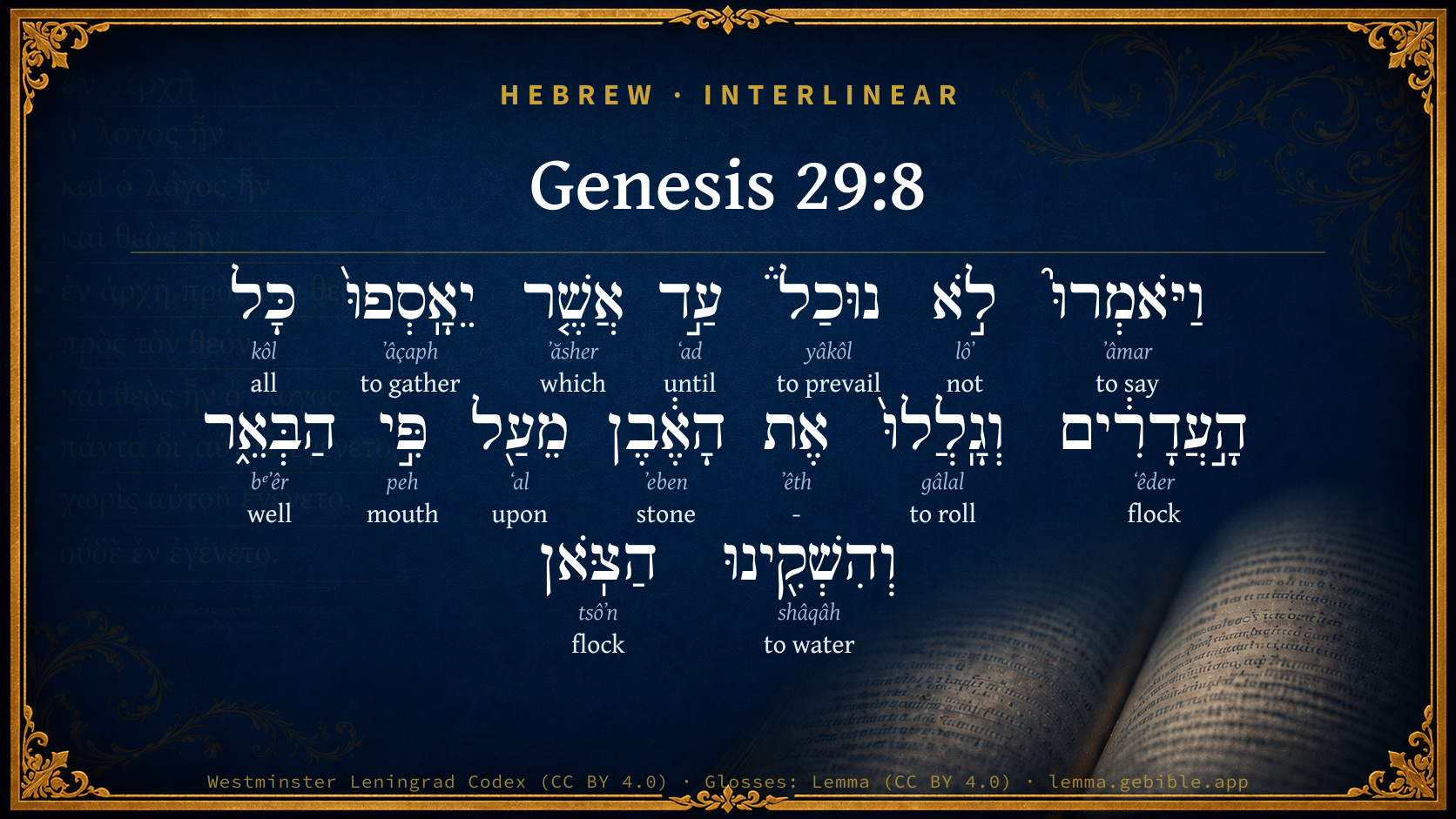
Hebrew (Westminster Leningrad Codex) Genesis 29:8 appears in the Hebrew Old Testament. The text above is from the Westminster Leningrad Codex. Each word links to its Strong’s number, a concise gloss, and parsing drawn from the Open Scriptures Hebrew Bible morphology. Click any word for its full Brown-Driver-Briggs (BDB) entry.
Download image
Cite this verse

Genesis 29:8 (World English Bible). Public Domain. Lemma interlinear Bible study tool, https://lemma.gebible.app/v/genesis/29/8.

Show BibTeX & RIS
BibTeX
RIS
English Translation
They said, "We can't, until all the flocks are gathered together, and they roll the stone from the well's mouth. Then we water the sheep."
World English Bible · Public Domain
Download a study sheet

One document with this verse’s original text, its word-by-word gloss line, the meaning frame, cross-references with their text, attributed commentary, and full source and license credits — printable, and it pastes into notes with its structure intact.

This verse Autodidact and up

Study sheet (.html) Plain text (.txt)

A passage Seminary Student

Up to 50 verses in one chapter. A passage sheet keeps up to 6 commentary sources and 12 cross-references per verse, in the order this page ranks them, and says so on the sheet whenever that leaves anything out. Ask for a single verse and you get the Autodidact verse sheet above.

Everything on this page stays free to read, with no account — the sheet is a download of what is already on screen, not access to it.

Want to remove ads? Support Godless Engineer
Compare translations 3

The same verse in 3 English versions, stacked beneath the original-language interlinear above. Click any original word for its lexicon entry.

Each is an independent rendering of the whole verse — the interlinear is not word-aligned to these translations.

Highlighted words mark where these versions differ — a whole-verse word diff, not a word-by-word alignment.

  • World English Bible Public Domain
    They said, "We can't, until all the flocks are gathered together, and they roll the stone from the well's mouth. Then we water the sheep."
  • King James Version Public Domain
    And they said, We cannot, until all the flocks be gathered together, and till they roll the stone from the well's mouth; then we water the sheep.
  • unfoldingWord Literal Text CC BY-SA 4.0
    But they said, “We cannot, until all the flocks are gathered and they roll the stone from over the mouth of the well. Then we will water the sheep.”

unfoldingWord Literal Text — © unfoldingWord, licensed CC BY-SA 4.0. Word-aligned USFM3 via Door43 (git.door43.org/unfoldingWord/en_ult).

Versions to compare (up to 4)

3 of 4 selected

Show all 18 translations

Every available English version of this verse, each an independent rendering of the whole verse.

  • World English Bible Public Domain
    They said, "We can't, until all the flocks are gathered together, and they roll the stone from the well's mouth. Then we water the sheep."
  • Berean Standard Bible Public Domain
    But they replied, “We cannot, until all the flocks have been gathered and the stone has been rolled away from the mouth of the well. Then we will water the sheep.”
  • Majority Standard Bible Public Domain
    But they replied, “We cannot, until all the flocks have been gathered and the stone has been rolled away from the mouth of the well. Then we will water the sheep.”
  • King James Version Public Domain
    And they said, We cannot, until all the flocks be gathered together, and till they roll the stone from the well's mouth; then we water the sheep.
  • American Standard Version (1901) Public Domain
    And they said, We cannot, until all the flocks be gathered together, and they roll the stone from the well's mouth. Then we water the sheep.
  • Revised Version (1885) Public Domain
    And they said, We cannot, until all the flocks be gathered together, and they roll the stone from the well’s mouth; then we water the sheep.
  • Geneva Bible (1599) Public Domain
    But they sayde, We may not vntill all the flocks be brought together, and till men rolle the stone from the welles mouth, that we may water the sheepe.
  • Douay-Rheims (1899) Public Domain
    They answered: We cannot, till all the cattle be gathered together, and we remove the stone from the well's mouth, that we may water the flocks.
  • Young's Literal Translation Public Domain
    And they say, `We are not able, till that all the droves be gathered together, and they have rolled away the stone from the mouth of the well, and we have watered the flock.'
  • Literal Standard Version CC BY-SA 4.0
    And they say, “We are not able, until all the droves be gathered together, and they have rolled away the stone from the mouth of the well, and we have watered the flock.”
  • Unlocked Literal Bible CC BY-SA 4.0
    They said, “We cannot water them until all the flocks are gathered together. The men will then roll the stone from the well's mouth, and we will water the sheep.”
  • unfoldingWord Literal Text CC BY-SA 4.0
    But they said, “We cannot, until all the flocks are gathered and they roll the stone from over the mouth of the well. Then we will water the sheep.”
  • Darby Bible Public Domain
    And they said, We cannot until all the flocks are gathered together, and they roll the stone from the mouth of the well, and we water the sheep.
  • World Messianic Bible Public Domain
    They said, “We can’t, until all the flocks are gathered together, and they roll the stone from the well’s mouth. Then we will water the sheep.”
  • Webster's Bible Public Domain
    And they said, We cannot, until all the flocks are collected, and till they roll the stone from the well's mouth; then we water the sheep.
  • Free Bible Version CC BY-SA 4.0
    “We can't do that until all the flocks have arrived,” they told him. “Then we roll away the stone from the well and let the sheep drink.”
  • Bible in Basic English Public Domain
    And they said, We are not able to do so till all the flocks have come together and the stone has been rolled away from the mouth of the water-hole; then we will get water for the sheep.
  • JPS Tanakh (1917) Public Domain
    And they said: 'We cannot, until all the flocks be gathered together, and they roll the stone from the well's mouth; then we water the sheep.'

Literal Standard Version (2020), Covenant Press — licensed CC BY-SA 4.0. Text via the HelloAO Bible API (eBible.org). Unlocked Literal Bible (unfoldingWord) — licensed CC BY-SA 4.0. Text via the HelloAO Bible API (eBible.org). unfoldingWord Literal Text — © unfoldingWord, licensed CC BY-SA 4.0. Word-aligned USFM3 via Door43 (git.door43.org/unfoldingWord/en_ult). Free Bible Version, Dr. Jonathan Gallagher — licensed CC BY-SA 4.0. Text via the HelloAO Bible API (eBible.org).

Word by word

More ways to search: Search by grammar → Find every occurrence → Compare this word →

Practice this passage: Drill this verse → Learn its vocabulary →

וְגָֽלֲלוּ֙
gâlal
H1556
“and · to roll”
Conjunction + Verb, Qal, Sequential Perfect, 3rd Person, Common, Plural
Part of Speech
Conjunction + Verb
Stem
Qal
Form
Sequential Perfect
Person
3rd Person
Gender
Common
Number
Plural
Full BDB Definition

Origin: a primitive root

TWOT: 353

to roll, roll away, roll down, roll together - (Qal) to roll - (Niphal) - to roll up - to flow down - (Pilpel) to roll - (Poal) to be rolled - (Hithpoel) to roll oneself - (Hithpalpel) to roll oneself - (Hiphil) to roll away
  1. וַיֹּאמְרוּ֮ ʼâmar H559 “and · to say” Conjunction + Verb, Qal, Sequential Imperfect, 3rd Person, Masculine, Plural
  2. לֹ֣א lôʼ H3808 “not” Particle, Negative
  3. נוּכַל֒ yâkôl H3201 “to prevail” Verb, Qal, Imperfect, 1st Person, Common, Plural
  4. עַ֣ד ʻad H5704 “until” Preposition
  5. אֲשֶׁ֤ר ʼăsher H834 “which” Particle, Relative
  6. יֵאָֽסְפוּ֙ ʼâçaph H622 “to gather” Verb, Niphal, Imperfect, 3rd Person, Masculine, Plural
  7. כָּל kôl H3605 “all of” Noun, Common, Masculine, Singular, Construct
  8. הָ֣עֲדָרִ֔ים ʻêder H5739 “the · flocks” Particle, Definite Article + Noun, Common, Masculine, Plural, Absolute
  9. אֶת ʼêth H853 “-” Particle, Direct Object
  10. הָאֶ֔בֶן ʼeben H68 “the · stone” Particle, Definite Article + Noun, Common, Feminine, Singular, Absolute
  11. מֵעַ֖ל ʻal H5921 “from · upon” Preposition + Preposition
  12. פִּ֣י peh H6310 “mouth of” Noun, Common, Masculine, Singular, Construct
  13. הַבְּאֵ֑ר bᵉʼêr H875 “the · well” Particle, Definite Article + Noun, Common, Feminine, Singular, Absolute
  14. וְהִשְׁקִ֖ינוּ shâqâh H8248 “and · to water” Conjunction + Verb, Hiphil, Sequential Perfect, 1st Person, Common, Plural
  15. הַצֹּֽאן tsôʼn H6629 “the · flock” Particle, Definite Article + Noun, Common, Both, Singular, Absolute

About this verse

These counts appear in no published source. They are computed here, from the morphology-tagged text and Lemma’s own curated glosses. What Lemma adds →

16
words
16
distinct lemmas
Pentateuch
section

Notable vocabulary

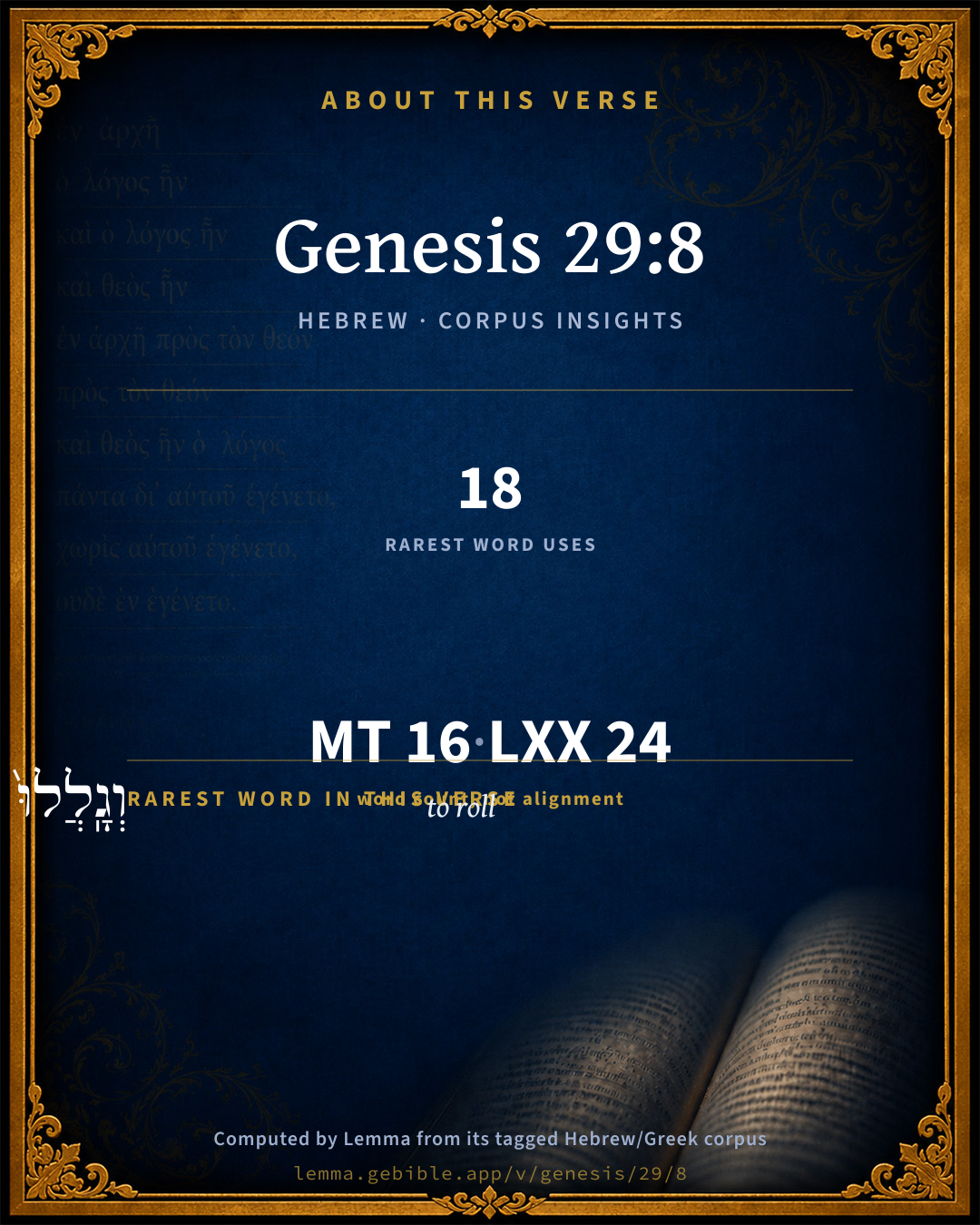
The rarest word here is וְגָֽלֲלוּ֙ to roll H1556 — appearing just 18 times in the whole Hebrew Bible.

Shared distinctive vocabulary

וְגָֽלֲלוּ֙ to roll H1556 occurs in 18 verses of the Hebrew Bible. Also found in:

Grammatical profile

  • 5 verbs
  • 6 nouns
  • 2 prepositions
  • 3 particles

Verb forms

  • וַיֹּאמְרוּ֮ Qal · Sequential Imperfect
  • נוּכַל֒ Qal · Imperfect
  • יֵאָֽסְפוּ֙ Niphal · Imperfect
  • וְגָֽלֲלוּ֙ Qal · Sequential Perfect
  • וְהִשְׁקִ֖ינוּ Hiphil · Sequential Perfect

Hebrew & Septuagint length

In English translation the verse runs 25 words from the Hebrew and 34 from the Septuagint (LXX English) — closely comparable.

A rough comparison of the two English renderings, which tokenize alike — not a word-level alignment.

Word counts can differ between the Hebrew and the Greek without any difference in meaning — e.g. the Hebrew direct-object marker אֵת has no separate Greek word, and Greek often adds the article ὁ.

In the original languages it is 16 Hebrew tokens and 24 Greek tokens — but the two are counted differently (Hebrew bundles its prefixes and suffixes into one token; the Greek is in lemma form), so that isn’t a like-for-like length.

Cross-references

5

Topical passages linked to Genesis 29:8 in the Treasury of Scripture Knowledge — connected by theme and wording, ordered by reader-vote popularity; previews shown in the World English Bible.

  • Mark 16:3 They were saying among themselves, "Who will roll away the stone from the door of the tomb for us?"
  • Luke 24:2 They found the stone rolled away from the tomb.
  • Genesis 29:3 There all the flocks were gathered. They rolled the stone from the well's mouth, and watered the sheep, and put the stone again on the well's mouth in its place.
  • Genesis 34:14 and said to them, "We can't do this thing, to give our sister to one who is uncircumcised; for that is a reproach to us.
  • Genesis 43:32 They served him by himself, and them by themselves, and the Egyptians, that ate with him, by themselves, because the Egyptians don't eat bread with the Hebrews, for that is an abomination to the Egyptians.

Cross-references courtesy of OpenBible.info (CC BY 4.0).

Hebrew and Greek witnesses Masoretic Hebrew ↔ Greek Septuagint

The same verse in the two great witnesses to the Old Testament, shown verse-for-verse.

These are two independent witnesses, not word-aligned to each other, and the Septuagint is shown in lemma (dictionary) form.

Hebrew Genesis 29:8 Masoretic · Westminster Leningrad Codex

וַיֹּאמְרוּ֮ לֹ֣א נוּכַל֒ עַ֣ד אֲשֶׁ֤ר יֵאָֽסְפוּ֙ כָּל הָ֣עֲדָרִ֔ים וְגָֽלֲלוּ֙ אֶת הָאֶ֔בֶן מֵעַ֖ל פִּ֣י הַבְּאֵ֑ר וְהִשְׁקִ֖ינוּ הַצֹּֽאן

They said, "We can't, until all the flocks are gathered together, and they roll the stone from the well's mouth. Then we water the sheep."

World English Bible · Public Domain

Greek LXX Genesis 29:8 Septuagint · lemma form

ὁ δέ εἶπον οὐ δύναμαι ἕως ὁ συνἄγω πᾶς ὁ ποιμήν καί ἀποκυλίω ὁ λίθος ἀπό ὁ στόμα ὁ φρέαρ καί ποτίζω ὁ πρόβατον

And they said, We shall not be able, until all the shepherds be gathered together, and they shall roll away the stone from the mouth of the well, then we will water the flocks.

LXX2012 (modern English Septuagint) · Public Domain

Hebrew: Westminster Leningrad Codex (CC BY 4.0). Greek: Septuagint (public domain); English from LXX2012 (modern English Septuagint) (Public Domain). How the Septuagint differs from the Hebrew →

Targum (Aramaic paraphrase)

2

The Targum is the ancient Jewish Aramaic paraphrase of the Hebrew Scriptures — an interpretive translation, not the Hebrew text itself. Onkelos (literal) and Pseudo-Jonathan (expansive) render the Torah, and Jonathan the Prophets. Coverage is partial: where no permissively-licensed English translation exists for a verse, only the Aramaic is shown. This is verse-level text, not a word-by-word alignment to the Hebrew.

  1. Targum Onkelos Torah (Genesis–Deuteronomy)
    וַאֲמָרוּ לָא נִכּוּל עַד דִי יִתְכַּנְשִׁין כָּל עֲדָרַיָּא וִיגַנְדְרוּן יָת אַבְנָא מֵעַל פוּמָא דְבֵירָא וְנַשְׁקֵי עָנָא

    (no public-domain English translation for this verse)

    Targum Onkelos — Aramaic: “Onkelos Genesis” (public domain); “Onkelos Exodus” (public domain); “Onkelos Leviticus” (public domain); “Onkelos Numbers” (public domain); “Onkelos Deuteronomy” (public domain). English: “Sefaria Community Translation” (CC0 1.0 (public-domain dedication)); “J.W. Etheridge. The Targums of Onkelos and Jonathan Ben Uzziel on the Pentateuch. London: Longmans, Green, 1862” (public domain). Text via Sefaria.

  2. Targum Pseudo-Jonathan Torah (Genesis–Deuteronomy)
    וַאֲמָרוּ לָא נֵיכוּל עַד דִי יִתְכַּנְשׁוּן כָּל עֶדְרַיָא וִיְגַלְגְלִין יַת אַבְנָא מֵעַל פּוּם בֵּירָא וְנַשְׁקֵי יַת עָנָא

    And they said, We cannot until all the flocks are gathered together, and we roll the stone from the mouth of the well and water the sheep.

    Targum Pseudo-Jonathan — Aramaic: “Targum Jonathan on Genesis” (public domain); “Targum Jonathan on Exodus” (public domain); “Targum Jonathan on Leviticus” (public domain); “Targum Jonathan on Numbers” (public domain); “Targum Jonathan on Deuteronomy” (public domain). English: “The Targum of Jonathan ben Uzziel, trans. J. W. Etheridge, London, 1862” (public domain). Text via Sefaria.

Commentary

Notes on Genesis 29:8 from classic Christian and Jewish commentators (each source and its license shown beneath its notes). The classic Christian expositions comment on the surrounding passage and are grouped to its opening verse, so a note may address several verses; the Jewish commentaries on the Tanakh (Rashi and others) are per-verse, so they appear only where the commentator wrote on this verse.

Lemma curates 59 commentaries, every one of them public domain or Creative Commons licensed, each selected and text-cleaned for this edition rather than reprinted as found. About our sources →

Trapp's Complete Commentary

John Trapp

Gen 29:8 And they said, We cannot, until all the flocks be gathered together, and [till] they roll the stone from the well’s mouth; then we water the sheep.

Ver. 8. We cannot, until all the flocks.] As we are not, by the example of these shepherds, to enterprise things above our strength, {Psa 131:1} so neither to be discouraged by every difficulty; but to lend, and borrow help one of another; each man "pleasing his neighbour for his good, and serving him in love, to edification". {Rom 14:1-2}

“ Divisae his operae, sed mens fuit unica, pavit

Ore Lutherus oves, flore Melancthon apes .”

John Trapp, A Commentary or Exposition upon All the Books of the Old and New Testament (1647–1656) — public domain. Text from a community e-Sword module.

Jamieson, Fausset & Brown

Robert Jamieson, A. R. Fausset & David Brown

They said, We cannot, until all the flocks be gathered--In order to prevent the consequences of too frequent exposure in places where water is scarce, the well is not only covered, but it is customary to have all the flocks collected round it before the covering is removed in presence of the owner or one of his representatives; and it was for this reason that those who were reposing at the well of Haran with the three flocks were waiting the arrival of Rachel.

Jamieson, Fausset & Brown — Commentary Critical and Explanatory on the Whole Bible (1871) — public domain (CC PDM 1.0). Text via the HelloAO Bible API.

Adam Clarke's Commentary

Verse 8. We cannot, until all the flocks be gathered together] It is a rule that the stone shall not be removed till all the shepherds and the flocks which have a right to this well be gathered together; then, and not before, we may water the sheep. See Clarke on Ge 29:3.

Adam Clarke's Commentary on the Bible (1810–1826) — public domain. Text from a community e-Sword/MySword module.

Ellicott's Commentary for English Readers

(8) And till they roll the stone . . . —More correctly, then they roll the stone from the well’s mouth, and we water the sheep. As soon as the flocks were all collected round the well the stone is removed. and all in their turn give their sheep water.

A Bible Commentary for English Readers, edited by Charles John Ellicott (1878–1897) — public domain. Text from a community e-Sword module.

The Cambridge Bible for Schools and Colleges

gen. ed. J. J. S. Perowne

8. We cannot] The local custom was not to be broken. All the flocks were to be collected, before any were to be watered; and then those who had come first had the privilege of watering their flocks first.

The Cambridge Bible for Schools and Colleges (gen. ed. J. J. S. Perowne; Cambridge University Press, 1878–1918) — public domain. Text from a community e-Sword module.

John Gill's Exposition

And they said, we cannot,.... That is, water the sheep; either because the stone was a great one, as Jarchi observes, and therefore used to be removed by the joint strength of all the shepherds when they came together, though Jacob rolled it away of himself afterwards; but this is imputed to his great strength: or rather it was a custom that obtained among them, or an agreement made between them, that the stone should not be removed from the mouth of the well, and any flock watered:

until all the flocks be gathered together; and therefore they could not fairly and rightly do it, without violating the law and custom among them:

and till they roll the stone from the well's mouth; that is, the shepherds of the several flocks:

then we water the sheep; and not till then.

John Gill's Exposition of the Whole Bible (1746–1763) — public domain (CC PDM 1.0). Text via the HelloAO Bible API.

Matthew Poole's English Annotations

Either because of the greatness of the stone, which they could not remove till more help came; or rather because of the custom, order, and agreement made amongst themselves about it.

We cannot, to wit, rightly; or we may not, as that word is used, Ge 34:14; 43:32; 44:26.

Matthew Poole's English Annotations on the Holy Bible (1683–1685) — public domain. Text from a community e-Sword/MySword module.

Whedon's Commentary on the Bible

Daniel D. Whedon

8. We cannot — There was an understanding among them that the stone should not be removed until all the flocks were gathered together. Thus all the shepherds and all the flocks would share equally, and each party prevented from taking any advantage of the other.

Daniel D. Whedon (gen. ed.), Commentary on the Old and New Testaments (1874–1909) — public domain. Text from a community e-Sword module.

The Pulpit Commentary

And they said, We cannot, not because of any physical difficulty (Kalisch), since three men could easily have accomplished what Jacob by himself did, but because they had agreed not to do so (Rosenm Murphy), but to wait until all the flocks be gathered together (when the watering was done at once, instead of at so many different times), and till they roll the stone from the well"s mouth; more correctly rendered, and (sc. then, i.e. when the flocks are assembled) they (i.e. the shepherds) roll away the stone then (or, and) we water the sheep. The object of watering the flocks collectively may have been, as above stated, for convenience, or to prevent the well from being opened too frequently, in which case dust might rapidly accumulate within it (Kalisch), or perhaps to secure an equal distribution of the water (Murphy).

The Pulpit Commentary (1880–1919), ed. H.D.M. Spence-Jones & Joseph S. Exell — public domain. Text from a community e-Sword module.

Rashi

Rabbi Shlomo Yitzchaki (Rashi)

לא נוכל WE CANNOT — give them water because the stone is a heavy one.

וגללו AND THEY ROLL AWAY — This word is rendered in the Targum by ויגנדרון “and they will roll away” (whilst in Genesis 5:3 it is rendered by an Aramaic participle) because the verb has here a future meaning.

Rashi on the Tanakh — English translations: “The Judaica Press complete Tanach with Rashi, translated by A. J. Rosenberg” (CC BY 4.0); “Pentateuch with Rashi's commentary by M. Rosenbaum and A.M. Silbermann, 1929-1934” (public domain); “The Metsudah Tanach series, Lakewood, N.J” (CC BY 4.0); and “The Book of Joshua, Metsudah Publications, 1997” (CC BY 4.0). Text via Sefaria.

Lesson kit

Teaching starters — assembled from the data on this page, not authored interpretation. Every prompt links to the verse data it draws on. Edit before teaching.

Genesis, in the Pentateuch, opens this verse with 16 words (16 distinct Hebrew lemmas). Its most distinctive word is gâlal (“to roll”). A historical commentator’s framing appears above. Read the whole chapter for the surrounding context.

Discussion questions

  1. The word gâlal carries the sense “to roll.” How does it shape the verse?
  2. How does Genesis 29:3, which shares the word «to roll», read alongside this verse?
  3. The translations on this page render this verse differently — a whole-verse word diff, not a word-by-word alignment. What might account for the different wordings?
  4. «וַיֹּאמְרוּ֮» is a Qal Sequential Imperfect verb. How does that grammatical form shape the action described?
  5. Compare how Trapp's Complete Commentary and Jamieson, Fausset & Brown read this verse. Where do they agree or differ?

Things to notice

Reading settings

Reading text

Shown beneath each verse's original-language words.

Old Testament
Old Testament edition

Read the OT as the Masoretic Hebrew (MT) or the Greek Septuagint (LXX).

English shown for the Greek Septuagint (in the Hebrew ↔ Greek comparison).

Comparing translations? Open the Compare panel on any verse page to stack up to four side by side.