Psalms 144:13

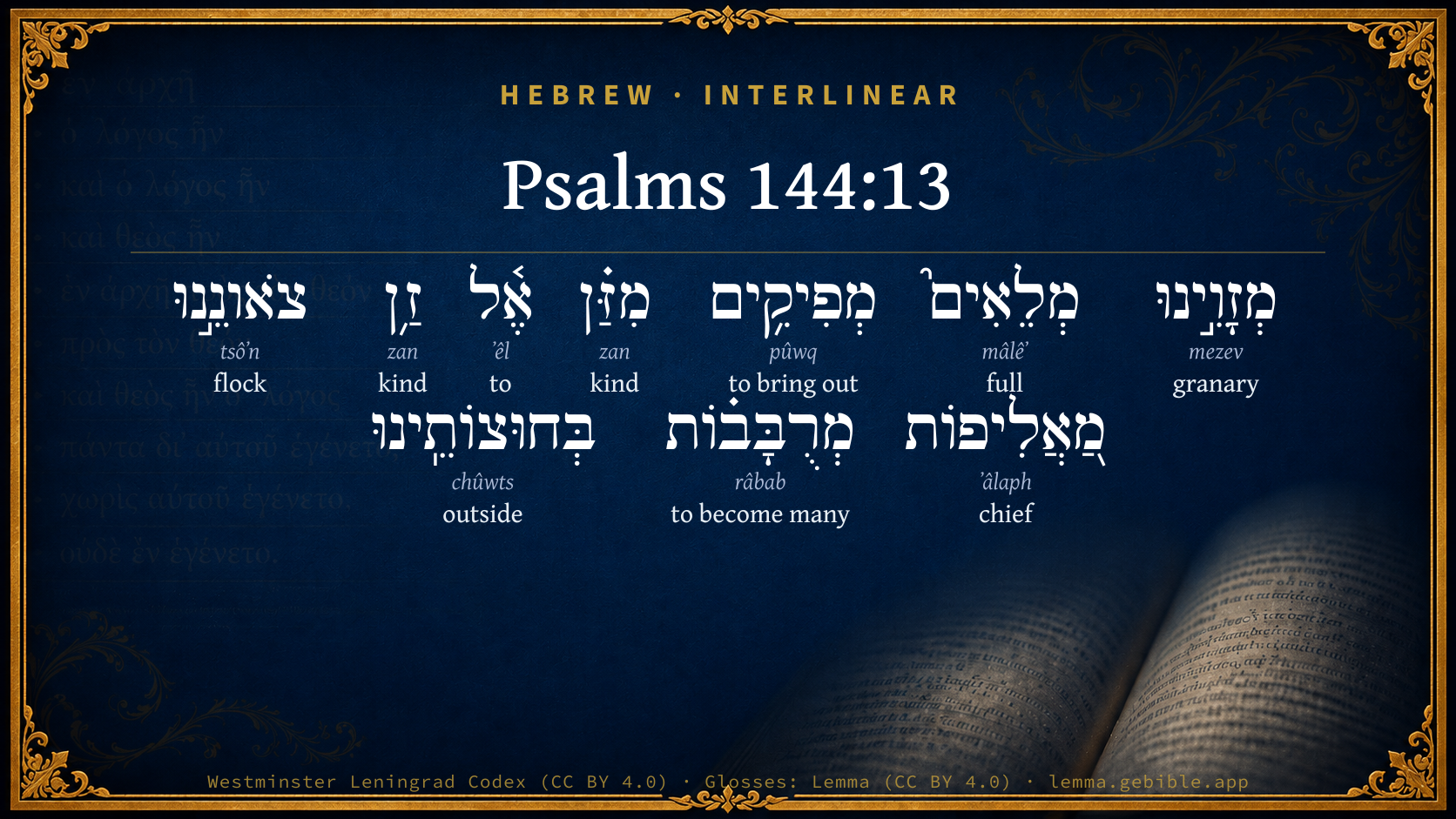
Hebrew (Westminster Leningrad Codex) Psalms 144:13 appears in the Hebrew Old Testament. The text above is from the Westminster Leningrad Codex. Each word links to its Strong’s number, a concise gloss, and parsing drawn from the Open Scriptures Hebrew Bible morphology. Click any word for its full Brown-Driver-Briggs (BDB) entry.
Download image
Cite this verse

Psalms 144:13 (World English Bible). Public Domain. Lemma interlinear Bible study tool, https://lemma.gebible.app/v/psalms/144/13.

Show BibTeX & RIS
BibTeX
RIS
English Translation
Our barns are full, filled with all kinds of provision. Our sheep bring forth thousands and ten thousands in our fields.
World English Bible · Public Domain
Highlights
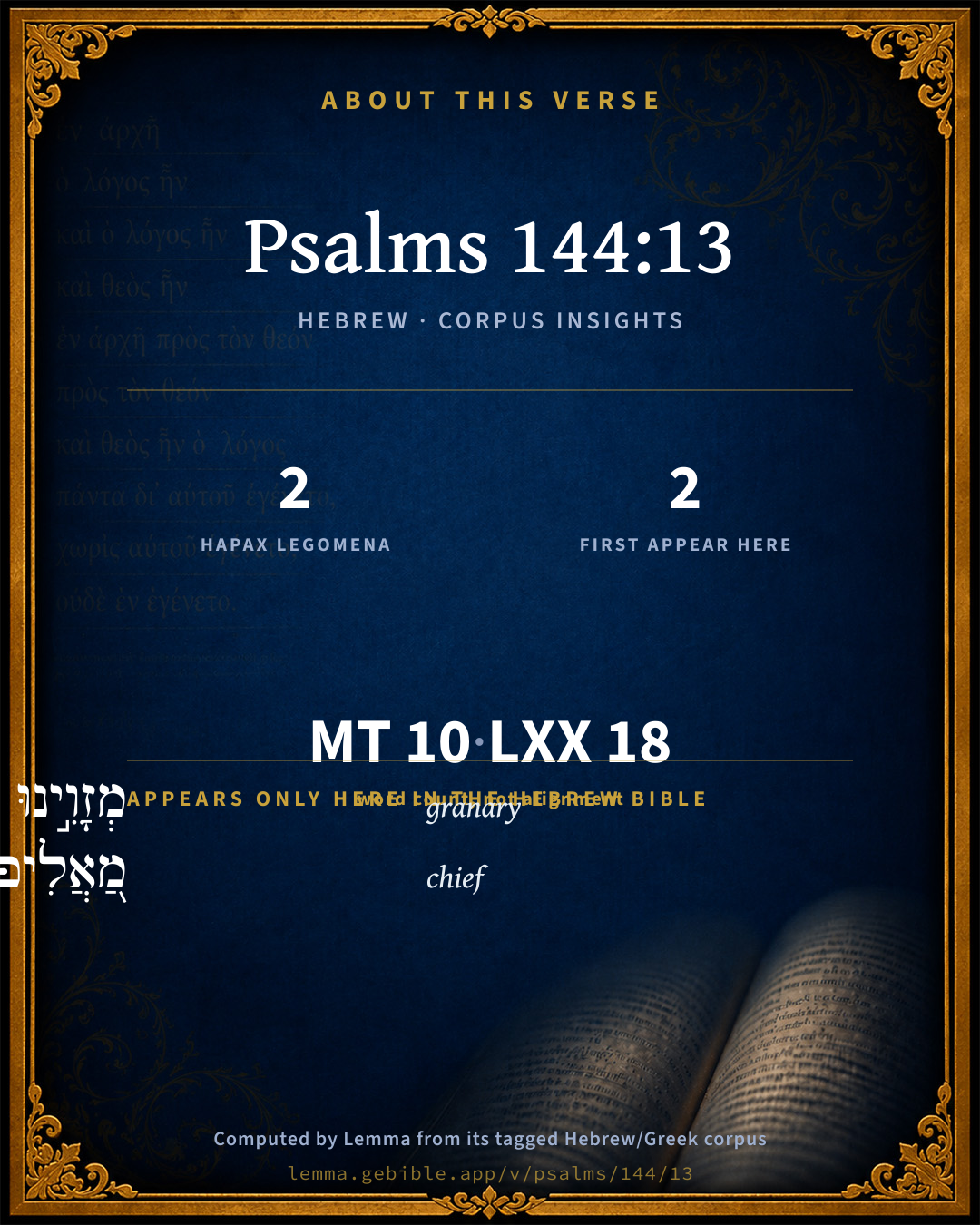
  • 2 hapax legomena — only here in the Hebrew Bible
  • 2 first appearances in the Hebrew Bible
Full analysis ↓
Download a study sheet

One document with this verse’s original text, its word-by-word gloss line, the meaning frame, cross-references with their text, attributed commentary, and full source and license credits — printable, and it pastes into notes with its structure intact.

This verse Autodidact and up

Study sheet (.html) Plain text (.txt)

A passage Seminary Student

Up to 50 verses in one chapter. A passage sheet keeps up to 6 commentary sources and 12 cross-references per verse, in the order this page ranks them, and says so on the sheet whenever that leaves anything out. Ask for a single verse and you get the Autodidact verse sheet above.

Everything on this page stays free to read, with no account — the sheet is a download of what is already on screen, not access to it.

Want to remove ads? Support Godless Engineer
Compare translations 3

The same verse in 3 English versions, stacked beneath the original-language interlinear above. Click any original word for its lexicon entry.

Each is an independent rendering of the whole verse — the interlinear is not word-aligned to these translations.

Highlighted words mark where these versions differ — a whole-verse word diff, not a word-by-word alignment.

  • World English Bible Public Domain
    Our barns are full, filled with all kinds of provision. Our sheep bring forth thousands and ten thousands in our fields.
  • King James Version Public Domain
    That our garners may be full, affording all manner of store: that our sheep may bring forth thousands and ten thousands in our streets:
  • unfoldingWord Literal Text CC BY-SA 4.0
    our granaries full, furnishing from kind to kind; may our flocks be thousanding, may they be myriading in our fields.

unfoldingWord Literal Text — © unfoldingWord, licensed CC BY-SA 4.0. Word-aligned USFM3 via Door43 (git.door43.org/unfoldingWord/en_ult).

Versions to compare (up to 4)

3 of 4 selected

Show all 17 translations

Every available English version of this verse, each an independent rendering of the whole verse.

  • World English Bible Public Domain
    Our barns are full, filled with all kinds of provision. Our sheep bring forth thousands and ten thousands in our fields.
  • Berean Standard Bible Public Domain
    Our storehouses will be full, supplying all manner of produce; our flocks will bring forth thousands, tens of thousands in our fields.
  • Majority Standard Bible Public Domain
    Our storehouses will be full, supplying all manner of produce; our flocks will bring forth thousands, tens of thousands in our fields.
  • King James Version Public Domain
    That our garners may be full, affording all manner of store: that our sheep may bring forth thousands and ten thousands in our streets:
  • American Standard Version (1901) Public Domain
    `When' our garners are full, affording all manner of store, `And' our sheep bring forth thousands and ten thousands in our fields;
  • Revised Version (1885) Public Domain
    When our garners are full, affording all manner of store; and our sheep bring forth thousands and ten thousands in our fields;
  • Geneva Bible (1599) Public Domain
    That our corners may be full, and abounding with diuers sorts, and that our sheepe may bring forth thousands and ten thousand in our streetes:
  • Young's Literal Translation Public Domain
    Our garners `are' full, bringing out from kind to kind, Our flocks are bringing forth thousands, Ten thousands in our out-places,
  • Literal Standard Version CC BY-SA 4.0
    Our granaries [are] full, bringing out from kind to kind, || Our flocks are bringing forth thousands, || Ten thousands in our out-places,
  • Unlocked Literal Bible CC BY-SA 4.0
    May our storehouses be full with every kind of produce, and may our sheep produce thousands and ten thousands in our fields.
  • unfoldingWord Literal Text CC BY-SA 4.0
    our granaries full, furnishing from kind to kind; may our flocks be thousanding, may they be myriading in our fields.
  • Darby Bible Public Domain
    Our granaries full, affording all manner of store; our sheep bringing forth thousands, ten thousands in our pastures;
  • World Messianic Bible Public Domain
    Our barns are full, filled with all kinds of provision. Our sheep produce thousands and ten thousands in our fields.
  • Webster's Bible Public Domain
    That our granaries may be full, affording all manner of store; that our sheep may bring forth thousands and ten thousands in our streets:
  • Free Bible Version CC BY-SA 4.0
    Our storehouses will be full of all kinds of crops; our flocks of sheep will grow by thousands, increasing by tens of thousands in the pastures.
  • Bible in Basic English Public Domain
    Our store-houses are full of all good things; and our sheep give birth to thousands and ten thousands in our fields.
  • JPS Tanakh (1917) Public Domain
    Whose garners are full, affording all manner of store; whose sheep increase by thousands and ten thousands in our fields;

Literal Standard Version (2020), Covenant Press — licensed CC BY-SA 4.0. Text via the HelloAO Bible API (eBible.org). Unlocked Literal Bible (unfoldingWord) — licensed CC BY-SA 4.0. Text via the HelloAO Bible API (eBible.org). unfoldingWord Literal Text — © unfoldingWord, licensed CC BY-SA 4.0. Word-aligned USFM3 via Door43 (git.door43.org/unfoldingWord/en_ult). Free Bible Version, Dr. Jonathan Gallagher — licensed CC BY-SA 4.0. Text via the HelloAO Bible API (eBible.org).

Word by word

More ways to search: Search by grammar → Find every occurrence → Compare this word →

Practice this passage: Drill this verse → Learn its vocabulary →

מְזָוֵ֣ינוּ
mezev
H4200
“granaries · our”
Noun, Common, Masculine, Plural, Construct + Suffix, Personal, 1st Person, Common, Plural
Part of Speech
Noun
Type
Common
Gender
Masculine
Number
Plural
State
Construct
Full BDB Definition

Origin: probably from an unused root meaning to gather in

TWOT: 534b

garner, granary
  1. מְלֵאִים֮ mâlêʼ H4392 “full” Adjective, Adjective, Masculine, Plural, Absolute
  2. מְפִיקִ֥ים pûwq H6329 “bringing out” Verb, Hiphil, Participle Active, Masculine, Plural, Absolute
  3. מִזַּ֗ן zan H2177 “from · kind” Preposition + Noun, Common, Masculine, Singular, Absolute
  4. אֶ֫ל ʼêl H413 “to” Preposition
  5. זַ֥ן zan H2177 “kind” Noun, Common, Masculine, Singular, Absolute
  6. צֹאונֵ֣נוּ tsôʼn H6629 “flocks · our” Noun, Common, Both, Plural, Construct + Suffix, Personal, 1st Person, Common, Plural
  7. מַ֭אֲלִיפוֹת ʼâlaph H503 “chief” Verb, Hiphil, Participle Active, Feminine, Plural, Absolute
  8. מְרֻבָּב֗וֹת râbab H7231 “become many” Verb, Pual, Participle Passive, Feminine, Plural, Absolute
  9. בְּחוּצוֹתֵֽינוּ chûwts H2351 “in/at · streets · our” Preposition + Noun, Common, Masculine, Plural, Construct + Suffix, Personal, 1st Person, Common, Plural

About this verse

These counts appear in no published source. They are computed here, from the morphology-tagged text and Lemma’s own curated glosses. What Lemma adds →

10
words
9
distinct lemmas
Wisdom
section

Notable vocabulary

2 hapax legomena — words that appear only here in the entire Hebrew Bible:

  • מְזָוֵ֣ינוּ granary H4200
  • מַ֭אֲלִיפוֹת chief H503

First appearance in Scripture

These words make their first canonical appearance in the Hebrew Bible here:

  • מְזָוֵ֣ינוּ granary H4200
  • מַ֭אֲלִיפוֹת chief H503

Shared distinctive vocabulary

מִזַּ֗ן kind H2177 occurs in 2 verses of the Hebrew Bible. Also found in:

Grammatical profile

  • 3 verbs
  • 5 nouns
  • 1 adjective
  • 1 preposition

Verb forms

  • מְפִיקִ֥ים Hiphil · Participle Active
  • מַ֭אֲלִיפוֹת Hiphil · Participle Active
  • מְרֻבָּב֗וֹת Pual · Participle Passive

Repetition

A word recurs within this verse — often emphatic in Hebrew:

  • מִזַּ֗ן kind H2177 ×2

Hebrew & Septuagint length

In English translation the verse runs 21 words from the Hebrew and 21 from the Septuagint (LXX English) — the same length.

A rough comparison of the two English renderings, which tokenize alike — not a word-level alignment.

Word counts can differ between the Hebrew and the Greek without any difference in meaning — e.g. the Hebrew direct-object marker אֵת has no separate Greek word, and Greek often adds the article ὁ.

In the original languages it is 10 Hebrew tokens and 18 Greek tokens — but the two are counted differently (Hebrew bundles its prefixes and suffixes into one token; the Greek is in lemma form), so that isn’t a like-for-like length.

Cross-references

10

Topical passages linked to Psalms 144:13 in the Treasury of Scripture Knowledge — connected by theme and wording, ordered by reader-vote popularity; previews shown in the World English Bible.

  • Deuteronomy 7:13–14 and he will love you, and bless you, and multiply you; he will also bless the fruit of your body and the fruit of your ground, your grain and your new wine and your oil, the increase of your cattle and the young of your flock, in the land which he swore to your fathers to give you.
  • Leviticus 26:10 You shall eat old store long kept, and you shall move out the old because of the new.
  • Deuteronomy 28:4 Blessed shall be the fruit of your body, and the fruit of your ground, and the fruit of your animals, the increase of your cattle, and the young of your flock.
  • Deuteronomy 28:8 Yahweh will command the blessing on you in your barns, and in all that you put your hand to; and he will bless you in the land which Yahweh your God gives you.
  • Genesis 30:29–31 He said to him, "You know how I have served you, and how your cattle have fared with me.
  • Leviticus 26:5 Your threshing shall reach to the vintage, and the vintage shall reach to the sowing time; and you shall eat your bread to the full, and dwell in your land safely.
  • Deuteronomy 8:3 He humbled you, and allowed you to hunger, and fed you with manna, which you didn't know, neither did your fathers know; that he might make you know that man does not live by bread only, but by everything that proceeds out of the mouth of Yahweh does man live.
  • Psalms 107:37–38 Sow fields, plant vineyards, And reap the fruits of increase.
  • Malachi 3:10 Bring the whole tithe into the store-house, that there may be food in my house, and test me now in this," says Yahweh of hosts, "if I will not open you the windows of heaven, and pour you out a blessing, that there shall not be room enough for.
  • Luke 12:16–20 He spoke a parable to them, saying, "The ground of a certain rich man brought forth abundantly.

Cross-references courtesy of OpenBible.info (CC BY 4.0).

Hebrew and Greek witnesses Masoretic Hebrew ↔ Greek Septuagint

The same verse in the two great witnesses to the Old Testament, shown verse-for-verse.

You’re reading Greek Psalm 143 (Hebrew Psalm 144). The Septuagint counts the superscription, so verse numbers can differ from the Hebrew — chapter-level alignment, not verse-by-verse. Numbering follows Rahlfs.

These are two independent witnesses, not word-aligned to each other, and the Septuagint is shown in lemma (dictionary) form.

Hebrew Psalms 144:13 Masoretic · Westminster Leningrad Codex

מְזָוֵ֣ינוּ מְלֵאִים֮ מְפִיקִ֥ים מִזַּ֗ן אֶ֫ל זַ֥ן צֹאונֵ֣נוּ מַ֭אֲלִיפוֹת מְרֻבָּב֗וֹת בְּחוּצוֹתֵֽינוּ

Our barns are full, filled with all kinds of provision. Our sheep bring forth thousands and ten thousands in our fields.

World English Bible · Public Domain

Greek LXX Greek Psalm 143:13 Septuagint · lemma form

ὁ ταμιεῖον αὐτός πλήρης ἐκἐρεύγομαι ἐκ οὗτος εἰς οὗτος ὁ πρόβατον αὐτός πολυτόκος πληθύνω ἐν ὁ ἔξοδος αὐτός

Their garners are full, and bursting with one kind of store after another; their sheep are prolific, multiplying in their streets.

LXX2012 (modern English Septuagint) · Public Domain

On this verse, Matthew Poole's English Annotations discusses the Septuagint’s reading. Read the note in Commentary ↓

Hebrew: Westminster Leningrad Codex (CC BY 4.0). Greek: Septuagint (public domain); English from LXX2012 (modern English Septuagint) (Public Domain). How the Septuagint differs from the Hebrew →

Commentary

Notes on Psalms 144:13 from classic Christian and Jewish commentators (each source and its license shown beneath its notes). The classic Christian expositions comment on the surrounding passage and are grouped to its opening verse, so a note may address several verses; the Jewish commentaries on the Tanakh (Rashi and others) are per-verse, so they appear only where the commentator wrote on this verse.

Lemma curates 59 commentaries, every one of them public domain or Creative Commons licensed, each selected and text-cleaned for this edition rather than reprinted as found. About our sources →

Trapp's Complete Commentary

John Trapp

Psa 144:13 [That] our garners [may be] full, affording all manner of store: [that] our sheep may bring forth thousands and ten thousands in our streets:

Ver. 13. That our garners] Heb. our corners, i.e. that every corner of our houses may be filled with pleasant and precious riches.

That our sheep] Foetosae multiparae, mille duplicantes, myriadificantes.

John Trapp, A Commentary or Exposition upon All the Books of the Old and New Testament (1647–1656) — public domain. Text from a community e-Sword module.

Tyndale Open Study Notes

Tyndale Open Resources

144:13-14 no enemy . . . no cries of alarm: These images depict peace and security.

Tyndale Open Study Notes — © Tyndale Open Resources, licensed CC BY-SA 4.0. Text via the HelloAO Bible API.

Geneva Bible (1599)

Geneva Bible translators

That the very corners of our houses may be full of store for the great abundance of thy blessings.

Geneva Bible (1599) marginal notes — public domain. Text via Bolls.life.

Adam Clarke's Commentary

Verse 13. That our garners, c.] Our garners are full. These are not prayers put up by David for such blessings: but assertions, that such blessings were actually in possession. All these expressions should be understood in the present tense.

Ten thousands in our streets.] בחצתינו bechutsotheynu should be translated in our pens or sheep-walks for sheep bringing forth in the streets of cities or towns is absurd.

Adam Clarke's Commentary on the Bible (1810–1826) — public domain. Text from a community e-Sword/MySword module.

John Calvin's Commentaries

13. Our recesses full, etc. Some read storehouses, מזוינו, Our garners. This word is to be found in Scripture only once, but it has most probably the same root as זוית, and it may denote primarily our corners, and then our garners; because garners or storehouses were usually at the ends or corners of edifices.” — Phillips

Literally, “from kind to kind.”

John Calvin's Commentaries (1540-1563) — public domain. Text from the Calvin Translation Society English edition (1840s-50s) via the Christian Classics Ethereal Library (ccel.org). Calvin's coverage is partial (roughly two-thirds of the Bible); uncommented books and verses are honest gaps, never fabricated. The 19th-century editor's footnotes and remarks are omitted so the notes are faithfully Calvin's own voice.

Ellicott's Commentary for English Readers

(13) All manner of store.—See margin, all kinds of corn.

Thousands and ten thousands.—Literally, thousands multiplied.

Streets.—Rather, outplaces, i.e., pastures, fields, as in Job_5:10 (where see margin).

A Bible Commentary for English Readers, edited by Charles John Ellicott (1878–1897) — public domain. Text from a community e-Sword module.

The Cambridge Bible for Schools and Colleges

gen. ed. J. J. S. Perowne

13. all manner of store] Lit. from kind to kind, every kind of produce. The word is an indication of the late date of the Psalm. It occurs elsewhere in the Heb. of the O.T. only in 2Ch_16:14; (Heb.) Sir_38:28; Psa_49:8 (?), but is common in Aramaic.

in our streets] Rather, in our fields.

The Cambridge Bible for Schools and Colleges (gen. ed. J. J. S. Perowne; Cambridge University Press, 1878–1918) — public domain. Text from a community e-Sword module.

John Gill's Exposition

That our garners may be full, affording all manner of store,.... Or "our corners" (s), the corners of their houses, as Aben Ezra and Kimchi; the nooks that were in them might be full of provisions for the supply of the family; or that their barns and granaries might be full of all kind of corn, as wheat, rye, barley, &c. which might be sufficient from year to year, as the Targum; plenty of all food is intended, in opposition to a scarcity, dearth, and famine, Pro 3:9; that so there might be enough for increasing families. Spiritually it may design that large provision of grace in the churches of Christ, and the fulness of the blessings of the Gospel the ministers of it come forth with, bringing out of their treasure things new and old, in the ministration of the word and administration of ordinances;

that our sheep may bring forth thousands and ten thousands in our streets; or millions; in which lay the riches of men formerly, and indeed in our nation now, where wool is the staple commodity of it; and these are creatures that breed and increase much; when they stand well, a few soon become a thousand, and these thousands produce ten thousands or millions, more. The Hebrew word "sheep", seems to be derived from the Arabic word "tzana", which signifies to be "fruitful", whether in men or beasts: "tzana": "foecunda fuit, et multos liberos hubuit mulier-----idem significat, et multa habuit pecora", Golius, col. 1428; and though for the most part they bring but one at a time, yet Aristotle (t) says, sometimes two, three, and four; and in India, Aelianus (u) says, they bring four, and never less than three. It is a beautiful sight to see them driven in such numbers through the streets of cities to markets, or to pasture. Or rather this may design the country towns and villages, where large flocks of them are kept. The people of God resemble these in their meekness, harmlessness, innocence, and other things; and who not only increase in grace and gifts, and spiritual knowledge, and in all goodness, which is desirable, but also in numbers, as they did in the first times of the Gospel, and will in the last, when they shall be increased as a flock; the fulness of the Gentiles, the other sheep, shall be brought in, and the nation of the Jews called at once.

(s) "anguli nostri", Pagninus, Vatablus, Cocceius, Michaelis. (t) Hist. Animal. l. 6. c. 19. (u) De Animal. l. 4. c. 32.

John Gill's Exposition of the Whole Bible (1746–1763) — public domain (CC PDM 1.0). Text via the HelloAO Bible API.

Albert Barnes' Notes on the Bible

That our garners may be full - That our fields may yield abundance, so that our granaries may be always filled.

Affording all manner of store - Margin, “From kind to kind.” Hebrew, “From sort to sort;” that is, every sort or kind of produce or grain; all, in variety, that is needful for the supply of man and beast.

That our sheep may bring forth thousands and ten thousands in our streets - A great part of the wealth of Palestine always consisted in flocks of sheep; and, from the earliest periods, not a few of the inhabitants were shepherds. This language, therefore, is used to denote national prosperity.

In our streets - The Hebrew word used here means properly whatever is outside; what is out of doors or abroad, as opposed to what is within, as the inside of a house; and then, what is outside of a town, as opposed to what is within. It may, therefore, mean a street Jer 37:21; Job 18:17; Isa 5:25; and then the country, the fields, pastures, etc.: Job 5:10; Pro 8:26. Here it refers to the pastures; the fields; the commons.

Albert Barnes' Notes on the Bible (1834–1885) — public domain. Text from a community e-Sword/MySword module.

Matthew Poole's English Annotations

So as they may fill our streets, being brought in thither for food to the towns and cities. Or, in our folds or stables, as the Chaldee and others render it; or, as the LXX. and others, in their (or rather, in our, as it is in the Hebrew) outlets or outgoings, i.e. in the fields, where they abide.

Matthew Poole's English Annotations on the Holy Bible (1683–1685) — public domain. Text from a community e-Sword/MySword module.

The Treasury of David

Charles H. Spurgeon

Ver. 13. That our garners may be full, affording all manner of store. A household must exercise thrift and forethought: it must have its granary as well as its nursery. Husbands should husband their resources; and should not only furnish their tables but fill their garners. Where there are happy households, there must needs be plentiful provision for them, for famine brings misery even where love abounds. It is well when there is plenty, and that plenty consists of "all manner of store." We have occasionally heard murmurs concerning the abundance of grain, and the cheapness of the poor man's loaf. A novel calamity! We dare not pray against it. David would have prayed for it, and blessed the Lord when he saw his heart's desire. When all the fruits of the earth are plentiful, the fruits of our lips should be joyful worship and thanksgiving. Plenteous and varied may cur products be, that every form of want may be readily supplied.

That our sheep may bring forth thousands and ten thousands in our streets, or rather in the open places, the fields, and sheep walks where lambs should be born. A teeming increase is here described. Adam tilled the ground to fill the garner, but Abel kept sheep, and watched the lambs. Each occupation needs the divine blessing. The second man who was born into this world was a shepherd, and that trade has ever held an important part in the economy of nations. Food and clothing come from the flock, and both are of first consideration.

Ver. 13. That our sheep may bring forth thousands, etc. The surprising fecundity of the sheep has been celebrated by writers of every class. It has not escaped the notice of the royal Psalmist, who, in a beautiful ascription of praise to the living and the true God, entreats that the sheep of his chosen people might "bring forth thousands and ten thousands in our streets." In another song of Zion, he represents, by a very elegant metaphor, the numerous flocks covering like a garment the face of the field: "The pastures are clothed with flocks; the valleys also are covered over with corn; they shout for joy, they also sing": Ps 65:13. The bold figure is fully warranted by the prodigious numbers of sheep which whitened the extensive pastures of Syria and Canaan. In that part of Arabia which borders on Judea, the patriarch Job possessed at first seven thousand, and after the return of his prosperity, fourteen thousand sheep; and Mesha, the king of Moab, paid the king of Israel "a yearly tribute of a hundred thousand lambs, and an equal number of rams with the wool": 2Ki 3:4. In the war which the tribe of Reuben waged with the Hagarites, the former drove away "two hundred and fifty thousand sheep": 1Ch 5:21. At the dedication of the temple, Solomon offered in sacrifice "an hundred and twenty thousand sheep." At the feast of the passover, Josiah, the king of Judah, "gave to the people, of the flock, lambs and kids, all for the passover offerings, for all that were present, to the number of thirty thousand, and three thousand bullocks: these were of the king's substance": 2Ch 35:7. The ewe brings forth her young commonly once a year, and in more ungenial climes, seldom more than one lamb at a time. But twin lambs are as frequent in the oriental regions, as they are rare in other places; which accounts in a satisfactory manner for the prodigious numbers which the Syrian shepherd led to the mountains. This uncommon fruitfulness seems to be intimated by Solomon in his address to the spouse: "Thy teeth are like a flock of sheep that are even shorn, which came up from the washing; whereof every one bear twins, and none is barren among them": So 4:2. George Paxton (1762-1837), in "Illustrations of Scripture."

Ver. 13-14. Streets, though not incorrect, is an inadequate translation of the Hebrew word, which means external spaces, streets as opposed to the inside of houses, fields or country as opposed to a whole town. Here it includes not only roads but fields. Joseph Addison Alexander.

Psalms 144:14*

Charles H. Spurgeon's The Treasury of David (1869–1885) — public domain. Psalms only. Text from a community e-Sword/MySword module.

The Pulpit Commentary

That our garners may be full, affording all manner of store; or, "while our garners are full," etc. That our sheep may bring forth; rather, and our sheep bring forth. Thousands and tea thousands in our streets ; rather, in our fields. Khutsoth (twOxWj) is rendered "fields" by our translators in Job_5:10 and Pro_8:26.

The Pulpit Commentary (1880–1919), ed. H.D.M. Spence-Jones & Joseph S. Exell — public domain. Text from a community e-Sword module.

Rashi

Rabbi Shlomo Yitzchaki (Rashi)

Our corners are full The corners of our storehouses are full of goodness.

supplying from harvest to harvest Supplying food from year to year. from harvest to harvest Heb. מזן אל זן, from the time of the ingathering of this year’s food until the time of the ingathering of next year’s food. זַן is gouvernayl in Old French, food, provisions.

produce thousands, yea, ten thousands They produce offspring of thousands and ten thousands.

Rashi on the Tanakh — English translations: “The Judaica Press complete Tanach with Rashi, translated by A. J. Rosenberg” (CC BY 4.0); “Pentateuch with Rashi's commentary by M. Rosenbaum and A.M. Silbermann, 1929-1934” (public domain); “The Metsudah Tanach series, Lakewood, N.J” (CC BY 4.0); and “The Book of Joshua, Metsudah Publications, 1997” (CC BY 4.0). Text via Sefaria.

Lesson kit

Teaching starters — assembled from the data on this page, not authored interpretation. Every prompt links to the verse data it draws on. Edit before teaching.

Psalms, in the Wisdom, opens this verse with 10 words (9 distinct Hebrew lemmas). Its most distinctive word is mezev (“granary”). A historical commentator’s framing appears above. Read the whole chapter for the surrounding context.

Discussion questions

  1. The word mezev carries the sense “granary.” How does it shape the verse?
  2. 2 words here appear nowhere else in the Hebrew Bible. Why might the author reach for such rare wording?
  3. 2 words make their first appearance in Scripture here. What does this debut establish?
  4. How does 2 Chronicles 16:14, which shares the word «kind», read alongside this verse?
  5. What does the repetition of “kind” (2× in this one verse) do in this verse?
  6. These translations render this verse differently; the difference is in the English rendering, not the original. What questions does that raise?
  7. «מְפִיקִ֥ים» is a Hiphil Participle Active verb. How does that grammatical form shape the action described?
  8. Compare how Trapp's Complete Commentary and Tyndale Open Study Notes read this verse. Where do they agree or differ?

Things to notice

  • 2 words in this verse appear nowhere else in the Hebrew Bible.
  • 2 words make their first canonical appearance in Scripture here.
  • This verse counts 10 Hebrew ↔ 18 Greek words.
  • These translations choose different wording for 23 words in this verse.
  • “kind” occurs 2× in this single verse.

Reading settings

Reading text

Shown beneath each verse's original-language words.

Old Testament
Old Testament edition

Read the OT as the Masoretic Hebrew (MT) or the Greek Septuagint (LXX).

English shown for the Greek Septuagint (in the Hebrew ↔ Greek comparison).

Comparing translations? Open the Compare panel on any verse page to stack up to four side by side.