
Joshua 7:24

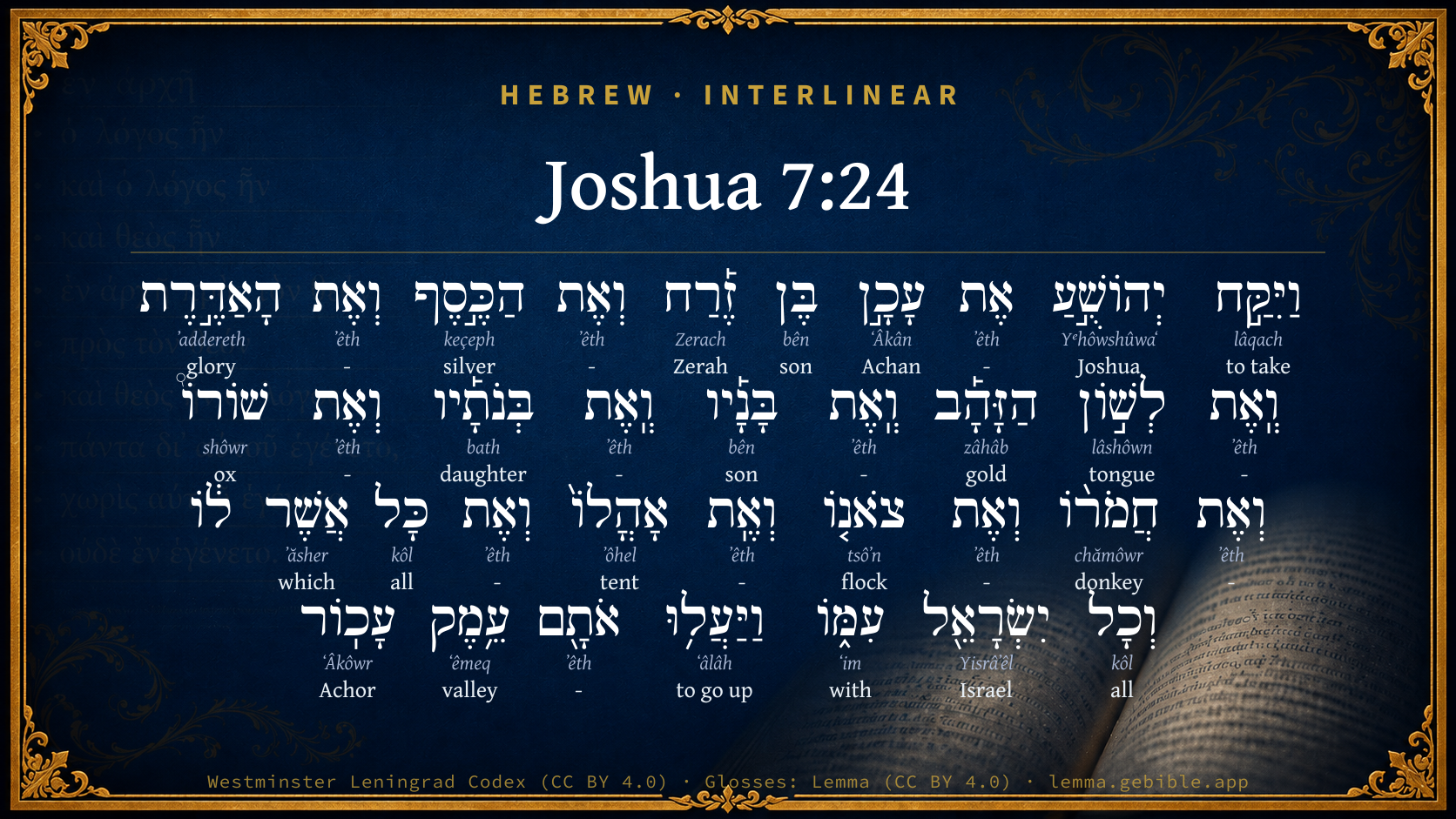
Hebrew (Westminster Leningrad Codex) Joshua 7:24 appears in the Hebrew Old Testament. The text above is from the Westminster Leningrad Codex. Each word links to its Strong’s number, a concise gloss, and parsing drawn from the Open Scriptures Hebrew Bible morphology. Click any word for its full Brown-Driver-Briggs (BDB) entry.
Download image
Cite this verse

Joshua 7:24 (World English Bible). Public Domain. Lemma interlinear Bible study tool, https://lemma.gebible.app/v/joshua/7/24.

Show BibTeX & RIS
BibTeX
RIS
English Translation
Joshua, and all Israel with him, took Achan the son of Zerah, and the silver, and the mantle, and the wedge of gold, and his sons, and his daughters, and his oxen, and his donkeys, and his sheep, and his tent, and all that he had: and they brought them up to the valley of Achor.
World English Bible · Public Domain
Highlights
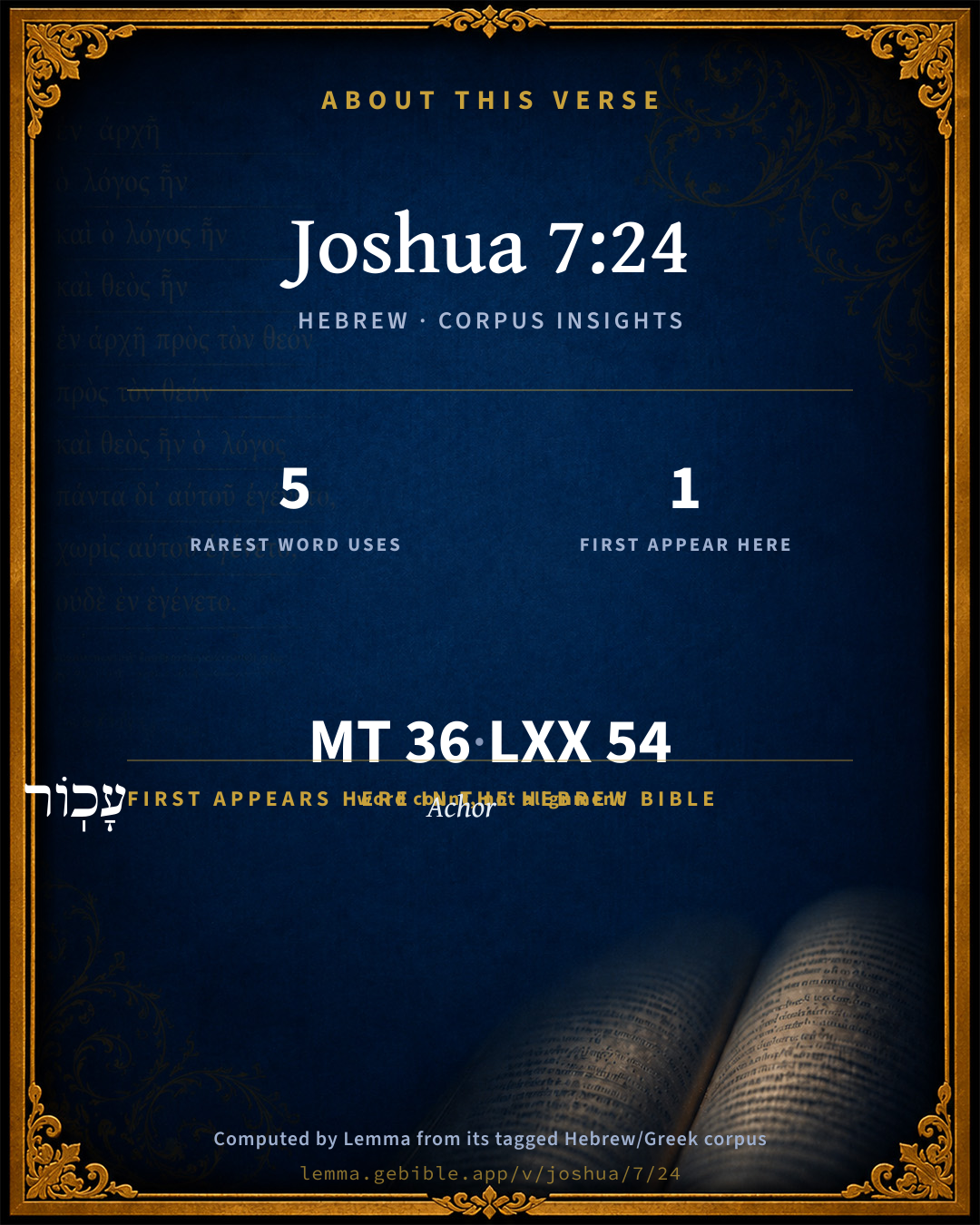
  • 1 first appearance in the Hebrew Bible
Full analysis ↓
Download a study sheet

One document with this verse’s original text, its word-by-word gloss line, the meaning frame, cross-references with their text, attributed commentary, and full source and license credits — printable, and it pastes into notes with its structure intact.

This verse Autodidact and up

Study sheet (.html) Plain text (.txt)

A passage Seminary Student

Up to 50 verses in one chapter. A passage sheet keeps up to 6 commentary sources and 12 cross-references per verse, in the order this page ranks them, and says so on the sheet whenever that leaves anything out. Ask for a single verse and you get the Autodidact verse sheet above.

Everything on this page stays free to read, with no account — the sheet is a download of what is already on screen, not access to it.

Want to remove ads? Support Godless Engineer
Compare translations 3

The same verse in 3 English versions, stacked beneath the original-language interlinear above. Click any original word for its lexicon entry.

Each is an independent rendering of the whole verse — the interlinear is not word-aligned to these translations.

Highlighted words mark where these versions differ — a whole-verse word diff, not a word-by-word alignment.

  • World English Bible Public Domain
    Joshua, and all Israel with him, took Achan the son of Zerah, and the silver, and the mantle, and the wedge of gold, and his sons, and his daughters, and his oxen, and his donkeys, and his sheep, and his tent, and all that he had: and they brought them up to the valley of Achor.
  • King James Version Public Domain
    And Joshua, and all Israel with him, took Achan the son of Zerah, and the silver, and the garment, and the wedge of gold, and his sons, and his daughters, and his oxen, and his asses, and his sheep, and his tent, and all that he had: and they brought them unto the valley of Achor.
  • unfoldingWord Literal Text CC BY-SA 4.0
    And Joshua took Achan, the son of Zerah, and the silver and the coat and the wedge of gold and his sons and his daughters and his ox and his donkey and his flock and his tent and all that to him, and all Israel with him. And they brought them up to the Valley of Achor.

unfoldingWord Literal Text — © unfoldingWord, licensed CC BY-SA 4.0. Word-aligned USFM3 via Door43 (git.door43.org/unfoldingWord/en_ult).

Versions to compare (up to 4)

3 of 4 selected

Show all 18 translations

Every available English version of this verse, each an independent rendering of the whole verse.

  • World English Bible Public Domain
    Joshua, and all Israel with him, took Achan the son of Zerah, and the silver, and the mantle, and the wedge of gold, and his sons, and his daughters, and his oxen, and his donkeys, and his sheep, and his tent, and all that he had: and they brought them up to the valley of Achor.
  • Berean Standard Bible Public Domain
    Then Joshua, together with all Israel, took Achan son of Zerah, the silver, the cloak, the bar of gold, his sons and daughters, his oxen and donkeys and sheep, his tent, and everything else he owned, and brought them to the Valley of Achor.
  • Majority Standard Bible Public Domain
    Then Joshua, together with all Israel, took Achan son of Zerah, the silver, the cloak, the bar of gold, his sons and daughters, his oxen and donkeys and sheep, his tent, and everything else he owned, and brought them to the Valley of Achor.
  • King James Version Public Domain
    And Joshua, and all Israel with him, took Achan the son of Zerah, and the silver, and the garment, and the wedge of gold, and his sons, and his daughters, and his oxen, and his asses, and his sheep, and his tent, and all that he had: and they brought them unto the valley of Achor.
  • American Standard Version (1901) Public Domain
    And Joshua, and all Israel with him, took Achan the son of Zerah, and the silver, and the mantle, and the wedge of gold, and his sons, and his daughters, and his oxen, and his asses, and his sheep, and his tent, and all that he had: and they brought them up unto the valley of Achor.
  • Revised Version (1885) Public Domain
    And Joshua, and all Israel with him, took Achan the son of Zerah, and the silver, and the mantle, and the wedge of gold, and his sons, and his daughters, and his oxen, and his asses, and his sheep, and his tent, and all that he had: and they brought them up unto the valley of Achor.
  • Geneva Bible (1599) Public Domain
    Then Ioshua tooke Achan the sonne of Zerah, and the siluer, and the garment and the wedge of golde and his sonnes, and his daughters, and his oxen, and his asses, and his sheepe, and his tent, and all that hee had: and all Israel with him brought them vnto the valley of Achor.
  • Douay-Rheims (1899) Public Domain
    Then Josue and all Israel with him took Achan the son of Zare, and the silver and the garments, and the golden rule, his sons also and his daughters, his oxen and asses and sheep, the tent also, and all the goods: and brought them to the valley of Achor:
  • Young's Literal Translation Public Domain
    And Joshua taketh Achan son of Zerah, and the silver, and the robe, and the wedge of gold, and his sons, and his daughters, and his ox, and his ass, and his flock, and his tent, and all that he hath, and all Israel with him, and they cause them to go up the valley of Achor.
  • Literal Standard Version CC BY-SA 4.0
    And Joshua takes Achan son of Zerah, and the silver, and the robe, and the wedge of gold, and his sons, and his daughters, and his ox, and his donkey, and his flock, and his tent, and all that he has, and all Israel with him, and they brought them up [to] the Valley of Achor.
  • Unlocked Literal Bible CC BY-SA 4.0
    Then Joshua, and all Israel with him, took Achan son of Zerah, and the silver, the coat, the bar of gold, his sons and daughters, his oxen, his donkeys, his sheep, his tent, and all that he had, and they brought them up to the Valley of Achor.
  • unfoldingWord Literal Text CC BY-SA 4.0
    And Joshua took Achan, the son of Zerah, and the silver and the coat and the wedge of gold and his sons and his daughters and his ox and his donkey and his flock and his tent and all that to him, and all Israel with him. And they brought them up to the Valley of Achor.
  • Darby Bible Public Domain
    Then Joshua, and all Israel with him, took Achan the son of Zerah, and the silver, and the mantle, and the bar of gold, and his sons, and his daughters, and his oxen, and his asses, and his sheep, and his tent, and all that he had; and they brought them up into the valley of Achor.
  • World Messianic Bible Public Domain
    Joshua, and all Israel with him, took Achan the son of Zerah, the silver, the robe, the wedge of gold, his sons, his daughters, his cattle, his donkeys, his sheep, his tent, and all that he had; and they brought them up to the valley of Achor.
  • Webster's Bible Public Domain
    And Joshua, and all Israel with him, took Achan the son of Zerah, and the silver, and the garment, and the wedge of gold, and his sons, and his daughters, and his oxen, and his asses, and his sheep, and his tent, and all that he had: and they brought them to the valley of Achor.
  • Free Bible Version CC BY-SA 4.0
    Then Joshua, with all the Israelites, took Achan, the son of Zerah, the silver, the cloak, and the bar of gold, together with his sons and daughters, his cattle, his donkeys, his sheep, and his tent—everything he had—and brought them to the Valley of Achor.
  • Bible in Basic English Public Domain
    Then Joshua and all Israel took Achan, the son of Zerah, and the silver and the robe and the mass of gold, and his sons and his daughters and his oxen and his asses and his sheep and his tent and everything he had; and they took them up into the valley of Achor.
  • JPS Tanakh (1917) Public Domain
    And Joshua, and all Israel with him, took Achan the son of Zerah, and the silver, and the mantle, and the wedge of gold, and his sons, and his daughters, and his oxen, and his asses, and his sheep, and his tent, and all that he had; and they brought them up unto the valley of Achor.

Literal Standard Version (2020), Covenant Press — licensed CC BY-SA 4.0. Text via the HelloAO Bible API (eBible.org). Unlocked Literal Bible (unfoldingWord) — licensed CC BY-SA 4.0. Text via the HelloAO Bible API (eBible.org). unfoldingWord Literal Text — © unfoldingWord, licensed CC BY-SA 4.0. Word-aligned USFM3 via Door43 (git.door43.org/unfoldingWord/en_ult). Free Bible Version, Dr. Jonathan Gallagher — licensed CC BY-SA 4.0. Text via the HelloAO Bible API (eBible.org).

Word by word

More ways to search: Search by grammar → Find every occurrence → Compare this word →

Practice this passage: Drill this verse → Learn its vocabulary →

עָכֽוֹר
ʻÂkôwr
H5911
“Achor”
Noun, Proper
Part of Speech
Noun
Type
Proper
Full BDB Definition

Origin: from H5916

TWOT: 1621a

trouble, disturbance - Achor - as the valley of trouble where Achan and his family were stoned
  1. וַיִּקַּ֣ח lâqach H3947 “and · to take” Conjunction + Verb, Qal, Sequential Imperfect, 3rd Person, Masculine, Singular
  2. יְהוֹשֻׁ֣עַ Yᵉhôwshûwaʻ H3091 “Joshua” Noun, Proper
  3. אֶת ʼêth H853 “-” Particle, Direct Object
  4. עָכָ֣ן ʻÂkân H5912 “Achan” Noun, Proper
  5. בֶּן bên H1121 “son of” Noun, Common, Masculine, Singular, Construct
  6. זֶ֡רַח Zerach H2226 “Zerah” Noun, Proper
  7. וְאֶת ʼêth H853 “and · -” Conjunction + Particle, Direct Object
  8. הַכֶּ֣סֶף keçeph H3701 “the · silver” Particle, Definite Article + Noun, Common, Masculine, Singular, Absolute
  9. וְאֶת ʼêth H853 “and · -” Conjunction + Particle, Direct Object
  10. הָאַדֶּ֣רֶת ʼaddereth H155 “the · glory” Particle, Definite Article + Noun, Common, Feminine, Singular, Absolute
  11. וְֽאֶת ʼêth H853 “and · -” Conjunction + Particle, Direct Object
  12. לְשׁ֣וֹן lâshôwn H3956 “tongue of” Noun, Common, Both, Singular, Construct
  13. הַזָּהָ֡ב zâhâb H2091 “the · gold” Particle, Definite Article + Noun, Common, Masculine, Singular, Absolute
  14. וְֽאֶת ʼêth H853 “and · -” Conjunction + Particle, Direct Object
  15. בָּנָ֡יו bên H1121 “sons · his” Noun, Common, Masculine, Plural, Construct + Suffix, Personal, 3rd Person, Masculine, Singular
  16. וְֽאֶת ʼêth H853 “and · -” Conjunction + Particle, Direct Object
  17. בְּנֹתָ֡יו bath H1323 “daughters · his” Noun, Common, Feminine, Plural, Construct + Suffix, Personal, 3rd Person, Masculine, Singular
  18. וְאֶת ʼêth H853 “and · -” Conjunction + Particle, Direct Object
  19. שׁוֹרוֹ֩ shôwr H7794 “ox · his” Noun, Common, Masculine, Singular, Construct + Suffix, Personal, 3rd Person, Masculine, Singular
  20. וְאֶת ʼêth H853 “and · -” Conjunction + Particle, Direct Object
  21. חֲמֹר֨וֹ chămôwr H2543 “donkey · his” Noun, Common, Both, Singular, Construct + Suffix, Personal, 3rd Person, Masculine, Singular
  22. וְאֶת ʼêth H853 “and · -” Conjunction + Particle, Direct Object
  23. צֹאנ֤וֹ tsôʼn H6629 “flock · his” Noun, Common, Both, Singular, Construct + Suffix, Personal, 3rd Person, Masculine, Singular
  24. וְאֶֽת ʼêth H853 “and · -” Conjunction + Particle, Direct Object
  25. אָהֳלוֹ֙ ʼôhel H168 “tent · his” Noun, Common, Masculine, Singular, Construct + Suffix, Personal, 3rd Person, Masculine, Singular
  26. וְאֶת ʼêth H853 “and · -” Conjunction + Particle, Direct Object
  27. כָּל kôl H3605 “all of” Noun, Common, Masculine, Singular, Construct
  28. אֲשֶׁר ʼăsher H834 “which” Particle, Relative
  29. וְכָל kôl H3605 “and · all of” Conjunction + Noun, Common, Masculine, Singular, Construct
  30. יִשְׂרָאֵ֖ל Yisrâʼêl H3478 “Israel” Noun, Proper
  31. עִמּ֑וֹ ʻim H5973 “with · him” Preposition + Suffix, Personal, 3rd Person, Masculine, Singular
  32. וַיַּעֲל֥וּ ʻâlâh H5927 “and · to go up” Conjunction + Verb, Hiphil, Sequential Imperfect, 3rd Person, Masculine, Plural
  33. אֹתָ֖ם ʼêth H853 “- · them” Particle, Direct Object + Suffix, Personal, 3rd Person, Masculine, Plural
  34. עֵ֥מֶק ʻêmeq H6010 “valley of” Noun, Common, Masculine, Singular, Construct

About this verse

These counts appear in no published source. They are computed here, from the morphology-tagged text and Lemma’s own curated glosses. What Lemma adds →

36
words
22
distinct lemmas
Historical
section

Notable vocabulary

The rarest word here is עָכֽוֹר Achor H5911 — appearing just 5 times in the whole Hebrew Bible.

First appearance in Scripture

This word makes its first canonical appearance in the Hebrew Bible here:

  • עָכֽוֹר Achor H5911

Shared distinctive vocabulary

עָכֽוֹר Achor H5911 occurs in 5 verses of the Hebrew Bible. Also found in:

Grammatical profile

  • 2 verbs
  • 19 nouns
  • 2 prepositions
  • 13 particles

Verb forms

  • וַיִּקַּ֣ח Qal · Sequential Imperfect
  • וַיַּעֲל֥וּ Hiphil · Sequential Imperfect

Repetition

Words recur within this verse — often emphatic in Hebrew:

Hebrew & Septuagint length

In English translation the verse runs 56 words from the Hebrew and 53 from the Septuagint (LXX English) — closely comparable.

A rough comparison of the two English renderings, which tokenize alike — not a word-level alignment.

Word counts can differ between the Hebrew and the Greek without any difference in meaning — e.g. the Hebrew direct-object marker אֵת has no separate Greek word, and Greek often adds the article ὁ.

In the original languages it is 36 Hebrew tokens and 54 Greek tokens — but the two are counted differently (Hebrew bundles its prefixes and suffixes into one token; the Greek is in lemma form), so that isn’t a like-for-like length.

Cross-references

16

Topical passages linked to Joshua 7:24 in the Treasury of Scripture Knowledge — connected by theme and wording, ordered by reader-vote popularity; previews shown in the World English Bible.

  • Proverbs 15:27 He who is greedy for gain troubles his own house, But he who hates bribes will live.
  • 1 Timothy 6:9–10 But those who are determined to be rich fall into a temptation and a snare and many foolish and harmful lusts, such as drown men in ruin and destruction.
  • Exodus 20:5 you shall not bow yourself down to them, nor serve them, for I, Yahweh your God, am a jealous God, visiting the iniquity of the fathers on the children, on the third and on the fourth generation of those who hate me,
  • Numbers 16:27–31 So they got them up from the tent of Korah, Dathan, and Abiram, on every side: and Dathan and Abiram came out, and stood at the door of their tents, and their wives, and their sons, and their little ones.
  • Joshua 7:26 They raised over him a great heap of stones, to this day; and Yahweh turned from the fierceness of his anger. Therefore the name of that place was called "The valley of Achor" to this day.
  • Joshua 15:7 and the border went up to Debir from the valley of Achor, and so northward, looking toward Gilgal, that is over against the ascent of Adummim, which is on the south side of the river; and the border passed along to the waters of En Shemesh, and the goings out of it were at En Rogel;
  • Isaiah 65:10 Sharon shall be a fold of flocks, and the valley of Achor a place for herds to lie down in, for my people who have sought me.
  • Hosea 2:15 I will give her vineyards from there, And the valley of Achor for a door of hope; And she will respond there, As in the days of her youth, And as in the day when she came up out of the land of Egypt.
  • Genesis 18:25 Be it far from you to do things like that, to kill the righteous with the wicked, that so the righteous should be as the wicked. May that be far from you. Shouldn't the Judge of all the earth do right?"
  • Joshua 6:18 But as for you, only keep yourselves from the devoted thing, lest when you have devoted it, you take of the devoted thing; so would you make the camp of Israel accursed, and trouble it.
  • Joshua 6:21 They utterly destroyed all that was in the city, both man and woman, both young and old, and ox, and sheep, and donkey, with the edge of the sword.
  • Joshua 7:1 But the children of Israel committed a trespass in the devoted thing; for Achan, the son of Carmi, the son of Zabdi, the son of Zerah, of the tribe of Judah, took of the devoted thing: and the anger of Yahweh was kindled against the children of Israel.
  • Job 20:15 He has swallowed down riches, and he shall vomit them up again. God will cast them out of his belly.
  • Job 20:23–28 When he is about to fill his belly, God will cast the fierceness of his wrath on him. It will rain on him while he is eating.
  • Ecclesiastes 5:13 There is a grievous evil which I have seen under the sun: wealth kept by its owner to his harm.
  • Ezekiel 22:13–14 Behold, therefore, I have struck my hand at your dishonest gain which you have made, and at your blood which has been in the midst of you.

Cross-references courtesy of OpenBible.info (CC BY 4.0).

Hebrew and Greek witnesses Masoretic Hebrew ↔ Greek Septuagint

The same verse in the two great witnesses to the Old Testament, shown verse-for-verse.

These are two independent witnesses, not word-aligned to each other, and the Septuagint is shown in lemma (dictionary) form.

Hebrew Joshua 7:24 Masoretic · Westminster Leningrad Codex

וַיִּקַּ֣ח יְהוֹשֻׁ֣עַ אֶת עָכָ֣ן בֶּן זֶ֡רַח וְאֶת הַכֶּ֣סֶף וְאֶת הָאַדֶּ֣רֶת וְֽאֶת לְשׁ֣וֹן הַזָּהָ֡ב וְֽאֶת בָּנָ֡יו וְֽאֶת בְּנֹתָ֡יו וְאֶת שׁוֹרוֹ֩ וְאֶת חֲמֹר֨וֹ וְאֶת צֹאנ֤וֹ וְאֶֽת אָהֳלוֹ֙ וְאֶת כָּל אֲשֶׁר ל֔וֹ וְכָל יִשְׂרָאֵ֖ל עִמּ֑וֹ וַיַּעֲל֥וּ אֹתָ֖ם עֵ֥מֶק עָכֽוֹר

Joshua, and all Israel with him, took Achan the son of Zerah, and the silver, and the mantle, and the wedge of gold, and his sons, and his daughters, and his oxen, and his donkeys, and his sheep, and his tent, and all that he had: and they brought them up to the valley of Achor.

World English Bible · Public Domain

Greek LXX Joshua 7:24 Septuagint · lemma form

καί λαμβάνω ἰησοῦς ὁ αχαρ υἱός ζαρα καί ἀναἄγω αὐτός εἰς φάραγξ αχωρ καί ὁ υἱός αὐτός καί ὁ θυγάτηρ αὐτός καί ὁ μόσχος αὐτός καί ὁ ὑποζύγιον αὐτός καί πᾶς ὁ πρόβατον αὐτός καί ὁ σκηνή αὐτός καί πᾶς ὁ ὑποἄρχω αὐτός καί πᾶς ὁ λαός μετά αὐτός καί ἀναἄγω αὐτός εἰς εμεκαχωρ

And Joshua took Achar the son of Zara, and brought him to the valley of Achor, and his sons, and his daughters, and his calves, and his asses, and all his sheep, and his tent, and all his property, and all the people were with him; and he brought them to Emec Achor.

LXX2012 (modern English Septuagint) · Public Domain

On this verse, Joseph Benson's Commentary discusses the Septuagint’s reading. Read the note in Commentary ↓

Hebrew: Westminster Leningrad Codex (CC BY 4.0). Greek: Septuagint (public domain); English from LXX2012 (modern English Septuagint) (Public Domain). How the Septuagint differs from the Hebrew →

Targum (Aramaic paraphrase)

1

The Targum is the ancient Jewish Aramaic paraphrase of the Hebrew Scriptures — an interpretive translation, not the Hebrew text itself. Onkelos (literal) and Pseudo-Jonathan (expansive) render the Torah, and Jonathan the Prophets. Coverage is partial: where no permissively-licensed English translation exists for a verse, only the Aramaic is shown. This is verse-level text, not a word-by-word alignment to the Hebrew.

  1. Targum Jonathan Prophets (Joshua–Malachi)
    וּדְבַר יְהוֹשֻׁעַ יַת עָכָן בַּר זֶרַח וְיַת כַּסְפָּא וְיַת אִצְטְלָא וְיַת לִישָׁנָא דְדַהֲבָא וּדְבַר יַת בְּנוֹהִי וְיַת בְּנָתֵיהּ וְיַת תּוֹרֵיהּ וְיַת חֲמָרֵיהּ וְיַת עָנֵיהּ וְיַת מַשְׁכְּנֵיהּ וְיַת כָּל דִילֵיהּ וְכָל יִשְׂרָאֵל עִמֵיהּ וְאַסִיקוּ יַתְהוֹן לְמֵישַׁר עָכוֹר:

    (no public-domain English translation for this verse)

    Targum Jonathan — Aramaic: “Mikraot Gedolot” (public domain). English: “Sefaria Community Translation” (CC0 1.0 (public-domain dedication)); “London "Chaldee Paraphrase," 1871” (public domain). Text via Sefaria.

Commentary

Notes on Joshua 7:24 from classic Christian and Jewish commentators (each source and its license shown beneath its notes). The classic Christian expositions comment on the surrounding passage and are grouped to its opening verse, so a note may address several verses; the Jewish commentaries on the Tanakh (Rashi and others) are per-verse, so they appear only where the commentator wrote on this verse.

Lemma curates 59 commentaries, every one of them public domain or Creative Commons licensed, each selected and text-cleaned for this edition rather than reprinted as found. About our sources →

Trapp's Complete Commentary

John Trapp

Jos 7:24 And Joshua, and all Israel with him, took Achan the son of Zerah, and the silver, and the garment, and the wedge of gold, and his sons, and his daughters, and his oxen, and his asses, and his sheep, and his tent, and all that he had: and they brought them unto the valley of Achor.

Ver. 24. Took Achan the son of Zerah.] Sed non nisi coactus, as that emperor said when he signed a writ of execution.

“ Ille dolet quoties cogitur esse ferox. ”

And his sons and daughters.] {See Trapp on "Jos 7:15"}

John Trapp, A Commentary or Exposition upon All the Books of the Old and New Testament (1647–1656) — public domain. Text from a community e-Sword module.

Joseph Benson's Commentary

Jos 7:24. And his sons and his daughters — It is very probable, Achan being an old man, that his children were grown up, and the things which he had stolen being buried in the midst of his tent, it is likely they were conscious of the fact, as the Jewish doctors affirm they were; and if they were not accomplices in his crime, yet, at least, they concealed it. This is said, on the supposition that they were stoned and burned. But, according to the LXX., who say nothing of his children, only he was put to death. And it is not necessary to understand even the Hebrew text as affirming any thing further. It says, all Israel stoned him with stones, without mentioning his family. And what it afterward adds, And burned them with fire after they had stoned them with stones, may be understood of the oxen, and asses, and sheep which belonged to Achan, and which God willed to be destroyed, together with his tent, and other effects, to excite a greater horror of his crime. For the brute creatures, though not capable of sin, nor of punishment, properly so called, yet, as they were made for man’s use, so they may be justly destroyed for man’s good. And as they are daily killed for our bodily food, it surely cannot seem strange that they should sometimes be killed for the instruction of our minds, that we may hereby learn the contagious nature of sin, which involves innocent creatures in its destructive effects.

Joseph Benson's Commentary on the Old and New Testaments (1811–1818) — public domain. Text from a community e-Sword module.

The Preacher's Complete Homiletical Commentary

Joseph S. Exell (gen. ed.)

CRITICAL NOTES.—

Jos_7:24. All that he had] In ordinary matters, touching the national welfare, the law provided that the children should not “be put to death for the fathers” (Deu_24:16), but this can hardly be used as an argument to prove that the family of Achan could not have been slain. (a) God might well reserve to Himself a right with which human discrimination and mercy were not to be trusted. (b) The awful solemnity with which the ban of devotement was regarded places it in an exceptional position. (c) This was a wrong deliberately done to God, as well as to the nation, and thus had features which might take it out of ordinary law. From Jos_7:15; Jos_7:25, with chap. Jos_22:20, it seems that all the family of Achan were put to death. They may have been privy to Achan’s sin, but this is not stated. Nothing is more solemn and emphatic throughout the whole chapter than the representative character given to the entire transaction. Even the camp of Israel was counted to be devoted till the iniquity was purged from out of their midst, and the thirty-six men who were slain in battle were as much made cherem as Achan himself.

Jos_7:26. The valley of Achor] This was doubtless so called from Achan’s sin and punishment. Is it not also probable that the man took his name from his sin, and thus is literally known by his deeds? It seems unlikely that Achan would have borne such a name before his transgression, nor would the coincidence, had he been known all his life as “the troubler,” be less singular. Instead of playing on the man’s original name, in Jos_7:25, does not Joshua bitterly and graphically so describe the act, that the term of description henceforth becomes the appellation by which the man is known in Israel, and thus also the name under which the historian refers back to so much of his life as is noticed? From Isa_65:10 and Hos_2:15, it is evident that this solemn judgment made a deep impression, and took a lasting hold of the national mind.

MAIN HOMILETICS OF THE PARAGRAPH.—Jos_7:24-26

THE PUNISHMENT OF SIN

When the Israelites were beaten back from Ai, and some of them slain, Joshua rent his clothes, and fell upon his face before the ark of the Lord, and fasted and prayed till the evening. He seems to have had some suspicion of evil among the people; his bearing and words have about them more of the tone of enquiry than of the spirit of complaint. Yet if Joshua suspected the people, he did not charge them with sin, or, apparently, so much as name it to them, until he knew from the lips of God that they were guilty. In the defeats and sufferings of men now, there may sometimes be cause to suspect that they are connected with transgression. But while defeat and suffering should lead us to examine ourselves, they should not lead us to make accusations against others. Let this course of treatment be recognised, and there would be no end to the recriminations of men against one another. It is related that Charles II. once said to John Milton, “Do not you think that your blindness is a judgment upon you for having written in defence of my father’s murder?” “Sir,” answered the poet, “it is true I have lost my eyes; but if all calamitous providences are to be considered as judgments, your majesty should remember that your royal father lost his head.” Every man who heedlessly charges a fellow-creature to find in his afflictions a proof of his wickedness, is open to some retort, although his family history may not furnish occasion for a rebuke so severe as that which was deservedly administered by Milton.

The affliction of Israel in the repulse at Ai is clearly seen, at this stage of the history, to stand connected with the transgression of Achan. The sin has been traced home to the sinner, and he who has brought shame and death upon others, is here called to suffer in like manner himself.

I. Achan’s punishment as the expression of a deep abhorrence of sin. Every man in the camp may not actually have felt this abhorrence. Where one man was found willing to commit such wickedness, it may be that there were others found to sympathise with it. By the severity and manner of punishing Achan, God would teach all the people that sin was to be hated exceedingly. Everything which the transgressor had stolen was to be destroyed; the Babylonish garment, and even the silver and gold, were to be utterly put away. All the goods which Achan had possessed before his theft were likewise to be devoted; the very tent which had sheltered him and his, and the oxen and asses and sheep which he had accumulated, were to be burnt with fire. Even his sons and his daughters seem to have been stoned with him, and then in like manner to have been consumed.

1. Iniquity is on no account to be passed over, but to be solemnly put away. Men may be forgiven, but sin never; that is to say, sin may be forgiven unto men, but it must never be forgiven in itself. Sin must be put away (a) irrespective of temporal loss, (b) irrespective of social affections, (c) and irrespective of pain in its severest forms.

2. The gains of iniquity are all to be esteemed unholy. To retain the things which Achan had stolen would be to retain the sin.

3. The gains of iniquity are not only accursed in themselves, they pollute also that which they touch. Zacchæus restored not only that in which he had wronged his fellows, but fourfold. Such a restitution acknowledges that all the estate of a man is corrupted by its corrupt part. “The eagle, in the fable, that stole flesh from the altar, brought a coal of fire with it, which burnt her nest (Hab_2:9-10; Zec_5:4). They lose their own that grasp at more than their own.” [Henry.] This expression of abhorrence against sin must not be held to relate merely to material possessions. The outward picture, given in such terrible colours to Israel, portrays also God’s law for the inner life. The sins of the heart are to be equally hated, and similarly put away. As Arnot has written, “To cover the sin which lies on the conscience with a layer of earnest efforts to do right will not take the sin away; the underlying sin will assimilate all the dead works that may be heaped upon it, and the result will be a greater mass of sin.

II. Achan’s punishment as a vindication of God’s law and covenant.

1. The punishment was to be carried out under the express provisions of the law. The law held (a) that Achan had made himself and his people to be devoted by taking of the devoted thing (chap. Jos_6:18; Deu_7:26); (b) that those who were thus sentenced to die should, as for other capital offences, be stoned (Deu_13:10); (c) that such individual persons as were put to death should be stoned without the camp (Lev_24:14); (d) that all the possessions of devoted persons, including the bodies of their slaughtered cattle, should be burnt, and that their own bodies should thus be consumed with their goods (Deu_13:15-17). Thus in the destruction of Achan the formalities of the law were emphatically carried into execution. God would have the Israelites trace Achan’s punishment, not to any sudden impulse of anger, but to that deliberate wrath against idolatry which stood as a perpetual record embodied in His covenant.

2. The punishment was to be carried out in the true spirit and interests of law. The one impression left on the thousands of Israel must have been that God would have His commandments honoured, no matter what the cost; yet the tenderness of Joshua and the merciful deliberateness of Jehovah must have assured the people that love to them, no less than hatred of sin, was moving slowly round and forward the wheels of this solemn judgment.

III. Achan’s punishment as a memorial for future guidance and help. Modern monuments are almost invariably, perhaps always, the records of triumphant personal career, or the memorials of national victory. Wisely or unwisely, men and nations now never celebrate their shame. History, more and more, gets to be one-sided; and while it presents much to animate, it has little to warn. The Israelites erected memorials of their great events, and not merely of their great victories. The passage of the Jordan has its cairn, but so has the grave of Achan; the stone of Ebenezer is set up between Mizpeh and Shen to tell the glory of victory, so also is the “very great heap of stones” piled over the body of Absalom, to perpetuate the shame of rebellion. This heap on the grave in the valley of Achor would be interpreted in Israel’s after history:—

1. As a memorial of solemn warning. Men should read there: “So speedily may sin be committed, so certainly does God behold it, so unerringly may it be revealed, and so bitter and shameful is its end.

2. As a memorial of national purification and reconciliation with God. If all Israel was held guilty in Achan’s sin, not less is all Israel held purified in his punishment; the purification is judicial, rather than personal—it lies immediately in the direction of justification, and only indirectly in that of sanctification; but the purification is held by God to be real, and not fictitious. “The Lord turned from the fierceness of His anger,” just as He had some time before declared that He would (Deu_13:17). Nor is this turning from anger any less real than the anger itself. As under the Divine anger Israel had been defeated, so under the Divine forgiveness Israel proceeded directly to victory. Sin had been put away in God’s method, and every person in the camp, not long since held to be “accursed,” or “devoted,” might now proceed to say, “There is therefore now no condemnation.” It should be noticed that in this revelation of God’s mind on the question of forgiving sin, there is absolutely no room for the commercial theory of an equivalent in atonement. All Israel was solemnly held to be worthy of death in Achan’s sin, but it cannot be pretended that the lives of Achan and his family were an equivalent for the lives of all the people. Atonement is here proclaimed to be, not so much value in blood for so much sin, but an adequate expression of a general abhorrence of sin so great that God who forgives, and man who is forgiven, alike are seen determining that, whatever the cost, sin shall not be tolerated even for a moment. Thus is law “magnified and made honourable;” thus, too, does Divine love proclaim itself in the one and only direction in which God could speak, or man be benefited—the direction of right, and truth, and purity.

3. As a memorial for guidance into hope in times of future darkness. The remembrance of Divine mercy which followed human penitence should long abide with Israel. In times when the national sin would lead to God’s departure, and to the consequent darkness of succeeding defeat, this vision of Achor should become a bow in the cloud, teaching the godly not to despair. It should be even more than this; it should become as the voice of one crying in the wilderness, Prepare ye the way of the Lord, and victory shall take the place of defeat; Repent ye, and the kingdom of heaven is at hand. Thus more than six centuries later the Lord stirred again the pulse of the national feeling by crying through Hosea, “I will give her vineyards from thence, and the valley of Achor for a door of hope.” Still later, Isaiah was taught to sing: “And Sharon shall be a fold of flocks, and the valley of Achor a place to lie down in, for my people that have sought me.” So careful is Divine mercy ever to leave a place to which sinful men may return in tears, and from which they may presently sing in joy, “We are saved by hope.” Let who will teach himself to despair, God ever leaves the fastenings of the “door of hope” well within reach of the hand of penitence.

OUTLINES AND COMMENTS ON THE VERSES

Jos_7:24-26.—THE DOOR OF HOPE.

Read in connection with Hosea’s obvious reference to this solemn incident, some such thoughts as the following might be expanded to profit:—

I. The unconscious beginnings of hope in the place of human sin and trouble.

II. The silent growth of hope under Divine chastisement.

III. Hope becoming visible through the putting away of iniquity.

IV. Hope fully revealed through words of Divine pardon and the witness of succeeding victories.

THE JUDGMENT IN THE VALLEY OF ACHOR

From the foregoing narrative we may learn:

I. The deceitfulness of sin.

II. The certainty of its exposure.

III. The awfulness of its reward.” [Bush.]

THE CERTAINTY AND SEVERITY OF SIN’S PUNISHMENT

“Punishment is the recoil of crime; and the strength of the back stroke is in proportion to the original blow.” [French.]

“The thought of the future punishment for the wicked which the Bible reveals is enough to make an earthquake of terror in every man’s soul. I do not accept the doctrine of eternal punishment because I delight in it. I would cast in doubts, if I could, till I had filled hell up to the brim; I would destroy all faith in it; but that would do me no good: I could not destroy the thing. Nor does it help me to take the word ‘everlasting,’ and put it into a rack, like an inquisitor, until I make it shriek out some other meaning: I cannot alter the stern fact.” [Beecher.]

“Day and night follow each other not more surely than punishment comes upon sin. Whether the sin be great or little, momentary or habitual, wilful or through infirmity, its own peculiar punishment seems, according to the law of nature, to follow, as far as our experience of that law carries us, sooner or later, lighter or heavier, as the case may be.… Who can pretend to estimate the effect of apparently slight transgression upon the spiritual state of any one of us? Who can pretend to say what the effect of it is in God’s sight? What do the angels think of it? What does our own guardian angel, if one be vouchsafed us, who has watched over us, and been intimate with us from our youth up; who joyed to see how we once grew together with God’s grace, but who now is in fear for us? Alas! what is the real condition of our heart itself? Dead bodies keep their warmth a short time; and who can tell but a soul so circumstanced may be severed from the grace of the ordinances, though he partakes them outwardly, and is but existing upon and exhausting the small treasure of strength and life which is laid up within him? Nay, we know that so it really is, if the sin be deliberate and wilful; for the word of Scripture assures us that such sin shuts us out from God’s presence, and obstructs the channels by which He gives us grace.” [J. H. Newman.]

“Let us suppose, that at the time when Britain was peopled by half-savage tribes, before the period of the Roman sway, some gifted seer among the Druids had engraven upon a rock a minute prediction of a portion of the future history of the island. Suppose he had declared that it should, ere long, be conquered by a warrior people from the south; that he should name the Cæsar himself, describe his eagle standard, and all the circumstances of the conquest. Suppose he should portray the Saxon invasion centuries after, the sevenfold division of the monarchy, the Danish inroad, the arrival and victory of the Normans. Our imagined prophet pauses here, or at whatever other precise period you please to suppose; and his next prediction, overleaping a vast undescribed interval, suddenly represents the England of the present day. Now conceive the forefathers of existing England to have studied this wondrous record, and to find, to their amazement, that every one of its predictions was accurately verified; that, as their generations succeeded, they but walked in the traces assigned for them by the prophetic inscription, and all it spoke progressively became fact. Can we suppose, that however far away in futurity was the one remaining event, and however impossible to them, at their early stage, to conceive the means by which all the present wonders of this mighty empire could ever be realised, they would permit themselves to doubt its absolute certainty after such overwhelming proofs of the supernatural powers of the seer who guaranteed it? Would they not shape their course as confidently in view of the unquestionable future as in reference to the unquestionable past? It should be thus with regard to the coming judgment.” [Archer Butler.]

THE SPIRIT IN WHICH SIN IS TO BE CONFRONTED

“Sin is never at a stay; if we do not retreat from it, we shall advance in it; and the further on we go, the more we have to come back.” [Barrow.]

“Use sin as it will use you; spare it not, for it will not spare you; it is your murderer, and the murderer of the world; use it therefore as a murderer should be used. Kill it before it kills you; and though it kill your bodies, it shall not be able to kill your souls; and though it bring you to the grave, as it did your Head, it shall not be able to keep you there. If the thoughts of death and the grave be not pleasant to you, hearken to every temptation to sin as you would hearken to a temptation to self-murder. You love not death; love not the cause of death.” [Baxter.]

The Preacher's Complete Homiletical Commentary (gen. ed. Joseph S. Exell; Funk & Wagnalls, c. 1892) — public domain (pre-1929). A full-Bible homiletical/sermon-outline anthology covering 65 of 66 books (2 John is absent from the source module). Text from a community e-Sword module.

Keil & Delitzsch

C. F. Keil & F. Delitzsch

Then Joshua and all Israel, i.e., the whole nation in the person of its heads or representatives, took Achan, together with the things which he had purloined, and his sons and daughters, his cattle, and his tent with all its furniture, and brought them into the valley of Achor, where they stoned them to death and then burned them, after Joshua had once more pronounced this sentence upon him in the place of judgment: "How hast thou troubled us" (עכר, as in Jos 6:18, to bring into trouble)! "The Lord will trouble thee this day." It by no means follows from the expression "stoned him" in Jos 7:25, that Achan only was stoned. The singular pronoun is used to designate Achan alone, as being the principal person concerned. But it is obvious enough that his children and cattle were stoned, from what follows in the very same verse: "They burned them (the persons stoned to death, and their things) with fire, and heaped up stones upon them." It is true that in Deu 24:16 the Mosaic law expressly forbids the putting to death of children for their fathers' sins; and many have imagined, therefore, that Achan's sons and daughters were simply taken into the valley to be spectators of the punishment inflicted upon the father, that it might be a warning to them. But for what reason, then, were Achan's cattle (oxen, sheep, and asses) taken out along with him? Certainly for no other purpose than to be stoned at the same time as he. The law in question only referred to the punishment of ordinary criminals, and therefore was not applicable at all to the present case, in which the punishment was commanded by the Lord himself. Achan had fallen under the ban by laying hands upon what had been banned, and consequently was exposed to the same punishment as a town that had fallen away to idolatry (Deu 13:16-17). The law of the ban was founded upon the assumption, that the conduct to be punished was not a crime of which the individual only was guilty, but one in which the whole family of the leading sinner, in fact everything connected with him, participated. Thus, in the case before us, the things themselves had been abstracted from the booty by Achan alone; but he had hidden them in his tent, buried them in the earth, which could hardly have been done so secretly that his sons and daughters knew nothing of it. By so doing he had made his family participators in his theft; they therefore fell under the ban along with him, together with their tent, their cattle, and the rest of their property, which were all involved in the consequences of his crime. The clause בּאבנים אתם ויּסקלוּ does not refer to the stoning as a capital punishment, but to the casting of stones upon the bodies after they were dead and had been burned, for the purpose of erecting a heap of stones upon them as a memorial of the disgrace (vid., Jos 8:29; Sa2 18:17). - In Jos 7:26, the account of the whole affair closes with these two remarks: (1) That after the punishment of the malefactor the Lord turned from the fierceness of His anger; and (2) That the valley in which Achan suffered his punishment received the name of Achor (troubling) with special reference to the fact that Joshua had described his punishment as well as Achan's sin as עכר (troubling: see Jos 7:25), and that it retained this name down to the writer's own time. With regard to the situation of this valley, it is evident from the word ויּעלוּ in Jos 7:24 that it was on higher ground than Gilgal and Jericho, probably in one of the ranges of hills that intersect the plain of Jericho, and from Jos 15:7, where the northern border of the possessions of Judah is said to have passed through this valley, that it is to be looked for to the south of Jericho. The only other places in which there is any allusion to this event are Hos 2:17 and Isa 65:10.

Keil & Delitzsch — Biblical Commentary on the Old Testament (1861–1891) — public domain (CC PDM 1.0). Text via the HelloAO Bible API. (Old Testament only.)

Tyndale Open Study Notes

Tyndale Open Resources

7:24 This careful listing of Achan’s relatives and possessions, including the stolen items, has the tone of a legal statement. Achan compromised all that pertained to him through his contact with the stolen items; thus, all had to be included in his judgment.

Tyndale Open Study Notes — © Tyndale Open Resources, licensed CC BY-SA 4.0. Text via the HelloAO Bible API.

Geneva Bible (1599)

Geneva Bible translators

Or, nephew.

Some read a plate: others, a rod, and some a tongue.

This judgment only appertaineth to God, and to whom he will reveal it, to man he had commanded not to punish the child for the father’s fault, Deut. 24:16.

Geneva Bible (1599) marginal notes — public domain. Text via Bolls.life.

Jamieson, Fausset & Brown

Robert Jamieson, A. R. Fausset & David Brown

Joshua, and all Israel with him, took Achan--He with his children and all his property, cattle as well as movables, were brought into one of the long broad ravines that open into the Ghor, and after being stoned to death (Num 15:30-35), his corpse, with all belonging to him, was consumed to ashes by fire. "All Israel" was present, not only as spectators, but active agents, as many as possible, in inflicting the punishment--thus testifying their abhorrence of the sacrilege, and their intense solicitude to regain the divine favor. As the divine law expressly forbade the children to be put to death for their father's sins (Deu 24:16), the conveyance of Achan's "sons and daughters" to the place of execution might be only as spectators, that they might take warning by the parental fate; or, if they shared his punishment (Jos 22:20), they had probably been accomplices in his crime, and, indeed, he could scarcely have dug a hole within his tent without his family being aware of it.

Jamieson, Fausset & Brown — Commentary Critical and Explanatory on the Whole Bible (1871) — public domain (CC PDM 1.0). Text via the HelloAO Bible API.

Adam Clarke's Commentary

Verse 24. Joshua - took Achan - and all that he had] He and his cattle and substance were brought to the valley to be consumed; his sons and his daughters, probably, to witness the judgments of God inflicted on their disobedient parent. See Jos 7:25.

Adam Clarke's Commentary on the Bible (1810–1826) — public domain. Text from a community e-Sword/MySword module.

John Calvin's Commentaries

24. And Joshua, and all Israel with him, etc Achan is led without the camp for two reasons; first, that it might not be tainted and polluted by the execution, (as God always required that some trace of humanity should remain, even in the infliction of legitimate punishments,) and secondly, that no defilement might remain among the people. It was customary to inflict punishment without the camp, that the people might have a greater abhorrence at the shedding of blood: but now, a rotten member is cut off from the body, and the camp is purified from pollution. We see that the example became memorable, as it gave its name to the spot.

If any one is disturbed and offended by the severity of the punishment, he must always be brought back to this point, that though our reason dissent from the judgments of God, we must check our presumption by the curb of a pious modesty and soberness, and not disapprove whatever does not please us. It seems harsh, nay, barbarous and inhuman, that young children, without fault, should be hurried off to cruel execution, to be stoned and burned. That dumb animals should be treated in the same manner is not so strange, as they were created for the sake of men, and thus deservedly follow the fate of their owners. Everything, therefore, which Achan possessed perished with him as an accessory, but still it seems a cruel vengeance to stone and burn children for the crime of their father; and here God publicly inflicts punishment on children for the sake of their parents, contrary to what he declares by Ezekiel. But how it is that he destroys no one who is innocent, and visits the sins of fathers upon children, I briefly explained when speaking of the common destruction of the city of Jericho, and the promiscuous slaughter of all ages. The infants and children who then perished by the sword we bewail as unworthily slain, as they had no apparent fault; but if we consider how much more deeply divine knowledge penetrates than human intellect can possibly do, we will rather acquiesce in his decree, than hurry ourselves to a precipice by giving way to presumption and extravagant pride. It was certainly not owing to reckless hatred that the sons of Achan were pitilessly slain. Not only were they the creatures of God’s hand, but circumcision, the infallible symbol of adoption, was engraved on their flesh; and yet he adjudges them to death. What here remains for us, but to acknowledge our weakness and submit to his incomprehensible counsel? It may be that death proved to them a medicine; but if they were reprobate, then condemnation could not be premature.

It may be added, that the life which God has given he may take away as often as pleases him, not more by disease than by any other mode. A wild beast seizes an infant and tears it to pieces; a serpent destroys another by its venomous bite; one falls into the water, another into the fire, a third is overlain by a nurse, a fourth is crushed by a falling stone; nay, some are not even permitted to open their eyes on the light. It is certain that none of all these deaths happens except by the will of God. But who will presume to call his procedure in this respect in question? Were any man so insane as to do so, what would it avail? We must hold, indeed, that none perish by his command but those whom he had doomed to death. From the enumeration of Achan’s oxen, asses, and sheep, we gather that he was sufficiently rich, and that therefore it was not poverty that urged him to the crime. It must therefore be regarded as a proof of his insatiable cupidity, that he coveted stolen articles, not for use but for luxury.

John Calvin's Commentaries (1540-1563) — public domain. Text from the Calvin Translation Society English edition (1840s-50s) via the Christian Classics Ethereal Library (ccel.org). Calvin's coverage is partial (roughly two-thirds of the Bible); uncommented books and verses are honest gaps, never fabricated. The 19th-century editor's footnotes and remarks are omitted so the notes are faithfully Calvin's own voice.

Ellicott's Commentary for English Readers

(24) And his sons, and his daughters, and his oxen, and his asses, and his sheep, and his tent, and all that he had.—All were evidently destroyed together (comp. Jos_22:20). For any other sin but this, Achan must have suffered alone. “The children shall not be put to death for the fathers.” But in this case, warning had been given that the man who took of the accursed thing, or chêrern, would be an accursed thing like it, if he brought it into his house (Deu_7:26), and would make the camp of Israel chêrem also (Jos_6:18), and thus Achan’s whole establishment was destroyed as though it had become part of Jericho. It is not necessary to assert that the family of Achan were accomplices. His cattle were not so, and yet they were destroyed. See also 1Ch_2:7, where his line is not continued. Observe also the incidental reference to the fact in Jos_22:20, “That man perished not alone in his iniquity.” The severity of the punishment must be estimated by the relation of Achan’s crime to the whole plan of the conquest of Canaan. If the destruction of the Canaanites was indeed the execution of the Divine vengeance, it must be kept entirely clear of all baser motives, lest men should say that Jehovah gave His people licence to deal with the Canaanites as it seemed best for themselves. The punishment of Saul for taking the spoil of Amalek (1 Samuel 15), and the repeated statement of the Book of Esther that the Jews who stood for their lives and slew their enemies, the supporters of Haman’s project, laid not their hands on the prey, are further illustrations of the same principle. The gratification of human passions may not be mingled with the execution of the vengeance of God. (See Est_8:11; Est_9:10; Est_9:15-16.)

The valley of Achor.—In 1Ch_2:7, Achan himself is designated Achar (one among several examples of the alteration of a name to suit some circumstance of a person’s history. Compare Bathsheba for Bathshua, Shallum for Jehoiachin, Ishbosheth for Eshbaal, &c.). There is a double play upon the names in Hos_2:15 : “I will give her her vineyards (Carmêha. Compare Carmi, “my vineyard”) from thence, and the valley of trouble (Achor) for a door of hope.” The valley of Achor is a pass leading from Gilgal towards the centre of the country, or, as it might be represented, from Jericho towards Jerusalem—i.e., from the city of destruction to the city of God. So it was to Israel in the conquest. The future state of Achan is in the hands of the Judge who “doeth judgment.” No mercy to his crime on earth was possible. It would have been injustice to all mankind.

A Bible Commentary for English Readers, edited by Charles John Ellicott (1878–1897) — public domain. Text from a community e-Sword module.

The Cambridge Bible for Schools and Colleges

gen. ed. J. J. S. Perowne

24. son of Zerah] Strictly, his great-grandson.

and his sons, and his daughters] Some have thought they were brought to the valley merely as spectators, that they might have a terrible warning: others think they must have been accomplices in his sin, and as he by his own act had placed himself under a ban (Jos_6:18), so all that he had was treated as coming under the same law. (Comp. Deu_13:15-17.)

the valley] Henceforth known by the name of “Achor,” i.e. causing trouble and sorrow. Comp. Jos_15:7, “And the border went up toward Debir from the valley of Achor;” Isa_65:10, “And Sharon shall be a fold of flocks, and the valley of Achor a place for the herds to lie down in;” Hos_2:15, “And I will give her her vineyards from thence, and the valley of Achor for a door of hope.” The exact site of the valley is unknown, but it was somewhere on the northern border of the tribe of Judah, among the ridges to the south of Jericho.

The Cambridge Bible for Schools and Colleges (gen. ed. J. J. S. Perowne; Cambridge University Press, 1878–1918) — public domain. Text from a community e-Sword module.

John Gill's Exposition

And Joshua, and all Israel with him, took Achan the son of Zerah,.... Joshua and all Israel are mentioned, to show the perfect agreement between Joshua and the heads of the people in this affair of Achan, and in the nature and manner of his punishment:

and the silver, and the garment, and the wedge of gold; which, though devoted to sacred uses, yet having been converted to another's use, and made his property, was not to be employed in the service of the sanctuary, but to be burnt with him:

and his sons and his daughters; who, according to Ben Gersom, Abarbinel, and Abendana, were not brought forth to be put to death, only to be spectators of the sentence of judgment, and the execution of it, that they might keep themselves from such evil things; though, as Achan may be supposed to be a man in years, being but the fourth generation from Judah; his sons and daughters were grown up in all probability, and might be accessories in this affair; and so, as some Jewish writers remark, were worthy of death, because they saw and knew what was done, and were silent and did not declare it (p); and it seems by what is said, Jos 22:20; that they died as well as Achan, since it is there said, "that man perished not alone in his iniquity"; though it may be interpreted of his substance, his cattle, perishing with him; and indeed from Jos 7:25; it seems as if none were stoned but himself, that is, of his family; no mention is made of his wife, who, if he had any, as Kimchi observes, knew nothing of the matter, it being hid from her:

and his oxen, and his asses, and his sheep; in which lay his substance, as that of the eastern people generally did:

and his tent, and all that he had; the tent he and his family dwelt in, with all the household goods in it:

and they brought them unto the valley of Achor; so called by anticipation here; for it had its name from the trouble Achan gave to Israel, and with which he was troubled himself: some render it, "they brought them up" (q); and as it is more proper to descend into a valley the to go up to it, it is thought there was a mountain between the camp of Israel and this valley, so Kimchi and Ben Melech; see Hos 2:15.

(p) Pirke Eliezer, ut supra (c. 38.) Kimchi in loc. (q) "ascendere fecerunt", Pagninus, Montanus, Drusius, Vatablus.

John Gill's Exposition of the Whole Bible (1746–1763) — public domain (CC PDM 1.0). Text via the HelloAO Bible API.

Albert Barnes' Notes on the Bible

The sin had been national (Jos 7:1 note), and accordingly the expiation of it was no less so. The whole nation, no doubt through its usual representatives, took part in executing the sentence. Achan had fallen by his own act under the ban Jos 6:18, and consequently he and his were treated as were communities thus devoted Deu 13:15-17. It would appear too that Achan’s family must have been accomplices in his sin; for the stolen spoil could hardly have been concealed in his tent without their being privy thereto.

Albert Barnes' Notes on the Bible (1834–1885) — public domain. Text from a community e-Sword/MySword module.

Haydock's Catholic Bible Commentary

His sons, &c. Probably conscious to, or accomplices of the crime of their father, (Challoner) as he could hardly have concealed these things in the midst of his tent without their knowledge. (Menochius) --- But granting, with St. Augustine (q. 8,) that they were innocent of this crime, God, who is the sovereign arbiter of life and death, might order them out of the world, on this occasion, without injustice.

George Leo Haydock (1774–1849), Haydock's Catholic Family Bible and Commentary, 1859 edition — public domain. Excludes Psalms (Douay-Rheims chapter numbering differs from Protestant) and Deuterocanonical books (Catholic canon only).

Matthew Poole's English Annotations

His sons and his daughters; but this seems hard and unjust, and therefore forbidden by God himself, Deu 24:16.

Answ. 1. That law was given to men, not to God, who certainly hath a more absolute right and sovereignty over men than one man hath over another.

2. Their death was a debt they owed to nature and to their own sins, which debt God may require when he pleaseth; and he could not take it in more honourable and excellent circumstances than these, that the death of a very few in the beginning of a new empire, and of their settlement in the land might be useful to prevent the death of many thousands, who took warning by this dreadful example, whom, if the fear of God did not, yet the love of their own and of their dear children’s lives would, restrain from such dangerous and pernicious practices.

3. It is very probable they were conscious of the fact, as the Jewish doctors affirm. If it be pretended that some of them were infants, the text doth not say so, but only calls them sons and daughters. And considering that Achan was an old man, as is most probable, because he was the fifth person from Judah, (of which See Poole "Jos 7:1",) it seems most likely that the children were grown up, and so capable of knowing, and concealing or discovering this fact. Nor doth it follow that they were not guilty because it is not said so; for it is apparent that many circumstances are omitted in divers historical relations in Scripture, which sometimes are supplied in other places.

His oxen, and his asses, and his sheep; which, though not capable of sin, nor of punishment properly so called, yet, as they were made for man’s use, so they are rightly destroyed for man’s good; and being daily killed for our bodily food, it cannot seem strange to kill them for the instruction of our minds, that hereby we might learn the detestable and contagious nature of sin, which involves innocent creatures in its plagues; and how much sorer punishments are reserved for man, who having a law given to him, and that excellent gift of reason and will to restrain him from the transgressions of it, his guilt must needs be unspeakably greater, and therefore his sufferings more severe and terrible. Further, by this enumeration it appears that he had no colour of necessity to induce him to this fact, but was wholly inexcusable.

Matthew Poole's English Annotations on the Holy Bible (1683–1685) — public domain. Text from a community e-Sword/MySword module.

Whedon's Commentary on the Bible

Daniel D. Whedon

24. Joshua, and all Israel with him — The objection of Colenso, that all Israel was a body too numerous to perform many acts recorded of them, is sufficiently met by the remark that the heads of the tribes and clans are constructively “all Israel.”

And his sons, and his daughters — These were taken, some say, not to be executed with their father, but to be witnesses of his execution. [But this is inadmissible. Were his oxen, and his asses, and his sheep, and his tent, taken to witness his execution? The narrative clearly conveys the impression that all Achan’s family and possessions perished with him. Compare also Jos_22:20. Why Achan’s family and property should all be destroyed for his sin is a question to be answered by reference to that archaic jurisprudence which dealt with families rather than with individuals. In the Patriarchal system of government the father was absolute lord and representative of the entire household. His children and possessions were identified with him in praise or in punishment. And this judicial idea of Patriarchism was also carried over into Mosaism. The family was sometimes punished rather than the individual, the latter being utterly absorbed in the former, and such family punishment sometimes continued through many generations. Exo_20:5; Exo_34:7; Num_14:18. Hence the punishment of Achan’s children for their father’s sin must not be judged by the standards of an age which has not “occasion any more to use the ancient proverb, The fathers have eaten sour grapes, and the children’s teeth are set on edge.” Eze_18:2-3.]

Valley of Achor — So called by prolepsis, or anticipation, (see Jos_7:26, note,) for the punishment of Achan gave it its name. That this valley was among the hills is evident from the Hebrew verb, they caused them to ascend into the valley of Achor. But its location is now a matter of conjecture. Jerome locates it to the north of Jericho.

Daniel D. Whedon (gen. ed.), Commentary on the Old and New Testaments (1874–1909) — public domain. Text from a community e-Sword module.

The Pulpit Commentary

Took Achan, the son of Zerah. Great-grandson in reality. (see ver. 1; cf. 1Ki_15:2, 1Ki_15:10) And his sons and his daughters (see note, ver. 15). Brought them. Hebrew, "brought them up. The valley of Achor was above Jericho, whether higher up the valley or on higher ground is not known. The valley of Achor. (see Jos_15:7 Isa_65:10 Hos_2:15) Achor means trouble. (see note on Jos_6:18)

The Pulpit Commentary (1880–1919), ed. H.D.M. Spence-Jones & Joseph S. Exell — public domain. Text from a community e-Sword module.

John Wesley's Explanatory Notes

His sons, and his daughters - Their death was a debt they owed to their own sins, which debt God may require when he pleaseth; and he could not take it in more honourable circumstances than these, that the death of a very few in the beginning of a new empire, and of their settlement in the land, might be useful to prevent the deaths of many thousands who took warning by this dreadful example, whom, if the fear of God did not, yet the love of their own, and of their dear children's lives would restrain from such pernicious practices. And it is very probable they were conscious of the fact, as the Jewish doctors affirm. If it be pretended that some of them were infants; the text doth not say so, but only calls them sons and daughters. And considering that Achan was an old man, as is most probable, because he was the fifth person from Judah, it seems most likely, that the children were grown up, and so capable of knowing, and concealing, or discovering this fact. His oxen, and his asses, and his sheep - Which, though not capable of sin, nor of punishment, properly so called, yet as they were made for man's use, so they are rightly destroyed for man's good; and being daily killed for our bodily food, it cannot seem strange to kill them for the instruction of our minds, that hereby we might learn the contagious nature of sin, which involves innocent creatures in its plagues; and how much sorer punishments are reserved for man, who having a law given to him, and that excellent gift of reason and will to restrain him from the transgressions of it, his guilt must needs be unspeakably greater, and therefore his sufferings more severe and terrible. Farther, by this enumeration it appears, that he had no colour of necessity to induce him to this fact.

John Wesley, Explanatory Notes Upon the Whole Bible (1754–1765) — public domain. Text via the GEBible commentary corpus.

unfoldingWord translationNotes

Door43 World Missions Community

the Valley of Achor

The name means "Valley of Trouble," but it is best to translate Achor the way it sounds. (See: How to Translate Names)

translationWords

Joshua

Israel

cow

donkey

ewe

tent

unfoldingWord translationNotes — © Distant Shores Media and the Door43 World Missions Community, licensed CC BY-SA 4.0. Source: git.door43.org/Door43/en_tn.

Rashi

Rabbi Shlomo Yitzchaki (Rashi)

His sons etc., and all of Yisroel. To witness his downfall, and to be forewarned against doing as he did.

His ox(en) and his mule(s) to destroy them, as it was said, ‘And he who is convicted by [his guilt in taking of] the sacred things, shall be burned with fire, he and all that he possesses.’

Rashi on the Tanakh — English translations: “The Judaica Press complete Tanach with Rashi, translated by A. J. Rosenberg” (CC BY 4.0); “Pentateuch with Rashi's commentary by M. Rosenbaum and A.M. Silbermann, 1929-1934” (public domain); “The Metsudah Tanach series, Lakewood, N.J” (CC BY 4.0); and “The Book of Joshua, Metsudah Publications, 1997” (CC BY 4.0). Text via Sefaria.

Lesson kit

Teaching starters — assembled from the data on this page, not authored interpretation. Every prompt links to the verse data it draws on. Edit before teaching.

Joshua, in the Historical, opens this verse with 36 words (22 distinct Hebrew lemmas). Its most distinctive word is ʻÂkôwr (“Achor”). A historical commentator’s framing appears above. Read the whole chapter for the surrounding context.

Discussion questions

  1. The word ʻÂkôwr carries the sense “Achor.” How does it shape the verse?
  2. This is the first place “Achor” appears in Scripture (first appears here). What does its debut here establish?
  3. How does Joshua 7:26, which shares the word «Achor», read alongside this verse?
  4. What does the repetition of “son” (2× in this one verse) do in this verse?
  5. These translations render this verse differently; the difference is in the English rendering, not the original. What questions does that raise?
  6. «וַיִּקַּ֣ח» is a Qal Sequential Imperfect verb. How does that grammatical form shape the action described?
  7. Compare how Trapp's Complete Commentary and Joseph Benson's Commentary read this verse. Where do they agree or differ?

Things to notice

Reading settings

Reading text

Shown beneath each verse's original-language words.

Old Testament
Old Testament edition

Read the OT as the Masoretic Hebrew (MT) or the Greek Septuagint (LXX).

English shown for the Greek Septuagint (in the Hebrew ↔ Greek comparison).

Comparing translations? Open the Compare panel on any verse page to stack up to four side by side.