
Exodus 10:9

Hebrew (Westminster Leningrad Codex) Exodus 10:9 appears in the Hebrew Old Testament. The text above is from the Westminster Leningrad Codex. Each word links to its Strong’s number, a concise gloss, and parsing drawn from the Open Scriptures Hebrew Bible morphology. Click any word for its full Brown-Driver-Briggs (BDB) entry.
Download image
Cite this verse

Exodus 10:9 (World English Bible). Public Domain. Lemma interlinear Bible study tool, https://lemma.gebible.app/v/exodus/10/9.

Show BibTeX & RIS
BibTeX
RIS
English Translation
Moses said, "We will go with our young and with our old; with our sons and with our daughters, with our flocks and with our herds will we go; for we must hold a feast to Yahweh."
World English Bible · Public Domain
Highlights
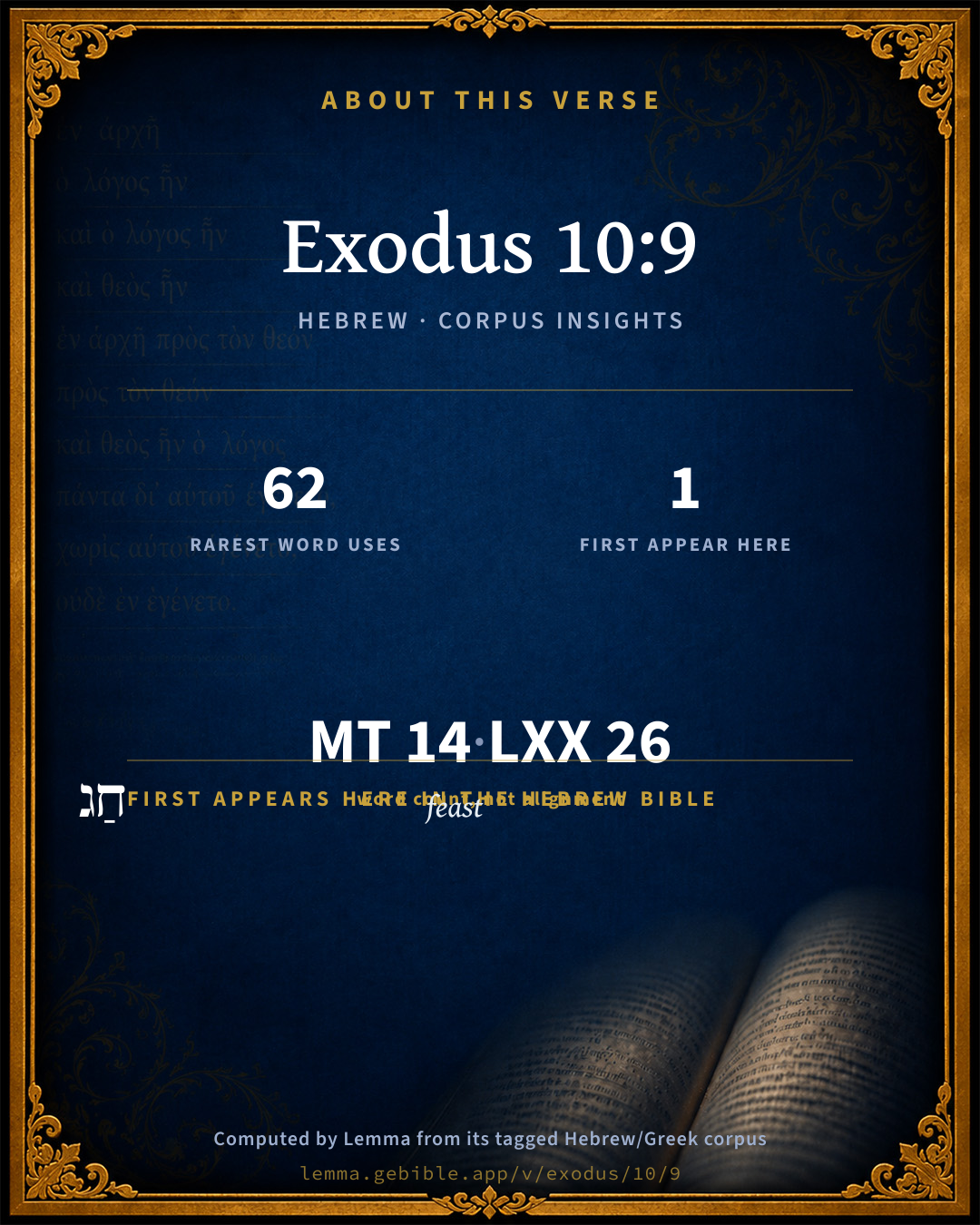
  • 1 first appearance in the Hebrew Bible
Full analysis ↓
Download a study sheet

One document with this verse’s original text, its word-by-word gloss line, the meaning frame, cross-references with their text, attributed commentary, and full source and license credits — printable, and it pastes into notes with its structure intact.

This verse Autodidact and up

Study sheet (.html) Plain text (.txt)

A passage Seminary Student

Up to 50 verses in one chapter. A passage sheet keeps up to 6 commentary sources and 12 cross-references per verse, in the order this page ranks them, and says so on the sheet whenever that leaves anything out. Ask for a single verse and you get the Autodidact verse sheet above.

Everything on this page stays free to read, with no account — the sheet is a download of what is already on screen, not access to it.

Want to remove ads? Support Godless Engineer
Compare translations 3

The same verse in 3 English versions, stacked beneath the original-language interlinear above. Click any original word for its lexicon entry.

Each is an independent rendering of the whole verse — the interlinear is not word-aligned to these translations.

Highlighted words mark where these versions differ — a whole-verse word diff, not a word-by-word alignment.

  • World English Bible Public Domain
    Moses said, "We will go with our young and with our old; with our sons and with our daughters, with our flocks and with our herds will we go; for we must hold a feast to Yahweh."
  • King James Version Public Domain
    And Moses said, We will go with our young and with our old, with our sons and with our daughters, with our flocks and with our herds will we go; for we must hold a feast unto the LORD.
  • unfoldingWord Literal Text CC BY-SA 4.0
    And Moses said, “We shall go with our young and with our old. We shall go with our sons and with our daughters, with our flocks and our herds, because the festival of Yahweh is for us.”

unfoldingWord Literal Text — © unfoldingWord, licensed CC BY-SA 4.0. Word-aligned USFM3 via Door43 (git.door43.org/unfoldingWord/en_ult).

Versions to compare (up to 4)

3 of 4 selected

Show all 18 translations

Every available English version of this verse, each an independent rendering of the whole verse.

  • World English Bible Public Domain
    Moses said, "We will go with our young and with our old; with our sons and with our daughters, with our flocks and with our herds will we go; for we must hold a feast to Yahweh."
  • Berean Standard Bible Public Domain
    “We will go with our young and old,” Moses replied. “We will go with our sons and daughters, and with our flocks and herds, for we must hold a feast to the LORD.”
  • Majority Standard Bible Public Domain
    “We will go with our young and old,” Moses replied. “We will go with our sons and daughters, and with our flocks and herds, for we must hold a feast to the LORD.”
  • King James Version Public Domain
    And Moses said, We will go with our young and with our old, with our sons and with our daughters, with our flocks and with our herds will we go; for we must hold a feast unto the LORD.
  • American Standard Version (1901) Public Domain
    And Moses said, We will go with our young and with our old; with our sons and with our daughters, with our flocks and with our herds will we go; for we must hold a feast unto Jehovah.
  • Revised Version (1885) Public Domain
    And Moses said, We will go with our young and with our old, with our sons and with our daughters, with our flocks and with our herds will we go; for we must hold a feast unto the LORD.
  • Geneva Bible (1599) Public Domain
    And Moses answered, We will go with our yong and with our olde, with our sonnes and with our daughters, with our sheepe and with our cattell will we goe: for we must celebrate a feast vnto the Lord.
  • Douay-Rheims (1899) Public Domain
    Moses said: We will go with our young and old, with our sons and daughters, with our sheep and herds: for it is the solemnity of the Lord our God.
  • Young's Literal Translation Public Domain
    And Moses saith, `With our young ones, and with our aged ones, we go, with our sons, and with our daughters, with our flock, and our herd, we go, for we have a festival to Jehovah.'
  • Literal Standard Version CC BY-SA 4.0
    And Moses says, “With our young ones, and with our aged ones, we go, with our sons, and with our daughters, with our flock, and our herd, we go, for we have a festival to YHWH.”
  • Unlocked Literal Bible CC BY-SA 4.0
    Moses said, “We will go with our young and with our old, with our sons and our daughters. We will go with our flocks and herds, for we must hold a festival for Yahweh.”
  • unfoldingWord Literal Text CC BY-SA 4.0
    And Moses said, “We shall go with our young and with our old. We shall go with our sons and with our daughters, with our flocks and our herds, because the festival of Yahweh is for us.”
  • Darby Bible Public Domain
    And Moses said, We will go with our young and with our old, with our sons and with our daughters; with our flocks and with our herds will we go; for we have a feast of Jehovah.
  • World Messianic Bible Public Domain
    Moses said, “We will go with our young and with our old. We will go with our sons and with our daughters, with our flocks and with our herds; for we must hold a feast to the LORD.”
  • Webster's Bible Public Domain
    And Moses said, We will go with our young and with our old, with our sons and with our daughters, with our flocks and with our herds will we go; for we must hold a feast to the LORD.
  • Free Bible Version CC BY-SA 4.0
    “We will all go,” Moses replied. “Young and old, sons and daughters—and we'll take our flocks and herds with us, for we're going to have a religious festival for the Lord.”
  • Bible in Basic English Public Domain
    And Moses said, We will go with our young and our old, with our sons and our daughters, with our flocks and our herds; for we are to keep a feast to the Lord.
  • JPS Tanakh (1917) Public Domain
    And Moses said: 'We will go with our young and with our old, with our sons and with our daughters, with our flocks and with our herds we will go; for we must hold a feast unto the LORD.'

Literal Standard Version (2020), Covenant Press — licensed CC BY-SA 4.0. Text via the HelloAO Bible API (eBible.org). Unlocked Literal Bible (unfoldingWord) — licensed CC BY-SA 4.0. Text via the HelloAO Bible API (eBible.org). unfoldingWord Literal Text — © unfoldingWord, licensed CC BY-SA 4.0. Word-aligned USFM3 via Door43 (git.door43.org/unfoldingWord/en_ult). Free Bible Version, Dr. Jonathan Gallagher — licensed CC BY-SA 4.0. Text via the HelloAO Bible API (eBible.org).

Word by word

More ways to search: Search by grammar → Find every occurrence → Compare this word →

Practice this passage: Drill this verse → Learn its vocabulary →

חַג
chag
H2282
“feast of”
Noun, Common, Masculine, Singular, Construct
Part of Speech
Noun
Type
Common
Gender
Masculine
Number
Singular
State
Construct
Full BDB Definition

Origin: from H2287

TWOT: 602a

festival, feast, festival-gathering, pilgrim-feast - feast - festival sacrifice
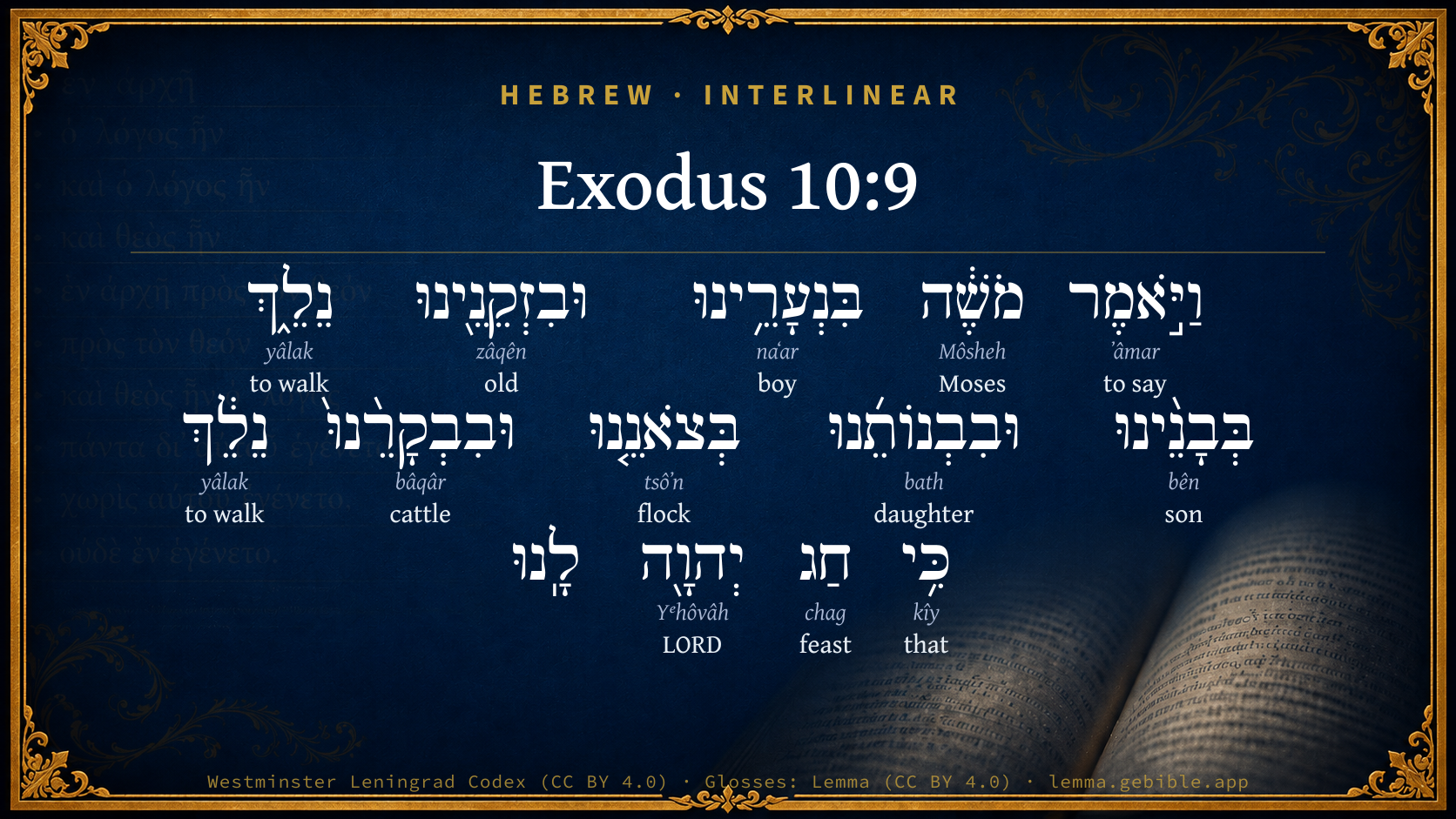
  1. וַיֹּ֣אמֶר ʼâmar H559 “and · to say” Conjunction + Verb, Qal, Sequential Imperfect, 3rd Person, Masculine, Singular
  2. מֹשֶׁ֔ה Môsheh H4872 “Moses” Noun, Proper
  3. בִּנְעָרֵ֥ינוּ naʻar H5288 “in/at · boys · our” Preposition + Noun, Common, Masculine, Plural, Construct + Suffix, Personal, 1st Person, Common, Plural
  4. וּבִזְקֵנֵ֖ינוּ zâqên H2205 “and · in/at · old · our” Conjunction + Preposition + Adjective, Adjective, Masculine, Plural, Construct + Suffix, Personal, 1st Person, Common, Plural
  5. נֵלֵ֑ךְ yâlak H3212 “to walk” Verb, Qal, Imperfect, 1st Person, Common, Plural
  6. בְּבָנֵ֨ינוּ bên H1121 “in/at · sons · our” Preposition + Noun, Common, Masculine, Plural, Construct + Suffix, Personal, 1st Person, Common, Plural
  7. וּבִבְנוֹתֵ֜נוּ bath H1323 “and · in/at · daughters · our” Conjunction + Preposition + Noun, Common, Feminine, Plural, Construct + Suffix, Personal, 1st Person, Common, Plural
  8. בְּצֹאנֵ֤נוּ tsôʼn H6629 “in/at · flock · our” Preposition + Noun, Common, Both, Singular, Construct + Suffix, Personal, 1st Person, Common, Plural
  9. וּבִבְקָרֵ֨נוּ֙ bâqâr H1241 “and · in/at · cattle · our” Conjunction + Preposition + Noun, Common, Both, Singular, Construct + Suffix, Personal, 1st Person, Common, Plural
  10. נֵלֵ֔ךְ yâlak H3212 “to walk” Verb, Qal, Imperfect, 1st Person, Common, Plural
  11. כִּ֥י kîy H3588 “that” Conjunction
  12. יְהוָ֖ה Yᵉhôvâh H3068 “LORD” Noun, Proper

About this verse

These counts appear in no published source. They are computed here, from the morphology-tagged text and Lemma’s own curated glosses. What Lemma adds →

14
words
12
distinct lemmas
Pentateuch
section

First appearance in Scripture

This word makes its first canonical appearance in the Hebrew Bible here:

Grammatical profile

  • 3 verbs
  • 8 nouns
  • 1 adjective
  • 1 preposition
  • 1 conjunction

Verb forms

  • וַיֹּ֣אמֶר Qal · Sequential Imperfect
  • נֵלֵ֑ךְ Qal · Imperfect
  • נֵלֵ֔ךְ Qal · Imperfect

Repetition

A word recurs within this verse — often emphatic in Hebrew:

  • נֵלֵ֑ךְ to walk H3212 ×2

Hebrew & Septuagint length

In English translation the verse runs 37 words from the Hebrew and 29 from the Septuagint (LXX English) — closely comparable.

A rough comparison of the two English renderings, which tokenize alike — not a word-level alignment.

Word counts can differ between the Hebrew and the Greek without any difference in meaning — e.g. the Hebrew direct-object marker אֵת has no separate Greek word, and Greek often adds the article ὁ.

In the original languages it is 14 Hebrew tokens and 26 Greek tokens — but the two are counted differently (Hebrew bundles its prefixes and suffixes into one token; the Greek is in lemma form), so that isn’t a like-for-like length.

Cross-references

14

Topical passages linked to Exodus 10:9 in the Treasury of Scripture Knowledge — connected by theme and wording, ordered by reader-vote popularity; previews shown in the World English Bible.

  • Exodus 5:1 Afterward Moses and Aaron came, and said to Pharaoh, "This is what Yahweh, the God of Israel, says, 'Let my people go, that they may hold a feast to me in the wilderness.'"
  • Deuteronomy 31:12–13 Assemble the people, the men and the women and the little ones, and your foreigner who is within your gates, that they may hear, and that they may learn, and fear Yahweh your God, and observe to do all the words of this law;
  • 1 Corinthians 5:7–8 Purge out the old yeast, that you may be a new lump, even as you are unleavened. For indeed Christ, our Passover, has been sacrificed in our place.
  • Exodus 3:18 They will listen to your voice, and you shall come, you and the elders of Israel, to the king of Egypt, and you shall tell him, 'Yahweh, the God of the Hebrews, has met with us. Now please let us go three days' journey into the wilderness, that we may sacrifice to Yahweh, our God.'
  • Genesis 50:8 all the house of Joseph, his brothers, and his father's house. Only their little ones, their flocks, and their herds, they left in the land of Goshen.
  • Exodus 5:3 They said, "The God of the Hebrews has met with us. Please let us go three days' journey into the wilderness, and sacrifice to Yahweh, our God, lest he fall on us with pestilence, or with the sword."
  • Exodus 8:25–28 Pharaoh called for Moses and for Aaron, and said, "Go, sacrifice to your God in the land!"
  • Exodus 13:6 Seven days you shall eat unleavened bread, and in the seventh day shall be a feast to Yahweh.
  • Numbers 29:12 On the fifteenth day of the seventh month you shall have a holy convocation; you shall do no servile work, and you shall keep a feast to Yahweh seven days:
  • Joshua 24:15 If it seem evil to you to serve Yahweh, choose you this day whom you will serve; whether the gods which your fathers served that were beyond the River, or the gods of the Amorites, in whose land you dwell: but as for me and my house, we will serve Yahweh.
  • Psalms 148:12–13 Both young men and maidens; Old men and children:
  • Proverbs 3:9 Honor Yahweh with your substance, With the first fruits of all your increase:
  • Ecclesiastes 12:1 Remember also your Creator in the days of your youth, Before the evil days come, and the years draw near, When you will say, "I have no pleasure in them;"
  • Ephesians 6:4 You fathers, don't provoke your children to wrath, but nurture them in the discipline and instruction of the Lord.

Cross-references courtesy of OpenBible.info (CC BY 4.0).

Hebrew and Greek witnesses Masoretic Hebrew ↔ Greek Septuagint

The same verse in the two great witnesses to the Old Testament, shown verse-for-verse.

These are two independent witnesses, not word-aligned to each other, and the Septuagint is shown in lemma (dictionary) form.

Hebrew Exodus 10:9 Masoretic · Westminster Leningrad Codex

וַיֹּ֣אמֶר מֹשֶׁ֔ה בִּנְעָרֵ֥ינוּ וּבִזְקֵנֵ֖ינוּ נֵלֵ֑ךְ בְּבָנֵ֨ינוּ וּבִבְנוֹתֵ֜נוּ בְּצֹאנֵ֤נוּ וּבִבְקָרֵ֨נוּ֙ נֵלֵ֔ךְ כִּ֥י חַג יְהוָ֖ה לָֽנוּ

Moses said, "We will go with our young and with our old; with our sons and with our daughters, with our flocks and with our herds will we go; for we must hold a feast to Yahweh."

World English Bible · Public Domain

Greek LXX Exodus 10:9 Septuagint · lemma form

καί λέγω μωυσῆς σύν ὁ νεανίσκος καί πρεσβύτερος πορεύομαι σύν ὁ υἱός καί θυγάτηρ καί πρόβατον καί βοῦς ἐγώ εἰμί γάρ ἑορτή κύριος ὁ θεός ἐγώ

And Moses said, We will go with the young and the old, with our sons, and daughters, and sheep, and oxen, for it is a feast of the Lord.

LXX2012 (modern English Septuagint) · Public Domain

Hebrew: Westminster Leningrad Codex (CC BY 4.0). Greek: Septuagint (public domain); English from LXX2012 (modern English Septuagint) (Public Domain). How the Septuagint differs from the Hebrew →

Targum (Aramaic paraphrase)

2

The Targum is the ancient Jewish Aramaic paraphrase of the Hebrew Scriptures — an interpretive translation, not the Hebrew text itself. Onkelos (literal) and Pseudo-Jonathan (expansive) render the Torah, and Jonathan the Prophets. Coverage is partial: where no permissively-licensed English translation exists for a verse, only the Aramaic is shown. This is verse-level text, not a word-by-word alignment to the Hebrew.

  1. Targum Onkelos Torah (Genesis–Deuteronomy)
    וַאֲמַר משֶׁה בְּעוּלֵמָנָּא וּבְסָבָנָּא נֵזֵיל בְּבָנָנָא וּבִבְנָתָנָא בְּעָנָנָא וּבְתוֹרָנָא נֵזֵיל אֲרֵי חַגָא קֳדָם יְיָ לָנָא:

    (no public-domain English translation for this verse)

    Targum Onkelos — Aramaic: “Onkelos Genesis” (public domain); “Onkelos Exodus” (public domain); “Onkelos Leviticus” (public domain); “Onkelos Numbers” (public domain); “Onkelos Deuteronomy” (public domain). English: “Sefaria Community Translation” (CC0 1.0 (public-domain dedication)); “J.W. Etheridge. The Targums of Onkelos and Jonathan Ben Uzziel on the Pentateuch. London: Longmans, Green, 1862” (public domain). Text via Sefaria.

  2. Targum Pseudo-Jonathan Torah (Genesis–Deuteronomy)
    וַאֲמַר משֶׁה בְּטַלְיָינָא וּבְסָבָנָא נֵיזִיל בִּבְנָנָא וּבִבְרַתָּנָא בְּעַנָנָא וּבְתוֹרָנָא נֵיזִיל אֲרוּם חַגָא קֳדָם יְיָ לָנָא

    And Mosheh said, With our children and with our old men will we go; with our sons and with our daughters we will go; with our sheep and with our oxen we will go; for we have a solemn feast before the Lord.

    Targum Pseudo-Jonathan — Aramaic: “Targum Jonathan on Genesis” (public domain); “Targum Jonathan on Exodus” (public domain); “Targum Jonathan on Leviticus” (public domain); “Targum Jonathan on Numbers” (public domain); “Targum Jonathan on Deuteronomy” (public domain). English: “The Targum of Jonathan ben Uzziel, trans. J. W. Etheridge, London, 1862” (public domain). Text via Sefaria.

Commentary

Notes on Exodus 10:9 from classic Christian and Jewish commentators (each source and its license shown beneath its notes). The classic Christian expositions comment on the surrounding passage and are grouped to its opening verse, so a note may address several verses; the Jewish commentaries on the Tanakh (Rashi and others) are per-verse, so they appear only where the commentator wrote on this verse.

Lemma curates 59 commentaries, every one of them public domain or Creative Commons licensed, each selected and text-cleaned for this edition rather than reprinted as found. About our sources →

Trapp's Complete Commentary

John Trapp

Exo 10:9 And Moses said, We will go with our young and with our old, with our sons and with our daughters, with our flocks and with our herds will we go; for we [must hold] a feast unto the LORD.

Ver. 9. For we must hold a feast.] {See Trapp on "Exo 5:1"}

John Trapp, A Commentary or Exposition upon All the Books of the Old and New Testament (1647–1656) — public domain. Text from a community e-Sword module.

Joseph Benson's Commentary

Exo 10:9. We must hold a feast unto the Lord — And in such solemnities the whole body of the nation, men, women, and children, and all who were not confined by sickness, were wont to join.

Joseph Benson's Commentary on the Old and New Testaments (1811–1818) — public domain. Text from a community e-Sword module.

Adam Clarke's Commentary

Verse 9. We will go with our young and with our old, c.] As a feast was to be celebrated to the honour of Jehovah, all who were partakers of his bounty and providential kindness must go and perform their part in the solemnity. The men and the women must make the feast, the children must witness it, and the cattle must be taken along with them to furnish the sacrifices necessary on this occasion. This must have appeared reasonable to the Egyptians, because it was their own custom in their religious assemblies. Men, women, and children attended them, often to the amount of several hundred thousand. Herodotus informs us, in speaking of the six annual feasts celebrated by the Egyptians in honour of their deities, that they hold their chief one at the city of Bubastis in honour of Neith or Diana that they go thither by water in boats-men, women, and children; that during their voyage some of the women play on castanets, and some of the men upon flutes, while the rest are employed in singing and clapping their hands; and that, when they arrive at Bubastis, they sacrifice a vast number of victims, and drink much wine; and that at one such festival, the inhabitants assured him, that there were not assembled fewer than 700,000 men and women, without reckoning the children. - Euterpe, chap. lix., lx. I find that the ancient Egyptians called Diana Neith; this comes as near as possible to the Gaile of the Isle of Man. The moon is called yn neith or neath; and also ke-sollus, from ke, smooth or even, and sollus, light, the SMOOTH LIGHT; perhaps to distinguish her from the sun, grian, from gri-tien or cri-tien, i.e., TREMBLING FIRE; yn neith-easya, as Macpherson has it, signifies wan complexion. I should rather incline to think it may come from aise. The Celtic nations thought that the heavenly luminaries were the residences of spirits which they distinguished by the name of aise, thus grian-ais signifies the spirit of the sun.

Moses and Aaron, requesting liberty for the Hebrews to go three days' journey into the wilderness, and with them all their wives, little ones, and cattle, in order to hold a feast unto Jehovah their God, must have at least appeared as reasonable to the Egyptians as their going to the city of Bubastis with their wives, little ones, and cattle, to hold a feast to Neith or Diana, who was there worshipped. The parallel in these two cases is too striking to pass unnoticed.

Adam Clarke's Commentary on the Bible (1810–1826) — public domain. Text from a community e-Sword/MySword module.

Ellicott's Commentary for English Readers

(9) With our sons and with our daughters . . . for we must hold a feast.—It was customary in Egypt for children to join in festivals (Herod. ii. 60).

With our flocks and with our herds.—The family of Jacob brought numerous flocks and herds into Egypt (Gen_47:1). These had, no doubt, increased, notwithstanding the oppression, and at the time of the Exodus must have been very numerous. The requirement to “take a lamb for an house” (Exo_12:2) on the institution of the Passover involved the killing, on a single day, of 200,000 lambs. Even after this the flocks and herds which went out with them (Exo_12:38) were “very much cattle.”

A Bible Commentary for English Readers, edited by Charles John Ellicott (1878–1897) — public domain. Text from a community e-Sword module.

The Cambridge Bible for Schools and Colleges

gen. ed. J. J. S. Perowne

9. a feast unto the Lord] more naturally, Jehovah’s feast.

The Cambridge Bible for Schools and Colleges (gen. ed. J. J. S. Perowne; Cambridge University Press, 1878–1918) — public domain. Text from a community e-Sword module.

John Gill's Exposition

Moses said, we will go with our young and with our old,.... The latter were necessary to guide, direct, and instruct in the business of sacrifice, and to perform it as heads of their respective families; and the former were to be present, that they might be trained up and inured to such religious services:

with our sons and with our daughters; as with persons of every age, so of every sex, who had all a concern herein, especially as it was a solemn feast, which all were to partake of:

with our flocks and with our herds will we go; which were requisite for the sacrifices, not knowing which they were to sacrifice, and with which to serve God, till they came to the place where they were to sacrifice; see Exo 10:26,

for we must hold a feast unto the Lord; which required the presence of old and young, men, women, and children, to join in it, and their flocks and their herds, out of which it was to be made.

John Gill's Exposition of the Whole Bible (1746–1763) — public domain (CC PDM 1.0). Text via the HelloAO Bible API.

Albert Barnes' Notes on the Bible

With our young ... - The demand was not contrary to Egyptian usage, as great festivals were kept by the whole population.

Albert Barnes' Notes on the Bible (1834–1885) — public domain. Text from a community e-Sword/MySword module.

Haydock's Catholic Bible Commentary

Herds. Out of which the Lord may choose what victims he requires. (Menochius) --- The people of Egypt kept solemnities of this description. (Herod. ii. 58, 59.)

George Leo Haydock (1774–1849), Haydock's Catholic Family Bible and Commentary, 1859 edition — public domain. Excludes Psalms (Douay-Rheims chapter numbering differs from Protestant) and Deuterocanonical books (Catholic canon only).

Matthew Poole's English Annotations

A feast upon a sacrifice, wherein all are concerned, and therefore all must be present and ready to do what God requires us.

Matthew Poole's English Annotations on the Holy Bible (1683–1685) — public domain. Text from a community e-Sword/MySword module.

Whedon's Commentary on the Bible

Daniel D. Whedon

9. We will go with our young and with our old — Moses gives a full enumeration of those who must go forth to the feast and sacrifice, and it was simply what would be demanded in the worship of any people. Herodotus relates (ii, 60) that men, women, and children participated in the Egyptian festivals and religious processions, and that, according to the native reports, 700,000 often attended the annual festival at Bubastis, without reckoning the children. It was therefore but pretence when Pharaoh declared (Exo_5:11) that he had supposed that men only were included in the request of Moses.

Daniel D. Whedon (gen. ed.), Commentary on the Old and New Testaments (1874–1909) — public domain. Text from a community e-Sword module.

The Pulpit Commentary

And Moses said, We will go with our young, and with our old. This statement was at any rate unambiguous, and no doubt could henceforth be even pretended as to what the demand was. The whole nation, with its flocks and herds, was to take its departure, since a feast was to be held in which all the nation ought to participate. The Egyptians were accustomed to the attendance of children at national festivals (Heb 2:60).

The Pulpit Commentary (1880–1919), ed. H.D.M. Spence-Jones & Joseph S. Exell — public domain. Text from a community e-Sword module.

unfoldingWord translationNotes

Door43 World Missions Community

if I ever let you go and your little ones go

Pharaoh says this to emphasize that he would not let Moses take the children with them to worship Yahweh. (See: Hypothetical Situations)

Then Moses and Aaron were driven out from Pharaoh's presence

This can be stated in active form. AT: "Then Pharaoh drove Moses and Aaron out from his presence" or "Then Pharaoh had his servants drive Moses and Aaron out from his presence" (See: Active or Passive)

translationWords

festival

Yahweh

Pharaoh

evil

mind

unfoldingWord translationNotes — © Distant Shores Media and the Door43 World Missions Community, licensed CC BY-SA 4.0. Source: git.door43.org/Door43/en_tn.

Lesson kit

Teaching starters — assembled from the data on this page, not authored interpretation. Every prompt links to the verse data it draws on. Edit before teaching.

Exodus, in the Pentateuch, opens this verse with 14 words (12 distinct Hebrew lemmas). Its most distinctive word is chag (“feast”). A historical commentator’s framing appears above. Read the whole chapter for the surrounding context.

Discussion questions

  1. The word chag carries the sense “feast.” How does it shape the verse?
  2. The word “feast” first appears here in Scripture. What is being introduced at this debut?
  3. Exodus 5:1 shares this passage’s theme. How do the two illuminate each other?
  4. “to walk” occurs 2× in this one verse. What is the effect of the repetition?
  5. These translations render this verse differently; the difference is in the English rendering, not the original. What questions does that raise?
  6. The verb «וַיֹּ֣אמֶר» is Qal Sequential Imperfect. How does its form color the action?
  7. Reading how Trapp's Complete Commentary and Joseph Benson's Commentary read this verse, where do the two commentators agree and where do they part?

Things to notice

Reading settings

Reading text

Shown beneath each verse's original-language words.

Old Testament
Old Testament edition

Read the OT as the Masoretic Hebrew (MT) or the Greek Septuagint (LXX).

English shown for the Greek Septuagint (in the Hebrew ↔ Greek comparison).

Comparing translations? Open the Compare panel on any verse page to stack up to four side by side.