
Genesis 29:3

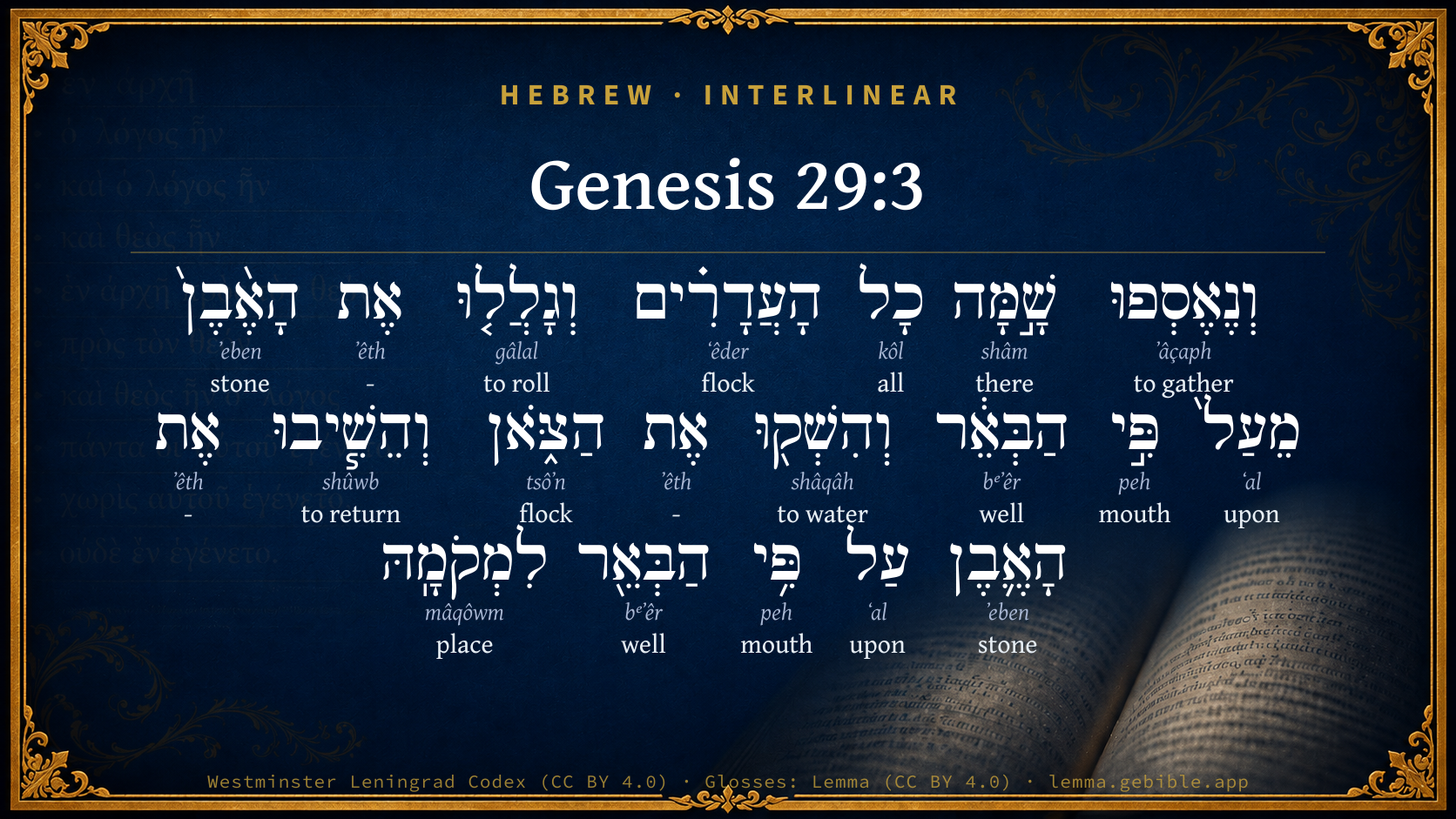
Hebrew (Westminster Leningrad Codex) Genesis 29:3 appears in the Hebrew Old Testament. The text above is from the Westminster Leningrad Codex. Each word links to its Strong’s number, a concise gloss, and parsing drawn from the Open Scriptures Hebrew Bible morphology. Click any word for its full Brown-Driver-Briggs (BDB) entry.
Download image
Cite this verse

Genesis 29:3 (World English Bible). Public Domain. Lemma interlinear Bible study tool, https://lemma.gebible.app/v/genesis/29/3.

Show BibTeX & RIS
BibTeX
RIS
English Translation
There all the flocks were gathered. They rolled the stone from the well's mouth, and watered the sheep, and put the stone again on the well's mouth in its place.
World English Bible · Public Domain
Highlights
  • 1 first appearance in the Hebrew Bible
Full analysis ↓
Download a study sheet

One document with this verse’s original text, its word-by-word gloss line, the meaning frame, cross-references with their text, attributed commentary, and full source and license credits — printable, and it pastes into notes with its structure intact.

This verse Autodidact and up

Study sheet (.html) Plain text (.txt)

A passage Seminary Student

Up to 50 verses in one chapter. A passage sheet keeps up to 6 commentary sources and 12 cross-references per verse, in the order this page ranks them, and says so on the sheet whenever that leaves anything out. Ask for a single verse and you get the Autodidact verse sheet above.

Everything on this page stays free to read, with no account — the sheet is a download of what is already on screen, not access to it.

Want to remove ads? Support Godless Engineer
Compare translations 3

The same verse in 3 English versions, stacked beneath the original-language interlinear above. Click any original word for its lexicon entry.

Each is an independent rendering of the whole verse — the interlinear is not word-aligned to these translations.

Highlighted words mark where these versions differ — a whole-verse word diff, not a word-by-word alignment.

  • World English Bible Public Domain
    There all the flocks were gathered. They rolled the stone from the well's mouth, and watered the sheep, and put the stone again on the well's mouth in its place.
  • King James Version Public Domain
    And thither were all the flocks gathered: and they rolled the stone from the well's mouth, and watered the sheep, and put the stone again upon the well's mouth in his place.
  • unfoldingWord Literal Text CC BY-SA 4.0
    And all the flocks would be gathered there, then they would roll the stone from over the mouth of the well and water the sheep. Then they would return the stone to its place over the mouth of the well.

unfoldingWord Literal Text — © unfoldingWord, licensed CC BY-SA 4.0. Word-aligned USFM3 via Door43 (git.door43.org/unfoldingWord/en_ult).

Versions to compare (up to 4)

3 of 4 selected

Show all 18 translations

Every available English version of this verse, each an independent rendering of the whole verse.

  • World English Bible Public Domain
    There all the flocks were gathered. They rolled the stone from the well's mouth, and watered the sheep, and put the stone again on the well's mouth in its place.
  • Berean Standard Bible Public Domain
    When all the flocks had been gathered there, the shepherds would roll away the stone from the mouth of the well and water the sheep. Then they would return the stone to its place over the mouth of the well.
  • Majority Standard Bible Public Domain
    When all the flocks had been gathered there, the shepherds would roll away the stone from the mouth of the well and water the sheep. Then they would return the stone to its place over the mouth of the well.
  • King James Version Public Domain
    And thither were all the flocks gathered: and they rolled the stone from the well's mouth, and watered the sheep, and put the stone again upon the well's mouth in his place.
  • American Standard Version (1901) Public Domain
    And thither were all the flocks gathered. And they rolled the stone from the well's mouth, and watered the sheep, and put the stone again upon the well's mouth in its place.
  • Revised Version (1885) Public Domain
    And thither were all the flocks gathered: and they rolled the stone from the well’s mouth, and watered the sheep, and put the stone again upon the well’s mouth in its place.
  • Geneva Bible (1599) Public Domain
    And thither were all the flockes gathered, and they rolled the stone from the welles mouth, and watered the sheepe, and put the stone againe vpon the welles mouth in his place.
  • Douay-Rheims (1899) Public Domain
    And the custom was, when all the sheep were gathered together to roll away the stone, and after the sheep were watered, to put it on the mouth of the well again.
  • Young's Literal Translation Public Domain
    (When thither have all the droves been gathered, and they have rolled the stone from off the mouth of the well, and have watered the flock, then they have turned back the stone on the mouth of the well to its place.)
  • Literal Standard Version CC BY-SA 4.0
    (When all the droves have been gathered there, and they have rolled the stone from off the mouth of the well, and have watered the flock, then they have turned back the stone on the mouth of the well to its place.)
  • Unlocked Literal Bible CC BY-SA 4.0
    When all the flocks had gathered there, the shepherds would roll the stone from the well's mouth and water the sheep, and then put the stone again over the well's mouth, back in its place.
  • unfoldingWord Literal Text CC BY-SA 4.0
    And all the flocks would be gathered there, then they would roll the stone from over the mouth of the well and water the sheep. Then they would return the stone to its place over the mouth of the well.
  • Darby Bible Public Domain
    And when all the flocks were gathered there, they rolled the stone from the mouth of the well, and watered the sheep, and put the stone again on the mouth of the well in its place.
  • World Messianic Bible Public Domain
    There all the flocks were gathered. They rolled the stone from the well’s mouth, and watered the sheep, and put the stone back on the well’s mouth in its place.
  • Webster's Bible Public Domain
    And thither were all the flocks gathered: and they rolled the stone from the well's mouth and watered the sheep, and put the stone again upon the well's mouth in its place.
  • Free Bible Version CC BY-SA 4.0
    The usual practice was that once all the flocks had arrived, the shepherds would roll away the stone from the well and give their sheep water. Then they would put the stone back again.
  • Bible in Basic English Public Domain
    And all the flocks would come together there, and when the stone had been rolled away, they would give the sheep water, and put the stone back again in its place on the mouth of the water-hole.
  • JPS Tanakh (1917) Public Domain
    And thither were all the flocks gathered; and they rolled the stone from the well's mouth, and watered the sheep, and put the stone back upon the well's mouth in its place. —

Literal Standard Version (2020), Covenant Press — licensed CC BY-SA 4.0. Text via the HelloAO Bible API (eBible.org). Unlocked Literal Bible (unfoldingWord) — licensed CC BY-SA 4.0. Text via the HelloAO Bible API (eBible.org). unfoldingWord Literal Text — © unfoldingWord, licensed CC BY-SA 4.0. Word-aligned USFM3 via Door43 (git.door43.org/unfoldingWord/en_ult). Free Bible Version, Dr. Jonathan Gallagher — licensed CC BY-SA 4.0. Text via the HelloAO Bible API (eBible.org).

Word by word

More ways to search: Search by grammar → Find every occurrence → Compare this word →

Practice this passage: Drill this verse → Learn its vocabulary →

וְגָלֲל֤וּ
gâlal
H1556
“and · to roll”
Conjunction + Verb, Qal, Perfect, 3rd Person, Common, Plural
Part of Speech
Conjunction + Verb
Stem
Qal
Form
Perfect
Person
3rd Person
Gender
Common
Number
Plural
Full BDB Definition

Origin: a primitive root

TWOT: 353

to roll, roll away, roll down, roll together - (Qal) to roll - (Niphal) - to roll up - to flow down - (Pilpel) to roll - (Poal) to be rolled - (Hithpoel) to roll oneself - (Hithpalpel) to roll oneself - (Hiphil) to roll away
  1. וְנֶאֶסְפוּ ʼâçaph H622 “and · to gather” Conjunction + Verb, Niphal, Perfect, 3rd Person, Common, Plural
  2. שָׁ֣מָּה shâm H8033 “there · toward” Adverb + Suffix, Demonstrative
  3. כָל kôl H3605 “all of” Noun, Common, Masculine, Singular, Construct
  4. הָעֲדָרִ֗ים ʻêder H5739 “the · flocks” Particle, Definite Article + Noun, Common, Masculine, Plural, Absolute
  5. אֶת ʼêth H853 “-” Particle, Direct Object
  6. הָאֶ֨בֶן֙ ʼeben H68 “the · stone” Particle, Definite Article + Noun, Common, Feminine, Singular, Absolute
  7. מֵעַל֙ ʻal H5921 “from · upon” Preposition + Preposition
  8. פִּ֣י peh H6310 “mouth of” Noun, Common, Masculine, Singular, Construct
  9. הַבְּאֵ֔ר bᵉʼêr H875 “the · well” Particle, Definite Article + Noun, Common, Feminine, Singular, Absolute
  10. וְהִשְׁק֖וּ shâqâh H8248 “and · to water” Conjunction + Verb, Hiphil, Perfect, 3rd Person, Common, Plural
  11. אֶת ʼêth H853 “-” Particle, Direct Object
  12. הַצֹּ֑אן tsôʼn H6629 “the · flock” Particle, Definite Article + Noun, Common, Both, Singular, Absolute
  13. וְהֵשִׁ֧יבוּ shûwb H7725 “and · to return” Conjunction + Verb, Hiphil, Perfect, 3rd Person, Common, Plural
  14. אֶת ʼêth H853 “-” Particle, Direct Object
  15. הָאֶ֛בֶן ʼeben H68 “the · stone” Particle, Definite Article + Noun, Common, Feminine, Singular, Absolute
  16. עַל ʻal H5921 “upon” Preposition
  17. פִּ֥י peh H6310 “mouth of” Noun, Common, Masculine, Singular, Construct
  18. הַבְּאֵ֖ר bᵉʼêr H875 “the · well” Particle, Definite Article + Noun, Common, Feminine, Singular, Absolute
  19. לִמְקֹמָֽהּ mâqôwm H4725 “to/for · place · her” Preposition + Noun, Common, Masculine, Singular, Construct + Suffix, Personal, 3rd Person, Feminine, Singular

About this verse

These counts appear in no published source. They are computed here, from the morphology-tagged text and Lemma’s own curated glosses. What Lemma adds →

20
words
14
distinct lemmas
Pentateuch
section

Notable vocabulary

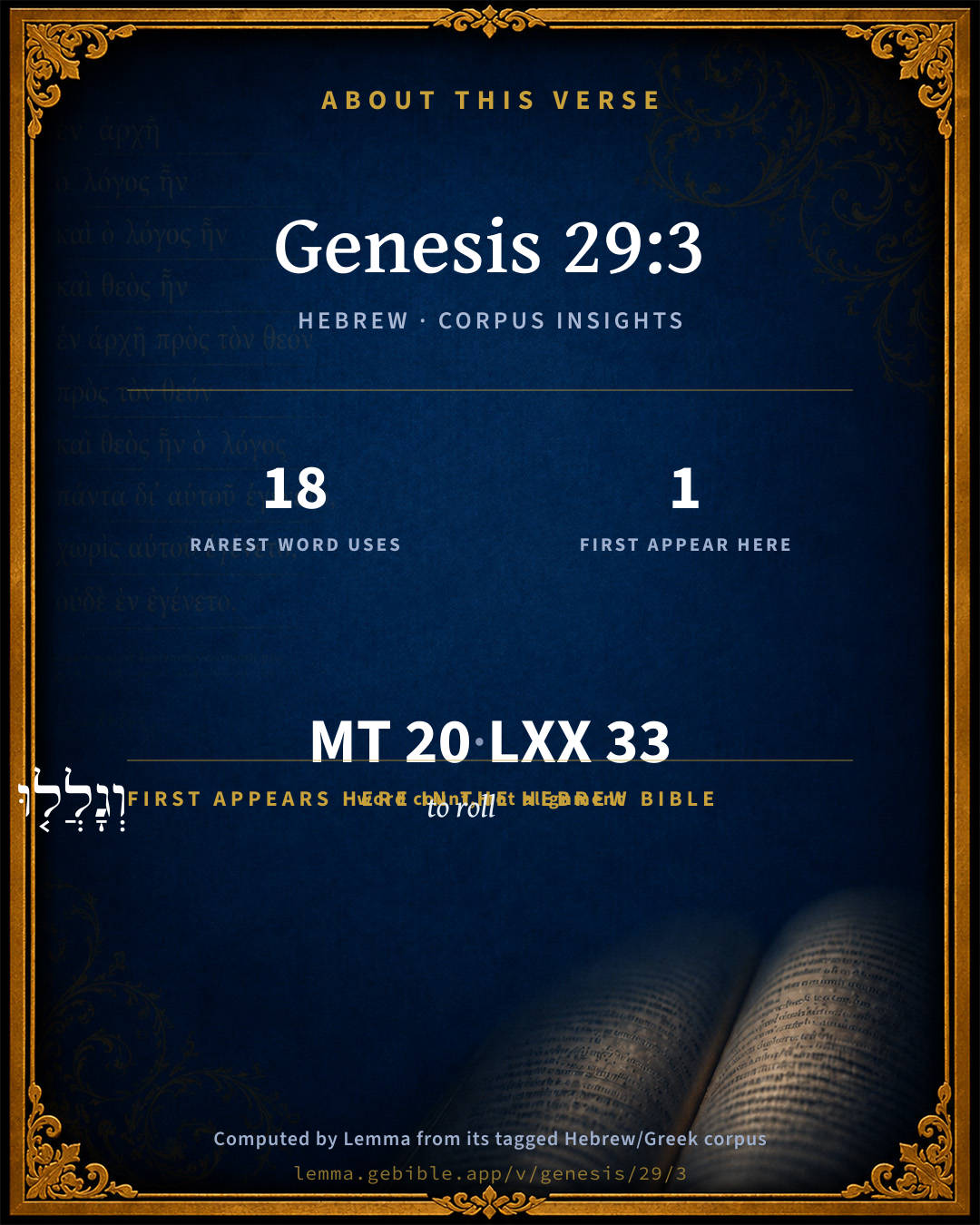
The rarest word here is וְגָלֲל֤וּ to roll H1556 — appearing just 18 times in the whole Hebrew Bible.

First appearance in Scripture

This word makes its first canonical appearance in the Hebrew Bible here:

  • וְגָלֲל֤וּ to roll H1556

Shared distinctive vocabulary

וְגָלֲל֤וּ to roll H1556 occurs in 18 verses of the Hebrew Bible. Also found in:

Grammatical profile

  • 4 verbs
  • 10 nouns
  • 2 prepositions
  • 1 adverb
  • 3 particles

Verb forms

  • וְנֶאֶסְפוּ Niphal · Perfect
  • וְגָלֲל֤וּ Qal · Perfect
  • וְהִשְׁק֖וּ Hiphil · Perfect
  • וְהֵשִׁ֧יבוּ Hiphil · Perfect

Repetition

Words recur within this verse — often emphatic in Hebrew:

  • הָאֶ֨בֶן֙ stone H68 ×2
  • מֵעַל֙ upon H5921 ×2
  • פִּ֣י mouth H6310 ×2
  • הַבְּאֵ֔ר well H875 ×2

Hebrew & Septuagint length

In English translation the verse runs 30 words from the Hebrew and 39 from the Septuagint (LXX English) — closely comparable.

A rough comparison of the two English renderings, which tokenize alike — not a word-level alignment.

Word counts can differ between the Hebrew and the Greek without any difference in meaning — e.g. the Hebrew direct-object marker אֵת has no separate Greek word, and Greek often adds the article ὁ.

In the original languages it is 20 Hebrew tokens and 33 Greek tokens — but the two are counted differently (Hebrew bundles its prefixes and suffixes into one token; the Greek is in lemma form), so that isn’t a like-for-like length.

Hebrew and Greek witnesses Masoretic Hebrew ↔ Greek Septuagint

The same verse in the two great witnesses to the Old Testament, shown verse-for-verse.

These are two independent witnesses, not word-aligned to each other, and the Septuagint is shown in lemma (dictionary) form.

Hebrew Genesis 29:3 Masoretic · Westminster Leningrad Codex

וְנֶאֶסְפוּ שָׁ֣מָּה כָל הָעֲדָרִ֗ים וְגָלֲל֤וּ אֶת הָאֶ֨בֶן֙ מֵעַל֙ פִּ֣י הַבְּאֵ֔ר וְהִשְׁק֖וּ אֶת הַצֹּ֑אן וְהֵשִׁ֧יבוּ אֶת הָאֶ֛בֶן עַל פִּ֥י הַבְּאֵ֖ר לִמְקֹמָֽהּ

There all the flocks were gathered. They rolled the stone from the well's mouth, and watered the sheep, and put the stone again on the well's mouth in its place.

World English Bible · Public Domain

Greek LXX Genesis 29:3 Septuagint · lemma form

καί συνἄγω ἐκεῖ πᾶς ὁ ποίμνιον καί ἀποκυλίω ὁ λίθος ἀπό ὁ στόμα ὁ φρέαρ καί ποτίζω ὁ πρόβατον καί ἀπο καταἵστημι ὁ λίθος ἐπί ὁ στόμα ὁ φρέαρ εἰς ὁ τόπος αὐτός

And there were all the flocks gathered, and they used to roll away the stone from the mouth of the well, and water the flocks, and set the stone again in its place on the mouth of the well.

LXX2012 (modern English Septuagint) · Public Domain

On this verse, Haydock's Catholic Bible Commentary discusses the Septuagint’s reading. Read the note in Commentary ↓

Hebrew: Westminster Leningrad Codex (CC BY 4.0). Greek: Septuagint (public domain); English from LXX2012 (modern English Septuagint) (Public Domain). How the Septuagint differs from the Hebrew →

Targum (Aramaic paraphrase)

2

The Targum is the ancient Jewish Aramaic paraphrase of the Hebrew Scriptures — an interpretive translation, not the Hebrew text itself. Onkelos (literal) and Pseudo-Jonathan (expansive) render the Torah, and Jonathan the Prophets. Coverage is partial: where no permissively-licensed English translation exists for a verse, only the Aramaic is shown. This is verse-level text, not a word-by-word alignment to the Hebrew.

  1. Targum Onkelos Torah (Genesis–Deuteronomy)
    וּמִתְכַּנְשִׁין לְתַמָּן כָּל עֲדָרַיָּא וּמְגַנְדְּרִין יָת אַבְנָא מֵעַל פּוּמָא דְבֵירָא וּמַשְׁקָן יָת עָנָא וּמְתִיבִין יָת אַבְנָא עַל פּוּמָא דְבֵירָא לְאַתְרַהּ

    (no public-domain English translation for this verse)

    Targum Onkelos — Aramaic: “Onkelos Genesis” (public domain); “Onkelos Exodus” (public domain); “Onkelos Leviticus” (public domain); “Onkelos Numbers” (public domain); “Onkelos Deuteronomy” (public domain). English: “Sefaria Community Translation” (CC0 1.0 (public-domain dedication)); “J.W. Etheridge. The Targums of Onkelos and Jonathan Ben Uzziel on the Pentateuch. London: Longmans, Green, 1862” (public domain). Text via Sefaria.

  2. Targum Pseudo-Jonathan Torah (Genesis–Deuteronomy)
    וּמִתְכַּנְשִׁין תַּמָן כָּל עֶדְרַיָא וּמְגַלְגְלִין יַת אַבְנָא מֵעַל פּוּם בֵּירָא וּמַשְׁקַן יַת עָנָא וּמְתִיבִין יַת אַבְנָא עַל פּוּם בֵּירָא לְאַתְרָהּ

    And they gathered the flocks there, and rolled the stone from the well's mouth, and watered the sheep, and set the stone on the mouth of the well in its place.

    Targum Pseudo-Jonathan — Aramaic: “Targum Jonathan on Genesis” (public domain); “Targum Jonathan on Exodus” (public domain); “Targum Jonathan on Leviticus” (public domain); “Targum Jonathan on Numbers” (public domain); “Targum Jonathan on Deuteronomy” (public domain). English: “The Targum of Jonathan ben Uzziel, trans. J. W. Etheridge, London, 1862” (public domain). Text via Sefaria.

Commentary

Notes on Genesis 29:3 from classic Christian and Jewish commentators (each source and its license shown beneath its notes). The classic Christian expositions comment on the surrounding passage and are grouped to its opening verse, so a note may address several verses; the Jewish commentaries on the Tanakh (Rashi and others) are per-verse, so they appear only where the commentator wrote on this verse.

Lemma curates 59 commentaries, every one of them public domain or Creative Commons licensed, each selected and text-cleaned for this edition rather than reprinted as found. About our sources →

Trapp's Complete Commentary

John Trapp

Gen 29:3 And thither were all the flocks gathered: and they rolled the stone from the well’s mouth, and watered the sheep, and put the stone again upon the well’s mouth in his place.

Ver. 3. And they put the stone again upon the well’s mouth.] To keep the waters clean and filth free. The Turks had procured some traitor in Scodra, where Scanderbeg ruled, to poison the town well. {a} The Pope hath endeavoured the like, by pouring out his deadly poison "upon the rivers and fountains of water" (the Scriptures) "that they might become blood". {Rev 16:4} Witness that heathenish decree of the Council of Trent; equalising, if not preferring, the Apocrypha to the canonical Scripture; the vulgar translation to the original; traditions to Holy Writ; and affirming that the Holy Ghost himseff is not to be heard, though he bring never so plain Scripture for himself; nisi accedat meretricis purpuratae effrons interpretatio , saith a learned doctor, unless the Pope may interpret it. {b} Horrible blasphemy! Had not God’s servants need to see to the cleansing of this well, and the keeping it free from the tramplings and defilements of this foul beast? The Council of Constance comes in with a Non-obstante against Christ’s institution, withholding the cup from the sacrament. {c} Before that the gospel was corrected, amended, and expounded, say the Canonists, there were many things permitted (as priests’ marriage); which now, since the time is come that all things are made perfect, are clearly abolished and taken away. When the Hussites denied to admit any doctrine that could not be proved by the Holy Scriptures, the Council of Basil answered them, by Cardinal Cusanus, that the Scriptures were not of the essence of the Church, but of the well being of it only; that the Word of God was so much the better taught the people, by how much it had less of the Scriptures in it; that the Scripture was to be interpreted according to the current rite of the Church; {d} qua mutante sententiam, mutetur et Dei iudicium . Can any hear this, and his ears not tingle? This was then the Pope’s express: for in Popish councils, the bishops and others have no more to do, but simply, inclinato capite , to say Placet to that which in the Pope’s name is propounded to them: as nothing was resolved by the Trent fathers, but all in Rome: whence grew that blasphemous proverb, which I abhor to relate. {e} This council was that sea, upon which the second angel poured out his vial, {Rev 16:3} and it became as the blood of a dead man; and every living soul died in that sea. Cavete .

{a} Turk. Hist.

{b} D. Prid., Lect. de Testibus .

{c} Licit Christus, post coenam, instituerit, et suis discipulis administraverit ,& c. - Caranza, Sum. Concil., sess. 13; Bee Hive of Rome, p. 12.

{d} Tanto dignius verbum Dei tradi, quanto remotius ab omni Scriptura: eam explicandam iuxta currentem Ecclesiae ritum , &c. - Revius, De Vit. Pontif ., p. 235.

{e} Hist. of Coun. of Trent, 497.

John Trapp, A Commentary or Exposition upon All the Books of the Old and New Testament (1647–1656) — public domain. Text from a community e-Sword module.

Jamieson, Fausset & Brown

Robert Jamieson, A. R. Fausset & David Brown

thither were all the flocks gathered; and a stone, &c.--In Arabia, owing to the shifting sands and in other places, owing to the strong evaporation, the mouth of a well is generally covered, especially when it is private property. Over many is laid a broad, thick, flat stone, with a round hole cut in the middle, forming the mouth of the cistern. This hole is covered with a heavy stone which it would require two or three men to roll away. Such was the description of the well at Haran.

Jamieson, Fausset & Brown — Commentary Critical and Explanatory on the Whole Bible (1871) — public domain (CC PDM 1.0). Text via the HelloAO Bible API.

Adam Clarke's Commentary

Verse 3. All the flocks] Instead of העדרים hadarim, flocks, the Samaritan reads [Samaritan] haroim, shepherds; for which reading Houbigant strongly contends, as well in this verse as in Ge 29:8. It certainly cannot be said that all the flocks rolled the stone from the well's mouth, and watered the sheep: and yet so it appears to read if we prefer the common Hebrew text to the Samaritan. It is probable that the same reading was originally that of the second verse also.

And put the stone again upon the well's mouth] It is very likely that the stone was a large one, which was necessary to prevent ill-minded individuals from either disturbing the water, or filling up the well; hence a great stone was provided, which required the joint exertions of several shepherds to remove it; and hence those who arrived first waited till all the others were come up, that they might water their respective flocks in concert.

Adam Clarke's Commentary on the Bible (1810–1826) — public domain. Text from a community e-Sword/MySword module.

John Gill's Exposition

And thither were all the flocks gathered,.... The three above mentioned, Gen 29:2,

and they rolled the stone from the well's mouth, and watered the sheep; that is, when they watered the sheep, they used to roll away the stone from the mouth of the well in order to do it; for as yet the flocks, now lying by it, had not been watered, as appears from Gen 29:7,

and put a stone upon the well's mouth in this place; this they were wont to do every time they watered the flocks.

John Gill's Exposition of the Whole Bible (1746–1763) — public domain (CC PDM 1.0). Text via the HelloAO Bible API.

Haydock's Catholic Bible Commentary

Sheep. Instead of this, Kennicott would read shepherds; as also ver. 2. and 8. In which last, the Samaritan, Arabic and Septuagint agree with him; as the two former do likewise in this third verse. (Haydock)

George Leo Haydock (1774–1849), Haydock's Catholic Family Bible and Commentary, 1859 edition — public domain. Excludes Psalms (Douay-Rheims chapter numbering differs from Protestant) and Deuterocanonical books (Catholic canon only).

The Pulpit Commentary

And thither were all the flecks gathered. "Fifteen minutes later we came to a large well in a valley among the swells, fitted up with troughs and reservoirs, with flocks waiting around" (Robinson, 3. p. 21).

And they rolled the stone from the well"s mouth, find watered the sheep, and put the stone again upon the well"s mouth in his place. From the middle of ver. 2 the words are parenthetical, the watering of the flocks not having taken place till Rachel had arrived (ver. 9) and Jacob had uncovered the well (ver. 10).

The Pulpit Commentary (1880–1919), ed. H.D.M. Spence-Jones & Joseph S. Exell — public domain. Text from a community e-Sword module.

Rashi

Rabbi Shlomo Yitzchaki (Rashi)

ונאספו [AND THITHER WERE ALL THE DROVES] GATHERED — they regularly gathered there because the stone was a heavy one

וגללו AND THEY ROLLED THE STONE — it means and they used to roll. In the Targum it is therefore translated by ומגנדרין (a participle). The idea of frequentative action is expressed indifferently by the imperfect (future) or the perfect (past) because every action that occurs continually, has already happened and will again happen,

והשיבו AND RESTORED [THE STONE] — In the Targum it is translated by ומתיבין(a participle) — and they were always putting back.

Rashi on the Tanakh — English translations: “The Judaica Press complete Tanach with Rashi, translated by A. J. Rosenberg” (CC BY 4.0); “Pentateuch with Rashi's commentary by M. Rosenbaum and A.M. Silbermann, 1929-1934” (public domain); “The Metsudah Tanach series, Lakewood, N.J” (CC BY 4.0); and “The Book of Joshua, Metsudah Publications, 1997” (CC BY 4.0). Text via Sefaria.

Radak

Rabbi David Kimhi (Radak)

ונאספו שמה...וגללו, the subject of the verse are the various shepherds who have as yet not been mentioned.

Radak on the Tanakh — English translations: “Sefaria Community Translation” (CC0 1.0 (public-domain dedication)); “Eliyahu Munk, HaChut Hameshulash” (CC BY 4.0); “Rabbi Mike Feuer, Jerusalem Anthology” (CC BY 4.0); and “R. David Kimhi on the first book of Psalms, Translated by R.G. Finch, London, 1919” (public domain). Text via Sefaria.

Lesson kit

Teaching starters — assembled from the data on this page, not authored interpretation. Every prompt links to the verse data it draws on. Edit before teaching.

Genesis, in the Pentateuch, opens this verse with 20 words (14 distinct Hebrew lemmas). Its most distinctive word is gâlal (“to roll”). A historical commentator’s framing appears above. Read the whole chapter for the surrounding context.

Discussion questions

  1. The word gâlal carries the sense “to roll.” How does it shape the verse?
  2. The word “to roll” first appears here in Scripture. What is being introduced at this debut?
  3. Genesis 29:8 shares the word «to roll» with this verse. How do the two illuminate each other?
  4. “stone” occurs 2× in this one verse. What is the effect of the repetition?
  5. The translations on this page render this verse differently — a whole-verse word diff, not a word-by-word alignment. What might account for the different wordings?
  6. The verb «וְנֶאֶסְפוּ» is Niphal Perfect. How does its form color the action?
  7. Reading how Trapp's Complete Commentary and Jamieson, Fausset & Brown read this verse, where do the two commentators agree and where do they part?

Things to notice

Reading settings

Reading text

Shown beneath each verse's original-language words.

Old Testament
Old Testament edition

Read the OT as the Masoretic Hebrew (MT) or the Greek Septuagint (LXX).

English shown for the Greek Septuagint (in the Hebrew ↔ Greek comparison).

Comparing translations? Open the Compare panel on any verse page to stack up to four side by side.