Exodus 10:24

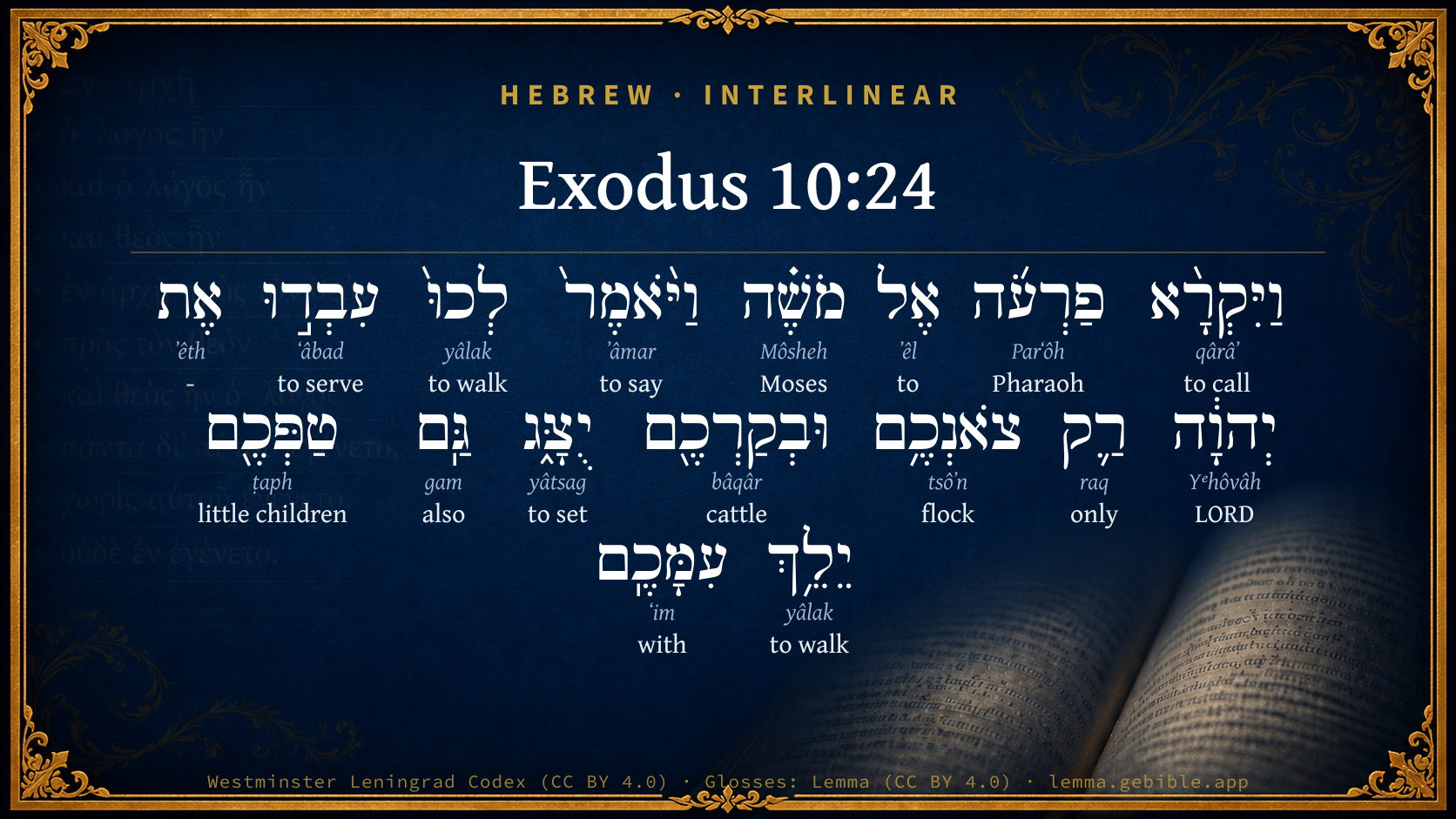
Hebrew (Westminster Leningrad Codex) Exodus 10:24 appears in the Hebrew Old Testament. The text above is from the Westminster Leningrad Codex. Each word links to its Strong’s number, a concise gloss, and parsing drawn from the Open Scriptures Hebrew Bible morphology. Click any word for its full Brown-Driver-Briggs (BDB) entry.
Download image
Cite this verse

Exodus 10:24 (World English Bible). Public Domain. Lemma interlinear Bible study tool, https://lemma.gebible.app/v/exodus/10/24.

Show BibTeX & RIS
BibTeX
RIS
English Translation
Pharaoh called to Moses, and said, "Go, serve Yahweh. Only let your flocks and your herds stay behind. Let your little ones also go with you."
World English Bible · Public Domain
Download a study sheet

One document with this verse’s original text, its word-by-word gloss line, the meaning frame, cross-references with their text, attributed commentary, and full source and license credits — printable, and it pastes into notes with its structure intact.

This verse Autodidact and up

Study sheet (.html) Plain text (.txt)

A passage Seminary Student

Up to 50 verses in one chapter. A passage sheet keeps up to 6 commentary sources and 12 cross-references per verse, in the order this page ranks them, and says so on the sheet whenever that leaves anything out. Ask for a single verse and you get the Autodidact verse sheet above.

Everything on this page stays free to read, with no account — the sheet is a download of what is already on screen, not access to it.

Want to remove ads? Support Godless Engineer
Compare translations 3

The same verse in 3 English versions, stacked beneath the original-language interlinear above. Click any original word for its lexicon entry.

Each is an independent rendering of the whole verse — the interlinear is not word-aligned to these translations.

Highlighted words mark where these versions differ — a whole-verse word diff, not a word-by-word alignment.

  • World English Bible Public Domain
    Pharaoh called to Moses, and said, "Go, serve Yahweh. Only let your flocks and your herds stay behind. Let your little ones also go with you."
  • King James Version Public Domain
    And Pharaoh called unto Moses, and said, Go ye, serve the LORD; only let your flocks and your herds be stayed: let your little ones also go with you.
  • unfoldingWord Literal Text CC BY-SA 4.0
    And Pharaoh called to Moses, and he said, “Go serve Yahweh. Only your flocks and your herds must remain behind; however, your children will go with you.”

unfoldingWord Literal Text — © unfoldingWord, licensed CC BY-SA 4.0. Word-aligned USFM3 via Door43 (git.door43.org/unfoldingWord/en_ult).

Versions to compare (up to 4)

3 of 4 selected

Show all 18 translations

Every available English version of this verse, each an independent rendering of the whole verse.

  • World English Bible Public Domain
    Pharaoh called to Moses, and said, "Go, serve Yahweh. Only let your flocks and your herds stay behind. Let your little ones also go with you."
  • Berean Standard Bible Public Domain
    Then Pharaoh summoned Moses and said, “Go, worship the LORD. Even your little ones may go with you; only your flocks and herds must stay behind.”
  • Majority Standard Bible Public Domain
    Then Pharaoh summoned Moses and said, “Go, worship the LORD. Even your little ones may go with you; only your flocks and herds must stay behind.”
  • King James Version Public Domain
    And Pharaoh called unto Moses, and said, Go ye, serve the LORD; only let your flocks and your herds be stayed: let your little ones also go with you.
  • American Standard Version (1901) Public Domain
    And Pharaoh called unto Moses, and said, Go ye, serve Jehovah; only let your flocks and your herds be stayed: let your little ones also go with you.
  • Revised Version (1885) Public Domain
    And Pharaoh called unto Moses, and said, Go ye, serve the LORD; only let your flocks and your herds be stayed: let your little ones also go with you.
  • Geneva Bible (1599) Public Domain
    The Pharaoh called for Moses and said, Go, serue the Lord: onely your sheepe and your cattel shall abide, and your children shall go with you.
  • Douay-Rheims (1899) Public Domain
    And Pharao called Moses and Aaron, and said to them: Go sacrifice to the Lord: let your sheep only, and herds remain; let your children go with you.
  • Young's Literal Translation Public Domain
    And Pharaoh calleth unto Moses and saith, `Go ye, serve Jehovah, only your flock and your herd are stayed, your infants also go with you;'
  • Literal Standard Version CC BY-SA 4.0
    And Pharaoh calls to Moses and says, “Go, serve YHWH, only your flock and your herd are stayed, your infants also go with you”;
  • Unlocked Literal Bible CC BY-SA 4.0
    Pharaoh summoned Moses and said, “Go worship Yahweh. Even your families may go with you, but your flocks and herds must remain behind.”
  • unfoldingWord Literal Text CC BY-SA 4.0
    And Pharaoh called to Moses, and he said, “Go serve Yahweh. Only your flocks and your herds must remain behind; however, your children will go with you.”
  • Darby Bible Public Domain
    And Pharaoh called Moses and said, Go, serve Jehovah; only, let your flocks and your herds remain; let your little ones also go with you.
  • World Messianic Bible Public Domain
    Pharaoh called to Moses, and said, “Go, serve the LORD. Only let your flocks and your herds stay behind. Let your little ones also go with you.”
  • Webster's Bible Public Domain
    And Pharaoh called to Moses, and said, Go ye, serve the LORD; only let your flocks and your herds be stayed: let your little ones also go with you.
  • Free Bible Version CC BY-SA 4.0
    Eventually Pharaoh called for Moses. “Go and worship the Lord,” he said. “Just leave your flocks and herds here. You can even take your children with you.”
  • Bible in Basic English Public Domain
    Then Pharaoh sent for Moses, and said, Go and give worship to the Lord; only let your flocks and your herds be kept here: your little ones may go with you.
  • JPS Tanakh (1917) Public Domain
    And Pharaoh called unto Moses, and said: 'Go ye, serve the LORD; only let your flocks and your herds be stayed; let your little ones also go with you.'

Literal Standard Version (2020), Covenant Press — licensed CC BY-SA 4.0. Text via the HelloAO Bible API (eBible.org). Unlocked Literal Bible (unfoldingWord) — licensed CC BY-SA 4.0. Text via the HelloAO Bible API (eBible.org). unfoldingWord Literal Text — © unfoldingWord, licensed CC BY-SA 4.0. Word-aligned USFM3 via Door43 (git.door43.org/unfoldingWord/en_ult). Free Bible Version, Dr. Jonathan Gallagher — licensed CC BY-SA 4.0. Text via the HelloAO Bible API (eBible.org).

Word by word

More ways to search: Search by grammar → Find every occurrence → Compare this word →

Practice this passage: Drill this verse → Learn its vocabulary →

יֻצָּ֑ג
yâtsag
H3322
“to set”
Verb, Hophal, Imperfect, 3rd Person, Masculine, Singular
Part of Speech
Verb
Stem
Hophal
Form
Imperfect
Person
3rd Person
Gender
Masculine
Number
Singular
Full BDB Definition

Origin: a primitive root

TWOT: 895

to place, set, establish - (Hiphil) - to set, place - to present - to exhibit - (Hophal) to be stopped, be stayed, be detained
  1. וַיִּקְרָ֨א qârâʼ H7121 “and · to call” Conjunction + Verb, Qal, Sequential Imperfect, 3rd Person, Masculine, Singular
  2. פַרְעֹ֜ה Parʻôh H6547 “Pharaoh” Noun, Proper
  3. אֶל ʼêl H413 “to” Preposition
  4. מֹשֶׁ֗ה Môsheh H4872 “Moses” Noun, Proper
  5. וַיֹּ֨אמֶר֙ ʼâmar H559 “and · to say” Conjunction + Verb, Qal, Sequential Imperfect, 3rd Person, Masculine, Singular
  6. לְכוּ֙ yâlak H3212 “walk” Verb, Qal, Imperative, 2nd Person, Masculine, Plural
  7. עִבְד֣וּ ʻâbad H5647 “serve” Verb, Qal, Imperative, 2nd Person, Masculine, Plural
  8. אֶת ʼêth H853 “-” Particle, Direct Object
  9. יְהוָ֔ה Yᵉhôvâh H3068 “LORD” Noun, Proper
  10. רַ֛ק raq H7535 “only” Particle, Accusative
  11. צֹאנְכֶ֥ם tsôʼn H6629 “flock · your” Noun, Common, Both, Singular, Construct + Suffix, Personal, 2nd Person, Masculine, Plural
  12. וּבְקַרְכֶ֖ם bâqâr H1241 “and · cattle · your” Conjunction + Noun, Common, Both, Singular, Construct + Suffix, Personal, 2nd Person, Masculine, Plural
  13. גַּֽם gam H1571 “also” Particle, Accusative
  14. טַפְּכֶ֖ם ṭaph H2945 “little children · your” Noun, Common, Masculine, Singular, Construct + Suffix, Personal, 2nd Person, Masculine, Plural
  15. יֵלֵ֥ךְ yâlak H3212 “to walk” Verb, Qal, Imperfect, 3rd Person, Masculine, Singular
  16. עִמָּכֶֽם ʻim H5973 “with · you” Preposition + Suffix, Personal, 2nd Person, Masculine, Plural

About this verse

These counts appear in no published source. They are computed here, from the morphology-tagged text and Lemma’s own curated glosses. What Lemma adds →

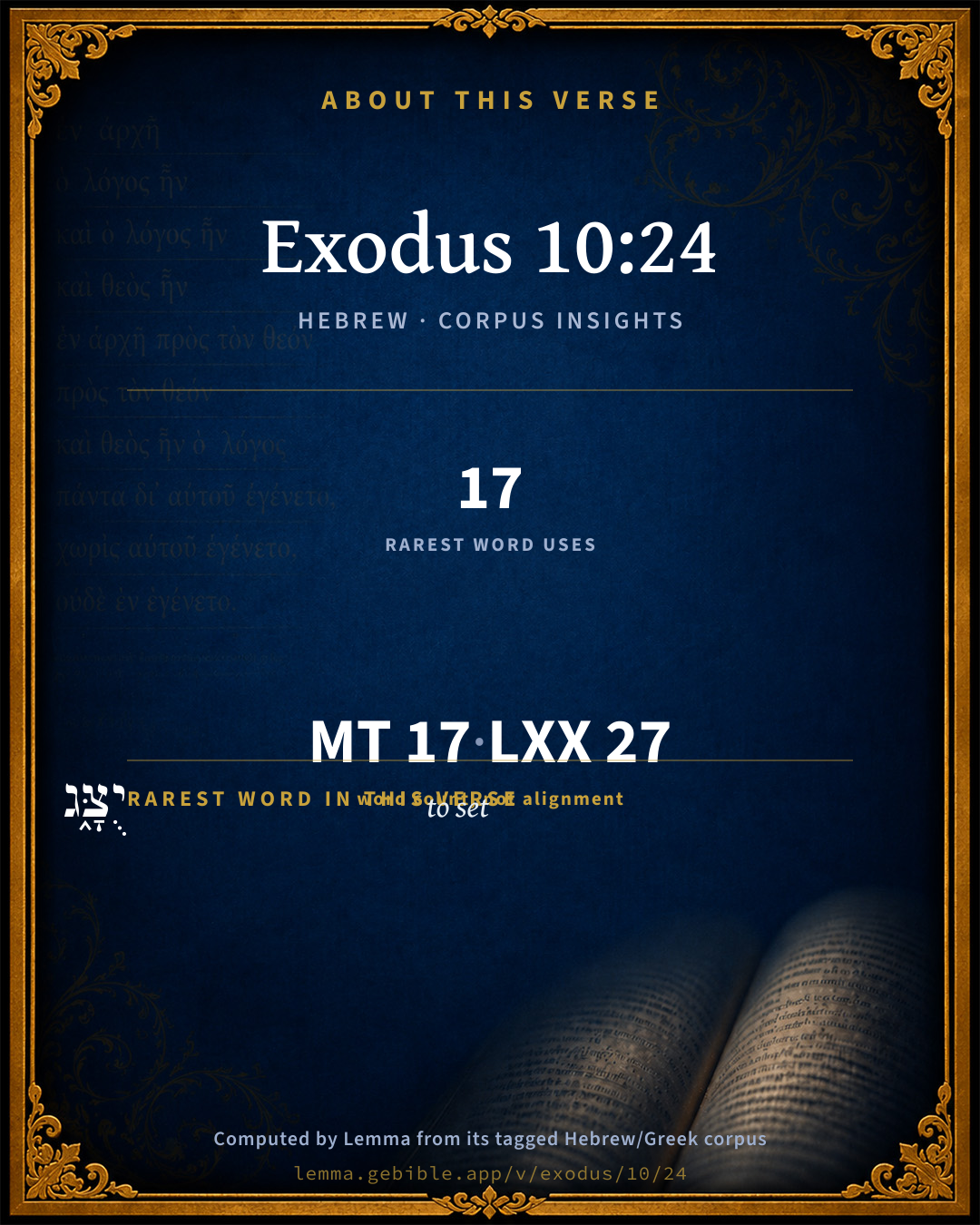
17
words
16
distinct lemmas
Pentateuch
section

Notable vocabulary

The rarest word here is יֻצָּ֑ג to set H3322 — appearing just 17 times in the whole Hebrew Bible.

Shared distinctive vocabulary

יֻצָּ֑ג to set H3322 occurs in 16 verses of the Hebrew Bible. Also found in:

Grammatical profile

  • 6 verbs
  • 6 nouns
  • 2 prepositions
  • 3 particles

Verb forms

  • וַיִּקְרָ֨א Qal · Sequential Imperfect
  • וַיֹּ֨אמֶר֙ Qal · Sequential Imperfect
  • לְכוּ֙ Qal · Imperative
  • עִבְד֣וּ Qal · Imperative
  • יֻצָּ֑ג Hophal · Imperfect
  • יֵלֵ֥ךְ Qal · Imperfect

Repetition

A word recurs within this verse — often emphatic in Hebrew:

  • לְכוּ֙ to walk H3212 ×2

Hebrew & Septuagint length

In English translation the verse runs 26 words from the Hebrew and 27 from the Septuagint (LXX English) — closely comparable.

A rough comparison of the two English renderings, which tokenize alike — not a word-level alignment.

Word counts can differ between the Hebrew and the Greek without any difference in meaning — e.g. the Hebrew direct-object marker אֵת has no separate Greek word, and Greek often adds the article ὁ.

In the original languages it is 17 Hebrew tokens and 27 Greek tokens — but the two are counted differently (Hebrew bundles its prefixes and suffixes into one token; the Greek is in lemma form), so that isn’t a like-for-like length.

Cross-references

4

Topical passages linked to Exodus 10:24 in the Treasury of Scripture Knowledge — connected by theme and wording, ordered by reader-vote popularity; previews shown in the World English Bible.

  • Exodus 8:28 Pharaoh said, "I will let you go, that you may sacrifice to Yahweh your God in the wilderness, only you shall not go very far away. Pray for me."
  • Exodus 10:8–10 Moses and Aaron were brought again to Pharaoh, and he said to them, "Go, serve Yahweh your God; but who are those who will go?"
  • Genesis 34:23 Won't their cattle and their substance and all their animals be ours? Only let us give our consent to them, and they will dwell with us."
  • Exodus 9:28 Pray to Yahweh; for there has been enough of mighty thunderings and hail. I will let you go, and you shall stay no longer."

Cross-references courtesy of OpenBible.info (CC BY 4.0).

Hebrew and Greek witnesses Masoretic Hebrew ↔ Greek Septuagint

The same verse in the two great witnesses to the Old Testament, shown verse-for-verse.

These are two independent witnesses, not word-aligned to each other, and the Septuagint is shown in lemma (dictionary) form.

Hebrew Exodus 10:24 Masoretic · Westminster Leningrad Codex

וַיִּקְרָ֨א פַרְעֹ֜ה אֶל מֹשֶׁ֗ה וַיֹּ֨אמֶר֙ לְכוּ֙ עִבְד֣וּ אֶת יְהוָ֔ה רַ֛ק צֹאנְכֶ֥ם וּבְקַרְכֶ֖ם יֻצָּ֑ג גַּֽם טַפְּכֶ֖ם יֵלֵ֥ךְ עִמָּכֶֽם

Pharaoh called to Moses, and said, "Go, serve Yahweh. Only let your flocks and your herds stay behind. Let your little ones also go with you."

World English Bible · Public Domain

Greek LXX Exodus 10:24 Septuagint · lemma form

καί καλέω φαραώ μωυσῆς καί ααρων λέγω βαδίζω λατρεύω κύριος ὁ θεός σύ πλήν ὁ πρόβατον καί ὁ βοῦς ὑπολείπω καί ὁ ἀποσκευή σύ ἀποτρέχω μετά σύ

And Pharao called Moses and Aaron, saying, Go, serve the Lord your God, only leave your sheep and your oxen, and let your store depart with you.

LXX2012 (modern English Septuagint) · Public Domain

Hebrew: Westminster Leningrad Codex (CC BY 4.0). Greek: Septuagint (public domain); English from LXX2012 (modern English Septuagint) (Public Domain). How the Septuagint differs from the Hebrew →

Targum (Aramaic paraphrase)

2

The Targum is the ancient Jewish Aramaic paraphrase of the Hebrew Scriptures — an interpretive translation, not the Hebrew text itself. Onkelos (literal) and Pseudo-Jonathan (expansive) render the Torah, and Jonathan the Prophets. Coverage is partial: where no permissively-licensed English translation exists for a verse, only the Aramaic is shown. This is verse-level text, not a word-by-word alignment to the Hebrew.

  1. Targum Onkelos Torah (Genesis–Deuteronomy)
    וּקְרָא פַרְעֹה לְמשֶׁה וַאֲמַר אֱזִילוּ פְּלָחוּ קֳדָם יְיָ לְחוֹד עָנְכוֹן וְתוֹרְכוֹן שְׁבוּקוּ אַף טַפְלְכוֹן יֵזֵיל עִמְכוֹן:

    (no public-domain English translation for this verse)

    Targum Onkelos — Aramaic: “Onkelos Genesis” (public domain); “Onkelos Exodus” (public domain); “Onkelos Leviticus” (public domain); “Onkelos Numbers” (public domain); “Onkelos Deuteronomy” (public domain). English: “Sefaria Community Translation” (CC0 1.0 (public-domain dedication)); “J.W. Etheridge. The Targums of Onkelos and Jonathan Ben Uzziel on the Pentateuch. London: Longmans, Green, 1862” (public domain). Text via Sefaria.

  2. Targum Pseudo-Jonathan Torah (Genesis–Deuteronomy)
    וּבְסוֹף תְּלָתָא יוֹמִין קָרָא פַּרְעה לְמשֶׁה וַאֲמַר זִילוּ פְלָחוּ קֳדָם יְיָ לְחוֹד עַנְכוֹן וְתוֹרֵיכוֹן יְקוּם גַּבִּי אוּף טַפְלְכוֹן יֵזִיל עִמְכוֹן

    And at the end of three days Pharoh called Mosheh, and said, Go, worship before the lord; only your sheep and your oxen shall abide with me: your children also may go with you.

    Targum Pseudo-Jonathan — Aramaic: “Targum Jonathan on Genesis” (public domain); “Targum Jonathan on Exodus” (public domain); “Targum Jonathan on Leviticus” (public domain); “Targum Jonathan on Numbers” (public domain); “Targum Jonathan on Deuteronomy” (public domain). English: “The Targum of Jonathan ben Uzziel, trans. J. W. Etheridge, London, 1862” (public domain). Text via Sefaria.

Commentary

Notes on Exodus 10:24 from classic Christian and Jewish commentators (each source and its license shown beneath its notes). The classic Christian expositions comment on the surrounding passage and are grouped to its opening verse, so a note may address several verses; the Jewish commentaries on the Tanakh (Rashi and others) are per-verse, so they appear only where the commentator wrote on this verse.

Lemma curates 59 commentaries, every one of them public domain or Creative Commons licensed, each selected and text-cleaned for this edition rather than reprinted as found. About our sources →

Trapp's Complete Commentary

John Trapp

Exo 10:24 And Pharaoh called unto Moses, and said, Go ye, serve the LORD; only let your flocks and your herds be stayed: let your little ones also go with you.

Ver. 24. Called unto Moses,] viz., When the darkness was over: though some think that, even during the darkness, Pharaoh - such was his madhess - raged against God, and menaced Moses.

John Trapp, A Commentary or Exposition upon All the Books of the Old and New Testament (1647–1656) — public domain. Text from a community e-Sword module.

The Biblical Illustrator

Joseph S. Exell

Exo_10:24-26

Thou must give us also sacrifices.

Lessons

1. Gods instruments of redemption seek not only liberty of persons, but of means, to serve Him.

2. Due worship and true sacrifice to God are the scope of all Gods redeemed (Exo_10:25).

3. Gods ministers must be resolute for all, and not bate a jot of what God requires. Not a hoof.

4. All the exactions of Gods instruments must be aimed at Gods service truly.

5. Gods servants know not themselves, but depend upon His discovery for what they must offer to Him (Exo_10:26). (G. Hughes, B. D.)

The reluctance with which men yield a complete obedience to the imperative claims of God

I. The fact of this reluctance on the part of man to yield complete obedience to the claims of God.

1. This reluctance is seen in the judgments that are sent to overcome it.

2. This reluctance is seen in the mercy that is despised.

3. This reluctance is seen in the faithful ministries that are rejected.

4. That men resist these judgments, etc., is complete evidence of their great reluctance to surrender all for Him.

(1) This reluctance is a matter of revelation.

(2) This reluctance is a matter of history.

(3) This reluctance is a matter of experience.

II. The reasons of this reluctance on the part of man to yield complete obedience to the claims of God. These reasons are obvious.

1. Depravity of nature.

2. Pride of heart.

3. Selfishness of motive.

4. Obstinacy of will.

III. The folly of this reluctance on the part of man to yield complete obedience to the claims of God.

1. Because it provokes painful judgments.

2. Because it is useless to contend with God.

3. Because final overthrow is its certain outcome.

Lessons:

1. That man will consent to any terms rather than yield a complete submission to the will of God.

2. That God will only be satisfied by an entire surrender to His will. (J. S. Exell, M. A.)

The way in which men endeavour to compromise the service of God

I. That men endeavour to compromise the service of God by nominal allegiance.

II. That men endeavour to compromise the service of God by an occasional performance of duty.

III. That men endeavour to compromise the service of God by a public profession of it accompanied with private reservations.

IV. That men endeavour to compromise the service of God by excluding it from their worldly pursuits.

Lessons:

1. That men must not compromise the service of God.

2. That ministers must warn men against compromising the service of God. (J. S. Exell, M. A.)

The picture of an unregenerate soul

I. It is opposed to the service of God.

II. It is loath to part with its evil possessions.

III. It is slow to heed the voice of the servants of truth. (J. S. Exell, M. A.)

Compromise; or, wealth left behind in Egypt

Only let your flocks and herds be stayed. How many souls are caught in this snare! They have left their business, their work, their worldly interests, down in Egypt. They cannot be very far away in such case, for they must needs go down to Egypt to attend to their possessions. Lay not up for yourselves treasures upon earth; Make not provision for the flesh, to fulfil the lusts thereof (Mat_4:9; Rom_13:14). These are words that need to be considered in connection with this last snare of Satan. I think when Satan sees a Christian go out of Egypt with all his flocks and herds, he has no hope of getting him back again. So he makes a last stand here: Keep your business and your religion separate. Give yourself to God; but do not consecrate your property. Now, will you just take a look at the state of the Christian world to-day. Look at the wealth of Christians in London, and in New York, and over the whole world. How they have piled it up--thousands upon thousands, heaps upon heaps! And where is it? Surely in Egypt. It is not held in sacred stewardship for the Lord. It is used for the most part to gratify the lust of the flesh, the lust of the eye, and the pride of life. Look, I pray, at the magnificence of the residences, the costliness of the furniture, and the expensiveness and luxury of the equipage. Go into the houses of the wealthy Egyptian Christians, and behold the splendour and costliness of their entertainments! See the crowds of Egyptians gathered there to enjoy the feasts and pleasures that are provided by Gods people with the proceeds of the flocks and herds that should be used in His service. Again, look at the condition of the Lords work the world over. Consider the fewness of the number of missionaries who are abroad! Note how from every direction the cry comes up for help! There are men and women who are waiting to give themselves to the work--to forsake home and country, and go to the darkest spots of heathendom; but there are not the men and the women who are ready to spare from their hoards the money to send and support them. If the flocks and herds were out of Egypt, and really given over to the Lord to be used in His service, the world could and would be evangelized in less than five years. (G. F. Pentecost, D. D.)

Not an hoof be left behind.--

Full redemption

Now, it seems to me, that this grand quarrel of old is but a picture of Gods continual contest with the powers of darkness. Evil is hard in dying; it will not readily be overcome. But this is the demand of God, and to the last will He have it. All My people; the whole of, every one of them, and all that My people have possessed, all shall come out of the land of Egypt. Christ will have the whole; He will not be contented with a part, and this He vows to accomplish. Not an hoof shall be left behind.

I. First, then, Christ will have the whole man. In His people whom He has purchased with His blood He will reign without a rival. No sin is to be spared; no service shunned; no power unconsecrated.

II. This is equally true of the whole church as of the whole man--Not an hoof shall be left behind. When I come to the matter of redemption it seems to me that whatever Christs design was in dying, that design cannot be frustrated, nor by any means disappointed. All that His heavenly Father gave Him shall come to Him. Iii. Jesus Christ will not only have all of a man, and all the men He bought, but He will have all that ever belonged to all these men. That is to say, all that Adam lost Christ will win back, and that without the diminution of a single jot or tittle, Not an inch of Paradise shall be given up, nor even a handful of its dust resigned. Christ will have all, or else He will have none.

IV. Christ will have the whole earth. (C. H. Spurgeon.)

All or none; or, compromise refused

This was the Divine policy of No surrender, and I plead for it with you. Satan says, Do not use your property for God. Do not use your talents and your abilities; especially do not use your money for the Lord Jesus. Keep that for yourself. You will want it one of these days, perhaps. Keep it for your own enjoyment. Live to God in other things, but, as to that, live to yourself. Now, a genuine Christian says, When I gave myself to the Lord I gave Him everything I had. From the crown of my head to the soul of my foot I am the Lords. He bids me provide things honest in the sight of all men, and care for my household; and so I shall; but yet I am not my own, for I am bought with a price; and therefore it becomes me to feel that everything I have, or ever shall have, is a dedicated thing, and belongs unto the Lord, that I may use it as His steward, not as if it were mine, but at His discretion and at His bidding. I cannot leave my substance to be the devils. That must come with me, and must be all my Lords, for His it is even as I am. (C. H. Spurgeon.)

Every hoof to be brought out

Gods will is that we should be completely set free. This will be accomplished. Repeated conflicts first.

I. The truth suggested that our deliverance will be complete.

1. Our natures will be entirely freed from the thraldom of sin. Every power of body, mind, and soul will ultimately escape from the dominion of evil.

2. Our families shall be saved.

3. The whole Church shall be saved.

II. The encouragement that may be derived from this truth. We need encouragement. The bondage is often bitter, and hope fails. The enslavers powerful and the chains strong. But a deliverance, complete, triumphant, and eternal, is sure. This ought to lead us--

1. To live in the expectation of perfect freedom from all evil.

2. To continue to strive, believe, and pray for it.

3. To pray and labour zealously for the salvation of our families.

4. To sympathize with and aid the weak and lowly in the Church. (W. O. Lilley.)

We know not with what we must serve the Lord until we come thither.--

Going forth to serve God

I. Some things are uncertain in the future.

1. The continuance of our life on earth.

2. The new circumstances in which we shall be placed.

3. The particular duties which will be required of us.

II. Some things are certain in the future.

1. The obligation of service.

2. Special opportunities of service.

3. Adequate directions for services.

III. Some things are necessary for the future.

1. Diligent preparation of heart.

2. Humble dependence on God.

3. Hopeful anticipation of better things to come. (B. Dale, M. A.)

The Lords stewards

I. The teaching is that not a part, but the whole, of our possessions must go out of egypt with us. There shall not an hoof be left behind. Is that so with you? Are you conscious that all your possessions are solemnly consecrated to the Lord, withdrawn from all Egyptian unrighteousness and sinful self-indulgence? Or are you using your wealth as any other worldly man might use it?

II. Notice, that it is more than taking wealth on to religious ground. It is distinctly taking it out for the purpose of serving the Lord. Not that the Lord is to have a portion; but that it is all held at His call, for, says Moses, We know not with what we must serve the Lord. It may be that He will want few, it may be that He will want many sacrifices. We must hold all subject to His call. This is a high standard to hold up before us; but it is without question the true one. I do not believe God grudges to His children any comfort which may be had out of wealth honestly and righteously won from the world; but without doubt the Lord does insist that the necessities of His service must first be met, before we can indulge ourselves. How far we must allow ourselves to go in self-provision is a question that can be easily settled by the man or woman who is honestly out-and-out--spirit, soul, body, and property--for the Lord. (G. F. Pentecost, D. D.)

The Biblical Illustrator, edited by Joseph S. Exell (c. 1880s–1900s) — public domain. Text from a community e-Sword module.

The Pulpit Commentary

Only let your flocks and your herds be stayed. The pitch darkness is more than Pharaoh can bear. On the third day of its duration probably, he sends a messenger who succeeds in finding Moses, and conducting him to the monarch"s presence. He has made up his mind to yield another point that on which he insisted so strongly at the last interview (vers. 10, 11) he will let the Israelites go with their families only, their flocks and herds must remain behind. This will be, he considers, a sufficient security for their return; since without cattle they would be unable to support life for many days in the wilderness. Your little ones. Rather, "your families.

Vers. 24-26. Compromise the favourite resort of the worldly-minded, the abomination of the spiritually-minded.

Pharaoh had tried compromise more than once and failed; (Exo_8:25-28 Exo_10:8-11) but he must needs try it again. This marks the tenacity with which the worldly-minded cling to what they think the height of policy, but what is, in reality, a weak and unworthy subterfuge. Pharaoh did not wish to grant any part of the request of Moses; but, if he must yield to some extent, he would save his dignity and his interest, he thought, by yielding less than what was demanded. On four occasions he makes four different offers.

I THEY MAY WORSHIP GOD WHEREVER THEY PLEASE WITHIN THE LIMITS OF EGYPT. (Exo_8:25) A foolish offer, which, if accepted, would certainly have led to a riot and possibly to a civil war (ib. 26). But Pharaoh had only thought of his own dignity, not of the consequences. So civil rulers frequently ask the Church of Christ to concede this or that for the honour of the State, when the concession would do the State the greatest possible injury. In their short-sightedness they do not see that in striking at the Church they will wound themselves. In their zeal for their own honour, they do not care how much the Church, or even how much the State suffers.

II THEY MAY WORSHIP GOD IN THE WILDERNESS, ONLY THEY MUST NOT GO VERY FAR AWAY. (Exo_8:28) This offer was an improvement; it did not require a plain violation of the express command of God. But it was insidious. It was made with the view of compelling a return. Pharaoh suspected from the first that the message, "Let my people go," meant "let them go altogether. " This, until stunned by the dread infliction of the last plague, he was fully resolved not to do. He would let them go as a cat lets a mouse go, so far but not further not out of his reach. So kings will give their people liberty, or the Church liberty, but only within narrow limits in seeming rather than in reality to such an extent as will not interfere with their being the real master, and re-asserting their absolute power at their pleasure. Once more Pharaoh was short-sighted. Had his offer been accepted, and had he then attempted to compel a return, he would only have precipitated some such catastrophe as befel his army at the Red Sea.

III THEY MAY GO THE THREE DAYS" JOURNEY INTO THE WILDERNESS, ONLY THEY MUST LEAVE THEIR FAMILIES BEHIND. (Exo_10:8-11) The rejection of his first and second offers left Pharaoh no choice but to allow of the Israelites departing beyond his reach. So he devises a compromise, by which he thinks to lure them back. They shall leave their families behind. But God had said, "Let my people go," and children are as essential an element in the composition of a nation as either women or men. This offer was therefore more contrary to the Divine message which he had received than his second one. Worldly-minded men will frequently, while pretending to offer a better compromise, offer a worse; and, both in private and public dealings, it behoves prudent persons to be on their guard, and not imagine that every fresh bid that is made must be an advance. The law of auction does not hold good either in private or in parliamentary bargaining.

IV THEY MAY GO THE THREE DAYS" JOURNEY INTO THE WILDERNESS, AND TAKE THEIR FAMILIES, IF THEY WILL ONLY LEAVE THEIR CATTLE BEHIND. (Exo_10:24) This was the most crafty suggestion of all. The cattle had not been mentioned in the Divine message, nor could it be said that they were part of the nation. The king could require the detention of the cattle without infringing the letter of the Divine command. But he secured the return of the nation to Egypt as certainly by this plan as by the retention of the families. A nomadic people could not subsist for many weeks scarcely for many days, without its flocks and herds. The Israelites would have been starved into surrender. Moses, however, without taking this objection, was able to point out that the terms of the message, rightly weighed with reference to all the circumstances, embraced the cattle, since sacrifice was spoken of, unaccompanied by any limitation. Once more, therefore, he was enabled to decline the compromise suggested as an infraction of the command which he had received, when its terms were rightly understood. Worldly men are continually placing their own construction on the words of God"s messages, and saying that this or that should be given up as not plainly contained in them. The example of Moses justifies Christians in scanning narrowly the whole bearing and intention of each message, and insisting on what it implies as much as upon what it expresses. True wisdom will teach them not to be driven to a compromise by worldly men"s explanations of the Divine Word. They will study it for themselves, and guide their conduct by their own reading (under God"s guidance) of the commands given them. Further, the example of Moses in rejecting all the four offers of Pharaoh, may teach us to suspect, misdoubt, and carefully examine every proposed compromise; the essence of compromise in religion being the surrender of something Divinely ordered or instituted for the sake of some supposed temporal convenience or advantage. It can really never be right to give up the smallest fragment of revealed truth, or to allow the infraction of the least of God"s commandments for even the greatest conceivable amount of temporal benefit either to ourselves or others.

The Pulpit Commentary (1880–1919), ed. H.D.M. Spence-Jones & Joseph S. Exell — public domain. Text from a community e-Sword module.

The Preacher's Complete Homiletical Commentary

Joseph S. Exell (gen. ed.)

MAIN HOMILETICS OF THE PARAGRAPH.—Exo_10:24-26

THE RELUCTANCE WITH WHICH MEN YIELD A COMPLETE OBEDIENCE TO THE IMPERATIVE CLAIMS OF GOD

I. The fact of this reluctance on the part of man to yield complete obedience to the claims of God.

1. This reluctance is seen in the judgments that are sent to overcome it. What judgments were sent to overcome the reluctance of Pharaoh to a complete surrender to the claims of God! How varied! How numerous! How afflictive! And yet all in vain. He continued to defy the servants of heaven. He sought to make a compromise with God and duty. There are many like him in our own times. They are afflicted by a providence designed to bring them to the performance of duty; yet they refuse subjection to the will of heaven.

2. This reluctance is seen in the mercy that is despised.

3. This reluctance is seen in the faithful ministries that are rejected. Moses and Aaron were many times sent to urge the king to compliance with the commands of God; but in vain. How many faithful and persuasive appeals have been made to us to give up all sin, and to render an unreserved service to the King of heaven! That men resist these judgments, these ministries, and the abundant mercy of God, is complete evidence of their great reluctance to surrender all for Him.

(1.) This reluctance is a matter of revelation.

(2.) This reluctance is a matter of history.

(3.) This reluctance is a matter of experience.

II. The reasons of this reluctance on the part of man to yield complete obedience to the claims of God. These reasons are obvious:—

1. Depravity of nature. Man is depraved in soul. He has fallen away from God. He has lost the love of God from his heart. Hence he has an aversion to the Divine service. He is at enmity with the Being who demands obedience. This is one reason of man’s reluctance.

2. Pride of heart. Man is proud and does not like to be humiliated by surrendering all to God. Pharaoh likes to keep his slaves. He fancies that they augment his importance, and the prowess of his nation. Men imagine that sin is an exaltation; hence they are unwilling to give it up.

3. Selfishness of motive. Pharaoh was selfish. He would not give up the wealth brought to his treasury by the energies of his slaves. Men imagine that sin is a gain and a profit; hence they are reluctant to make an entire surrender of it at the call of heaven.

4. Obstinate in will. Pharaoh was obstinate. He did not wish to yield to Jehovah, of whom he had but little knowledge. Men obstinately resist a fancied invasion of their rights, and hence will not yield to the claims of God.

III. The folly of this reluctance on the part of man to yield complete obedience to the claims of God.

1. Because it provokes painful judgments.

2. Because it is useless to contend with God.

3. Because final overthrow is its certain outcome. Surely we see the folly of this reluctance in the case of Pharaoh, in the plagues it brought on him and his people, in the useless conflict he conducted with the Infinite, and in his final overthrow in the Red Sea. Men who will not yield to the claims of God are ultimately overtaken with sad calamity. Are we reluctant to yield entire obedience to the claims of duty? LESSONS:—

1. That man will consent to any terms rather than yield a complete submission to the will of God.

2. That God will only be satisfied by an entire surrender to His will.

THE WAY IN WHICH MEN ENDEAVOUR TO COMPROMISE THE SERVICE OF GOD

I. That men endeavour to compromise the service of God by nominal allegiance. Pharaoh consented that Moses and the Israelites should worship God in the land of Egypt (Exo_8:25). He would then have rendered any assistance for the service; as it would not much have interfered with his selfish and despotic purpose. After the worship the slaves could have returned to their bondage and toil. There are many who seek thus to compromise the service of God. They consent to the worship of God, but they wish to do it in their own way, and at their own time, and so to nullify its design. They seek to pay homage to heaven and yet to retain their sins. Their homage is only nominal. It is the outcome of fear or policy.

II. That men endeavour to compromise the service of God by an occasional performance of duty. Pharaoh told Moses that Israel might go into the wilderness and sacrifice, provided they did not go very far away; so that they might afterwards return. And so some people try to satisfy the claims of God by going occasionally into the wilderness to sacrifice to Him. They go to the wilderness for this purpose once a month, and then spend all the rest of their time in rejection of the Divine will. This is mockery. It shows that men know better, but that they have not sufficient moral resolution to do better. The service of heaven cannot be compromised in this manner. Men cannot serve God and Satan.

III. That men endeavour to compromise the service of God by a public profession of it accompanied with private reservations. Pharaoh gave permission for the men to go with Moses to sacrifice to God (Exo_10:10-11). But the little ones were to remain in bondage. Thus he hoped to satisfy the Divine claims upon him. He no doubt thought this a great concession. And there are people who seek to be religious by letting their great sins go, but they reserve their little faults. They make outwardly a great pretence of goodness, whereas inwardly there are reservations of heart displeasing to God.

IV. That men endeavour to compromise the service of God by excluding it from their worldly pursuits. Pharaoh gave Moses permission to go and sacrifice to God, only he was to leave the flocks and herds behind, in the possession of the tyrant. And how many business men, who feel the claims of God’s service resting upon them, seek to let all go but the flocks and the herds! They are not willing to bring religion into their business. They think that they would suffer loss by so doing. Such a compromise can never be allowed. LESSONS:—

1. That men must not compromise the service of God.

2. That ministers must warn men against compromising the service of God.

SUGGESTIVE COMMENTS ON THE VERSES

Exo_10:24-26. God’s instruments of redemption seek not only liberty of persons but of means to serve Him.

True worship and true sacrifice to God, is the duty of God’s redeemed people.

God’s ministers must be resolute, and not abate a jot of what God requires.

All the exactions of ministers must be made for God’s service.

God’s servants know not themselves, but depend upon His discovery for what they must offer to Him.

THE PICTURE OF AN UNREGENERATE SOUL

I. It is opposed to the service of God.

II. It is loath to part with its evil possessions.

III. It is slow to heed the voice of the servants of Truth.

“Every hoof to be brought out”—part of Exo_10:26. Evil personified in Pharaoh. Egypt our sinful condition that clings around us, and brings us into bondage. God’s will is that we should be completely set free. This will be accomplished. Repeated conflicts first.

I. The truth suggested that our deliverance will be complete.

(1.) Our natures will be entirely freed from the thraldom of sin. Every power of body, mind, and soul will ultimately escape from the dominion of evil. The body shall be delivered from the grave. Every faculty—even the lowliest—shall be set free for God. Not a hoof, &c.

(2.) Our families shall be saved. Often there is much anxiety about the wayward and the fallen; but every truly pious parent should expect the salvation of his children. No child that is sincerely prayed for and worked for will be left to perish in Egypt.

(3.) The whole Church will be saved. Christ will deliver all who believe in Him. Not one of His true followers shall finally be left in the bondage of evil. The weakest, the most desponding, the poorest and most insignificant, shall all escape. Not one faithful soul shall be missing: for Not a hoof, &c.

II. The encouragement that may be derived from this truth. We need encouragement. The bondage is often bitter, and hope fails. The enslavers powerful and the chains strong. We groan to be delivered from our bondage, and deliverance is delayed. But a deliverance, complete, triumphant, and eternal, is sure. This ought to lead us—

1. To live in the expectation of perfect freedom from all evil.

2. To continue to strive, believe, and pray for it.

3. To pray and labour zealously for the salvation of our families.

4. To sympathise with and aid the weak and lowly in the Church. Nothing is too hard for God; He can overthrow the most direful bondage. He has declared by His servants that He will bring His people, and all that they possess, out of the land of Egypt.

W. Osborne Lilley.

The Preacher's Complete Homiletical Commentary (gen. ed. Joseph S. Exell; Funk & Wagnalls, c. 1892) — public domain (pre-1929). A full-Bible homiletical/sermon-outline anthology covering 65 of 66 books (2 John is absent from the source module). Text from a community e-Sword module.

Tyndale Open Study Notes

Tyndale Open Resources

10:24 leave your flocks and herds: Pharaoh again attempted to save some scrap of his prestige and authority from the debacle.

Tyndale Open Study Notes — © Tyndale Open Resources, licensed CC BY-SA 4.0. Text via the HelloAO Bible API.

Jamieson, Fausset & Brown

Robert Jamieson, A. R. Fausset & David Brown

Pharaoh called unto Moses, and said, Go ye, serve the Lord--Terrified by the preternatural darkness, the stubborn king relents, and proposes another compromise--the flocks and herds to be left as hostages for their return. But the crisis is approaching, and Moses insists on every iota of his demand. The cattle would be needed for sacrifice--how many or how few could not be known till their arrival at the scene of religious observance. But the emancipation of Israel from Egyptian bondage was to be complete.

Jamieson, Fausset & Brown — Commentary Critical and Explanatory on the Whole Bible (1871) — public domain (CC PDM 1.0). Text via the HelloAO Bible API.

Adam Clarke's Commentary

Verse 24. Only let your flocks and your herds be stayed] Pharaoh cannot get all he wishes; and as he sees it impossible to contend with Jehovah, he now consents to give up the Israelites, their wives and their children, provided he may keep their flocks and their herds. The cruelty of this demand is not more evident than its avarice. Had six hundred thousand men, besides women and children, gone three days' journey into the wilderness without their cattle, they must have inevitably perished, being without milk for their little ones, and animal food for their own sustenance, in a place where little as a substitute could possibly be found. It is evident from this that Pharaoh intended the total destruction of the whole Israelitish host.

Adam Clarke's Commentary on the Bible (1810–1826) — public domain. Text from a community e-Sword/MySword module.

Ellicott's Commentary for English Readers

(24) Let your little ones also go with you.—Rather, your families. Pharaoh yields another point, but he will not yield all. He has not yet made up his mind really to “let the people go.” He must still keep some hold on them, and the cattle will serve his purpose equally with the “little ones.” If the Israelites depart without their cattle, they will be sure to return for them.

A Bible Commentary for English Readers, edited by Charles John Ellicott (1878–1897) — public domain. Text from a community e-Sword module.

The Cambridge Bible for Schools and Colleges

gen. ed. J. J. S. Perowne

24–26. The Pharaoh now summons Moses again, and offers a greater concession than before (vv. 8–11): the entire people may go; only their flocks and herds must be left behind (as a security for their return). But Moses will not listen to such a compromise. The passage must belong to the same source as vv. 8–11 (J).

The Cambridge Bible for Schools and Colleges (gen. ed. J. J. S. Perowne; Cambridge University Press, 1878–1918) — public domain. Text from a community e-Sword module.

John Gill's Exposition

Our cattle also shall go with us,.... Of every kind, of the flocks and of the herds:

there shall not an hoof be left behind; not a single creature that has an hoof: it is a proverbial expression, signifying that they should carry all that belonged to them with them:

for thereof must we take to serve the Lord our God; something of every kind and sort, all they had being devoted to his service, and to be yielded to him upon demand:

and we know not with what we must serve the Lord, until we come thither; into the wilderness; they knew not exactly and precisely what kind of creatures or how many of them, as Aben Ezra observes, they were to offer at a time; for though before this there was a known distinction between clean and unclean creatures, and the various offerings and sacrifices of the patriarchs might in a good measure direct them in the use of them; yet the special and peculiar laws about sacrifices were not given until after their deliverance, and they were got into the wilderness; so that this was not a bare pretence to get their cattle along with them, but was the true case and real matter of fact.

John Gill's Exposition of the Whole Bible (1746–1763) — public domain (CC PDM 1.0). Text via the HelloAO Bible API.

Albert Barnes' Notes on the Bible

Your flocks and your herds - Pharaoh still exacts what would of course be a complete security for their return: but the demand was wholly incompatible with the object assigned for the journey into the wilderness.

Albert Barnes' Notes on the Bible (1834–1885) — public domain. Text from a community e-Sword/MySword module.

Matthew Poole's English Annotations

And Pharaoh, or therefore, or then, to wit, after the darkness was either wholly or in part removed.

Let your flocks and your herds be stayed, either as a pledge of your return after your sacrifice is ended, or as a recompence for the cattle which I have lost by your means. Let your little ones also go with you, and consequently the women, whose help and service was necessary for their little ones in divers regards.

Matthew Poole's English Annotations on the Holy Bible (1683–1685) — public domain. Text from a community e-Sword/MySword module.

Whedon's Commentary on the Bible

Daniel D. Whedon

24. Go ye, serve the Lord — Now Pharaoh is willing that all the people should go, but insists that the flocks and herds should remain, as hostages for their return.

Daniel D. Whedon (gen. ed.), Commentary on the Old and New Testaments (1874–1909) — public domain. Text from a community e-Sword module.

Scofield Reference Notes

C. I. Scofield

said, Go ye

i.e. "Leave your property in the world." Cf. Mat 16:25-27; Luk 18:18-25.

The Scofield Reference Bible (1917 edition), notes by C. I. Scofield — public domain. Text from a community e-Sword module.

unfoldingWord translationNotes

Door43 World Missions Community

not a hoof of them may be left behind

Here the word "hoof" refers to the entire animal. This can be stated in active form. AT: "we cannot leave behind a single animal" (See: Synecdoche and Active or Passive)

translationWords

worship

flocks

sacrifice

burnt offering

cow

unfoldingWord translationNotes — © Distant Shores Media and the Door43 World Missions Community, licensed CC BY-SA 4.0. Source: git.door43.org/Door43/en_tn.

Rashi

Rabbi Shlomo Yitzchaki (Rashi)

יצג means SHALL REMAIN STANDING in its place.

Rashi on the Tanakh — English translations: “The Judaica Press complete Tanach with Rashi, translated by A. J. Rosenberg” (CC BY 4.0); “Pentateuch with Rashi's commentary by M. Rosenbaum and A.M. Silbermann, 1929-1934” (public domain); “The Metsudah Tanach series, Lakewood, N.J” (CC BY 4.0); and “The Book of Joshua, Metsudah Publications, 1997” (CC BY 4.0). Text via Sefaria.

Ramban (Nachmanides)

Rabbi Moshe ben Nachman (Ramban / Nachmanides)

ONLY LET YOUR FLOCKS AND YOUR HERDS BE STAYED. Since the Israelites were keepers of cattle, and all their wealth and belongings consisted of cattle, Pharaoh thought that they would not leave all their possessions and flee from the country. Even if they were to flee, he would be left with their great wealth, as they were very rich in cattle.

Ramban (Nachmanides) on the Tanakh — English translation: “Commentary on the Torah by Ramban (Nachmanides). Translated and annotated by Charles B. Chavel. New York, Shilo Pub. House, 1971-1976” (CC BY 4.0). Text via Sefaria.

Lesson kit

Teaching starters — assembled from the data on this page, not authored interpretation. Every prompt links to the verse data it draws on. Edit before teaching.

Exodus, in the Pentateuch, opens this verse with 17 words (16 distinct Hebrew lemmas). Its most distinctive word is yâtsag (“to set”). A historical commentator’s framing appears above. Read the whole chapter for the surrounding context.

Discussion questions

  1. What does “to set” (yâtsag) contribute to the verse as a whole?
  2. How does Genesis 30:38, which shares the word «to set», read alongside this verse?
  3. What does the repetition of “to walk” (2× in this one verse) do in this verse?
  4. These translations render this verse differently; the difference is in the English rendering, not the original. What questions does that raise?
  5. «וַיִּקְרָ֨א» is a Qal Sequential Imperfect verb. How does that grammatical form shape the action described?
  6. Compare how Trapp's Complete Commentary and The Biblical Illustrator read this verse. Where do they agree or differ?

Things to notice

Reading settings

Reading text

Shown beneath each verse's original-language words.

Old Testament
Old Testament edition

Read the OT as the Masoretic Hebrew (MT) or the Greek Septuagint (LXX).

English shown for the Greek Septuagint (in the Hebrew ↔ Greek comparison).

Comparing translations? Open the Compare panel on any verse page to stack up to four side by side.