Jeremiah 12:3

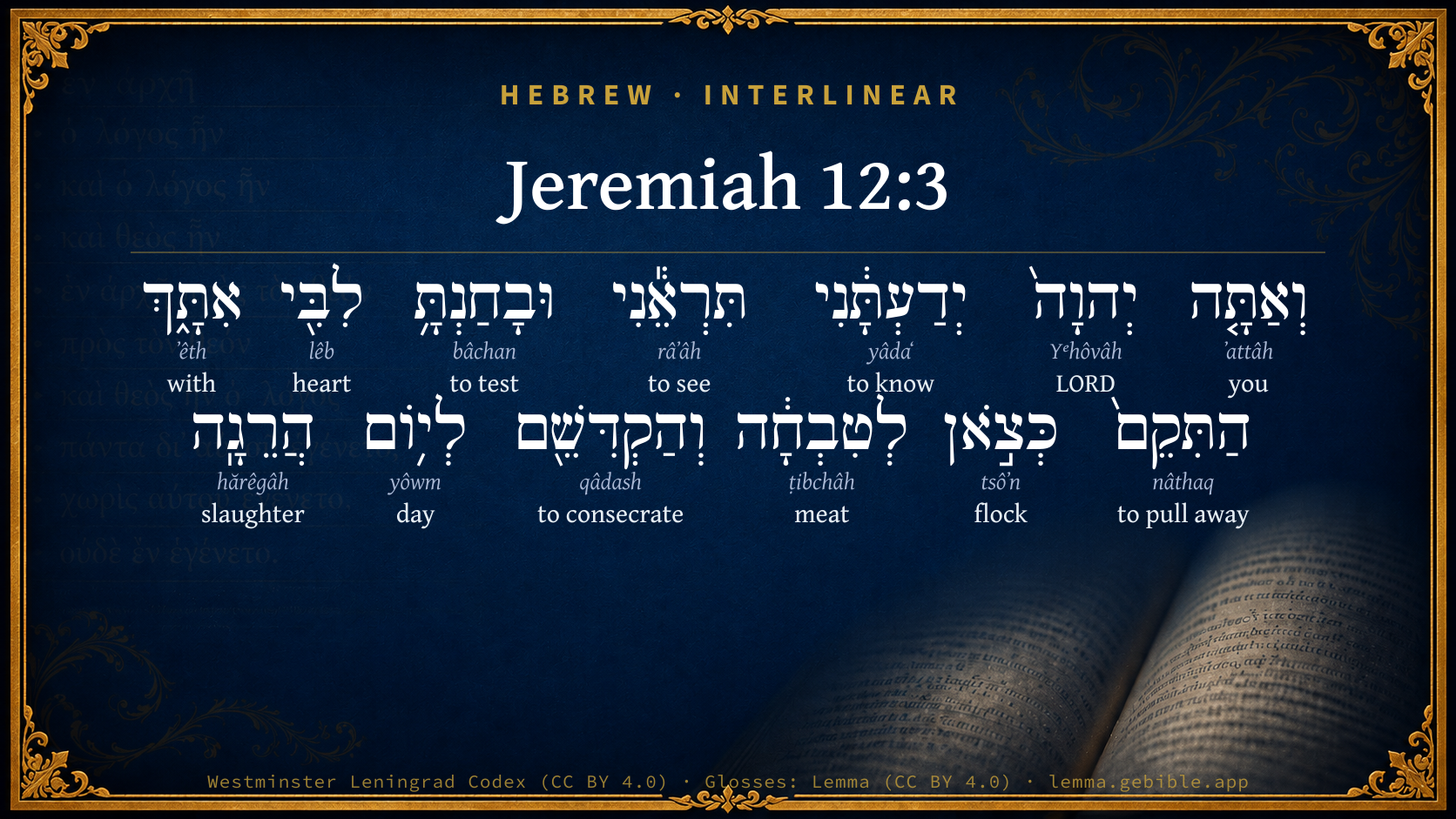
Hebrew (Westminster Leningrad Codex) Jeremiah 12:3 appears in the Hebrew Old Testament. The text above is from the Westminster Leningrad Codex. Each word links to its Strong’s number, a concise gloss, and parsing drawn from the Open Scriptures Hebrew Bible morphology. Click any word for its full Brown-Driver-Briggs (BDB) entry.
Download image
Cite this verse

Jeremiah 12:3 (World English Bible). Public Domain. Lemma interlinear Bible study tool, https://lemma.gebible.app/v/jeremiah/12/3.

Show BibTeX & RIS
BibTeX
RIS
English Translation
But you, Yahweh, know me; you see me, and try my heart toward you: pull them out like sheep for the slaughter, and prepare them for the day of slaughter.
World English Bible · Public Domain
Download a study sheet

One document with this verse’s original text, its word-by-word gloss line, the meaning frame, cross-references with their text, attributed commentary, and full source and license credits — printable, and it pastes into notes with its structure intact.

This verse Autodidact and up

Study sheet (.html) Plain text (.txt)

A passage Seminary Student

Up to 50 verses in one chapter. A passage sheet keeps up to 6 commentary sources and 12 cross-references per verse, in the order this page ranks them, and says so on the sheet whenever that leaves anything out. Ask for a single verse and you get the Autodidact verse sheet above.

Everything on this page stays free to read, with no account — the sheet is a download of what is already on screen, not access to it.

Want to remove ads? Support Godless Engineer
Compare translations 3

The same verse in 3 English versions, stacked beneath the original-language interlinear above. Click any original word for its lexicon entry.

Each is an independent rendering of the whole verse — the interlinear is not word-aligned to these translations.

Highlighted words mark where these versions differ — a whole-verse word diff, not a word-by-word alignment.

  • World English Bible Public Domain
    But you, Yahweh, know me; you see me, and try my heart toward you: pull them out like sheep for the slaughter, and prepare them for the day of slaughter.
  • King James Version Public Domain
    But thou, O LORD, knowest me: thou hast seen me, and tried mine heart toward thee: pull them out like sheep for the slaughter, and prepare them for the day of slaughter.
  • unfoldingWord Literal Text CC BY-SA 4.0
    But you, Yahweh, know me; you see me and you test my heart toward you. Drag them away like sheep for slaughter, and set them apart for the day of slaughter!

unfoldingWord Literal Text — © unfoldingWord, licensed CC BY-SA 4.0. Word-aligned USFM3 via Door43 (git.door43.org/unfoldingWord/en_ult).

Versions to compare (up to 4)

3 of 4 selected

Show all 18 translations

Every available English version of this verse, each an independent rendering of the whole verse.

  • World English Bible Public Domain
    But you, Yahweh, know me; you see me, and try my heart toward you: pull them out like sheep for the slaughter, and prepare them for the day of slaughter.
  • Berean Standard Bible Public Domain
    But You know me, O LORD; You see me and test my heart toward You. Drag away the wicked like sheep to the slaughter and set them apart for the day of carnage.
  • Majority Standard Bible Public Domain
    But You know me, O LORD; You see me and test my heart toward You. Drag away the wicked like sheep to the slaughter and set them apart for the day of carnage.
  • King James Version Public Domain
    But thou, O LORD, knowest me: thou hast seen me, and tried mine heart toward thee: pull them out like sheep for the slaughter, and prepare them for the day of slaughter.
  • American Standard Version (1901) Public Domain
    But thou, O Jehovah, knowest me; thou seest me, and triest my heart toward thee: pull them out like sheep for the slaughter, and prepare them for the day of slaughter.
  • Revised Version (1885) Public Domain
    But thou, O LORD, knowest me; thou seest me, and triest mine heart toward thee: pull them out like sheep for the slaughter, and prepare them for the day of slaughter.
  • Geneva Bible (1599) Public Domain
    But thou, Lord, knowest me: thou hast seene me, and tried mine heart towarde thee: pull them out like sheepe for the slaughter, and prepare them for the day of slaughter.
  • Douay-Rheims (1899) Public Domain
    And thou, O Lord, hast known me, thou hast seen me, and proved my heart with thee: gather them together as sheep for a sacrifice, and prepare them for the day of slaughter.
  • Young's Literal Translation Public Domain
    And Thou, O Jehovah, Thou hast known me, Thou seest me, and hast tried my heart with Thee, Draw them away as sheep to slaughter, And separate them for a day of slaughter.
  • Literal Standard Version CC BY-SA 4.0
    And You, O YHWH, You have known me, || You see me, and have tried my heart with You, || Draw them away as sheep to slaughter, || And separate them for a day of slaughter.
  • Unlocked Literal Bible CC BY-SA 4.0
    Yet you, Yahweh, know me. You see me and you test my heart toward you. Take them away like sheep to the slaughter, and set them apart for the day of slaughter!
  • unfoldingWord Literal Text CC BY-SA 4.0
    But you, Yahweh, know me; you see me and you test my heart toward you. Drag them away like sheep for slaughter, and set them apart for the day of slaughter!
  • Darby Bible Public Domain
    But thou, Jehovah, knowest me; thou hast seen me, and proved my heart toward thee. Drag them out like sheep for the slaughter, and set them apart for the day of slaughter.
  • World Messianic Bible Public Domain
    But you, LORD, know me. You see me, and test my heart toward you. Pull them out like sheep for the slaughter, and prepare them for the day of slaughter.
  • Webster's Bible Public Domain
    But thou, O LORD, knowest me: thou hast seen me, and tried my heart towards thee: pull them out like sheep for the slaughter, and prepare them for the day of slaughter.
  • Free Bible Version CC BY-SA 4.0
    But you know me, Lord, you see me, and examine what I think about you. Drag off these people like sheep to be slaughtered; keep them apart for the time when they're killed.
  • Bible in Basic English Public Domain
    But you, O Lord, have knowledge of me; you see me, searching and testing how my heart is with you: let them be pulled out like sheep to be put to death, make them ready for the day of death.
  • JPS Tanakh (1917) Public Domain
    But Thou, O LORD, knowest me, Thou seest me, and triest my heart toward Thee; pull them out like sheep for the slaughter, and prepare them for the day of slaughter.

Literal Standard Version (2020), Covenant Press — licensed CC BY-SA 4.0. Text via the HelloAO Bible API (eBible.org). Unlocked Literal Bible (unfoldingWord) — licensed CC BY-SA 4.0. Text via the HelloAO Bible API (eBible.org). unfoldingWord Literal Text — © unfoldingWord, licensed CC BY-SA 4.0. Word-aligned USFM3 via Door43 (git.door43.org/unfoldingWord/en_ult). Free Bible Version, Dr. Jonathan Gallagher — licensed CC BY-SA 4.0. Text via the HelloAO Bible API (eBible.org).

Word by word

More ways to search: Search by grammar → Find every occurrence → Compare this word →

Practice this passage: Drill this verse → Learn its vocabulary →

לְטִבְחָ֔ה
ṭibchâh
H2878
“to/for · meat”
Preposition + Noun, Common, Feminine, Singular, Absolute
Part of Speech
Preposition + Noun
Type
Common
Gender
Feminine
Number
Singular
State
Absolute
Full BDB Definition

Origin: from H2874

TWOT: 786b

slaughtered meat, a slaughter, flesh, meat, thing slaughtered
  1. וְאַתָּ֤ה ʼattâh H859 “and · you” Conjunction + Pronoun, Personal, 2nd Person, Masculine, Singular
  2. יְהוָה֙ Yᵉhôvâh H3068 “LORD” Noun, Proper
  3. יְדַעְתָּ֔נִי yâdaʻ H3045 “to know · me” Verb, Qal, Perfect, 2nd Person, Masculine, Singular + Suffix, Personal, 1st Person, Common, Singular
  4. תִּרְאֵ֕נִי râʼâh H7200 “to see · me” Verb, Qal, Imperfect, 2nd Person, Masculine, Singular + Suffix, Personal, 1st Person, Common, Singular
  5. וּבָחַנְתָּ֥ bâchan H974 “and · to test” Conjunction + Verb, Qal, Sequential Perfect, 2nd Person, Masculine, Singular
  6. לִבִּ֖י lêb H3820 “heart · my” Noun, Common, Masculine, Singular, Construct + Suffix, Personal, 1st Person, Common, Singular
  7. אִתָּ֑ךְ ʼêth H854 “with · you” Preposition + Suffix, Personal, 2nd Person, Feminine, Singular
  8. הַתִּקֵם֙ nâthaq H5423 “pull away · them” Verb, Hiphil, Imperative, 2nd Person, Masculine, Singular + Suffix, Personal, 3rd Person, Masculine, Plural
  9. כְּצֹ֣אן tsôʼn H6629 “like/as · flock” Preposition + Noun, Common, Both, Singular, Absolute
  10. וְהַקְדִּשֵׁ֖ם qâdash H6942 “and · consecrate · them” Conjunction + Verb, Hiphil, Imperative, 2nd Person, Masculine, Singular + Suffix, Personal, 3rd Person, Masculine, Plural
  11. לְי֥וֹם yôwm H3117 “to/for · day of” Preposition + Noun, Common, Masculine, Singular, Construct
  12. הֲרֵגָֽה hărêgâh H2028 “slaughter” Noun, Common, Feminine, Singular, Absolute

About this verse

These counts appear in no published source. They are computed here, from the morphology-tagged text and Lemma’s own curated glosses. What Lemma adds →

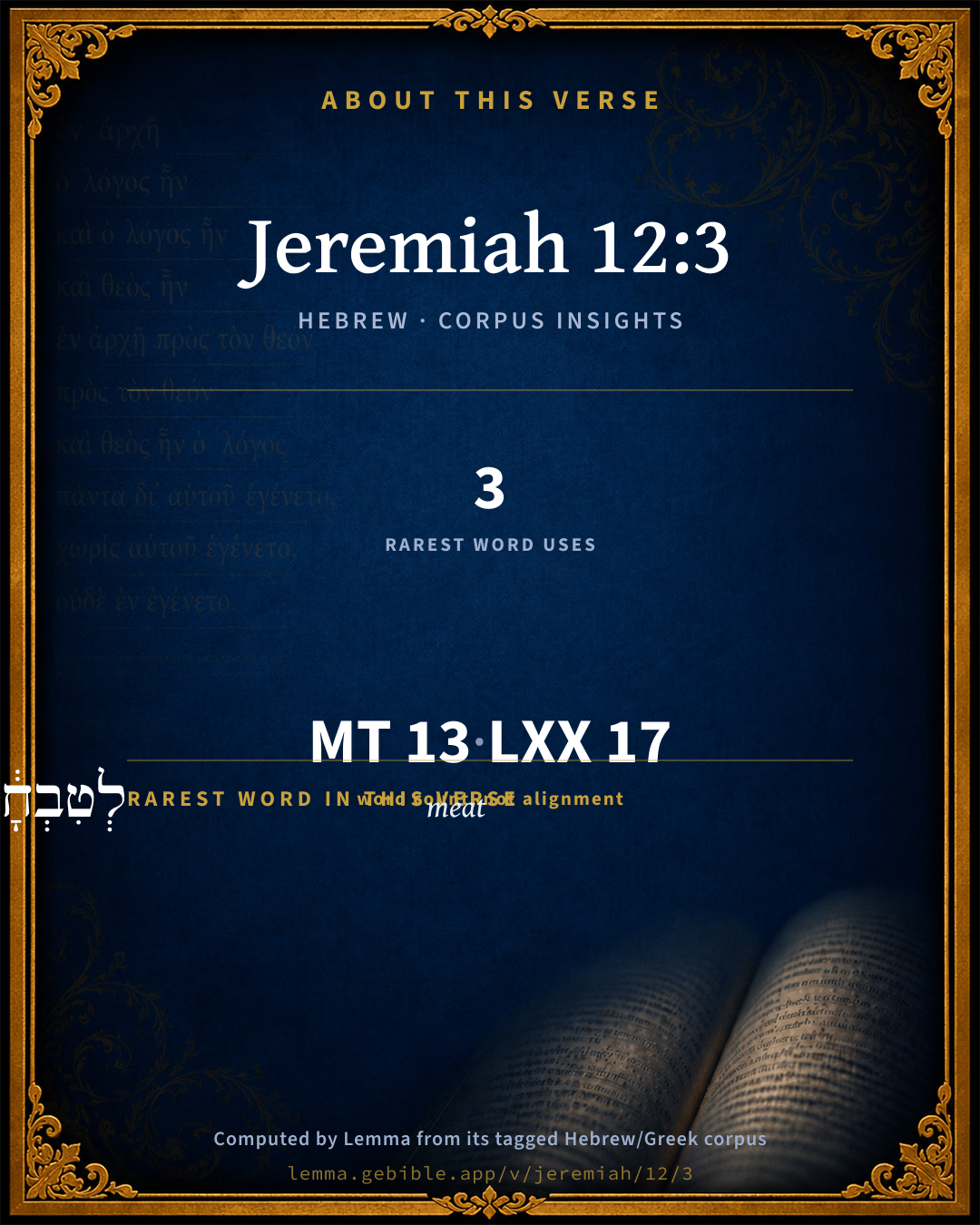
13
words
13
distinct lemmas
Prophets
section

Notable vocabulary

The rarest word here is לְטִבְחָ֔ה meat H2878 — appearing just 3 times in the whole Hebrew Bible.

Shared distinctive vocabulary

לְטִבְחָ֔ה meat H2878 occurs in 3 verses of the Hebrew Bible. Also found in:

Grammatical profile

  • 5 verbs
  • 6 nouns
  • 1 pronoun
  • 1 preposition

Verb forms

  • יְדַעְתָּ֔נִי Qal · Perfect
  • תִּרְאֵ֕נִי Qal · Imperfect
  • וּבָחַנְתָּ֥ Qal · Sequential Perfect
  • הַתִּקֵם֙ Hiphil · Imperative
  • וְהַקְדִּשֵׁ֖ם Hiphil · Imperative

Hebrew & Septuagint length

In the original languages it is 13 Hebrew tokens and 17 Greek tokens — but the two are counted differently (Hebrew bundles its prefixes and suffixes into one token; the Greek is in lemma form), so that isn’t a like-for-like length.

Cross-references

20

Topical passages linked to Jeremiah 12:3 in the Treasury of Scripture Knowledge — connected by theme and wording, ordered by reader-vote popularity; previews shown in the World English Bible.

  • 2 Kings 20:3 Remember now, Yahweh, I beg you, how I have walked before you in truth and with a perfect heart, and have done that which is good in your sight. Hezekiah wept sore.
  • Jeremiah 17:18 Let them be disappointed who persecute me, but let not me be disappointed; let them be dismayed, but don't let me be dismayed; bring on them the day of evil, and destroy them with double destruction.
  • Psalms 17:3 You have proved my heart; you have visited me in the night; You have tried me, and found nothing; I have resolved that my mouth shall not disobey.
  • Psalms 139:1–4 Yahweh, you have searched me, And you know me.
  • James 5:5 You have lived delicately on the earth, and taken your pleasure. You have nourished your hearts as in a day of slaughter.
  • Psalms 26:1 Judge me, Yahweh, for I have walked in my integrity. I have trusted also in Yahweh without wavering.
  • Psalms 44:21–22 Won't God search this out? For he knows the secrets of the heart.
  • Psalms 139:23 Search me, God, and know my heart. Try me, and know my thoughts.
  • Jeremiah 50:27 Kill all her bulls; let them go down to the slaughter: woe to them! for their day is come, the time of their visitation.
  • 1 Chronicles 29:17 I know also, my God, that you try the heart, and have pleasure in uprightness. As for me, in the uprightness of my heart I have willingly offered all these things: and now have I seen with joy your people, that are present here, offer willingly to you.
  • Job 23:10 But he knows the way that I take. When he has tried me, I shall come forth like gold.
  • Psalms 7:9 Oh let the wickedness of the wicked come to an end, But establish the righteous; Their minds and hearts are searched by the righteous God.
  • Psalms 11:5 Yahweh examines the righteous, But the wicked and him who loves violence his soul hates.
  • Jeremiah 11:19–20 But I was like a gentle lamb that is led to the slaughter; and I didn't know that they had devised devices against me, [saying], Let us destroy the tree with the fruit of it, and let us cut him off from the land of the living, that his name may be no more remembered.
  • Jeremiah 18:21–23 Therefore deliver up their children to the famine, and give them over to the power of the sword; and let their wives become childless, and widows; and let their men be slain of death, [and] their young men struck of the sword in battle.
  • Jeremiah 20:12 But, Yahweh of Hosts, who tests the righteous, who sees the heart and the mind, let me see your vengeance on them; for to you have I revealed my cause.
  • Jeremiah 48:15 Moab is laid waste, and they are gone up into his cities, and his chosen young men are gone down to the slaughter, says the King, whose name is Yahweh of Hosts.
  • Jeremiah 51:4 They shall fall down slain in the land of the Chaldeans, and thrust through in her streets.
  • John 21:17 He said to him the third time, "Simon, son of Jonah, do you have affection for me?" Peter was grieved because he asked him the third time, "Do you have affection for me?" He said to him, "Lord, you know everything. You know that I have affection for you." Jesus said to him, "Feed my sheep.
  • 1 John 3:20–21 because if our heart condemns us, God is greater than our heart, and knows all things.

Cross-references courtesy of OpenBible.info (CC BY 4.0).

Hebrew and Greek witnesses Masoretic Hebrew ↔ Greek Septuagint

The same verse in the two great witnesses to the Old Testament, shown verse-for-verse.

These are two independent witnesses, not word-aligned to each other, and the Septuagint is shown in lemma (dictionary) form.

Hebrew Jeremiah 12:3 Masoretic · Westminster Leningrad Codex

וְאַתָּ֤ה יְהוָה֙ יְדַעְתָּ֔נִי תִּרְאֵ֕נִי וּבָחַנְתָּ֥ לִבִּ֖י אִתָּ֑ךְ הַתִּקֵם֙ כְּצֹ֣אן לְטִבְחָ֔ה וְהַקְדִּשֵׁ֖ם לְי֥וֹם הֲרֵגָֽה

But you, Yahweh, know me; you see me, and try my heart toward you: pull them out like sheep for the slaughter, and prepare them for the day of slaughter.

World English Bible · Public Domain

Greek LXX Structure differs

In the Septuagint, Jeremiah is about an eighth shorter than the Hebrew and arranges its material differently — the Oracles Against the Nations (Hebrew chapters 46–51) appear in the middle of the Greek book, after 25:13. Because the chapter and verse boundaries do not line up, a verse-for-verse comparison with the Hebrew is not shown.

A verse-for-verse comparison isn’t shown here because the chapters and verses don’t line up. Switch to the LXX edition with the MT / LXX toggle above to read the Greek directly.

Hebrew: Westminster Leningrad Codex (CC BY 4.0). Greek: Septuagint (public domain); English from a public-domain English Septuagint. How the Septuagint differs from the Hebrew →

Targum (Aramaic paraphrase)

1

The Targum is the ancient Jewish Aramaic paraphrase of the Hebrew Scriptures — an interpretive translation, not the Hebrew text itself. Onkelos (literal) and Pseudo-Jonathan (expansive) render the Torah, and Jonathan the Prophets. Coverage is partial: where no permissively-licensed English translation exists for a verse, only the Aramaic is shown. This is verse-level text, not a word-by-word alignment to the Hebrew.

  1. Targum Jonathan Prophets (Joshua–Malachi)
    וְאַתְּ יְיָ כּוֹלָא יְדִיעַ וּגְלֵי קֳדָמָךְ דְאַתְּ בָּחַר לְבָבַיָא (וְדָעָן) דְרָעַן בִּדְחַלְתָּךְ רַשִׁיעַיָא אַתְקְנִינוּן כְּעָנָא לְנִכְסְתָא וְזַמְנִינוּן לְיוֹם קָטוֹלֵי:

    (no public-domain English translation for this verse)

    Targum Jonathan — Aramaic: “Mikraot Gedolot” (public domain). English: “Sefaria Community Translation” (CC0 1.0 (public-domain dedication)); “London "Chaldee Paraphrase," 1871” (public domain). Text via Sefaria.

Commentary

Notes on Jeremiah 12:3 from classic Christian and Jewish commentators (each source and its license shown beneath its notes). The classic Christian expositions comment on the surrounding passage and are grouped to its opening verse, so a note may address several verses; the Jewish commentaries on the Tanakh (Rashi and others) are per-verse, so they appear only where the commentator wrote on this verse.

Lemma curates 59 commentaries, every one of them public domain or Creative Commons licensed, each selected and text-cleaned for this edition rather than reprinted as found. About our sources →

Trapp's Complete Commentary

John Trapp

Jer 12:3 But thou, O LORD, knowest me: thou hast seen me, and tried mine heart toward thee: pull them out like sheep for the slaughter, and prepare them for the day of slaughter.

Ver. 3. But thou, Lord, knowest me, &c., ] q.d., I can safely appeal unto thee, and take thee for a witness of mine innocence and integrity, that I have thee not in my mouth only, as they, but in my heart also, which is wholly devoted to thy fear, ut sit tecum, hanging toward thee, and hankering after thee continually. {a}

Pull them out as sheep.] Punish some of them presently for an example of thy providence, and reserve others of them till hereafter for an instance of thy patience. See Jer 11:20.

Prepare them.] Heb., Sanctify them. {as Isa 13:3; Isa 6:7} Fatted ware is but fitted for the shambles.

{a} Tremellius.

John Trapp, A Commentary or Exposition upon All the Books of the Old and New Testament (1647–1656) — public domain. Text from a community e-Sword module.

Tyndale Open Study Notes

Tyndale Open Resources

12:3 Although Jeremiah’s words seem self-righteous, he was submissive to the Lord’s personal searching of his heart. Jeremiah was also angry enough to demand that his enemies suffer the fate they had intended for him. He hoped they would be butchered or slaughtered like helpless sheep. Jeremiah did not seem to desire their forgiveness or their return to the Lord.

Tyndale Open Study Notes — © Tyndale Open Resources, licensed CC BY-SA 4.0. Text via the HelloAO Bible API.

Geneva Bible (1599)

Geneva Bible translators

The Hebrew word is, Sanctify them, meaning, that God would be sanctified in the destruction of the wicked, to whom God for a while giveth prosperity, that afterward they should the more feel his heavy judgment when they lack their riches which were a sign of his mercy.

Geneva Bible (1599) marginal notes — public domain. Text via Bolls.life.

Jamieson, Fausset & Brown

Robert Jamieson, A. R. Fausset & David Brown

knowest me-- (Psa 139:1).

tried . . . heart-- (Jer 11:20).

toward thee--rather, "with Thee," that is, entirely devoted to Thee; contrasted with the hypocrites (Jer 12:2), "near in . . . mouth, and far from . . . reins." This being so, how is it that I fare so ill, they so well?

pull . . . out--containing the metaphor, from a "rooted tree" (Jer 12:2).

prepare--literally, "separate," or "set apart as devoted."

day of slaughter-- (Jam 5:5).

Jamieson, Fausset & Brown — Commentary Critical and Explanatory on the Whole Bible (1871) — public domain (CC PDM 1.0). Text via the HelloAO Bible API.

Adam Clarke's Commentary

Verse 3. But thou, O Lord, knowest me] I know that the very secrets of my heart are known to thee; and I am glad of it, for thou knowest that my heart is towards thee - is upright and sincere.

Adam Clarke's Commentary on the Bible (1810–1826) — public domain. Text from a community e-Sword/MySword module.

John Calvin's Commentaries

The Prophet is not here solicitous about himself, but, on the contrary, undertakes the defense of his own office, as though he had said that, he faithfully discharged the office committed to him by God. Though then the Jews, and even the citizens of Anathoth, his own people, unjustly persecuted him, yet he was not excited by private wrongs; and though he disregarded these entirely, he yet could not give up the defense of his office. He then does not speak here of his own private feelings, but only claims for himself faithfulness and sincerity before God in performing his office as a teacher; as though he had said that he executed what God had commanded him to do, and that therefore the Jews contended not with a mortal being, but with God himself.

Hence he says, But thou, Jehovah, knowest me and seest me, and triest my heart towards thee; that is, thou knowest how sincerely I serve thee, and endeavor to fulfin my vocation, and thus to obey thy command. He afterwards glories over them as a conqueror, and says, Draw them forth as sheep for the day of sacrificing, prepare them for slaughter Here no doubt the Prophet intended not only to touch, but sharply to wound the Jews, in order that they might know that they had been hitherto secure to no purpose, and to their own ruin, because God had spared them. They who consider that the Prophet was himself troubled, because he saw that God was propitious and kind to the ungodly, think that, with reference to himself, he took comfort from this, — that the judgment of God was nigh at hand; but I doubt not but that the Prophet had regard to the Jews, as I have already reminded you. When, therefore, he saw that they were torpid in their delusions, he intended to rouse their sensibilities by saying, “I see how it is, O Lord; thou dost indeed concede thyself; but what else is thy purpose but that they should be fattened for the day of slaughter?”

He says, first, Thou wilt draw them out: others read, “Thou wilt lead them forth,” and quote a passage in Judges 20:32, where נתק nutak, is taken in this sense. The word properly means to draw out with force, as when a tree is pulled up, or when any one is drawn out against his will; and this is the sense most suitable to the present passage. Thou wilt then draw them out; that is, thou wilt suddenly draw them out to slaughter. He then intimates that there was no reason for the Jews to be dormant in their prosperity, for God could in a moment act against them; and as the pain of one in labor is sudden, so also, when the wicked say, Peace and security, their ruin will come suddenly upon them. (1 Thessalonians 5:3) This then is what the Prophet now means: but he goes on in his way of teaching; for he does not address men as they were all deaf, but speaks to God himself, that his doctrine might be more effectual: Thou then wilt draw them out, and do thou prepare them; for it is a prayer: do thou then prepare them for the day of slaughter

The last expression ought especially to be noticed. The Prophet indeed seems here in an excited feeling to imprecate ruin on the people; but there is no doubt but that he was here discharging the duty of his office, for he was the herald of God’s vengeance. He therefore asks God to execute what he had commanded him to denounce on the people. He had often promulgated what God had resolved to do to them, but he had moved no one: he now then asks God to fulfin what he had foretold the Jews — that they should shortly perish, because they refused to repent.

We may also learn from this passage, — that when the ungodly accumulate wealth, they are in a manner fattened. When oxen plough, and sheep are fed that they may bear wool and bring forth young, they are not fed that they may grow fat, and a moderate quantity of food will suffice them; but when any one intends to prepare sheep or oxen for the slaughter, he fattens them. So then the feeding of them is nothing else than the fattening of them; and the fattening of them is a preparation for their slaughter. I have therefore said that a very useful doctrine is included in this form of speaking; for when we see that plenty of wealth and power abound with the ungodly and the despisers of God, we see that they are in a manner thus fined with good things, that they may grow fat: — it is fattening or cramming. Let us then not bear it in that they are thus covered with their own fatness, for they are prepared for the day of slaughter. It follows —

John Calvin's Commentaries (1540-1563) — public domain. Text from the Calvin Translation Society English edition (1840s-50s) via the Christian Classics Ethereal Library (ccel.org). Calvin's coverage is partial (roughly two-thirds of the Bible); uncommented books and verses are honest gaps, never fabricated. The 19th-century editor's footnotes and remarks are omitted so the notes are faithfully Calvin's own voice.

Ellicott's Commentary for English Readers

(3) Thou, O Lord, knowest me.—Like all faithful sufferers from evil-doers before and after him, the prophet appeals to the righteous Judge, who knows how falsely he has been accused. In words in which the natural impatience of suffering shows itself as clearly as in the complaints of Psalms 69, 109, he asks that the judgment may be immediate, open, terrible. As if recalling the very phrase which he had himself but lately used (Jer_11:19), he prays that they too may be as “sheep for the slaughter,” dragged or torn away from their security to the righteous penalty of their wrong.

Prepare.—Better, devote. The Hebrew word, as in Jer_6:4, involves the idea of consecration.

A Bible Commentary for English Readers, edited by Charles John Ellicott (1878–1897) — public domain. Text from a community e-Sword module.

The Cambridge Bible for Schools and Colleges

gen. ed. J. J. S. Perowne

3. The second half of the v. presents some difficulty. Jeremiah’s personal enemies have not yet been definitely mentioned, nor, if we take Co.’s view and place this passage (see on Jer_11:18-23) earlier, have they been even hinted at. If, on the other hand, it refers to the wicked generally, we may question whether Jeremiah drew a distinction between their coming fortunes and those of the nation as a whole. Co. accordingly agrees so far with Du. as to omit this part of the v.

pull them out] a strong expression in the Hebrew. The verb is that rendered “are broken” in Jer_10:20.

prepare] For mg. Heb. sanctify see on Jer_6:4.

The Cambridge Bible for Schools and Colleges (gen. ed. J. J. S. Perowne; Cambridge University Press, 1878–1918) — public domain. Text from a community e-Sword module.

John Gill's Exposition

But thou, O Lord, knowest me,.... The Lord knew him before he was born, Jer 1:5, he knew what he designed him for, and what use he would make of him; and he knew him now, and loved him, and cared for him, as his prophet; he knew his sincerity and faithfulness, and took notice of it, with what integrity he performed his office, and discharged his duty; and he knew that all his enemies said of him were scandal and reproach, lies and calumnies.

Thou hast seen me; his inside, his heart, and all in it; for all things are naked and open to the eyes of an omniscient God:

and tried mine heart towards thee; he had tried him by various afflictive providences, and his heart was found towards God; the affections and desires of his soul were towards him, and he remained faithful and upright before him, and not like the wicked before mentioned.

Pull them out like sheep for the slaughter; either out of the fold, or from a fat pasture; so fat sheep are plucked from the rest, in order to be killed: this shows that their riches, affluence, and plenty, served but to ripen them for ruin and destruction, and were like the fattening of sheep for slaughter; which the prophet, by this imprecation, suggests and foretells would be their case, as a righteous judgment upon them; see Jam 5:5.

Prepare them for the day of slaughter; or, "sanctify them" (w); set them apart for it: this, doubtless, refers to the time of Jerusalem's destruction by the Chaldeans.

(w) "et sanctifica eos", V. L. Montanus; "segrega", Piscator; "destina", Schmidt; "consecra", Cocceius.

John Gill's Exposition of the Whole Bible (1746–1763) — public domain (CC PDM 1.0). Text via the HelloAO Bible API.

Albert Barnes' Notes on the Bible

Thou hast seen me ... - Rather, “Thou seest me and triest mine heart” at all times, and knowest the sincerity of its devotion” toward Thee.”

Pull them out - The original is used Jer 10:20 of the rending asunder of the cords of the tent, and Eze 17:9 of the tearing up of roots. Jeremiah does not doubt God’s justice, or the ultimate punishment of the wicked, but he wants it administered in a summary way.

Prepare - literally, “sanctify,” i. e., devote.

Albert Barnes' Notes on the Bible (1834–1885) — public domain. Text from a community e-Sword/MySword module.

Haydock's Catholic Bible Commentary

Gather. God orders his prophet to announce the misery of the wicked.

George Leo Haydock (1774–1849), Haydock's Catholic Family Bible and Commentary, 1859 edition — public domain. Excludes Psalms (Douay-Rheims chapter numbering differs from Protestant) and Deuterocanonical books (Catholic canon only).

Matthew Poole's English Annotations

But thou, O Lord, knowest me: thou hast seen me, and tried my heart toward thee: here seemeth to be something understood, viz. But, Lord, it is otherwise with me, I am maligned, and my life is hunted after; yet, Lord, thou knowest the sincerity of my heart before and towards thee, thou hast had experience of me in the discharge of my prophetical office, and knowest that I have been faithful in revealing to the people what thou didst reveal to me, yet for this it is they seek my life and would have my blood.

Prepare them for the day of slaughter: Lord, avenge me on this wicked generation, confirm the words against them which I have from thee denounced. Concerning the meaning of expressions of this nature, and the lawfulness of putting up such petitions against those who are not only our enemies, but God’s also, See Poole "Jer 11:20".

Matthew Poole's English Annotations on the Holy Bible (1683–1685) — public domain. Text from a community e-Sword/MySword module.

Whedon's Commentary on the Bible

Daniel D. Whedon

3. Thou, O Lord, knowest me — A solemn appeal to the heart-searching God, not in the spirit of Phariseeism, but with a clear consciousness of thorough honesty. The fact that God is omniscient is terrible to the sinner, but a source of ineffably precious consolation and strength to the Christian.

Pull them out — Literally, tear them out. The same word is used in Jer_10:20, of the breaking of the cords of the tent, and in Eze_17:9, of the tearing up of roots. No more vigorous word could have been used in this place.

Daniel D. Whedon (gen. ed.), Commentary on the Old and New Testaments (1874–1909) — public domain. Text from a community e-Sword module.

The Pulpit Commentary

Hast seen me, and tried; rather, seest me, and triest. Pull them out. Perhaps this is correct, and there is an allusion to the figure of the plant in Ver. 2. But the verb need mean no more than "separate". (Jer_6:29) Prepare them; literally, consecrate them, as victims for the sacrifice.

Imprecatory prayers.

"Pull them out like sheep," etc. There are many of these. Some of them, like this one, are very terrible. (cf. Ps 109 Psa_137:9, etc.) How are they to be understood? how justified? Of what use are they to us now? Questions like these cannot but be started in reading such prayers. The difficulty of them has been felt by almost every Christian and even humane reader. To get rid of such difficulty

I SOME HAVE SPIRITUALIZED THEM. The slaughter work which they call for is to be done, not on human bodies, but on human wickednesses, those inward and deadly foes which are so many and which hate us with cruel hatred. But whilst it is quite lawful to so make use of these petitions, it cannot be said that this is what they who first prayed them meant.

II OTHERS HAVE TRIED TO TURN THEM SIMPLY INTO PROPHETIC PREDICTIONS mere announcements of what God would do. But such alteration would never have been thought of but for the moral difficulty of letting them stand as they are. And the alteration is not permissible.

III OTHERS, VERY MANY, HAVE EXPLAINED THEM ON THE GROUND OF THE IMPERFECT SPIRITUAL CONDITION OF GOD"S ANCIENT PEOPLE. "They knew," it is said, "no better. True, their prayers are wrong, unchristian, cruel, but they are to be excused because of the dim light, the very partial knowledge, of those days." But, in reply, it is clear that they were not ignorant; they had plain laws against revenge. (cf. Lev_19:8 Exo_23:4, Exo_23:5) And hence St. Paul, when arguing against revenge, cites the Old Testament, as in Rom_12:19, Rom_12:20, quoting from Deu_32:35 and Pro_25:21. (cf. also Pro_20:22 Pro_24:17) And Job (Job 31) emphatically disavows both the act and thought of revenge; and so David. (Psa_7:4, Psa_7:5) And see David"s conduct in regard to Saul twice. See, too, his gratitude to Abigail for holding him back from revenge. (1Sa 25) And they had numerous laws enjoining mercy (cf. also Balaam"s speech, given in Micah, "What cloth the Lord require of thee, but to do justly, and to love mercy," etc.?).

IV OTHERS HAVE SAID THAT SUCH REVENGEFUL UTTERANCES ARE BUT THE HUMAN ELEMENT IN THE OLD TESTAMENT WRITERS that they were not inspired when they thus speak. But David claims inspiration. (2Sa_23:1, 2Sa_23:2) And the apostles claim it for him; and with especial reference to the hundred and ninth psalm, one of the most notable of these utterances. (Act_1:16) And they were composed for the temple service as acts of worship. Hengstenberg says of them," They were from the first destined for use in the sanctuary. The sacred authors come forth under the full consciousness of being interpreters of the spiritual feelings of the community, organs of God for the ennobling of their feelings. They give back what in the holiest and purest hours of their life had been given to them." Hence we are compelled to regard these utterances as being only

V THAT WHICH IT WOULD BE RIGHT FOR A GOOD MAN, PLACED IN THE LIKE CIRCUMSTANCES, BOTH TO FEEL AND UTTER. Let it be remembered:

1. They knew nothing or but little of the great day of future judgment as we do.

2. The judgments implicated are all temporal. It can never be fight to pray for the eternal damnation of any soul, and this they never do.

3. Many of the expressions are poetical.

4. These desires for the overthrow of their enemies were:

(1) Natural. Resentment against wrong, anger on account of it, and desire that it may be punished, are implanted in us. Let us but place ourselves in their position. How did we feel in the time, e.g., of the Indian Mutiny?

(2) Necessary. In those fierce days a stern and fierce spirit was needed if any people were to hold their own at all (cf. Isaac Taylor, on "Spirit of the Hebrew Poetry").

(3) Based on the eternal truth of Gods retributive justice. God had declared by word and deed this attribute of his. Could it, then, be wrong that they should call on him to show himself what he had declared himself to be?

(4) Left to God to carry out. "Unto God," says Jeremiah, "have I revealed or, "committed my cause.

(5) And in the New Testament we have some similar utterances. (Cf. Mat_23:11)

(6) And we ourselves in war which we all allow to be at times lawful act on these very principles, and do for ourselves what the Old Testament saints only besought God to do. Hence conclude that, in like circumstances and for similar reasons, such prayers as these are not evil. What the New Testament condemns is revenge for private personal injuries, for persecution when suffered for the gospel"s sake; but not war for defensive purposes, and therefore not the stern spirit which is essential to war. And one practical lesson from all such utterances is that they reflect what exists in God a determined and fierce hatred against wickedness and therefore they awaken a salutary fear of that vengeance and an earnest desire to flee from the wrath to come. C.

The Pulpit Commentary (1880–1919), ed. H.D.M. Spence-Jones & Joseph S. Exell — public domain. Text from a community e-Sword module.

unfoldingWord translationNotes

Door43 World Missions Community

General Information:

Jeremiah continues speaking to Yahweh.

my heart

Here the "heart" represents a person's thoughts and true feelings. AT: "my thoughts" or "my inner feelings" (See: Metonymy)

Take them away like sheep to the slaughter

Here Jeremiah asks Yahweh to prepare to punish the wicked as if they were sheep to be taken away to be slaughtered. AT: "Take the wicked people away, like sheep for slaughter" or "Prepare to punish those wicked people" (See: Metaphor)

the day of slaughter

"the day they will be destroyed"

How long will the land go on drying up ... because of the wickedness of its inhabitants?

Their land is dry and rain has not come as punishment for the peoples' wickedness.

wither

dry up

The animals and the birds have been taken away

This can be stated in active form. AT: "The animals and the birds are gone" or "The animals and the birds have all died" (See: Active or Passive)

God will not see what happens to us

Possible meanings are 1) The people are saying that God does not know what things will happen to them in their future or 2) God is unaware of their sin. AT: "God does not see the sinful things that we do"

translationWords

know

ewe

slaughter

set apart

mourn

beast

people group

God

unfoldingWord translationNotes — © Distant Shores Media and the Door43 World Missions Community, licensed CC BY-SA 4.0. Source: git.door43.org/Door43/en_tn.

Rashi

Rabbi Shlomo Yitzchaki (Rashi)

But You, O Lord, have known me Also, concerning the men of Anathoth You have aided me, for You have known me.

Draw them out like sheep to the slaughter Draw them out of life to death (detache les in French, separate them, cut them off). Comp. (Joshua 8:6) “until we have drawn (התיקנו) them from the city.”

and prepare them Heb. הקדישם, prepare them.

Rashi on the Tanakh — English translations: “The Judaica Press complete Tanach with Rashi, translated by A. J. Rosenberg” (CC BY 4.0); “Pentateuch with Rashi's commentary by M. Rosenbaum and A.M. Silbermann, 1929-1934” (public domain); “The Metsudah Tanach series, Lakewood, N.J” (CC BY 4.0); and “The Book of Joshua, Metsudah Publications, 1997” (CC BY 4.0). Text via Sefaria.

Lesson kit

Teaching starters — assembled from the data on this page, not authored interpretation. Every prompt links to the verse data it draws on. Edit before teaching.

Jeremiah, in the Prophets, opens this verse with 13 words (13 distinct Hebrew lemmas). Its most distinctive word is ṭibchâh (“meat”). A historical commentator’s framing appears above. Read the whole chapter for the surrounding context.

Discussion questions

  1. What does “meat” (ṭibchâh) contribute to the verse as a whole?
  2. How does 1 Samuel 25:11, which shares the word «meat», read alongside this verse?
  3. These translations render this verse differently. What is at stake in choosing one wording over another?
  4. «יְדַעְתָּ֔נִי» is a Qal Perfect verb. How does that grammatical form shape the action described?
  5. Compare how Trapp's Complete Commentary and Tyndale Open Study Notes read this verse. Where do they agree or differ?

Things to notice

Reading settings

Reading text

Shown beneath each verse's original-language words.

Old Testament
Old Testament edition

Read the OT as the Masoretic Hebrew (MT) or the Greek Septuagint (LXX).

English shown for the Greek Septuagint (in the Hebrew ↔ Greek comparison).

Comparing translations? Open the Compare panel on any verse page to stack up to four side by side.