
2 Samuel 12:4

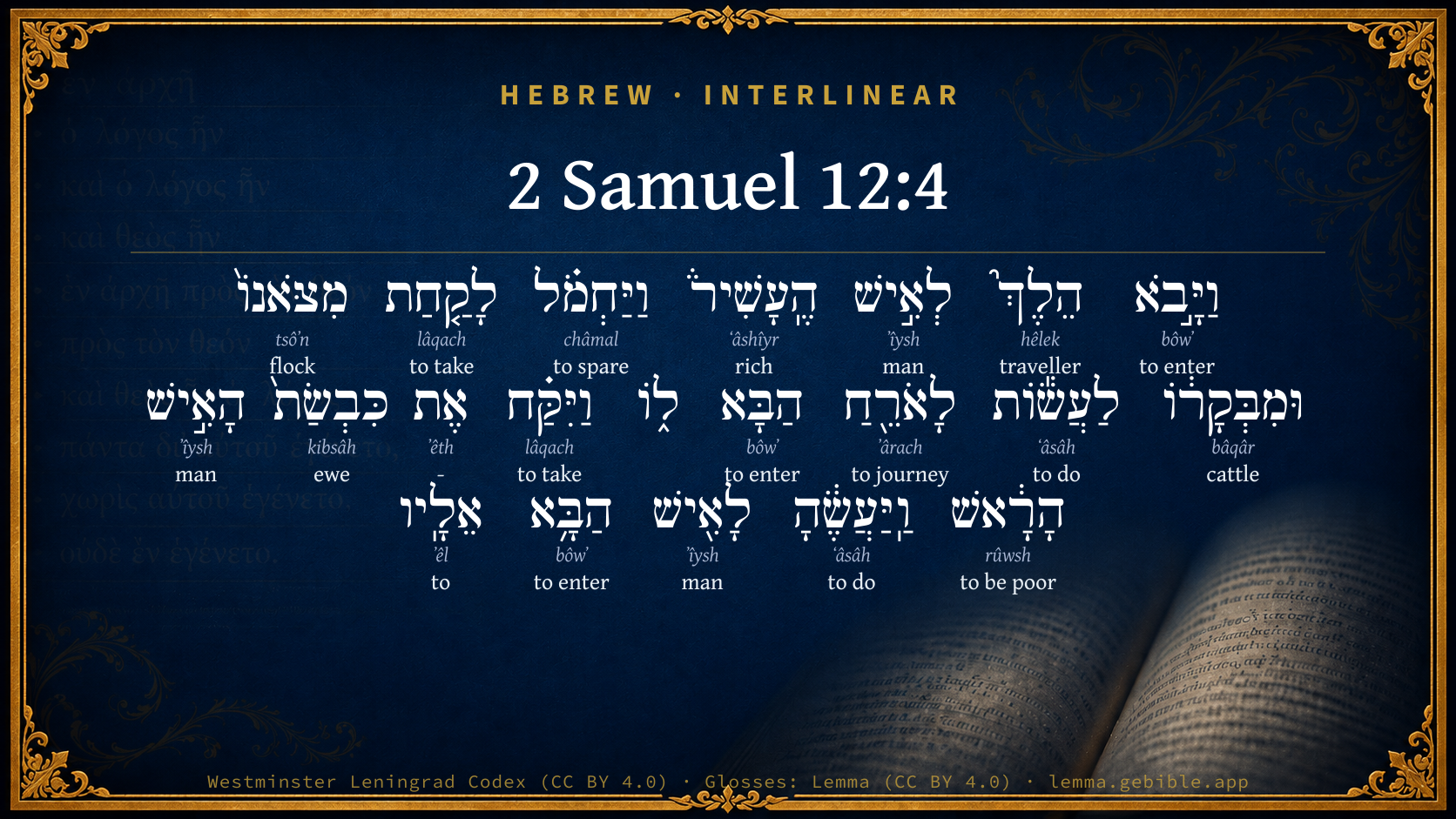
Hebrew (Westminster Leningrad Codex) 2 Samuel 12:4 appears in the Hebrew Old Testament. The text above is from the Westminster Leningrad Codex. Each word links to its Strong’s number, a concise gloss, and parsing drawn from the Open Scriptures Hebrew Bible morphology. Click any word for its full Brown-Driver-Briggs (BDB) entry.
Download image
Cite this verse

2 Samuel 12:4 (World English Bible). Public Domain. Lemma interlinear Bible study tool, https://lemma.gebible.app/v/2-samuel/12/4.

Show BibTeX & RIS
BibTeX
RIS
English Translation
A traveler came to the rich man, and he spared to take of his own flock and of his own herd, to dress for the wayfaring man who had come to him, but took the poor man's lamb, and dressed it for the man who had come to him."
World English Bible · Public Domain
Download a study sheet

One document with this verse’s original text, its word-by-word gloss line, the meaning frame, cross-references with their text, attributed commentary, and full source and license credits — printable, and it pastes into notes with its structure intact.

This verse Autodidact and up

Study sheet (.html) Plain text (.txt)

A passage Seminary Student

Up to 50 verses in one chapter. A passage sheet keeps up to 6 commentary sources and 12 cross-references per verse, in the order this page ranks them, and says so on the sheet whenever that leaves anything out. Ask for a single verse and you get the Autodidact verse sheet above.

Everything on this page stays free to read, with no account — the sheet is a download of what is already on screen, not access to it.

Want to remove ads? Support Godless Engineer
Compare translations 3

The same verse in 3 English versions, stacked beneath the original-language interlinear above. Click any original word for its lexicon entry.

Each is an independent rendering of the whole verse — the interlinear is not word-aligned to these translations.

Highlighted words mark where these versions differ — a whole-verse word diff, not a word-by-word alignment.

  • World English Bible Public Domain
    A traveler came to the rich man, and he spared to take of his own flock and of his own herd, to dress for the wayfaring man who had come to him, but took the poor man's lamb, and dressed it for the man who had come to him."
  • King James Version Public Domain
    And there came a traveler unto the rich man, and he spared to take of his own flock and of his own herd, to dress for the wayfaring man that was come unto him; but took the poor man's lamb, and dressed it for the man that was come to him.
  • unfoldingWord Literal Text CC BY-SA 4.0
    Now a traveler came to the rich man, and he spared to take from his flock or from his herd to prepare for the wayfarer having come to him, but he took the ewe of the poor man, and he prepared it for the man having come to him.”

unfoldingWord Literal Text — © unfoldingWord, licensed CC BY-SA 4.0. Word-aligned USFM3 via Door43 (git.door43.org/unfoldingWord/en_ult).

Versions to compare (up to 4)

3 of 4 selected

Show all 18 translations

Every available English version of this verse, each an independent rendering of the whole verse.

  • World English Bible Public Domain
    A traveler came to the rich man, and he spared to take of his own flock and of his own herd, to dress for the wayfaring man who had come to him, but took the poor man's lamb, and dressed it for the man who had come to him."
  • Berean Standard Bible Public Domain
    Now a traveler came to the rich man, who refrained from taking one of his own sheep or cattle to prepare for the traveler who had come to him. Instead, he took the poor man’s lamb and prepared it for his guest.”
  • Majority Standard Bible Public Domain
    Now a traveler came to the rich man, who refrained from taking one of his own sheep or cattle to prepare for the traveler who had come to him. Instead, he took the poor man’s lamb and prepared it for his guest.”
  • King James Version Public Domain
    And there came a traveler unto the rich man, and he spared to take of his own flock and of his own herd, to dress for the wayfaring man that was come unto him; but took the poor man's lamb, and dressed it for the man that was come to him.
  • American Standard Version (1901) Public Domain
    And there came a traveller unto the rich man, and he spared to take of his own flock and of his own herd, to dress for the wayfaring man that was come unto him, but took the poor man's lamb, and dressed it for the man that was come to him.
  • Revised Version (1885) Public Domain
    And there came a traveller unto the rich man, and he spared to take of his own flock and of his own herd, to dress for the wayfaring man that was come unto him, but took the poor man’s lamb, and dressed it for the man that was come to him.
  • Geneva Bible (1599) Public Domain
    Now there came a stranger vnto the rich man, who refused to take of his owne sheepe, and of his owne oxen to dresse for the stranger that was come vnto him, but tooke the poore mans sheepe, and dressed it for the man that was come to him.
  • Douay-Rheims (1899) Public Domain
    And when a certain stranger was come to the rich man, he spared to take of his own sheep and oxen, to make a feast for that stranger, who was come to him, but took the poor man's ewe, and dressed it for the man that was come to him.
  • Young's Literal Translation Public Domain
    And there cometh a traveller to the rich man, And he spareth to take Of his own flock, and of his own herd, To prepare for the traveller Who hath come to him, And he taketh the ewe-lamb of the poor man, And prepareth it for the man Who hath come unto him.'
  • Literal Standard Version CC BY-SA 4.0
    And a traveler comes to the rich man, and he spares to take from his own flock, and from his own herd, to prepare for the traveling [man] who has come to him; and he takes the ewe-lamb of the poor man and prepares it for the man who has come to him.”
  • Unlocked Literal Bible CC BY-SA 4.0
    One day a visitor came to the rich man, but the rich man was unwilling to take an animal from his own flocks and herds to provide food for him. Instead he took the poor man's ewe lamb and cooked it for his visitor.”
  • unfoldingWord Literal Text CC BY-SA 4.0
    Now a traveler came to the rich man, and he spared to take from his flock or from his herd to prepare for the wayfarer having come to him, but he took the ewe of the poor man, and he prepared it for the man having come to him.”
  • Darby Bible Public Domain
    And there came a traveller to the rich man, and he spared to take of his own flock and of his own herd, to dress for the wayfaring man that had come to him; and he took the poor man's lamb, and dressed it for the man that had come to him.
  • World Messianic Bible Public Domain
    A traveler came to the rich man, and he didn’t want to take of his own flock and of his own herd to prepare for the wayfaring man who had come to him, but took the poor man’s lamb and prepared it for the man who had come to him.”
  • Webster's Bible Public Domain
    And there came a traveler to the rich man, and he spared to take of his own flock and of his own herd, to dress for the way-faring man that had come to him; but took the poor man's lamb, and dressed it for the man that had come to him.
  • Free Bible Version CC BY-SA 4.0
    One day the rich man had a visitor. He didn't want to take one of his own sheep or cattle to feed his visitor. He took the poor man's lamb instead to prepare a meal for his visitor.”
  • Bible in Basic English Public Domain
    Now a traveller came to the house of the man of wealth, but he would not take anything from his flock or his herd to make a meal for the traveller who had come to him, but he took the poor man's lamb and made it ready for the man who had come.
  • JPS Tanakh (1917) Public Domain
    And there came a traveller unto the rich man, and he spared to take of his own flock and of his own herd, to dress for the wayfaring man that was come unto him, but took the poor man's lamb, and dressed it for the man that was come to him.'

Literal Standard Version (2020), Covenant Press — licensed CC BY-SA 4.0. Text via the HelloAO Bible API (eBible.org). Unlocked Literal Bible (unfoldingWord) — licensed CC BY-SA 4.0. Text via the HelloAO Bible API (eBible.org). unfoldingWord Literal Text — © unfoldingWord, licensed CC BY-SA 4.0. Word-aligned USFM3 via Door43 (git.door43.org/unfoldingWord/en_ult). Free Bible Version, Dr. Jonathan Gallagher — licensed CC BY-SA 4.0. Text via the HelloAO Bible API (eBible.org).

Word by word

More ways to search: Search by grammar → Find every occurrence → Compare this word →

Practice this passage: Drill this verse → Learn its vocabulary →

הֵלֶךְ֮
hêlek
H1982
“traveller”
Noun, Common, Masculine, Singular, Absolute
Part of Speech
Noun
Type
Common
Gender
Masculine
Number
Singular
State
Absolute
Full BDB Definition

Origin: from H1980

TWOT: 498a

traveller
  1. וַיָּ֣בֹא bôwʼ H935 “and · to enter” Conjunction + Verb, Qal, Sequential Imperfect, 3rd Person, Masculine, Singular
  2. לְאִ֣ישׁ ʼîysh H376 “to/for · man of” Preposition + Noun, Common, Masculine, Singular, Construct
  3. הֶֽעָשִׁיר֒ ʻâshîyr H6223 “the · rich” Particle, Definite Article + Adjective, Adjective, Masculine, Singular, Absolute
  4. וַיַּחְמֹ֗ל châmal H2550 “and · to spare” Conjunction + Verb, Qal, Sequential Imperfect, 3rd Person, Masculine, Singular
  5. לָקַ֤חַת lâqach H3947 “to take” Preposition + Verb, Qal, Infinitive Construct
  6. מִצֹּאנוֹ֙ tsôʼn H6629 “from · flock · his” Preposition + Noun, Common, Both, Singular, Construct + Suffix, Personal, 3rd Person, Masculine, Singular
  7. וּמִבְּקָר֔וֹ bâqâr H1241 “and · from · cattle · his” Conjunction + Preposition + Noun, Common, Both, Singular, Construct + Suffix, Personal, 3rd Person, Masculine, Singular
  8. לַעֲשׂ֕וֹת ʻâsâh H6213 “to do” Preposition + Verb, Qal, Infinitive Construct
  9. לָאֹרֵ֖חַ ʼârach H732 “to/for the · journeying” Preposition, Determined + Verb, Qal, Participle Active, Masculine, Singular, Absolute
  10. הַבָּא bôwʼ H935 “the · entering” Particle, Definite Article + Verb, Qal, Participle Active, Masculine, Singular, Absolute
  11. וַיִּקַּ֗ח lâqach H3947 “and · to take” Conjunction + Verb, Qal, Sequential Imperfect, 3rd Person, Masculine, Singular
  12. אֶת ʼêth H853 “-” Particle, Direct Object
  13. כִּבְשַׂת֙ kibsâh H3535 “ewe of” Noun, Common, Feminine, Singular, Construct
  14. הָאִ֣ישׁ ʼîysh H376 “the · man” Particle, Definite Article + Noun, Common, Masculine, Singular, Absolute
  15. הָרָ֔אשׁ rûwsh H7326 “the · being poor” Particle, Definite Article + Verb, Qal, Participle Active, Masculine, Singular, Absolute
  16. וַֽיַּעֲשֶׂ֔הָ ʻâsâh H6213 “and · to do · her” Conjunction + Verb, Qal, Sequential Imperfect, 3rd Person, Masculine, Singular + Suffix, Personal, 3rd Person, Feminine, Singular
  17. לָאִ֖ישׁ ʼîysh H376 “to/for the · man” Preposition, Determined + Noun, Common, Masculine, Singular, Absolute
  18. הַבָּ֥א bôwʼ H935 “the · entering” Particle, Definite Article + Verb, Qal, Participle Active, Masculine, Singular, Absolute
  19. אֵלָֽיו ʼêl H413 “to · him” Preposition + Suffix, Personal, 3rd Person, Masculine, Singular

About this verse

These counts appear in no published source. They are computed here, from the morphology-tagged text and Lemma’s own curated glosses. What Lemma adds →

21
words
14
distinct lemmas
Historical
section

Notable vocabulary

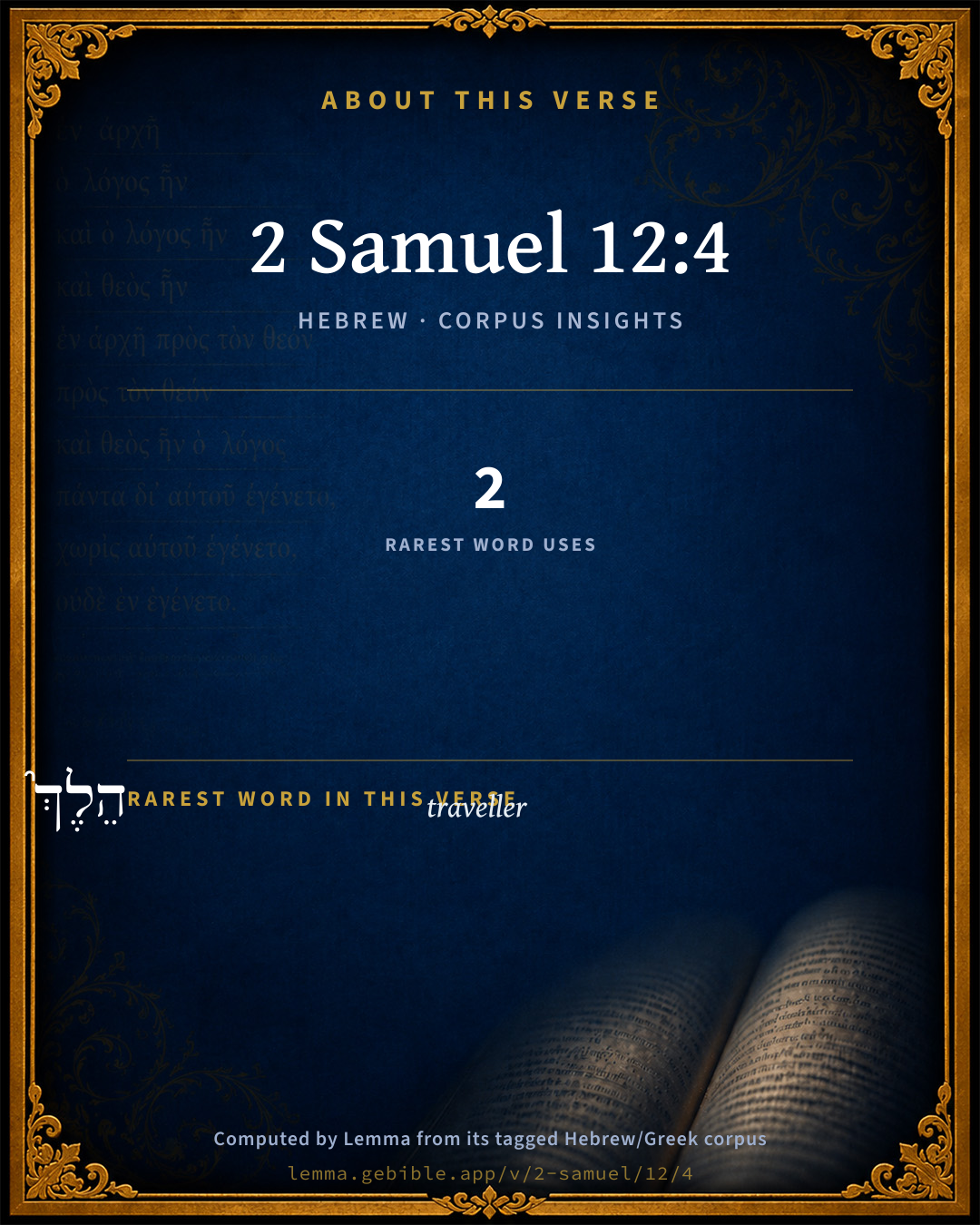
The rarest word here is הֵלֶךְ֮ traveller H1982 — appearing just 2 times in the whole Hebrew Bible.

Shared distinctive vocabulary

הֵלֶךְ֮ traveller H1982 occurs in 2 verses of the Hebrew Bible. Also found in:

Grammatical profile

  • 10 verbs
  • 7 nouns
  • 1 adjective
  • 2 prepositions
  • 1 particle

Verb forms

  • וַיָּ֣בֹא Qal · Sequential Imperfect
  • וַיַּחְמֹ֗ל Qal · Sequential Imperfect
  • לָקַ֤חַת Qal · Infinitive Construct
  • לַעֲשׂ֕וֹת Qal · Infinitive Construct
  • לָאֹרֵ֖חַ Qal · Participle Active
  • הַבָּא Qal · Participle Active
  • וַיִּקַּ֗ח Qal · Sequential Imperfect
  • הָרָ֔אשׁ Qal · Participle Active
  • וַֽיַּעֲשֶׂ֔הָ Qal · Sequential Imperfect
  • הַבָּ֥א Qal · Participle Active

Repetition

Words recur within this verse — often emphatic in Hebrew:

  • וַיָּ֣בֹא to enter H935 ×3
  • לְאִ֣ישׁ man H376 ×3
  • לָקַ֤חַת to take H3947 ×2
  • לַעֲשׂ֕וֹת to do H6213 ×2

Hebrew & Septuagint length

In English translation the verse runs 49 words from the Hebrew and 46 from the Septuagint (LXX English) — closely comparable.

A rough comparison of the two English renderings, which tokenize alike — not a word-level alignment.

Word counts can differ between the Hebrew and the Greek without any difference in meaning — e.g. the Hebrew direct-object marker אֵת has no separate Greek word, and Greek often adds the article ὁ.

Cross-references

3

Topical passages linked to 2 Samuel 12:4 in the Treasury of Scripture Knowledge — connected by theme and wording, ordered by reader-vote popularity; previews shown in the World English Bible.

  • James 1:14 But each one is tempted, when he is drawn away by his own lust, and enticed.
  • 2 Samuel 11:3–4 David send and inquired after the woman. One said, Is not this Bathsheba, the daughter of Eliam, the wife of Uriah the Hittite?
  • Genesis 18:2–7 He lifted up his eyes and looked, and saw that three men stood opposite him. When he saw them, he ran to meet them from the tent door, and bowed himself to the earth,

Cross-references courtesy of OpenBible.info (CC BY 4.0).

Hebrew and Greek witnesses Masoretic Hebrew ↔ Greek Septuagint

The same verse in the two great witnesses to the Old Testament, shown verse-for-verse.

These are two independent witnesses, not word-aligned to each other, and the Septuagint is shown in lemma (dictionary) form.

Hebrew 2 Samuel 12:4 Masoretic · Westminster Leningrad Codex

וַיָּ֣בֹא הֵלֶךְ֮ לְאִ֣ישׁ הֶֽעָשִׁיר֒ וַיַּחְמֹ֗ל לָקַ֤חַת מִצֹּאנוֹ֙ וּמִבְּקָר֔וֹ לַעֲשׂ֕וֹת לָאֹרֵ֖חַ הַבָּא ל֑וֹ וַיִּקַּ֗ח אֶת כִּבְשַׂת֙ הָאִ֣ישׁ הָרָ֔אשׁ וַֽיַּעֲשֶׂ֔הָ לָאִ֖ישׁ הַבָּ֥א אֵלָֽיו

A traveler came to the rich man, and he spared to take of his own flock and of his own herd, to dress for the wayfaring man who had come to him, but took the poor man's lamb, and dressed it for the man who had come to him."

World English Bible · Public Domain

Greek LXX 2 Samuel 12:4 Septuagint · lemma form

καί ἔρχομαι πάροδος ὁ ἀνήρ ὁ πλούσιος καί φείδομαι λαμβάνω ἐκ ὁ ποίμνιον αὐτός καί ἐκ ὁ βουλόλιον αὐτός ὁ ποιέω ὁ ξένος ὁδοιπόρος ἔρχομαι πρός αὐτός καί λαμβάνω ὁ ἀμνάς ὁ πένης καί ποιέω αὐτός ὁ ἀνήρ ὁ ἔρχομαι πρός αὐτός

And a traveller came to the rich man, and he spared to take of his flocks and of his herds, to dress for the traveller that came to him; and he took the poor man's lamb, and dressed it for the man that came to him.

LXX2012 (modern English Septuagint) · Public Domain

Hebrew: Westminster Leningrad Codex (CC BY 4.0). Greek: Septuagint (public domain); English from LXX2012 (modern English Septuagint) (Public Domain). How the Septuagint differs from the Hebrew →

Targum (Aramaic paraphrase)

1

The Targum is the ancient Jewish Aramaic paraphrase of the Hebrew Scriptures — an interpretive translation, not the Hebrew text itself. Onkelos (literal) and Pseudo-Jonathan (expansive) render the Torah, and Jonathan the Prophets. Coverage is partial: where no permissively-licensed English translation exists for a verse, only the Aramaic is shown. This is verse-level text, not a word-by-word alignment to the Hebrew.

  1. Targum Jonathan Prophets (Joshua–Malachi)
    וַאֲתָא אוֹרְחָא לְגַבְרָא עַתִּירָא וְחַס לְמֵיסַב מֵעָנֵיהּ וּמִתּוֹרֵיהּ לְמֶעְבַּד לְאוֹרְחָא דַאֲתָא לֵיהּ וּנְסֵיב יַת אִמַרְתָּא דְגַבְרָא מִסְכֵּינָא וְעַבְדָהּ לְגַבְרָא דַאֲתָא לְוָתֵיהּ:

    (no public-domain English translation for this verse)

    Targum Jonathan — Aramaic: “Mikraot Gedolot” (public domain). English: “Sefaria Community Translation” (CC0 1.0 (public-domain dedication)); “London "Chaldee Paraphrase," 1871” (public domain). Text via Sefaria.

Commentary

Notes on 2 Samuel 12:4 from classic Christian and Jewish commentators (each source and its license shown beneath its notes). The classic Christian expositions comment on the surrounding passage and are grouped to its opening verse, so a note may address several verses; the Jewish commentaries on the Tanakh (Rashi and others) are per-verse, so they appear only where the commentator wrote on this verse.

Lemma curates 59 commentaries, every one of them public domain or Creative Commons licensed, each selected and text-cleaned for this edition rather than reprinted as found. About our sources →

Trapp's Complete Commentary

John Trapp

2Sa 12:4 And there came a traveller unto the rich man, and he spared to take of his own flock and of his own herd, to dress for the wayfaring man that was come unto him; but took the poor man’s lamb, and dressed it for the man that was come to him.

Ver. 4. And there came a traveller.] This was the devil, say some, whom David feasted by abusing Bathsheba; and indeed he is a great traveller and trudge-over-the-world. {Job 1:7 1Pe 5:8} Others - and better - understand it of fleshly lust, which beareth the name of the mother, called in general concupiscence or corruption; this to good David was but a stranger, and not a home dweller: and it must be our care, that though corruption enter, it may not be entertained - "How long shall thy vain thoughts lodge within thee?" {Jer 4:14} - lest the traveller become the man of the house, lest the Lurdan (Lord-Dane) play rex in the soul.

And he spared to take of his own flock.] While Nathan was querulously discoursing of the cruel rich man, how he spared to take of his own flock, &c., how willingly doth David listen to the story, and how sharply - even above law - doth he censure the fact!

But took the poor man’s lamb.] So sweet are stolen waters, and so pleasant is bread of secrecies, or eaten in hugger-mugger. {Pro 9:17}

“ Quod licet ingratum est, quod non licet acrius urit:

Sic interdietis imminet roger aquis. ” - Ovid.

And dressed it for the man that was come to him.] This was for lack of true charity, doubtless, which biddeth a man to make bold with his own, and not to meddle with others’ goods. Nevertheless that saying of Gul. Parisiensis hath a great deal of truth in it, Charitas est fur fidelissimus et innocentissimus: quia omnia bona proximoram sua facit, neque tamen illi adimit. Charity is a most faithful and most innocent thief: for why? it maketh all another man’s good its own, without taking anything away from him.

John Trapp, A Commentary or Exposition upon All the Books of the Old and New Testament (1647–1656) — public domain. Text from a community e-Sword module.

Joseph Benson's Commentary

2Sa 12:4. There came a traveller unto the rich man — This aptly signifies David’s roving affection, which he suffered to wander from his own home, and to covet another man’s wife. The Jewish doctors say it represents the evil disposition or desire that is in us, which must be carefully watched and resisted when we feel its motions. But took the poor man’s lamb — Nathan, in this parable, omits touching the murder committed to cover the adultery, perhaps in order that David might not readily apprehend his meaning, and so be induced, unawares, to pronounce sentence of condemnation upon himself.

Joseph Benson's Commentary on the Old and New Testaments (1811–1818) — public domain. Text from a community e-Sword module.

Tyndale Open Study Notes

Tyndale Open Resources

12:4 he took the poor man’s lamb: Samuel had previously warned that a king would take what was not his (1 Sam 8:11-17).

Tyndale Open Study Notes — © Tyndale Open Resources, licensed CC BY-SA 4.0. Text via the HelloAO Bible API.

Geneva Bible (1599)

Geneva Bible translators

Or, spared.

Or, wayfaring man.

Geneva Bible (1599) marginal notes — public domain. Text via Bolls.life.

The Cambridge Bible for Schools and Colleges

gen. ed. J. J. S. Perowne

4. “The apologue of the rich man and the ewe lamb … ventures to disregard all particulars, and is content to aim at awakening the general sense of outraged justice. It fastens on the essential guilt of David’s sin; not its sensuality or its impurity, so much as its meanness and selfishness … A true description of a real incident, if like in its general character however unlike to our own case in all the surrounding particulars, strikes home with greater force than the sternest personal invective.” Stanley’s Lect. II. 90.

The Cambridge Bible for Schools and Colleges (gen. ed. J. J. S. Perowne; Cambridge University Press, 1878–1918) — public domain. Text from a community e-Sword module.

John Gill's Exposition

And David's anger was greatly kindled against the man,.... That had done this, taking it for a real fact:

and he said to Nathan, as the Lord liveth, the man that hath done this thing shall surely die; which be said in the transport of his wrath and fury; otherwise a thief, according to the law of Moses, was not to be put to death, but to make restitution; and if he was not able to make it, then to be sold, but he was not to die for it; but David thought the crime was so greatly aggravated by being done by a rich man, and by the loss the poor man sustained, it being his all, and the fact, in all its circumstances, so cruel and barbarous, that the guilty person ought to die: how much more vehemently, and indeed with justice, would he have passed the sentence of death on him, or condemned him to it, had it been put in the parable, that the rich man not only took the poor man's ewe lamb, but killed the poor man himself? but this Nathan left out, that David might not take his meaning, as Abarbinel thinks, who then would have been upon his guard, and not have condemned himself; and hereby also Nathan had this advantage against him, that if this man deserved to die, who had only taken the poor man's ewe lamb, then how much more ought he to die, who had not only committed adultery with Bathsheba, but had slain Uriah?

John Gill's Exposition of the Whole Bible (1746–1763) — public domain (CC PDM 1.0). Text via the HelloAO Bible API.

Haydock's Catholic Bible Commentary

To him. This wanton cruelty caused David to pronounce him deserving of death; as simple theft was punished with only a four-fold restitution, Exodus xxii. 1. Judges sometimes diminish, and at other times increase, the severity of the law, according to the dispositions of the offenders, which lawgivers could not exactly foresee. (Calmet)

George Leo Haydock (1774–1849), Haydock's Catholic Family Bible and Commentary, 1859 edition — public domain. Excludes Psalms (Douay-Rheims chapter numbering differs from Protestant) and Deuterocanonical books (Catholic canon only).

Matthew Poole's English Annotations

A traveller: this some make to be the devil, whom David gratified by his sin; but it rather seems added for the decency of the parable.

Matthew Poole's English Annotations on the Holy Bible (1683–1685) — public domain. Text from a community e-Sword/MySword module.

Whedon's Commentary on the Bible

Daniel D. Whedon

4. Spared to take of his own — David had Saul’s harem, and all the house of Israel, from which to take young virgins as wives, without interfering with Uriah’s possessions. Compare 2Sa_12:8.

Daniel D. Whedon (gen. ed.), Commentary on the Old and New Testaments (1874–1909) — public domain. Text from a community e-Sword module.

The Pulpit Commentary

A traveller,... wayfaring man, man that was come to him. Nathan probably used these three terms chiefly to diversify his language, but it has served as a handle for much allegorizing. Thus Rashi explains it of covetousness, which comes at first as a mere "passer by," the literal meaning of the word rendered "traveller." But, if admitted, it grows into "a wayfaring man," who comes and goes on business, and stays a longer time. Finally it changes into "one who has come to him," and remains permanently. Such allegorical interpretations are common in the Fathers, and thus Augustine compares the three stages of sin to our Lord"s three miracles of raising the dead. The sinner is at first like Jairus"s daughter, just dead, and repentance can restore him immediately to life; but, if sin be persisted in, he becomes like the son of the widow of Nain, carried away to burial; and finally like Lazarus, given over to corruption.

The Pulpit Commentary (1880–1919), ed. H.D.M. Spence-Jones & Joseph S. Exell — public domain. Text from a community e-Sword module.

unfoldingWord translationNotes

Door43 World Missions Community

ewe lamb

a young, female sheep

for his visitor

It was for his visitor to eat. AT: "for his visitor to eat" (See: Assumed Knowledge and Implicit Information)

David was hot with anger against

Here the author describes how David was very angry as if his body were physically hot because of his anger. AT: "David became furious with" or "David became very angry with" (See: Metaphor)

he raged to Nathan

This means that David spoke angrily to Nathan.

As Yahweh lives

This expresses that David was swearing an oath or serious promise. AT: "I declare, as surely as Yahweh lives" (See: Assumed Knowledge and Implicit Information)

to be put to death

This means to be killed. Also, that can be stated in active form. AT: "to be killed" or "to die" (See: Idiom and Active or Passive)

He must pay back the lamb four times over

The amount the rich man was required to pay back to the poor man was to be four times what the little lamb cost. "He must pay the poor man four times the price of the lamb" (See: Numbers and Assumed Knowledge and Implicit Information)

pity

to feel sadness and love for someone who is suffering or hurt or not loved

translationWords

flocks

anger

rage

die

unfoldingWord translationNotes — © Distant Shores Media and the Door43 World Missions Community, licensed CC BY-SA 4.0. Source: git.door43.org/Door43/en_tn.

Rashi

Rabbi Shlomo Yitzchaki (Rashi)

A traveler came. [Noson] compared the evil inclination at first to a sojourner that is [quickly] going on his way. Afterwords he is compared to a guest that has become a resident and afterwords he is compared to a man who is the owner of the house.

Rashi on the Tanakh — English translations: “The Judaica Press complete Tanach with Rashi, translated by A. J. Rosenberg” (CC BY 4.0); “Pentateuch with Rashi's commentary by M. Rosenbaum and A.M. Silbermann, 1929-1934” (public domain); “The Metsudah Tanach series, Lakewood, N.J” (CC BY 4.0); and “The Book of Joshua, Metsudah Publications, 1997” (CC BY 4.0). Text via Sefaria.

Lesson kit

Teaching starters — assembled from the data on this page, not authored interpretation. Every prompt links to the verse data it draws on. Edit before teaching.

2 Samuel, in the Historical, opens this verse with 21 words (14 distinct Hebrew lemmas). Its most distinctive word is hêlek (“traveller”). A historical commentator’s framing appears above. Read the whole chapter for the surrounding context.

Discussion questions

  1. What does “traveller” (hêlek) contribute to the verse as a whole?
  2. 1 Samuel 14:26 shares the word «traveller» with this verse. How do the two illuminate each other?
  3. “to enter” occurs 3× in this one verse. What is the effect of the repetition?
  4. These translations render this verse differently. What is at stake in choosing one wording over another?
  5. The verb «וַיָּ֣בֹא» is Qal Sequential Imperfect. How does its form color the action?
  6. Reading how Trapp's Complete Commentary and Joseph Benson's Commentary read this verse, where do the two commentators agree and where do they part?

Things to notice

Reading settings

Reading text

Shown beneath each verse's original-language words.

Old Testament
Old Testament edition

Read the OT as the Masoretic Hebrew (MT) or the Greek Septuagint (LXX).

English shown for the Greek Septuagint (in the Hebrew ↔ Greek comparison).

Comparing translations? Open the Compare panel on any verse page to stack up to four side by side.