Ezekiel 34:3

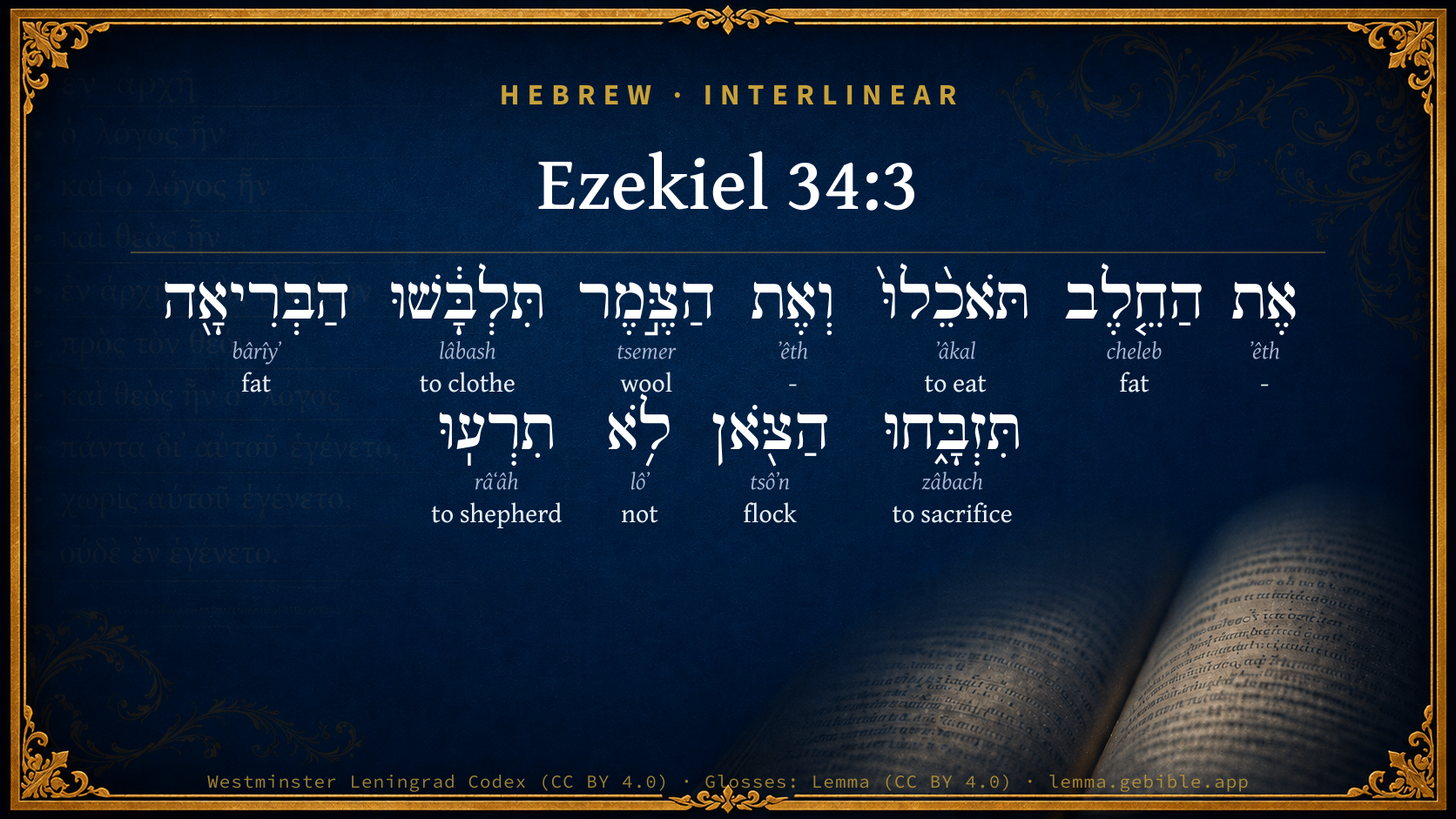
Hebrew (Westminster Leningrad Codex) Ezekiel 34:3 appears in the Hebrew Old Testament. The text above is from the Westminster Leningrad Codex. Each word links to its Strong’s number, a concise gloss, and parsing drawn from the Open Scriptures Hebrew Bible morphology. Click any word for its full Brown-Driver-Briggs (BDB) entry.
Download image
Cite this verse

Ezekiel 34:3 (World English Bible). Public Domain. Lemma interlinear Bible study tool, https://lemma.gebible.app/v/ezekiel/34/3.

Show BibTeX & RIS
BibTeX
RIS
English Translation
You eat the fat, and you clothe you with the wool, you kill the fatlings; but you don't feed the sheep.
World English Bible · Public Domain
Download a study sheet

One document with this verse’s original text, its word-by-word gloss line, the meaning frame, cross-references with their text, attributed commentary, and full source and license credits — printable, and it pastes into notes with its structure intact.

This verse Autodidact and up

Study sheet (.html) Plain text (.txt)

A passage Seminary Student

Up to 50 verses in one chapter. A passage sheet keeps up to 6 commentary sources and 12 cross-references per verse, in the order this page ranks them, and says so on the sheet whenever that leaves anything out. Ask for a single verse and you get the Autodidact verse sheet above.

Everything on this page stays free to read, with no account — the sheet is a download of what is already on screen, not access to it.

Want to remove ads? Support Godless Engineer
Compare translations 3

The same verse in 3 English versions, stacked beneath the original-language interlinear above. Click any original word for its lexicon entry.

Each is an independent rendering of the whole verse — the interlinear is not word-aligned to these translations.

Highlighted words mark where these versions differ — a whole-verse word diff, not a word-by-word alignment.

  • World English Bible Public Domain
    You eat the fat, and you clothe you with the wool, you kill the fatlings; but you don't feed the sheep.
  • King James Version Public Domain
    Ye eat the fat, and ye clothe you with the wool, ye kill them that are fed: but ye feed not the flock.
  • unfoldingWord Literal Text CC BY-SA 4.0
    You eat the fatty portions and you dress in wool. You slaughter the fatlings of the flock. You do not shepherd at all.

unfoldingWord Literal Text — © unfoldingWord, licensed CC BY-SA 4.0. Word-aligned USFM3 via Door43 (git.door43.org/unfoldingWord/en_ult).

Versions to compare (up to 4)

3 of 4 selected

Show all 18 translations

Every available English version of this verse, each an independent rendering of the whole verse.

  • World English Bible Public Domain
    You eat the fat, and you clothe you with the wool, you kill the fatlings; but you don't feed the sheep.
  • Berean Standard Bible Public Domain
    You eat the fat, wear the wool, and butcher the fattened sheep, but you do not feed the flock.
  • Majority Standard Bible Public Domain
    You eat the fat, wear the wool, and butcher the fattened sheep, but you do not feed the flock.
  • King James Version Public Domain
    Ye eat the fat, and ye clothe you with the wool, ye kill them that are fed: but ye feed not the flock.
  • American Standard Version (1901) Public Domain
    Ye eat the fat, and ye clothe you with the wool, ye kill the fatlings; but ye feed not the sheep.
  • Revised Version (1885) Public Domain
    Ye eat the fat, and ye clothe you with the wool, ye kill the fatlings; but ye feed not the sheep.
  • Geneva Bible (1599) Public Domain
    Yee eate the fat, and yee clothe you with the wooll: yee kill them that are fed, but ye feede not the sheepe.
  • Douay-Rheims (1899) Public Domain
    You ate the milk, end you clothed yourselves with the wool, and you killed that which was fat: but my flock you did not feed.
  • Young's Literal Translation Public Domain
    The fat ye do eat, and the wool ye put on, The fed one ye slaughter, the flock ye feed not.
  • Literal Standard Version CC BY-SA 4.0
    You eat the fat, and you put on the wool, || You slaughter the fed one, || You do not feed the flock.
  • Unlocked Literal Bible CC BY-SA 4.0
    You eat the fatty portions and you dress in wool. You slaughter the fatlings of the flock. You do not shepherd at all.
  • unfoldingWord Literal Text CC BY-SA 4.0
    You eat the fatty portions and you dress in wool. You slaughter the fatlings of the flock. You do not shepherd at all.
  • Darby Bible Public Domain
    Ye eat the fat, and ye clothe you with the wool; ye kill them that are fattened: [but] ye feed not the flock.
  • World Messianic Bible Public Domain
    You eat the fat. You clothe yourself with the wool. You kill the fatlings, but you don’t feed the sheep.
  • Webster's Bible Public Domain
    Ye eat the fat, and ye clothe yourselves with the wool, ye kill them that are fed: but ye feed not the flock.
  • Free Bible Version CC BY-SA 4.0
    You eat the cream, you use the wool for clothes, and you slaughter the fattened sheep, but you don't feed the flock.
  • Bible in Basic English Public Domain
    You take the milk and are clothed with the wool, you put the fat beasts to death, but you give the sheep no food.
  • JPS Tanakh (1917) Public Domain
    Ye did eat the fat, and ye clothed you with the wool, ye killed the fatlings; but ye fed not the sheep.

Literal Standard Version (2020), Covenant Press — licensed CC BY-SA 4.0. Text via the HelloAO Bible API (eBible.org). Unlocked Literal Bible (unfoldingWord) — licensed CC BY-SA 4.0. Text via the HelloAO Bible API (eBible.org). unfoldingWord Literal Text — © unfoldingWord, licensed CC BY-SA 4.0. Word-aligned USFM3 via Door43 (git.door43.org/unfoldingWord/en_ult). Free Bible Version, Dr. Jonathan Gallagher — licensed CC BY-SA 4.0. Text via the HelloAO Bible API (eBible.org).

Word by word

More ways to search: Search by grammar → Find every occurrence → Compare this word →

Practice this passage: Drill this verse → Learn its vocabulary →

הַבְּרִיאָ֖ה
bârîyʼ
H1277
“the · fat”
Particle, Definite Article + Adjective, Adjective, Feminine, Singular, Absolute
Part of Speech
Particle + Adjective
Type
Adjective
Gender
Feminine
Number
Singular
State
Absolute
Full BDB Definition

Origin: from H1254 (in the sense of H1262 )

TWOT: 279a

fat - (TWOT) fat, fatter, fed, firm, plenteous, rank
  1. אֶת ʼêth H853 “-” Particle, Direct Object
  2. הַחֵ֤לֶב cheleb H2459 “the · fat” Particle, Definite Article + Noun, Common, Masculine, Singular, Absolute
  3. תֹּאכֵ֨לוּ֙ ʼâkal H398 “to eat” Verb, Qal, Imperfect, 2nd Person, Masculine, Plural
  4. וְאֶת ʼêth H853 “and · -” Conjunction + Particle, Direct Object
  5. הַצֶּ֣מֶר tsemer H6785 “the · wool” Particle, Definite Article + Noun, Common, Masculine, Singular, Absolute
  6. תִּלְבָּ֔שׁוּ lâbash H3847 “to clothe” Verb, Qal, Imperfect, 2nd Person, Masculine, Plural
  7. תִּזְבָּ֑חוּ zâbach H2076 “to sacrifice” Verb, Qal, Imperfect, 2nd Person, Masculine, Plural
  8. הַצֹּ֖אן tsôʼn H6629 “the · flock” Particle, Definite Article + Noun, Common, Both, Singular, Absolute
  9. לֹ֥א lôʼ H3808 “not” Particle, Negative
  10. תִרְעֽוּ râʻâh H7462 “to shepherd” Verb, Qal, Imperfect, 2nd Person, Masculine, Plural

About this verse

These counts appear in no published source. They are computed here, from the morphology-tagged text and Lemma’s own curated glosses. What Lemma adds →

11
words
10
distinct lemmas
Prophets
section

Notable vocabulary

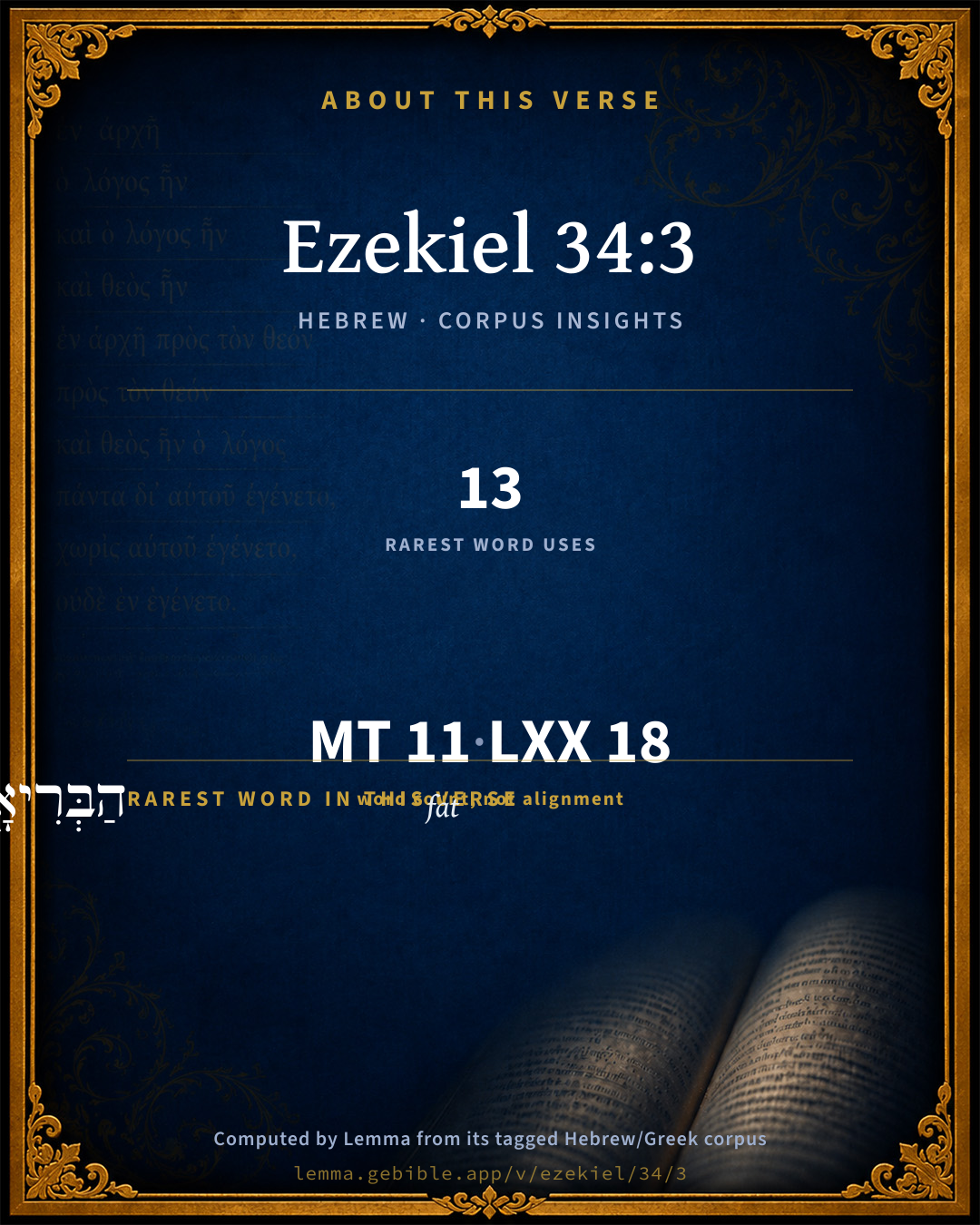
The rarest word here is הַבְּרִיאָ֖ה fat H1277 — appearing just 13 times in the whole Hebrew Bible.

Shared distinctive vocabulary

הַבְּרִיאָ֖ה fat H1277 occurs in 13 verses of the Hebrew Bible. Also found in:

Grammatical profile

  • 4 verbs
  • 3 nouns
  • 1 adjective
  • 3 particles

Verb forms

  • תֹּאכֵ֨לוּ֙ Qal · Imperfect
  • תִּלְבָּ֔שׁוּ Qal · Imperfect
  • תִּזְבָּ֑חוּ Qal · Imperfect
  • תִרְעֽוּ Qal · Imperfect

Hebrew & Septuagint length

In English translation the verse runs 21 words from the Hebrew and 22 from the Septuagint (LXX English) — closely comparable.

A rough comparison of the two English renderings, which tokenize alike — not a word-level alignment.

Word counts can differ between the Hebrew and the Greek without any difference in meaning — e.g. the Hebrew direct-object marker אֵת has no separate Greek word, and Greek often adds the article ὁ.

In the original languages it is 11 Hebrew tokens and 18 Greek tokens — but the two are counted differently (Hebrew bundles its prefixes and suffixes into one token; the Greek is in lemma form), so that isn’t a like-for-like length.

Cross-references

16

Topical passages linked to Ezekiel 34:3 in the Treasury of Scripture Knowledge — connected by theme and wording, ordered by reader-vote popularity; previews shown in the World English Bible.

  • Zechariah 11:16 For, behold, I will raise up a shepherd in the land, who will not visit those who are cut off, neither will seek those who are scattered, nor heal that which is broken, nor feed that which is sound; but he will eat the flesh of the fat sheep, and will tear their hoofs in pieces.
  • 1 Kings 21:13–16 The two men, the base fellows, came in and sat before him: and the base fellows bore witness against him, even against Naboth, in the presence of the people, saying, Naboth did curse God and the king. Then they carried him forth out of the city, and stoned him to death with stones.
  • 2 Kings 21:16 Moreover Manasseh shed innocent blood very much, until he had filled Jerusalem from one end to another; besides his sin with which he made Judah to sin, in doing that which was evil in the sight of Yahweh.
  • Isaiah 1:10 Hear the word of Yahweh, you rulers of Sodom! Listen to the law of our God, you people of Gomorrah!
  • Isaiah 1:15 When you spread forth your hands, I will hide my eyes from you; Yes, when you make many prayers, I will not hear. Your hands are full of blood.
  • Isaiah 56:11–12 Yes, the dogs are greedy, they can never have enough; and these are shepherds who can't understand: they have all turned to their own way, each one to his gain, from every quarter.
  • Jeremiah 2:30 In vain have I struck your children; they received no correction: your own sword has devoured your prophets, like a destroying lion.
  • Jeremiah 22:17 But your eyes and your heart are not but for your covetousness, and for shedding innocent blood, and for oppression, and for violence, to do it.
  • Lamentations 4:13 [It is] because of the sins of her prophets, [and] the iniquities of her priests, That have shed the blood of the just in the midst of her.
  • Ezekiel 19:3 She brought up one of her cubs: he became a young lion, and he learned to catch the prey; he devoured men.
  • Ezekiel 19:6 He went up and down among the lions; he became a young lion, and he learned to catch the prey; he devoured men.
  • Ezekiel 22:25–28 There is a conspiracy of her prophets in the midst of it, like a roaring lion ravening the prey: they have devoured souls; they take treasure and precious things; they have made her widows many in the midst of it.
  • Ezekiel 33:25–26 Therefore tell them, Thus says the Lord Yahweh: You eat with the blood, and lift up your eyes to your idols, and shed blood: and shall you possess the land?
  • Micah 3:1–3 I said, "Please listen, you heads of Jacob, And rulers of the house of Israel: Isn't it for you to know justice?
  • Zechariah 11:5 Their buyers slaughter them, and go unpunished. Those who sell them say, 'Blessed be Yahweh, for I am rich;' and their own shepherds don't pity them.
  • Zephaniah 3:3 Her princes in the midst of her are roaring lions. Her judges are evening wolves. They leave nothing until the next day.

Cross-references courtesy of OpenBible.info (CC BY 4.0).

Hebrew and Greek witnesses Masoretic Hebrew ↔ Greek Septuagint

The same verse in the two great witnesses to the Old Testament, shown verse-for-verse.

These are two independent witnesses, not word-aligned to each other, and the Septuagint is shown in lemma (dictionary) form.

Hebrew Ezekiel 34:3 Masoretic · Westminster Leningrad Codex

אֶת הַחֵ֤לֶב תֹּאכֵ֨לוּ֙ וְאֶת הַצֶּ֣מֶר תִּלְבָּ֔שׁוּ הַבְּרִיאָ֖ה תִּזְבָּ֑חוּ הַצֹּ֖אן לֹ֥א תִרְעֽוּ

You eat the fat, and you clothe you with the wool, you kill the fatlings; but you don't feed the sheep.

World English Bible · Public Domain

Greek LXX Ezekiel 34:3 Septuagint · lemma form

ἰδού ὁ γάλα καταἐσθίω καί ὁ ἔριον περιβάλλω καί ὁ παχύς σφάζω καί ὁ πρόβατον ἐγώ οὐ βόσκω

Behold, you⌃ feed on the milk, and clothe yourselves with the wool, and kill the fat: but you⌃ feed not my sheep.

LXX2012 (modern English Septuagint) · Public Domain

On this verse, Joseph Benson's Commentary discusses the Septuagint’s reading. Read the note in Commentary ↓

Hebrew: Westminster Leningrad Codex (CC BY 4.0). Greek: Septuagint (public domain); English from LXX2012 (modern English Septuagint) (Public Domain). How the Septuagint differs from the Hebrew →

Targum (Aramaic paraphrase)

1

The Targum is the ancient Jewish Aramaic paraphrase of the Hebrew Scriptures — an interpretive translation, not the Hebrew text itself. Onkelos (literal) and Pseudo-Jonathan (expansive) render the Torah, and Jonathan the Prophets. Coverage is partial: where no permissively-licensed English translation exists for a verse, only the Aramaic is shown. This is verse-level text, not a word-by-word alignment to the Hebrew.

  1. Targum Jonathan Prophets (Joshua–Malachi)
    יַת טוּבָא אַתִּין אָכְלִין וַעֲמַר נָקִי אַתּוּן לָבְשִׁין פַטִימַיָא אַתּוּן נָכְסִין לְעַמָא לֵיתֵיכוֹן מְפַרְנְסִין:

    (no public-domain English translation for this verse)

    Targum Jonathan — Aramaic: “Mikraot Gedolot” (public domain). English: “Sefaria Community Translation” (CC0 1.0 (public-domain dedication)); “London "Chaldee Paraphrase," 1871” (public domain). Text via Sefaria.

Commentary

Notes on Ezekiel 34:3 from classic Christian and Jewish commentators (each source and its license shown beneath its notes). The classic Christian expositions comment on the surrounding passage and are grouped to its opening verse, so a note may address several verses; the Jewish commentaries on the Tanakh (Rashi and others) are per-verse, so they appear only where the commentator wrote on this verse.

Lemma curates 59 commentaries, every one of them public domain or Creative Commons licensed, each selected and text-cleaned for this edition rather than reprinted as found. About our sources →

Trapp's Complete Commentary

John Trapp

Eze 34:3 Ye eat the fat, and ye clothe you with the wool, ye kill them that are fed: [but] ye feed not the flock.

Ver. 3. Ye eat the fat.] Ecce, lac et lanam recipitis. This ye might do, if in measure, for the workman is worthy of his wages, {see 1Co 9:7} but ye gorge yourselves with the best of the best. Et si ventri bene, si lateri, as Epicurus in Horace, If the belly may be filled, the back fitted, that is all you take care for. In parabola ovis capras quaeritis, et vestrum maxime compendium spectatis; ye are all for your own ends, nourishing your hearts as in a day of slaughter, or of good cheer. {Jas 5:5}

Ye kill them that are fed.] Heb., Ye sacrifice them; so ye pretend, but mind your own fat paunches. See Pro 7:14.

But ye feed not the flock.] As being falsi et ficti imo picti pastores, mock shepherds.

John Trapp, A Commentary or Exposition upon All the Books of the Old and New Testament (1647–1656) — public domain. Text from a community e-Sword module.

Joseph Benson's Commentary

Eze 34:3-4. Ye eat the fat — Or, the milk, as the LXX. render it. The Hebrew words chalab, milk, and cheleb, fat, differ only in their points, so that the ancient versions take them promiscuously one for the other. These shepherds of the Lord’s flock, these civil and ecclesiastical rulers of the people, used their power over them, and exercised their offices, merely for their temporal advantage and emolument. “They exacted their tribute and taxes, their tithes and perquisites, with great earnestness; and they oppressed, and even destroyed the people, to enrich themselves: but they bestowed no pains to provide for the welfare of the state, or of the souls of those intrusted to them.” — Scott. Ye kill them that are fed — Ye take away the lives of the wealthy and substantial by unjust means, in order to enrich yourselves with their estates. But ye feed not the flock — Ye take no care for their benefit, temporal or spiritual. Ye are so ignorant that ye know not how to feed them, and ye are so indolent that ye will not take any pains to do it, and ye are so treacherous and unfaithful that ye never desired or designed it. The diseased — The weak and languishing; have ye not strengthened — With your help, counsel, or countenance. Ye have not applied proper remedies to the wants and necessities of those committed to your charge. The magistrates have not taken care to relieve the needy and defend the oppressed. The priests and the prophets have not been diligent in giving the people proper instructions, in rectifying the mistakes of those that were in error, in warning the unruly, or comforting the disconsolate. Neither have ye bound up that which was broken — Ye have not given relief to the afflicted and miserable: a metaphor taken from surgeons binding up wounds in order to cure them. Neither have ye brought again that which was driven away, &c. — Or, which was gone astray, as the word נדחה is translated, Deu 22:1. Ye have not, by your instructions and exhortations, endeavoured to reduce those who had wandered from the way of truth, or to reclaim those who were ready to perish in their sins; but with force and cruelty have ye ruled them — Have endeavoured to reduce and govern them by the rough methods of compulsion and cruelty, and not by the gentle way of reason and argument, longsuffering, meekness, and love; and your government over them has been exercised by tyranny and oppression, instead of justice, kindness, and beneficence.

Joseph Benson's Commentary on the Old and New Testaments (1811–1818) — public domain. Text from a community e-Sword module.

Geneva Bible (1599)

Geneva Bible translators

Ye seek to enrich yourselves by their commodities, and to spoil their riches and substance.

Geneva Bible (1599) marginal notes — public domain. Text via Bolls.life.

Jamieson, Fausset & Brown

Robert Jamieson, A. R. Fausset & David Brown

fat--or, by differently pointing the Hebrew, "milk" [Septuagint]. Thus the repetition "fat" and "fed" is avoided: also the eating of "fat" would not probably be put before the "killing" of the sheep. The eating of sheep's or goats' milk as food (Deu 32:14; Pro 27:27) was unobjectionable, had not these shepherds milked them too often, and that without duly "feeding" them [BOCHART], (Isa 56:11). The rulers levied exorbitant tributes.

kill . . . fed--kill the rich by false accusation so as to get possession of their property.

feed not . . . flock--take no care of the people (Joh 10:12).

Jamieson, Fausset & Brown — Commentary Critical and Explanatory on the Whole Bible (1871) — public domain (CC PDM 1.0). Text via the HelloAO Bible API.

Adam Clarke's Commentary

Verse 3. Ye eat the fat] I think החלב hacheleb should be translated the milk; and so most of the Versions understand it. Or they lived on the fat sheep, and took the wool of all.

"The priests," says Calmet, "ate the tithes, the first-fruits, and the offerings of the people; the princes received the tributes and imposts; and instead of instructing and protecting them, the latter took away their lives by the cruelties they practiced against them: the former destroyed their souls by the poison of their doctrine, and by their bad example. The fat sheep point out the rich, to whom these pastors often disguised the truth, by a cruel condescension and complaisance."

Adam Clarke's Commentary on the Bible (1810–1826) — public domain. Text from a community e-Sword/MySword module.

The Cambridge Bible for Schools and Colleges

gen. ed. J. J. S. Perowne

3. Ye eat the fat] LXX. the milk (the consonants are the same). Cf. Isa_7:22; Zec_11:16.

The Cambridge Bible for Schools and Colleges (gen. ed. J. J. S. Perowne; Cambridge University Press, 1878–1918) — public domain. Text from a community e-Sword module.

John Gill's Exposition

Ye eat the fat,.... The Septuagint, Vulgate Latin, and Arabic versions, render it, "the milk"; the words for fat and milk differ only in the points; and this was not unlawful, for

who feedeth a flock, and eateth not of the milk of the flock? Co1 9:7, provided it was done with moderation, that they ate some, but not all; but these rulers milked their subjects too much, oppressed them with heavy taxes, and got their substance into their own hands. The Targum is,

"ye eat the good;''

they got possessed of the best of their substance; as did also their ecclesiastical rulers, who were greedy shepherds, that could never have enough; they looked for their gain from their quarter, and even devoured widows' houses, Isa 56:11,

ye clothe you with the wool: the pure wool, as the Targum, the finest of it; they fleeced the flock, and stripped the people of their riches; and minded nothing but their own backs and bellies:

ye kill them that are fed; or, that "are fat" (q); the richest of the people they brought accusations and charges against for capital crimes; and so put them to death under a colour of justice, that they, might get their estates into their hands:

but ye feed not the flock; did not govern the people well, by doing justice and judgment among men, as became civil magistrates; did not deliver out words of faith and sound doctrine, to feed the souls of men with, which is the duty of those that preside in the church of God.

(q) "quod pingue est", Vatablus, Bochartus; "pinguem", Cocceius, Starckius. So Ben Melech.

John Gill's Exposition of the Whole Bible (1746–1763) — public domain (CC PDM 1.0). Text via the HelloAO Bible API.

Haydock's Catholic Bible Commentary

Fat. Pastors often disguise the truth to flatter the rich, or the more just souls are ruined by their negligence.

George Leo Haydock (1774–1849), Haydock's Catholic Family Bible and Commentary, 1859 edition — public domain. Excludes Psalms (Douay-Rheims chapter numbering differs from Protestant) and Deuterocanonical books (Catholic canon only).

Matthew Poole's English Annotations

The fat; rather the milk, which insatiably and without measure you devour; you exhaust their purses and weaken their estates by tributes, exacted by extortions: so the temporal rulers and the spiritual rulers had their methods and arts to milk them dry, these lived on the sins of the people.

With the wool; with best and finest, as best suiting with your pride and luxury, on which you force the people to bestow so much that they have not to clothe themselves and theirs; this was mighty oppression.

Ye kill them; contrive methods for a seeming legal course to forfeit first the life, and next the estate, of the well-fed, the rich, and wealthy, and then make merry and feast, as voluptuous, unfaithful shepherds feast on the fattest of the sheep in their masters’ fold. Ye feed not the flock; take no care to lead, protect, provide for, and watch over them, but, as idle shepherds feasted with the fattest, let the rest starve for any thing they care.

Matthew Poole's English Annotations on the Holy Bible (1683–1685) — public domain. Text from a community e-Sword/MySword module.

The Pulpit Commentary

Ye eat the fat. The LXX and the Vulgate, following a different reading, give milk, and, as "killing" comes in the next clause, this is probably preferable. (comp. 1Co_9:7; Isa_7:22)

The Pulpit Commentary (1880–1919), ed. H.D.M. Spence-Jones & Joseph S. Exell — public domain. Text from a community e-Sword module.

John Wesley's Explanatory Notes

Ye kill - You contrive methods, to take first the life, and next the estate of the well-fed, the rich and wealthy. But - You take care to lead, protect, provide for, and watch over them.

John Wesley, Explanatory Notes Upon the Whole Bible (1754–1765) — public domain. Text via the GEBible commentary corpus.

Lesson kit

Teaching starters — assembled from the data on this page, not authored interpretation. Every prompt links to the verse data it draws on. Edit before teaching.

Ezekiel, in the Prophets, opens this verse with 11 words (10 distinct Hebrew lemmas). Its most distinctive word is bârîyʼ (“fat”). A historical commentator’s framing appears above. Read the whole chapter for the surrounding context.

Discussion questions

  1. The word bârîyʼ carries the sense “fat.” How does it shape the verse?
  2. How does Genesis 41:2, which shares the word «fat», read alongside this verse?
  3. These translations render this verse differently; the difference is in the English rendering, not the original. What questions does that raise?
  4. «תֹּאכֵ֨לוּ֙» is a Qal Imperfect verb. How does that grammatical form shape the action described?
  5. Compare how Trapp's Complete Commentary and Joseph Benson's Commentary read this verse. Where do they agree or differ?

Things to notice

Reading settings

Reading text

Shown beneath each verse's original-language words.

Old Testament
Old Testament edition

Read the OT as the Masoretic Hebrew (MT) or the Greek Septuagint (LXX).

English shown for the Greek Septuagint (in the Hebrew ↔ Greek comparison).

Comparing translations? Open the Compare panel on any verse page to stack up to four side by side.