
Numbers 15:3

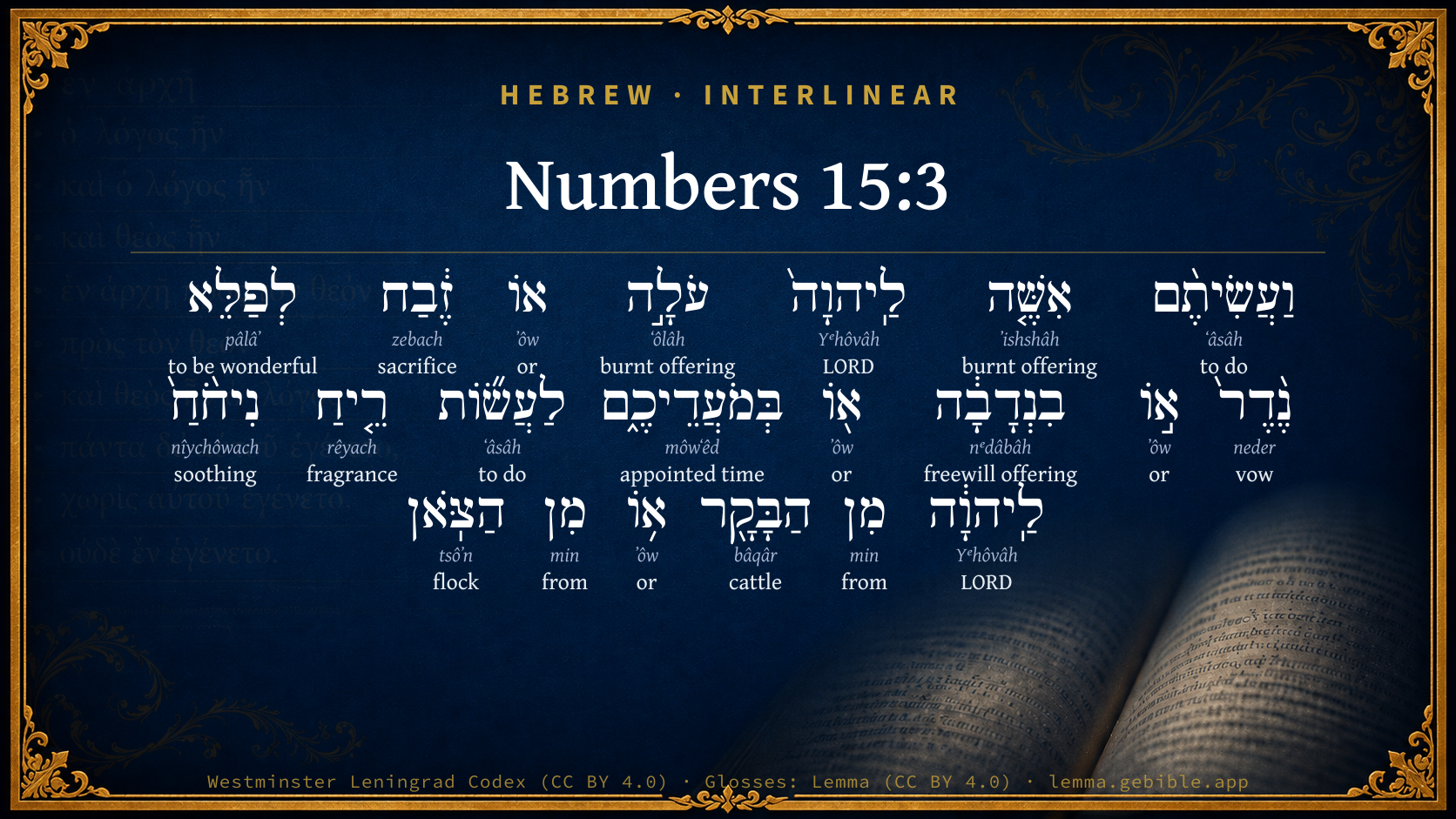
Hebrew (Westminster Leningrad Codex) Numbers 15:3 appears in the Hebrew Old Testament. The text above is from the Westminster Leningrad Codex. Each word links to its Strong’s number, a concise gloss, and parsing drawn from the Open Scriptures Hebrew Bible morphology. Click any word for its full Brown-Driver-Briggs (BDB) entry.
Download image
Cite this verse

Numbers 15:3 (World English Bible). Public Domain. Lemma interlinear Bible study tool, https://lemma.gebible.app/v/numbers/15/3.

Show BibTeX & RIS
BibTeX
RIS
English Translation
and will make an offering by fire to Yahweh, a burnt offering, or a sacrifice, to accomplish a vow, or as a freewill-offering, or in your set feasts, to make a sweet savor to Yahweh, of the herd, or of the flock;
World English Bible · Public Domain
Download a study sheet

One document with this verse’s original text, its word-by-word gloss line, the meaning frame, cross-references with their text, attributed commentary, and full source and license credits — printable, and it pastes into notes with its structure intact.

This verse Autodidact and up

Study sheet (.html) Plain text (.txt)

A passage Seminary Student

Up to 50 verses in one chapter. A passage sheet keeps up to 6 commentary sources and 12 cross-references per verse, in the order this page ranks them, and says so on the sheet whenever that leaves anything out. Ask for a single verse and you get the Autodidact verse sheet above.

Everything on this page stays free to read, with no account — the sheet is a download of what is already on screen, not access to it.

Want to remove ads? Support Godless Engineer
Compare translations 3

The same verse in 3 English versions, stacked beneath the original-language interlinear above. Click any original word for its lexicon entry.

Each is an independent rendering of the whole verse — the interlinear is not word-aligned to these translations.

Highlighted words mark where these versions differ — a whole-verse word diff, not a word-by-word alignment.

  • World English Bible Public Domain
    and will make an offering by fire to Yahweh, a burnt offering, or a sacrifice, to accomplish a vow, or as a freewill-offering, or in your set feasts, to make a sweet savor to Yahweh, of the herd, or of the flock;
  • King James Version Public Domain
    And will make an offering by fire unto the LORD, a burnt offering, or a sacrifice in performing a vow, or in a freewill offering, or in your solemn feasts, to make a sweet savor unto the LORD, of the herd or of the flock:
  • unfoldingWord Literal Text CC BY-SA 4.0
    and you make a gift to Yahweh, a burnt offering or a sacrifice, to make extraordinary a vow, or in a freewill offering, or at your appointed times, to make a scent of pleasing for Yahweh from the cattle or from the flock,

unfoldingWord Literal Text — © unfoldingWord, licensed CC BY-SA 4.0. Word-aligned USFM3 via Door43 (git.door43.org/unfoldingWord/en_ult).

Versions to compare (up to 4)

3 of 4 selected

Show all 18 translations

Every available English version of this verse, each an independent rendering of the whole verse.

  • World English Bible Public Domain
    and will make an offering by fire to Yahweh, a burnt offering, or a sacrifice, to accomplish a vow, or as a freewill-offering, or in your set feasts, to make a sweet savor to Yahweh, of the herd, or of the flock;
  • Berean Standard Bible Public Domain
    and you present an offering made by fire to the LORD from the herd or flock to produce a pleasing aroma to the LORD—either a burnt offering or a sacrifice, for a special vow or freewill offering or appointed feast—
  • Majority Standard Bible Public Domain
    and you present a food offering to the LORD from the herd or flock to produce a pleasing aroma to the LORD—either a burnt offering or a sacrifice, for a special vow or freewill offering or appointed feast—
  • King James Version Public Domain
    And will make an offering by fire unto the LORD, a burnt offering, or a sacrifice in performing a vow, or in a freewill offering, or in your solemn feasts, to make a sweet savor unto the LORD, of the herd or of the flock:
  • American Standard Version (1901) Public Domain
    and will make an offering by fire unto Jehovah, a burnt-offering, or a sacrifice, to accomplish a vow, or as a freewill-offering, or in your set feasts, to make a sweet savor unto Jehovah, of the herd, or of the flock;
  • Revised Version (1885) Public Domain
    and will make an offering by fire unto the LORD, a burnt offering, or a sacrifice, to accomplish a vow, or as a freewill offering, or in your set feasts, to make a sweet savour unto the LORD, of the herd, or of the flock:
  • Geneva Bible (1599) Public Domain
    And will make an offring by fire vnto the Lord, a burnt offring or a sacrifice to fulfil a vowe, or a free offring, or in your feastes, to make a sweete sauour vnto the Lord of the hearde, or of the flocke.
  • Douay-Rheims (1899) Public Domain
    And shall make an offering to the Lord, for a holocaust, or a victim, paying your vows, or voluntarily offering gifts, or in your solemnities burning a sweet savour unto the Lord, of oxen or of sheep:
  • Young's Literal Translation Public Domain
    then ye have prepared a fire-offering to Jehovah, a burnt-offering, or a sacrifice, at separating a vow or free-will-offering, or in your appointed things, to make a sweet fragrance to Jehovah, out of the herd, or out of the flock.
  • Literal Standard Version CC BY-SA 4.0
    then you have prepared a fire-offering to YHWH, a burnt-offering or a sacrifice, for separating a vow or free-will offering, or in your appointed things, to make a refreshing fragrance to YHWH, out of the herd or out of the flock.
  • Unlocked Literal Bible CC BY-SA 4.0
    you are to prepare an offering by fire to Yahweh, either a burnt offering or a sacrifice to fulfill a vow or a freewill offering, or an offering at your feasts, to produce a pleasing aroma for Yahweh from the herd or the flock.
  • unfoldingWord Literal Text CC BY-SA 4.0
    and you make a gift to Yahweh, a burnt offering or a sacrifice, to make extraordinary a vow, or in a freewill offering, or at your appointed times, to make a scent of pleasing for Yahweh from the cattle or from the flock,
  • Darby Bible Public Domain
    and will make an offering by fire to Jehovah, a burnt-offering or a sacrifice for the performance of a vow, or as a voluntary offering, or in your set feasts, to make a sweet odour to Jehovah, of the herd or of the flock,
  • World Messianic Bible Public Domain
    and will make an offering by fire to the LORD—a burnt offering, or a sacrifice, to accomplish a vow, or as a free will offering, or in your set feasts, to make a pleasant aroma to the LORD, of the herd, or of the flock—
  • Webster's Bible Public Domain
    And will make an offering by fire to the LORD, a burnt-offering, or a sacrifice in performing a vow, or in a free-will-offering, or in your solemn feasts, to make a sweet savor to the LORD, of the herd, or of the flock:
  • Free Bible Version CC BY-SA 4.0
    When you bring an offering to the Lord from your herd or flock (whether it's a burnt offering, a sacrifice to fulfill a promise you made, or a freewill or festival offering) that will be acceptable to the Lord,
  • Bible in Basic English Public Domain
    And are going to make an offering by fire to the Lord, a burned offering or an offering in connection with an oath, or an offering freely given, or at your regular feasts, an offering for a sweet smell to the Lord, from the herd or the flock:
  • JPS Tanakh (1917) Public Domain
    and will make an offering by fire unto the LORD, a burnt-offering, or a sacrifice, in fulfilment of a vow clearly uttered, or as a freewill-offering, or in your appointed seasons, to make a sweet savour unto the LORD, of the herd, or of the flock;

Literal Standard Version (2020), Covenant Press — licensed CC BY-SA 4.0. Text via the HelloAO Bible API (eBible.org). Unlocked Literal Bible (unfoldingWord) — licensed CC BY-SA 4.0. Text via the HelloAO Bible API (eBible.org). unfoldingWord Literal Text — © unfoldingWord, licensed CC BY-SA 4.0. Word-aligned USFM3 via Door43 (git.door43.org/unfoldingWord/en_ult). Free Bible Version, Dr. Jonathan Gallagher — licensed CC BY-SA 4.0. Text via the HelloAO Bible API (eBible.org).

Word by word

More ways to search: Search by grammar → Find every occurrence → Compare this word →

Practice this passage: Drill this verse → Learn its vocabulary →

בִנְדָבָ֔ה
nᵉdâbâh
H5071
“in/at · freewill offering”
Preposition + Noun, Common, Feminine, Singular, Absolute
Part of Speech
Preposition + Noun
Type
Common
Gender
Feminine
Number
Singular
State
Absolute
Full BDB Definition

Origin: from H5068

TWOT: 1299a

voluntariness, free-will offering - voluntariness - freewill, voluntary, offering
  1. וַעֲשִׂיתֶ֨ם ʻâsâh H6213 “and · to do” Conjunction + Verb, Qal, Sequential Perfect, 2nd Person, Masculine, Plural
  2. אִשֶּׁ֤ה ʼishshâh H801 “burnt offering” Noun, Common, Masculine, Singular, Absolute
  3. לַֽיהוָה֙ Yᵉhôvâh H3068 “to/for · LORD” Preposition + Noun, Proper
  4. עֹלָ֣ה ʻôlâh H5930 “burnt offering” Noun, Common, Feminine, Singular, Absolute
  5. אוֹ ʼôw H176 “or” Conjunction
  6. זֶ֔בַח zebach H2077 “sacrifice” Noun, Common, Masculine, Singular, Absolute
  7. לְפַלֵּא pâlâʼ H6381 “to be wonderful” Preposition + Verb, Piel, Infinitive Construct
  8. נֶ֨דֶר֙ neder H5088 “vow” Noun, Common, Masculine, Singular, Absolute
  9. א֣וֹ ʼôw H176 “or” Conjunction
  10. א֖וֹ ʼôw H176 “or” Conjunction
  11. בְּמֹעֲדֵיכֶ֑ם môwʻêd H4150 “in/at · appointed times · your” Preposition + Noun, Common, Masculine, Plural, Construct + Suffix, Personal, 2nd Person, Masculine, Plural
  12. לַעֲשׂ֞וֹת ʻâsâh H6213 “to do” Preposition + Verb, Qal, Infinitive Construct
  13. רֵ֤יחַ rêyach H7381 “fragrance of” Noun, Common, Masculine, Singular, Construct
  14. נִיחֹ֨חַ֙ nîychôwach H5207 “soothing” Noun, Common, Masculine, Singular, Absolute
  15. לַֽיהוָ֔ה Yᵉhôvâh H3068 “to/for · LORD” Preposition + Noun, Proper
  16. מִן min H4480 “from” Preposition
  17. הַבָּקָ֖ר bâqâr H1241 “the · cattle” Particle, Definite Article + Noun, Common, Both, Singular, Absolute
  18. א֥וֹ ʼôw H176 “or” Conjunction
  19. מִן min H4480 “from” Preposition
  20. הַצֹּֽאן tsôʼn H6629 “the · flock” Particle, Definite Article + Noun, Common, Both, Singular, Absolute

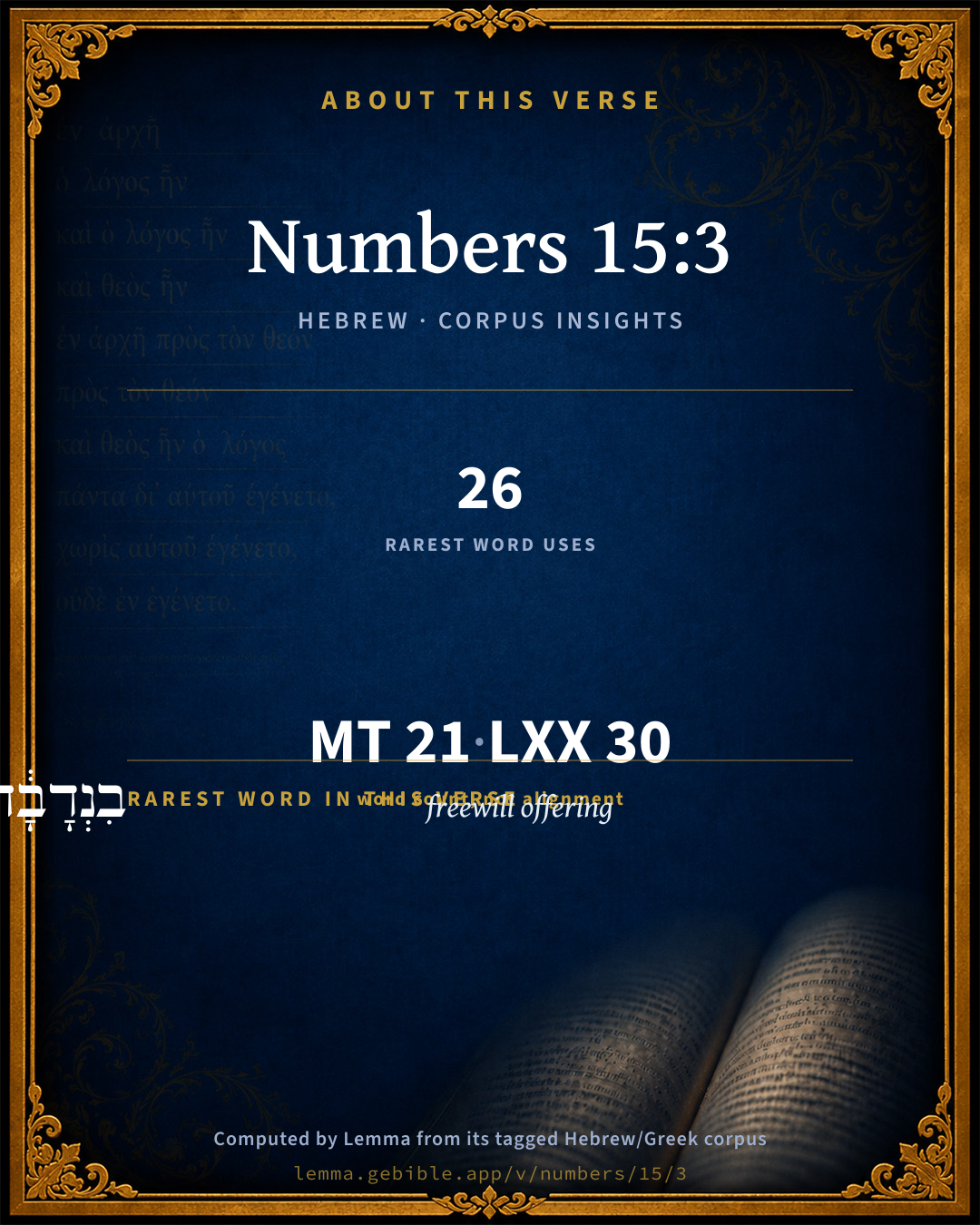
About this verse

These counts appear in no published source. They are computed here, from the morphology-tagged text and Lemma’s own curated glosses. What Lemma adds →

21
words
15
distinct lemmas
Pentateuch
section

Shared distinctive vocabulary

בִנְדָבָ֔ה freewill offering H5071 occurs in 25 verses of the Hebrew Bible. Also found in:

Grammatical profile

  • 3 verbs
  • 12 nouns
  • 2 prepositions
  • 4 conjunctions

Verb forms

  • וַעֲשִׂיתֶ֨ם Qal · Sequential Perfect
  • לְפַלֵּא Piel · Infinitive Construct
  • לַעֲשׂ֞וֹת Qal · Infinitive Construct

Repetition

Words recur within this verse — often emphatic in Hebrew:

  • וַעֲשִׂיתֶ֨ם to do H6213 ×2
  • לַֽיהוָה֙ LORD H3068 ×2
  • אוֹ or H176 ×4
  • מִן from H4480 ×2

Hebrew & Septuagint length

In English translation the verse runs 42 words from the Hebrew and 46 from the Septuagint (LXX English) — closely comparable.

A rough comparison of the two English renderings, which tokenize alike — not a word-level alignment.

Word counts can differ between the Hebrew and the Greek without any difference in meaning — e.g. the Hebrew direct-object marker אֵת has no separate Greek word, and Greek often adds the article ὁ.

In the original languages it is 21 Hebrew tokens and 30 Greek tokens — but the two are counted differently (Hebrew bundles its prefixes and suffixes into one token; the Greek is in lemma form), so that isn’t a like-for-like length.

Cross-references

22

Topical passages linked to Numbers 15:3 in the Treasury of Scripture Knowledge — connected by theme and wording, ordered by reader-vote popularity; previews shown in the World English Bible.

  • Exodus 29:18 You shall burn the whole ram on the altar: it is a burnt offering to Yahweh; it is a sweet savor, an offering made by fire to Yahweh.
  • Genesis 8:21 Yahweh smelled the sweet savor. Yahweh said in his heart, "I will not again curse the ground any more for man's sake, because the imagination of man's heart is evil from his youth; neither will I ever again strike everything living, as I have done.
  • Numbers 28:27 but you shall offer a burnt offering for a sweet savor to Yahweh: two young bulls, one ram, seven he-lambs a year old;
  • Philippians 4:18 But I have all things, and abound. I am filled, having received from Epaphroditus the things that came from you, a sweet-smelling fragrance, an acceptable and well-pleasing sacrifice to God.
  • Leviticus 1:1–17 Yahweh called to Moses, and spoke to him out of the Tent of Meeting, saying,
  • Leviticus 22:18–23 "Speak to Aaron, and to his sons, and to all the children of Israel, and say to them, 'Whoever is of the house of Israel, or of the foreigners in Israel, who offers his offering, whether it be any of their vows, or any of their freewill offerings, which they offer to Yahweh for a burnt offering;
  • Leviticus 23:1–44 Yahweh spoke to Moses, saying,
  • Leviticus 27:2 "Speak to the children of Israel, and say to them, 'When a man makes a vow, the persons shall be for Yahweh by your valuation.
  • Numbers 28:16–19 In the first month, on the fourteenth day of the month, is Yahweh's Passover.
  • Exodus 29:41 The other lamb you shall offer at evening, and shall do to it according to the meal-offering of the morning, and according to its drink-offering, for a sweet savor, an offering made by fire to Yahweh.
  • Leviticus 7:16 "'But if the sacrifice of his offering is a vow, or a freewill offering, it shall be eaten on the day that he offers his sacrifice; and on the next day what remains of it shall be eaten:
  • Leviticus 10:13 and you shall eat it in a holy place, because it is your portion, and your sons' portion, of the offerings of Yahweh made by fire: for so I am commanded.
  • Numbers 29:1–2 In the seventh month, on the first day of the month, you shall have a holy convocation; you shall do no servile work: it is a day of blowing of trumpets to you.
  • Numbers 29:8 but you shall offer a burnt offering to Yahweh for a sweet savor: one young bull, one ram, seven he-lambs a year old; they shall be to you without blemish;
  • Numbers 29:13–40 and you shall offer a burnt offering, an offering made by fire, of a sweet savor to Yahweh; thirteen young bulls, two rams, fourteen he-lambs a year old; they shall be without blemish;
  • Deuteronomy 12:6 and there you shall bring your burnt offerings, and your sacrifices, and your tithes, and the heave-offering of your hand, and your vows, and your freewill-offerings, and the firstborn of your herd and of your flock:
  • Deuteronomy 12:11 then it shall happen that to the place which Yahweh your God shall choose, to cause his name to dwell there, there shall you bring all that I command you: your burnt offerings, and your sacrifices, your tithes, and the heave-offering of your hand, and all your choice vows which you vow to Yahweh.
  • Deuteronomy 12:17 You may not eat within your gates the tithe of your grain, or of your new wine, or of your oil, or the firstborn of your herd or of your flock, nor any of your vows which you vow, nor your freewill-offerings, nor the heave-offering of your hand;
  • Deuteronomy 16:1–17 Observe the month of Abib, and keep the Passover to Yahweh your God; for in the month of Abib Yahweh your God brought you forth out of Egypt by night.
  • Matthew 3:17 Behold, a voice out of the heavens said, "This is my beloved Son, with whom I am well pleased."
  • Ephesians 5:2 Walk in love, even as Christ also loved you, and gave himself up for us, an offering and a sacrifice to God for a sweet-smelling fragrance.
  • Exodus 29:25 You shall take them from their hands, and burn them on the altar on the burnt offering, for a sweet savor before Yahweh: it is an offering made by fire to Yahweh.

Cross-references courtesy of OpenBible.info (CC BY 4.0).

Hebrew and Greek witnesses Masoretic Hebrew ↔ Greek Septuagint

The same verse in the two great witnesses to the Old Testament, shown verse-for-verse.

These are two independent witnesses, not word-aligned to each other, and the Septuagint is shown in lemma (dictionary) form.

Hebrew Numbers 15:3 Masoretic · Westminster Leningrad Codex

וַעֲשִׂיתֶ֨ם אִשֶּׁ֤ה לַֽיהוָה֙ עֹלָ֣ה אוֹ זֶ֔בַח לְפַלֵּא נֶ֨דֶר֙ א֣וֹ בִנְדָבָ֔ה א֖וֹ בְּמֹעֲדֵיכֶ֑ם לַעֲשׂ֞וֹת רֵ֤יחַ נִיחֹ֨חַ֙ לַֽיהוָ֔ה מִן הַבָּקָ֖ר א֥וֹ מִן הַצֹּֽאן

and will make an offering by fire to Yahweh, a burnt offering, or a sacrifice, to accomplish a vow, or as a freewill-offering, or in your set feasts, to make a sweet savor to Yahweh, of the herd, or of the flock;

World English Bible · Public Domain

Greek LXX Numbers 15:3 Septuagint · lemma form

καί ποιέω ὁλοκαύτωμα κύριος ὁλοκάρπωμα ἤ θυσία μεγαλύνω εὐχή ἤ κατά ἑκούσιος ἤ ἐν ὁ ἑορτή σύ ποιέω ὀσμή εὐωδία κύριος εἰ μέν ἀπό ὁ βοῦς ἤ ἀπό ὁ πρόβατον

and you will offer whole burnt offerings to the Lord, a whole burnt offering or a meat-offering to perform a vow, or a free-will offering, or to offer in your feasts a sacrifice of sweet savor to the Lord, whether of the herd or the flock:

LXX2012 (modern English Septuagint) · Public Domain

Hebrew: Westminster Leningrad Codex (CC BY 4.0). Greek: Septuagint (public domain); English from LXX2012 (modern English Septuagint) (Public Domain). How the Septuagint differs from the Hebrew →

Targum (Aramaic paraphrase)

2

The Targum is the ancient Jewish Aramaic paraphrase of the Hebrew Scriptures — an interpretive translation, not the Hebrew text itself. Onkelos (literal) and Pseudo-Jonathan (expansive) render the Torah, and Jonathan the Prophets. Coverage is partial: where no permissively-licensed English translation exists for a verse, only the Aramaic is shown. This is verse-level text, not a word-by-word alignment to the Hebrew.

  1. Targum Onkelos Torah (Genesis–Deuteronomy)
    וְתַעְבְּדוּן קֻרְבָּנָא קָדָם יְיָ עֲלָתָא אוֹ נִכְסַת קוּדְשַׁיָא לְאַפְרָשָׁא נִדְרָא אוֹ בִנְדַבְתָּא אוֹ בְּמוֹעֲדֵיכוֹן לְמֶעְבַּד לְאִתְקַבָּלָא בְרַעֲוָא קֳדָם יְיָ מִן תּוֹרֵי אוֹ מִן עָנָא

    (no public-domain English translation for this verse)

    Targum Onkelos — Aramaic: “Onkelos Genesis” (public domain); “Onkelos Exodus” (public domain); “Onkelos Leviticus” (public domain); “Onkelos Numbers” (public domain); “Onkelos Deuteronomy” (public domain). English: “Sefaria Community Translation” (CC0 1.0 (public-domain dedication)); “J.W. Etheridge. The Targums of Onkelos and Jonathan Ben Uzziel on the Pentateuch. London: Longmans, Green, 1862” (public domain). Text via Sefaria.

  2. Targum Pseudo-Jonathan Torah (Genesis–Deuteronomy)
    וְתַעַבְּדוּן עַל מַדְבְּחָא קוּרְבָּנָא קֳדָם יְיָ עֲלָתָא אוֹ נִכְסַת קוּדְשַׁיָא לְפַרְשָׁא נִדְרָא אוֹ בִּנְדִיבוּתָא אוֹ בִּזְמַן מוֹעֲדֵיכוֹן לְמֶעֱבַּד רַעֲוָותָא דְמָרֵי עַלְמָא לְאִתְקַבָּלָא בְּרַעֲוָא קֳדָם יְיָ מִן תּוֹרֵי אוֹ מִן עָנָא

    and you may make an oblation upon the altar before the Lord, burnt offering or consecrated sacrifice for release of a vow, or by free-will offering; or at the time of your feasts you offer what is acceptable to the Lord of the world, to be received with approval before the Lord from the herd or from the flock:

    Targum Pseudo-Jonathan — Aramaic: “Targum Jonathan on Genesis” (public domain); “Targum Jonathan on Exodus” (public domain); “Targum Jonathan on Leviticus” (public domain); “Targum Jonathan on Numbers” (public domain); “Targum Jonathan on Deuteronomy” (public domain). English: “The Targum of Jonathan ben Uzziel, trans. J. W. Etheridge, London, 1862” (public domain). Text via Sefaria.

Commentary

Notes on Numbers 15:3 from classic Christian and Jewish commentators (each source and its license shown beneath its notes). The classic Christian expositions comment on the surrounding passage and are grouped to its opening verse, so a note may address several verses; the Jewish commentaries on the Tanakh (Rashi and others) are per-verse, so they appear only where the commentator wrote on this verse.

Lemma curates 59 commentaries, every one of them public domain or Creative Commons licensed, each selected and text-cleaned for this edition rather than reprinted as found. About our sources →

Joseph Benson's Commentary

Num 15:3. An offering made by fire — This is a general expression for those offerings which were in whole or in part burned upon the altar. A sacrifice in performing a vow — Namely, peace-offerings, which are often called sacrifices, in general, as Exo 18:12, and Lev 17:5; Lev 17:8. See the nature of them explained, Lev 3:1; Lev 7:11.

Joseph Benson's Commentary on the Old and New Testaments (1811–1818) — public domain. Text from a community e-Sword module.

Tyndale Open Study Notes

Tyndale Open Resources

15:3 special gifts . . . a pleasing aroma to the Lord: God is pleased by the honor and thanksgiving that sacrifices and offerings show him.

Tyndale Open Study Notes — © Tyndale Open Resources, licensed CC BY-SA 4.0. Text via the HelloAO Bible API.

Geneva Bible (1599)

Geneva Bible translators

Or, separate.

Geneva Bible (1599) marginal notes — public domain. Text via Bolls.life.

Jamieson, Fausset & Brown

Robert Jamieson, A. R. Fausset & David Brown

make an offering by fire unto the Lord, a burnt offering--It is evident that a peace offering is referred to because this term is frequently used in such a sense (Exo 18:12; Lev 17:5).

Jamieson, Fausset & Brown — Commentary Critical and Explanatory on the Whole Bible (1871) — public domain (CC PDM 1.0). Text via the HelloAO Bible API.

Adam Clarke's Commentary

Verse 3. And will make an offering] For the different kinds of offerings, sacrifices, c., see Le 1:2, Le 1:7.

Adam Clarke's Commentary on the Bible (1810–1826) — public domain. Text from a community e-Sword/MySword module.

The Cambridge Bible for Schools and Colleges

gen. ed. J. J. S. Perowne

3. an offering by fire] A general term covering every kind of offering that was consumed on the altar. The next words define the two species of these offerings with which the section deals, i.e. burnt- and peace-offerings, after which are mentioned the different occasions (private and public) on which the peace-offerings might be presented.

a sacrifice] This, as distinguished from the burnt-offering, means the peace-offering, of which the worshipper and priest partook. See on Num_6:14.

a sweet savour] a soothing odour. The expression had its origin in far-off days when the deity was supposed to be soothed or placated by the actual smell of the sacrificial smoke. In Gen_8:21 (J ), the only Biblical occurrence of the words earlier than Ezekiel, there is a trace of the primitive conception.

The Cambridge Bible for Schools and Colleges (gen. ed. J. J. S. Perowne; Cambridge University Press, 1878–1918) — public domain. Text from a community e-Sword module.

John Gill's Exposition

And will make an offering by fire unto the Lord, a burnt offering,.... The first of these respects such offerings by fire, which were not wholly burnt, but part of them were eaten by the priests, Deu 18:1; and the latter such as were wholly burnt, unless the latter can be thought to be only an explanation of the former:

or a sacrifice in performing a vow, or in a freewill offering; these were peace offerings, some of which were for thanksgiving, and others were either a vow or a freewill offering, as here: see Lev 7:11,

or in your solemn feasts; as the passover, pentecost, &c. of which, and the offerings in them, see Lev 23:4,

to make a sweet savour unto the Lord; for acceptance with him:

of the herd or of the flock; a bullock of the one, a lamb or kid of the goats of the other; fowls are not mentioned, because burnt offerings of them required no drink offerings (f).

(f) Maimon. Maaseh Hakorbanot, c. 2. sect. 2.

John Gill's Exposition of the Whole Bible (1746–1763) — public domain (CC PDM 1.0). Text via the HelloAO Bible API.

Haydock's Catholic Bible Commentary

Victim "of peace," as some Latin copies read, including all the different sorts, ver. 28. (Calmet)

George Leo Haydock (1774–1849), Haydock's Catholic Family Bible and Commentary, 1859 edition — public domain. Excludes Psalms (Douay-Rheims chapter numbering differs from Protestant) and Deuterocanonical books (Catholic canon only).

Matthew Poole's English Annotations

A sacrifice, i.e. a peace-offering, as appears,

1. Because that word put by itself is oft so taken, as Exo 18:12; Lev 17:5,8; 23:37; Deu 12:27.

2. Because the offerings for sins and trespasses had no meat-offerings and drink-offerings attending upon them, excepting only the case of the

leper’s cleansing, Lev 14:10.

3. Because this is explained by and called peace-offereings, Num 15:8.

4. From the words here following, because peace-offerings were commonly offerede either in performance of a vow, or freely, or by God’s command in their solemn feasts, all which are here expressed.

Matthew Poole's English Annotations on the Holy Bible (1683–1685) — public domain. Text from a community e-Sword/MySword module.

Whedon's Commentary on the Bible

Daniel D. Whedon

3. And will make an offering — There are two theories respecting the origin of sacrifices: (1.) An express command of God, and (2.) The promptings of the soul under its sense of dependence and guilt. On this question Moses is entirely silent. A command to offer sacrifices may have been given, though it is not recorded. Moses was evidently studious of brevity, omitting the prophecy of Enoch, the preaching of Noah, and the vexation of Lot’s spirit in view of the iniquities of Sodom. But it must be confessed that in this verse and in Lev_1:2, the traditional sacrifices seem to be spoken of as optional and not required. If this be true, it argues that sacrifices are not essentially at variance with the laws of our moral nature, and that worship can be paid by sacrificing whatever each one holds most precious. Similar views are entertained by the rabbins. Chrysostom affirms that Abel was persuaded to offer true sacrifices, not as being taught by any one, not from obedience to any express statute, but by the dictates of reason and conscience. These remarks do not apply to the law-created sin offerings and trespass offerings. See Isa_1:12, and Introduction to Leviticus, (2.)

Burnt offering — See Lev_1:3; Lev_6:9, notes.

A vow… free-will offering — See Lev_27:2; Lev_22:18; Lev_7:11; Lev_7:16, notes.

Sweet savour — See Lev_1:9, note.

Herd…flock — See Lev_1:2, note.

Daniel D. Whedon (gen. ed.), Commentary on the Old and New Testaments (1874–1909) — public domain. Text from a community e-Sword module.

The Pulpit Commentary

A burnt offering, or a sacrifice, i.e., a whole burnt offering, or a slain offering. There should be a comma after the word "sacrifice." In performing a vow, or in a free-will offering, or in your solemn feasts. The burnt offering, or slain offering, might be offered in either of these three ways, in addition to the more ordinary sacrifices which do not come into question here.

The Pulpit Commentary (1880–1919), ed. H.D.M. Spence-Jones & Joseph S. Exell — public domain. Text from a community e-Sword module.

John Wesley's Explanatory Notes

A sacrifice - A peace-offering.

John Wesley, Explanatory Notes Upon the Whole Bible (1754–1765) — public domain. Text via the GEBible commentary corpus.

Rashi

Rabbi Shlomo Yitzchaki (Rashi)

ועשיתם אשה — This is not a command: when you come into the land you shall make a fire-offering — but the meaning is: When you will come there and it enters your mind to make a fire-offering unto the Lord.

לפלא נדר או בנדבה וגו׳ TO DISTINGUISH YOURSELVES BY A VOW OR A FREE-WILL OFFERING [OR ON YOUR FESTIVALS] — i.e. or that you would make the fire-offering on account of the obligatory festival sacrifice which I have obligated you to offer on a festival....

ריח ניחח [TO MAKE] A PLEASING ODOR — i.e. to cause satisfaction to Me.

Rashi on the Tanakh — English translations: “The Judaica Press complete Tanach with Rashi, translated by A. J. Rosenberg” (CC BY 4.0); “Pentateuch with Rashi's commentary by M. Rosenbaum and A.M. Silbermann, 1929-1934” (public domain); “The Metsudah Tanach series, Lakewood, N.J” (CC BY 4.0); and “The Book of Joshua, Metsudah Publications, 1997” (CC BY 4.0). Text via Sefaria.

Lesson kit

Teaching starters — assembled from the data on this page, not authored interpretation. Every prompt links to the verse data it draws on. Edit before teaching.

Numbers, in the Pentateuch, opens this verse with 21 words (15 distinct Hebrew lemmas). Its most distinctive word is nᵉdâbâh (“freewill offering”). A historical commentator’s framing appears above. Read the whole chapter for the surrounding context.

Discussion questions

  1. How does “freewill offering” (nᵉdâbâh) shape what this verse is saying?
  2. How does Exodus 35:29, which shares the word «freewill offering», read alongside this verse?
  3. What does the repetition of “to do” (2× in this one verse) do in this verse?
  4. These translations render this verse differently. What is at stake in choosing one wording over another?
  5. «וַעֲשִׂיתֶ֨ם» is a Qal Sequential Perfect verb. How does that grammatical form shape the action described?
  6. Compare how Joseph Benson's Commentary and Tyndale Open Study Notes read this verse. Where do they agree or differ?

Things to notice

Reading settings

Reading text

Shown beneath each verse's original-language words.

Old Testament
Old Testament edition

Read the OT as the Masoretic Hebrew (MT) or the Greek Septuagint (LXX).

English shown for the Greek Septuagint (in the Hebrew ↔ Greek comparison).

Comparing translations? Open the Compare panel on any verse page to stack up to four side by side.