
Job 21:11

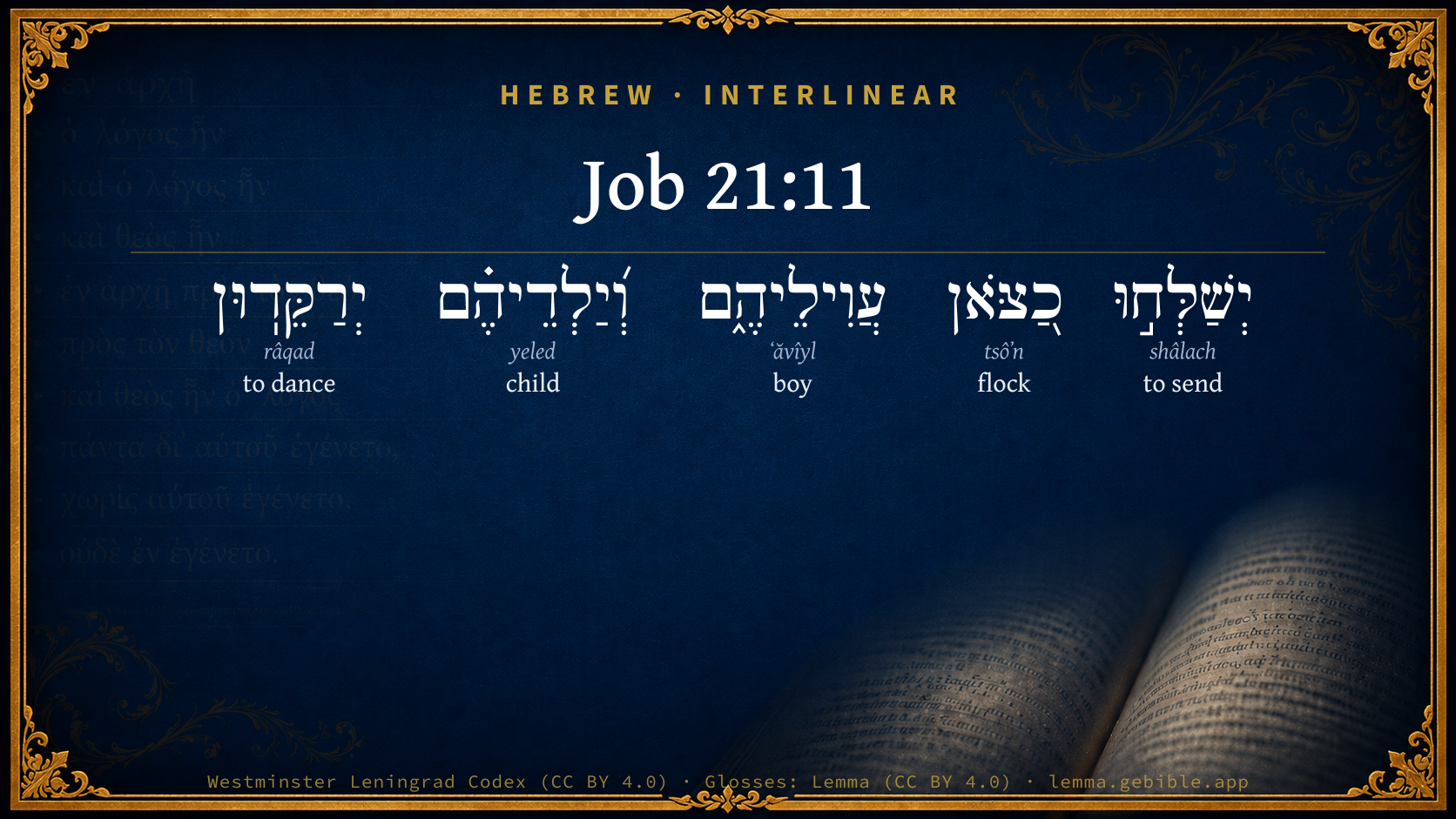
Hebrew (Westminster Leningrad Codex) Job 21:11 appears in the Hebrew Old Testament. The text above is from the Westminster Leningrad Codex. Each word links to its Strong’s number, a concise gloss, and parsing drawn from the Open Scriptures Hebrew Bible morphology. Click any word for its full Brown-Driver-Briggs (BDB) entry.
Download image
Cite this verse

Job 21:11 (World English Bible). Public Domain. Lemma interlinear Bible study tool, https://lemma.gebible.app/v/job/21/11.

Show BibTeX & RIS
BibTeX
RIS
English Translation
They send forth their little ones like a flock. Their children dance.
World English Bible · Public Domain
Download a study sheet

One document with this verse’s original text, its word-by-word gloss line, the meaning frame, cross-references with their text, attributed commentary, and full source and license credits — printable, and it pastes into notes with its structure intact.

This verse Autodidact and up

Study sheet (.html) Plain text (.txt)

A passage Seminary Student

Up to 50 verses in one chapter. A passage sheet keeps up to 6 commentary sources and 12 cross-references per verse, in the order this page ranks them, and says so on the sheet whenever that leaves anything out. Ask for a single verse and you get the Autodidact verse sheet above.

Everything on this page stays free to read, with no account — the sheet is a download of what is already on screen, not access to it.

Want to remove ads? Support Godless Engineer
Compare translations 3

The same verse in 3 English versions, stacked beneath the original-language interlinear above. Click any original word for its lexicon entry.

Each is an independent rendering of the whole verse — the interlinear is not word-aligned to these translations.

Highlighted words mark where these versions differ — a whole-verse word diff, not a word-by-word alignment.

  • World English Bible Public Domain
    They send forth their little ones like a flock. Their children dance.
  • King James Version Public Domain
    They send forth their little ones like a flock, and their children dance.
  • unfoldingWord Literal Text CC BY-SA 4.0
    They send out their babes like a flock, and their children dance.

unfoldingWord Literal Text — © unfoldingWord, licensed CC BY-SA 4.0. Word-aligned USFM3 via Door43 (git.door43.org/unfoldingWord/en_ult).

Versions to compare (up to 4)

3 of 4 selected

Show all 18 translations

Every available English version of this verse, each an independent rendering of the whole verse.

  • World English Bible Public Domain
    They send forth their little ones like a flock. Their children dance.
  • Berean Standard Bible Public Domain
    They send forth their little ones like a flock; their children skip about,
  • Majority Standard Bible Public Domain
    They send forth their little ones like a flock; their children skip about,
  • King James Version Public Domain
    They send forth their little ones like a flock, and their children dance.
  • American Standard Version (1901) Public Domain
    They send forth their little ones like a flock, And their children dance.
  • Revised Version (1885) Public Domain
    They send forth their little ones like a flock, and their children dance.
  • Geneva Bible (1599) Public Domain
    They send forth their children like sheepe, and their sonnes dance.
  • Douay-Rheims (1899) Public Domain
    Their little ones go out like a flock, and their children dance and play.
  • Young's Literal Translation Public Domain
    They send forth as a flock their sucklings, And their children skip,
  • Literal Standard Version CC BY-SA 4.0
    They send forth their sucklings as a flock, || And their children skip,
  • Unlocked Literal Bible CC BY-SA 4.0
    They send out their little ones like a flock, and their children dance.
  • unfoldingWord Literal Text CC BY-SA 4.0
    They send out their babes like a flock, and their children dance.
  • Darby Bible Public Domain
    They send forth their little ones like a flock, and their children dance.
  • World Messianic Bible Public Domain
    They send out their little ones like a flock. Their children dance.
  • Webster's Bible Public Domain
    They send forth their little ones like a flock, and their children dance.
  • Free Bible Version CC BY-SA 4.0
    They send out their little ones like lambs to play; their children dance around.
  • Bible in Basic English Public Domain
    They send out their young ones like a flock, and their children have pleasure in the dance,
  • JPS Tanakh (1917) Public Domain
    They send forth their little ones like a flock, and their children dance.

Literal Standard Version (2020), Covenant Press — licensed CC BY-SA 4.0. Text via the HelloAO Bible API (eBible.org). Unlocked Literal Bible (unfoldingWord) — licensed CC BY-SA 4.0. Text via the HelloAO Bible API (eBible.org). unfoldingWord Literal Text — © unfoldingWord, licensed CC BY-SA 4.0. Word-aligned USFM3 via Door43 (git.door43.org/unfoldingWord/en_ult). Free Bible Version, Dr. Jonathan Gallagher — licensed CC BY-SA 4.0. Text via the HelloAO Bible API (eBible.org).

Word by word

More ways to search: Search by grammar → Find every occurrence → Compare this word →

Practice this passage: Drill this verse → Learn its vocabulary →

About this verse

These counts appear in no published source. They are computed here, from the morphology-tagged text and Lemma’s own curated glosses. What Lemma adds →

5
words
5
distinct lemmas
Wisdom
section

Notable vocabulary

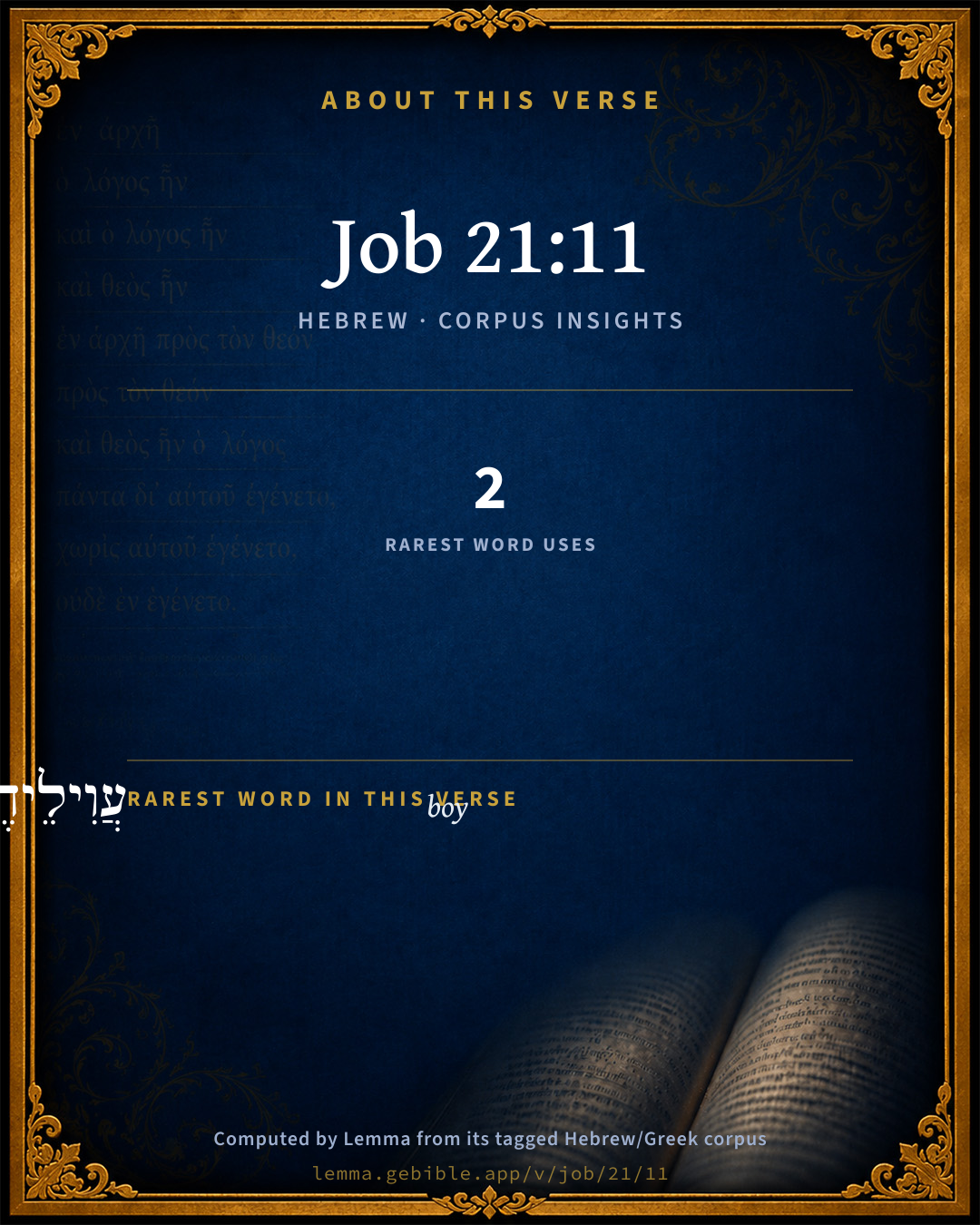
The rarest word here is עֲוִילֵיהֶ֑ם boy H5759 — appearing just 2 times in the whole Hebrew Bible.

Shared distinctive vocabulary

עֲוִילֵיהֶ֑ם boy H5759 occurs in 2 verses of the Hebrew Bible. Also found in:

Grammatical profile

  • 2 verbs
  • 3 nouns

Verb forms

  • יְשַׁלְּח֣וּ Piel · Imperfect
  • יְרַקֵּדֽוּן Piel · Imperfect

Hebrew & Septuagint length

In English translation the verse runs 12 words from the Hebrew and 19 from the Septuagint (LXX English) — the Septuagint runs noticeably longer here. See the side-by-side →

A rough comparison of the two English renderings, which tokenize alike — not a word-level alignment.

Word counts can differ between the Hebrew and the Greek without any difference in meaning — e.g. the Hebrew direct-object marker אֵת has no separate Greek word, and Greek often adds the article ὁ.

Cross-references

2

Topical passages linked to Job 21:11 in the Treasury of Scripture Knowledge — connected by theme and wording, ordered by reader-vote popularity; previews shown in the World English Bible.

  • Psalms 107:41 Yet he lifts the needy out of their affliction, And increases their families like a flock.
  • Psalms 127:3–5 Behold, children are a heritage of Yahweh. The fruit of the womb is his reward.

Cross-references courtesy of OpenBible.info (CC BY 4.0).

Hebrew and Greek witnesses Masoretic Hebrew ↔ Greek Septuagint

The same verse in the two great witnesses to the Old Testament, shown verse-for-verse.

Here the Septuagint runs noticeably longer than the Hebrew — LXX2012 (modern English Septuagint) 19 words vs World English Bible 12. A rough length comparison of the two English translations, not a word-level alignment — read both below.

These are two independent witnesses, not word-aligned to each other, and the Septuagint is shown in lemma (dictionary) form.

Hebrew Job 21:11 Masoretic · Westminster Leningrad Codex

יְשַׁלְּח֣וּ כַ֭צֹּאן עֲוִילֵיהֶ֑ם וְ֝יַלְדֵיהֶ֗ם יְרַקֵּדֽוּן

They send forth their little ones like a flock. Their children dance.

World English Bible · Public Domain

Greek LXX Job 21:11 Septuagint · lemma form

μένω δέ ὡς πρόβατον αἰώνιος ὁ δέ παιδίον αὐτός προςπαίζω

And they remain as an unfailing flock, and their children play before them, taking up the lute and harp;

LXX2012 (modern English Septuagint) · Public Domain

On this verse, Albert Barnes' Notes on the Bible discusses the Septuagint’s reading. Read the note in Commentary ↓

Hebrew: Westminster Leningrad Codex (CC BY 4.0). Greek: Septuagint (public domain); English from LXX2012 (modern English Septuagint) (Public Domain). How the Septuagint differs from the Hebrew →

Commentary

Notes on Job 21:11 from classic Christian and Jewish commentators (each source and its license shown beneath its notes). The classic Christian expositions comment on the surrounding passage and are grouped to its opening verse, so a note may address several verses; the Jewish commentaries on the Tanakh (Rashi and others) are per-verse, so they appear only where the commentator wrote on this verse.

Lemma curates 59 commentaries, every one of them public domain or Creative Commons licensed, each selected and text-cleaned for this edition rather than reprinted as found. About our sources →

Trapp's Complete Commentary

John Trapp

Job 21:11 They send forth their little ones like a flock, and their children dance.

Ver. 11. They send forth their little ones like a flock] Sunt qui de eorum vitulis intelligunt recens natis, saith Mercer. Some understand it to be young calves, but better of young children, which have here their name from a root which signifieth wickedness, naughtiness, to show what little ones are, not innocents, as we call them, not pueri quasi puri; νηπιος, is both a fool and a child. The first blanket wherein a child is wrapped, is woven of sin, shame, blood, and filth, Eze 16:4; Eze 16:6. Hence infants were circumcised, and their foreskin cast away, to show that they themselves had deserved to be so served. Parents therefore should strive to mend that by education which they have marred by propagation. Wicked parents think not on this, though they send out their little ones like a flock, but tend them not, keep them not from the wolf of hell, who seeketh to devour them.

And their children dance] Exiliunt, vitulantur, choreas ducunt, they skip and leap up and down, as young cattle, and are taught to dance artificially, which no sober man will do, saith Cicero, Nemo sobrius saltat. And, the better dancer the worse man, said Diogenes.

John Trapp, A Commentary or Exposition upon All the Books of the Old and New Testament (1647–1656) — public domain. Text from a community e-Sword module.

Geneva Bible (1599)

Geneva Bible translators

They have store of children, lusty and healthful, and in these points he answereth to that which Zophar alleged before.

Geneva Bible (1599) marginal notes — public domain. Text via Bolls.life.

Jamieson, Fausset & Brown

Robert Jamieson, A. R. Fausset & David Brown

send forth--namely, out of doors, to their happy sports under the skies, like a joyful flock sent to the pastures.

little ones--like lambkins.

children--somewhat older than the former.

dance--not formal dances; but skip, like lambs, in joyous and healthful play.

Jamieson, Fausset & Brown — Commentary Critical and Explanatory on the Whole Bible (1871) — public domain (CC PDM 1.0). Text via the HelloAO Bible API.

Adam Clarke's Commentary

Verse 11. They send forth their little ones] It is not very clear whether this refers to the young of the flocks or to their children. The first clause may mean the former, the next clause the latter; while the young of their cattle are in flocks, their numerous children are healthy and vigorous, and dance for joy.

Adam Clarke's Commentary on the Bible (1810–1826) — public domain. Text from a community e-Sword/MySword module.

Ellicott's Commentary for English Readers

(11, 12) They send forth their little ones . . .—In striking contrast to the fate of Job’s own children, and in contradiction to what Eliphaz had said (Job_15:29-33).

A Bible Commentary for English Readers, edited by Charles John Ellicott (1878–1897) — public domain. Text from a community e-Sword module.

The Cambridge Bible for Schools and Colleges

gen. ed. J. J. S. Perowne

11. Their children, numerous like the flock and happy like the lambs, skip in their glee and sport.

The Cambridge Bible for Schools and Colleges (gen. ed. J. J. S. Perowne; Cambridge University Press, 1878–1918) — public domain. Text from a community e-Sword module.

John Gill's Exposition

They take the timbrel and harp,.... Not the children, but the parents of them; these took these instruments of music into their hands, and played upon them while their children danced; thus merrily they spent their time: or, as Jarchi and Aben Ezra, they lift up the voice with the tabret and harp; that is, while they played on these with their hands, they sung songs with their mouths; they used both vocal and instrumental music together, to make the greater harmony, and give the greater pleasure, like those in Amo 6:5;

and rejoice at the sound of the organ; a musical instrument, very pleasant and entertaining, from whence it has its name in the Hebrew tongue; but of what form it was cannot be with certainty said; that which we now so call is of later invention, and unknown in those times: probably Job may have respect to Jubal, the inventor of this sort of music, and others of the posterity of Cain before the flood, who practised it, and were delighted in it; in which they were imitated and followed by wicked men after it, and in Job's time, Gen 4:21.

John Gill's Exposition of the Whole Bible (1746–1763) — public domain (CC PDM 1.0). Text via the HelloAO Bible API.

Albert Barnes' Notes on the Bible

They send forth their little ones - Their numerous and happy children they send forth to plays and pastimes.

Like a flock - In great numbers. This is an exquisitely beautiful image of prosperity. What can be more so than a group of happy children around a man’s dwelling?

And their children dance - Dance for joy. They are playful and sportive, like the lambs of the flock. It is the skip of playfulness and exultation that is referred to here, and not the set and formal dance where children are instructed in the art; the sportiveness of children in the fields, the woods, and on the lawn, and not the set step taught in the dancing-school. The word used here (רקד râqad), means “to leap, to skip” - as from joy, and then to dance. Jerome has well rendered it, “exultant lusibus” - “they leap about in their plays.” So the Septuagint, προσπαίζουσιν prospaizousin - “they frolic” or “play.” There is no evidence here that Job meant to say that they taught their children to dance; that they caused them to be trained in anything that now corresponds to dancing-schools; and that he meant to say that such a training was improper and tended to exclude God from the heart.

The image is one simply of health, abundance, exuberance of feeling, cheerfulness, prosperity. The houses were free from alarms; the fields were filled with herds and flocks, and their families of happy and playful children were around them. The object of Job was not to say that all this was in itself wrong, but that it was a plain matter of fact that God did not take away the comforts of all the wicked and overwhelm them with calamity. Of the impropriety of training children in a dancing-school, there ought to be but one opinion among the friends of religion (see National Preacher for January 1844), but there is no evidence that Job referred to any such training here, “and” this passage should not be adduced to prove that dancing is wrong. It refers to the playfulness and the cheerful sports of children, and God has made them so that they “will” find pleasure in such sports, and so that they are benefited by them. There is not a more lovely picture of happiness and of the benevolence of God any where on earth than in such groups of children, and in their sportiveness and playfulness there is no more that is wrong than there is in the gambols of the lambs of the flock.

Albert Barnes' Notes on the Bible (1834–1885) — public domain. Text from a community e-Sword/MySword module.

Haydock's Catholic Bible Commentary

Their. Septuagint, "They continue like eternal sheep, as if they and their flocks would never die. (Calmet) --- And play, is to shew the nature of the dance. It is not in Hebrew. (Haydock) --- The children are healthy and sportive. (Menochius) --- Septuagint, "they play before them." (Haydock)

George Leo Haydock (1774–1849), Haydock's Catholic Family Bible and Commentary, 1859 edition — public domain. Excludes Psalms (Douay-Rheims chapter numbering differs from Protestant) and Deuterocanonical books (Catholic canon only).

Matthew Poole's English Annotations

Like a flock of sheep or goats, as the word signifies; in great numbers, and with sweet concord; which is a singular delight to them and to their parents.

Matthew Poole's English Annotations on the Holy Bible (1683–1685) — public domain. Text from a community e-Sword/MySword module.

Whedon's Commentary on the Bible

Daniel D. Whedon

11. Like a flock — His wounded heart conceives of the choicest of God’s gifts under the beautiful figure of a flock. Epiphanius has observed that in the early ages of the world the child rarely died before the parent. Hence the emphasis laid upon the death of Haran before that of his father, Terah, (Gen_11:28,) who, he thinks, was thus punished for his idolatry. (Jos_24:2; Jos_24:14.) The thought of his dead family must have added to the perplexities of Job, and may account somewhat for his confusion as to the moral government of God.

Children dance — וקד, jump about, (Delitzsch,) like the young of the flocks. The children of the wicked disport themselves under the skies (this is implied by ישׁלחו, they send them forth, namely, out of doors) like the sheep of the pastures. (Umbreit.) There is no evidence that their diversion corresponded to the modern dance. The harmless frolicking of the children was simply one of the features of domestic happiness that crowned the homes of the wicked. While the passage has no bearing on the question of dancing, as such, it is not unworthy of remark that the moralist, having in view the well-being of the soul, has ever felt himself called upon to condemn dancing as practiced in modern times.

Daniel D. Whedon (gen. ed.), Commentary on the Old and New Testaments (1874–1909) — public domain. Text from a community e-Sword module.

The Pulpit Commentary

They send forth their little ones like a flock. Free, i.e. joyful and frolicsome, to disport themselves as they please. The picture is charmingly idyllic. And their children dance. Frisk, i.e. "and skip, and leap," like the young of cattle full of health, anti in the enjoyment of plenty" (Lee).

The Pulpit Commentary (1880–1919), ed. H.D.M. Spence-Jones & Joseph S. Exell — public domain. Text from a community e-Sword module.

Rashi

Rabbi Shlomo Yitzchaki (Rashi)

They send forth their infants like sheep etc. At the time of his birth, he would go and dance immediately, and if he would meet a demon, he would battle with him, and his mother would say to him, “Bring me a pair of scissors and I will cut your umbilical cord,” in Haggadath Bereishith, “Go and light a candle for me,” in Gen. Rabbah (36:1).

Rashi on the Tanakh — English translations: “The Judaica Press complete Tanach with Rashi, translated by A. J. Rosenberg” (CC BY 4.0); “Pentateuch with Rashi's commentary by M. Rosenbaum and A.M. Silbermann, 1929-1934” (public domain); “The Metsudah Tanach series, Lakewood, N.J” (CC BY 4.0); and “The Book of Joshua, Metsudah Publications, 1997” (CC BY 4.0). Text via Sefaria.

Lesson kit

Teaching starters — assembled from the data on this page, not authored interpretation. Every prompt links to the verse data it draws on. Edit before teaching.

Job, in the Wisdom, opens this verse with 5 words (5 distinct Hebrew lemmas). Its most distinctive word is ʻăvîyl (“boy”). The Greek Septuagint runs longer here. A historical commentator’s framing appears above. Read the whole chapter for the surrounding context.

Discussion questions

  1. How does “boy” (ʻăvîyl) shape what this verse is saying?
  2. Job 19:18 shares the word «boy» with this verse. How do the two illuminate each other?
  3. Compared with the Hebrew, the Septuagint runs longer here. What questions does that raise?
  4. These translations render this verse differently. What is at stake in choosing one wording over another?
  5. The verb «יְשַׁלְּח֣וּ» is Piel Imperfect. How does its form color the action?
  6. Reading how Trapp's Complete Commentary and Geneva Bible (1599) read this verse, where do the two commentators agree and where do they part?

Things to notice

Reading settings

Reading text

Shown beneath each verse's original-language words.

Old Testament
Old Testament edition

Read the OT as the Masoretic Hebrew (MT) or the Greek Septuagint (LXX).

English shown for the Greek Septuagint (in the Hebrew ↔ Greek comparison).

Comparing translations? Open the Compare panel on any verse page to stack up to four side by side.