Hosea 5:6

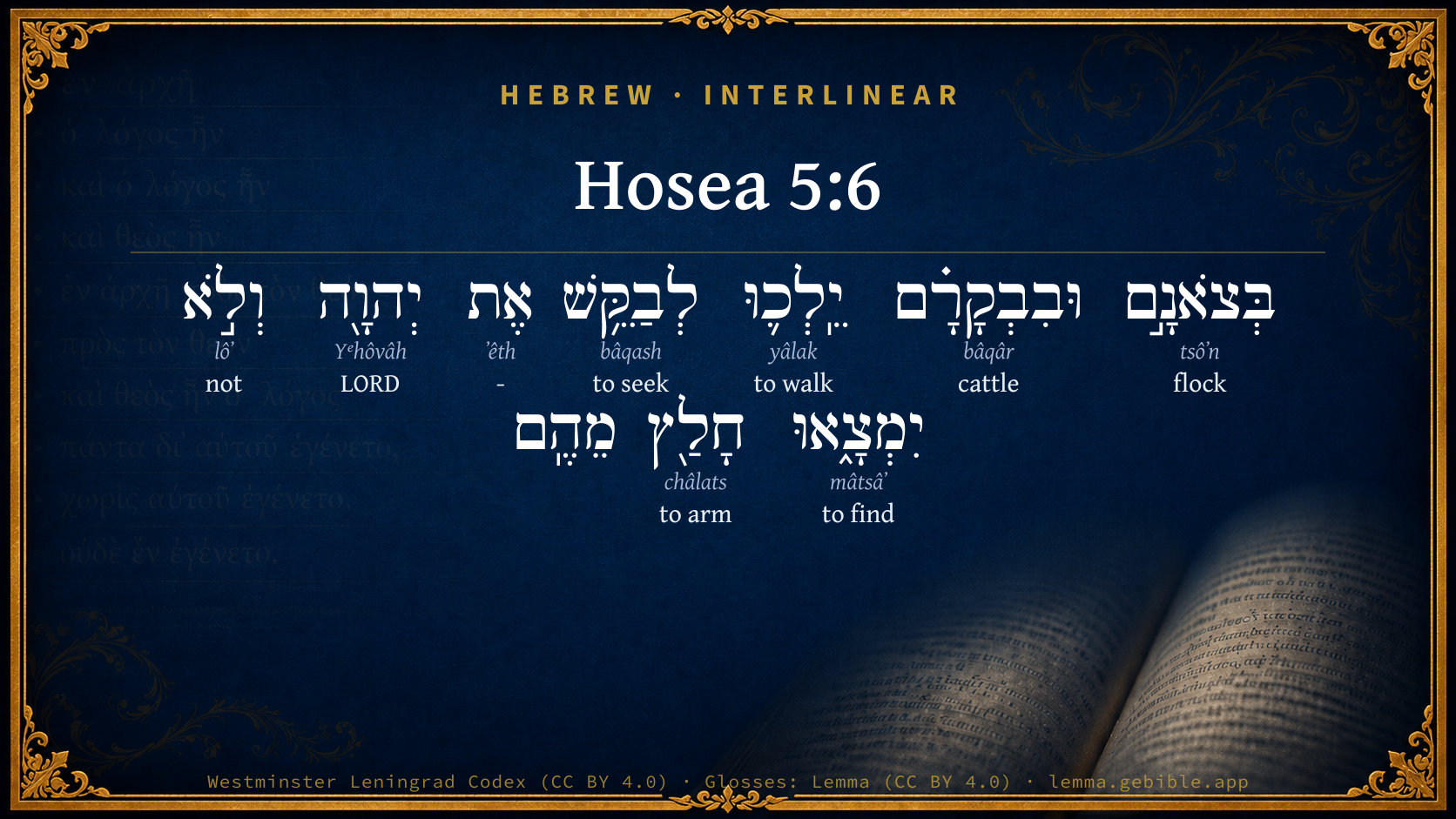
Hebrew (Westminster Leningrad Codex) Hosea 5:6 appears in the Hebrew Old Testament. The text above is from the Westminster Leningrad Codex. Each word links to its Strong’s number, a concise gloss, and parsing drawn from the Open Scriptures Hebrew Bible morphology. Click any word for its full Brown-Driver-Briggs (BDB) entry.
Download image
Cite this verse

Hosea 5:6 (World English Bible). Public Domain. Lemma interlinear Bible study tool, https://lemma.gebible.app/v/hosea/5/6.

Show BibTeX & RIS
BibTeX
RIS
English Translation
They will go with their flocks and with their herds to seek Yahweh; But they won't find him. He has withdrawn himself from them.
World English Bible · Public Domain
Download a study sheet

One document with this verse’s original text, its word-by-word gloss line, the meaning frame, cross-references with their text, attributed commentary, and full source and license credits — printable, and it pastes into notes with its structure intact.

This verse Autodidact and up

Study sheet (.html) Plain text (.txt)

A passage Seminary Student

Up to 50 verses in one chapter. A passage sheet keeps up to 6 commentary sources and 12 cross-references per verse, in the order this page ranks them, and says so on the sheet whenever that leaves anything out. Ask for a single verse and you get the Autodidact verse sheet above.

Everything on this page stays free to read, with no account — the sheet is a download of what is already on screen, not access to it.

Want to remove ads? Support Godless Engineer
Compare translations 3

The same verse in 3 English versions, stacked beneath the original-language interlinear above. Click any original word for its lexicon entry.

Each is an independent rendering of the whole verse — the interlinear is not word-aligned to these translations.

Highlighted words mark where these versions differ — a whole-verse word diff, not a word-by-word alignment.

  • World English Bible Public Domain
    They will go with their flocks and with their herds to seek Yahweh; But they won't find him. He has withdrawn himself from them.
  • King James Version Public Domain
    They shall go with their flocks and with their herds to seek the LORD; but they shall not find him; he hath withdrawn himself from them.
  • unfoldingWord Literal Text CC BY-SA 4.0
    With their flocks and with their herds they will go to seek Yahweh, but they will not find. He has withdrawn from them.

unfoldingWord Literal Text — © unfoldingWord, licensed CC BY-SA 4.0. Word-aligned USFM3 via Door43 (git.door43.org/unfoldingWord/en_ult).

Versions to compare (up to 4)

3 of 4 selected

Show all 18 translations

Every available English version of this verse, each an independent rendering of the whole verse.

  • World English Bible Public Domain
    They will go with their flocks and with their herds to seek Yahweh; But they won't find him. He has withdrawn himself from them.
  • Berean Standard Bible Public Domain
    They go with their flocks and herds to seek the LORD, but they do not find Him; He has withdrawn Himself from them.
  • Majority Standard Bible Public Domain
    They go with their flocks and herds to seek the LORD, but they do not find Him; He has withdrawn Himself from them.
  • King James Version Public Domain
    They shall go with their flocks and with their herds to seek the LORD; but they shall not find him; he hath withdrawn himself from them.
  • American Standard Version (1901) Public Domain
    They shall go with their flocks and with their herds to seek Jehovah; but they shall not find him: he hath withdrawn himself from them.
  • Revised Version (1885) Public Domain
    They shall go with their flocks and with their herds to seek the LORD; but they shall not find him: he hath withdrawn himself from them.
  • Geneva Bible (1599) Public Domain
    They shall goe with their sheepe, and with their bullockes to seeke the Lord: but they shall not finde him: for he hath withdrawne himselfe from them.
  • Douay-Rheims (1899) Public Domain
    With their flocks, and with their herds, they shall go to seek the Lord, and shall not find him: he is withdrawn from them.
  • Young's Literal Translation Public Domain
    With their flock and with their herd, They go to seek Jehovah, and do not find, He hath withdrawn from them.
  • Literal Standard Version CC BY-SA 4.0
    With their flock and with their herd, || They go to seek YHWH, and do not find, || He has withdrawn from them.
  • Unlocked Literal Bible CC BY-SA 4.0
    They will go with their flocks and herds to seek Yahweh, but they will not find him, for he has withdrawn himself from them.
  • unfoldingWord Literal Text CC BY-SA 4.0
    With their flocks and with their herds they will go to seek Yahweh, but they will not find. He has withdrawn from them.
  • Darby Bible Public Domain
    They shall go with their flocks and with their herds to seek Jehovah; but they shall not find [him]: he hath withdrawn himself from them.
  • World Messianic Bible Public Domain
    They will go with their flocks and with their herds to seek the LORD, but they won’t find him. He has withdrawn himself from them.
  • Webster's Bible Public Domain
    They shall go with their flocks and with their herds to seek the LORD; but they shall not find him; he hath withdrawn himself from them.
  • Free Bible Version CC BY-SA 4.0
    They will go to seek the Lord with their herds and flocks, but they will not find him, for he has given up on them.
  • Bible in Basic English Public Domain
    They will go, with their flocks and their herds, in search of the Lord, but they will not see him; he has taken himself out of their view.
  • JPS Tanakh (1917) Public Domain
    With their flocks and with their herds they shall go to seek the LORD, but they shall not find Him; He hath withdrawn Himself from them.

Literal Standard Version (2020), Covenant Press — licensed CC BY-SA 4.0. Text via the HelloAO Bible API (eBible.org). Unlocked Literal Bible (unfoldingWord) — licensed CC BY-SA 4.0. Text via the HelloAO Bible API (eBible.org). unfoldingWord Literal Text — © unfoldingWord, licensed CC BY-SA 4.0. Word-aligned USFM3 via Door43 (git.door43.org/unfoldingWord/en_ult). Free Bible Version, Dr. Jonathan Gallagher — licensed CC BY-SA 4.0. Text via the HelloAO Bible API (eBible.org).

Word by word

More ways to search: Search by grammar → Find every occurrence → Compare this word →

Practice this passage: Drill this verse → Learn its vocabulary →

חָלַ֖ץ
châlats
H2502
“to arm”
Verb, Qal, Perfect, 3rd Person, Masculine, Singular
Part of Speech
Verb
Stem
Qal
Form
Perfect
Person
3rd Person
Gender
Masculine
Number
Singular
Full BDB Definition

Origin: a primitive root

TWOT: 667 , 668

to remove, draw out, draw off, take off, withdraw, equip (for war), arm for war, rescue, be rescued - (Qal) equipped (participle) - (Niphal) - to be equipped - to go equipped - to be armed - (Hiphil) - to make strong, brace up - to invigorate - to draw off or out, withdraw - (Qal) - to draw, draw off - to withdraw - (Niphal) - to be delivered - to be saved - (Piel) - to pull out, tear out - to rescue, deliver, set free - to take away, plunder
  1. בְּצֹאנָ֣ם tsôʼn H6629 “in/at · flock · their” Preposition + Noun, Common, Both, Singular, Construct + Suffix, Personal, 3rd Person, Masculine, Plural
  2. וּבִבְקָרָ֗ם bâqâr H1241 “and · in/at · cattle · their” Conjunction + Preposition + Noun, Common, Both, Singular, Construct + Suffix, Personal, 3rd Person, Masculine, Plural
  3. יֵֽלְכ֛וּ yâlak H3212 “to walk” Verb, Qal, Imperfect, 3rd Person, Masculine, Plural
  4. לְבַקֵּ֥שׁ bâqash H1245 “to seek” Preposition + Verb, Piel, Infinitive Construct
  5. אֶת ʼêth H853 “-” Particle, Direct Object
  6. יְהוָ֖ה Yᵉhôvâh H3068 “LORD” Noun, Proper
  7. וְלֹ֣א lôʼ H3808 “and · not” Conjunction + Particle, Negative
  8. יִמְצָ֑אוּ mâtsâʼ H4672 “to find” Verb, Qal, Imperfect, 3rd Person, Masculine, Plural

About this verse

These counts appear in no published source. They are computed here, from the morphology-tagged text and Lemma’s own curated glosses. What Lemma adds →

10
words
9
distinct lemmas
Prophets
section

Shared distinctive vocabulary

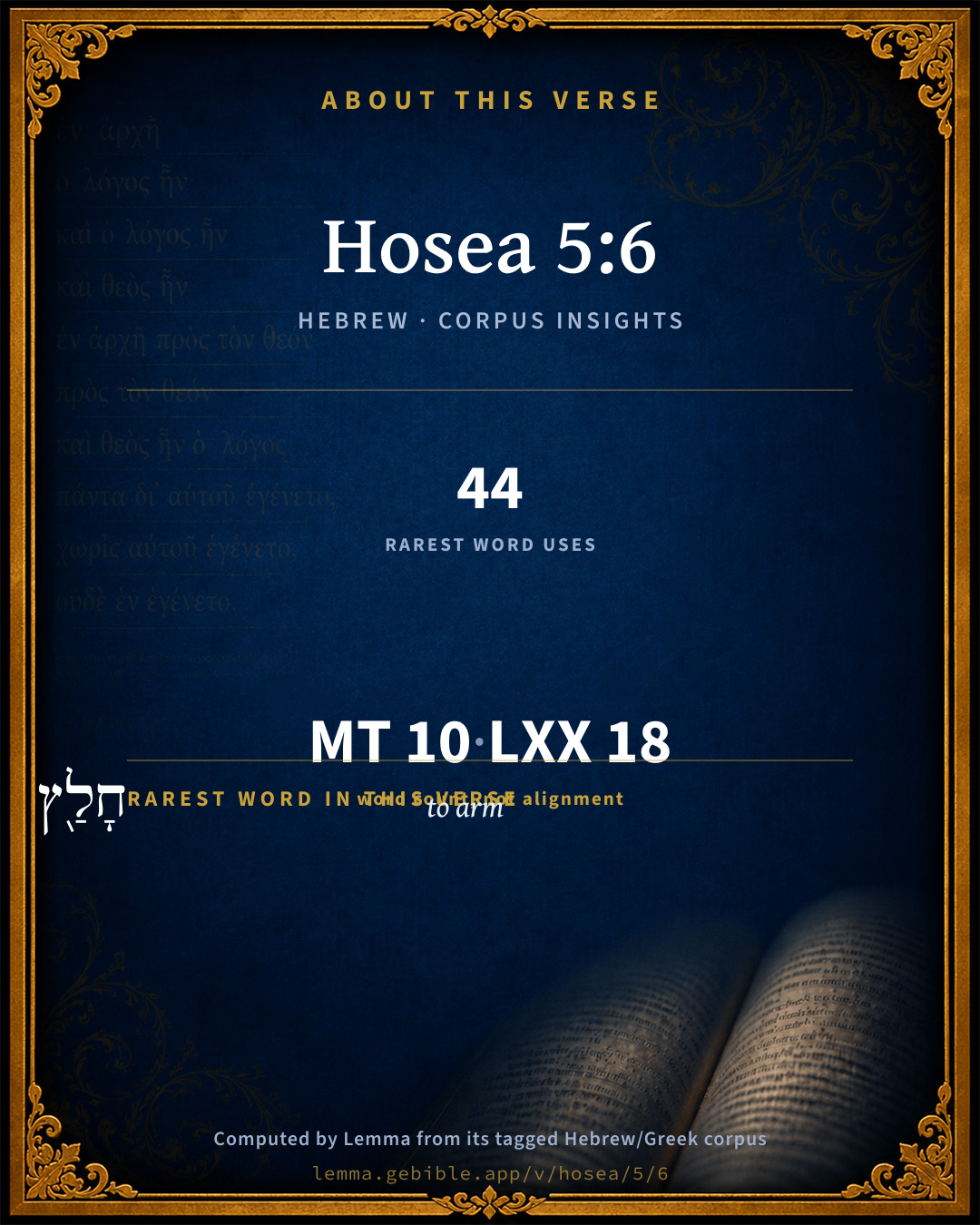
חָלַ֖ץ to arm H2502 occurs in 44 verses of the Hebrew Bible. Also found in:

Grammatical profile

  • 4 verbs
  • 3 nouns
  • 1 preposition
  • 2 particles

Verb forms

  • יֵֽלְכ֛וּ Qal · Imperfect
  • לְבַקֵּ֥שׁ Piel · Infinitive Construct
  • יִמְצָ֑אוּ Qal · Imperfect
  • חָלַ֖ץ Qal · Perfect

Hebrew & Septuagint length

In English translation the verse runs 24 words from the Hebrew and 25 from the Septuagint (LXX English) — closely comparable.

A rough comparison of the two English renderings, which tokenize alike — not a word-level alignment.

Word counts can differ between the Hebrew and the Greek without any difference in meaning — e.g. the Hebrew direct-object marker אֵת has no separate Greek word, and Greek often adds the article ὁ.

In the original languages it is 10 Hebrew tokens and 18 Greek tokens — but the two are counted differently (Hebrew bundles its prefixes and suffixes into one token; the Greek is in lemma form), so that isn’t a like-for-like length.

Cross-references

18

Topical passages linked to Hosea 5:6 in the Treasury of Scripture Knowledge — connected by theme and wording, ordered by reader-vote popularity; previews shown in the World English Bible.

  • Proverbs 1:28 Then will they call on me, but I will not answer. They will seek me diligently, but they will not find me;
  • John 7:34 You will seek me, and won't find me; and where I am, you can't come."
  • Micah 6:6–7 How shall I come before Yahweh, And bow myself before the exalted God? Shall I come before him with burnt offerings, With calves a year old?
  • Proverbs 15:8 The sacrifice made by the wicked is an abomination to Yahweh, But the prayer of the upright is his delight.
  • Isaiah 1:11–15 "What are the multitude of your sacrifices to me?," says Yahweh. "I have had enough of the burnt offerings of rams, And the fat of fed animals. I don't delight in the blood of bulls, Or of lambs, Or of male goats.
  • Jeremiah 7:4 Don't you trust in lying words, saying, The temple of Yahweh, the temple of Yahweh, the temple of Yahweh, are these.
  • Lamentations 3:44 You have covered yourself with a cloud, so that no prayer can pass through.
  • Ezekiel 8:6 He said to me, Son of man, see you what they do? even the great abominations that the house of Israel do commit here, that I should go far off from my sanctuary? but you shall again see yet other great abominations.
  • Exodus 10:9 Moses said, "We will go with our young and with our old; with our sons and with our daughters, with our flocks and with our herds will we go; for we must hold a feast to Yahweh."
  • Exodus 10:24–26 Pharaoh called to Moses, and said, "Go, serve Yahweh. Only let your flocks and your herds stay behind. Let your little ones also go with you."
  • Proverbs 21:27 The sacrifice of the wicked is an abomination: How much more, when he brings it with a wicked mind!
  • Song of Solomon 5:6 I opened to my beloved; But my beloved left; gone away. My heart went out when he spoke. I looked for him, but I didn't find him. I called him, but he didn't answer.
  • Isaiah 66:3 He who kills an ox is as he who kills a man; he who sacrifices a lamb, as he who breaks a dog's neck; he who offers an offering, [as he who offers] pig's blood; he who burns frankincense, as he who blesses an idol. Yes, they have chosen their own ways, and their soul delights in their abominations:
  • Jeremiah 11:11 Therefore thus says Yahweh, Behold, I will bring evil on them, which they shall not be able to escape; and they shall cry to me, but I will not listen to them.
  • Amos 5:21–23 I hate, I despise your feasts, And I can't stand your solemn assemblies.
  • Luke 5:16 But he withdrew himself into the desert, and prayed.
  • Ezekiel 8:18 Therefore will I also deal in wrath; my eye shall not spare, neither will I have pity; and though they cry in my ears with a loud voice, yet will I not hear them.
  • Micah 3:4 Then they will cry to Yahweh, But he will not answer them. Yes, he will hide his face from them at that time, Because they made their deeds evil."

Cross-references courtesy of OpenBible.info (CC BY 4.0).

Hebrew and Greek witnesses Masoretic Hebrew ↔ Greek Septuagint

The same verse in the two great witnesses to the Old Testament, shown verse-for-verse.

These are two independent witnesses, not word-aligned to each other, and the Septuagint is shown in lemma (dictionary) form.

Hebrew Hosea 5:6 Masoretic · Westminster Leningrad Codex

בְּצֹאנָ֣ם וּבִבְקָרָ֗ם יֵֽלְכ֛וּ לְבַקֵּ֥שׁ אֶת יְהוָ֖ה וְלֹ֣א יִמְצָ֑אוּ חָלַ֖ץ מֵהֶֽם

They will go with their flocks and with their herds to seek Yahweh; But they won't find him. He has withdrawn himself from them.

World English Bible · Public Domain

Greek LXX Hosea 5:6 Septuagint · lemma form

μετά πρόβατον καί μόσχος πορεύομαι ὁ ἐκζητέω ὁ κύριος καί οὐ μή εὑρίσκω αὐτός ὅτι ἐκκλίνω ἀπό αὐτός

They shall go with sheep and calves diligently to seek the Lord; but they shall not find him, for he has withdrawn himself from them.

LXX2012 (modern English Septuagint) · Public Domain

Hebrew: Westminster Leningrad Codex (CC BY 4.0). Greek: Septuagint (public domain); English from LXX2012 (modern English Septuagint) (Public Domain). How the Septuagint differs from the Hebrew →

Targum (Aramaic paraphrase)

1

The Targum is the ancient Jewish Aramaic paraphrase of the Hebrew Scriptures — an interpretive translation, not the Hebrew text itself. Onkelos (literal) and Pseudo-Jonathan (expansive) render the Torah, and Jonathan the Prophets. Coverage is partial: where no permissively-licensed English translation exists for a verse, only the Aramaic is shown. This is verse-level text, not a word-by-word alignment to the Hebrew.

  1. Targum Jonathan Prophets (Joshua–Malachi)
    בְּעָנְהוֹן וּבְתוֹרֵיהוֹן יַהֲכוּן לְמִתְבַּע אוּלְפַן מִן קֳדָם יְיָ וְלָא יִשְׁכְּחוּן סְלִיק שְׁכִנְתִּי מִנְהוֹן:

    (no public-domain English translation for this verse)

    Targum Jonathan — Aramaic: “Mikraot Gedolot” (public domain). English: “Sefaria Community Translation” (CC0 1.0 (public-domain dedication)); “London "Chaldee Paraphrase," 1871” (public domain). Text via Sefaria.

Commentary

Notes on Hosea 5:6 from classic Christian and Jewish commentators (each source and its license shown beneath its notes). The classic Christian expositions comment on the surrounding passage and are grouped to its opening verse, so a note may address several verses; the Jewish commentaries on the Tanakh (Rashi and others) are per-verse, so they appear only where the commentator wrote on this verse.

Lemma curates 59 commentaries, every one of them public domain or Creative Commons licensed, each selected and text-cleaned for this edition rather than reprinted as found. About our sources →

Trapp's Complete Commentary

John Trapp

Hos 5:6 They shall go with their flocks and with their herds to seek the LORD; but they shall not find [him]; he hath withdrawn himself from them.

Ver. 6. They shall go with their flocks, and with their herds] Cursitabunt, they shall cut up and down, from altar to altar, with all their stock, as if they would buy off their sins, redeem their sorrows, with hecatombs, {a large number of animals for sacrifce} and store of holocausts; {whole burnt offerings} and then be ready to say, as that heathen emperor did, when he was to meet his enemy in the field, Non sic Deos coluimus, aut sic viximus ut ille nos vinceret (Antonin. Philosoph.). We have not so served the gods, or lived so, that the enemy should have the better of us. They thought they had merited better at God’s hands by their thousands of rams, and ten thousand rivers of oil, Mic 6:7, than to fall, as in Hos 5:5, than to be relinquished by him, as here. Lo, this is the guise of graceless hypocrites: by their outward performances they think to oblige God unto them, and by their good deeds to set off for their bad. Thus Brunheldis (that French Athaliah), after many murders and much mischief wrought by her, 600 AD, built many colleges for priests and monks in Burgundy and Austria, eo scilicet beneficio maleficia sun expiavit, saith the French chronicler; thereby thinking to satisfy for all her cruelty. So here in King Stephen’s time, there were more abbeys built than in a hundred years before. So the Papists at this day spend and are spent in their blind devotions; they "lavish money out of the bag," and run up and down from saint to saint with their cost; they pray publicly in public calamities, for forty hours together, by the pope’s command, that they may pacify God, and divert his displeasure ( Quarantoras Italico nomine istas preces recant. Polan. in loc.). For the same cause they make the same man (in their greater cities appointed) to preach every day in Lent without intermission; so as six days in the week he preacheth on the gospel of the days; and on the Saturday, in honour and praise of our Lady, as they call her (Spec. Europ.). Lo, thus they go, as they think, to seek God with their will worship and work done, but they find him as little as they did here, with their flocks, and with their herds. And why? First, they go to seek him; they run, but in a wrong way; and so fulfil that sacred proverb, "He that hasteth with his feet sinneth," Pro 19:2; for the faster he runs the farther he is out. Next, they pretend to seek him, but indeed they seek themselves; they seek him, but it is to be rid of his rod; they do not so much serve him as serve themselves, and their own turns upon him; as those hypocrites in Zachary fasted to themselves; not to get off their sins, but their chains, Zec 7:6. Thirdly, they go with their flocks, &c.; not mine, but theirs, saith God; he will not so much as own them, though they were tendered to him in sacrifice; because brought with a wicked mind, Pro 21:27, as Balak and Balaam did, Num 23:1-2, and as Cain did, Gen 4:5, to whom therefore God had no respect, because he brought non personam sed opus personae, not himself but his sacrifice, as Luther hath it; who also calleth all those Cainists that offer to God the work done, but present not their bodies for a lively sacrifice, Rom 12:1. Hence he rejects their services with infinite disdain, as Isa 1:11-12; Isa 66:2-3, though never so numerous and precious, Mic 6:7 Hos 8:13. And to set forth this, as he calleth them here, their flocks, and not his, so, fourthly, he calleth them flocks and herds, not sacrifices; that was too good a name for them. Thus, Jer 7:21, in scorn he calleth their sacrifice flesh; such as was ordinary, sold in the meat markets. And thus also, Hos 9:4, speaking of the meat offering appointed, Lev 2:5, he calleth it, their bread for their souls, or, for their life and livelihood, the bread for their natural sustenance; and saith, it shall not come into his house, he will have none of it. See Mal 1:7. {See Trapp on "Mal 1:7"}

But they shall not find him] Non erit ipsis domi, non favebit eis, saith an interpreter here, he will not be at home, not within, to open to them when they knock at his door; it will be as strange to them as ever they were to him, because they bring him not that best sacrifice of a broken heart; and because they come too late when the gate of grace is shut, when the gale of grace is over, when he hath fully resolved upon their ruin, and will not repent.

When he hath withdrawn himself from them] Heb, חלע hath snatched away himself, hath thrown himself out of their company, as Peter threw himself, επεβαλων, out from the rude soldiers into a bycorner, to weep bitterly, Mar 14:72. Cum se proripuisset, so Beza rendereth it. When God is well pleased with his people, they can no sooner cry but he will say, Here I am, Isa 58:9. And though they offer but small things unto him, as Samuel did a sucking lamb, 1Sa 7:9, they are highly accepted, and graciously answered. "But woe unto them when I depart from them," saith God, Hos 9:12; yea, woe upon woe when God’s soul is once disjointed from them, Jer 6:8. "An evil, an only evil, behold, is come. An end is come, the end is come: it watcheth for thee; behold, it is come," Eze 7:5-6. And why? Because God was withdrawing from them. Hence all evils came rushing in, as by a sluice. In the ninth, tenth, and eleventh chapters of that prophecy God maketh divers removals. And still, as he goes out, some judgment comes in. First he removeth from the cherubims in the oracle to the threshold, Eze 9:3, and upon that removal, see what followeth, Eze 9:5-7, &c. Secondly, he removeth to the cherubims on the right side of the house, Eze 10:1, and see what follows, Eze 10:2. Thirdly, to the east gate of the house, and the first entrance into the temple, Eze 10:19, and then see what succeeds, Eze 11:8-10. Fourthly, he removed to Mount Olivet, quite out of the city, Eze 11:23, and when God was quite gone, then followed the fatal calamity in the ruin thereof. As there is no light in the world but from the sun, no water but from the sea; so no sound comfort or happiness to be had but with and in God. Better have him angry with us than not have him at all with us. The loss of God is a piece of hell: in the suburbs whereof the saints feel themselves when but a while deserted.

John Trapp, A Commentary or Exposition upon All the Books of the Old and New Testament (1647–1656) — public domain. Text from a community e-Sword module.

The Biblical Illustrator

Joseph S. Exell

Hos_5:6

He hath withdrawn Himself from them.

Divine withdrawal

Withdrawn is a word that may well chill our heart. It would be enough to express intolerable displeasure, if it stood just as it stands in this verse; but a larger meaning belongs to the word. Withdrawn is in some senses a negative relation, but it was a distinctly positive and we may add repelling action which the Lord meant to convey by the use of the term. All words were originally pictures, and the real dictionary when it appears will be pictorial. The Lord in this instance frees Himself from them. That is the literal and broader meaning of the prophecy. He releases Himself, He detaches Himself, He shakes off an encumbrance, a nuisance, a claim that is without righteousness. This may be taken in two senses.

1. The people are going with flocks and herds as if bent on sacrificial purpose; they will give the Lord any quantity of blood--hot, reeking blood; but the Lord says, I will have no more of your sacrifices; they are an abomination to Me; I hate all the programme of ritual and ceremony and attitude, if it fail to express a hunger and a reverence of the heart and mind. So the Lord is seen here in the act of taking up all these flocks and herds, and all these unwilling priests, and freeing Himself from them, throwing them away, as men pass out of their custody things that are offensive, worthless, and corrupting. Or--

2. It may mean that the Lord shakes Himself free from the clutch of hands that have no heart in them: He will walk alone. He will not give up His shepherdliness, though He have no flock to follow Him. Every woman is mother, every man is father, and a man is not the less father that all his children are thrice dead, and are as plants plucked up by the roots, and cast out to the burning. The shepherdliness is not determined by the number of sheep following or going before; shepherdliness is a quality, a disposition, an inspiration, an eternal solicitude. If need be God will continue His shepherdliness though every sheep go astray, and every lamb should die. Mark the disastrous possibility! Men may be left without God; the Almighty and All-merciful may have retired, gone away; away into the shade, the darkness of night; He may have enshrouded Himself in a pavilion of thick darkness, where our poor prayers are lost on the outside. To this dreadful issue things may come. (Joseph Parker, D. D.)

Unacceptable sacrifices

The heap of their sacrifices should not recall the sentence against them, nor bring any mitigation of their trouble, nor procure access to God and His favour, who had justly deserted them.

1. The greatest contemners of God may at last stand sensibly in need of Him.

2. Impenitent sinners may make offer of many things, when they do not give themselves to God.

3. It is a very sad stroke, when the Lord is not only away, but has really deserted a people, withdrawn Himself from them. (George Hutcheson.)

But they shall not find Him.

Too late

I. The most important of all works. Seek the Lord. This implies a distance between man and his Maker. It is not the distance of being, but the distance of character. The great work of man is to seek the Lord morally, to seek His character.

1. This is a work in which all men should engage.

2. This is a work which all men must attend to sooner or later.

II. The most important of all works undertaken too late. They shall not find Him. He will withdraw Himself from them. This is the language of accommodation. He puts forth no effort to conceal Himself, He alters not His position, but He seems to withdraw from them. As the white cliffs of Albion seem to withdraw from the emigrant as his vessel bears him away to distant shores, so God seems to withdraw from the man who seeks Him too late. (Homilist.)

Repenting too late

The main truth in this and other passages of Holy Scripture which speak of a time when it is too late to turn to God, is this; that it shall be too late to knock when the door shall be shut, and too late to cry for mercy when it is the time of justice. God waits long for sinners; He threatens long before He strikes; He strikes and pierces in lesser degrees, and with increasing severity, before the final blow comes. In this life He places man in a new state of trial, even after His first judgments have fallen on the sinner. But the general rule of His dealings is this; that when the time of each judgment is actually come, then, as to that judgment, it is too late to pray. Not too late for other mercy, but too late as to this one. (E. B. Pusey, D. D.)

Too late

About thirty years ago, a gentleman from New York, who was travelling in the South, met a young girl of great beauty and wealth, and married her. They returned to New York, and plunged into a mad whirl of gaiety. The young wife had been a gentle, thoughtful girl, anxious to help all in suffering or want, and to serve her God faithfully. But as Mrs. L. she had troops of flatterers; her beauty and dresses were described in the society journals; her bon-mots flew from mouth to mouth; her equipage was one of the most attractive in the park. In a few months she was intoxicated with admiration. She and her husband flitted from New York to Newport, from London to Paris, with no object but enjoyment. There were other men and women of their class who had some worthier pursuit--literature, or art, or the elevation of the poorer classes--but L. and his wife lived solely for amusement. Mrs. L. was looked upon as the foremost leader of society. About ten years ago she was returning alone from California, when an accident occurred to the railroad train in which she was a passenger, and she received a fatal internal injury. She was carried into a wayside station, and there, attended only by a physician from the neighbouring village, she died. The doctor said that it was one of the most painful experiences of his life. I had to tell her that she had but one hour to live. She was not suffering any pain. Her only consciousness of hurt was that she was unable to move; so that it was no wonder she could not at first believe me. I have but an hour, you tell me? Not more And this is all that is left me of the world. It is not much, doctor, with a half smile. The men left the room, and I locked the door, that she might not be disturbed. She threw her arm over her face and lay quiet a long time; then she turned on me in a frenzy. To think of all that I might have done with my money and my time! God wanted me to help the poor and the sick! Its too late now! Ive only an hour, She struggled up wildly. Why, doctor, I did nothing--nothing but lead the fashion! The fashion! Now Ive only an hour! An hour!--But she had not even that, for the exertion proved fatal, and in a moment she lay dead at my feet.. No sermon that I ever heard was like that womans despairing cry, Its too late now!

The Biblical Illustrator, edited by Joseph S. Exell (c. 1880s–1900s) — public domain. Text from a community e-Sword module.

Joseph Benson's Commentary

Hos 5:6. They shall go with their flocks and herds to seek the Lord — They shall seek to make their peace with God, and to induce him to be favourable to them by a multitude of sacrifices; but they shall not find their expectations answered. This is spoken of the people of Judah, mentioned in the latter part of the foregoing verse; who, though they attended the temple worship, yet did it without any true sense of religion, for which the Prophets Isaiah and Jeremiah particularly reprove them. The prophecy seems to look forward to the times of Hezekiah and Josiah, declaring that the attempts of those pious kings to reclaim the people from idolatry, and to restore the true worship of God, would fail of any durable effect, and would not avail to reverse the doom pronounced upon the guilty people. He hath withdrawn himself from them — God is said to hide and withdraw himself, when he will not answer men’s prayers, nor afford them seasonable relief in time of need. Hebrew, חלצ מהם, he hath disengaged, or loosened himself from them, or hath taken himself away.

Joseph Benson's Commentary on the Old and New Testaments (1811–1818) — public domain. Text from a community e-Sword module.

Keil & Delitzsch

C. F. Keil & F. Delitzsch

Israel, moreover, will not be able to avert the threatening judgment by sacrifices. Jehovah will withdraw from the faithless generation, and visit it with His judgments. This is the train of thought in the next strophe (Hos 5:6-10). Hos 5:6. "They will go with their sheep and their oxen to seek Jehovah, and will not find Him: He has withdrawn Himself from them. Hos 5:7. They acted treacherously against Jehovah, for they have born strange children: now will the new moon devour them with their fields." The offering of sacrifices will be no help to them, because God has withdrawn Himself from them, and does not hear their prayers; for God has no pleasure in sacrifices which are offered in an impenitent state of mind (cf. Hos 6:6; Isa 1:11.; Jer 7:21.; Psa 50:7, Psa 50:8.). The reason for this is given in Hos 5:7. Bâgad, to act faithlessly, which is frequently applied to the infidelity of a wife towards her husband (e.g., Jer 3:20; Mal 2:14; cf. Exo 21:8), points to the conjugal relation in which Israel stood to Jehovah. Hence the figure which follows. "Strange children" are such as do not belong to the home (Deu 25:5), i.e., such as have not sprung from the conjugal union. In actual fact, the expression is equivalent to בּני זנוּנים in Hos 1:2; Hos 2:4, though zâr does not expressly mean "adulterous." Israel ought to have begotten children of God in the maintenance of the covenant with the Lord; but in its apostasy from God it had begotten an adulterous generation, children whom the Lord could not acknowledge as His own. "The new moon will devour them," viz., those who act so faithlessly. the meaning is not, "they will be destroyed on the next new moon;" but the new moon, as the festal season, on which sacrifices were offered (Sa1 20:6, Sa1 20:29; Isa 1:13-14), stands here for the sacrifices themselves that were offered upon it. The meaning is this: your sacrificial feast, your hypocritical worship, so far from bringing you salvation, will rather prove your sin. חלקיהם are not sacrificial portions, but the hereditary portions of Israel, the portions of land that fell to the different families and households, and from the produce of which they offered sacrifices to the Lord.

(Note: It is very evident from this verse, that the feasts and the worship prescribed in the Mosaic law were observed in the kingdom of the ten tribes, at the places of worship in Bethel and Dan.)

Keil & Delitzsch — Biblical Commentary on the Old Testament (1861–1891) — public domain (CC PDM 1.0). Text via the HelloAO Bible API. (Old Testament only.)

Tyndale Open Study Notes

Tyndale Open Resources

5:6-7 The people might think that they could win God’s favor with their sacrifices, but Hosea warned them that they would not find him; God had left them to the consequences of their sin.

Tyndale Open Study Notes — © Tyndale Open Resources, licensed CC BY-SA 4.0. Text via the HelloAO Bible API.

Jamieson, Fausset & Brown

Robert Jamieson, A. R. Fausset & David Brown

with . . . flocks--to propitiate Jehovah (Isa 1:11-15).

seek . . . not find--because it is slavish fear that leads them to seek Him; and because it then shall be too late (Pro 1:28; Joh 7:34).

Jamieson, Fausset & Brown — Commentary Critical and Explanatory on the Whole Bible (1871) — public domain (CC PDM 1.0). Text via the HelloAO Bible API.

Adam Clarke's Commentary

Verse 6. They shall go with their flocks] They shall offer many sacrifices, professing to seek and be reconciled to the Lord; but they shall not find him. As they still retain the spirit of their idolatry, he has withdrawn himself from them.

Adam Clarke's Commentary on the Bible (1810–1826) — public domain. Text from a community e-Sword/MySword module.

John Calvin's Commentaries

The Prophet here laughs to scorn the hypocrisy of the people, because they thought they had ready at hand a way of dealing with God, which was, to pacify him with their sacrifices. He therefore shows that neither the Israelites nor the Jews would gain any thing by accumulating burnt-offerings, for they could not in this way return into favor with God. He thereby intimates that God requires true repentance, and that he will not be reconciled to men, except from the heart they seek him and consecrate themselves to his service; and not because they offer brute beasts. The faithful, no doubt, expiated their sins at that time by sacrifices, but only typically: for they knew for what end and purpose God had made the law concerning sacrifices, and that was, that the sinner, being reminded by the sight of the victim, might confess himself to be worthy of eternal death, and thus flee to God’s mercy and look to Christ and his sacrifice; for in him, and nowhere else, is to be found true and effectual expiation. For this end then had God instituted sacrifices: so the faithful, while offering sacrifices, did not suppose any satisfaction to be done by the external work, nor even imagined it to be the price of redemption; but they exercised themselves in these rites in faith and repentance.

The Prophet now, by implication, sets oxen, and rams, and lambs, in opposition to spiritual sacrifices; for a contrast is to be understood in the words, They shall come with their sheep, etc. What bring they to God’s presence? They bring, he says, only their rams, they bring oxen; but God commands what is far different: he commands men to consecrate themselves to him, and that in a spiritual manner, and as to external rites, to refer them to Christ, and to the true expiation, which was yet hid in hope. Since then the Israelites brought only their oxen and lambs to God, they in vain expected him to be propitious to them; for he is not pacified by such trifles; inasmuch as every one who separates the outward sacrifice from its design, brings nothing but what is profane. Indeed, the true and lawful consecration is by the word; and by the word we are guided to faith in Christ, we are guided to repentance: when these are neglected and disregarded, and men securely trust in their sacrifices, they do nothing but mock God. We hence see that the Prophet exposes not here without reason this folly of the Israelites, that they sought God with their flocks and their herds

And he says, They shall come, or shall go, to seek God By this sentence he intimates that hypocrites sedulously labour to reconcile God to themselves; and we even see with what zeal they weary themselves; and of this there is a remarkable instance at this day in the Papists; for they spare no diligence, when they seek to pacify God. But the Prophet says that this labour is vain and foolish. “Let them go,” he says, that is, “Let them weary themselves; but they shall do so without profit, for they shall not find God.” But when he says, that they would come to seek Jehovah, he is not to be understood as saying, that they would really do so; for hypocrites turn aside from God by circuitous courses and windings, rather than seek access to him. But yet they propose it as their final intention, as they speak, to seek God: they do not indeed come afterwards to him; nay, they dread his face, and shun it as much as they can; and yet when one asks them what they intend by sacrificing and by performing other rites, the answer is ready on their lips, “We worship God,” that is, “We desire to worship him.” Since then hypocrites are wont to boast of this, the Prophet speaks by way of concession, and says, They shall come to seek God, but shall not find him

The Papists of this day pursue a similar course, when they go round their altars, when they gad away to perform vowed pilgrimages, when they whisper their prayers, when they hear and buy masses; for to what purpose are all these things, but by interposing these veils to escape God’s judgment? They know themselves to be exposed to his judgment; their conscience forces them to pacify God: but what do they in the meantime? “I will find out a way in which God will not pursue me: let this then be the price of redemption, let this be a compensation.” In a word, we see that the Papists mock God with their ceremonies, that they have nothing else in view but to seek hiding-places: and hence the Lord by his Prophet complains, that his temple was like a den of robbers, (Jeremiah 7:11:) for men securely sin, when they publicly offer such expiations. Nay, the Papists, when they mutter their prayers, say that the final intention is pleasing to God, though they may wander in their thoughts: for if, when they begin to pray, it should come to their minds, that God is prayed to, though they may not attend to their prayers, though they may pollute themselves with many depraved lusts yet, if with the mouth they utter prayers, they maintain that the final intention pleases God. — Why? Because their design is to seek God. This is, indeed, extremely sottish and puerile: but, as I have already said, the Prophet does not press this point, but concedes to the Israelites what they pretended, “Ye seek God; but yet ye run not in the right way; and these circuitous courses will not lead you to God.” How so? “For ye recede farther from him.” So Isaiah says, ‘She will greatly weary herself in her ways:’ but in the meantime she followed not the right way, but, on the contrary, turned aside after various errors, and thus receded from the Lord, and came not to him.

By saying, that God had removed or separated himself from them, he intimates that he is not propitious but to the faithful, who think not so grossly of him, as to seek to feed him with the flesh of oxen or other sacrifices, or to pacify him with disagreeable odour; but who seek him spiritually and from the heart, who bring true repentance. It now follows —

John Calvin's Commentaries (1540-1563) — public domain. Text from the Calvin Translation Society English edition (1840s-50s) via the Christian Classics Ethereal Library (ccel.org). Calvin's coverage is partial (roughly two-thirds of the Bible); uncommented books and verses are honest gaps, never fabricated. The 19th-century editor's footnotes and remarks are omitted so the notes are faithfully Calvin's own voice.

Ellicott's Commentary for English Readers

(6) The vain effort to repent when it is too late. The spirit with which sacrifices of flocks and herds were offered is of more consequence than the multitude of such oblations (Mic_3:4; Isa_1:11; Psa_40:6). Ghastly and revolting results follow the substitution of ritual of any kind for the weightier matter of the law.

A Bible Commentary for English Readers, edited by Charles John Ellicott (1878–1897) — public domain. Text from a community e-Sword module.

The Cambridge Bible for Schools and Colleges

gen. ed. J. J. S. Perowne

6. with their flocks and with their herds] i.e., with their sacrificial offerings. This passage affords decisive proof (if indeed the converging evidence from other quarters can be held incomplete) that the Israelites of the north simply and in good faith professed to be worshippers of Jehovah. It will be too late, says the prophet, to use the ordinary means of appeasing Jehovah’s wrath, which have only a value as the outward signs of penitence and faith (see on Hos_6:6). Micah uses similar expressions respecting prayers which are offered too late (Mic_3:4).

The Cambridge Bible for Schools and Colleges (gen. ed. J. J. S. Perowne; Cambridge University Press, 1878–1918) — public domain. Text from a community e-Sword module.

John Gill's Exposition

They shall go with their flocks and with their herds to seek the Lord,.... Not only the two tribes of Judah and Benjamin, to whom Kimchi, Aben Ezra, and Abarbinel, restrain the words; but the ten tribes of Israel also, who, when in distress, and seeing ruin coming upon them, should seek the Lord; seek help from him against their enemies, and the pardon of their sins; seek his face and favour, and to appease his wrath, by bringing a multitude of sacrifices out of their flocks and herds; such a number of them, as if they brought all their flocks and herds with them; but not with true repentance for their sins, nor with faith in the great sacrifice, which legal sacrifices, rightly performed, prefigured. Kimchi refers this to the times of Josiah; but, as it respects Israel as well as Judah, it seems to design some time a little before the ruin of them both:

but they shall not find him; shall not find grace and mercy with him; he will not be favourable to them, will not afford them any help, but give them up to utter ruin and destruction; as he did Israel at the Assyrian captivity, and Judah at the Babylonish captivity:

he hath withdrawn himself from them; the glory of the Lord departed from them; his Shechinah, or divine Majesty, as the Targum, removed from them, because of their idolatry, and other sins; they sought him not where and while he was to be found; and therefore, when they sought him, found him not, because he had withdrawn his presence from among them, being provoked by their iniquities.

John Gill's Exposition of the Whole Bible (1746–1763) — public domain (CC PDM 1.0). Text via the HelloAO Bible API.

Albert Barnes' Notes on the Bible

They shall go with their flocks - “They had let slip the day of grace, wherein God had called them to repentance, and promised to be found of them and to accept them. When then the decree was gone forth and judgment determined against them, all their outward shew of worship and late repentance shall not prevail to gain admittance for them to Him. He will not be found of them, hear them, nor accept them. They stopped their ears obstinately against Him calling on them, and proffering mercy in the day of mercy: He will now stop His ear against them, crying for it in the Day of Judgment.” Repenting thus late, (as is the case with most who repent, or think that they repent, at the close of life) they did not repent out of the love of God, but out of slavish fear, on account of the calamity which was coming upon them. But the main truth, contained in this and other passages of Holy Scripture which speak of a time when it is too late to turn to God, is this: that “it shall be too late to knock when the door shall be shut, and too late to cry for mercy when it is the time of justice.”

God waits long for sinners; He threatens long before He strikes; He strikes and pierces in lesser degrees, and with increasing severity, before the final blow comes. In this life, He places man in a new state of trial, even after His first judgments have fallen on the sinner. But the general rule of His dealings is this; that, when the time of each judgment is actually come, then, as to “that” judgment, it is too late to pray. It is “not” too late for other mercy, or for final forgiveness, so long as man’s state of probation lasts; but it is too late as to this one. And thus, each judgment in time is a picture of the eternal judgment, when the day of mercy is past forever, to those who have finally, in this life, hardened themselves against it. But temporal mercies correspond with temporal judgments; eternal mercy with eternal judgment. In time, it may be too late to turn away temporal judgments; it is not too late, while God continues grace, to flee from eternal; and the desire not to lose God, is a proof to the soul that it is not forsaken by God, by whom alone the longing for Himself is kept alive or re-awakened in His creature.

They shall not find Him - This befell the Jews in the time of Josiah. Josiah himself “turned to the Lord with all his heart and with all his soul and with all his might, according to all the law of Moses” 2Ki 23:25-27. He put away idolatry thoroughly; and the people so tier followed his example. He held such a Passover, as had not been held since the time of the judges. “Notwithstanding the Lord turned not from the fierceness of this great wrath, wherewith His anger was kindled against Judah because of all the provocations that Manasseh had provoked Him withal. And the Lord said, I will remove Judah out of My sight, as I have removed Israel, and will cast off this city Jerusalem, which I have chosen, and the house of which I said, My name shall be there.”

The prophet describes the people, as complying with God’s commands; “they shall go,” i. e., to the place which God had chosen and commanded, “with their flocks and their herds,” i. e., with the most costly sacrifices, “the flocks” supplying the sheep and goats prescribed by the law; the “herds” supplying the bullocks, calves and heifers offered. They seem to have come, so far, sincerely. Yet perhaps it is not without further meaning, that the prophet speaks of those outward sacrifices only, not of the heart; and the reformation under Josiah may therefore have failed, because the people were too ingrained with sin under Manasseh, and returned outwardly only under Josiah, as they fell back again after his death. And so God speaketh here, as He does by David, “I will take no bullock out of thine house, nor he-goat out of thy fold. Thinkest thou, that I will eat bulls’ flesh, or drink the blood of goats?” Psa 50:9, Psa 50:13, and by Isaiah, “To what purpose is the multitude of your sacrifices unto Me? I am full of the burnt-offerings of rams, and the fat of fed beasts” Isa 1:11.

He hath withdrawn Himself from them - Perhaps he would say, that God, as it were “freed Himself” from them, as He saith in Isaiah, “I am weary to bear them” Isa 1:14, the union of sacrifices and of sin.

Albert Barnes' Notes on the Bible (1834–1885) — public domain. Text from a community e-Sword/MySword module.

Haydock's Catholic Bible Commentary

Them. He will receive their victims no longer, Isaias i. 11. (Calmet) --- In vain do they expect to escape by this appearance of sanctity, while they continue in sin. (Haydock)

George Leo Haydock (1774–1849), Haydock's Catholic Family Bible and Commentary, 1859 edition — public domain. Excludes Psalms (Douay-Rheims chapter numbering differs from Protestant) and Deuterocanonical books (Catholic canon only).

Matthew Poole's English Annotations

They; the people of Judah, say some, but I rather think it is spoken of the Ephraimites, and either implies by what they did support their confidence of escaping ruin, or else foretells that extremity of sufferings should force them at last to offer sacrifices to God; and the Jewish doctors tell us, that under Hoshea’s reign Israel had liberty of bringing their offerings and sacrifices to Jerusalem: whether this were so or not, it is certain they did not seek him in right manner, it was with their flocks and herds, but not with their hearts, not with sound repentance.

But they shall not find him; whilst he might have been found they would not seek him, now as a punishment, and to leave them remediless, God will not be found of them; he will not either accept a sacrifice, or pardon their sin, or return to save them.

He hath withdrawn himself from them; in displeasure hath withdrawn his favourable presence from them, and with resolution to leave them to the violences of the Assyrian powers.

Matthew Poole's English Annotations on the Holy Bible (1683–1685) — public domain. Text from a community e-Sword/MySword module.

Whedon's Commentary on the Bible

Daniel D. Whedon

6. It is impossible to appease the divine wrath and to avert the threatened judgment by the means with which Israel is accustomed to seek the favor of Jehovah. Go…

seek Jehovah — Hos_6:1-3, indicates that they sought Jehovah only to find relief from calamity; repentance was lacking completely (see on Amo_5:4).

Flocks… herds — Multitudes of sacrificial animals. These are of value only when offered in the right spirit and backed by a life acceptable to Jehovah (Introduction, p. 32; compare Amo_5:21 ff.; Isa_1:11 ff.).

He hath withdrawn himself — He has cut the ties which bound him to the people; he can no longer be reached by them (Hos_5:15; compare Isa_8:17). Why? Hos_5:7 supplies the answer.

Dealt treacherously — Better, They have been faithless. The verb is used of the infidelity of a wife to her husband (Jer_3:20). The next figure expresses a similar thought. They have begotten [“borne”] strange children — Children not the offspring of a legitimate union. “Israel ought to have begotten children of God in the maintenance of the covenant with the Lord; but in its apostasy from God it had begotten an adulterous generation” — a generation which from its infancy was led astray by the example of the parents. The second clause marks an advance. Not only have they themselves become faithless; in addition they have brought into the world a generation which is estranged from Jehovah.

Now shall a month devour them with their portions — R.V., “now shall the new moon devour them with their fields.” Marti alters the text so as to read, “Now shall a destroyer devour them; and wasted shall become their fields.” Less radical emendations have been proposed, but, since all are based upon conjecture, if we accept any we may as well accept the one giving the best sense. But what does the present Hebrew text mean? Are emendations absolutely necessary? If we follow A.V. in reading month the meaning might be either that within a month’s time the destroyer will be upon them (Clarke), or that a brief month will be sufficient to completely destroy them and their possessions. A still different meaning is suggested by G.A. Smith; he translates, “Now may a month devour them with their portions,” which he interprets, “Any month may bring the swift invader.” These interpretations would make the transition from 7 to 8 quite natural. The destroyer will soon be here; therefore (8) give the signal, prepare for battle. The Revisers, however, preferred the translation “new moon,” one of the most ancient festivals among the Hebrews, on which it was customary to offer sacrifice (Hos_2:11; 1Sa_20:6; 1Sa_20:29; Isa_1:13). Even with this translation Cheyne finds in the passage a thought similar to that expressed by G.A. Smith: “Instead of watching gladly for the new moon… they should have a ‘fearful looking for of judgment,’ increasing as each new moon arose. If not this, then perhaps the next would bring a slaughtering, plundering horde of invaders.” A vivid imagination is needed to see this meaning in the words. A more natural interpretation would be to regard new moon as synonymous with festival or, better, as representing the entire superficial sacrificial system and worship. “Your hypocritical worship, so far from bringing you salvation, will rather prove your ruin” (Keil). If the portions or fields of the individuals are destroyed it will amount to the devastation of the whole land. The differences among commentators show the obscurity of the passage. The interpretation of G.A. Smith, on the one hand, and that of Keil, on the other, reproduce most faithfully the present Hebrew text; of these that of G.A. Smith connects more naturally with Hos_5:8.

Daniel D. Whedon (gen. ed.), Commentary on the Old and New Testaments (1874–1909) — public domain. Text from a community e-Sword module.

The Pulpit Commentary

They shall go with their flocks and with their herds to seek the Lord. In this way they attempt to break, if not pro-vent, their fall. With numerous and costly sacrifices they endeavor to propitiate Jehovah. With sheep and goats out of their flocks, and with bullocks and heifers out of their herd, they try to make reparation for the past or to secure present and future favor. But in vain. Israel might go to Bethel and Judah to Jerusalem; but to no purpose. They shall not find him; he hath withdrawn himself. Their repentance came too late; or when it did come it wanted sincerity; or it was a wrong motive which prompted it fear of approaching calamity and not love to their Creator; or their sins ran parallel with their sacrifice. Forgetting that obedience is better than sacrifice, they cherished a disobedient spirit or continued in their course of disobedience notwithstanding their outward sacrificial service. For one cause or other they fail in their efforts to find him; for, instead of being a present help in time of trouble, he has withdrawn beyond their reach; he has removed the Shechinah-glory of his presence from among them; or he has loosed himself from all those ties that once bound him in mercy to them, just as a husband frees himself from all responsibilities and disarms all liabilities on behalf of a faithless partner whom he has been forced to divorce. And such is the specific reason assigned in the next verse.

Vers. 6-10. No place found for repentance.

They would seek the Lord with sacrifices from the flock and from the herd, but they would not find him; they multiplied sacrifices, but the Lord had withdrawn himself. Thus in the New Testament we read that Esau found no place of repentance, though he sought it carefully with tears;" or, according to the Revised Version, "even when he afterward desired to inherit the blessing, he was rejected (for he found no place of repentance), though he sought it diligently with tears." In one of our Lord"s parables the parable of the ten virgins we read that after those who were ready had gone in with him to the marriage, "the door was shut." This brief sentence is in one aspect of it among the most impressive and solemn in the whole Word of God. The sentiment conveyed by it is somewhat, indeed much, akin to that of the statement of the prophet in reference to Israel.

I IT IS IMPORTANT TO REALIZE THE NATURE OF SUCH WITHDRAWAL. The loss of earthly friends or their estrangement from us is much to be deplored; how much sadder it is when we forfeit the favor of Heaven, and God withdraws himself! On earth friends may, from misconduct on our part, or misconception on their part, or misrepresentation on the part of some intermeddler, or misapprehension of one kind or other, shut the door against us, or we may shut the door against ourselves. But however such an event is to be regretted, still a proper understanding may reopen the once friendly door, or time may unbar it, or the kindly interposition of mutual friends may again open it; or, failing all this, another door may be opened in its stead, and other friends replace those whose friendship has been lost, or even better friends may be raised up in their room. But when the Lord shuts to the door and withdraws himself, no interposition shall unbar it, no time reopen it, no explanation ever fling or force it back; nothing shall ever be able to remove the bar that closes it. Once shut, it is shut forever; once closed, it never opens; once locked, no key can enter its wards; once bolted, that bolt remains an everlasting fixture.

II IT IS WELL TO REFLECT ON THE TIME WHEN GOD WITHDRAWS HIMSELF AND IS NO LONGER TO BE FOUND. There may be some difficulty in ascertaining the precise times when God withdraws himself and is no longer found.

1. One thing, however, is abundantly certain, that in the case of sinners who live and die in sin, impenitent and unpardoned, this withdrawal takes place at death; for there is neither knowledge nor device in the grave. Then the day of grace is concluded, then the time of probation ends, then the means of salvation terminate, then the space for repentance is past, and God has forever withdrawn himself. Death seals the sinner"s doom irreversibly; the last opportunity is gone, and for ever; prayer is then powerless and penitence hopeless. There remains only the dooming, damning sentence, "I know you not whence ye are." Hollow-hearted hypocrites ye must have been, workers of iniquity, and nothing more and nothing better, false professors, fruitless fig trees, cumbering and cursing the rich vineyard soil. Children of God ye never were; I never owned you as such; I cannot do so now. And thus he withdraws, leaving them to their fate.

2. But even before death this withdrawal may take place, at least in a certain sense. We are warned in Scripture that the Spirit will not always strive. To the Israelites of old he swore that they would never cuter into his rest, and so a whole generation of them was excluded from the land of promise; in reference to which the inspired penman utters the solemn warning, "Let us labor therefore to enter into that rest, lest any man fall alter the same example of unbelief" ("disobedience," Revised Version and margin). In this very book God"s abandonment of Ephraim and consequent withdrawal are affirmed. "Ephraim is joined to his idols: let him alone." Let us, then, beware of provoking God to withhold or withdraw the gracious influences of his Spirit, and thus leave us to judicial blindness. Let us beware of sinning away our day of grace, and in this respect outliving it.

3. We would not venture to limit the mercy of God, or set bounds to his sovereign grace. "While the lamp holds out to burn The vilest sinner may return.

But God at any moment may withdraw the breath of his Spirit, or withhold the oil of his grace, and the lamp go out in everlasting darkness! Pusey makes a very interesting distinction, as follows: "The general rule of his dealings is this: that when the time of each judgment is actually come, then as to that judgment it is too late to pray. It is not too late for other mercy, or for final forgiveness, so long as man"s state of probation lasts; but it is too late as to this one.

III IT IS OF MOMENT TO ASSIGN SOME REASONS WHY GOD WITHDRAWS HIMSELF. This frequently takes place, we doubt not, in consequence of men silencing conscience and stifling convictions. Conscience may become callous or seared, and convictions may wear gradually weak, nay: at length cease altogether. The same result may be brought about by allowing any sin to have the mastery, and in consequence of not seeking grace to resist it, or not summoning up resolution to break its yoke.

1. The people particularly referred to by the prophet had not sought the Lord in time. It was only when ruin stared them in the face that they bethought themselves of seeking God; it was fear drove them to his service.

2. They were only half-hearted in his service, and it was a divided allegiance they rendered; but God claims the whole heart of his worshippers, otherwise he will not be found of them.

3. Their repentance was not genuine; it appears to have been outward sacrifice, not inward service. They brought their herds, not their hearts; their flocks, not the feelings of their souls.

4. Their faithlessness had a prospective as well as present evil influence. Their children, instead of being trained in the nurture and admonition of the Lord, inured to idolatry and irreligion both by the precept and example of their parents, would, as a matter of course, prove as faithless and godless, or more so than they.

5. No wonder God set a time to ease him of his adversaries and avenge him of his enemies. That time, a month, was certain, short, and sudden.

IV GOD SPEAKS BEFORE HE STRIKES. God suffereth long with the provocations of sinners. He warns them of the evil of their ways; he apprises them of the ruinous consequences of their sinful courses.

1. He threatens before he inflicts the blow; he gives notice of his judgments before they arrive. Dark clouds precede the coming storm. Milder judgments are sent as precursors of more severe visitations. It is of God"s mercy that men are not only informed of their duty, but apprised of their danger. Ministers of the gospel are to sound the alarm, that men may flee from the wrath to come.

2. When God"s judgments are near at hand, their approach has a startling effect. Those who made light of them, or thought them far off, are confounded and amazed; while this confusion may be reflected in the very abruptness of the expression, "After thee, O Benjamin;" at thy back comes the enemy disaster, destruction, desolation.

3. The judgments of God, thus announced as near, at the very door, are represented as sure. They are no mere menaces or make-believes; they are not meant merely to alarm; they are dread realities, which impenitent sinners can by no means escape or evade. "Among the tribes of Israel have I made known that which shall surely be." To all notice had been given, so that no one could urge the plea of ignorance on his own part, nor charge precipitancy on the part of God. In his mercy he had made it known to all without exception, in his truth he will make it sure. They had been warned, called to repentance, chastened paternally; but they had despised all this. And the day of mercy is now past; the time of judgment is come; the final doom, fixed and irreversible, is denounced. When princes, making their will law, trample on the privileges of their people, or infringe the Law of God, or in any way set aside sacred and solemn obligations, they incur a fearful responsibility. When, not only by their edicts but by their example, they set aside the enactments of Heaven, and encourage their subjects to do likewise, they open upon themselves the flood-gates of Divine wrath which God pours out upon them, like the waters of the deluge on the guilty antediluvians. Pusey supposes that the reference to the princes of Judah being "like them that remove the bound," contains some such allusion as the following: "Since the prophet had just pronounced the desolation of Israel, perhaps that sin was that, instead of taking warning from the threatened destruction and turning to God, they thought only how the removal of Ephraim would benefit them by the enlargement of their borders. They might hope also to increase their private estates out of the desolate lands of Ephraim their brother.

Divine withdrawal.

When the Lord invited Israel"s approach, Israel remained afar off in unbelief and impenitence. And when, in distress and anxiety, Israel drew near the Lord, it was to find that he would no longer reveal his face or bestow his favor.

I THE OCCASION OF THE DIVINE WITHDRAWAL. The Scriptures often represent the Lord as hiding his face, as turning away his ear, as repenting him of the favor he had shown, as hiding himself. Why such action? Surely this withdrawal is always and only because of human sin. Whilst his subjects are loyal, they always find him gracious and accessible; but from the rebellious and obstinate he withdraws himself in displeasure.

II THE SIGNS OF THE DIVINE WITHDRAWAL. In the case of Israel prayers were unheard, sacrifices were disregarded, enemies were suffered to triumph, and national disasters followed one another thick and fast. God has ways of withdrawing himself from a soul as well as from a nation. He removes the joyful light of his countenance, and suffers afflictions to befall those from whom tie hides his face for a moment.

III THE PURPOSES OF THE DIVINE WITHDRAWAL. It is a purpose of mercy, not of malevolence or vindictiveness. If men will not obey God, he leaves them to taste the fruits of disobedience. When they are wearied of his absence, and turn unto him, it is with great mercies that he gathers them. T.

Too late.

"They shall go with their flocks and with their herds to seek the Lord; but they shall not find him; he hath withdrawn himself from them." This verse directs us to two subjects of thought.

I THE MOST IMPORTANT OF ALL WORKS. "They shall go with their flocks and with their herds to seek the Lord." "Seek the Lord:" this implies a distance between man and his Maker. The Bible abounds with allusions to this distance. What is it? It is not the distance of being, for both are in close vital contact. "In him we live and move and have our being." It is the distance of character. Between the sympathies, principles, and aim of the two there is a distance vast as infinitude. "His thoughts are not our thoughts," etc. Hence the great work of man is to seek the Lord morally to seek his character, and thus become a "partaker of the Divine nature.

1. This is a work in which all men should engage. The grand duty of all souls is to be "holy, even as he is holy." Holiness is the condition of fellowship with him in "whose presence there is joy, and at whose right hand there are pleasures for evermore.

2. This is a work which all men must attend to sooner or later. The time hastens on when the most wicked and worthless man on earth will wake up to the importance of holiness, and strenuously try for his friendship. Of all works, then, this is the most important. Every ether avocation of life is puerile compared with this. Man"s great want is the Lord the Lord"s character, the Lord"s fellowship. Without this, whatever else he has, he is lost lost to happiness, to usefulness, and to the grand ends of his being.

II The most important of all works UNDERTAKEN TOO LATE. "They shall not find him; he hath withdrawn himself from them." Though they take with them their flocks and their herds, and are prepared to make the greatest sacrifices, their efforts are fruitless hath withdrawn himself from them." This is the language of accommodation. He puts forth no effort to conceal himself, he alters not his position, but he seems to withdraw from them. As the white cliffs of Albion seem to withdraw from the emigrant as his vessel bears him away to distant shores, so God seems to withdraw from the man who seeks him "too late.

CONCLUSION. "Then shall they call upon me, but I will not answer; they shall seek me early, but they shall not find me: for that they hated knowledge, and did not choose the fear of the Lord: they would none of my counsel: they despised all my reproof. Therefore shall they eat of the fruit of their own way, and be filled with their own devices. D.T.

The Pulpit Commentary (1880–1919), ed. H.D.M. Spence-Jones & Joseph S. Exell — public domain. Text from a community e-Sword module.

John Wesley's Explanatory Notes

To seek the Lord - The Jewish doctors tell us, that under Hosea, Israel had liberty of bringing their sacrifices to Jerusalem. Shall not find him - God will not be found of them. Hath withdrawn himself - For their impenitency.

John Wesley, Explanatory Notes Upon the Whole Bible (1754–1765) — public domain. Text via the GEBible commentary corpus.

Rashi

Rabbi Shlomo Yitzchaki (Rashi)

With their flocks and with their cattle With their sacrifices.

He has withdrawn Heb. חָלַץ, slipped away. Comp. (II Sam. 2:21) “and take to yourself his clothing (חֲלִצָתוֹ),” the clothing that you will slip off them.

Rashi on the Tanakh — English translations: “The Judaica Press complete Tanach with Rashi, translated by A. J. Rosenberg” (CC BY 4.0); “Pentateuch with Rashi's commentary by M. Rosenbaum and A.M. Silbermann, 1929-1934” (public domain); “The Metsudah Tanach series, Lakewood, N.J” (CC BY 4.0); and “The Book of Joshua, Metsudah Publications, 1997” (CC BY 4.0). Text via Sefaria.

Lesson kit

Teaching starters — assembled from the data on this page, not authored interpretation. Every prompt links to the verse data it draws on. Edit before teaching.

Hosea, in the Prophets, opens this verse with 10 words (9 distinct Hebrew lemmas). Its most distinctive word is châlats (“to arm”). A historical commentator’s framing appears above. Read the whole chapter for the surrounding context.

Discussion questions

  1. How does “to arm” (châlats) shape what this verse is saying?
  2. How does Leviticus 14:40, which shares the word «to arm», read alongside this verse?
  3. The translations on this page render this verse differently — a whole-verse word diff, not a word-by-word alignment. What might account for the different wordings?
  4. «יֵֽלְכ֛וּ» is a Qal Imperfect verb. How does that grammatical form shape the action described?
  5. Compare how Trapp's Complete Commentary and The Biblical Illustrator read this verse. Where do they agree or differ?

Things to notice

Reading settings

Reading text

Shown beneath each verse's original-language words.

Old Testament
Old Testament edition

Read the OT as the Masoretic Hebrew (MT) or the Greek Septuagint (LXX).

English shown for the Greek Septuagint (in the Hebrew ↔ Greek comparison).

Comparing translations? Open the Compare panel on any verse page to stack up to four side by side.