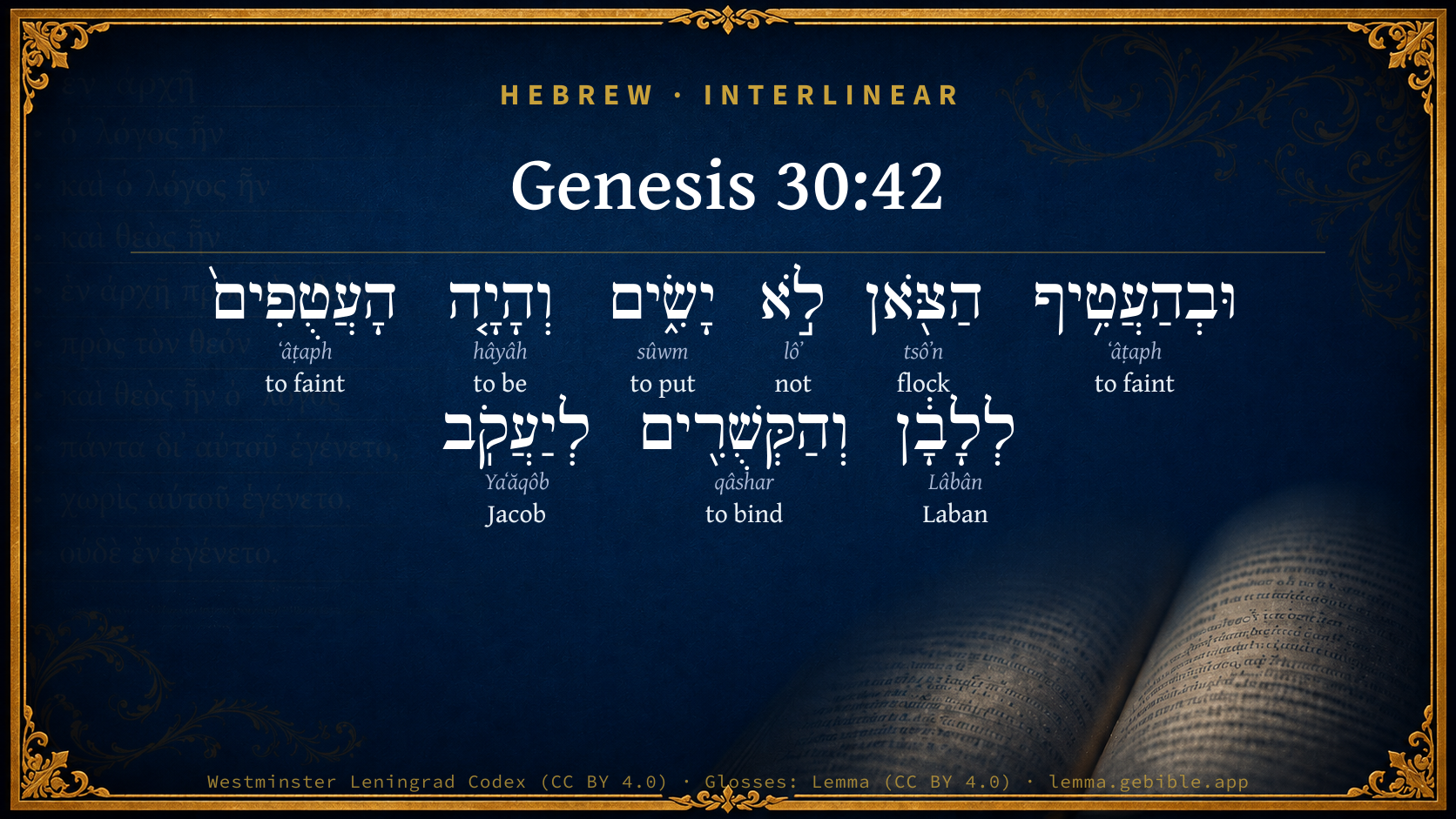
Genesis 30:42

Hebrew (Westminster Leningrad Codex) Genesis 30:42 appears in the Hebrew Old Testament. The text above is from the Westminster Leningrad Codex. Each word links to its Strong’s number, a concise gloss, and parsing drawn from the Open Scriptures Hebrew Bible morphology. Click any word for its full Brown-Driver-Briggs (BDB) entry.
Download image
Cite this verse

Genesis 30:42 (World English Bible). Public Domain. Lemma interlinear Bible study tool, https://lemma.gebible.app/v/genesis/30/42.

Show BibTeX & RIS
BibTeX
RIS
English Translation
but when the flock were feeble, he didn't put them in. So the feebler were Laban's, and the stronger Jacob's.
World English Bible · Public Domain
Highlights
  • 1 first appearance in the Hebrew Bible
Full analysis ↓
Download a study sheet

One document with this verse’s original text, its word-by-word gloss line, the meaning frame, cross-references with their text, attributed commentary, and full source and license credits — printable, and it pastes into notes with its structure intact.

This verse Autodidact and up

Study sheet (.html) Plain text (.txt)

A passage Seminary Student

Up to 50 verses in one chapter. A passage sheet keeps up to 6 commentary sources and 12 cross-references per verse, in the order this page ranks them, and says so on the sheet whenever that leaves anything out. Ask for a single verse and you get the Autodidact verse sheet above.

Everything on this page stays free to read, with no account — the sheet is a download of what is already on screen, not access to it.

Want to remove ads? Support Godless Engineer
Compare translations 3

The same verse in 3 English versions, stacked beneath the original-language interlinear above. Click any original word for its lexicon entry.

Each is an independent rendering of the whole verse — the interlinear is not word-aligned to these translations.

Highlighted words mark where these versions differ — a whole-verse word diff, not a word-by-word alignment.

  • World English Bible Public Domain
    but when the flock were feeble, he didn't put them in. So the feebler were Laban's, and the stronger Jacob's.
  • King James Version Public Domain
    But when the cattle were feeble, he put them not in: so the feebler were Laban's, and the stronger Jacob's.
  • unfoldingWord Literal Text CC BY-SA 4.0
    But when the animals were weak, he did not put. So it was the weak to Laban, and the strong to Jacob,

unfoldingWord Literal Text — © unfoldingWord, licensed CC BY-SA 4.0. Word-aligned USFM3 via Door43 (git.door43.org/unfoldingWord/en_ult).

Versions to compare (up to 4)

3 of 4 selected

Show all 18 translations

Every available English version of this verse, each an independent rendering of the whole verse.

  • World English Bible Public Domain
    but when the flock were feeble, he didn't put them in. So the feebler were Laban's, and the stronger Jacob's.
  • Berean Standard Bible Public Domain
    But if the animals were weak, he did not set out the branches. So the weaker animals went to Laban and the stronger ones to Jacob.
  • Majority Standard Bible Public Domain
    But if the animals were weak, he did not set out the branches. So the weaker animals went to Laban and the stronger ones to Jacob.
  • King James Version Public Domain
    But when the cattle were feeble, he put them not in: so the feebler were Laban's, and the stronger Jacob's.
  • American Standard Version (1901) Public Domain
    but when the flock were feeble, he put them not in: so the feebler were Laban's, and the stronger Jacob's.
  • Revised Version (1885) Public Domain
    but when the flock were feeble, he put them not in: so the feebler were Laban’s, and the stronger Jacob’s.
  • Geneva Bible (1599) Public Domain
    But when the sheepe were feeble, hee put them not in: and so the feebler were Labans, and the stronger Iaakobs.
  • Douay-Rheims (1899) Public Domain
    But when the latter coming was, and the last conceiving, he did not put them. And those that were late ward, become Laban's: and they of the first time, Jacob's.
  • Young's Literal Translation Public Domain
    and when the flock is feeble, he doth not set `them'; and the feeble ones have been Laban's, and the strong ones Jacob's.
  • Literal Standard Version CC BY-SA 4.0
    and when the flock is feeble, he does not set [them]; and the feeble ones have been Laban’s, and the strong ones Jacob’s.
  • Unlocked Literal Bible CC BY-SA 4.0
    But when the feebler animals in the flock came, he did not put the sticks in front of them. So the feebler animals were Laban's, and the stronger were Jacob's.
  • unfoldingWord Literal Text CC BY-SA 4.0
    But when the animals were weak, he did not put. So it was the weak to Laban, and the strong to Jacob,
  • Darby Bible Public Domain
    but when the sheep were feeble, he put [them] not in; so the feeble were Laban's, and the strong Jacob's.
  • World Messianic Bible Public Domain
    but when the flock were feeble, he didn’t put them in. So the feebler were Laban’s, and the stronger Jacob’s.
  • Webster's Bible Public Domain
    But when the cattle were feeble, he put them not in: so the feebler were Laban's, and the stronger Jacob's.
  • Free Bible Version CC BY-SA 4.0
    He didn't do this for the weaker females. The weaker ones went to Laban, and the strong ones went to Jacob.
  • Bible in Basic English Public Domain
    But when the flocks were feeble, he did not put the sticks before them; so that the feebler flocks were Laban's and the stronger were Jacob's.
  • JPS Tanakh (1917) Public Domain
    but when the flock were feeble, he put them not in; so the feebler were Laban's, and the stronger Jacob's.

Literal Standard Version (2020), Covenant Press — licensed CC BY-SA 4.0. Text via the HelloAO Bible API (eBible.org). Unlocked Literal Bible (unfoldingWord) — licensed CC BY-SA 4.0. Text via the HelloAO Bible API (eBible.org). unfoldingWord Literal Text — © unfoldingWord, licensed CC BY-SA 4.0. Word-aligned USFM3 via Door43 (git.door43.org/unfoldingWord/en_ult). Free Bible Version, Dr. Jonathan Gallagher — licensed CC BY-SA 4.0. Text via the HelloAO Bible API (eBible.org).

Word by word

More ways to search: Search by grammar → Find every occurrence → Compare this word →

Practice this passage: Drill this verse → Learn its vocabulary →

וּבְהַעֲטִ֥יף
ʻâṭaph
H5848
“and · in/at · to faint”
Conjunction + Preposition + Verb, Hiphil, Infinitive Construct
Part of Speech
Conjunction + Preposition + Verb
Stem
Hiphil
Form
Infinitive Construct
Full BDB Definition

Origin: a primitive root

TWOT: 1605 , 1606 , 1607

to turn aside - (Qal) to turn aside, turn (in order to cover) - to envelop oneself - (Qal) to envelop oneself, cover - to be feeble, be faint, grow weak - (Qal) to be feeble, be faint - (Niphal) to faint - (Hiphil) to show feebleness - (Hithpael) to faint, faint away
  1. הַצֹּ֖אן tsôʼn H6629 “the · flock” Particle, Definite Article + Noun, Common, Both, Singular, Absolute
  2. לֹ֣א lôʼ H3808 “not” Particle, Negative
  3. יָשִׂ֑ים sûwm H7760 “to put” Verb, Qal, Imperfect, 3rd Person, Masculine, Singular
  4. וְהָיָ֤ה hâyâh H1961 “and · to be” Conjunction + Verb, Qal, Perfect, 3rd Person, Masculine, Singular
  5. הָעֲטֻפִים֙ ʻâṭaph H5848 “the · fainted” Particle, Definite Article + Verb, Qal, Participle Passive, Masculine, Plural, Absolute
  6. לְלָבָ֔ן Lâbân H3837 “to/for · Laban” Preposition + Noun, Proper
  7. וְהַקְּשֻׁרִ֖ים qâshar H7194 “and · the · bound” Conjunction + Particle, Definite Article + Verb, Qal, Participle Passive, Masculine, Plural, Absolute
  8. לְיַעֲקֹֽב Yaʻăqôb H3290 “to/for · Jacob” Preposition + Noun, Proper

About this verse

These counts appear in no published source. They are computed here, from the morphology-tagged text and Lemma’s own curated glosses. What Lemma adds →

9
words
8
distinct lemmas
Pentateuch
section

Notable vocabulary

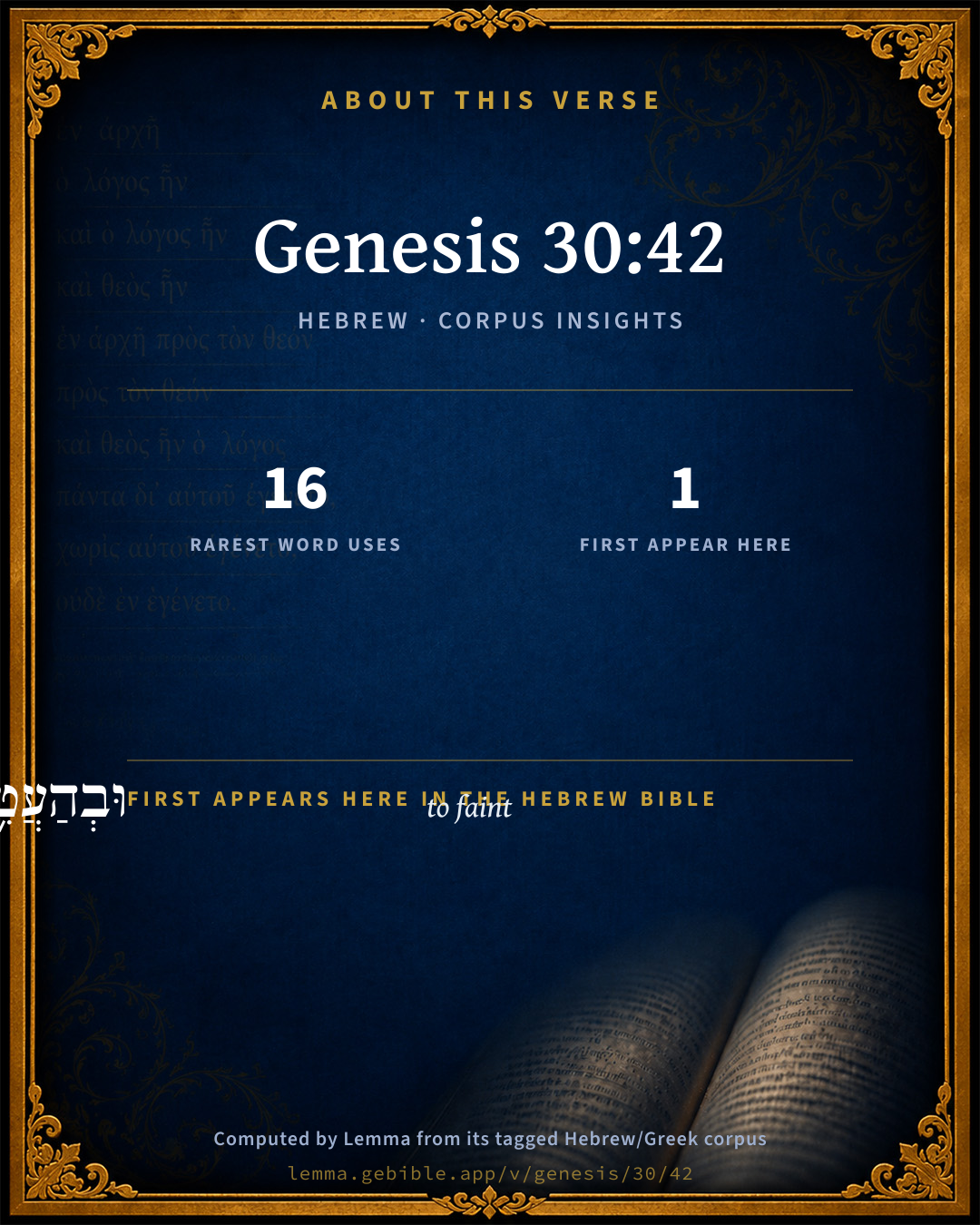
The rarest word here is וּבְהַעֲטִ֥יף to faint H5848 — appearing just 16 times in the whole Hebrew Bible.

First appearance in Scripture

This word makes its first canonical appearance in the Hebrew Bible here:

  • וּבְהַעֲטִ֥יף to faint H5848

Shared distinctive vocabulary

וּבְהַעֲטִ֥יף to faint H5848 occurs in 15 verses of the Hebrew Bible. Also found in:

Grammatical profile

  • 5 verbs
  • 3 nouns
  • 1 particle

Verb forms

  • וּבְהַעֲטִ֥יף Hiphil · Infinitive Construct
  • יָשִׂ֑ים Qal · Imperfect
  • וְהָיָ֤ה Qal · Perfect
  • הָעֲטֻפִים֙ Qal · Participle Passive
  • וְהַקְּשֻׁרִ֖ים Qal · Participle Passive

Repetition

A word recurs within this verse — often emphatic in Hebrew:

  • וּבְהַעֲטִ֥יף to faint H5848 ×2

Hebrew & Septuagint length

In English translation the verse runs 20 words from the Hebrew and 27 from the Septuagint (LXX English) — closely comparable.

A rough comparison of the two English renderings, which tokenize alike — not a word-level alignment.

Word counts can differ between the Hebrew and the Greek without any difference in meaning — e.g. the Hebrew direct-object marker אֵת has no separate Greek word, and Greek often adds the article ὁ.

Hebrew and Greek witnesses Masoretic Hebrew ↔ Greek Septuagint

The same verse in the two great witnesses to the Old Testament, shown verse-for-verse.

These are two independent witnesses, not word-aligned to each other, and the Septuagint is shown in lemma (dictionary) form.

Hebrew Genesis 30:42 Masoretic · Westminster Leningrad Codex

וּבְהַעֲטִ֥יף הַצֹּ֖אן לֹ֣א יָשִׂ֑ים וְהָיָ֤ה הָעֲטֻפִים֙ לְלָבָ֔ן וְהַקְּשֻׁרִ֖ים לְיַעֲקֹֽב

but when the flock were feeble, he didn't put them in. So the feebler were Laban's, and the stronger Jacob's.

World English Bible · Public Domain

Greek LXX Genesis 30:42 Septuagint · lemma form

ἡνίκα δέ ἄν τίκτω ὁ πρόβατον οὐ τίθημι γίγνομαι δέ ὁ ἄσημος ὁ λαβαν ὁ δέ ἐπίσημος ὁ ἰακώβ

But he did not put them in indiscriminately whenever the cattle happened to bring forth, but the unmarked ones were Laban's, and the marked ones were Jacob's.

LXX2012 (modern English Septuagint) · Public Domain

On this verse, The Cambridge Bible for Schools and Colleges discusses the Septuagint’s reading. Read the note in Commentary ↓

Hebrew: Westminster Leningrad Codex (CC BY 4.0). Greek: Septuagint (public domain); English from LXX2012 (modern English Septuagint) (Public Domain). How the Septuagint differs from the Hebrew →

Targum (Aramaic paraphrase)

2

The Targum is the ancient Jewish Aramaic paraphrase of the Hebrew Scriptures — an interpretive translation, not the Hebrew text itself. Onkelos (literal) and Pseudo-Jonathan (expansive) render the Torah, and Jonathan the Prophets. Coverage is partial: where no permissively-licensed English translation exists for a verse, only the Aramaic is shown. This is verse-level text, not a word-by-word alignment to the Hebrew.

  1. Targum Onkelos Torah (Genesis–Deuteronomy)
    וּבְלַקִּישׁוּת עָנָא לָא מְשַׁוֵּי וַהֲווֹ לַקִּישָׁא לְלָבָן וּבַכִּירַיָּא לְיַעֲקֹב

    (no public-domain English translation for this verse)

    Targum Onkelos — Aramaic: “Onkelos Genesis” (public domain); “Onkelos Exodus” (public domain); “Onkelos Leviticus” (public domain); “Onkelos Numbers” (public domain); “Onkelos Deuteronomy” (public domain). English: “Sefaria Community Translation” (CC0 1.0 (public-domain dedication)); “J.W. Etheridge. The Targums of Onkelos and Jonathan Ben Uzziel on the Pentateuch. London: Longmans, Green, 1862” (public domain). Text via Sefaria.

  2. Targum Pseudo-Jonathan Torah (Genesis–Deuteronomy)
    וּבְלִקוּשֵׁי עָנָא לָא מְשַׁוִי וַהֲווֹן לַקִישַׁיָא לְלָבָן וּבַכִּירַיָיא לְיַעֲקב

    But with the late sheep he did not set them; and the late sheep were Laban's and the early ones Jakob's.

    Targum Pseudo-Jonathan — Aramaic: “Targum Jonathan on Genesis” (public domain); “Targum Jonathan on Exodus” (public domain); “Targum Jonathan on Leviticus” (public domain); “Targum Jonathan on Numbers” (public domain); “Targum Jonathan on Deuteronomy” (public domain). English: “The Targum of Jonathan ben Uzziel, trans. J. W. Etheridge, London, 1862” (public domain). Text via Sefaria.

Commentary

Notes on Genesis 30:42 from classic Christian and Jewish commentators (each source and its license shown beneath its notes). The classic Christian expositions comment on the surrounding passage and are grouped to its opening verse, so a note may address several verses; the Jewish commentaries on the Tanakh (Rashi and others) are per-verse, so they appear only where the commentator wrote on this verse.

Lemma curates 59 commentaries, every one of them public domain or Creative Commons licensed, each selected and text-cleaned for this edition rather than reprinted as found. About our sources →

Trapp's Complete Commentary

John Trapp

Gen 30:42 But when the cattle were feeble, he put [them] not in: so the feebler were Laban’s, and the stronger Jacob’s.

Ver. 42. So the feebler were Laban’s.] So elsewhere God promiseth that his people "shall rob those that robbed them, and spoil those that spoiled them". {Eze 39:10}

John Trapp, A Commentary or Exposition upon All the Books of the Old and New Testament (1647–1656) — public domain. Text from a community e-Sword module.

Tyndale Open Study Notes

Tyndale Open Resources

30:42 Laban now received due recompense for his treatment of Jacob. Laban’s attempt to defraud Jacob resulted in Jacob’s coming out ahead, because God was at work in his life.

Tyndale Open Study Notes — © Tyndale Open Resources, licensed CC BY-SA 4.0. Text via the HelloAO Bible API.

The Cambridge Bible for Schools and Colleges

gen. ed. J. J. S. Perowne

42. the feebler … the stronger] These words were a difficulty to the versions. LXX τὰ ἄσημα … τὰ ἐπίσημα, Lat. quae erant serotina … quae primi temporis. So Aq. Sym. πρώϊμα ὄψιμα, and Targum of Onkelos “early” and “late,” referring to the time of breeding. The earlier breeding sheep were the stronger. Pliny, H. N., viii. 187, postea concepti invalidi (quoted by Skinner).

The Cambridge Bible for Schools and Colleges (gen. ed. J. J. S. Perowne; Cambridge University Press, 1878–1918) — public domain. Text from a community e-Sword module.

Haydock's Catholic Bible Commentary

Later-coming, in autumn, when the spring lambs were of an inferior value. These he was willing to abandon for the most part to Laban; and therefore did not use his rods. Pliny, Natural History viii. 47; and Columella viii. 3, agree, that the lambs which are produced in spring do not thrive so well as those of autumn, at least in Italy, and in those countries where sheep lamb twice a year. Bis gravidæ pecudes, Virgil. (Calmet) --- Many who have tried the same experiment as Jacob, have not experienced the same success; whence St. Chrysostom, and most of the Greek fathers, suppose that it was miraculous. (Tirinus)

George Leo Haydock (1774–1849), Haydock's Catholic Family Bible and Commentary, 1859 edition — public domain. Excludes Psalms (Douay-Rheims chapter numbering differs from Protestant) and Deuterocanonical books (Catholic canon only).

Whedon's Commentary on the Bible

Daniel D. Whedon

42. The feebler were Laban’s — This was a third trick. The Eastern sheep lamb twice a year, in spring and fall, and those born in the fall, according to Pliny, were the stronger. It is probable that after a time Laban suspected or discovered Jacob’s artifice, and accordingly changed his wages, or the terms of the contract, many times. See Gen_31:7-8. But Jacob was smart enough to frustrate all his attempts to overreach him.

Daniel D. Whedon (gen. ed.), Commentary on the Old and New Testaments (1874–1909) — public domain. Text from a community e-Sword module.

The Pulpit Commentary

But when the cattle were feeble, literally, in the covering (sc. with wool; hence weakening) of the flock, which took place in autumnhe put them not in (partly to prevent the introduction of feeble animals amongst his parti-colored flocks, but partly also, it is thought, to avoid prematurely exciting Laban"s suspicion): so the feebler were Laban"s, and the stronger Jacob"s.

The Pulpit Commentary (1880–1919), ed. H.D.M. Spence-Jones & Joseph S. Exell — public domain. Text from a community e-Sword module.

Rashi

Rabbi Shlomo Yitzchaki (Rashi)

ובהעטיף WHEN THE FLOCKS WERE FEEBLE — the word has the meaning of “being late”, as the Targum renders it בלקישות the late-bearing ones (cf. מלקוש the “latter” rain). Menachem classifies it under the same root as (Isaiah 3:22) “the aprons and the mantelets (המעטפות)”, so that it has the meaning of wrapping oneself in a garment, and the word denotes those animals that are well wrapped up in their skin and fur so that they do not desire to be warmed by the males.

Rashi on the Tanakh — English translations: “The Judaica Press complete Tanach with Rashi, translated by A. J. Rosenberg” (CC BY 4.0); “Pentateuch with Rashi's commentary by M. Rosenbaum and A.M. Silbermann, 1929-1934” (public domain); “The Metsudah Tanach series, Lakewood, N.J” (CC BY 4.0); and “The Book of Joshua, Metsudah Publications, 1997” (CC BY 4.0). Text via Sefaria.

Lesson kit

Teaching starters — assembled from the data on this page, not authored interpretation. Every prompt links to the verse data it draws on. Edit before teaching.

Genesis, in the Pentateuch, opens this verse with 9 words (8 distinct Hebrew lemmas). Its most distinctive word is ʻâṭaph (“to faint”). A historical commentator’s framing appears above. Read the whole chapter for the surrounding context.

Discussion questions

  1. How does “to faint” (ʻâṭaph) shape what this verse is saying?
  2. This is the first place “to faint” appears in Scripture (first appears here). What does its debut here establish?
  3. How does Job 23:9, which shares the word «to faint», read alongside this verse?
  4. What does the repetition of “to faint” (2× in this one verse) do in this verse?
  5. These translations render this verse differently. What is at stake in choosing one wording over another?
  6. «וּבְהַעֲטִ֥יף» is a Hiphil Infinitive Construct verb. How does that grammatical form shape the action described?
  7. Compare how Trapp's Complete Commentary and Tyndale Open Study Notes read this verse. Where do they agree or differ?

Things to notice

  • 1 word makes its first canonical appearance in Scripture here.
  • These translations choose different wording for 14 words in this verse.
  • “to faint” occurs 2× in this single verse.
  • 8 distinct Hebrew lemmas span 9 words in this verse.

Reading settings

Reading text

Shown beneath each verse's original-language words.

Old Testament
Old Testament edition

Read the OT as the Masoretic Hebrew (MT) or the Greek Septuagint (LXX).

English shown for the Greek Septuagint (in the Hebrew ↔ Greek comparison).

Comparing translations? Open the Compare panel on any verse page to stack up to four side by side.