
Numbers 31:30

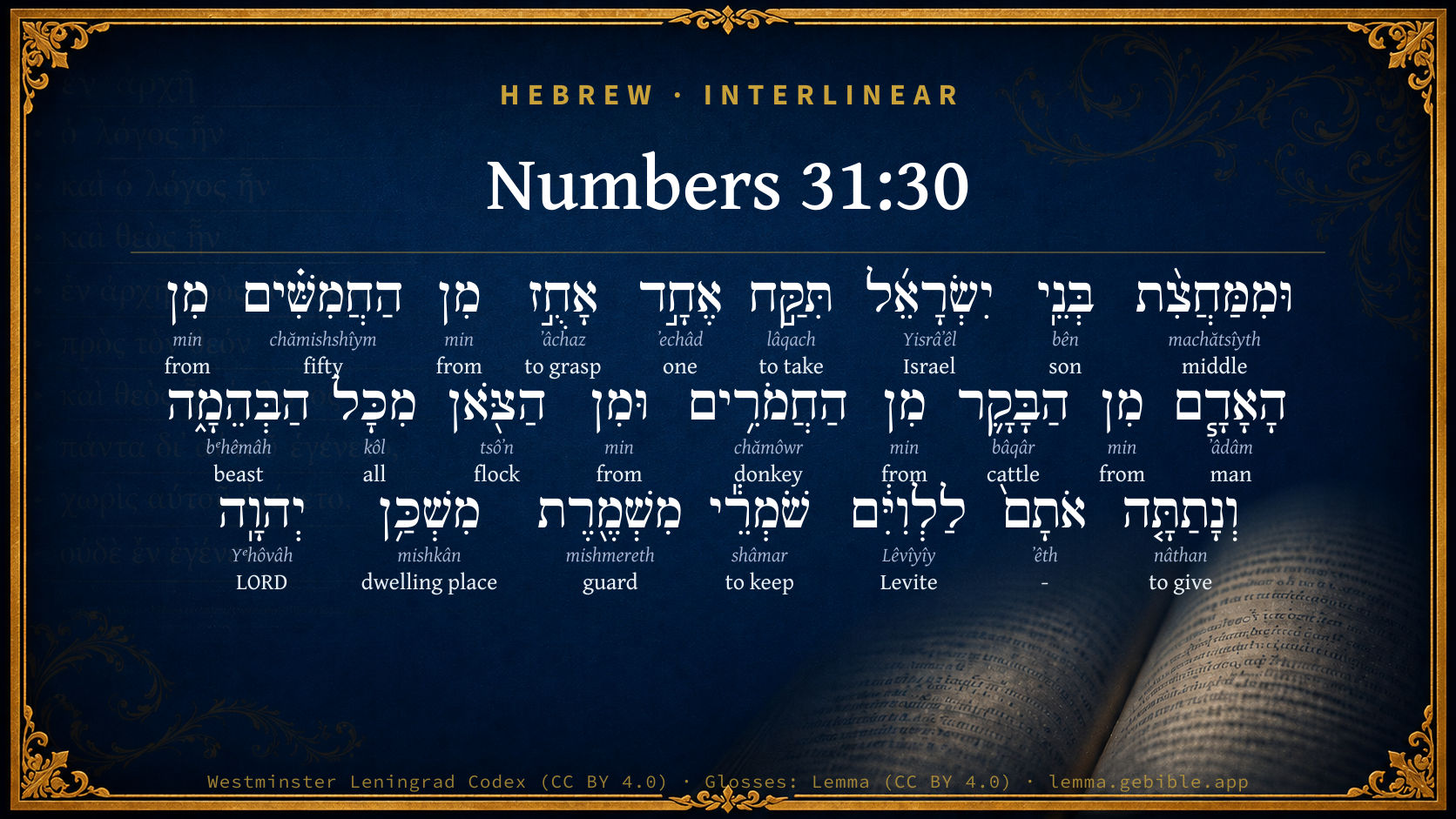
Hebrew (Westminster Leningrad Codex) Numbers 31:30 appears in the Hebrew Old Testament. The text above is from the Westminster Leningrad Codex. Each word links to its Strong’s number, a concise gloss, and parsing drawn from the Open Scriptures Hebrew Bible morphology. Click any word for its full Brown-Driver-Briggs (BDB) entry.
Download image
Cite this verse

Numbers 31:30 (World English Bible). Public Domain. Lemma interlinear Bible study tool, https://lemma.gebible.app/v/numbers/31/30.

Show BibTeX & RIS
BibTeX
RIS
English Translation
Of the children of Israel's half, you shall take one drawn out of every fifty, of the persons, of the oxen, of the donkeys, and of the flocks, [even] of all the cattle, and give them to the Levites, who keep the charge of the tent of Yahweh.
World English Bible · Public Domain
Download a study sheet

One document with this verse’s original text, its word-by-word gloss line, the meaning frame, cross-references with their text, attributed commentary, and full source and license credits — printable, and it pastes into notes with its structure intact.

This verse Autodidact and up

Study sheet (.html) Plain text (.txt)

A passage Seminary Student

Up to 50 verses in one chapter. A passage sheet keeps up to 6 commentary sources and 12 cross-references per verse, in the order this page ranks them, and says so on the sheet whenever that leaves anything out. Ask for a single verse and you get the Autodidact verse sheet above.

Everything on this page stays free to read, with no account — the sheet is a download of what is already on screen, not access to it.

Want to remove ads? Support Godless Engineer
Compare translations 3

The same verse in 3 English versions, stacked beneath the original-language interlinear above. Click any original word for its lexicon entry.

Each is an independent rendering of the whole verse — the interlinear is not word-aligned to these translations.

Highlighted words mark where these versions differ — a whole-verse word diff, not a word-by-word alignment.

  • World English Bible Public Domain
    Of the children of Israel's half, you shall take one drawn out of every fifty, of the persons, of the oxen, of the donkeys, and of the flocks, [even] of all the cattle, and give them to the Levites, who keep the charge of the tent of Yahweh.
  • King James Version Public Domain
    And of the children of Israel's half, thou shalt take one portion of fifty, of the persons, of the beeves, of the asses, and of the flocks, of all manner of beasts, and give them unto the Levites, which keep the charge of the tabernacle of the LORD.
  • unfoldingWord Literal Text CC BY-SA 4.0
    And from the half of the sons of Israel you shall take one taken from the 50, from human, from cattle, from the donkeys and from the flock, from every animal, and you shall give them to the Levites, the keepers of the keeping of the Dwelling of Yahweh.”

unfoldingWord Literal Text — © unfoldingWord, licensed CC BY-SA 4.0. Word-aligned USFM3 via Door43 (git.door43.org/unfoldingWord/en_ult).

Versions to compare (up to 4)

3 of 4 selected

Show all 18 translations

Every available English version of this verse, each an independent rendering of the whole verse.

  • World English Bible Public Domain
    Of the children of Israel's half, you shall take one drawn out of every fifty, of the persons, of the oxen, of the donkeys, and of the flocks, [even] of all the cattle, and give them to the Levites, who keep the charge of the tent of Yahweh.
  • Berean Standard Bible Public Domain
    From the Israelites’ half, take one out of every fifty, whether persons, cattle, donkeys, sheep, or other animals, and give them to the Levites who keep charge of the tabernacle of the LORD.”
  • Majority Standard Bible Public Domain
    From the Israelites’ half, take one out of every fifty, whether persons, cattle, donkeys, sheep, or other animals, and give them to the Levites who keep charge of the tabernacle of the LORD.”
  • King James Version Public Domain
    And of the children of Israel's half, thou shalt take one portion of fifty, of the persons, of the beeves, of the asses, and of the flocks, of all manner of beasts, and give them unto the Levites, which keep the charge of the tabernacle of the LORD.
  • American Standard Version (1901) Public Domain
    And of the children of Israel's half, thou shalt take one drawn out of every fifty, of the persons, of the oxen, of the asses, and of the flocks, `even' of all the cattle, and give them unto the Levites, that keep the charge of the tabernacle of Jehovah.
  • Revised Version (1885) Public Domain
    And of the children of Israel’s half, thou shalt take one drawn out of every fifty, of the persons, of the beeves, of the asses, and of the flocks, even of all the cattle, and give them unto the Levites, which keep the charge of the tabernacle of the LORD.
  • Geneva Bible (1599) Public Domain
    But of the halfe of the children of Israel thou shalt take one, taken out of fiftie, both of the persons, of the beeues, of the asses, and of the sheepe, euen of all the cattel: and thou shalt giue them vnto the Leuites, which haue the charge of the Tabernacle of the Lord.
  • Douay-Rheims (1899) Public Domain
    Out of the moiety also of the children of Israel thou shalt take the fiftieth head of persons, and of oxen, and asses, and sheep, and of all beasts, and thou shalt give them to the Levites that watch in the charge of the tabernacle of the Lord.
  • Young's Literal Translation Public Domain
    `And from the sons of Israel's half thou dost take one possession out of fifty, of man, of the herd, of the asses, and of the flock, of all the cattle, and thou hast given them to the Levites keeping the charge of the tabernacle of Jehovah.'
  • Literal Standard Version CC BY-SA 4.0
    And from the sons of Israel’s half you take one possession out of fifty, of man, of the herd, of the donkeys, and of the flock, of all the livestock, and you have given them to the Levites keeping the charge of the Dwelling Place of YHWH.”
  • Unlocked Literal Bible CC BY-SA 4.0
    Also from the people of Israel's half, you must take one out of every fifty—from the persons, cattle, donkeys, sheep, and goats. Give these to the Levites who take care of my tabernacle.”
  • unfoldingWord Literal Text CC BY-SA 4.0
    And from the half of the sons of Israel you shall take one taken from the 50, from human, from cattle, from the donkeys and from the flock, from every animal, and you shall give them to the Levites, the keepers of the keeping of the Dwelling of Yahweh.”
  • Darby Bible Public Domain
    And of the children of Israel's half, thou shalt take one portion of fifty, of the persons, of the oxen, of the asses, and of the small cattle, of every [kind of] beasts, and thou shalt give them unto the Levites, who keep the charge of the tabernacle of Jehovah.
  • World Messianic Bible Public Domain
    Of the children of Israel’s half, you shall take one drawn out of every fifty, of the persons, of the cattle, of the donkeys, and of the flocks, of all the livestock, and give them to the Levites, who perform the duty of the LORD’s tabernacle.”
  • Webster's Bible Public Domain
    And of the children of Israel's half, thou shalt take one portion of fifty, of the persons, of the beeves, of the asses, and of the flocks, of all manner of beasts, and give them to the Levites, who keep the charge of the tabernacle of the LORD.
  • Free Bible Version CC BY-SA 4.0
    From the Israelites half share, take one out of every fifty people, cattle, donkeys, or sheep, or other animals, and give them to the Levites who take care of the Lord's Tabernacle.”
  • Bible in Basic English Public Domain
    And from the part given to the children of Israel, take one out of every fifty, from the persons, and from the oxen and asses and sheep, and give it to the Levites who have the care of the House of the Lord.
  • JPS Tanakh (1917) Public Domain
    And of the children of Israel's half, thou shalt take one drawn out of every fifty, of the persons, of the beeves, of the asses, and of the flocks, even of all the cattle, and give them unto the Levites, that keep the charge of the tabernacle of the LORD.'

Literal Standard Version (2020), Covenant Press — licensed CC BY-SA 4.0. Text via the HelloAO Bible API (eBible.org). Unlocked Literal Bible (unfoldingWord) — licensed CC BY-SA 4.0. Text via the HelloAO Bible API (eBible.org). unfoldingWord Literal Text — © unfoldingWord, licensed CC BY-SA 4.0. Word-aligned USFM3 via Door43 (git.door43.org/unfoldingWord/en_ult). Free Bible Version, Dr. Jonathan Gallagher — licensed CC BY-SA 4.0. Text via the HelloAO Bible API (eBible.org).

Word by word

More ways to search: Search by grammar → Find every occurrence → Compare this word →

Practice this passage: Drill this verse → Learn its vocabulary →

וּמִמַּחֲצִ֨ת
machătsîyth
H4276
“and · from · middle of”
Conjunction + Preposition + Noun, Common, Feminine, Singular, Construct
Part of Speech
Conjunction + Preposition + Noun
Type
Common
Gender
Feminine
Number
Singular
State
Construct
Full BDB Definition

Origin: from H2673

TWOT: 719e

half, middle - half - middle, midday, noon
  1. בְּנֵֽי bên H1121 “sons of” Noun, Common, Masculine, Plural, Construct
  2. יִשְׂרָאֵ֜ל Yisrâʼêl H3478 “Israel” Noun, Proper
  3. תִּקַּ֣ח lâqach H3947 “to take” Verb, Qal, Imperfect, 2nd Person, Masculine, Singular
  4. אֶחָ֣ד ʼechâd H259 “one” Adjective, Cardinal number, Masculine, Singular, Absolute
  5. אָחֻ֣ז ʼâchaz H270 “grasped” Verb, Qal, Participle Passive, Masculine, Singular, Absolute
  6. מִן min H4480 “from” Preposition
  7. הַחֲמִשִּׁ֗ים chămishshîym H2572 “the · fifty” Particle, Definite Article + Adjective, Cardinal number, Both, Plural, Absolute
  8. מִן min H4480 “from” Preposition
  9. הָאָדָ֧ם ʼâdâm H120 “the · man” Particle, Definite Article + Noun, Common, Masculine, Singular, Absolute
  10. מִן min H4480 “from” Preposition
  11. הַבָּקָ֛ר bâqâr H1241 “the · cattle” Particle, Definite Article + Noun, Common, Both, Singular, Absolute
  12. מִן min H4480 “from” Preposition
  13. הַחֲמֹרִ֥ים chămôwr H2543 “the · donkeys” Particle, Definite Article + Noun, Common, Both, Plural, Absolute
  14. וּמִן min H4480 “and · from” Conjunction + Preposition
  15. הַצֹּ֖אן tsôʼn H6629 “the · flock” Particle, Definite Article + Noun, Common, Both, Singular, Absolute
  16. מִכָּל kôl H3605 “from · all of” Preposition + Noun, Common, Masculine, Singular, Construct
  17. הַבְּהֵמָ֑ה bᵉhêmâh H929 “the · beast” Particle, Definite Article + Noun, Common, Feminine, Singular, Absolute
  18. וְנָתַתָּ֤ה nâthan H5414 “and · to give” Conjunction + Verb, Qal, Sequential Perfect, 2nd Person, Masculine, Singular
  19. אֹתָם֙ ʼêth H853 “- · them” Particle, Direct Object + Suffix, Personal, 3rd Person, Masculine, Plural
  20. לַלְוִיִּ֔ם Lêvîyîy H3881 “to/for the · Levites” Preposition, Determined + Noun, Gentilic, Masculine, Plural, Absolute
  21. שֹׁמְרֵ֕י shâmar H8104 “keeping” Verb, Qal, Participle Active, Masculine, Plural, Construct
  22. מִשְׁמֶ֖רֶת mishmereth H4931 “guard of” Noun, Common, Feminine, Singular, Construct
  23. מִשְׁכַּ֥ן mishkân H4908 “dwelling place of” Noun, Common, Masculine, Singular, Construct
  24. יְהוָֽה Yᵉhôvâh H3068 “LORD” Noun, Proper

About this verse

These counts appear in no published source. They are computed here, from the morphology-tagged text and Lemma’s own curated glosses. What Lemma adds →

25
words
21
distinct lemmas
Pentateuch
section

Notable vocabulary

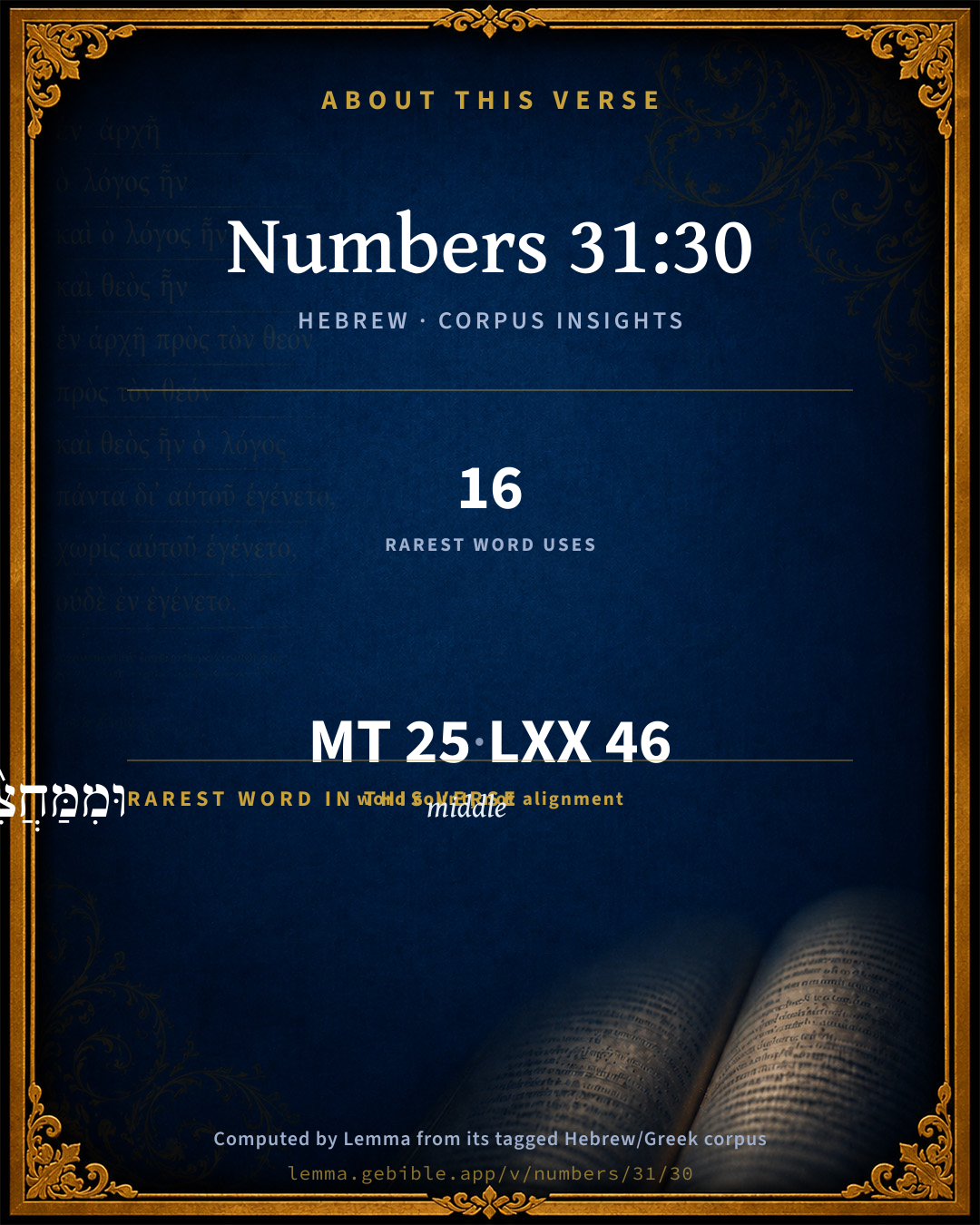
The rarest word here is וּמִמַּחֲצִ֨ת middle H4276 — appearing just 16 times in the whole Hebrew Bible.

Shared distinctive vocabulary

וּמִמַּחֲצִ֨ת middle H4276 occurs in 14 verses of the Hebrew Bible. Also found in:

Grammatical profile

  • 4 verbs
  • 13 nouns
  • 2 adjectives
  • 5 prepositions
  • 1 particle

Verb forms

  • תִּקַּ֣ח Qal · Imperfect
  • אָחֻ֣ז Qal · Participle Passive
  • וְנָתַתָּ֤ה Qal · Sequential Perfect
  • שֹׁמְרֵ֕י Qal · Participle Active

Repetition

A word recurs within this verse — often emphatic in Hebrew:

Hebrew & Septuagint length

In English translation the verse runs 48 words from the Hebrew and 54 from the Septuagint (LXX English) — closely comparable.

A rough comparison of the two English renderings, which tokenize alike — not a word-level alignment.

Word counts can differ between the Hebrew and the Greek without any difference in meaning — e.g. the Hebrew direct-object marker אֵת has no separate Greek word, and Greek often adds the article ὁ.

In the original languages it is 25 Hebrew tokens and 46 Greek tokens — but the two are counted differently (Hebrew bundles its prefixes and suffixes into one token; the Greek is in lemma form), so that isn’t a like-for-like length.

Cross-references

15

Topical passages linked to Numbers 31:30 in the Treasury of Scripture Knowledge — connected by theme and wording, ordered by reader-vote popularity; previews shown in the World English Bible.

  • Numbers 3:7–8 They shall keep his charge, and the charge of the whole congregation before the Tent of Meeting, to do the service of the tabernacle.
  • Numbers 3:25 The charge of the sons of Gershon in the Tent of Meeting shall be the tabernacle, and the tent, its covering, and the screen for the door of the Tent of Meeting,
  • Numbers 3:31 Their charge shall be the ark, the table, the lamp stand, the altars, the vessels of the sanctuary with which they minister, and the screen, and all its service.
  • Numbers 3:36–39 The appointed charge of the sons of Merari shall be the tabernacle's boards, its bars, its pillars, its sockets, all its instruments, all its service,
  • Numbers 18:1–5 Yahweh said to Aaron, You and your sons and your fathers' house with you shall bear the iniquity of the sanctuary; and you and your sons with you shall bear the iniquity of your priesthood.
  • Numbers 18:23–28 But the Levites shall do the service of the tent of meeting, and they shall bear their iniquity: it shall be a statute forever throughout your generations; and among the children of Israel they shall have no inheritance.
  • Numbers 31:28 Levy a tribute to Yahweh of the men of war who went out to battle: one soul of five hundred, [both] of the persons, and of the oxen, and of the donkeys, and of the flocks:
  • 1 Chronicles 9:27–29 They lodged round about the house of God, because the charge [of it] was on them; and to them pertained the opening of it morning by morning.
  • 1 Chronicles 23:32 and that they should keep the charge of the tent of meeting, and the charge of the holy place, and the charge of the sons of Aaron their brothers, for the service of the house of Yahweh.
  • 1 Chronicles 26:20–27 Of the Levites, Ahijah was over the treasures of the house of God, and over the treasures of the dedicated things.
  • Acts 20:28 Take heed, therefore, to yourselves, and to all the flock, in which the Holy Spirit has made you overseers, to shepherd the assembly of the Lord and God which he purchased with his own blood.
  • 1 Corinthians 4:2 Here, moreover, it is required of stewards, that they be found faithful.
  • 1 Corinthians 9:13–14 Don't you know that those who serve around sacred things eat from the things of the temple, and those who wait on the altar have their portion with the altar?
  • Colossians 4:17 Tell Archippus, "Take heed to the ministry which you have received in the Lord, that you fulfill it."
  • Hebrews 13:17 Obey your leaders and submit to them, for they watch on behalf of your souls, as those who will give account, that they may do this with joy, and not with groaning, for that would be unprofitable for you.

Cross-references courtesy of OpenBible.info (CC BY 4.0).

Hebrew and Greek witnesses Masoretic Hebrew ↔ Greek Septuagint

The same verse in the two great witnesses to the Old Testament, shown verse-for-verse.

These are two independent witnesses, not word-aligned to each other, and the Septuagint is shown in lemma (dictionary) form.

Hebrew Numbers 31:30 Masoretic · Westminster Leningrad Codex

וּמִמַּחֲצִ֨ת בְּנֵֽי יִשְׂרָאֵ֜ל תִּקַּ֣ח אֶחָ֣ד אָחֻ֣ז מִן הַחֲמִשִּׁ֗ים מִן הָאָדָ֧ם מִן הַבָּקָ֛ר מִן הַחֲמֹרִ֥ים וּמִן הַצֹּ֖אן מִכָּל הַבְּהֵמָ֑ה וְנָתַתָּ֤ה אֹתָם֙ לַלְוִיִּ֔ם שֹׁמְרֵ֕י מִשְׁמֶ֖רֶת מִשְׁכַּ֥ן יְהוָֽה

Of the children of Israel's half, you shall take one drawn out of every fifty, of the persons, of the oxen, of the donkeys, and of the flocks, [even] of all the cattle, and give them to the Levites, who keep the charge of the tent of Yahweh.

World English Bible · Public Domain

Greek LXX Numbers 31:30 Septuagint · lemma form

καί ἀπό ὁ ἥμισυς ὁ ὁ υἱός ἰσραήλ λαμβάνω εἷς ἀπό ὁ πεντήκοντα ἀπό ὁ ἄνθρωπος καί ἀπό ὁ βοῦς καί ἀπό ὁ πρόβατον καί ἀπό ὁ ὄνος καί ἀπό πᾶς ὁ κτῆνος καί δίδωμι αὐτός ὁ λευίτης ὁ φυλάσσω ὁ φυλακή ἐν ὁ σκηνή κύριος

And from the half belonging to the children of Israel you shall take one in fifty from the men, and from the oxen, and from the sheep, and from the asses, and from all the cattle; and you shall give them to the Levites that keep the charges in the tabernacle of the Lord.

LXX2012 (modern English Septuagint) · Public Domain

Hebrew: Westminster Leningrad Codex (CC BY 4.0). Greek: Septuagint (public domain); English from LXX2012 (modern English Septuagint) (Public Domain). How the Septuagint differs from the Hebrew →

Targum (Aramaic paraphrase)

2

The Targum is the ancient Jewish Aramaic paraphrase of the Hebrew Scriptures — an interpretive translation, not the Hebrew text itself. Onkelos (literal) and Pseudo-Jonathan (expansive) render the Torah, and Jonathan the Prophets. Coverage is partial: where no permissively-licensed English translation exists for a verse, only the Aramaic is shown. This is verse-level text, not a word-by-word alignment to the Hebrew.

  1. Targum Onkelos Torah (Genesis–Deuteronomy)
    וּמִפַּלְגוּת בְּנֵי יִשְׂרָאֵל תִּסַב חָד דְאִתַּחָד מִן חַמְשִׁין מִן אֱנָשָׁא מִן תּוֹרֵי מִן חֲמָרֵי וּמִן עָנָא מִכָּל בְּעִירָא וְתִתֵּן יָתְהוֹן לְלֵוָאֵי נַטְרֵי מַטְרַת מַשְׁכְּנָא דַיְיָ

    (no public-domain English translation for this verse)

    Targum Onkelos — Aramaic: “Onkelos Genesis” (public domain); “Onkelos Exodus” (public domain); “Onkelos Leviticus” (public domain); “Onkelos Numbers” (public domain); “Onkelos Deuteronomy” (public domain). English: “Sefaria Community Translation” (CC0 1.0 (public-domain dedication)); “J.W. Etheridge. The Targums of Onkelos and Jonathan Ben Uzziel on the Pentateuch. London: Longmans, Green, 1862” (public domain). Text via Sefaria.

  2. Targum Pseudo-Jonathan Torah (Genesis–Deuteronomy)
    וּמִפַּלְגוּת דִבְנֵי יִשְרָאֵל תִּיסַב חַד דִמִיתַחַד מִן חַמְשִׁין מִן בַּת נְשָׁא וּמִן תּוֹרֵי וּמִן חַמְרֵי וּמִן כָּל בְּעִירָא וְתִתֵּן יַתְהוֹן לְלֵיוָאֵי נַטְרֵי מַטְרַת מַשְׁכְּנָא דַיְיָ

    but of the half (falling to) the children of Israel thou shalt take one out of fifty of the women, and of the oxen, the asses, and of all the cattle, and give them to the Levites who keep charge of the Lord's tabernacle;

    Targum Pseudo-Jonathan — Aramaic: “Targum Jonathan on Genesis” (public domain); “Targum Jonathan on Exodus” (public domain); “Targum Jonathan on Leviticus” (public domain); “Targum Jonathan on Numbers” (public domain); “Targum Jonathan on Deuteronomy” (public domain). English: “The Targum of Jonathan ben Uzziel, trans. J. W. Etheridge, London, 1862” (public domain). Text via Sefaria.

Commentary

Notes on Numbers 31:30 from classic Christian and Jewish commentators (each source and its license shown beneath its notes). The classic Christian expositions comment on the surrounding passage and are grouped to its opening verse, so a note may address several verses; the Jewish commentaries on the Tanakh (Rashi and others) are per-verse, so they appear only where the commentator wrote on this verse.

Lemma curates 59 commentaries, every one of them public domain or Creative Commons licensed, each selected and text-cleaned for this edition rather than reprinted as found. About our sources →

Geneva Bible (1599)

Geneva Bible translators

The Israelites which had not been at war, of every fiftieth paid one to the Lord: and the soldiers one of every five hundredth.

Geneva Bible (1599) marginal notes — public domain. Text via Bolls.life.

Ellicott's Commentary for English Readers

(30) One portion of fifty.—The Levites were much more numerous than the priests, and consequently it was ordered that they should have two per cent. of the spoil which fell to the congregation, whereas the priests had only one-fifth percent, of a like amount. The portion of the Levites, therefore, was 320 maidens, 6,750 sheep and goats, 720 oxen, and 610 asses.

A Bible Commentary for English Readers, edited by Charles John Ellicott (1878–1897) — public domain. Text from a community e-Sword module.

John Gill's Exposition

We have therefore brought an oblation to the Lord,.... A freewill offering, out of the spoil, over and above the tribute levied out of the half that came unto them:

what every man hath gotten: or "found" (f), in the houses, and upon the bodies of the slain, or of such that were taken captives:

of jewels of gold either such as were set in gold; or rather, as the words may be rendered:

vessels of gold (g), as dishes, cups, spoons, and the like:

chains; which were wore about the neck, or upon the arm, as Aben Ezra:

and bracelets; for the hand, as the same writer, see Gen 24:22,

rings; for the finger:

ear rings; for the ear, as we render it, the word signifies something round:

and tablets; which, according to the Targum of Jonathan, were ornaments that hung down between the breasts:

to make an atonement for our souls before the Lord; not only this offering was brought as a token of gratitude and thankfulness, for sparing of everyone of their lives, and giving them such success and victory, and so large a spoil of the enemy; but also to expiate any sins they had been guilty of in going out, and coming in, and particularly for sparing the women they should have put to death, for which Moses was wroth with them, Num 31:14.

(f) "invenit", Pagninus, Montanus. (g) "vas auri", Montanus; "vasa aurea", Vatablus.

John Gill's Exposition of the Whole Bible (1746–1763) — public domain (CC PDM 1.0). Text via the HelloAO Bible API.

Matthew Poole's English Annotations

One portion of fifty; whereas the former part was one of five hundred: the reason of the difference is, partly because this was taken out of the people’s portion, whose hazards being less than the others, their gains also in all reason were to be less; partly because this was to be distributed into more hands, the Levites being now numerous, when the priests were but few.

Matthew Poole's English Annotations on the Holy Bible (1683–1685) — public domain. Text from a community e-Sword/MySword module.

Whedon's Commentary on the Bible

Daniel D. Whedon

30. One… of fifty,… unto the Levites — Two per cent. of the spoils shall be given by the people to Levi, the priestly tribe. These in turn, according to law, (chap. Num_18:26-28,) would give a tenth of their receipts, or a five hundredth of the whole booty, to the priests, making their entire receipts two five hundredths of the whole. But in this case the law was not applied, as appears from the following allotment of the spoils:

Sheep.Beeves.Asses.Persons.Whole number675,00072,00061,00032,000To the army337,50036,00030,50016,000To the people337,50036,00030,50016,000To the Levites6,750720610320To Jehovah675726132If the Levites gave a tithe of their portion to Jehovah, of which we have no record in this case, his portion would have been double that which is shown in the account. The spoils, strictly so called, armour, household goods, clothing, and money were not divided in common, but belonged to the individual captors. We are not to suppose that the above scheme includes the sheep and beeves consumed by the army in the field, but only those brought to the camp on the plains of Moab. The enormous quantity of the booty indicates the strength of the foe and the magnitude of the victory.

Daniel D. Whedon (gen. ed.), Commentary on the Old and New Testaments (1874–1909) — public domain. Text from a community e-Sword module.

The Pulpit Commentary

One portion of fifty. Two percent of the prey. This probably corresponded very closely to the number of Levites as compared with the twelve tribes, and would tend to show that God intended the Levites to be neither better nor worse off than their neighbours.

The Pulpit Commentary (1880–1919), ed. H.D.M. Spence-Jones & Joseph S. Exell — public domain. Text from a community e-Sword module.

John Wesley's Explanatory Notes

One of fifty - Whereas the former part was one of five hundred; the reason of the difference is, partly, because this was taken out of the peoples portion, whose hazards being less than the others, their gains also in all reason were to be less: partly because this was to be distributed into more hands, the Levites being now numerous, whereas the priests were but few.

John Wesley, Explanatory Notes Upon the Whole Bible (1754–1765) — public domain. Text via the GEBible commentary corpus.

unfoldingWord translationNotes

Door43 World Missions Community

General Information:

Yahweh continues speaking to Moses.

Also from the people of Israel's half

"Also from the people of Israel's half of the plunder"

every fifty

"every 50" (See: Numbers)

who take care

those who oversee and maintain the tabernacle and sacrifices to Yahweh

translationWords

Israel

Levi

tabernacle

command

unfoldingWord translationNotes — © Distant Shores Media and the Door43 World Missions Community, licensed CC BY-SA 4.0. Source: git.door43.org/Door43/en_tn.

Lesson kit

Teaching starters — assembled from the data on this page, not authored interpretation. Every prompt links to the verse data it draws on. Edit before teaching.

Numbers, in the Pentateuch, opens this verse with 25 words (21 distinct Hebrew lemmas). Its most distinctive word is machătsîyth (“middle”). A historical commentator’s framing appears above. Read the whole chapter for the surrounding context.

Discussion questions

  1. What does “middle” (machătsîyth) contribute to the verse as a whole?
  2. How does Exodus 30:13, which shares the word «middle», read alongside this verse?
  3. What does the repetition of “from” (5× in this one verse) do in this verse?
  4. These translations render this verse differently; the difference is in the English rendering, not the original. What questions does that raise?
  5. «תִּקַּ֣ח» is a Qal Imperfect verb. How does that grammatical form shape the action described?
  6. Compare how Geneva Bible (1599) and Ellicott's Commentary for English Readers read this verse. Where do they agree or differ?

Things to notice

Reading settings

Reading text

Shown beneath each verse's original-language words.

Old Testament
Old Testament edition

Read the OT as the Masoretic Hebrew (MT) or the Greek Septuagint (LXX).

English shown for the Greek Septuagint (in the Hebrew ↔ Greek comparison).

Comparing translations? Open the Compare panel on any verse page to stack up to four side by side.