2 Chronicles 15:11

Hebrew (Westminster Leningrad Codex) 2 Chronicles 15:11 appears in the Hebrew Old Testament. The text above is from the Westminster Leningrad Codex. Each word links to its Strong’s number, a concise gloss, and parsing drawn from the Open Scriptures Hebrew Bible morphology. Click any word for its full Brown-Driver-Briggs (BDB) entry.
Download image
Cite this verse

2 Chronicles 15:11 (World English Bible). Public Domain. Lemma interlinear Bible study tool, https://lemma.gebible.app/v/2-chronicles/15/11.

Show BibTeX & RIS
BibTeX
RIS
English Translation
They sacrificed to Yahweh in that day, of the spoil which they had brought, seven hundred oxen and seven thousand sheep.
World English Bible · Public Domain
Download a study sheet

One document with this verse’s original text, its word-by-word gloss line, the meaning frame, cross-references with their text, attributed commentary, and full source and license credits — printable, and it pastes into notes with its structure intact.

This verse Autodidact and up

Study sheet (.html) Plain text (.txt)

A passage Seminary Student

Up to 50 verses in one chapter. A passage sheet keeps up to 6 commentary sources and 12 cross-references per verse, in the order this page ranks them, and says so on the sheet whenever that leaves anything out. Ask for a single verse and you get the Autodidact verse sheet above.

Everything on this page stays free to read, with no account — the sheet is a download of what is already on screen, not access to it.

Want to remove ads? Support Godless Engineer
Compare translations 3

The same verse in 3 English versions, stacked beneath the original-language interlinear above. Click any original word for its lexicon entry.

Each is an independent rendering of the whole verse — the interlinear is not word-aligned to these translations.

Highlighted words mark where these versions differ — a whole-verse word diff, not a word-by-word alignment.

  • World English Bible Public Domain
    They sacrificed to Yahweh in that day, of the spoil which they had brought, seven hundred oxen and seven thousand sheep.
  • King James Version Public Domain
    And they offered unto the LORD the same time, of the spoil which they had brought, seven hundred oxen and seven thousand sheep.
  • unfoldingWord Literal Text CC BY-SA 4.0
    And they sacrificed to Yahweh in that day from the plunder they brought: 700 oxen and 7,000 sheep.

unfoldingWord Literal Text — © unfoldingWord, licensed CC BY-SA 4.0. Word-aligned USFM3 via Door43 (git.door43.org/unfoldingWord/en_ult).

Versions to compare (up to 4)

3 of 4 selected

Show all 18 translations

Every available English version of this verse, each an independent rendering of the whole verse.

  • World English Bible Public Domain
    They sacrificed to Yahweh in that day, of the spoil which they had brought, seven hundred oxen and seven thousand sheep.
  • Berean Standard Bible Public Domain
    At that time they sacrificed to the LORD seven hundred oxen and seven thousand sheep from all the plunder they had brought back.
  • Majority Standard Bible Public Domain
    At that time they sacrificed to the LORD seven hundred oxen and seven thousand sheep from all the plunder they had brought back.
  • King James Version Public Domain
    And they offered unto the LORD the same time, of the spoil which they had brought, seven hundred oxen and seven thousand sheep.
  • American Standard Version (1901) Public Domain
    And they sacrificed unto Jehovah in that day, of the spoil which they had brought, seven hundred oxen and seven thousand sheep.
  • Revised Version (1885) Public Domain
    And they sacrificed unto the LORD in that day, of the spoil which they had brought, seven hundred oxen and seven thousand sheep.
  • Geneva Bible (1599) Public Domain
    And they offred vnto the Lord the same time of the spoyle, which they had brought, euen seuen hundreth bullockes, and seuen thousande sheepe.
  • Douay-Rheims (1899) Public Domain
    They sacrificed to the Lord in that day of the spoils, and of the prey, that they had brought, seven hundred oxen, and seven thousand rams.
  • Young's Literal Translation Public Domain
    and sacrifice to Jehovah on that day from the spoil they have brought in -- oxen seven hundred, and sheep seven thousand,
  • Literal Standard Version CC BY-SA 4.0
    and sacrifice to YHWH on that day from the spoil they have brought in—seven hundred oxen and seven thousand sheep,
  • Unlocked Literal Bible CC BY-SA 4.0
    They sacrificed to Yahweh in that day some of the plunder that they had brought: seven hundred oxen and seven thousand sheep and goats.
  • unfoldingWord Literal Text CC BY-SA 4.0
    And they sacrificed to Yahweh in that day from the plunder they brought: 700 oxen and 7,000 sheep.
  • Darby Bible Public Domain
    And they sacrificed to Jehovah in that day, of the spoil that they had brought, seven hundred oxen and seven thousand sheep.
  • World Messianic Bible Public Domain
    They sacrificed to the LORD in that day, of the plunder which they had brought, seven hundred head of cattle and seven thousand sheep.
  • Webster's Bible Public Domain
    And they offered to the LORD at the same time, of the spoil which they had brought, seven hundred oxen and seven thousand sheep.
  • Free Bible Version CC BY-SA 4.0
    That day they sacrificed to the Lord seven hundred oxen and seven thousand sheep from the plunder they had brought back.
  • Bible in Basic English Public Domain
    And that day they made offerings to the Lord of the things they had taken in war, seven hundred oxen and seven thousand sheep.
  • JPS Tanakh (1917) Public Domain
    And they sacrificed unto the LORD in that day, of the spoil which they had brought, seven hundred oxen and seven thousand sheep.

Literal Standard Version (2020), Covenant Press — licensed CC BY-SA 4.0. Text via the HelloAO Bible API (eBible.org). Unlocked Literal Bible (unfoldingWord) — licensed CC BY-SA 4.0. Text via the HelloAO Bible API (eBible.org). unfoldingWord Literal Text — © unfoldingWord, licensed CC BY-SA 4.0. Word-aligned USFM3 via Door43 (git.door43.org/unfoldingWord/en_ult). Free Bible Version, Dr. Jonathan Gallagher — licensed CC BY-SA 4.0. Text via the HelloAO Bible API (eBible.org).

Word by word

More ways to search: Search by grammar → Find every occurrence → Compare this word →

Practice this passage: Drill this verse → Learn its vocabulary →

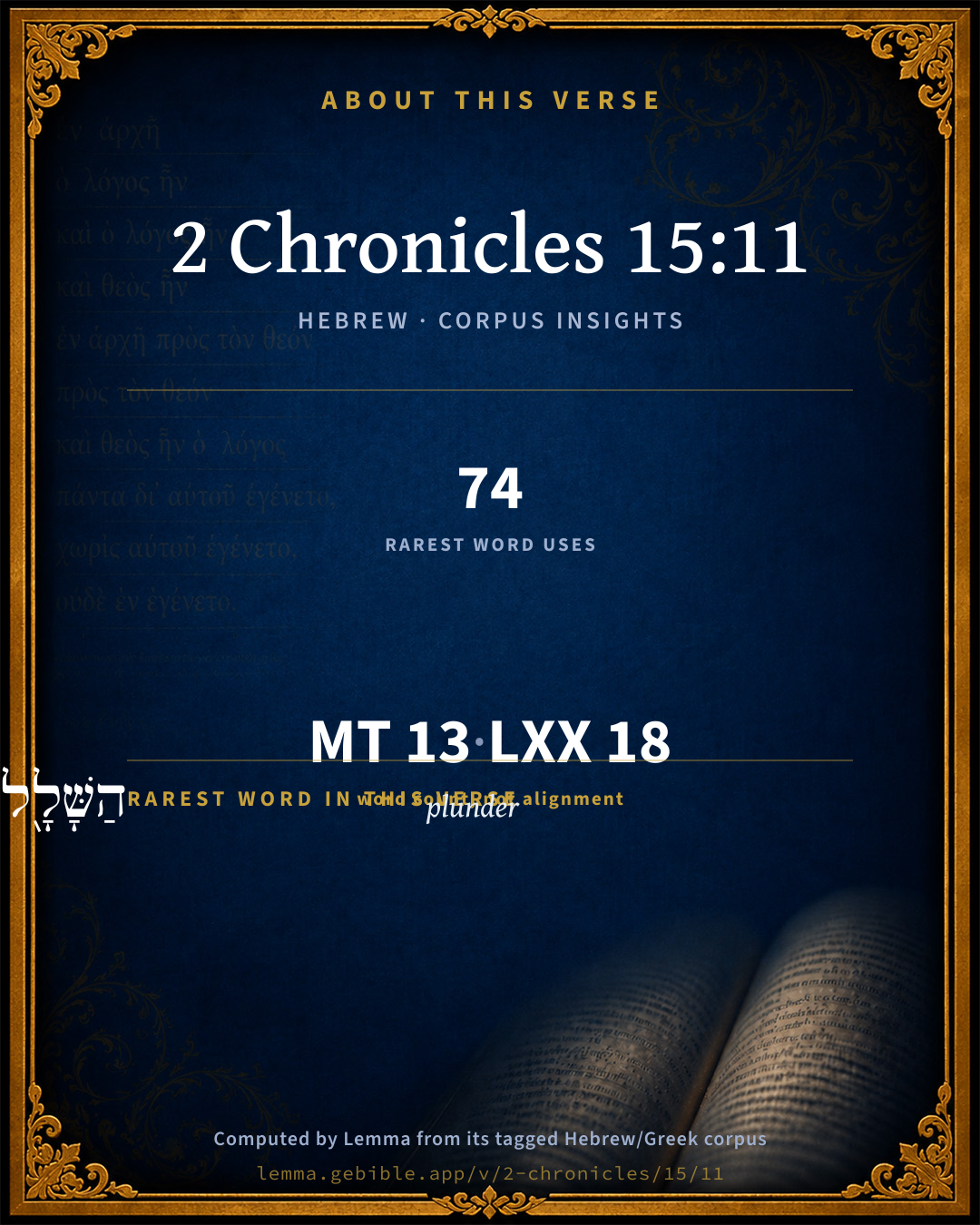
הַשָּׁלָ֖ל
shâlâl
H7998
“the · plunder”
Particle, Definite Article + Noun, Common, Masculine, Singular, Absolute
Part of Speech
Particle + Noun
Type
Common
Gender
Masculine
Number
Singular
State
Absolute
Full BDB Definition

Origin: from H7997

TWOT: 2400a

prey, plunder, spoil, booty - prey - booty, spoil, plunder (of war) - plunder (private) - gain (meaning dubious)
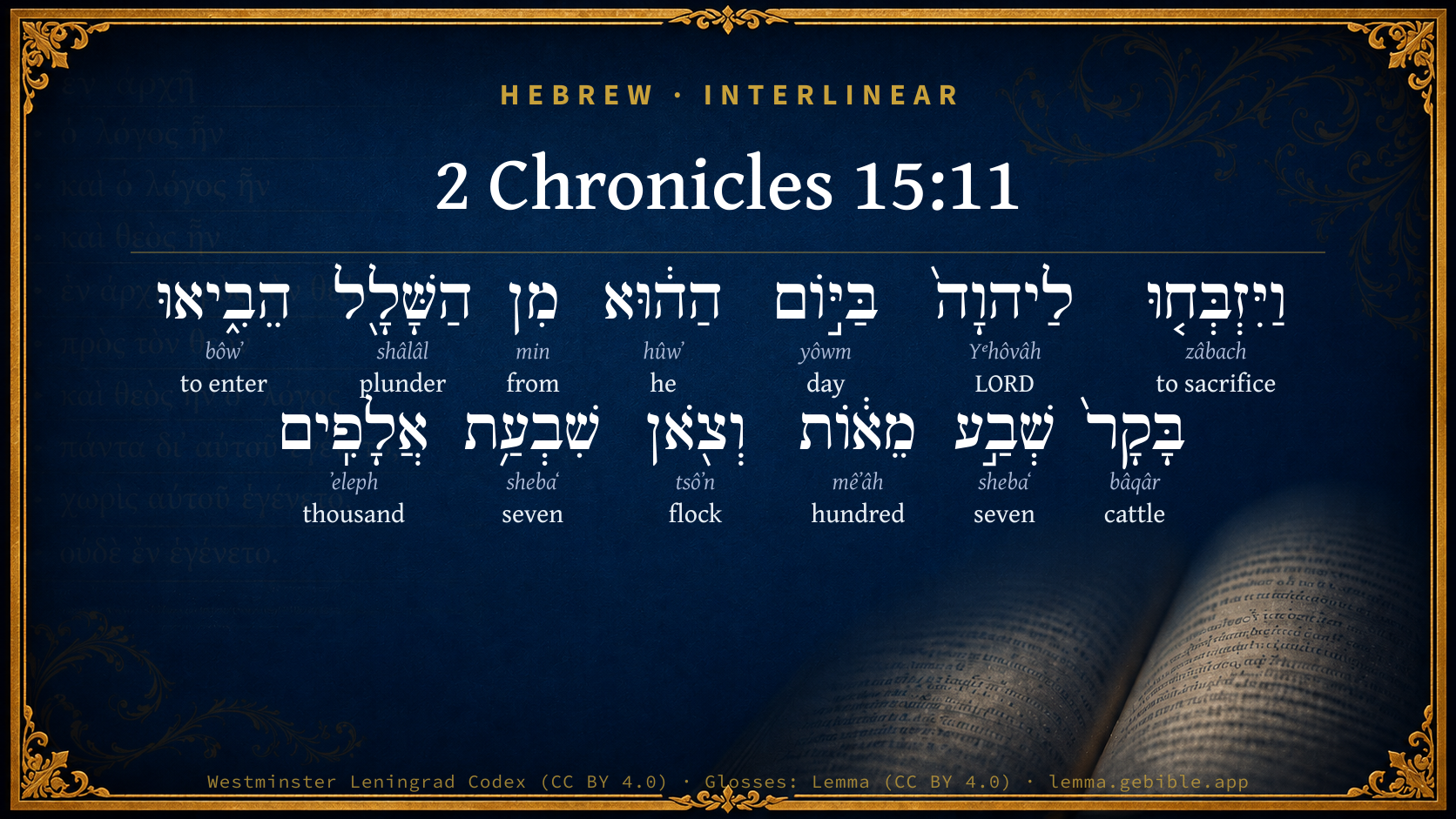
  1. וַיִּזְבְּח֤וּ zâbach H2076 “and · to sacrifice” Conjunction + Verb, Qal, Sequential Imperfect, 3rd Person, Masculine, Plural
  2. לַיהוָה֙ Yᵉhôvâh H3068 “to/for · LORD” Preposition + Noun, Proper
  3. בַּיּ֣וֹם yôwm H3117 “in/at the · day” Preposition, Determined + Noun, Common, Masculine, Singular, Absolute
  4. הַה֔וּא hûwʼ H1931 “the · he” Particle, Definite Article + Pronoun, Personal, 3rd Person, Masculine, Singular
  5. מִן min H4480 “from” Preposition
  6. הֵבִ֑יאוּ bôwʼ H935 “to enter” Verb, Hiphil, Perfect, 3rd Person, Common, Plural
  7. בָּקָר֙ bâqâr H1241 “cattle” Noun, Common, Both, Singular, Absolute
  8. שְׁבַ֣ע shebaʻ H7651 “seven” Adjective, Cardinal number, Feminine, Singular, Absolute
  9. מֵא֔וֹת mêʼâh H3967 “hundred” Adjective, Cardinal number, Both, Plural, Absolute
  10. וְצֹ֖אן tsôʼn H6629 “and · flock” Conjunction + Noun, Common, Both, Singular, Absolute
  11. שִׁבְעַ֥ת shebaʻ H7651 “seven” Adjective, Cardinal number, Masculine, Singular, Construct
  12. אֲלָפִֽים ʼeleph H505 “thousand” Adjective, Cardinal number, Both, Plural, Absolute

About this verse

These counts appear in no published source. They are computed here, from the morphology-tagged text and Lemma’s own curated glosses. What Lemma adds →

13
words
12
distinct lemmas
Historical
section

Grammatical profile

  • 2 verbs
  • 5 nouns
  • 4 adjectives
  • 1 pronoun
  • 1 preposition

Verb forms

  • וַיִּזְבְּח֤וּ Qal · Sequential Imperfect
  • הֵבִ֑יאוּ Hiphil · Perfect

Repetition

A word recurs within this verse — often emphatic in Hebrew:

  • שְׁבַ֣ע seven H7651 ×2

Hebrew & Septuagint length

In English translation the verse runs 21 words from the Hebrew and 22 from the Septuagint (LXX English) — closely comparable.

A rough comparison of the two English renderings, which tokenize alike — not a word-level alignment.

Word counts can differ between the Hebrew and the Greek without any difference in meaning — e.g. the Hebrew direct-object marker אֵת has no separate Greek word, and Greek often adds the article ὁ.

In the original languages it is 13 Hebrew tokens and 18 Greek tokens — but the two are counted differently (Hebrew bundles its prefixes and suffixes into one token; the Greek is in lemma form), so that isn’t a like-for-like length.

Cross-references

8

Topical passages linked to 2 Chronicles 15:11 in the Treasury of Scripture Knowledge — connected by theme and wording, ordered by reader-vote popularity; previews shown in the World English Bible.

  • 2 Chronicles 14:13–15 Asa and the people who were with him pursued them to Gerar: and there fell of the Ethiopians so many that they could not recover themselves; for they were destroyed before Yahweh, and before his host; and they carried away very much booty.
  • Numbers 31:28–29 Levy a tribute to Yahweh of the men of war who went out to battle: one soul of five hundred, [both] of the persons, and of the oxen, and of the donkeys, and of the flocks:
  • Numbers 31:50 We have brought Yahweh's offering, what every man has gotten, of jewels of gold, ankle-chains, and bracelets, signet-rings, ear-rings, and armlets, to make atonement for our souls before Yahweh.
  • 1 Samuel 15:15 Saul said, They have brought them from the Amalekites: for the people spared the best of the sheep and of the oxen, to sacrifice to Yahweh your God; and the rest we have utterly destroyed.
  • 1 Samuel 15:21 But the people took of the spoil, sheep and oxen, the chief of the devoted things, to sacrifice to Yahweh your God in Gilgal.
  • 1 Chronicles 26:26–27 This Shelomoth and his brothers were over all the treasures of the dedicated things, which David the king, and the heads of the fathers' [houses], the captains over thousands and hundreds, and the captains of the host, had dedicated.
  • 2 Chronicles 1:6 Solomon went up there to the brazen altar before Yahweh, which was at the tent of meeting, and offered one thousand burnt offerings on it.
  • 2 Chronicles 7:5 King Solomon offered a sacrifice of twenty-two thousand oxen, and a hundred and twenty thousand sheep. So the king and all the people dedicated the house of God.

Cross-references courtesy of OpenBible.info (CC BY 4.0).

Hebrew and Greek witnesses Masoretic Hebrew ↔ Greek Septuagint

The same verse in the two great witnesses to the Old Testament, shown verse-for-verse.

These are two independent witnesses, not word-aligned to each other, and the Septuagint is shown in lemma (dictionary) form.

Hebrew 2 Chronicles 15:11 Masoretic · Westminster Leningrad Codex

וַיִּזְבְּח֤וּ לַיהוָה֙ בַּיּ֣וֹם הַה֔וּא מִן הַשָּׁלָ֖ל הֵבִ֑יאוּ בָּקָר֙ שְׁבַ֣ע מֵא֔וֹת וְצֹ֖אן שִׁבְעַ֥ת אֲלָפִֽים

They sacrificed to Yahweh in that day, of the spoil which they had brought, seven hundred oxen and seven thousand sheep.

World English Bible · Public Domain

Greek LXX 2 Chronicles 15:11 Septuagint · lemma form

καί θύω ὁ κύριος ἐν ἐκεῖνος ὁ ἡμέρα ἀπό ὁ σκῦλον ὅς φέρω μόσχος ἑπτακόσιοι καί πρόβατον ἑπτακισχίλιοι

And he sacrificed to the Lord in that day of the spoils which they brought, seven hundred calves and seven thousand sheep.

LXX2012 (modern English Septuagint) · Public Domain

Hebrew: Westminster Leningrad Codex (CC BY 4.0). Greek: Septuagint (public domain); English from LXX2012 (modern English Septuagint) (Public Domain). How the Septuagint differs from the Hebrew →

Commentary

Notes on 2 Chronicles 15:11 from classic Christian and Jewish commentators (each source and its license shown beneath its notes). The classic Christian expositions comment on the surrounding passage and are grouped to its opening verse, so a note may address several verses; the Jewish commentaries on the Tanakh (Rashi and others) are per-verse, so they appear only where the commentator wrote on this verse.

Lemma curates 59 commentaries, every one of them public domain or Creative Commons licensed, each selected and text-cleaned for this edition rather than reprinted as found. About our sources →

Trapp's Complete Commentary

John Trapp

2Ch 15:11 And they offered unto the LORD the same time, of the spoil [which] they had brought, seven hundred oxen and seven thousand sheep.

Ver. 11. And they offered of the spoil.] Heathens also did so, ascribing thereby the victory to their gods.

John Trapp, A Commentary or Exposition upon All the Books of the Old and New Testament (1647–1656) — public domain. Text from a community e-Sword module.

Joseph Benson's Commentary

2Ch 15:11-12. They offered of the spoil which they had brought — Taken from Zerah, and his army and allies. They entered into a covenant, &c. — Repenting that they had violated their engagements to God, and resolving to attend to, and endeavour to fulfil them in future. The matter of this covenant was nothing but what they were before obliged to. And though no promise could lay any higher obligation upon them than they were already under, yet it would help to increase their sense of the obligation, and to arm them against temptations: and, by joining all together in this, they strengthened the hands of each other. To seek the God of their fathers — In the way their fathers had sought him, and in dependence on the promise made to their fathers; with all their heart, and with all their soul — For only those seek God acceptably and successfully, who seek him thus. God demands all the heart: and when such an inestimable blessing as the divine favour is to be found, it is proper that the whole heart should be engaged in the pursuit of it.

Joseph Benson's Commentary on the Old and New Testaments (1811–1818) — public domain. Text from a community e-Sword module.

Geneva Bible (1599)

Geneva Bible translators

Which they had taken of the Ethiopians.

Geneva Bible (1599) marginal notes — public domain. Text via Bolls.life.

Adam Clarke's Commentary

Verse 11. The spoil which they had brought] The spoil which they had taken from Zerah and his auxiliaries, 2Ch 14:14; 2Ch 14:15.

Adam Clarke's Commentary on the Bible (1810–1826) — public domain. Text from a community e-Sword/MySword module.

Ellicott's Commentary for English Readers

(11) The same time.—On that day; viz., the day appointed for the festival, in the third month, i.e., Sivan, corresponding to part of May and June.

Of the spoil which they had brought.—The spoil of Zerah, the cities round Gerar, and the nomadic tribes (2Ch_14:13-15).

A Bible Commentary for English Readers, edited by Charles John Ellicott (1878–1897) — public domain. Text from a community e-Sword module.

The Cambridge Bible for Schools and Colleges

gen. ed. J. J. S. Perowne

11. the same time] R.V. in that day.

the spoil] Cp. 2Ch_14:13-15.

The Cambridge Bible for Schools and Colleges (gen. ed. J. J. S. Perowne; Cambridge University Press, 1878–1918) — public domain. Text from a community e-Sword module.

John Gill's Exposition

And they offered unto the Lord the same time,.... The Targum adds, on the feast of weeks, or Pentecost: of the spoil which they had brought; from the camp of the Ethiopians, and the cities of the Philistines:

seven hundred oxen and seven thousand sheep; partly for burnt offerings, and partly for peace offerings, by way of thankfulness to the Lord for the victory he had given them, and for a feast at the making of the following covenant with him.

John Gill's Exposition of the Whole Bible (1746–1763) — public domain (CC PDM 1.0). Text via the HelloAO Bible API.

Albert Barnes' Notes on the Bible

The prevalence of the number “seven” in the religious system of the Jews has been noticed often. Seven bullocks and seven rams were a common offering Num 29:32; 1Ch 15:26; 2Ch 29:21; Job 42:8; Eze 14:23. At the larger sacrifices, however, it is seldom that we find the number seven at all prominent (compare 2Ch 30:24; 2Ch 35:7-9; 1Ki 8:63).

Albert Barnes' Notes on the Bible (1834–1885) — public domain. Text from a community e-Sword/MySword module.

Haydock's Catholic Bible Commentary

Spoils, which they had sold, and now testified their gratitude. (Tirinus) --- Rams. Protestants, "sheep."

George Leo Haydock (1774–1849), Haydock's Catholic Family Bible and Commentary, 1859 edition — public domain. Excludes Psalms (Douay-Rheims chapter numbering differs from Protestant) and Deuterocanonical books (Catholic canon only).

Matthew Poole's English Annotations

Taken from Zerah and his accomplices, 2Ch 14:13, &c.

Matthew Poole's English Annotations on the Holy Bible (1683–1685) — public domain. Text from a community e-Sword/MySword module.

The Pulpit Commentary

These offerings were probably chiefly of the nature of peace offerings. (Lev_7:11-21) In the mention of the "spoil" (2Ch_14:13, 2Ch_14:15) nothing is said of oxen. Seven hundred seven thousand. The number seven is common when the sacrifices were in units (as e.g. Num_29:32; 1Ch_15:26, etc.) but uncommon in hundreds and thousands, for see 1Ki_8:63; 2Ch_35:7-9, comparing, however, 2Ch_30:24.

The Pulpit Commentary (1880–1919), ed. H.D.M. Spence-Jones & Joseph S. Exell — public domain. Text from a community e-Sword module.

Rashi

Rabbi Shlomo Yitzchaki (Rashi)

And they sacrificed to the Lord on that day of the plunder they brought The meaning is: And the plunder that they brought, they sacrificed seven hundred cattle and seven thousand sheep which they had captured, and from that they brought, as above: (14:14): “And they also smote the tents of the livestock, and they captured many sheep. etc.” Another possible explanation is: “And they sacrificed to the Lord on that day” - when they were victorious and came in peace to Jerusalem. “from the plunder they brought” - from the plunder that they had brought, i.e., seven hundred cattle and seven thousand sheep.

Rashi on the Tanakh — English translations: “The Judaica Press complete Tanach with Rashi, translated by A. J. Rosenberg” (CC BY 4.0); “Pentateuch with Rashi's commentary by M. Rosenbaum and A.M. Silbermann, 1929-1934” (public domain); “The Metsudah Tanach series, Lakewood, N.J” (CC BY 4.0); and “The Book of Joshua, Metsudah Publications, 1997” (CC BY 4.0). Text via Sefaria.

Lesson kit

Teaching starters — assembled from the data on this page, not authored interpretation. Every prompt links to the verse data it draws on. Edit before teaching.

2 Chronicles, in the Historical, opens this verse with 13 words (12 distinct Hebrew lemmas). Its most distinctive word is shâlâl (“plunder”). A historical commentator’s framing appears above. Read the whole chapter for the surrounding context.

Discussion questions

  1. What does “plunder” (shâlâl) contribute to the verse as a whole?
  2. 2 Chronicles 14:13–15 shares this passage’s theme. How do the two illuminate each other?
  3. “seven” occurs 2× in this one verse. What is the effect of the repetition?
  4. These translations render this verse differently. What is at stake in choosing one wording over another?
  5. The verb «וַיִּזְבְּח֤וּ» is Qal Sequential Imperfect. How does its form color the action?
  6. Reading how Trapp's Complete Commentary and Joseph Benson's Commentary read this verse, where do the two commentators agree and where do they part?

Things to notice

Reading settings

Reading text

Shown beneath each verse's original-language words.

Old Testament
Old Testament edition

Read the OT as the Masoretic Hebrew (MT) or the Greek Septuagint (LXX).

English shown for the Greek Septuagint (in the Hebrew ↔ Greek comparison).

Comparing translations? Open the Compare panel on any verse page to stack up to four side by side.