
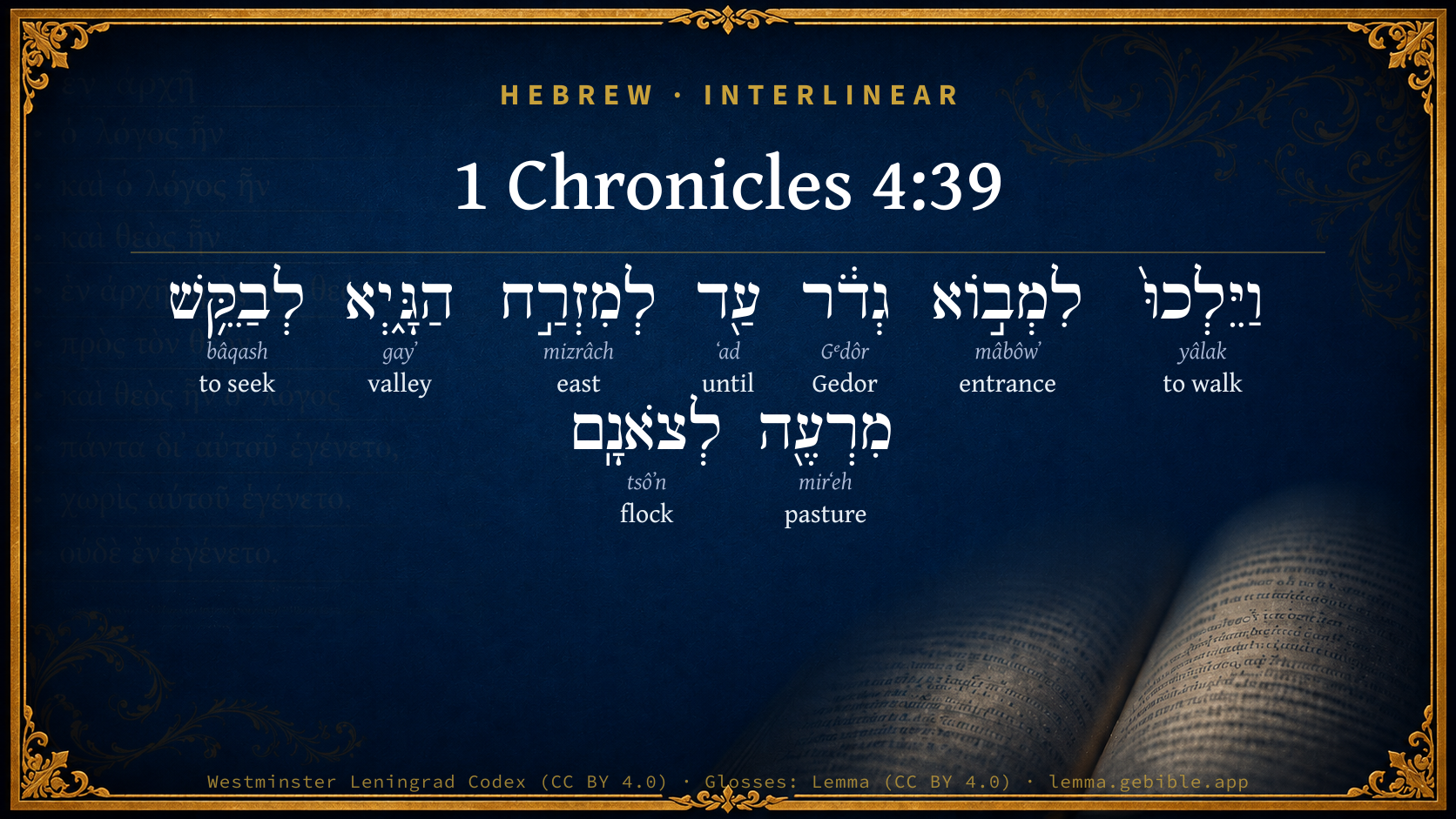
1 Chronicles 4:39

Hebrew (Westminster Leningrad Codex) 1 Chronicles 4:39 appears in the Hebrew Old Testament. The text above is from the Westminster Leningrad Codex. Each word links to its Strong’s number, a concise gloss, and parsing drawn from the Open Scriptures Hebrew Bible morphology. Click any word for its full Brown-Driver-Briggs (BDB) entry.
Download image
Cite this verse

1 Chronicles 4:39 (World English Bible). Public Domain. Lemma interlinear Bible study tool, https://lemma.gebible.app/v/1-chronicles/4/39.

Show BibTeX & RIS
BibTeX
RIS
English Translation
They went to the entrance of Gedor, even to the east side of the valley, to seek pasture for their flocks.
World English Bible · Public Domain
Download a study sheet

One document with this verse’s original text, its word-by-word gloss line, the meaning frame, cross-references with their text, attributed commentary, and full source and license credits — printable, and it pastes into notes with its structure intact.

This verse Autodidact and up

Study sheet (.html) Plain text (.txt)

A passage Seminary Student

Up to 50 verses in one chapter. A passage sheet keeps up to 6 commentary sources and 12 cross-references per verse, in the order this page ranks them, and says so on the sheet whenever that leaves anything out. Ask for a single verse and you get the Autodidact verse sheet above.

Everything on this page stays free to read, with no account — the sheet is a download of what is already on screen, not access to it.

Want to remove ads? Support Godless Engineer
Compare translations 3

The same verse in 3 English versions, stacked beneath the original-language interlinear above. Click any original word for its lexicon entry.

Each is an independent rendering of the whole verse — the interlinear is not word-aligned to these translations.

Highlighted words mark where these versions differ — a whole-verse word diff, not a word-by-word alignment.

  • World English Bible Public Domain
    They went to the entrance of Gedor, even to the east side of the valley, to seek pasture for their flocks.
  • King James Version Public Domain
    And they went to the entrance of Gedor, even unto the east side of the valley, to seek pasture for their flocks.
  • unfoldingWord Literal Text CC BY-SA 4.0
    And they went to the entrance of Gedor, unto to the east of the valley, to seek pasture for their flock.

unfoldingWord Literal Text — © unfoldingWord, licensed CC BY-SA 4.0. Word-aligned USFM3 via Door43 (git.door43.org/unfoldingWord/en_ult).

Versions to compare (up to 4)

3 of 4 selected

Show all 18 translations

Every available English version of this verse, each an independent rendering of the whole verse.

  • World English Bible Public Domain
    They went to the entrance of Gedor, even to the east side of the valley, to seek pasture for their flocks.
  • Berean Standard Bible Public Domain
    and they journeyed to the entrance of Gedor, to the east side of the valley, in search of pasture for their flocks.
  • Majority Standard Bible Public Domain
    and they journeyed to the entrance of Gedor, to the east side of the valley, in search of pasture for their flocks.
  • King James Version Public Domain
    And they went to the entrance of Gedor, even unto the east side of the valley, to seek pasture for their flocks.
  • American Standard Version (1901) Public Domain
    And they went to the entrance of Gedor, even unto the east side of the valley, to seek pasture for their flocks.
  • Revised Version (1885) Public Domain
    And they went to the entering in of Gedor, even unto the east side of the valley, to seek pasture for their flocks.
  • Geneva Bible (1599) Public Domain
    And they went to the entring in of Gedor, euen vnto the East side of the valley, to seeke pasture for their sheepe.
  • Douay-Rheims (1899) Public Domain
    And they went forth to enter into Gador as far as to the east side of the valley, to seek pastures for their flocks.
  • Young's Literal Translation Public Domain
    and they go to the entrance of Gedor, unto the east of the valley, to seek pasture for their flock,
  • Literal Standard Version CC BY-SA 4.0
    and they go to the entrance of Gedor, to the east of the valley, to seek pasture for their flock,
  • Unlocked Literal Bible CC BY-SA 4.0
    They went near Gedor, on the east side of the valley, to seek pasture for their flocks.
  • unfoldingWord Literal Text CC BY-SA 4.0
    And they went to the entrance of Gedor, unto to the east of the valley, to seek pasture for their flock.
  • Darby Bible Public Domain
    And they went to the entrance of Gedor, as far as the east side of the valley, to seek pasture for their flocks.
  • World Messianic Bible Public Domain
    They went to the entrance of Gedor, even to the east side of the valley, to seek pasture for their flocks.
  • Webster's Bible Public Domain
    And they went to the entrance of Gedor, even to the east side of the valley, to seek pasture for their flocks.
  • Free Bible Version CC BY-SA 4.0
    They went far as the border of Gedor on the east side of the valley to look for pasture for their flocks.
  • Bible in Basic English Public Domain
    And they went to the opening into Gedor, as far as the east side of the valley, in search of grass-land for their flocks.
  • JPS Tanakh (1917) Public Domain
    And they went to the entrance of Gedor, even unto the east side of the valley, to seek pasture for their flocks.

Literal Standard Version (2020), Covenant Press — licensed CC BY-SA 4.0. Text via the HelloAO Bible API (eBible.org). Unlocked Literal Bible (unfoldingWord) — licensed CC BY-SA 4.0. Text via the HelloAO Bible API (eBible.org). unfoldingWord Literal Text — © unfoldingWord, licensed CC BY-SA 4.0. Word-aligned USFM3 via Door43 (git.door43.org/unfoldingWord/en_ult). Free Bible Version, Dr. Jonathan Gallagher — licensed CC BY-SA 4.0. Text via the HelloAO Bible API (eBible.org).

Word by word

More ways to search: Search by grammar → Find every occurrence → Compare this word →

Practice this passage: Drill this verse → Learn its vocabulary →

גְדֹ֔ר
Gᵉdôr
H1446
“Gedor”
Noun, Proper
Part of Speech
Noun
Type
Proper
Full BDB Definition

Origin: from H1443

TWOT: None

Gedor = "wall" - a son of Penuel (noun proper masculine) - a son of Jered (noun proper masculine) - a Benjamite of Gibeon (noun proper masculine) - a town in the mountainous part of Judah a few miles north of Hebron (noun proper locative)
  1. וַיֵּלְכוּ֙ yâlak H3212 “and · to walk” Conjunction + Verb, Qal, Sequential Imperfect, 3rd Person, Masculine, Plural
  2. לִמְב֣וֹא mâbôwʼ H3996 “to/for · entrance of” Preposition + Noun, Common, Masculine, Singular, Construct
  3. עַ֖ד ʻad H5704 “until” Preposition
  4. לְמִזְרַ֣ח mizrâch H4217 “to/for · east of” Preposition + Noun, Common, Masculine, Singular, Construct
  5. הַגָּ֑יְא gayʼ H1516 “the · valley” Particle, Definite Article + Noun, Common, Both, Singular, Absolute
  6. לְבַקֵּ֥שׁ bâqash H1245 “to seek” Preposition + Verb, Piel, Infinitive Construct
  7. מִרְעֶ֖ה mirʻeh H4829 “pasture” Noun, Common, Masculine, Singular, Absolute
  8. לְצֹאנָֽם tsôʼn H6629 “to/for · flock · their” Preposition + Noun, Common, Both, Singular, Construct + Suffix, Personal, 3rd Person, Masculine, Plural

About this verse

These counts appear in no published source. They are computed here, from the morphology-tagged text and Lemma’s own curated glosses. What Lemma adds →

9
words
9
distinct lemmas
Historical
section

Notable vocabulary

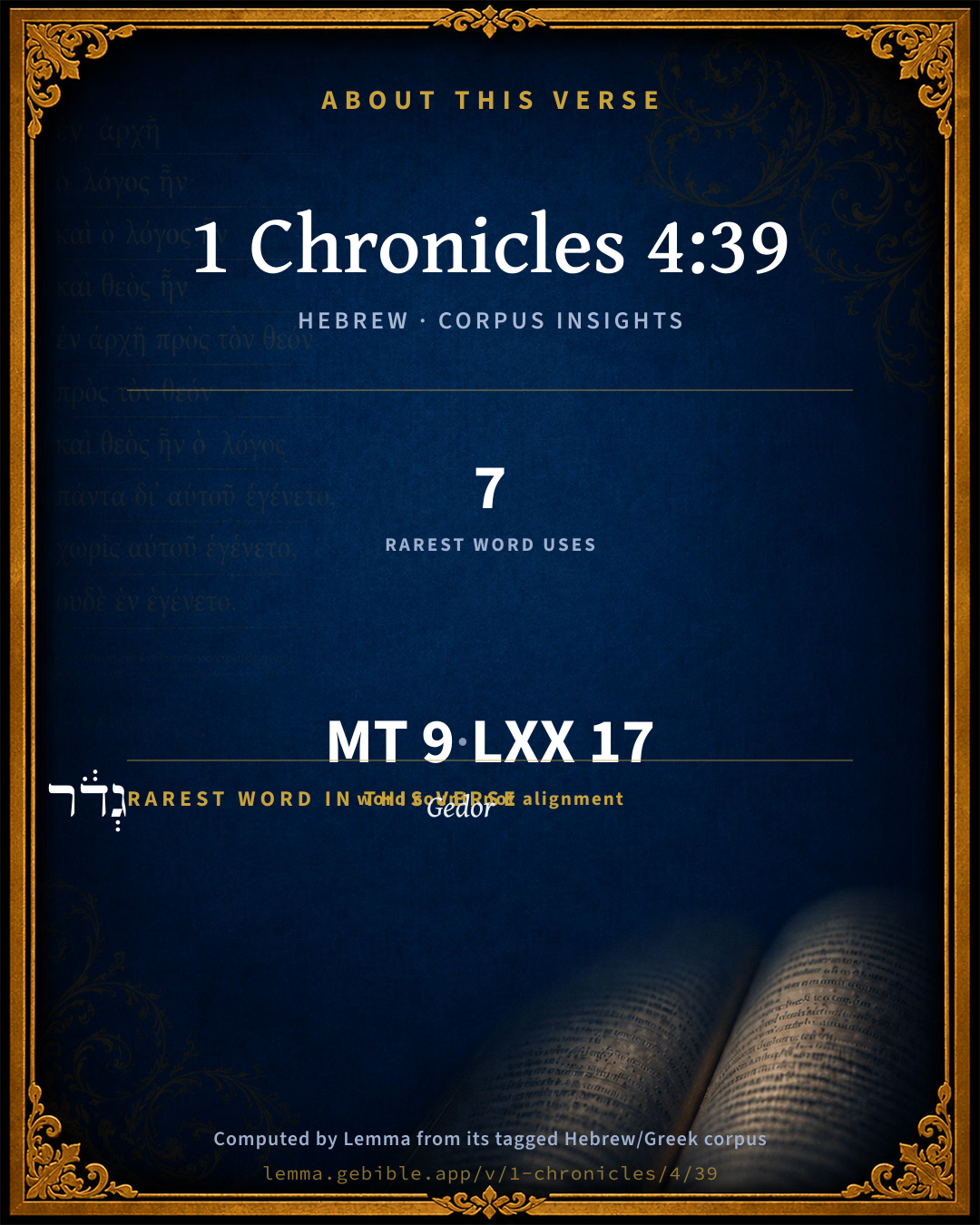
The rarest word here is גְדֹ֔ר Gedor H1446 — appearing just 7 times in the whole Hebrew Bible.

Shared distinctive vocabulary

גְדֹ֔ר Gedor H1446 occurs in 7 verses of the Hebrew Bible. Also found in:

Grammatical profile

  • 2 verbs
  • 6 nouns
  • 1 preposition

Verb forms

  • וַיֵּלְכוּ֙ Qal · Sequential Imperfect
  • לְבַקֵּ֥שׁ Piel · Infinitive Construct

Hebrew & Septuagint length

In English translation the verse runs 21 words from the Hebrew and 19 from the Septuagint (LXX English) — closely comparable.

A rough comparison of the two English renderings, which tokenize alike — not a word-level alignment.

Word counts can differ between the Hebrew and the Greek without any difference in meaning — e.g. the Hebrew direct-object marker אֵת has no separate Greek word, and Greek often adds the article ὁ.

In the original languages it is 9 Hebrew tokens and 17 Greek tokens — but the two are counted differently (Hebrew bundles its prefixes and suffixes into one token; the Greek is in lemma form), so that isn’t a like-for-like length.

Cross-references

4

Topical passages linked to 1 Chronicles 4:39 in the Treasury of Scripture Knowledge — connected by theme and wording, ordered by reader-vote popularity; previews shown in the World English Bible.

  • Joshua 15:58 Halhul, Beth Zur, and Gedor,
  • 1 Chronicles 4:4 and Penuel the father of Gedor, and Ezer the father of Hushah. These are the sons of Hur, the firstborn of Ephrathah, the father of Bethlehem.
  • 1 Chronicles 4:18 His wife the Jewess bore Jered the father of Gedor, and Heber the father of Soco, and Jekuthiel the father of Zanoah. These are the sons of Bithiah the daughter of Pharaoh, whom Mered took.
  • Joshua 12:13 the king of Debir, one; the king of Geder, one;

Cross-references courtesy of OpenBible.info (CC BY 4.0).

Hebrew and Greek witnesses Masoretic Hebrew ↔ Greek Septuagint

The same verse in the two great witnesses to the Old Testament, shown verse-for-verse.

These are two independent witnesses, not word-aligned to each other, and the Septuagint is shown in lemma (dictionary) form.

Hebrew 1 Chronicles 4:39 Masoretic · Westminster Leningrad Codex

וַיֵּלְכוּ֙ לִמְב֣וֹא גְדֹ֔ר עַ֖ד לְמִזְרַ֣ח הַגָּ֑יְא לְבַקֵּ֥שׁ מִרְעֶ֖ה לְצֹאנָֽם

They went to the entrance of Gedor, even to the east side of the valley, to seek pasture for their flocks.

World English Bible · Public Domain

Greek LXX 1 Chronicles 4:39 Septuagint · lemma form

καί πορεύομαι ἕως ὁ ἔρχομαι γεραρα ἕως ὁ ἀνατολή ὁ γαι ὁ ζητέω νομή ὁ κτῆνος αὐτός

And they went till they came to Gerara, to the east of Gai, to seek pasture for their cattle.

LXX2012 (modern English Septuagint) · Public Domain

On this verse, The Cambridge Bible for Schools and Colleges discusses the Septuagint’s reading. Read the note in Commentary ↓

Hebrew: Westminster Leningrad Codex (CC BY 4.0). Greek: Septuagint (public domain); English from LXX2012 (modern English Septuagint) (Public Domain). How the Septuagint differs from the Hebrew →

Commentary

Notes on 1 Chronicles 4:39 from classic Christian and Jewish commentators (each source and its license shown beneath its notes). The classic Christian expositions comment on the surrounding passage and are grouped to its opening verse, so a note may address several verses; the Jewish commentaries on the Tanakh (Rashi and others) are per-verse, so they appear only where the commentator wrote on this verse.

Lemma curates 59 commentaries, every one of them public domain or Creative Commons licensed, each selected and text-cleaned for this edition rather than reprinted as found. About our sources →

Tyndale Open Study Notes

Tyndale Open Resources

4:39 Gerar: The actual territory is not certain, since Gedor (as in Hebrew) is a common name; the Greek variant Gerar would refer to a city in Philistia, to the west of Judah (Gen 10:19).

Tyndale Open Study Notes — © Tyndale Open Resources, licensed CC BY-SA 4.0. Text via the HelloAO Bible API.

Geneva Bible (1599)

Geneva Bible translators

For the tribe of Simeon was so great in number, that in the time of Hezekiah they sought new dwellings unto Gedor, which is in the tribe of Dan.

Geneva Bible (1599) marginal notes — public domain. Text via Bolls.life.

The Cambridge Bible for Schools and Colleges

gen. ed. J. J. S. Perowne

39. the entrance of Gedor] R.V. the entering in of Gedor. The Gedor of Jos_15:58 is identified with Jedur, Ijdur (north of Hebron, Bädeker, p. 135), the neighbourhood of which seems an unlikely scene in the days of Hezekiah for the exploit described in 1Ch_4:41. LXX. has Gerar (cp. Gen_20:1; Gen_26:1), perhaps rightly.

The Cambridge Bible for Schools and Colleges (gen. ed. J. J. S. Perowne; Cambridge University Press, 1878–1918) — public domain. Text from a community e-Sword module.

John Gill's Exposition

And these written by name,.... Before in Ch1 4:34,

came in the days of Hezekiah king of Judah; as Dr. Lightfoot (m) thinks, not within the first fourteen years of his reign, when the Syrian army was abroad, and none dost peep out, but in his last fifteen years, when the army was destroyed and gone:

and smote their tents; the tents of those who dwelt there for the sake of feeding their flocks, and whose pasturage the Simeonites wanted:

and the habitations that were found there; or the Meunaim or Maonites, which the Septuagint Version here calls Mineans, a people sometimes mentioned along with the Philistines, and others: see Jdg 10:11.

and destroyed them utterly unto this day: to the writing of this book; they had not then recovered their possessions:

and dwelt in their room, because there was pasture there for their flocks; which was the thing they were in search of.

(m) Works, vol. 1. p. 111.

John Gill's Exposition of the Whole Bible (1746–1763) — public domain (CC PDM 1.0). Text via the HelloAO Bible API.

Albert Barnes' Notes on the Bible

Gedor - Rather read, “Gerar” (Septuagint) a fertile district Gen 26:6-12; 2Ch 14:14-15 in Philistine country.

Albert Barnes' Notes on the Bible (1834–1885) — public domain. Text from a community e-Sword/MySword module.

Matthew Poole's English Annotations

To the entrance of Gedor, to that country that belongs to Gedor, or borders upon it; either that Gedor, Jos 15:58, or that called Gederah, Jos 15:36.

Unto the east side of the valley; of which See Poole "1Sa 17:2,52".

Matthew Poole's English Annotations on the Holy Bible (1683–1685) — public domain. Text from a community e-Sword/MySword module.

Whedon's Commentary on the Bible

Daniel D. Whedon

39. They went to… Gedor — So the Simeonites, like the Danites, (Judges xviii,) enlarged their possessions by conquest. Whether this Gedor is the same as that in the mountains of Judah, (Jos_15:58,) which Dr. Robinson identifies with Jedur north of Hebron, is uncertain. Ewald proposes to amend by reading, with the Septuagint, Gerar, the city where Abraham and Isaac dwelt. Gen_20:1; Gen_26:1. But wherever the place, the Simeonites found there the rich pastures they desired, and did not hesitate to destroy the tents of the peaceful occupants, and to take forcible possession of their fields, as the Danites did in the case of the inhabitants of Laish.

Daniel D. Whedon (gen. ed.), Commentary on the Old and New Testaments (1874–1909) — public domain. Text from a community e-Sword module.

The Pulpit Commentary

The place Gedor cannot be identified in this connection. There is a town of the name situated in the mountainous district of Judah between Halhul and Beth-zur, to the north of Hebron. (Jos_15:58) It is evident that this cannot be the place we require here. There is another town of the name, (1Ch_12:7) probably belonging to Benjamin, and which as little admits of being fitted in here. Both the Alexandrine and the Vatican Codex of the Septuagint, however, evidently read rdG for rdoG.

Now, Gerar of the Philistines would suit well for position and description, and also (Gen_10:14) for the allusion found here (ver. 40) to the dwelling there "of old" of the people of Ham. The Hebrew word, however, generally applied to the valley of Gerar (lj"n," wady) is not the word used here of Gedor (ayg; h," ravine). See Stanley"s "Syria and Palestine," p. 159, and note. Not only are references frequent to the fertility of Gerar, but the significance of that in 2Ch_14:14 speaks for itself. This alteration of reading, however, with acceptance of the Septuagint manuscripts, cannot be regarded as altogether satisfactory, and Keil ("Comm.," in loc.) offers some suggestions of weight against those of Ewald, Bertheau, and others.

Vers. 39-41.

Might and right.

The place named Gedor is not otherwise mentioned in Scripture. Ewald and Bertheau think Gerar is the true reading; and this is given in the Septuagint Version. Reference, then, is to a portion of the Philistine country, which was remarkable for its fertility (Gen_26:6-12; 2Ch_14:14, 2Ch_14:15) We cannot tell whether these princes had any justifiable ground for their aggression. But we may dwell on this as an instance of "might" overmastering "right;" for the earlier occupiers may be fairly considered to have had the right," and the point of the story is that these princes grew strong, and when they had "might" they used it to drive out, and possess the lands of, those who had only right. " The Eastern mode of keeping flocks by moving them to different parts of wide pasture-grounds should be explained, and the rivalry and the quarrelling which this too often entails may be illustrated in the relations of Abraham and Lot. And the way in which weakening and decaying tribes have to yield before strong and rising tribes and nations, may illustrate the modern doctrine of the "survival of the fittest;" and instances may be found in the story of the great nations, such as Persia, Greece, Rome, etc.

I MAN"S MIGHT IS OFTEN THOUGHT RIGHT. The two things are perfectly distinct. What we can do is not necessarily what we ought to do. And man"s power must ever be held down under the mastery of a will guided by good judgment, right principles, sweet charity, and tender consideration for the claims and rights of others. The Nasmyth steam-hammer affords a good illustration of splendid power held in full control. Yet in the commoner spheres of life, as well as by kings and great men, might is often mistaken for right. It is often one of the easiest pieces of self-deception. One of the master principles swaying men is the love of power. Therefore do men get large numbers of servants, retainers, and workmen; they increase wealth and possessions; push into places of position and influence; and in every possible way seek to gain sway over their fellow-men. And this becomes a peril, and, for many men, the severest test of virtue and charity. Every true-hearted man will feel the peril of confusing might with right; and will accept the fact that these two will often be in conflict, and that, for such conflict, the issue must always be the triumph of the right. Man"s might is a fatal force for the liberty of his fellow-man, unless it not only seems to be to him, but it actually is, the same as the right. So the practical question ever and again recurring in life is this: "I can, but may I? Will it be right?" Man"s nobility is full loyalty to the right.

II GOD"S RIGHT ALWAYS PROVES TO BE MIGHT. Always in the long run," We make many mistakes by only seeing pieces and parts of things; so we sometimes say, "The way of the Lord is not equal. " Yet right does always triumph, if we can properly discern the "right," and properly appraise "triumph," Right is invincible. Nature, all the good there is in the earth, all the long ages, and God himself, are on the side of the right. This is true for the individual man when, in all simplicity and loyalty, he does God"s right, whatever of seeming disabilities it may involve. He may have the most perfect confidence that God will make it might, and in the due time "bring forth his righteousness as the light, and his judgment as the noonday." It may be practically enforced that man"s violence overreaches itself, as did Hamans.

And that all forcings of his way and will by man imply a failing of trust in God"s living love and lead. It is a spirit in striking contrast with that expressed in Jabez"s prayer. R.T. (1Ch_4:10)

The Pulpit Commentary (1880–1919), ed. H.D.M. Spence-Jones & Joseph S. Exell — public domain. Text from a community e-Sword module.

Keil & Delitzsch

C. F. Keil & F. Delitzsch

And these written by name,.... Before in Ch1 4:34,

came in the days of Hezekiah king of Judah; as Dr. Lightfoot (m) thinks, not within the first fourteen years of his reign, when the Syrian army was abroad, and none dost peep out, but in his last fifteen years, when the army was destroyed and gone:

and smote their tents; the tents of those who dwelt there for the sake of feeding their flocks, and whose pasturage the Simeonites wanted:

and the habitations that were found there; or the Meunaim or Maonites, which the Septuagint Version here calls Mineans, a people sometimes mentioned along with the Philistines, and others: see Jdg 10:11.

and destroyed them utterly unto this day: to the writing of this book; they had not then recovered their possessions:

and dwelt in their room, because there was pasture there for their flocks; which was the thing they were in search of.

(m) Works, vol. 1. p. 111.

Keil & Delitzsch — Biblical Commentary on the Old Testament (1861–1891) — public domain (CC PDM 1.0). Text via the HelloAO Bible API. (Old Testament only.)

unfoldingWord translationNotes

Door43 World Missions Community

Gedor

This is the name of a town. (See: How to Translate Names)

pasture for their flocks

an area of land where their flocks could feed on the grass

abundant and good pasture

"pastures with much good food for their animals"

Hamites

a people group, descendants of Ham

Meunites

a people group. AT: "descendants of Meun" (See: How to Translate Names)

translationWords

flocks

life

Hezekiah

king

Judah

Ham

unfoldingWord translationNotes — © Distant Shores Media and the Door43 World Missions Community, licensed CC BY-SA 4.0. Source: git.door43.org/Door43/en_tn.

Rashi

Rabbi Shlomo Yitzchaki (Rashi)

And they went therefore to the approach to Gedor, etc. to seek pasture for their flocks.

Rashi on the Tanakh — English translations: “The Judaica Press complete Tanach with Rashi, translated by A. J. Rosenberg” (CC BY 4.0); “Pentateuch with Rashi's commentary by M. Rosenbaum and A.M. Silbermann, 1929-1934” (public domain); “The Metsudah Tanach series, Lakewood, N.J” (CC BY 4.0); and “The Book of Joshua, Metsudah Publications, 1997” (CC BY 4.0). Text via Sefaria.

Lesson kit

Teaching starters — assembled from the data on this page, not authored interpretation. Every prompt links to the verse data it draws on. Edit before teaching.

1 Chronicles, in the Historical, opens this verse with 9 words (9 distinct Hebrew lemmas). Its most distinctive word is Gᵉdôr (“Gedor”). A historical commentator’s framing appears above. Read the whole chapter for the surrounding context.

Discussion questions

  1. The word Gᵉdôr carries the sense “Gedor.” How does it shape the verse?
  2. How does Joshua 15:58, which shares the word «Gedor», read alongside this verse?
  3. The translations on this page render this verse differently — a whole-verse word diff, not a word-by-word alignment. What might account for the different wordings?
  4. «וַיֵּלְכוּ֙» is a Qal Sequential Imperfect verb. How does that grammatical form shape the action described?
  5. Compare how Tyndale Open Study Notes and Geneva Bible (1599) read this verse. Where do they agree or differ?

Things to notice

Reading settings

Reading text

Shown beneath each verse's original-language words.

Old Testament
Old Testament edition

Read the OT as the Masoretic Hebrew (MT) or the Greek Septuagint (LXX).

English shown for the Greek Septuagint (in the Hebrew ↔ Greek comparison).

Comparing translations? Open the Compare panel on any verse page to stack up to four side by side.