Genesis 4:2

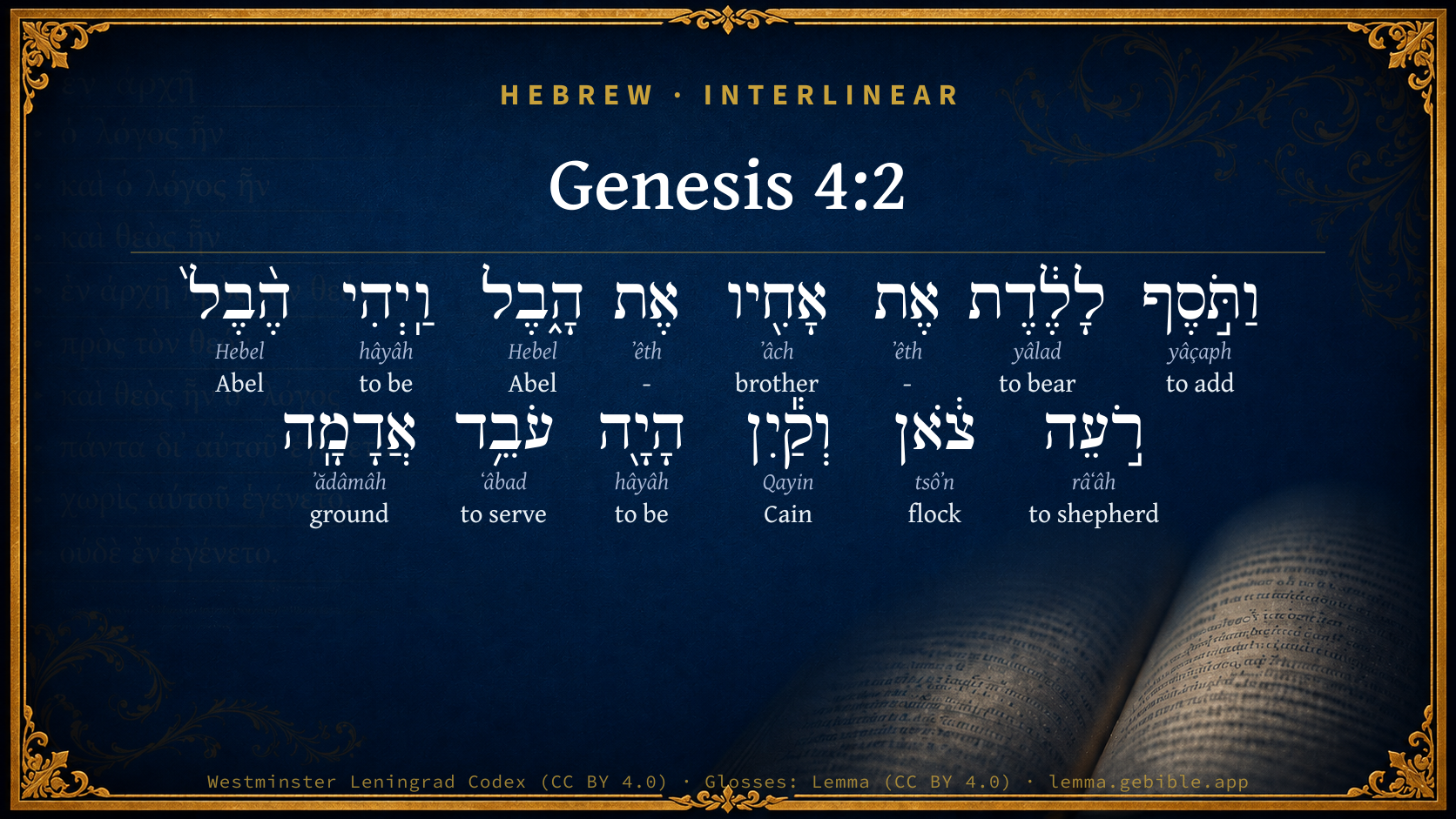
Hebrew (Westminster Leningrad Codex) Genesis 4:2 appears in the Hebrew Old Testament. The text above is from the Westminster Leningrad Codex. Each word links to its Strong’s number, a concise gloss, and parsing drawn from the Open Scriptures Hebrew Bible morphology. Click any word for its full Brown-Driver-Briggs (BDB) entry.
Download image
Cite this verse

Genesis 4:2 (World English Bible). Public Domain. Lemma interlinear Bible study tool, https://lemma.gebible.app/v/genesis/4/2.

Show BibTeX & RIS
BibTeX
RIS
English Translation
Again she gave birth, to Cain's brother Abel. Abel was a keeper of sheep, but Cain was a tiller of the ground.
World English Bible · Public Domain
Highlights
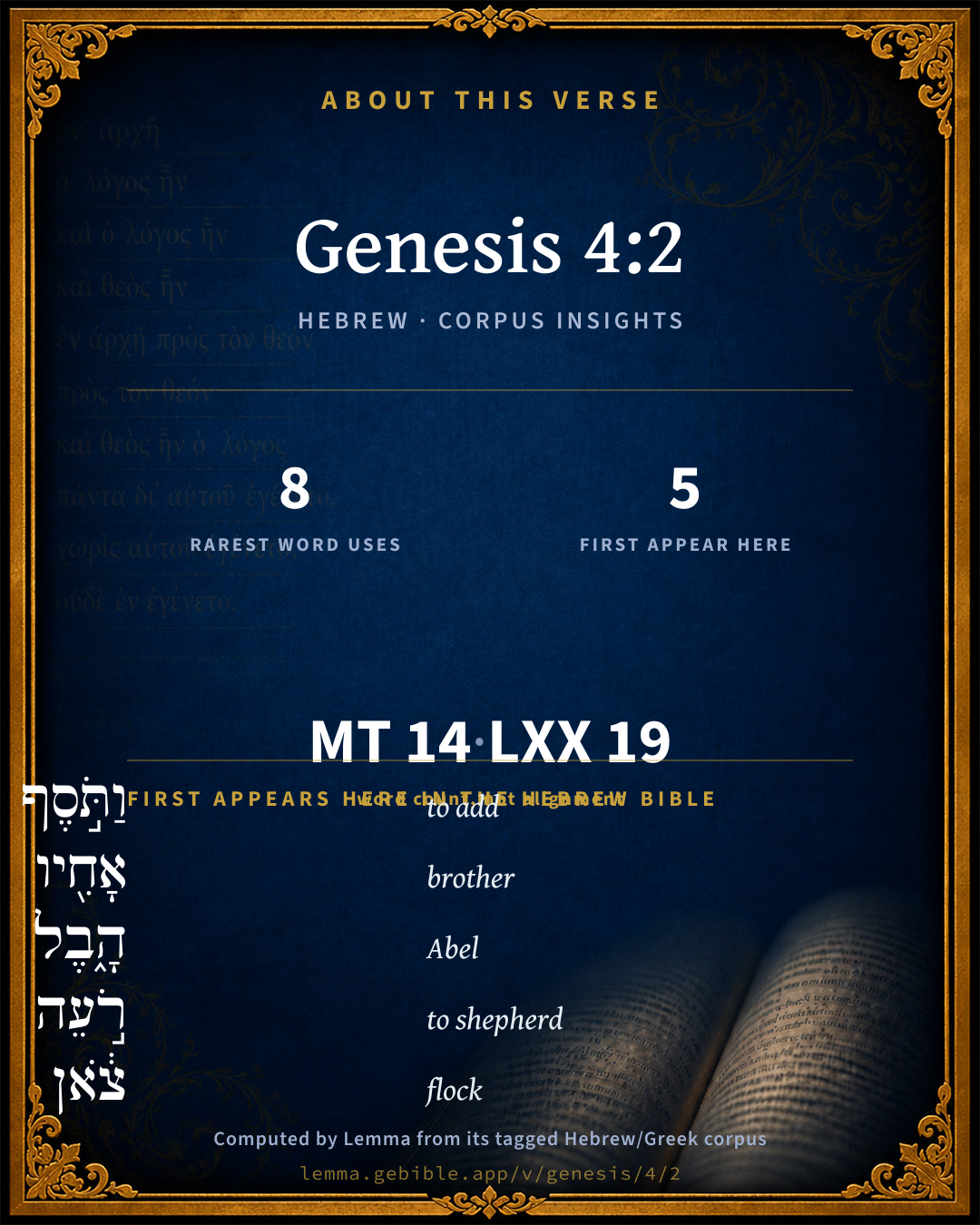
  • 5 first appearances in the Hebrew Bible
Full analysis ↓
Download a study sheet

One document with this verse’s original text, its word-by-word gloss line, the meaning frame, cross-references with their text, attributed commentary, and full source and license credits — printable, and it pastes into notes with its structure intact.

This verse Autodidact and up

Study sheet (.html) Plain text (.txt)

A passage Seminary Student

Up to 50 verses in one chapter. A passage sheet keeps up to 6 commentary sources and 12 cross-references per verse, in the order this page ranks them, and says so on the sheet whenever that leaves anything out. Ask for a single verse and you get the Autodidact verse sheet above.

Everything on this page stays free to read, with no account — the sheet is a download of what is already on screen, not access to it.

Want to remove ads? Support Godless Engineer
Compare translations 3

The same verse in 3 English versions, stacked beneath the original-language interlinear above. Click any original word for its lexicon entry.

Each is an independent rendering of the whole verse — the interlinear is not word-aligned to these translations.

Highlighted words mark where these versions differ — a whole-verse word diff, not a word-by-word alignment.

  • World English Bible Public Domain
    Again she gave birth, to Cain's brother Abel. Abel was a keeper of sheep, but Cain was a tiller of the ground.
  • King James Version Public Domain
    And she again bare his brother Abel. And Abel was a keeper of sheep, but Cain was a tiller of the ground.
  • unfoldingWord Literal Text CC BY-SA 4.0
    Then she continued on to bear his brother Abel. Now Abel became a keeper of flock, and Cain became a worker of the ground.

unfoldingWord Literal Text — © unfoldingWord, licensed CC BY-SA 4.0. Word-aligned USFM3 via Door43 (git.door43.org/unfoldingWord/en_ult).

Versions to compare (up to 4)

3 of 4 selected

Show all 18 translations

Every available English version of this verse, each an independent rendering of the whole verse.

  • World English Bible Public Domain
    Again she gave birth, to Cain's brother Abel. Abel was a keeper of sheep, but Cain was a tiller of the ground.
  • Berean Standard Bible Public Domain
    Later she gave birth to Cain’s brother Abel. Now Abel was a keeper of sheep, while Cain was a tiller of the soil.
  • Majority Standard Bible Public Domain
    Later she gave birth to Cain’s brother Abel. Now Abel was a keeper of sheep, while Cain was a tiller of the soil.
  • King James Version Public Domain
    And she again bare his brother Abel. And Abel was a keeper of sheep, but Cain was a tiller of the ground.
  • American Standard Version (1901) Public Domain
    And again she bare his brother Abel. And Abel was a keeper of sheep, but Cain was a tiller of the ground.
  • Revised Version (1885) Public Domain
    And again she bare his brother Abel. And Abel was a keeper of sheep, but Cain was a tiller of the ground.
  • Geneva Bible (1599) Public Domain
    And againe she brought foorth his brother Habel, and Habel was a keeper of sheepe, and Kain was a tiller of the ground.
  • Douay-Rheims (1899) Public Domain
    And again she brought forth his brother Abel. And Abel was a shepherd, and Cain a husbandman.
  • Young's Literal Translation Public Domain
    and she addeth to bear his brother, even Abel. And Abel is feeding a flock, and Cain hath been servant of the ground.
  • Literal Standard Version CC BY-SA 4.0
    and she adds to bear his brother, even Abel. And Abel is feeding a flock, and Cain has been servant of the ground.
  • Unlocked Literal Bible CC BY-SA 4.0
    Then she gave birth to his brother Abel. Now Abel became a shepherd, but Cain cultivated the soil.
  • unfoldingWord Literal Text CC BY-SA 4.0
    Then she continued on to bear his brother Abel. Now Abel became a keeper of flock, and Cain became a worker of the ground.
  • Darby Bible Public Domain
    And she further bore his brother Abel. And Abel was a shepherd, but Cain was a husbandman.
  • World Messianic Bible Public Domain
    Again she gave birth, to Cain’s brother Abel. Abel was a keeper of sheep, but Cain was a tiller of the ground.
  • Webster's Bible Public Domain
    And she again bore his brother Abel. And Abel was a keeper of sheep, but Cain was a tiller of the ground.
  • Free Bible Version CC BY-SA 4.0
    Later she gave birth to his brother Abel. Abel became a shepherd, while Cain was a crop farmer.
  • Bible in Basic English Public Domain
    Then again she became with child and gave birth to Abel, his brother. And Abel was a keeper of sheep, but Cain was a farmer.
  • JPS Tanakh (1917) Public Domain
    And again she bore his brother Abel. And Abel was a keeper of sheep, but Cain was a tiller of the ground.

Literal Standard Version (2020), Covenant Press — licensed CC BY-SA 4.0. Text via the HelloAO Bible API (eBible.org). Unlocked Literal Bible (unfoldingWord) — licensed CC BY-SA 4.0. Text via the HelloAO Bible API (eBible.org). unfoldingWord Literal Text — © unfoldingWord, licensed CC BY-SA 4.0. Word-aligned USFM3 via Door43 (git.door43.org/unfoldingWord/en_ult). Free Bible Version, Dr. Jonathan Gallagher — licensed CC BY-SA 4.0. Text via the HelloAO Bible API (eBible.org).

Word by word

More ways to search: Search by grammar → Find every occurrence → Compare this word →

Practice this passage: Drill this verse → Learn its vocabulary →

הָ֑בֶל
Hebel
H1893
“Abel”
Noun, Proper
Part of Speech
Noun
Type
Proper
Full BDB Definition

Origin: the same as H1892

TWOT: None

Abel = "breath" - second son of Adam and Eve, killed by his brother Cain
  1. וַתֹּ֣סֶף yâçaph H3254 “and · to add” Conjunction + Verb, Hiphil, Sequential Imperfect, 3rd Person, Feminine, Singular
  2. לָלֶ֔דֶת yâlad H3205 “to bear” Preposition + Verb, Qal, Infinitive Construct
  3. אֶת ʼêth H853 “-” Particle, Direct Object
  4. אָחִ֖יו ʼâch H251 “brother · his” Noun, Common, Masculine, Singular, Construct + Suffix, Personal, 3rd Person, Masculine, Singular
  5. אֶת ʼêth H853 “-” Particle, Direct Object
  6. וַֽיְהִי hâyâh H1961 “and · to be” Conjunction + Verb, Qal, Sequential Imperfect, 3rd Person, Masculine, Singular
  7. הֶ֨בֶל֙ Hebel H1893 “Abel” Noun, Proper
  8. רֹ֣עֵה râʻâh H7462 “shepherding” Verb, Qal, Participle Active, Masculine, Singular, Construct
  9. צֹ֔אן tsôʼn H6629 “flock” Noun, Common, Both, Singular, Absolute
  10. וְקַ֕יִן Qayin H7014 “and · Cain” Conjunction + Noun, Proper
  11. הָיָ֖ה hâyâh H1961 “to be” Verb, Qal, Perfect, 3rd Person, Masculine, Singular
  12. עֹבֵ֥ד ʻâbad H5647 “serving” Verb, Qal, Participle Active, Masculine, Singular, Construct
  13. אֲדָמָֽה ʼădâmâh H127 “ground” Noun, Common, Feminine, Singular, Absolute

About this verse

These counts appear in no published source. They are computed here, from the morphology-tagged text and Lemma’s own curated glosses. What Lemma adds →

14
words
11
distinct lemmas
Pentateuch
section

Notable vocabulary

The rarest word here is הָ֑בֶל Abel H1893 — appearing just 8 times in the whole Hebrew Bible.

First appearance in Scripture

These words make their first canonical appearance in the Hebrew Bible here:

  • וַתֹּ֣סֶף to add H3254
  • אָחִ֖יו brother H251
  • הָ֑בֶל Abel H1893
  • רֹ֣עֵה to shepherd H7462
  • צֹ֔אן flock H6629

Shared distinctive vocabulary

הָ֑בֶל Abel H1893 occurs in 5 verses of the Hebrew Bible. Also found in:

Grammatical profile

  • 6 verbs
  • 6 nouns
  • 2 particles

Verb forms

  • וַתֹּ֣סֶף Hiphil · Sequential Imperfect
  • לָלֶ֔דֶת Qal · Infinitive Construct
  • וַֽיְהִי Qal · Sequential Imperfect
  • רֹ֣עֵה Qal · Participle Active
  • הָיָ֖ה Qal · Perfect
  • עֹבֵ֥ד Qal · Participle Active

Repetition

Words recur within this verse — often emphatic in Hebrew:

  • הָ֑בֶל Abel H1893 ×2
  • וַֽיְהִי to be H1961 ×2

Hebrew & Septuagint length

In English translation the verse runs 22 words from the Hebrew and 22 from the Septuagint (LXX English) — the same length.

A rough comparison of the two English renderings, which tokenize alike — not a word-level alignment.

Word counts can differ between the Hebrew and the Greek without any difference in meaning — e.g. the Hebrew direct-object marker אֵת has no separate Greek word, and Greek often adds the article ὁ.

In the original languages it is 14 Hebrew tokens and 19 Greek tokens — but the two are counted differently (Hebrew bundles its prefixes and suffixes into one token; the Greek is in lemma form), so that isn’t a like-for-like length.

Cross-references

16

Topical passages linked to Genesis 4:2 in the Treasury of Scripture Knowledge — connected by theme and wording, ordered by reader-vote popularity; previews shown in the World English Bible.

  • 1 John 3:12 unlike Cain, who was of the evil one, and killed his brother. Why did he kill him? Because his works were evil, and his brother's righteous.
  • 1 John 3:15 Whoever hates his brother is a murderer, and you know that no murderer has eternal life remaining in him.
  • Luke 11:51 from the blood of Abel to the blood of Zachariah, who perished between the altar and the sanctuary.' Yes, I tell you, it will be required of this generation.
  • Genesis 47:3 Pharaoh said to his brothers, "What is your occupation?" They said to Pharaoh, "Your servants are shepherds, both we, and our fathers."
  • John 8:44 You are of your Father, the devil, and you want to do the desires of your father. He was a murderer from the beginning, and doesn't stand in the truth, because there is no truth in him. When he speaks a lie, he speaks on his own; for he is a liar, and the father of it.
  • 1 John 3:10 In this the children of God are revealed, and the children of the devil. Whoever doesn't do righteousness is not of God, neither is he who doesn't love his brother.
  • Exodus 3:1 Now Moses was keeping the flock of Jethro, his father-in-law, the priest of Midian, and he led the flock to the back of the wilderness, and came to God's mountain, to Horeb.
  • Psalms 78:70–72 He also chose David his servant, And took him from the sheepfolds;
  • Genesis 3:23 Therefore Yahweh God sent him forth from the garden of Eden, to till the ground from whence he was taken.
  • Genesis 4:25–26 Adam knew his wife again. She gave birth to a son, and named him Seth. For, she said, "God has appointed me another child instead of Abel, for Cain killed him."
  • Genesis 9:20 Noah began to be a farmer, and planted a vineyard.
  • Genesis 30:29–31 He said to him, "You know how I have served you, and how your cattle have fared with me.
  • Genesis 37:13 Israel said to Joseph, "Aren't your brothers feeding the flock in Shechem? Come, and I will send you to them." He said to him, "Here I am."
  • Genesis 46:32–34 These men are shepherds, for they have been keepers of cattle, and they have brought their flocks, and their herds, and all that they have.'
  • Psalms 127:3 Behold, children are a heritage of Yahweh. The fruit of the womb is his reward.
  • Amos 7:15 and Yahweh took me from following the flock, and Yahweh said to me, 'Go, prophesy to my people Israel.'

Cross-references courtesy of OpenBible.info (CC BY 4.0).

Hebrew and Greek witnesses Masoretic Hebrew ↔ Greek Septuagint

The same verse in the two great witnesses to the Old Testament, shown verse-for-verse.

These are two independent witnesses, not word-aligned to each other, and the Septuagint is shown in lemma (dictionary) form.

Hebrew Genesis 4:2 Masoretic · Westminster Leningrad Codex

וַתֹּ֣סֶף לָלֶ֔דֶת אֶת אָחִ֖יו אֶת הָ֑בֶל וַֽיְהִי הֶ֨בֶל֙ רֹ֣עֵה צֹ֔אן וְקַ֕יִן הָיָ֖ה עֹבֵ֥ד אֲדָמָֽה

Again she gave birth, to Cain's brother Abel. Abel was a keeper of sheep, but Cain was a tiller of the ground.

World English Bible · Public Domain

Greek LXX Genesis 4:2 Septuagint · lemma form

καί προςτίθημι τίκτω ὁ ἀδελφός αὐτός ὁ αβελ καί γίγνομαι αβελ ποιμήν πρόβατον καιν δέ εἰμί ἐργάζομαι ὁ γῆ

And she again bore his brother Abel. And Abel was a keeper of sheep, but Cain was a tiller of the ground.

LXX2012 (modern English Septuagint) · Public Domain

On this verse, The Pulpit Commentary discusses the Septuagint’s reading. Read the note in Commentary ↓

Hebrew: Westminster Leningrad Codex (CC BY 4.0). Greek: Septuagint (public domain); English from LXX2012 (modern English Septuagint) (Public Domain). How the Septuagint differs from the Hebrew →

Targum (Aramaic paraphrase)

2

The Targum is the ancient Jewish Aramaic paraphrase of the Hebrew Scriptures — an interpretive translation, not the Hebrew text itself. Onkelos (literal) and Pseudo-Jonathan (expansive) render the Torah, and Jonathan the Prophets. Coverage is partial: where no permissively-licensed English translation exists for a verse, only the Aramaic is shown. This is verse-level text, not a word-by-word alignment to the Hebrew.

  1. Targum Onkelos Torah (Genesis–Deuteronomy)
    וְאוֹסִיפַת לְמֵילַד יָת אֲחוֹהִי יָת הָבֶל וַהֲוָה הֶבֶל רָעֵי עָנָא וְקַיִן הֲוָה פָלַח בְּאַרְעָא

    (no public-domain English translation for this verse)

    Targum Onkelos — Aramaic: “Onkelos Genesis” (public domain); “Onkelos Exodus” (public domain); “Onkelos Leviticus” (public domain); “Onkelos Numbers” (public domain); “Onkelos Deuteronomy” (public domain). English: “Sefaria Community Translation” (CC0 1.0 (public-domain dedication)); “J.W. Etheridge. The Targums of Onkelos and Jonathan Ben Uzziel on the Pentateuch. London: Longmans, Green, 1862” (public domain). Text via Sefaria.

  2. Targum Pseudo-Jonathan Torah (Genesis–Deuteronomy)
    וְאוֹסִיפַת לְמֵילַד מִן בַּעֲלָהּ אָדָם יַת תְּיוּמָתֵיהּ וְיַת הֶבֶל וַהֲוָה הֶבֶל רָעֵי עָנָא וְקַיִן הֲוָה גְבַר פְּלַח בְאַרְעָא

    And she added to bear from her husband Adam his twin, even Habel. And Habel was a shepherd of the flock, but Kain was a man working in the earth.

    Targum Pseudo-Jonathan — Aramaic: “Targum Jonathan on Genesis” (public domain); “Targum Jonathan on Exodus” (public domain); “Targum Jonathan on Leviticus” (public domain); “Targum Jonathan on Numbers” (public domain); “Targum Jonathan on Deuteronomy” (public domain). English: “The Targum of Jonathan ben Uzziel, trans. J. W. Etheridge, London, 1862” (public domain). Text via Sefaria.

Commentary

Notes on Genesis 4:2 from classic Christian and Jewish commentators (each source and its license shown beneath its notes). The classic Christian expositions comment on the surrounding passage and are grouped to its opening verse, so a note may address several verses; the Jewish commentaries on the Tanakh (Rashi and others) are per-verse, so they appear only where the commentator wrote on this verse.

Lemma curates 59 commentaries, every one of them public domain or Creative Commons licensed, each selected and text-cleaned for this edition rather than reprinted as found. About our sources →

Tyndale Open Study Notes

Tyndale Open Resources

4:2 his brother . . . Abel: The name (Hebrew habel) means “breath,” “vapor,” or “meaningless,” anticipating his tragically brief life (cp. Eccl 1:2).

Tyndale Open Study Notes — © Tyndale Open Resources, licensed CC BY-SA 4.0. Text via the HelloAO Bible API.

Jamieson, Fausset & Brown

Robert Jamieson, A. R. Fausset & David Brown

Abel was a keeper of sheep--literally, "a feeder of a flock," which, in Oriental countries, always includes goats as well as sheep. Abel, though the younger, is mentioned first, probably on account of the pre-eminence of his religious character.

Jamieson, Fausset & Brown — Commentary Critical and Explanatory on the Whole Bible (1871) — public domain (CC PDM 1.0). Text via the HelloAO Bible API.

Adam Clarke's Commentary

Verse 2. And she again bare his brother Abel.] Literally, She added to bear (ותסף ללדת vattoseph laledeth) his brother. From the very face of this account it appears evident that Cain and Abel were twins. In most cases where a subject of this kind is introduced in the Holy Scriptures, and the successive births of children of the same parents are noted, the acts of conceiving and bringing forth are mentioned in reference to each child; here it is not said that she conceived and brought forth Abel, but simply she added to bring forth Abel his brother; that is, as I understand it, Cain was the first-born, Abel, his twin brother, came next.

Abel was a keeper of sheep] Adam was originally a gardener, Abel a shepherd, and Cain an agriculturist or farmer. These were the three primitive employments, and, I may add, the most rational, and consequently the best calculated to prevent strife and an immoderate love of the world.

Adam Clarke's Commentary on the Bible (1810–1826) — public domain. Text from a community e-Sword/MySword module.

John Calvin's Commentaries

2. And she again bare his brother Abel It is well known whence the name of Cain is deduced, and for what reason it was given to him. For his mother said, קניתי (kaniti,) I have gotten a man; and therefore she called his name Cain. The same explanation is not given with respect to Abel. The opinion of some, that he was so called by his mother out of contempt, as if he would prove superfluous and almost useless, is perfectly absurd; for she remembered the end to which her fruitfulness would lead; nor had she forgotten the benediction, “Increase and multiply.” We should (in my judgment) more correctly infer that whereas Eve had testified, in the name given to her firstborn, the joy which suddenly burst upon her, and celebrated the grace of God; she afterwards, in her other offspring, returned to the recollection of the miseries of the human race. And certainly, though the new blessing of God was an occasion for no common joy; yet, on the other hand, she could not look upon a posterity devoted to so many and great evils, of which she had herself been the cause, without the most bitter grief. Therefore, she wished that a monument of her sorrow should exist in the name she gave her second son; and she would, at the same time, hold up a common mirror, by which she might admonish her whole progeny of the vanity of man. That some censure the judgment of Eve as absurd, because she regarded her just and holy sons as worthy to be rejected in comparison with her other wicked and abandoned son, is what I do not approve. For Eve had reason why she should congratulate herself in her firstborn; and no blame attaches to her for having proposed, in her second son, a memorial to herself and to all others, of their own vanity, to induce them to exercise themselves in diligent reflection on their own evils.

And Abel was a keeper of sheep. Whether both the brothers had married wives, and each had a separate home, Moses does not relate. This therefore, remains to us in uncertainty, although it is probable that Cain was married before he slew his brother; since Moses soon after adds, that he knew his wife, and begot children: and no mention is there made of his marriage. Both followed a kind of life in itself holy and laudable. For the cultivation of the earth was commanded by God; and the labor of feeding sheep was not less honorable than useful; in short, the whole of rustic life was innocent and simple, and most of all accommodated to the true order of nature. This, therefore, is to be maintained in the first place, that both exercised themselves in labors approved by God, and necessary to the common use of human life. Whence it is inferred, that they had been well instructed by their father. The rite of sacrificing more fully confirms this; because it proves that they had been accustomed to the worship of God. The life of Cain, therefore, was, in appearance, very well regulated; inasmuch as he cultivated the duties of piety towards God, and sought a maintenance for himself and his, by honest and just labor, as became a provident and sober father of a family. Moreover, it will be here proper to recall to memory what we have before said, that the first men, though they had been deprived of the sacrament of divine love, when they were prohibited from the tree of life, had yet been only so deprived of it, that a hope of salvation was still left to them, of which they had the signs in sacrifices. For we must remember, that the custom of sacrificing was not rashly devised by them, but was divinely delivered to them. For since the Apostle refers the dignity of Abel’s accepted sacrifice to faith, it follows, first, that he had not offered it without the command of God, (Hebrews 11:4.) Secondly, it has been true from the beginning, of the world, that obedience is better than any sacrifices, (1 Samuel 15:22,) and is the parent of all virtues. Hence it also follows that man had been taught by God what was pleasing to Him. Thirdly, since God has been always like himself, we may not say that he was ever delighted with mere carnal and external worship. Yet he deemed those sacrifices of the first age acceptable. It follows, therefore, further, that they had been spiritually offered to him: that is, that the holy fathers did not mock him with empty ceremonies, but comprehended something more sublime and secret; which they could not have done without divine instruction. For it is interior truth alone which, in the external signs, distinguishes the genuine and rational worship of God from that which is gross and superstitious. And, certainly, they could not sincerely devote their mind to the worship of God, unless they had been assured of his benevolence; because voluntary reverence springs from a sense of, and confidence in, his goodness; but, on the other hand, whosoever regards God hostile to himself, is compelled to flee from him with very fear and horror. We see then that God, when he takes away the tree of life, in which he had first given the pledge of his grace, proves and declares himself to be propitious to man by other means. Should anyone object, that all nations have had their own sacrifices, and that in these there was no pure and solid religion, the solution is ready: namely, that mention is here made of such sacrifices as are lawful and approved by God; of which nothing but an adulterated imitation afterwards descended to the Gentiles. For although nothing but the word מנחה(minchah,) is here placed, which properly signifies a gift, and therefore is extended generally to every kind of oblation; yet we may infer, for two reasons, that the command respecting sacrifice was given to the fathers from the beginning; first, for the purpose of making the exercise of piety common to all, seeing they professed themselves to be the property of God, and esteemed all they possessed as received from him; and, secondly, for the purpose of admonishing them of the necessity of some expiation in order to their reconciliation with God. When each offers something of his property, there is a solemn giving of thanks, as if he would testify by his present act that he owes to God whatever he possesses. But the sacrifice of cattle and the effusion of blood contains something further, namely, that the offerer should have death before his eyes; and should, nevertheless, believe in God as propitious to him. Concerning the sacrifices of Adam no mention is made.

John Calvin's Commentaries (1540-1563) — public domain. Text from the Calvin Translation Society English edition (1840s-50s) via the Christian Classics Ethereal Library (ccel.org). Calvin's coverage is partial (roughly two-thirds of the Bible); uncommented books and verses are honest gaps, never fabricated. The 19th-century editor's footnotes and remarks are omitted so the notes are faithfully Calvin's own voice.

Ellicott's Commentary for English Readers

(2) Abel.—Of this name Dr. Oppert imagined that it was the Assyrian Abil, a son. Really it is Hebel; and there is no reason why we should prefer an Assyrian to a Hebrew etymology. An Accadian derivation would have been important, but Assyrian is only a Semitic dialect, and Abil is the Hebrew ben. Hebel means a thing unstable, not abiding, like a breath or vapour. Now, we can scarcely suppose that Eve so called her child from a presentiment of evil or a mere passing depression of spirits; more probably it was a title given to him after his untimely death. Giving names to children would become usual only when population increased; and it was not till a religious rite was instituted for their dedication to God that they had names given to them in their infancy. Even then Esau was changed to Edom, and Jacob to Israel, while previously such names as Eber and Peleg, and earlier still Jabal and Jubal, must have been given to those who bore them from what they became. Such names too as Esau, Jacob, and most of those borne by Jacob’s children, seem to have been playful titles, given them in the women’s tents by quick-witted nurses, who caught up any chance words of the mother, until at length it became the Jewish rule for women to name their children. Probably, therefore, it was only after Abel’s death that his sorrowing relatives called him the Breath that had passed away.

Abel was a keeper of sheep, but Cain was a tiller of the ground.—As Adam was 130 years old when Seth was born (Gen_5:3), there was a long period for the increase of Adam’s family (comp. Gen_4:14-17), and also for the development of the characters of these his two eldest sons. In the one we seem to see a rough, strong nature, who took the hard work as he found it, and subdued the ground with muscular energy; in the other a nature more refined and thoughtful, and making progress upwards. Adam had already tamed animals in Paradise: to these Abel devotes himself, tends them carefully, and gains from them ample and easy means of sustenance, higher in kind even than the fruits of Paradise. Round these two the other sons and daughters of Adam group themselves, and Cain seems already to have had a wife when he murdered his brother (Gen_4:17).

A Bible Commentary for English Readers, edited by Charles John Ellicott (1878–1897) — public domain. Text from a community e-Sword module.

The Cambridge Bible for Schools and Colleges

gen. ed. J. J. S. Perowne

2. Abel] Heb. Hebel = “breath,” or “vapour,” a name suggestive of fleeting life, cf. Job_7:16. No better explanation of the name is given. Assyriologists have suggested that the name reproduces the Assyrian aplu = “a son.” But it is doubtful whether the resemblance is anything more than accidental. At any rate, no Babylonian version of this narrative has yet come to light. More probable is the suggestion that “Hebel” might represent a form of “Jabal,” as the keeper of sheep (cf. Gen_4:20). As in the case of Cain (see above), the original form and significance of proper names preserved in primitive folk-lore must be extremely uncertain. In the course of the transmission and repetition of the narrative, less known names would continually be altered to forms which would suggest familiar ideas.

keeper of sheep] Abel is here mentioned first, as the representative of pastoral life. Cain follows the agricultural life, which was commanded for Adam in Gen_3:17; Gen_3:23. The calling of Abel is one for which the Israelites had a special fondness. The metaphors taken from the shepherd and the sheep are among the most frequent and the most striking in Holy Scripture.

The Cambridge Bible for Schools and Colleges (gen. ed. J. J. S. Perowne; Cambridge University Press, 1878–1918) — public domain. Text from a community e-Sword module.

John Gill's Exposition

And she again bare his brother Abel,.... Or "added to bare" (y), not directly or immediately, but perhaps the following year; though some have thought, because no mention is made of her conceiving again, that she brought forth Abel at the same time she did Cain, or that the birth of the one immediately followed upon that of the other: and it is the common opinion of the Jews (z) that with Abel, as with Cain, was born a twin sister, whom the Arabic writers (a) call Lebuda: the name of Abel, or rather Hebel, signifies not "mourning", as Josephus (b) observes, but "vanity", Eve not making that account of him as she did of Cain; or perhaps because by this time she became sensible of her mistake in him, or had met with something which convinced her that all earthly enjoyments were vanity; or by a spirit of prophecy foresaw what would befall this her second son, that he should be very early deprived of his life in a violent manner:

and Abel was a keeper of sheep: a calling which he either chose himself, or his father put him to, and gave him; for though he and his brother were born to a large estate, being the heirs of Adam, the lord of the whole earth, yet they were not brought up in idleness, but in useful and laborious employments:

but Cain was a tiller of the ground: of the same occupation his father was, and he being the first born, was brought up in the same business, and might be a reason why he was put into it.

(y) "et addidit ut pareret", Pagninus, Montanus; "addidit autem parere", Cocceius, Schmidt. (z) Pirke Eliezer. c. 21. (a) Abulpharag. ut supra. (Hist. Dynast. p. 6.) (b) Antiqu. l. 1. c. 2. sect. 1.

John Gill's Exposition of the Whole Bible (1746–1763) — public domain (CC PDM 1.0). Text via the HelloAO Bible API.

Matthew Poole's English Annotations

Abel signifies vanity, a vain, mortal, miserable man, whereas she thought Cain to be more than an ordinary man; or this name might prophetically design his miserable life, and untimely and unnatural death. To till the ground was esteemed a more honourable calling than that of a shepherd, and therefore either chosen by the elder brother, or allotted to him by his father.

Matthew Poole's English Annotations on the Holy Bible (1683–1685) — public domain. Text from a community e-Sword/MySword module.

Whedon's Commentary on the Bible

Daniel D. Whedon

2. She again bare — Literally, she added to bear; which expression has usually been construed to mean that Cain and Abel were twins; but such meaning is not necessarily in the words. They simply mean that Eve bore another son. Nor is it necessary to suppose that Abel was born next after Cain; between the two, Adam and Eve may have begotten many sons and daughters. Gen_5:4. The name Abel, (which means a breath, a vapour, vanity, or nothingness,) suggests that the mother, so joyful and hopeful over her firstborn, had now perceived her error, and the vanity of hopes of human birth. Or, perhaps, the name Abel was given with a fearful presentiment of his lamentable death.

A keeper of sheep… a tiller of the ground — Thus the occupations of shepherding and agriculture appear side by side in this most ancient history. The notion that man’s primitive condition was that of savagery, in which he lived by hunting, and from which he subsequently advanced into nomadic pursuits, and later still into the pursuits of agriculture, has no support here. Adam was put in the garden to dress and keep it, (Gen_2:15,) and on his expulsion thence he was probably instructed to keep sheep for sacrifice and clothing, (Gen_3:21.) But there is no evidence that the first generation of men were endued with any superior gifts or with a high civilization. The conditions of such a civilization were, from the nature of the case, wanting. The first men were neither savages nor barbarians; but their numbers were limited, and their habits and pursuits of the most simple kind.

Daniel D. Whedon (gen. ed.), Commentary on the Old and New Testaments (1874–1909) — public domain. Text from a community e-Sword module.

The Pulpit Commentary

And she again bare (literally, added to bear, a Hebraism adopted in the New Testament; vide (Luk_20:11) his brother Abel. Habel (vanity), supposed to hint either that a mother"s eager hopes had already begun to be disappointed in her eider son, or that, having in her first child"s name given expression to her faith, in this she desired to preserve a monument of the miseries of human life, of which, perhaps, she had been forcibly reminded by her own maternal sorrows. Perhaps also, though unconsciously, a melancholy prophecy of his premature re-moral by the hand of fratricidal rage, to which it has been thought there is an outlook by the historian In the frequent (seven times repeated) and almost pathetic mention of the fact that Abel was Cain s brother. The absence of the usual expression rhTw, as well as the peculiar phraseology et addidit parere has suggested that Abel was Cain"s twin brother (Calvin, Kimchi, Candlish), though this is not necessarily implied in the text. And Abel was a keeper of sheep (poimhtwn, LXX; the latter term includes goats, (Lev_1:10) but Cain was a tiller of the ground. These occupations, indirectly suggested by God in the command to till the ground and the gift of the clothes of skin (Keil), were doubtless both practiced by the first man, who would teach them to his sons. It is neither justifiable nor necessary to trace a difference of moral character in the different callings which the young men selected, though probably their choices were determined by their talents and their tastes. Ainsworth sees in Abel a figure of Christ "in shepherd as in sacrificing and martyrdom."

The Pulpit Commentary (1880–1919), ed. H.D.M. Spence-Jones & Joseph S. Exell — public domain. Text from a community e-Sword module.

John Wesley's Explanatory Notes

Abel signifies vanity. The name given to this son is put upon the whole race, Psalm xxxix, 5. Every man is at his best estate vanity; Abel, vanity. He chose that employment which did most befriend contemplation and devotion, for that hath been looked upon as the advantage of a pastoral life. Moses and David kept sheep, and in their solitudes conversed with God.

John Wesley, Explanatory Notes Upon the Whole Bible (1754–1765) — public domain. Text via the GEBible commentary corpus.

Scofield Reference Notes

C. I. Scofield

Abel

Abel ("exhalation," or, "that which ascends") is a type of the spiritual man. His sacrifice, in which atoning blood was shed Heb 9:22 was therefore at once his confession of sin and the expression of his faith in the interposition of a substitute Heb 11:4

The Scofield Reference Bible (1917 edition), notes by C. I. Scofield — public domain. Text from a community e-Sword module.

Rashi

Rabbi Shlomo Yitzchaki (Rashi)

רעה צאן A FEEDER OF FLOCKS — Because the earth had been cursed he refrained from cultivating it.

Rashi on the Tanakh — English translations: “The Judaica Press complete Tanach with Rashi, translated by A. J. Rosenberg” (CC BY 4.0); “Pentateuch with Rashi's commentary by M. Rosenbaum and A.M. Silbermann, 1929-1934” (public domain); “The Metsudah Tanach series, Lakewood, N.J” (CC BY 4.0); and “The Book of Joshua, Metsudah Publications, 1997” (CC BY 4.0). Text via Sefaria.

Radak

Rabbi David Kimhi (Radak)

ותוסף ללדת את אחיו את הבל, the construction of ותוסף ללדת instead of ותהר עוד ותלד, “she again became pregnant and gave birth,” supports the words of our sages in Bereshit Rabbah 22,2 that the two brothers Kayin and Hevel were born as twins. The birth was additional, not the pregnancy. Our sages added further that not only were these two brothers born as twins, but that a twin sister was born at the same time to each of them. This also is in line with a statement by Rabbi Eleazar ben Azaryah in the same Midrash that on that day three miracles occurred. 1) Adam and Chavah had been created on that day. 2) They had engaged in marital intercourse on that same day. 3) They produced twin children on that same day. Rabbi Yehoshua ben Korchoh phrased it as follows: “2 human beings united on the bed and eight descended from the bed.” He referred to Kayin and his twin sister and Hevel with two twin sisters. [in my count this makes only 7. Actually, in my version of Bereshit Rabbah, it says that “seven” descended from that bed. Ed.] The Torah fails to mention why Chavah called her second son Hevel. [In fact, the Torah does not say that it was Chavah who named Hevel. Ed.] There is nothing unusual in the Torah not providing the reason for the name Hevel, as there are hundreds of names which have not been explained in the Torah. None of the names of the people in the generations between Sheth and Noach have been explained. Perhaps, the reason why Chavah called the second son Hevel is an allusion to Psalms 62,10 כי הבל בני אדם כזב בני איש, “men are mere breath; mortals illusion.” Perhaps Chavah expressed her realisation that even the good found in this material world may prove short-lived, illusory, as her brief sojourn in Gan Eden had taught her. Seeing that both her husband’s and her own life had become very difficult compared to what it had been like, she showed that she had assimilated this truth as being something she had to bequeath to her offspring now that she had children. It is immaterial in this connection if Hevel was named by her or by her husband.

ויהי הבל רועה צאן, as the brothers grew up, they divided their occupation in accordance with their respective needs. The one who became the shepherd was interested in eating the dairy products obtainable from the sheep and goats. He was also in need of the wool of the sheep to make clothing. They restricted themselves to these vocations, seeing that G’d had not permitted the eating of meat but only grass, fruit of the trees, and bread after backbreaking labour, as we have explained. The generations until the deluge adapted themselves to this lifestyle. It was only in Genesis 9,3 that G’d permitted killing animals for the purpose of eating their meat.

Radak on the Tanakh — English translations: “Sefaria Community Translation” (CC0 1.0 (public-domain dedication)); “Eliyahu Munk, HaChut Hameshulash” (CC BY 4.0); “Rabbi Mike Feuer, Jerusalem Anthology” (CC BY 4.0); and “R. David Kimhi on the first book of Psalms, Translated by R.G. Finch, London, 1919” (public domain). Text via Sefaria.

Lesson kit

Teaching starters — assembled from the data on this page, not authored interpretation. Every prompt links to the verse data it draws on. Edit before teaching.

Genesis, in the Pentateuch, opens this verse with 14 words (11 distinct Hebrew lemmas). Its most distinctive word is Hebel (“Abel”). A historical commentator’s framing appears above. Read the whole chapter for the surrounding context.

Discussion questions

  1. The word Hebel carries the sense “Abel.” How does it shape the verse?
  2. 5 words here appear for the first time in Scripture. What is being introduced at this debut?
  3. Genesis 4:4 shares the word «Abel» with this verse. How do the two illuminate each other?
  4. “Abel” occurs 2× in this one verse. What is the effect of the repetition?
  5. The translations on this page render this verse differently — a whole-verse word diff, not a word-by-word alignment. What might account for the different wordings?
  6. The verb «וַתֹּ֣סֶף» is Hiphil Sequential Imperfect. How does its form color the action?
  7. Reading how Tyndale Open Study Notes and Jamieson, Fausset & Brown read this verse, where do the two commentators agree and where do they part?

Things to notice

Reading settings

Reading text

Shown beneath each verse's original-language words.

Old Testament
Old Testament edition

Read the OT as the Masoretic Hebrew (MT) or the Greek Septuagint (LXX).

English shown for the Greek Septuagint (in the Hebrew ↔ Greek comparison).

Comparing translations? Open the Compare panel on any verse page to stack up to four side by side.