1 Samuel 25:16

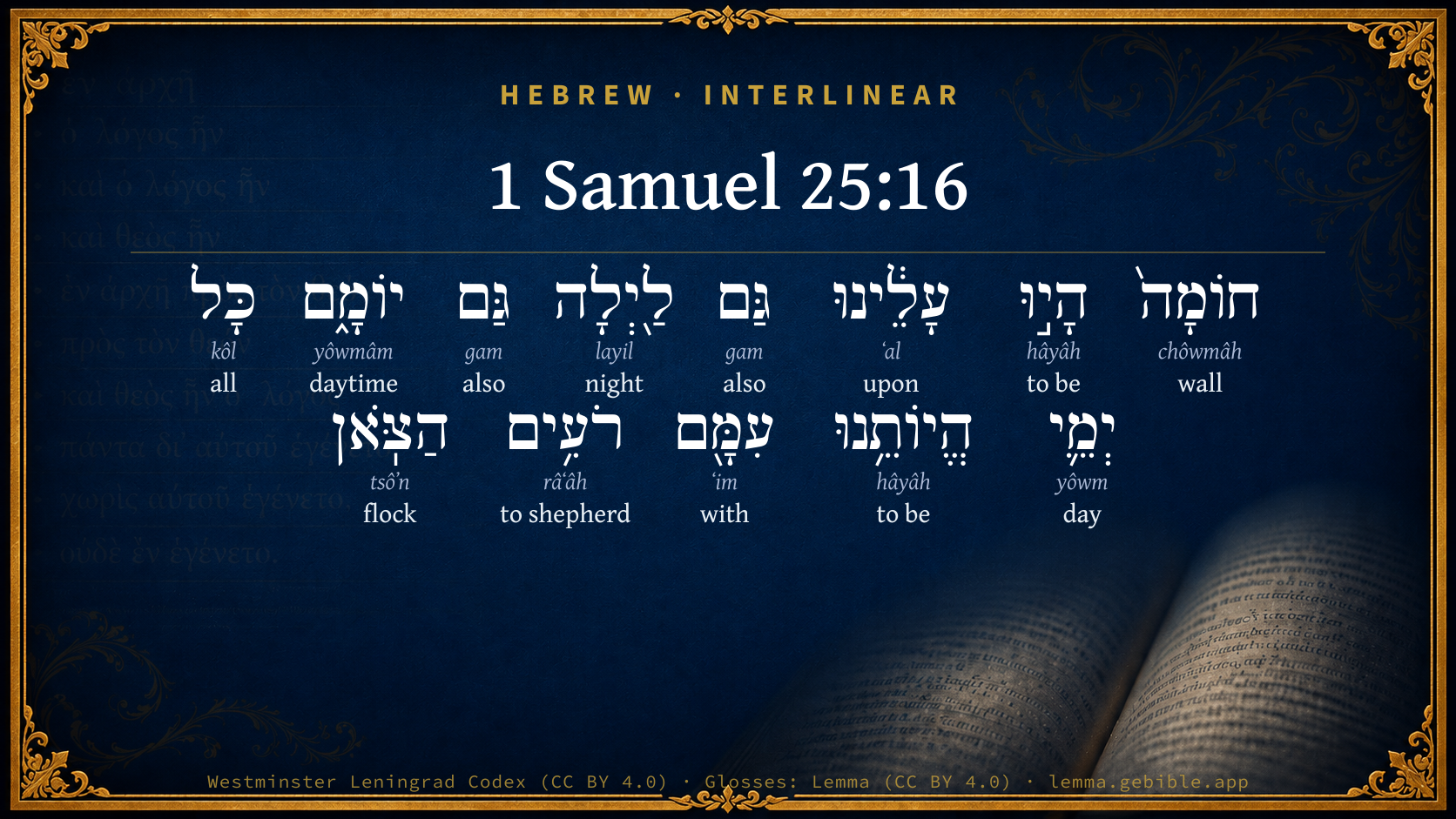
Hebrew (Westminster Leningrad Codex) 1 Samuel 25:16 appears in the Hebrew Old Testament. The text above is from the Westminster Leningrad Codex. Each word links to its Strong’s number, a concise gloss, and parsing drawn from the Open Scriptures Hebrew Bible morphology. Click any word for its full Brown-Driver-Briggs (BDB) entry.
Download image
Cite this verse

1 Samuel 25:16 (World English Bible). Public Domain. Lemma interlinear Bible study tool, https://lemma.gebible.app/v/1-samuel/25/16.

Show BibTeX & RIS
BibTeX
RIS
English Translation
they were a wall to us both by night and by day, all the while we were with them keeping the sheep.
World English Bible · Public Domain
Download a study sheet

One document with this verse’s original text, its word-by-word gloss line, the meaning frame, cross-references with their text, attributed commentary, and full source and license credits — printable, and it pastes into notes with its structure intact.

This verse Autodidact and up

Study sheet (.html) Plain text (.txt)

A passage Seminary Student

Up to 50 verses in one chapter. A passage sheet keeps up to 6 commentary sources and 12 cross-references per verse, in the order this page ranks them, and says so on the sheet whenever that leaves anything out. Ask for a single verse and you get the Autodidact verse sheet above.

Everything on this page stays free to read, with no account — the sheet is a download of what is already on screen, not access to it.

Want to remove ads? Support Godless Engineer
Compare translations 3

The same verse in 3 English versions, stacked beneath the original-language interlinear above. Click any original word for its lexicon entry.

Each is an independent rendering of the whole verse — the interlinear is not word-aligned to these translations.

Highlighted words mark where these versions differ — a whole-verse word diff, not a word-by-word alignment.

  • World English Bible Public Domain
    they were a wall to us both by night and by day, all the while we were with them keeping the sheep.
  • King James Version Public Domain
    They were a wall unto us both by night and day, all the while we were with them keeping the sheep.
  • unfoldingWord Literal Text CC BY-SA 4.0
    They were a wall for us both night and day, all of the days of our being with them, tending the sheep.

unfoldingWord Literal Text — © unfoldingWord, licensed CC BY-SA 4.0. Word-aligned USFM3 via Door43 (git.door43.org/unfoldingWord/en_ult).

Versions to compare (up to 4)

3 of 4 selected

Show all 18 translations

Every available English version of this verse, each an independent rendering of the whole verse.

  • World English Bible Public Domain
    they were a wall to us both by night and by day, all the while we were with them keeping the sheep.
  • Berean Standard Bible Public Domain
    They were a wall around us, both day and night, the whole time we were herding our sheep near them.
  • Majority Standard Bible Public Domain
    They were a wall around us, both day and night, the whole time we were herding our sheep near them.
  • King James Version Public Domain
    They were a wall unto us both by night and day, all the while we were with them keeping the sheep.
  • American Standard Version (1901) Public Domain
    they were a wall unto us both by night and by day, all the while we were with them keeping the sheep.
  • Revised Version (1885) Public Domain
    they were a wall unto us both by night and by day, all the while we were with them keeping the sheep.
  • Geneva Bible (1599) Public Domain
    They were as a wall vnto vs both by night and by day, all the while we were with them keeping sheepe.
  • Douay-Rheims (1899) Public Domain
    They were a wall unto us both by night and day, all the while we were with them keeping the sheep.
  • Young's Literal Translation Public Domain
    a wall they have been unto us both by night and by day, all the days of our being with them, feeding the flock.
  • Literal Standard Version CC BY-SA 4.0
    they have been a wall to us both by night and by day, all the days of our being with them, feeding the flock.
  • Unlocked Literal Bible CC BY-SA 4.0
    They were a wall to us both day and night, all the while we were with them tending the sheep.
  • unfoldingWord Literal Text CC BY-SA 4.0
    They were a wall for us both night and day, all of the days of our being with them, tending the sheep.
  • Darby Bible Public Domain
    They were a wall to us both by night and day, all the while we were with them feeding the sheep.
  • World Messianic Bible Public Domain
    They were a wall to us both by night and by day, all the while we were with them keeping the sheep.
  • Webster's Bible Public Domain
    They were a wall to us both by night and day, all the while we were with them keeping the sheep.
  • Free Bible Version CC BY-SA 4.0
    They were like a protective wall to us, both day and night, during the whole time we were with them looking after the sheep.
  • Bible in Basic English Public Domain
    But day and night they were like a wall round us while we were with them, looking after the sheep.
  • JPS Tanakh (1917) Public Domain
    they were a wall unto us both by night and by day, all the while we were with them keeping the sheep.

Literal Standard Version (2020), Covenant Press — licensed CC BY-SA 4.0. Text via the HelloAO Bible API (eBible.org). Unlocked Literal Bible (unfoldingWord) — licensed CC BY-SA 4.0. Text via the HelloAO Bible API (eBible.org). unfoldingWord Literal Text — © unfoldingWord, licensed CC BY-SA 4.0. Word-aligned USFM3 via Door43 (git.door43.org/unfoldingWord/en_ult). Free Bible Version, Dr. Jonathan Gallagher — licensed CC BY-SA 4.0. Text via the HelloAO Bible API (eBible.org).

Word by word

More ways to search: Search by grammar → Find every occurrence → Compare this word →

Practice this passage: Drill this verse → Learn its vocabulary →

יוֹמָ֑ם
yôwmâm
H3119
“daytime”
Adverb
Part of Speech
Adverb
Full BDB Definition

Origin: from H3117

TWOT: 852a

by day, in the daytime (adverb) - daytime (substantive)
  1. חוֹמָה֙ chôwmâh H2346 “wall” Noun, Common, Feminine, Singular, Absolute
  2. הָי֣וּ hâyâh H1961 “to be” Verb, Qal, Perfect, 3rd Person, Common, Plural
  3. עָלֵ֔ינוּ ʻal H5921 “upon · us” Preposition + Suffix, Personal, 1st Person, Common, Plural
  4. גַּם gam H1571 “also” Particle, Accusative
  5. לַ֖יְלָה layil H3915 “night” Noun, Common, Masculine, Singular, Absolute
  6. גַּם gam H1571 “also” Particle, Accusative
  7. כָּל kôl H3605 “all of” Noun, Common, Masculine, Singular, Construct
  8. יְמֵ֛י yôwm H3117 “days of” Noun, Common, Masculine, Plural, Construct
  9. הֱיוֹתֵ֥נוּ hâyâh H1961 “to be · us” Verb, Qal, Infinitive Construct + Suffix, Personal, 1st Person, Common, Plural
  10. עִמָּ֖ם ʻim H5973 “with · them” Preposition + Suffix, Personal, 3rd Person, Masculine, Plural
  11. רֹעִ֥ים râʻâh H7462 “shepherding” Verb, Qal, Participle Active, Masculine, Plural, Absolute
  12. הַצֹּֽאן tsôʼn H6629 “the · flock” Particle, Definite Article + Noun, Common, Both, Singular, Absolute

About this verse

These counts appear in no published source. They are computed here, from the morphology-tagged text and Lemma’s own curated glosses. What Lemma adds →

13
words
11
distinct lemmas
Historical
section

Shared distinctive vocabulary

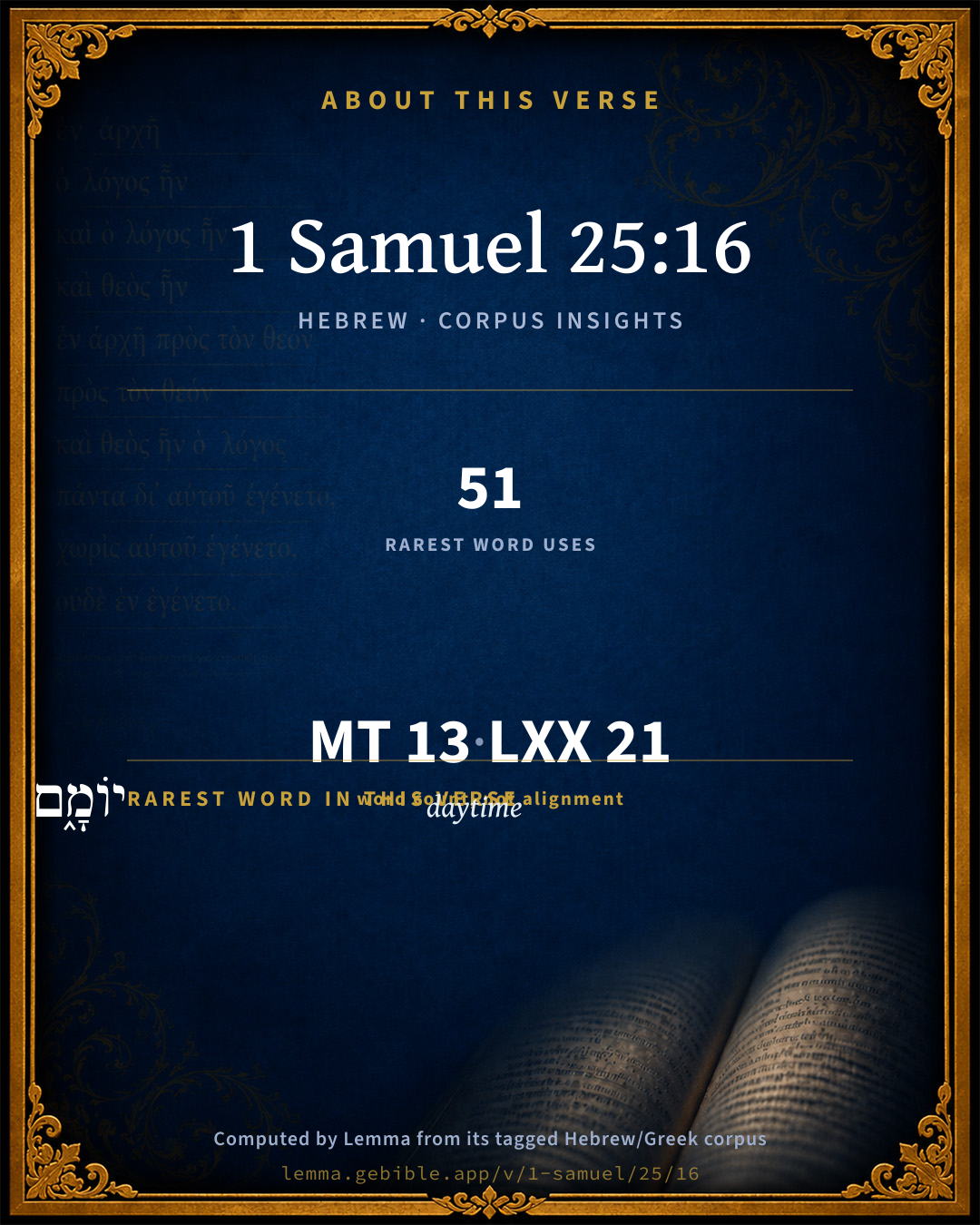
יוֹמָ֑ם daytime H3119 occurs in 50 verses of the Hebrew Bible. Also found in:

Grammatical profile

  • 3 verbs
  • 5 nouns
  • 2 prepositions
  • 1 adverb
  • 2 particles

Verb forms

  • הָי֣וּ Qal · Perfect
  • הֱיוֹתֵ֥נוּ Qal · Infinitive Construct
  • רֹעִ֥ים Qal · Participle Active

Repetition

Words recur within this verse — often emphatic in Hebrew:

  • הָי֣וּ to be H1961 ×2
  • גַּם also H1571 ×2

Hebrew & Septuagint length

In English translation the verse runs 22 words from the Hebrew and 32 from the Septuagint (LXX English) — the Septuagint runs noticeably longer here. See the side-by-side →

A rough comparison of the two English renderings, which tokenize alike — not a word-level alignment.

Word counts can differ between the Hebrew and the Greek without any difference in meaning — e.g. the Hebrew direct-object marker אֵת has no separate Greek word, and Greek often adds the article ὁ.

In the original languages it is 13 Hebrew tokens and 21 Greek tokens — but the two are counted differently (Hebrew bundles its prefixes and suffixes into one token; the Greek is in lemma form), so that isn’t a like-for-like length.

Cross-references

4

Topical passages linked to 1 Samuel 25:16 in the Treasury of Scripture Knowledge — connected by theme and wording, ordered by reader-vote popularity; previews shown in the World English Bible.

  • Job 1:10 Haven't you made a hedge around him, and around his house, and around all that he has, on every side? You have blessed the work of his hands, and his substance is increased in the land.
  • Exodus 14:22 The children of Israel went into the midst of the sea on the dry ground, and the waters were a wall to them on their right hand, and on their left.
  • Zechariah 2:5 For I,' says Yahweh, 'will be to her a wall of fire around it, and I will be the glory in the midst of her.
  • Jeremiah 15:20 I will make you to this people a fortified brazen wall; and they shall fight against you, but they shall not prevail against you; for I am with you to save you and to deliver you, says Yahweh.

Cross-references courtesy of OpenBible.info (CC BY 4.0).

Hebrew and Greek witnesses Masoretic Hebrew ↔ Greek Septuagint

The same verse in the two great witnesses to the Old Testament, shown verse-for-verse.

Here the Septuagint runs noticeably longer than the Hebrew — LXX2012 (modern English Septuagint) 32 words vs World English Bible 22. A rough length comparison of the two English translations, not a word-level alignment — read both below.

These are two independent witnesses, not word-aligned to each other, and the Septuagint is shown in lemma (dictionary) form.

Hebrew 1 Samuel 25:16 Masoretic · Westminster Leningrad Codex

חוֹמָה֙ הָי֣וּ עָלֵ֔ינוּ גַּם לַ֖יְלָה גַּם יוֹמָ֑ם כָּל יְמֵ֛י הֱיוֹתֵ֥נוּ עִמָּ֖ם רֹעִ֥ים הַצֹּֽאן

they were a wall to us both by night and by day, all the while we were with them keeping the sheep.

World English Bible · Public Domain

Greek LXX 1 Samuel 25:16 Septuagint · lemma form

ὡς τεῖχος εἰμί περί ἐγώ καί ὁ νύξ καί ὁ ἡμέρα πᾶς ὁ ἡμέρα ὅς εἰμί παρά αὐτός ποιμαίνω ὁ ποίμνιον

And when we were in the field, they were as a wall round about us, both by night and by day, all the days that we were with them feeding the flock.

LXX2012 (modern English Septuagint) · Public Domain

Hebrew: Westminster Leningrad Codex (CC BY 4.0). Greek: Septuagint (public domain); English from LXX2012 (modern English Septuagint) (Public Domain). How the Septuagint differs from the Hebrew →

Targum (Aramaic paraphrase)

1

The Targum is the ancient Jewish Aramaic paraphrase of the Hebrew Scriptures — an interpretive translation, not the Hebrew text itself. Onkelos (literal) and Pseudo-Jonathan (expansive) render the Torah, and Jonathan the Prophets. Coverage is partial: where no permissively-licensed English translation exists for a verse, only the Aramaic is shown. This is verse-level text, not a word-by-word alignment to the Hebrew.

  1. Targum Jonathan Prophets (Joshua–Malachi)
    שׁוּר מַקַף הֲווֹ עִלָנָא אַף בְּלֵילֵי אַף בִּימָם כָּל יוֹמִין דַהֲוֵינָא עִמְהוֹן רָעָן עָנָא:

    (no public-domain English translation for this verse)

    Targum Jonathan — Aramaic: “Mikraot Gedolot” (public domain). English: “Sefaria Community Translation” (CC0 1.0 (public-domain dedication)); “London "Chaldee Paraphrase," 1871” (public domain). Text via Sefaria.

Commentary

Notes on 1 Samuel 25:16 from classic Christian and Jewish commentators (each source and its license shown beneath its notes). The classic Christian expositions comment on the surrounding passage and are grouped to its opening verse, so a note may address several verses; the Jewish commentaries on the Tanakh (Rashi and others) are per-verse, so they appear only where the commentator wrote on this verse.

Lemma curates 59 commentaries, every one of them public domain or Creative Commons licensed, each selected and text-cleaned for this edition rather than reprinted as found. About our sources →

Trapp's Complete Commentary

John Trapp

1Sa 25:16 They were a wall unto us both by night and day, all the while we were with them keeping the sheep.

Ver. 16. They were a wall unto us.] A guard against unreasonable men and wild beasts; and therefore we owe them maintenance.

John Trapp, A Commentary or Exposition upon All the Books of the Old and New Testament (1647–1656) — public domain. Text from a community e-Sword module.

The Cambridge Bible for Schools and Colleges

gen. ed. J. J. S. Perowne

16. a wall unto us] A defence against the predatory tribes of the desert. See Job_1:15; Job_1:17.

The Cambridge Bible for Schools and Colleges (gen. ed. J. J. S. Perowne; Cambridge University Press, 1878–1918) — public domain. Text from a community e-Sword module.

John Gill's Exposition

They were a wall unto us both by night and day,.... Protecting and defending them against the Philistines, who, as they robbed the threshing floors of Keilah, would have plundered the flocks of Nabal; or it may be rather against the incursions of the Arabs in the wilderness of Paran, the posterity of Ishmael, who lived by plunder, and against the wild beasts of the desert, who otherwise would have carried off many of their sheep and lambs, by night or by day:

all the while we were with them keeping the sheep; all which showed how reasonable it was that Nabal should have used them well, and given them a portion of his entertainment at his sheep shearing; for had it not been for them, he would not have had so many sheep to shear as he had.

John Gill's Exposition of the Whole Bible (1746–1763) — public domain (CC PDM 1.0). Text via the HelloAO Bible API.

Albert Barnes' Notes on the Bible

A wall - To protect them from the attacks of the Bedouins, etc. They had been as safe with David’s men around them as if they had been dwelling in a walled town.

Albert Barnes' Notes on the Bible (1834–1885) — public domain. Text from a community e-Sword/MySword module.

Matthew Poole's English Annotations

A wall, i.e. a defence against wild beasts, and robbers, and enemies.

Matthew Poole's English Annotations on the Holy Bible (1683–1685) — public domain. Text from a community e-Sword/MySword module.

Whedon's Commentary on the Bible

Daniel D. Whedon

16. A wall unto us both by night and day — This shows that David used his men not for purposes of plunder, but for the protection of the helpless. The son of Jesse therefore had a just claim on Nabal for the services he had rendered him.

Daniel D. Whedon (gen. ed.), Commentary on the Old and New Testaments (1874–1909) — public domain. Text from a community e-Sword module.

unfoldingWord translationNotes

Door43 World Missions Community

They were a wall

David's men were like a wall around a city that protects the people in the city from their enemies. (See: Metaphor)

evil is plotted against our master

The speaker is careful not to name the one plotting the evil. This can be translated in active form. AT: "someone is plotting to do evil things to our master" (See: Active or Passive)

our master

The speaker speaks of David as if David were another person to show that he respects David. AT: "you" (See: Pronouns)

translationWords

evil

lord

house

unfoldingWord translationNotes — © Distant Shores Media and the Door43 World Missions Community, licensed CC BY-SA 4.0. Source: git.door43.org/Door43/en_tn.

Lesson kit

Teaching starters — assembled from the data on this page, not authored interpretation. Every prompt links to the verse data it draws on. Edit before teaching.

1 Samuel, in the Historical, opens this verse with 13 words (11 distinct Hebrew lemmas). Its most distinctive word is yôwmâm (“daytime”). The Greek Septuagint runs longer here. A historical commentator’s framing appears above. Read the whole chapter for the surrounding context.

Discussion questions

  1. How does “daytime” (yôwmâm) shape what this verse is saying?
  2. Exodus 13:21 shares the word «daytime» with this verse. How do the two illuminate each other?
  3. “to be” occurs 2× in this one verse. What is the effect of the repetition?
  4. Compared with the Hebrew, the Septuagint runs longer here. What questions does that raise?
  5. The translations on this page render this verse differently — a whole-verse word diff, not a word-by-word alignment. What might account for the different wordings?
  6. The verb «הָי֣וּ» is Qal Perfect. How does its form color the action?
  7. Reading how Trapp's Complete Commentary and The Cambridge Bible for Schools and Colleges read this verse, where do the two commentators agree and where do they part?

Things to notice

Reading settings

Reading text

Shown beneath each verse's original-language words.

Old Testament
Old Testament edition

Read the OT as the Masoretic Hebrew (MT) or the Greek Septuagint (LXX).

English shown for the Greek Septuagint (in the Hebrew ↔ Greek comparison).

Comparing translations? Open the Compare panel on any verse page to stack up to four side by side.