
1 Kings 8:63

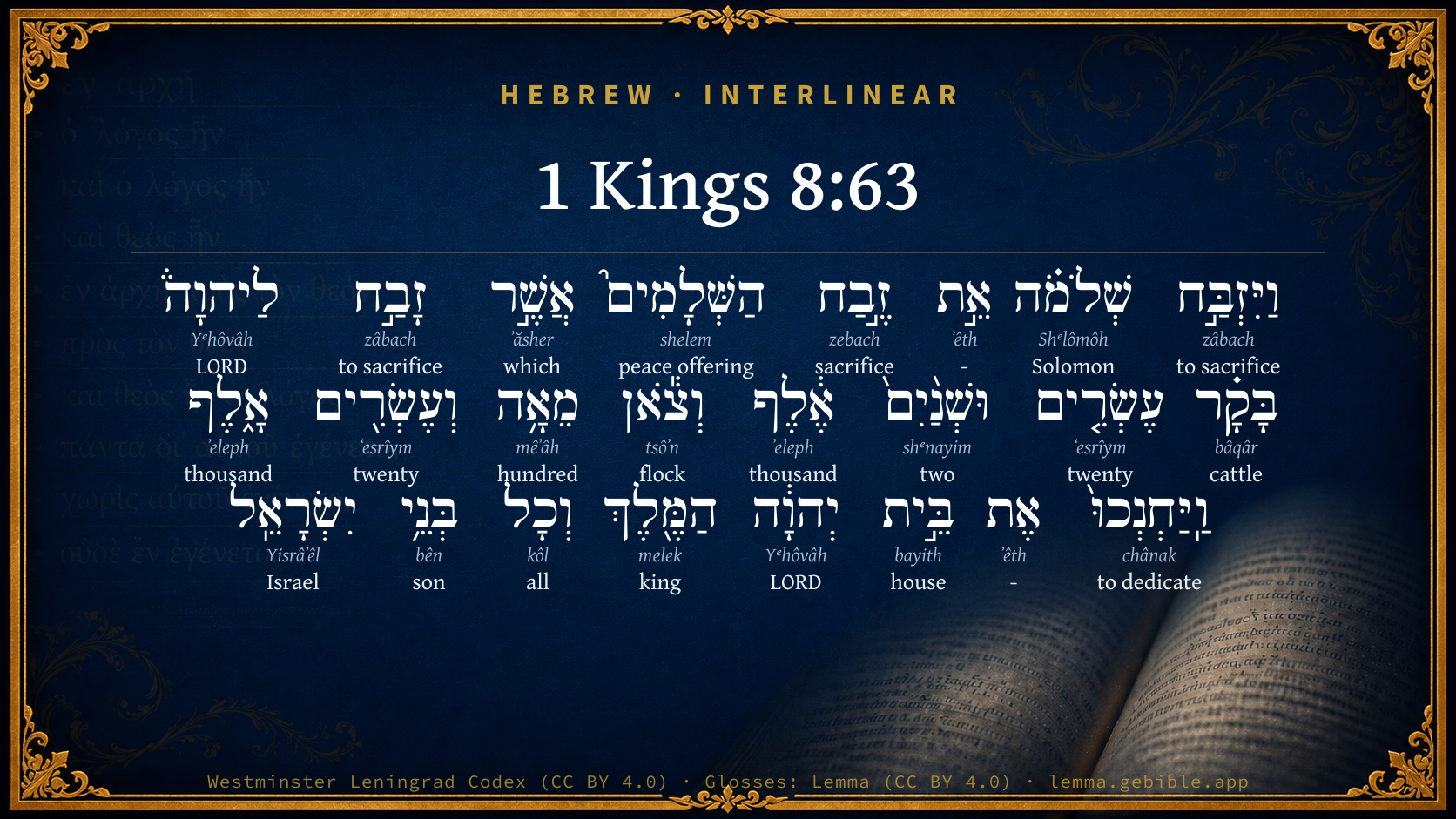
Hebrew (Westminster Leningrad Codex) 1 Kings 8:63 appears in the Hebrew Old Testament. The text above is from the Westminster Leningrad Codex. Each word links to its Strong’s number, a concise gloss, and parsing drawn from the Open Scriptures Hebrew Bible morphology. Click any word for its full Brown-Driver-Briggs (BDB) entry.
Download image
Cite this verse

1 Kings 8:63 (World English Bible). Public Domain. Lemma interlinear Bible study tool, https://lemma.gebible.app/v/1-kings/8/63.

Show BibTeX & RIS
BibTeX
RIS
English Translation
Solomon offered for the sacrifice of peace-offerings, which he offered to Yahweh, two and twenty thousand oxen, and one hundred twenty thousand sheep. So the king and all the children of Israel dedicated the house of Yahweh.
World English Bible · Public Domain
Download a study sheet

One document with this verse’s original text, its word-by-word gloss line, the meaning frame, cross-references with their text, attributed commentary, and full source and license credits — printable, and it pastes into notes with its structure intact.

This verse Autodidact and up

Study sheet (.html) Plain text (.txt)

A passage Seminary Student

Up to 50 verses in one chapter. A passage sheet keeps up to 6 commentary sources and 12 cross-references per verse, in the order this page ranks them, and says so on the sheet whenever that leaves anything out. Ask for a single verse and you get the Autodidact verse sheet above.

Everything on this page stays free to read, with no account — the sheet is a download of what is already on screen, not access to it.

Want to remove ads? Support Godless Engineer
Compare translations 3

The same verse in 3 English versions, stacked beneath the original-language interlinear above. Click any original word for its lexicon entry.

Each is an independent rendering of the whole verse — the interlinear is not word-aligned to these translations.

Highlighted words mark where these versions differ — a whole-verse word diff, not a word-by-word alignment.

  • World English Bible Public Domain
    Solomon offered for the sacrifice of peace-offerings, which he offered to Yahweh, two and twenty thousand oxen, and one hundred twenty thousand sheep. So the king and all the children of Israel dedicated the house of Yahweh.
  • King James Version Public Domain
    And Solomon offered a sacrifice of peace offerings, which he offered unto the LORD, two and twenty thousand oxen, and an hundred and twenty thousand sheep. So the king and all the children of Israel dedicated the house of the LORD.
  • unfoldingWord Literal Text CC BY-SA 4.0
    And Solomon sacrificed a sacrifice of peace offerings that he sacrificed to Yahweh, 22, 000 cattle and 120, 000 sheep. And the king and all of the sons of Israel dedicated the house of Yahweh.

unfoldingWord Literal Text — © unfoldingWord, licensed CC BY-SA 4.0. Word-aligned USFM3 via Door43 (git.door43.org/unfoldingWord/en_ult).

Versions to compare (up to 4)

3 of 4 selected

Show all 18 translations

Every available English version of this verse, each an independent rendering of the whole verse.

  • World English Bible Public Domain
    Solomon offered for the sacrifice of peace-offerings, which he offered to Yahweh, two and twenty thousand oxen, and one hundred twenty thousand sheep. So the king and all the children of Israel dedicated the house of Yahweh.
  • Berean Standard Bible Public Domain
    And Solomon offered as peace offerings to the LORD 22,000 oxen and 120,000 sheep. So the king and all the Israelites dedicated the house of the LORD.
  • Majority Standard Bible Public Domain
    And Solomon offered as peace offerings to the LORD 22,000 oxen and 120,000 sheep. So the king and all the Israelites dedicated the house of the LORD.
  • King James Version Public Domain
    And Solomon offered a sacrifice of peace offerings, which he offered unto the LORD, two and twenty thousand oxen, and an hundred and twenty thousand sheep. So the king and all the children of Israel dedicated the house of the LORD.
  • American Standard Version (1901) Public Domain
    And Solomon offered for the sacrifice of peace-offerings, which he offered unto Jehovah, two and twenty thousand oxen, and a hundred and twenty thousand sheep. So the king and all the children of Israel dedicated the house of Jehovah.
  • Revised Version (1885) Public Domain
    And Solomon offered for the sacrifice of peace offerings, which he offered unto the LORD, two and twenty thousand oxen, and an hundred and twenty thousand sheep. So the king and all the children of Israel dedicated the house of the LORD.
  • Geneva Bible (1599) Public Domain
    And Salomon offered a sacrifice of peace offrings which he offered vnto the Lord, to wit, two and twentie thousande beeues, and an hundreth and twentie thousande sheepe: so the king and all the children of Israel dedicated the house of the Lord.
  • Douay-Rheims (1899) Public Domain
    And Solomon slew victims of peace offerings, which he sacrificed to the Lord, two and twenty thousand oxen, and hundred and twenty thousand sheep: so the king, and the children of Israel dedicated the temple of the Lord.
  • Young's Literal Translation Public Domain
    and Solomon sacrificeth the sacrifice of peace-offerings, which he hath sacrificed to Jehovah, oxen, twenty and two thousand, and sheep, a hundred and twenty thousand; and the king and all the sons of Israel dedicate the house of Jehovah.
  • Literal Standard Version CC BY-SA 4.0
    and Solomon sacrifices the sacrifice of peace-offerings, which he has sacrificed to YHWH: twenty-two thousand oxen and one hundred and twenty thousand sheep; and the king and all the sons of Israel dedicate the house of YHWH.
  • Unlocked Literal Bible CC BY-SA 4.0
    Solomon offered a sacrifice of fellowship offerings to Yahweh: twenty-two thousand oxen and 120,000 sheep. So the king and all the people of Israel dedicated the house of Yahweh.
  • unfoldingWord Literal Text CC BY-SA 4.0
    And Solomon sacrificed a sacrifice of peace offerings that he sacrificed to Yahweh, 22, 000 cattle and 120, 000 sheep. And the king and all of the sons of Israel dedicated the house of Yahweh.
  • Darby Bible Public Domain
    And Solomon sacrificed a sacrifice of peace-offerings, which he sacrificed to Jehovah, twenty-two thousand oxen and a hundred and twenty thousand sheep. So the king and all the children of Israel dedicated the house of Jehovah.
  • World Messianic Bible Public Domain
    Solomon offered for the sacrifice of peace offerings, which he offered to the LORD, twenty two thousand head of cattle and one hundred twenty thousand sheep. So the king and all the children of Israel dedicated the LORD’s house.
  • Webster's Bible Public Domain
    And Solomon offered a sacrifice of peace-offerings, which he offered to the LORD, two and twenty thousand oxen, and a hundred and twenty thousand sheep. So the king and all the children of Israel dedicated the house of the LORD.
  • Free Bible Version CC BY-SA 4.0
    Solomon presented as friendship offerings to the Lord 22,000 bulls and 120,000 sheep. In this way the king and all the people of Israel dedicated the Lord's Temple.
  • Bible in Basic English Public Domain
    And Solomon gave to the Lord for peace-offerings, twenty-two thousand oxen and a hundred and twenty thousand sheep. So the king and all the children of Israel kept the feast of the opening of the Lord's house.
  • JPS Tanakh (1917) Public Domain
    And Solomon offered for the sacrifice of peace-offerings, which he offered unto the LORD, two and twenty thousand oxen, and a hundred and twenty thousand sheep. So the king and all the children of Israel dedicated the house of the LORD.

Literal Standard Version (2020), Covenant Press — licensed CC BY-SA 4.0. Text via the HelloAO Bible API (eBible.org). Unlocked Literal Bible (unfoldingWord) — licensed CC BY-SA 4.0. Text via the HelloAO Bible API (eBible.org). unfoldingWord Literal Text — © unfoldingWord, licensed CC BY-SA 4.0. Word-aligned USFM3 via Door43 (git.door43.org/unfoldingWord/en_ult). Free Bible Version, Dr. Jonathan Gallagher — licensed CC BY-SA 4.0. Text via the HelloAO Bible API (eBible.org).

Word by word

More ways to search: Search by grammar → Find every occurrence → Compare this word →

Practice this passage: Drill this verse → Learn its vocabulary →

וַֽיַּחְנְכוּ֙
chânak
H2596
“and · to dedicate”
Conjunction + Verb, Qal, Sequential Imperfect, 3rd Person, Masculine, Plural
Part of Speech
Conjunction + Verb
Stem
Qal
Form
Sequential Imperfect
Person
3rd Person
Gender
Masculine
Number
Plural
Full BDB Definition

Origin: a primitive root

TWOT: TWOT- 693

to train, dedicate, inaugurate - (Qal) - to train, train up - to dedicate
  1. וַיִּזְבַּ֣ח zâbach H2076 “and · to sacrifice” Conjunction + Verb, Qal, Sequential Imperfect, 3rd Person, Masculine, Singular
  2. שְׁלֹמֹ֗ה Shᵉlômôh H8010 “Solomon” Noun, Proper
  3. אֵ֣ת ʼêth H853 “-” Particle, Direct Object
  4. זֶ֣בַח zebach H2077 “sacrifice of” Noun, Common, Masculine, Singular, Construct
  5. הַשְּׁלָמִים֮ shelem H8002 “the · peace offerings” Particle, Definite Article + Noun, Common, Masculine, Plural, Absolute
  6. אֲשֶׁ֣ר ʼăsher H834 “which” Particle, Relative
  7. זָבַ֣ח zâbach H2076 “to sacrifice” Verb, Qal, Perfect, 3rd Person, Masculine, Singular
  8. לַיהוָה֒ Yᵉhôvâh H3068 “to/for · LORD” Preposition + Noun, Proper
  9. בָּקָ֗ר bâqâr H1241 “cattle” Noun, Common, Both, Singular, Absolute
  10. עֶשְׂרִ֤ים ʻesrîym H6242 “twenty” Adjective, Cardinal number, Both, Plural, Absolute
  11. וּשְׁנַ֨יִם֙ shᵉnayim H8147 “and · two” Conjunction + Adjective, Cardinal number, Masculine, Dual, Absolute
  12. אֶ֔לֶף ʼeleph H505 “thousand” Adjective, Cardinal number, Both, Singular, Absolute
  13. וְצֹ֕אן tsôʼn H6629 “and · flock” Conjunction + Noun, Common, Both, Singular, Absolute
  14. מֵאָ֥ה mêʼâh H3967 “hundred” Adjective, Cardinal number, Both, Singular, Absolute
  15. וְעֶשְׂרִ֖ים ʻesrîym H6242 “and · twenty” Conjunction + Adjective, Cardinal number, Both, Plural, Absolute
  16. אָ֑לֶף ʼeleph H505 “thousand” Adjective, Cardinal number, Both, Singular, Absolute
  17. אֶת ʼêth H853 “-” Particle, Direct Object
  18. בֵּ֣ית bayith H1004 “house of” Noun, Common, Masculine, Singular, Construct
  19. יְהוָ֔ה Yᵉhôvâh H3068 “LORD” Noun, Proper
  20. הַמֶּ֖לֶךְ melek H4428 “the · king” Particle, Definite Article + Noun, Common, Masculine, Singular, Absolute
  21. וְכָל kôl H3605 “and · all of” Conjunction + Noun, Common, Masculine, Singular, Construct
  22. בְּנֵ֥י bên H1121 “sons of” Noun, Common, Masculine, Plural, Construct
  23. יִשְׂרָאֵֽל Yisrâʼêl H3478 “Israel” Noun, Proper

About this verse

These counts appear in no published source. They are computed here, from the morphology-tagged text and Lemma’s own curated glosses. What Lemma adds →

24
words
19
distinct lemmas
Historical
section

Notable vocabulary

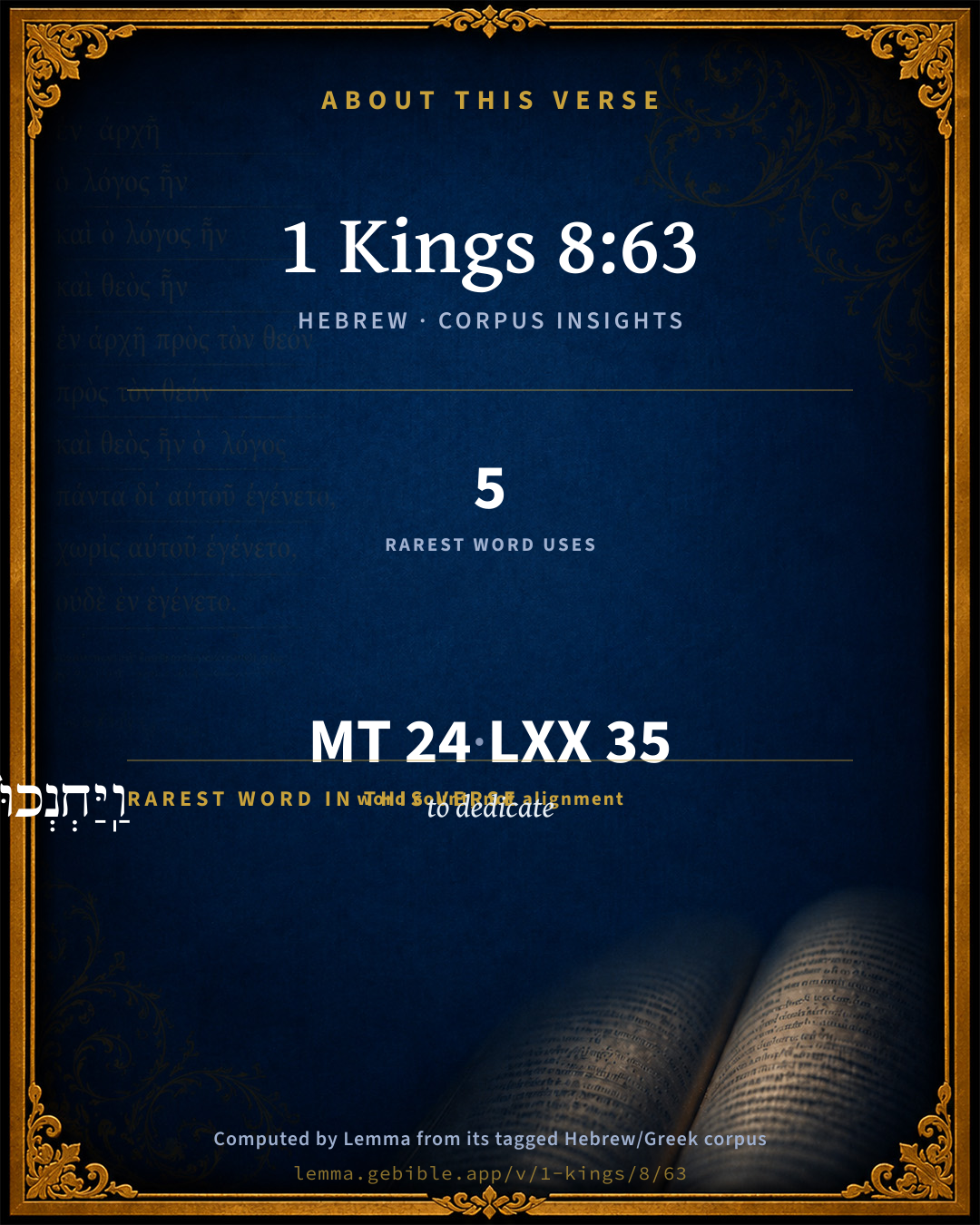
The rarest word here is וַֽיַּחְנְכוּ֙ to dedicate H2596 — appearing just 5 times in the whole Hebrew Bible.

Shared distinctive vocabulary

וַֽיַּחְנְכוּ֙ to dedicate H2596 occurs in 4 verses of the Hebrew Bible. Also found in:

Grammatical profile

  • 3 verbs
  • 12 nouns
  • 6 adjectives
  • 3 particles

Verb forms

  • וַיִּזְבַּ֣ח Qal · Sequential Imperfect
  • זָבַ֣ח Qal · Perfect
  • וַֽיַּחְנְכוּ֙ Qal · Sequential Imperfect

Repetition

Words recur within this verse — often emphatic in Hebrew:

  • וַיִּזְבַּ֣ח to sacrifice H2076 ×2
  • לַיהוָה֒ LORD H3068 ×2
  • עֶשְׂרִ֤ים twenty H6242 ×2
  • אֶ֔לֶף thousand H505 ×2

Hebrew & Septuagint length

In English translation the verse runs 37 words from the Hebrew and 41 from the Septuagint (LXX English) — closely comparable.

A rough comparison of the two English renderings, which tokenize alike — not a word-level alignment.

Word counts can differ between the Hebrew and the Greek without any difference in meaning — e.g. the Hebrew direct-object marker אֵת has no separate Greek word, and Greek often adds the article ὁ.

In the original languages it is 24 Hebrew tokens and 35 Greek tokens — but the two are counted differently (Hebrew bundles its prefixes and suffixes into one token; the Greek is in lemma form), so that isn’t a like-for-like length.

Cross-references

15

Topical passages linked to 1 Kings 8:63 in the Treasury of Scripture Knowledge — connected by theme and wording, ordered by reader-vote popularity; previews shown in the World English Bible.

  • Ezra 6:16–17 The children of Israel, the priests, and the Levites, and the rest of the children of the captivity, kept the dedication of this house of God with joy.
  • 2 Chronicles 15:11 They sacrificed to Yahweh in that day, of the spoil which they had brought, seven hundred oxen and seven thousand sheep.
  • Nehemiah 12:27 At the dedication of the wall of Jerusalem they sought the Levites out of all their places, to bring them to Jerusalem, to keep the dedication with gladness, both with giving thanks, and with singing, with cymbals, psalteries, and with harps.
  • Leviticus 3:1–17 "'If his offering is a sacrifice of peace offerings; if he offers it from the herd, whether male or female, he shall offer it without blemish before Yahweh.
  • Numbers 7:10–11 The princes gave offerings for the dedication of the altar in the day that it was anointed, even the princes gave their offerings before the altar.
  • Numbers 7:84–88 This was the dedication of the altar, on the day when it was anointed, by the princes of Israel: twelve silver platters, twelve silver bowls, twelve golden ladles;
  • 1 Chronicles 29:21 They sacrificed sacrifices to Yahweh, and offered burnt offerings to Yahweh, on the next day after that day, even one thousand bulls, one thousand rams, and one thousand lambs, with their drink-offerings, and sacrifices in abundance for all Israel,
  • 2 Chronicles 2:4 Behold, I am about to build a house for the name of Yahweh my God, to dedicate it to him, and to burn before him incense of sweet spices, and for the continual show bread, and for the burnt offerings morning and evening, on the Sabbaths, and on the new moons, and on the set feasts of Yahweh our God. This is [an ordinance] forever to Israel.
  • 2 Chronicles 7:5 King Solomon offered a sacrifice of twenty-two thousand oxen, and a hundred and twenty thousand sheep. So the king and all the people dedicated the house of God.
  • 2 Chronicles 29:32–35 The number of the burnt offerings which the assembly brought was seventy bulls, one hundred rams, and two hundred lambs: all these were for a burnt offering to Yahweh.
  • 2 Chronicles 30:24 For Hezekiah king of Judah did give to the assembly for offerings one thousand bulls and seven thousand sheep; and the princes gave to the assembly a thousand bulls and ten thousand sheep: and a great number of priests sanctified themselves.
  • 2 Chronicles 35:7–9 Josiah gave to the children of the people, of the flock, lambs and kids, all of them for the Passover offerings, to all who were present, to the number of thirty thousand, and three thousand bulls: these were of the king's substance.
  • Ezekiel 45:17 It shall be the prince's part to give the burnt offerings, and the meal-offerings, and the drink-offerings, in the feasts, and on the new moons, and on the Sabbaths, in all the appointed feasts of the house of Israel: he shall prepare the sin-offering, and the meal-offering, and the burnt offering, and the peace-offerings, to make atonement for the house of Israel.
  • Micah 6:7 Will Yahweh be pleased with thousands of rams? With tens of thousands of rivers of oil? Shall I give my firstborn for my disobedience? The fruit of my body for the sin of my soul?
  • John 10:22 It was the Feast of the Dedication at Jerusalem.

Cross-references courtesy of OpenBible.info (CC BY 4.0).

Hebrew and Greek witnesses Masoretic Hebrew ↔ Greek Septuagint

The same verse in the two great witnesses to the Old Testament, shown verse-for-verse.

These are two independent witnesses, not word-aligned to each other, and the Septuagint is shown in lemma (dictionary) form.

Hebrew 1 Kings 8:63 Masoretic · Westminster Leningrad Codex

וַיִּזְבַּ֣ח שְׁלֹמֹ֗ה אֵ֣ת זֶ֣בַח הַשְּׁלָמִים֮ אֲשֶׁ֣ר זָבַ֣ח לַיהוָה֒ בָּקָ֗ר עֶשְׂרִ֤ים וּשְׁנַ֨יִם֙ אֶ֔לֶף וְצֹ֕אן מֵאָ֥ה וְעֶשְׂרִ֖ים אָ֑לֶף וַֽיַּחְנְכוּ֙ אֶת בֵּ֣ית יְהוָ֔ה הַמֶּ֖לֶךְ וְכָל בְּנֵ֥י יִשְׂרָאֵֽל

Solomon offered for the sacrifice of peace-offerings, which he offered to Yahweh, two and twenty thousand oxen, and one hundred twenty thousand sheep. So the king and all the children of Israel dedicated the house of Yahweh.

World English Bible · Public Domain

Greek LXX 1 Kings 8:63 Septuagint · lemma form

καί θύω ὁ βασιλεύς σαλωμών ὁ θυσία ὁ εἰρηνικός ὅς θύω ὁ κύριος βοῦς δύο καί εἴκοσι χιλιάς καί πρόβατον ἑκατόν εἴκοσι χιλιάς καί ἐνκαινίζω ὁ οἶκος κύριος ὁ βασιλεύς καί πᾶς ὁ υἱός ἰσραήλ

And king Solomon offered for the sacrifices of peace-offering which he sacrificed to the Lord, two and twenty thousand oxen, one hundred and twenty thousand sheep: and the king and all the children of Israel dedicated the house of the Lord.

LXX2012 (modern English Septuagint) · Public Domain

Hebrew: Westminster Leningrad Codex (CC BY 4.0). Greek: Septuagint (public domain); English from LXX2012 (modern English Septuagint) (Public Domain). How the Septuagint differs from the Hebrew →

Targum (Aramaic paraphrase)

1

The Targum is the ancient Jewish Aramaic paraphrase of the Hebrew Scriptures — an interpretive translation, not the Hebrew text itself. Onkelos (literal) and Pseudo-Jonathan (expansive) render the Torah, and Jonathan the Prophets. Coverage is partial: where no permissively-licensed English translation exists for a verse, only the Aramaic is shown. This is verse-level text, not a word-by-word alignment to the Hebrew.

  1. Targum Jonathan Prophets (Joshua–Malachi)
    וּנְכַס שְׁלֹמֹה יַת נִכְסַת קוּדְשַׁיָא דִי נְכִיס קֳדָם יְיָ תּוֹרֵי תַּרְתֵּין רִבּוֹא וּתְרֵין אַלְפִין וַעֲנָא תַּרְתָּא עַסְרֵי רִבּוֹא וַחֲנִיכוּ יַת בֵּית מַקְדְשָׁא דַייָ מַלְכָּא וְכָל בְּנֵי יִשְׂרָאֵל:

    (no public-domain English translation for this verse)

    Targum Jonathan — Aramaic: “Mikraot Gedolot” (public domain). English: “Sefaria Community Translation” (CC0 1.0 (public-domain dedication)); “London "Chaldee Paraphrase," 1871” (public domain). Text via Sefaria.

Commentary

Notes on 1 Kings 8:63 from classic Christian and Jewish commentators (each source and its license shown beneath its notes). The classic Christian expositions comment on the surrounding passage and are grouped to its opening verse, so a note may address several verses; the Jewish commentaries on the Tanakh (Rashi and others) are per-verse, so they appear only where the commentator wrote on this verse.

Lemma curates 59 commentaries, every one of them public domain or Creative Commons licensed, each selected and text-cleaned for this edition rather than reprinted as found. About our sources →

Trapp's Complete Commentary

John Trapp

1Ki 8:63 And Solomon offered a sacrifice of peace offerings, which he offered unto the LORD, two and twenty thousand oxen, and an hundred and twenty thousand sheep. So the king and all the children of Israel dedicated the house of the LORD.

Ver. 63. And Solomon offered.] This was the greatest sacrifice that we anywhere read of. Those hypocrites in Mic 6:7 made an overture of great cost, so they might thereby have purchased a dispensation to live in sin. Lycurgus forbade costly sacrifices, lest men should grow weary of the charge, and give over their devotion.

John Trapp, A Commentary or Exposition upon All the Books of the Old and New Testament (1647–1656) — public domain. Text from a community e-Sword module.

Joseph Benson's Commentary

1Ki 8:63. And Solomon offered — By the hands of the priests, two and twenty thousand oxen, &c. — Not all in one day, but in seven, or, it may be, in the fourteen days mentioned 1Ki 8:65. So the king and all Israel dedicated the house of the Lord — Began to set it apart for the work and services of God by these sacrifices and holy exercises.

Joseph Benson's Commentary on the Old and New Testaments (1811–1818) — public domain. Text from a community e-Sword module.

Geneva Bible (1599)

Geneva Bible translators

Before the oracle where the Ark was.

Geneva Bible (1599) marginal notes — public domain. Text via Bolls.life.

Jamieson, Fausset & Brown

Robert Jamieson, A. R. Fausset & David Brown

So the king and all the children of Israel dedicated the house of the Lord--The dedication was not a ceremony ordained by the law, but it was done in accordance with the sentiments of reverence naturally associated with edifices appropriated to divine worship. [See on Ch2 7:5.]

Jamieson, Fausset & Brown — Commentary Critical and Explanatory on the Whole Bible (1871) — public domain (CC PDM 1.0). Text via the HelloAO Bible API.

Adam Clarke's Commentary

Verse 63. Two and twenty thousand oxen] This was the whole amount of the victims that had been offered during the fourteen days; i.e., the seven days of the dedication, and the seven days of the feast of tabernacles. In what way could they dispose of the blood of so many victims?

Adam Clarke's Commentary on the Bible (1810–1826) — public domain. Text from a community e-Sword/MySword module.

Ellicott's Commentary for English Readers

(63) And Solomon offered.—The number here given, enormous as it is, can hardly be supposed due to any error in the text; for it is exactly reproduced in the Chronicles and by Josephus. Much explanation of it has been wasted through misunderstanding of the real difficulty involved. It is comparatively easy to conceive how such a mass of victims could be brought as offerings or consumed, when we consider the vastness of the assembled multitude from the whole of the great dominions of Solomon, dwelling in or encamped about the city. Even at the Passovers of the last days of Jerusalem the multitude of worshippers seems to have been numbered by hundreds of thousands. The real difficulty is to conceive how, even through the fourteen days of the festival, and over the whole of the hallowed portion of the court, the victims could have been offered. But it is not unlikely that on such an occasion it might be deemed sufficient actually to sacrifice only certain representative victims of each hecatomb, and simply to dedicate the rest to the Lord, leaving them to be killed and eaten elsewhere.

This profusion of sacrifices, good as expressing the natural desire of all to offer at such a time, may perhaps have involved something of the idea, so frequent in heathen sacrifice, and so emphatically condemned by the prophets, that the Lord would be “pleased with thousands of rams and ten thousands of rivers of oil”—something also of that display of the magnificence of the king and his people, even in the very act of homage to God, which the history throughout seems to imply. If so, in these ideas lurked the evils which hereafter were to overthrow the prosperity of Israel, and make the Temple a heap of stones.

A Bible Commentary for English Readers, edited by Charles John Ellicott (1878–1897) — public domain. Text from a community e-Sword module.

The Cambridge Bible for Schools and Colleges

gen. ed. J. J. S. Perowne

62–66. The great sacrifice and festival (2Ch_7:4-11)

63. And Solomon offered a sacrifice of peace offerings] It is ordered in the Law (Lev_7:15) that the greatest part of such peace offerings shall be eaten at the time of the offering. The fat and certain internal portions of the victim are to be consumed in the fire on the altar, but all else is to go for food. This explains in part the enormous number of animals mentioned in this verse. Not only among the Jews, but among all ancient nations, sacrifices were feasts, sometimes on a very large scale. Homer supplies abundant instances. The dedication of the Temple was an event for which all who could come were sure to assemble, and for the support of such an enormous crowd for fourteen days (cf. 2Ch_7:8-9) the supply here mentioned need not be thought excessive. Great multitudes can assemble in Eastern climates, where the shelter of a roof at night is not a necessity, with less preparation, except for actual food, than is required in western lands. Josephus says “all the Hebrews feasted with their wives and children, moreover also the king celebrated the feast which is called the feast of Tabernacles grandly and magnificently before the Temple, feasting together with all the people.”

two and twenty thousand oxen] Contrary to his custom Josephus gives here a smaller number than that in the Hebrew text. He says twelve thousand oxen, but keeps the same number, one hundred and twenty thousand, for the sheep. Though it be said that the king offered this large sacrifice, we need not suppose that any great part of the offering was performed by him personally or in his presence. The next verse shows that provision was made for offering sacrifices in other places than on the brazen altar, viz. on temporary altars set up for the occasion.

The Cambridge Bible for Schools and Colleges (gen. ed. J. J. S. Perowne; Cambridge University Press, 1878–1918) — public domain. Text from a community e-Sword module.

John Gill's Exposition

On the eighth day he sent the people away,.... That is, of the feast of tabernacles, the eighth from the first of that, which was a solemn day, and fell on the twenty second of the month; at the close of which the dismission was made, or they had leave to go, but they did not until the twenty third, according to Ch2 7:10.

and they blessed the king; returned him thanks for his care, and charge, and pains, in building the temple; for prayers for them, and the feast he had now made, and wished all health and happiness to him:

and went unto their tents joyful and glad of heart; or to their cities, as the Targum, to their several habitations; being greatly delighted with what they had seen and heard, and partook of especially:

for all the goodness the Lord had done for David his servant, and for Israel his people; in Ch2 7:10, it is added, "unto Solomon"; for David, in giving him such a son and successor, who according to promise had built the house of the Lord; and for Solomon, in raising him up to such dignity, and enabling him to build such a temple for the worship of God and his glory; and for the people of Israel, in giving them such a king to rule over them, under whom they enjoyed so much peace and prosperity, and the full and free exercise of the true religion, with such accommodations, and in such a splendid manner as now.

Next: 1 Kings Chapter 9

John Gill's Exposition of the Whole Bible (1746–1763) — public domain (CC PDM 1.0). Text via the HelloAO Bible API.

Albert Barnes' Notes on the Bible

These numbers have been thought incredible, but they are not impossible. At least 100, 000, or 120, 000 men 1Ki 8:65 were assembled; and as they all offered sacrifice with the king 1Ki 8:62, the number of victims must have been enormous. Part of the flesh of so many victims would be eaten; but much of the meat may have been privately burned Lev 19:6, the object of the sacrifice being the glory of God, and not the convenience of the people. Profusion was a usual feature of the sacrifices of antiquity.

Albert Barnes' Notes on the Bible (1834–1885) — public domain. Text from a community e-Sword/MySword module.

Haydock's Catholic Bible Commentary

Sheep, and other small beasts, during the seven days, without counting the oblations of individuals. The law had not prescribed any particular rites for the dedication of places. But common sense dictated that sacred things should be distinguished from such as were common. Moses and David had set a pattern, which was followed by the Jews after the captivity, and by the Machabees, Exodus xl. 9., 1 Kings vi. 17., 1 Esdras iii. 10., and 1 Machabees iv. 56. (Calmet) --- The festival of the dedication was observed by our Saviour, John x. 22. (Haydock) --- Even private houses received a sort of dedication, Deuteronomy xx. 5. The pagans observed the like practice, with regard to statues and temples, lands and public places, Daniel iii. 1. Among the Romans, such ceremonies were performed by a general or consul, with his head covered, reciting some ancient prayers, at the suggestion of the pontiff, before a fire and an assembly of the people, called on purpose, while some person played upon the flute. (Cicero, pro Domo. Alex. Genial. vi. 14.)

George Leo Haydock (1774–1849), Haydock's Catholic Family Bible and Commentary, 1859 edition — public domain. Excludes Psalms (Douay-Rheims chapter numbering differs from Protestant) and Deuterocanonical books (Catholic canon only).

Matthew Poole's English Annotations

Solomon offered a sacrifice, by the hands of the priests.

A hundred and twenty thousand sheep; not all in one day, but in the seven, or, it may be, in the fourteen days, mentioned 1Ki 8:65. So, i.e. by these sacrifices and holy exercises.

Dedicated the house of the Lord, i.e. began to set it apart for the work and service of God.

Matthew Poole's English Annotations on the Holy Bible (1683–1685) — public domain. Text from a community e-Sword/MySword module.

Whedon's Commentary on the Bible

Daniel D. Whedon

63. Twenty thousand oxen — “If, besides the elders, heads of families and tribes, all Israel from the region of Hamath to the river of Egypt, in great assembly, appeared at this festival, there may have easily been one hundred thousand fathers, and twenty thousand elders, heads of families and tribes, assembled. Now if, on an average, every father offered only one sheep, every elder an ox, and the king, out of his abundance, two thousand oxen and two thousand sheep, the number of victims stated will not appear too great. Whether a man could consume all the flesh of these offerings at the festival or not is a matter of no consequence, as the law in this case commanded the burning of the remainder. Lev_7:17; Lev_19:6.” — Keil.

Daniel D. Whedon (gen. ed.), Commentary on the Old and New Testaments (1874–1909) — public domain. Text from a community e-Sword module.

The Pulpit Commentary

And Solomon offered a sacrifice Solomon is mentioned as chief donor, and as the executive. But others shared in the gift of peace offerings Lev_7:11 sqq. This was especially the sacrifice of praise it is called "the sacrifice of thanksgiving of his peace offerings," ib. vers. 13, 15. See Bahr, Symb. 2:368 sqq. In the peace offering, the fat was burnt on the altar, but the flesh was eaten (ver. 15; cf. Deu_12:7), so that this form of offering was, in every way, adapted to a festival. The idea that "ox after ox, to the number of 22, 000, and sheep after sheep, to the number of 120, 000, were consumed," sc. by fire (Stanley), is expressly excluded, which he offered unto the Lord, two and twenty thousand oxen, and a hundred and twenty thousand sheep. it is very possible that these numbers have been altered in course of transcription, as is the case with numbers elsewhere, but there is no ground for suspecting exaggeration or mistake. For, in the first place, the Chronicles and all the Versions agree with the text, and, secondly, the numbers, compared with what we know of the sacrifices offered on other occasions, are not unduly large, nor were they such that (as has been alleged) it would be impossible to offer them within the time specified. If, at an ordinary Passover a quarter of a million of lambs could be sacrificed within the space of two or three hours (Jos., Bell. Jud_1:6:9:8), there can obviously have been "no difficulty in sacrificing 3000 oxen and 18, 000 sheep on each of the seven days of the festival" (Keil). (But were not the sacrifices spread over fourteen days? ver. 65.) And it is to be remembered

(1) that "profusion was a usual feature of the sacrifices of antiquity Sacrifices of a thousand oxen (ciliombai) were not infrequent. According to an Arabian historian (Koto beddyn), the Caliph Moktader sacrificed during his pilgrimage to Mecca 40, 000 camels and cows and 50, 000 sheep. Tavernier speaks of 100, 000 victims as offered by the King of Tonquin" (Rawlinson, Stanley); and

(2) that the context insists on the ex traordinary number of victims. They were so numerous, we are told, that the brazen altar was quite inadequate to receive them (ver. 64). It has been already pointed out (note on ver. 62) that the people joined the king in the sacrifices. Indeed it is against not only ver. 62, but vers. 63, 65, to suppose that all the victims were offered by Solomon alone (Ewald, Stanley). If these numbers, therefore, include those offered by the people, we can the more readily understand them. For, by the lowest computation, there could hardly be less than 100, 000 heads of houses present at the feast (Bahr, Keil), and if the numbers of David"s census (2Sa_24:9) may be trusted, there may very well have been four or five times that number, and on such an occasion as that, an occasion altogether without precedent, every Israelite would doubtless offer his sacrifice of thanksgiving the more so as a large number of victims would be required for the purposes of the subsequent feast. And as to the impossibility of the priests offering so prodigious a number within the specified time (Thenius, al.), we have only to remember

(1) that if there were 38, 000 Levites (men over thirty years of age) in the time of David, (1Ch_23:3) or any thing like that number, there must have been at the very least at this period two or three thousand priests (Keil), and we can hardly think that at the dedication of so glorious a temple, in which they were so profoundly interested, many of them would be absent from Jerusalem. But if there were only one thousand present, that number would have been amply sufficient to perform all the priestly functions. For it was no necessary, part of the priests" office either to slay the victim, or to prepare it for sacrifice that any Israelite might do Lev_1:5, Lev_1:6, 11 3:2, 8, etc.); the duty of the priest was strictly limited to "sprinkling the blood round about upon the altar" (Lev_3:2, Lev_3:8; cf. 1:5), and burning the fat, the kidneys, etc., upon the altar Lev_3:5). It is clear, consequently, that there is no difficulty whatsoever as to the manual acts required of the priests. It only remains to notice one other objection, viz., that the people could not possibly have eaten all the flesh of these peace offerings. But here again the answer is conclusive, viz.

(1) that it was not necessary that all should be eaten, for the law expressly provided that if any of the flesh remained over until the third day, it should be burnt with fire, (Lev_7:15 Lev_19:6) and

(2) no one can say what the number of people may not have been (see below on ver. 65), and

(3) the sacrifices were spread over fourteen days. So the king and all the children of Israel dedicated the house of the Lord.

The Pulpit Commentary (1880–1919), ed. H.D.M. Spence-Jones & Joseph S. Exell — public domain. Text from a community e-Sword module.

John Wesley's Explanatory Notes

Offered - Not all in one day, but in the seven, or it may be in the fourteen days, mentioned ver. 65.

John Wesley, Explanatory Notes Upon the Whole Bible (1754–1765) — public domain. Text via the GEBible commentary corpus.

Lesson kit

Teaching starters — assembled from the data on this page, not authored interpretation. Every prompt links to the verse data it draws on. Edit before teaching.

1 Kings, in the Historical, opens this verse with 24 words (19 distinct Hebrew lemmas). Its most distinctive word is chânak (“to dedicate”). A historical commentator’s framing appears above. Read the whole chapter for the surrounding context.

Discussion questions

  1. The word chânak carries the sense “to dedicate.” How does it shape the verse?
  2. Deuteronomy 20:5 shares the word «to dedicate» with this verse. How do the two illuminate each other?
  3. “to sacrifice” occurs 2× in this one verse. What is the effect of the repetition?
  4. These translations render this verse differently; the difference is in the English rendering, not the original. What questions does that raise?
  5. The verb «וַיִּזְבַּ֣ח» is Qal Sequential Imperfect. How does its form color the action?
  6. Reading how Trapp's Complete Commentary and Joseph Benson's Commentary read this verse, where do the two commentators agree and where do they part?

Things to notice

Reading settings

Reading text

Shown beneath each verse's original-language words.

Old Testament
Old Testament edition

Read the OT as the Masoretic Hebrew (MT) or the Greek Septuagint (LXX).

English shown for the Greek Septuagint (in the Hebrew ↔ Greek comparison).

Comparing translations? Open the Compare panel on any verse page to stack up to four side by side.