Numbers 11:22

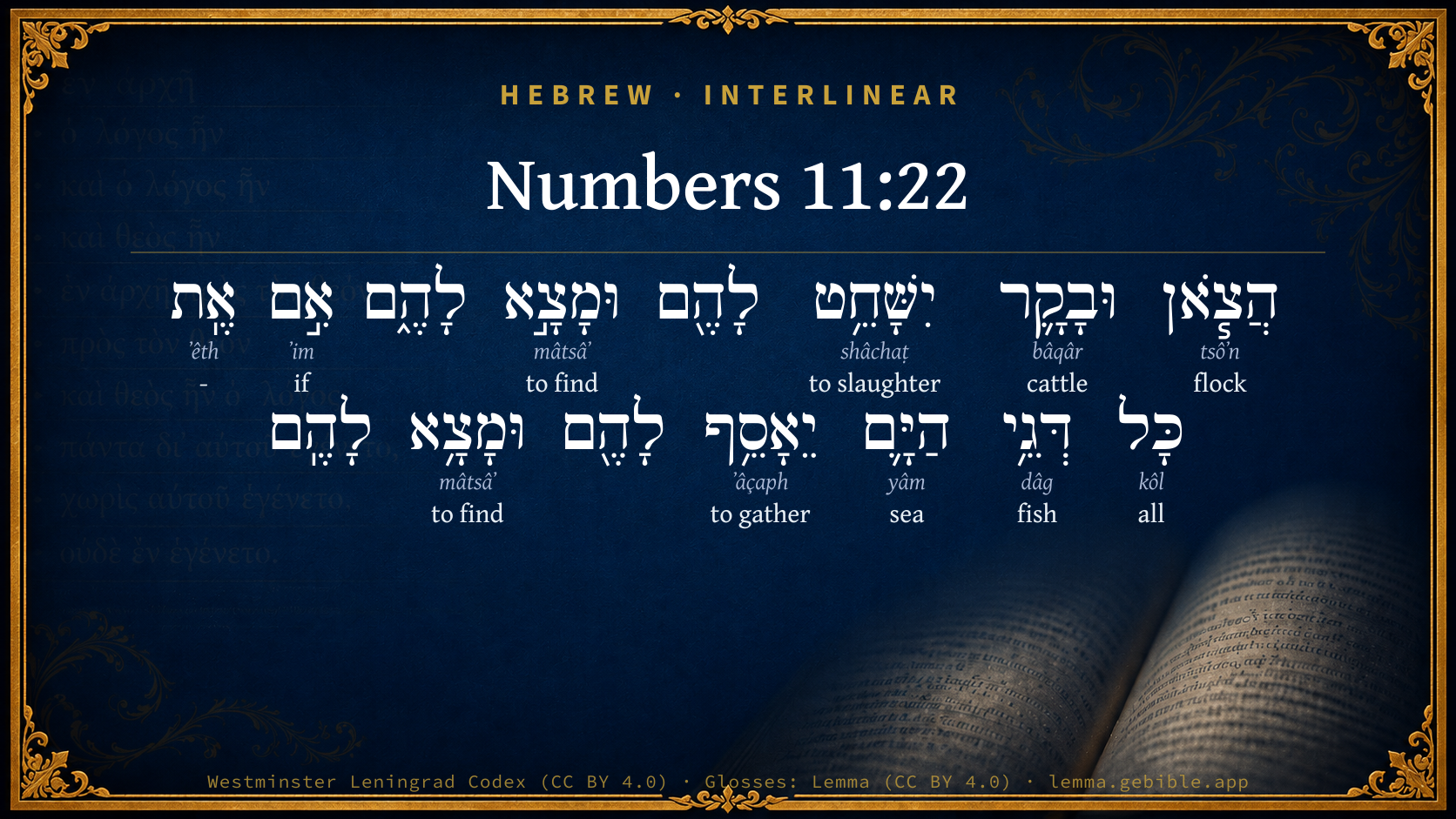
Hebrew (Westminster Leningrad Codex) Numbers 11:22 appears in the Hebrew Old Testament. The text above is from the Westminster Leningrad Codex. Each word links to its Strong’s number, a concise gloss, and parsing drawn from the Open Scriptures Hebrew Bible morphology. Click any word for its full Brown-Driver-Briggs (BDB) entry.
Download image
Cite this verse

Numbers 11:22 (World English Bible). Public Domain. Lemma interlinear Bible study tool, https://lemma.gebible.app/v/numbers/11/22.

Show BibTeX & RIS
BibTeX
RIS
English Translation
Shall flocks and herds be slain for them, to suffice them? or shall all the fish of the sea be gathered together for them, to suffice them?
World English Bible · Public Domain
Download a study sheet

One document with this verse’s original text, its word-by-word gloss line, the meaning frame, cross-references with their text, attributed commentary, and full source and license credits — printable, and it pastes into notes with its structure intact.

This verse Autodidact and up

Study sheet (.html) Plain text (.txt)

A passage Seminary Student

Up to 50 verses in one chapter. A passage sheet keeps up to 6 commentary sources and 12 cross-references per verse, in the order this page ranks them, and says so on the sheet whenever that leaves anything out. Ask for a single verse and you get the Autodidact verse sheet above.

Everything on this page stays free to read, with no account — the sheet is a download of what is already on screen, not access to it.

Want to remove ads? Support Godless Engineer
Compare translations 3

The same verse in 3 English versions, stacked beneath the original-language interlinear above. Click any original word for its lexicon entry.

Each is an independent rendering of the whole verse — the interlinear is not word-aligned to these translations.

Highlighted words mark where these versions differ — a whole-verse word diff, not a word-by-word alignment.

  • World English Bible Public Domain
    Shall flocks and herds be slain for them, to suffice them? or shall all the fish of the sea be gathered together for them, to suffice them?
  • King James Version Public Domain
    Shall the flocks and the herds be slain for them, to suffice them? or shall all the fish of the sea be gathered together for them, to suffice them?
  • unfoldingWord Literal Text CC BY-SA 4.0
    Shall flock and cattle be slaughtered for them, and it shall find for them? Or shall all the fish of the sea be gathered for them, and it shall find for them?”

unfoldingWord Literal Text — © unfoldingWord, licensed CC BY-SA 4.0. Word-aligned USFM3 via Door43 (git.door43.org/unfoldingWord/en_ult).

Versions to compare (up to 4)

3 of 4 selected

Show all 18 translations

Every available English version of this verse, each an independent rendering of the whole verse.

  • World English Bible Public Domain
    Shall flocks and herds be slain for them, to suffice them? or shall all the fish of the sea be gathered together for them, to suffice them?
  • Berean Standard Bible Public Domain
    If all our flocks and herds were slaughtered for them, would they have enough? Or if all the fish in the sea were caught for them, would they have enough?”
  • Majority Standard Bible Public Domain
    If all our flocks and herds were slaughtered for them, would they have enough? Or if all the fish in the sea were caught for them, would they have enough?”
  • King James Version Public Domain
    Shall the flocks and the herds be slain for them, to suffice them? or shall all the fish of the sea be gathered together for them, to suffice them?
  • American Standard Version (1901) Public Domain
    Shall flocks and herds be slain for them, to suffice them? or shall all the fish of the sea be gathered together for them, to suffice them?
  • Revised Version (1885) Public Domain
    Shall flocks and herds be slain for them, to suffice them? or shall all the fish of the sea be gathered together for them, to suffice them?
  • Geneva Bible (1599) Public Domain
    Shall the sheepe and the beeues be slaine for them, to finde them? either shall all the fish of the sea be gathered together for them to suffice them?
  • Douay-Rheims (1899) Public Domain
    Shall then a multitude of sheep and oxen be killed, that it may suffice for their food? or shall the fishes of the sea be gathered together to fill them?
  • Young's Literal Translation Public Domain
    Is flock and herd slaughtered for them, that one hath found for them? -- are all the fishes of the sea gathered for them -- that one hath found for them?'
  • Literal Standard Version CC BY-SA 4.0
    Is flock and herd slaughtered for them, that one has found [enough] for them? Are all the fishes of the sea gathered for them, that one has found [enough] for them?”
  • Unlocked Literal Bible CC BY-SA 4.0
    Should we kill flocks and herds to satisfy them? Should we catch all the fish in the sea to satisfy them?”
  • unfoldingWord Literal Text CC BY-SA 4.0
    Shall flock and cattle be slaughtered for them, and it shall find for them? Or shall all the fish of the sea be gathered for them, and it shall find for them?”
  • Darby Bible Public Domain
    Shall flocks and herds be slaughtered for them, to suffice them? or shall all the fish of the sea be gathered for them, to suffice them?
  • World Messianic Bible Public Domain
    Shall flocks and herds be slaughtered for them, to be sufficient for them? Shall all the fish of the sea be gathered together for them, to be sufficient for them?”
  • Webster's Bible Public Domain
    Shall the flocks and the herds be slain for them, to suffice for them? or shall all the fish of the sea be gathered for them, to suffice for them?
  • Free Bible Version CC BY-SA 4.0
    Even if all our flocks and herds were slaughtered, would that be enough for them? Even if all the fish in the sea were caught, would that be enough for them?”
  • Bible in Basic English Public Domain
    Are flocks and herds to be put to death for them? or are all the fish in the sea to be got together so that they may be full?
  • JPS Tanakh (1917) Public Domain
    If flocks and herds be slain for them, will they suffice them? or if all the fish of the sea be gathered together for them, will they suffice them?'

Literal Standard Version (2020), Covenant Press — licensed CC BY-SA 4.0. Text via the HelloAO Bible API (eBible.org). Unlocked Literal Bible (unfoldingWord) — licensed CC BY-SA 4.0. Text via the HelloAO Bible API (eBible.org). unfoldingWord Literal Text — © unfoldingWord, licensed CC BY-SA 4.0. Word-aligned USFM3 via Door43 (git.door43.org/unfoldingWord/en_ult). Free Bible Version, Dr. Jonathan Gallagher — licensed CC BY-SA 4.0. Text via the HelloAO Bible API (eBible.org).

Word by word

More ways to search: Search by grammar → Find every occurrence → Compare this word →

Practice this passage: Drill this verse → Learn its vocabulary →

דְּגֵ֥י
dâg
H1709
“fish of”
Noun, Common, Masculine, Plural, Construct
Part of Speech
Noun
Type
Common
Gender
Masculine
Number
Plural
State
Construct
Full BDB Definition

Origin: from H1711

TWOT: 401a

fish
  1. הֲצֹ֧אן tsôʼn H6629 “flock” Particle, Interrogative + Noun, Common, Both, Singular, Absolute
  2. וּבָקָ֛ר bâqâr H1241 “and · cattle” Conjunction + Noun, Common, Both, Singular, Absolute
  3. יִשָּׁחֵ֥ט shâchaṭ H7819 “to slaughter” Verb, Niphal, Imperfect, 3rd Person, Masculine, Singular
  4. וּמָצָ֣א mâtsâʼ H4672 “and · to find” Conjunction + Verb, Qal, Sequential Perfect, 3rd Person, Masculine, Singular
  5. אִ֣ם ʼim H518 “if” Conjunction
  6. אֶֽת ʼêth H853 “-” Particle, Direct Object
  7. כָּל kôl H3605 “all of” Noun, Common, Masculine, Singular, Construct
  8. הַיָּ֛ם yâm H3220 “the · sea” Particle, Definite Article + Noun, Common, Masculine, Singular, Absolute
  9. יֵאָסֵ֥ף ʼâçaph H622 “to gather” Verb, Niphal, Imperfect, 3rd Person, Masculine, Singular
  10. וּמָצָ֥א mâtsâʼ H4672 “and · to find” Conjunction + Verb, Qal, Sequential Perfect, 3rd Person, Masculine, Singular

About this verse

These counts appear in no published source. They are computed here, from the morphology-tagged text and Lemma’s own curated glosses. What Lemma adds →

15
words
10
distinct lemmas
Pentateuch
section

Notable vocabulary

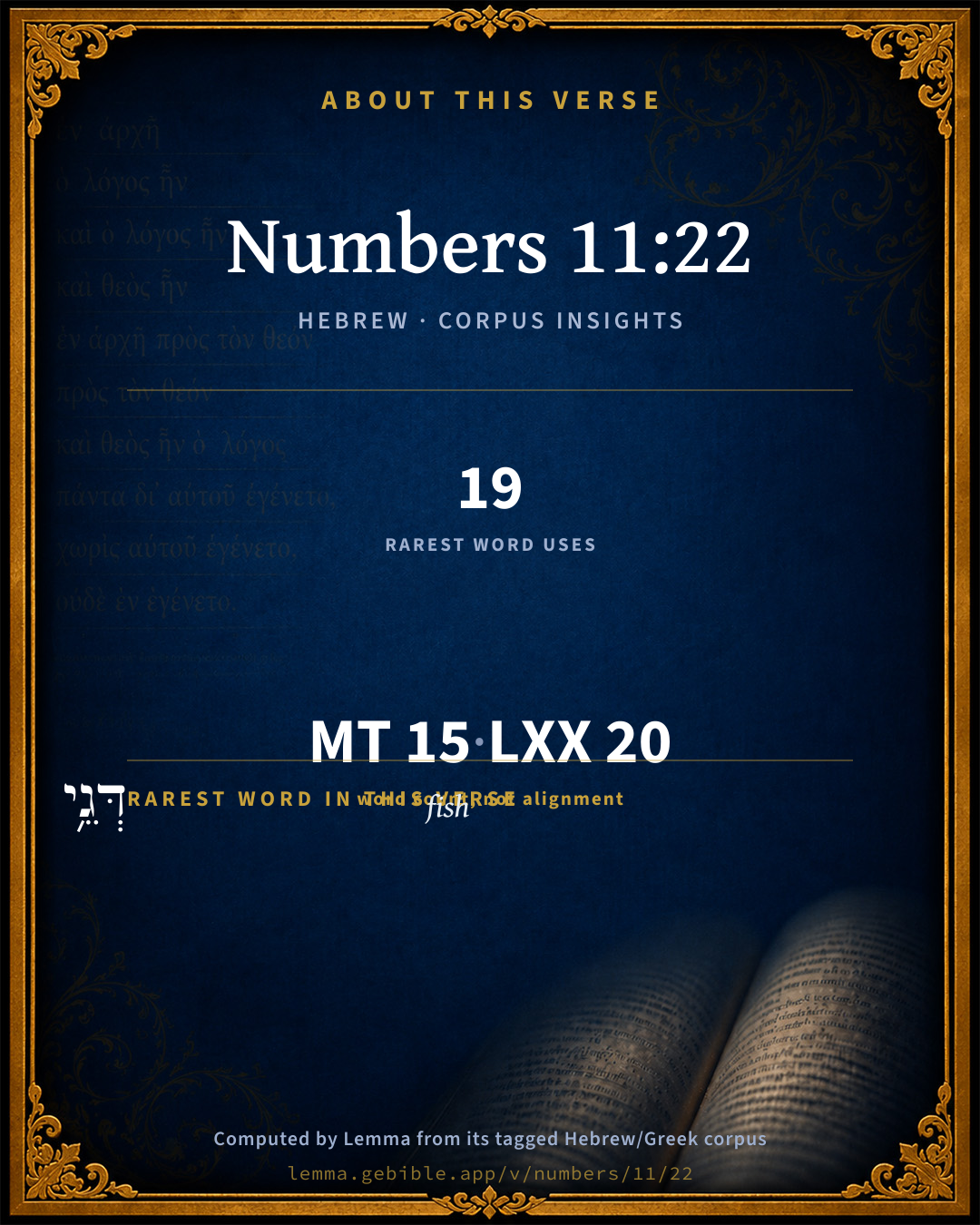
The rarest word here is דְּגֵ֥י fish H1709 — appearing just 19 times in the whole Hebrew Bible.

Shared distinctive vocabulary

דְּגֵ֥י fish H1709 occurs in 18 verses of the Hebrew Bible. Also found in:

Grammatical profile

  • 4 verbs
  • 5 nouns
  • 4 prepositions
  • 1 conjunction
  • 1 particle

Verb forms

  • יִשָּׁחֵ֥ט Niphal · Imperfect
  • וּמָצָ֣א Qal · Sequential Perfect
  • יֵאָסֵ֥ף Niphal · Imperfect
  • וּמָצָ֥א Qal · Sequential Perfect

Repetition

A word recurs within this verse — often emphatic in Hebrew:

  • וּמָצָ֣א to find H4672 ×2

Hebrew & Septuagint length

In English translation the verse runs 27 words from the Hebrew and 31 from the Septuagint (LXX English) — closely comparable.

A rough comparison of the two English renderings, which tokenize alike — not a word-level alignment.

Word counts can differ between the Hebrew and the Greek without any difference in meaning — e.g. the Hebrew direct-object marker אֵת has no separate Greek word, and Greek often adds the article ὁ.

In the original languages it is 15 Hebrew tokens and 20 Greek tokens — but the two are counted differently (Hebrew bundles its prefixes and suffixes into one token; the Greek is in lemma form), so that isn’t a like-for-like length.

Cross-references

8

Topical passages linked to Numbers 11:22 in the Treasury of Scripture Knowledge — connected by theme and wording, ordered by reader-vote popularity; previews shown in the World English Bible.

  • 2 Kings 7:2 Then the captain on whose hand the king leaned answered the man of God, and said, Behold, if Yahweh should make windows in heaven, might this thing be? He said, Behold, you shall see it with your eyes, but shall not eat of it.
  • Matthew 15:33 The disciples said to him, "Where should we get so many loaves in a deserted place as to satisfy so great a multitude?"
  • Mark 6:37 But he answered them, "You give them something to eat." They asked him, "Shall we go and buy two hundred denarii worth of bread, and give them something to eat?"
  • Mark 8:4 His disciples answered him, "From where could one satisfy these people with bread here in a deserted place?"
  • Luke 1:18 Zacharias said to the angel, "How can I be sure of this? For I am an old man, and my wife is well advanced in years."
  • Luke 1:34 Mary said to the angel, "How can this be, seeing I am a virgin?"
  • John 6:6–7 This he said to test him, for he himself knew what he would do.
  • John 6:9 "There is a boy here who has five barley loaves and two fish, but what are these among so many?"

Cross-references courtesy of OpenBible.info (CC BY 4.0).

Hebrew and Greek witnesses Masoretic Hebrew ↔ Greek Septuagint

The same verse in the two great witnesses to the Old Testament, shown verse-for-verse.

These are two independent witnesses, not word-aligned to each other, and the Septuagint is shown in lemma (dictionary) form.

Hebrew Numbers 11:22 Masoretic · Westminster Leningrad Codex

הֲצֹ֧אן וּבָקָ֛ר יִשָּׁחֵ֥ט לָהֶ֖ם וּמָצָ֣א לָהֶ֑ם אִ֣ם אֶֽת כָּל דְּגֵ֥י הַיָּ֛ם יֵאָסֵ֥ף לָהֶ֖ם וּמָצָ֥א לָהֶֽם

Shall flocks and herds be slain for them, to suffice them? or shall all the fish of the sea be gathered together for them, to suffice them?

World English Bible · Public Domain

Greek LXX Numbers 11:22 Septuagint · lemma form

μή πρόβατον καί βοῦς σφάζω αὐτός καί ἀρκέω αὐτός ἤ πᾶς ὁ ὄψος ὁ θάλασσα συνἄγω αὐτός καί ἀρκέω αὐτός

Shall sheep and oxen be slain for them, and shall it suffice them? or shall all the fish of the sea be gathered together for them, and shall it suffice them?

LXX2012 (modern English Septuagint) · Public Domain

Hebrew: Westminster Leningrad Codex (CC BY 4.0). Greek: Septuagint (public domain); English from LXX2012 (modern English Septuagint) (Public Domain). How the Septuagint differs from the Hebrew →

Targum (Aramaic paraphrase)

2

The Targum is the ancient Jewish Aramaic paraphrase of the Hebrew Scriptures — an interpretive translation, not the Hebrew text itself. Onkelos (literal) and Pseudo-Jonathan (expansive) render the Torah, and Jonathan the Prophets. Coverage is partial: where no permissively-licensed English translation exists for a verse, only the Aramaic is shown. This is verse-level text, not a word-by-word alignment to the Hebrew.

  1. Targum Onkelos Torah (Genesis–Deuteronomy)
    הֲעָן וְתוֹרִין יִתְנַכְסוּן לְהוֹן הַיְסַפְּקוּן לְהוֹן אִם יָת כָּל נוּנֵי יַמָא יִתְכַנְשׁוּן לְהוֹן הַיְסַפְּקוּן לְהוֹן

    (no public-domain English translation for this verse)

    Targum Onkelos — Aramaic: “Onkelos Genesis” (public domain); “Onkelos Exodus” (public domain); “Onkelos Leviticus” (public domain); “Onkelos Numbers” (public domain); “Onkelos Deuteronomy” (public domain). English: “Sefaria Community Translation” (CC0 1.0 (public-domain dedication)); “J.W. Etheridge. The Targums of Onkelos and Jonathan Ben Uzziel on the Pentateuch. London: Longmans, Green, 1862” (public domain). Text via Sefaria.

  2. Targum Pseudo-Jonathan Torah (Genesis–Deuteronomy)
    הַעֲנָא דִבְעֲרָב וְתוֹרֵי דִבְנָבָט יִתְנַכְסוּן לְהוֹן וִיסַפְּקוּן לְהוֹן אִין יַת כָּל נוּנֵי דְיַמָא רַבָּא יִתְכַּנְשׁוּן לְהוֹן וִיסַפְּקוּן לְהוֹן

    Shall the flocks of Araby or the cattle of Nabatea be killed for them to satisfy them, or all the fishes of the Great Sea be collected, that they may have enough?

    Targum Pseudo-Jonathan — Aramaic: “Targum Jonathan on Genesis” (public domain); “Targum Jonathan on Exodus” (public domain); “Targum Jonathan on Leviticus” (public domain); “Targum Jonathan on Numbers” (public domain); “Targum Jonathan on Deuteronomy” (public domain). English: “The Targum of Jonathan ben Uzziel, trans. J. W. Etheridge, London, 1862” (public domain). Text via Sefaria.

Commentary

Notes on Numbers 11:22 from classic Christian and Jewish commentators (each source and its license shown beneath its notes). The classic Christian expositions comment on the surrounding passage and are grouped to its opening verse, so a note may address several verses; the Jewish commentaries on the Tanakh (Rashi and others) are per-verse, so they appear only where the commentator wrote on this verse.

Lemma curates 59 commentaries, every one of them public domain or Creative Commons licensed, each selected and text-cleaned for this edition rather than reprinted as found. About our sources →

Trapp's Complete Commentary

John Trapp

Num 11:22 Shall the flocks and the herds be slain for them, to suffice them? or shall all the fish of the sea be gathered together for them, to suffice them?

Ver. 22. Or shall all the fish of the sea.] Moses forgat, belike, the fowls of the air, but God sent them such a drift of quails, as Moses dreamed not of: he fed them with meat of kings, bread of angels.

John Trapp, A Commentary or Exposition upon All the Books of the Old and New Testament (1647–1656) — public domain. Text from a community e-Sword module.

Adam Clarke's Commentary

Verse 22. Shall the flocks and the herds be slain] There is certainly a considerable measure of weakness and unbelief manifested in the complaints and questions of Moses on this occasion; but his conduct appears at the same time so very simple, honest, and affectionate, that we cannot but admire it, while we wonder that he had not stronger confidence in that God whose miracles he had so often witnessed in Egypt.

Adam Clarke's Commentary on the Bible (1810–1826) — public domain. Text from a community e-Sword/MySword module.

Ellicott's Commentary for English Readers

(22) Shall the flocks and the herds . .?—Rather, Shall flocks and herds . .? The definite article is not used here, nor the possessive pronoun, as elsewhere, where the flocks and herds of the Israelites are denoted. (Comp. Exo_10:9; Exo_34:3; Deu_12:6.) There is no evidence, therefore, that Moses alluded exclusively, or even primarily, to the flocks and herds which the Israelites had brought out of Egypt. Moreover, a large number of the sheep and goats must have been recently slain at the Passover. Whether the encampment was, or was not within an easy distance of the Ælanitic Gulf, the gathering together of the fish of the sea in sufficient quantities to satisfy such a multitude for so long a time would require a miraculous agency; and the same agency could also bring together from unknown sources flocks and herds. The expression may be regarded as a form of natural hyperbole.

A Bible Commentary for English Readers, edited by Charles John Ellicott (1878–1897) — public domain. Text from a community e-Sword module.

John Gill's Exposition

Shall the flocks and the herds be slain for them, to suffice them?.... Suggesting that if all their cattle, their sheep, and oxen were killed, which they and the mixed multitude brought out of Egypt, they would not be sufficient for them to live upon a whole month; and intimating also, that it would be an unwise thing, and very improper, to slay them all, were they sufficient, since then they would have none for sacrifice, or to breed when they came into the land of Canaan; the Targum of Jonathan is,"shall the sheep that are in Arabia and the oxen that are in Nabatea be slain for them, and be sufficient for them?"

or shall all the fish of the sea be gathered together for them to suffice them? of the great sea, as Jonathan; which, to gather together, is, humanly speaking, impossible; indeed, if it could be done, they would not suffice such a number of people a month together: Moses takes notice only of the flesh of beasts and of fishes, and seems not to have thought of the flesh of fowls with which, and not the other, the Lord afterwards fed them a whole month.

John Gill's Exposition of the Whole Bible (1746–1763) — public domain (CC PDM 1.0). Text via the HelloAO Bible API.

Haydock's Catholic Bible Commentary

Fishes. Moses does not distinguish them from flesh, no more than St. Paul does, 1 Corinthians xv. 39. Fish was not formerly allowed on fasting days. (Calmet)

George Leo Haydock (1774–1849), Haydock's Catholic Family Bible and Commentary, 1859 edition — public domain. Excludes Psalms (Douay-Rheims chapter numbering differs from Protestant) and Deuterocanonical books (Catholic canon only).

Matthew Poole's English Annotations

Will they be sufficient for them? or where shall they have more?

Matthew Poole's English Annotations on the Holy Bible (1683–1685) — public domain. Text from a community e-Sword/MySword module.

Whedon's Commentary on the Bible

Daniel D. Whedon

22. All the fish of the sea — See Num_11:5, note. The Mediterranean and the Red Sea were the only seas with which Israel was acquainted.

Daniel D. Whedon (gen. ed.), Commentary on the Old and New Testaments (1874–1909) — public domain. Text from a community e-Sword module.

The Pulpit Commentary

Shall the flocks and herds be slain? Which they had brought out of Egypt with them, (see on Exo_12:32) and which no doubt were carefully husbanded, partly in order to supply them with milk and other produce, partly in order to maintain the sacrifices of the law. All the fish of the sea. A wild expression from which nothing can be fairly argued as to the present position of the comp.

The Pulpit Commentary (1880–1919), ed. H.D.M. Spence-Jones & Joseph S. Exell — public domain. Text from a community e-Sword module.

Rashi

Rabbi Shlomo Yitzchaki (Rashi)

הצאן והבקר ישחט SHALL THE FLOCKS AND HERDS BE SLAUGHTERED [FOR THEM TO SUFFICE THEM?] — This is one of those four things (Biblical passages) which R. Akiba interpreted in a certain way but R. Simeon did not interpret them similarly. Rabbi Akiba says: שש מאות אלף רגלי... ואתה אמרת בשר אתן להם ואכלו חדש ימים הצאן ובקר — all this is to be taken literally and the words ומצא להם should be rendered by “would it suffice for them?”, in the same sense as we find this word used in (Leviticus 25:26) “and he have sufficient (ומצא כדי) for redeeming it" (ומצא להם is taken as the equivalent of ומצא כדי להם). Now — R. Akiba continued — which case was worse? This or that when Moses exclaimed, (Numbers 20:10) Hear now, ye rebels!?” Obviously this case here was worse, only because he did not utter his doubt in public, Scripture (God) showed some regard for him and did not punish him, whilst that sin at Meriba took place in public, therefore Scripture does not show any regard for him. Rabbi Simeon, however, says: “God forbid!” — “Such an idea never entered the mind of that righteous man! He of whom Scripture writes, (Numbers 12:7) ‘He is faithful in all my house’ — would he have said, ‘The Omnipresent cannot supply sufficient for us!’ But what he said was this: ‘[the people, amongst whom I am, are] six hundred thousand footmen; and Thou hast said, I will give them flesh, for a whole month — and then You want to kill a nation so great as this is?! Shall the flocks and the herds be slaughtered for them that they (the people) should immediately be killed, and this eating should be their last (lit., should satisfy them for ever: ומצא להם)?! Is this Your praise? Do people say to an ass, take (eat) this Kor of barley and then we will cut off thy head!’? The Holy One, blessed be He, thereupon said to him, ‘But if I do not give them flesh, they will say that My hand has waxed short; would it be pleasing to you that the hand of the Lord should appear in their eyes to have waxed short? — Let them and a hundred like them perish but let not My hand appear to them to have waxed short even for a single moment’!” (Tosefta Sotah 6:4)

Rashi on the Tanakh — English translations: “The Judaica Press complete Tanach with Rashi, translated by A. J. Rosenberg” (CC BY 4.0); “Pentateuch with Rashi's commentary by M. Rosenbaum and A.M. Silbermann, 1929-1934” (public domain); “The Metsudah Tanach series, Lakewood, N.J” (CC BY 4.0); and “The Book of Joshua, Metsudah Publications, 1997” (CC BY 4.0). Text via Sefaria.

Lesson kit

Teaching starters — assembled from the data on this page, not authored interpretation. Every prompt links to the verse data it draws on. Edit before teaching.

Numbers, in the Pentateuch, opens this verse with 15 words (10 distinct Hebrew lemmas). Its most distinctive word is dâg (“fish”). A historical commentator’s framing appears above. Read the whole chapter for the surrounding context.

Discussion questions

  1. The word dâg carries the sense “fish.” How does it shape the verse?
  2. Genesis 9:2 shares the word «fish» with this verse. How do the two illuminate each other?
  3. “to find” occurs 2× in this one verse. What is the effect of the repetition?
  4. These translations render this verse differently. What is at stake in choosing one wording over another?
  5. The verb «יִשָּׁחֵ֥ט» is Niphal Imperfect. How does its form color the action?
  6. Reading how Trapp's Complete Commentary and Adam Clarke's Commentary read this verse, where do the two commentators agree and where do they part?

Things to notice

Reading settings

Reading text

Shown beneath each verse's original-language words.

Old Testament
Old Testament edition

Read the OT as the Masoretic Hebrew (MT) or the Greek Septuagint (LXX).

English shown for the Greek Septuagint (in the Hebrew ↔ Greek comparison).

Comparing translations? Open the Compare panel on any verse page to stack up to four side by side.