Leviticus 27:32

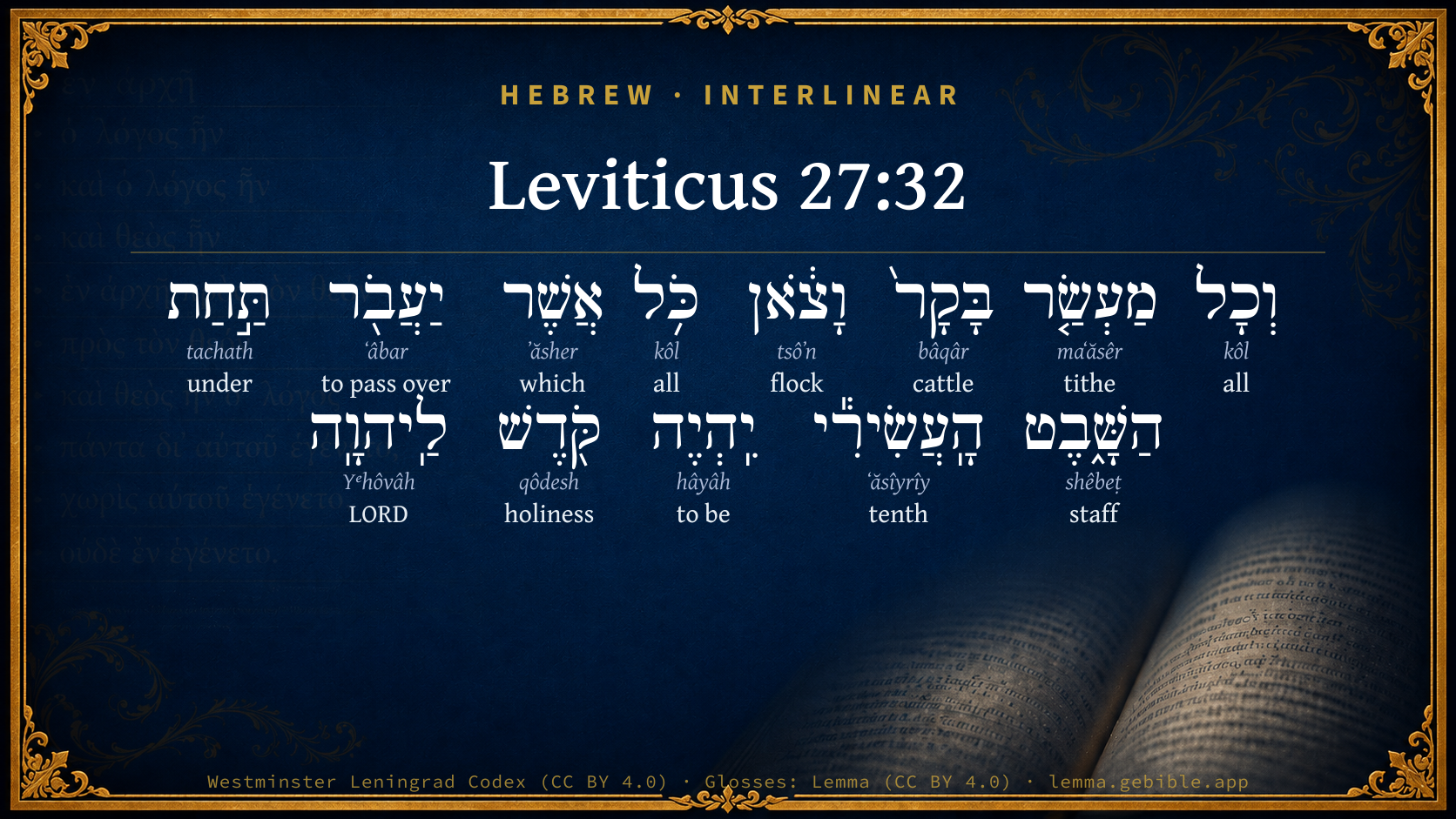
Hebrew (Westminster Leningrad Codex) Leviticus 27:32 appears in the Hebrew Old Testament. The text above is from the Westminster Leningrad Codex. Each word links to its Strong’s number, a concise gloss, and parsing drawn from the Open Scriptures Hebrew Bible morphology. Click any word for its full Brown-Driver-Briggs (BDB) entry.
Download image
Cite this verse

Leviticus 27:32 (World English Bible). Public Domain. Lemma interlinear Bible study tool, https://lemma.gebible.app/v/leviticus/27/32.

Show BibTeX & RIS
BibTeX
RIS
English Translation
All the tithe of the herds or the flocks, whatever passes under the rod, the tenth shall be holy to Yahweh.
World English Bible · Public Domain
Download a study sheet

One document with this verse’s original text, its word-by-word gloss line, the meaning frame, cross-references with their text, attributed commentary, and full source and license credits — printable, and it pastes into notes with its structure intact.

This verse Autodidact and up

Study sheet (.html) Plain text (.txt)

A passage Seminary Student

Up to 50 verses in one chapter. A passage sheet keeps up to 6 commentary sources and 12 cross-references per verse, in the order this page ranks them, and says so on the sheet whenever that leaves anything out. Ask for a single verse and you get the Autodidact verse sheet above.

Everything on this page stays free to read, with no account — the sheet is a download of what is already on screen, not access to it.

Want to remove ads? Support Godless Engineer
Compare translations 3

The same verse in 3 English versions, stacked beneath the original-language interlinear above. Click any original word for its lexicon entry.

Each is an independent rendering of the whole verse — the interlinear is not word-aligned to these translations.

Highlighted words mark where these versions differ — a whole-verse word diff, not a word-by-word alignment.

  • World English Bible Public Domain
    All the tithe of the herds or the flocks, whatever passes under the rod, the tenth shall be holy to Yahweh.
  • King James Version Public Domain
    And concerning the tithe of the herd, or of the flock, even of whatsoever passeth under the rod, the tenth shall be holy unto the LORD.
  • unfoldingWord Literal Text CC BY-SA 4.0
    And all tithe of cattle and flock, all which passes under the rod, the tenth will be holy to Yahweh.

unfoldingWord Literal Text — © unfoldingWord, licensed CC BY-SA 4.0. Word-aligned USFM3 via Door43 (git.door43.org/unfoldingWord/en_ult).

Versions to compare (up to 4)

3 of 4 selected

Show all 18 translations

Every available English version of this verse, each an independent rendering of the whole verse.

  • World English Bible Public Domain
    All the tithe of the herds or the flocks, whatever passes under the rod, the tenth shall be holy to Yahweh.
  • Berean Standard Bible Public Domain
    Every tenth animal from the herd or flock that passes under the shepherd’s rod will be holy to the LORD.
  • Majority Standard Bible Public Domain
    Every tenth animal from the herd or flock that passes under the shepherd’s rod will be holy to the LORD.
  • King James Version Public Domain
    And concerning the tithe of the herd, or of the flock, even of whatsoever passeth under the rod, the tenth shall be holy unto the LORD.
  • American Standard Version (1901) Public Domain
    And all the tithe of the herd or the flock, whatsoever passeth under the rod, the tenth shall be holy unto Jehovah.
  • Revised Version (1885) Public Domain
    And all the tithe of the herd or the flock, whatsoever passeth under the rod, the tenth shall be holy unto the LORD.
  • Geneva Bible (1599) Public Domain
    And euery tithe of bullock, and of sheepe, and of all that goeth vnder the rod, the tenth shalbe holy vnto the Lord.
  • Douay-Rheims (1899) Public Domain
    Of all the tithes of oxen, and sheep, and goats, that pass under the shepherd's rod, every tenth that cometh shall be sanctified to the Lord.
  • Young's Literal Translation Public Domain
    `And all the tithe of the herd and of the flock -- all that passeth by under the rod -- the tenth is holy to Jehovah;
  • Literal Standard Version CC BY-SA 4.0
    And all the tithe of the herd and of the flock—all that passes by under the rod—the tenth is holy to YHWH;
  • Unlocked Literal Bible CC BY-SA 4.0
    As for every tenth of the herd or the flock, whatever passes under the shepherd's rod, one-tenth must be set apart to Yahweh.
  • unfoldingWord Literal Text CC BY-SA 4.0
    And all tithe of cattle and flock, all which passes under the rod, the tenth will be holy to Yahweh.
  • Darby Bible Public Domain
    And as to every tithe of the herd, or of the flock, of whatever passeth under the rod, the tenth shall be holy to Jehovah.
  • World Messianic Bible Public Domain
    All the tithe of the herds or the flocks, whatever passes under the rod, the tenth shall be holy to the LORD.
  • Webster's Bible Public Domain
    And concerning the tithe of the herd, or of the flock, even of whatever passeth under the rod, the tenth shall be holy to the LORD.
  • Free Bible Version CC BY-SA 4.0
    When you count your herds and flocks, every tenth animal that passes under the shepherd's rod is holy to the Lord.
  • Bible in Basic English Public Domain
    And a tenth part of the herd and of the flock, whatever goes under the rod of the valuer, will be holy to the Lord.
  • JPS Tanakh (1917) Public Domain
    And all the tithe of the herd or the flock, whatsoever passeth under the rod, the tenth shall be holy unto the LORD.

Literal Standard Version (2020), Covenant Press — licensed CC BY-SA 4.0. Text via the HelloAO Bible API (eBible.org). Unlocked Literal Bible (unfoldingWord) — licensed CC BY-SA 4.0. Text via the HelloAO Bible API (eBible.org). unfoldingWord Literal Text — © unfoldingWord, licensed CC BY-SA 4.0. Word-aligned USFM3 via Door43 (git.door43.org/unfoldingWord/en_ult). Free Bible Version, Dr. Jonathan Gallagher — licensed CC BY-SA 4.0. Text via the HelloAO Bible API (eBible.org).

Word by word

More ways to search: Search by grammar → Find every occurrence → Compare this word →

Practice this passage: Drill this verse → Learn its vocabulary →

הָֽעֲשִׂירִ֕י
ʻăsîyrîy
H6224
“the · tenth”
Particle, Definite Article + Adjective, Ordinal number, Masculine, Singular, Absolute
Part of Speech
Particle + Adjective
Type
Ordinal number
Gender
Masculine
Number
Singular
State
Absolute
Full BDB Definition

Origin: from H6235

TWOT: 1711f

ordinal number - a tenth
  1. וְכָל kôl H3605 “and · all of” Conjunction + Noun, Common, Masculine, Singular, Construct
  2. מַעְשַׂ֤ר maʻăsêr H4643 “tithe of” Noun, Common, Masculine, Singular, Construct
  3. בָּקָר֙ bâqâr H1241 “cattle” Noun, Common, Both, Singular, Absolute
  4. וָצֹ֔אן tsôʼn H6629 “and · flock” Conjunction + Noun, Common, Both, Singular, Absolute
  5. כֹּ֥ל kôl H3605 “all” Noun, Common, Masculine, Singular, Absolute
  6. אֲשֶׁר ʼăsher H834 “which” Particle, Relative
  7. יַעֲבֹ֖ר ʻâbar H5674 “to pass over” Verb, Qal, Imperfect, 3rd Person, Masculine, Singular
  8. תַּ֣חַת tachath H8478 “under” Preposition
  9. הַשָּׁ֑בֶט shêbeṭ H7626 “the · staff” Particle, Definite Article + Noun, Common, Masculine, Singular, Absolute
  10. יִֽהְיֶה hâyâh H1961 “to be” Verb, Qal, Imperfect, 3rd Person, Masculine, Singular
  11. קֹּ֖דֶשׁ qôdesh H6944 “holiness” Noun, Common, Masculine, Singular, Absolute
  12. לַֽיהוָֽה Yᵉhôvâh H3068 “to/for · LORD” Preposition + Noun, Proper

About this verse

These counts appear in no published source. They are computed here, from the morphology-tagged text and Lemma’s own curated glosses. What Lemma adds →

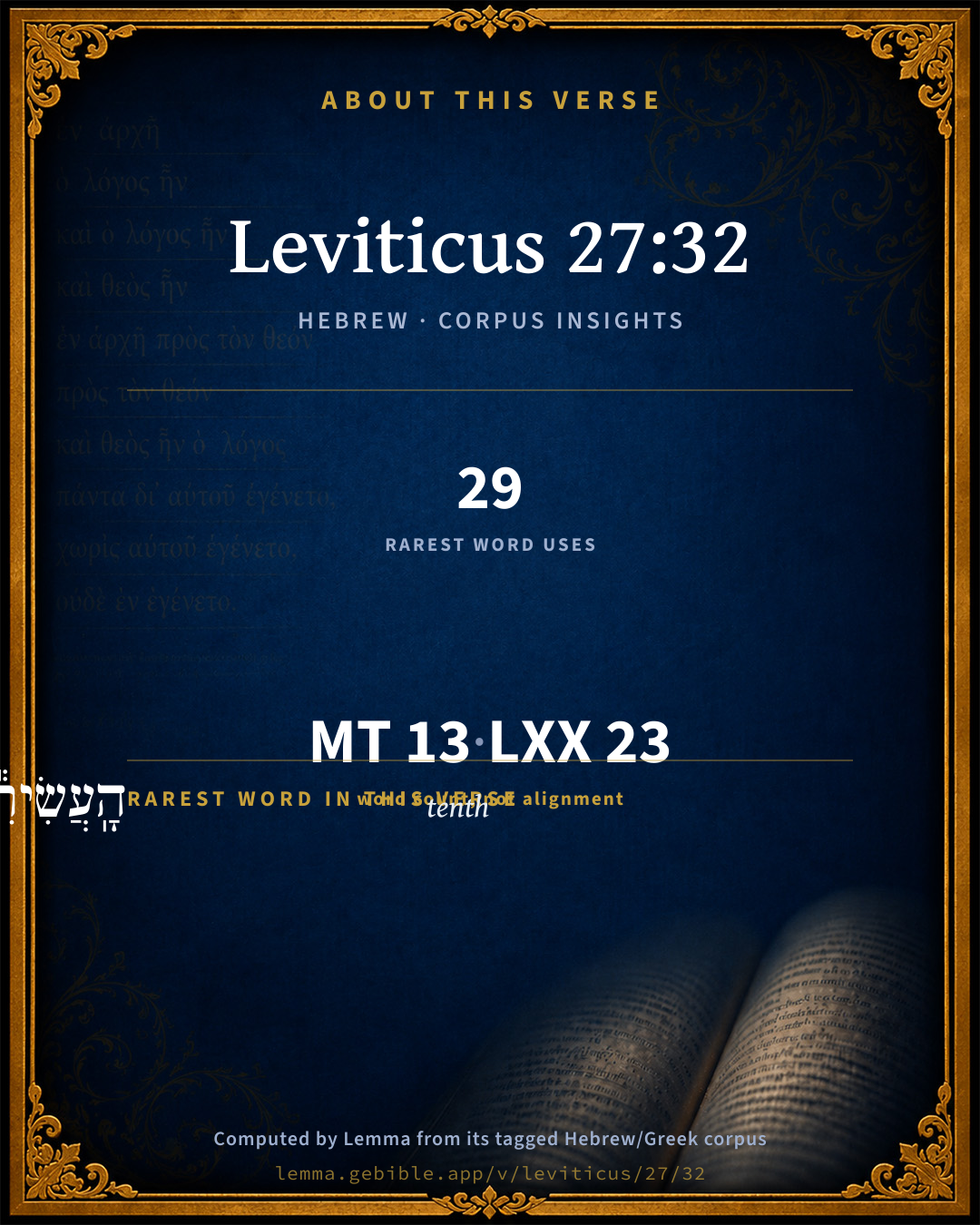
13
words
12
distinct lemmas
Pentateuch
section

Shared distinctive vocabulary

הָֽעֲשִׂירִ֕י tenth H6224 occurs in 26 verses of the Hebrew Bible. Also found in:

Grammatical profile

  • 2 verbs
  • 8 nouns
  • 1 adjective
  • 1 preposition
  • 1 particle

Verb forms

  • יַעֲבֹ֖ר Qal · Imperfect
  • יִֽהְיֶה Qal · Imperfect

Repetition

A word recurs within this verse — often emphatic in Hebrew:

  • וְכָל all H3605 ×2

Hebrew & Septuagint length

In English translation the verse runs 21 words from the Hebrew and 25 from the Septuagint (LXX English) — closely comparable.

A rough comparison of the two English renderings, which tokenize alike — not a word-level alignment.

Word counts can differ between the Hebrew and the Greek without any difference in meaning — e.g. the Hebrew direct-object marker אֵת has no separate Greek word, and Greek often adds the article ὁ.

In the original languages it is 13 Hebrew tokens and 23 Greek tokens — but the two are counted differently (Hebrew bundles its prefixes and suffixes into one token; the Greek is in lemma form), so that isn’t a like-for-like length.

Cross-references

3

Topical passages linked to Leviticus 27:32 in the Treasury of Scripture Knowledge — connected by theme and wording, ordered by reader-vote popularity; previews shown in the World English Bible.

  • Jeremiah 33:13 In the cities of the hill-country, in the cities of the lowland, and in the cities of the South, and in the land of Benjamin, and in the places about Jerusalem, and in the cities of Judah, shall the flocks again pass under the hands of him who numbers them, says Yahweh.
  • Ezekiel 20:37 I will cause you to pass under the rod, and I will bring you into the bond of the covenant;
  • Micah 7:14 Shepherd your people with your staff, The flock of your heritage, Who dwell by themselves in a forest, In the midst of fertile pasture land, let them feed; In Bashan and Gilead, as in the days of old.

Cross-references courtesy of OpenBible.info (CC BY 4.0).

Hebrew and Greek witnesses Masoretic Hebrew ↔ Greek Septuagint

The same verse in the two great witnesses to the Old Testament, shown verse-for-verse.

These are two independent witnesses, not word-aligned to each other, and the Septuagint is shown in lemma (dictionary) form.

Hebrew Leviticus 27:32 Masoretic · Westminster Leningrad Codex

וְכָל מַעְשַׂ֤ר בָּקָר֙ וָצֹ֔אן כֹּ֥ל אֲשֶׁר יַעֲבֹ֖ר תַּ֣חַת הַשָּׁ֑בֶט הָֽעֲשִׂירִ֕י יִֽהְיֶה קֹּ֖דֶשׁ לַֽיהוָֽה

All the tithe of the herds or the flocks, whatever passes under the rod, the tenth shall be holy to Yahweh.

World English Bible · Public Domain

Greek LXX Leviticus 27:32 Septuagint · lemma form

καί πᾶς δέκατος βοῦς καί πρόβατον καί πᾶς ὅς ἐάν ἔρχομαι ἐν ὁ ἀριθμός ὑπό ὁ ῥάβδος ὁ δέκατος εἰμί ἅγιος ὁ κύριος

And every tithe of oxen, and of sheep, and whatever may come in numbering under the rod, the tenth shall be holy to the Lord.

LXX2012 (modern English Septuagint) · Public Domain

Hebrew: Westminster Leningrad Codex (CC BY 4.0). Greek: Septuagint (public domain); English from LXX2012 (modern English Septuagint) (Public Domain). How the Septuagint differs from the Hebrew →

Targum (Aramaic paraphrase)

2

The Targum is the ancient Jewish Aramaic paraphrase of the Hebrew Scriptures — an interpretive translation, not the Hebrew text itself. Onkelos (literal) and Pseudo-Jonathan (expansive) render the Torah, and Jonathan the Prophets. Coverage is partial: where no permissively-licensed English translation exists for a verse, only the Aramaic is shown. This is verse-level text, not a word-by-word alignment to the Hebrew.

  1. Targum Onkelos Torah (Genesis–Deuteronomy)
    וְכָל מַעֲשַׂר תּוֹרִין וְעָן כֹּל דְיֵעִבַּר תְּחוֹת חֻטְרָא עֲשִׂירָאָה יְהֵי קַדִישׁ קֳדָם יְיָ

    (no public-domain English translation for this verse)

    Targum Onkelos — Aramaic: “Onkelos Genesis” (public domain); “Onkelos Exodus” (public domain); “Onkelos Leviticus” (public domain); “Onkelos Numbers” (public domain); “Onkelos Deuteronomy” (public domain). English: “Sefaria Community Translation” (CC0 1.0 (public-domain dedication)); “J.W. Etheridge. The Targums of Onkelos and Jonathan Ben Uzziel on the Pentateuch. London: Longmans, Green, 1862” (public domain). Text via Sefaria.

  2. Targum Pseudo-Jonathan Torah (Genesis–Deuteronomy)
    וְכָל מַעַשְרָא דְתוֹרֵי וְעָנֵי כָּל דְחַלְפוּן תְּחוֹת שַׁרְבִיטָא עֲשִירָאָה יְהֵי קוּדְשָׁא קֳדָם יְיָ

    And every tythe of oxen and sheep, whatever passeth under the (tything) rod, the tenth shall be consecrated before the Lord.

    Targum Pseudo-Jonathan — Aramaic: “Targum Jonathan on Genesis” (public domain); “Targum Jonathan on Exodus” (public domain); “Targum Jonathan on Leviticus” (public domain); “Targum Jonathan on Numbers” (public domain); “Targum Jonathan on Deuteronomy” (public domain). English: “The Targum of Jonathan ben Uzziel, trans. J. W. Etheridge, London, 1862” (public domain). Text via Sefaria.

Commentary

Notes on Leviticus 27:32 from classic Christian and Jewish commentators (each source and its license shown beneath its notes). The classic Christian expositions comment on the surrounding passage and are grouped to its opening verse, so a note may address several verses; the Jewish commentaries on the Tanakh (Rashi and others) are per-verse, so they appear only where the commentator wrote on this verse.

Lemma curates 59 commentaries, every one of them public domain or Creative Commons licensed, each selected and text-cleaned for this edition rather than reprinted as found. About our sources →

Ellicott's Commentary for English Readers

(32) Whatsoever passeth under the rod.—That is, for the purpose of counting and tithing them. The manner in which this was done is described by the Jewish canonists as follows: “The owner is to gather all his lambs or all his calves into the fold and make a little door to it, so that two should not be able to go out at once. He is to place their dams without. As they bleat the lambs hear their voice and go out of the fold to meet them, as it is said, ‘whatsoever passeth under the rod’ (Lev_27:32), since it must pass of itself, and not be brought out by his hand. And as they come out of the fold one after another he counts them with the rod, one, two, three, etc., and the tenth which comes out, whether it be male or female, whether it be perfect or blemished, he marks it with a red mark, and says, ‘This is the tithe.’” It is to this custom that the prophet alludes when he says, “I will cause you to pass under the rod, and I will bring you into the bond of the covenant” (Eze_20:37), that is, shall once more claim you, being marked as belonging to the Lord.

A Bible Commentary for English Readers, edited by Charles John Ellicott (1878–1897) — public domain. Text from a community e-Sword module.

Trapp's Complete Commentary

John Trapp

Lev 27:32 And concerning the tithe of the herd, or of the flock, [even] of whatsoever passeth under the rod, the tenth shall be holy unto the LORD.

Ver. 32. Passeth under the rod.] Coloured at the end with red, to mark out the tenth, as they passed out. See Jer 33:13.

John Trapp, A Commentary or Exposition upon All the Books of the Old and New Testament (1647–1656) — public domain. Text from a community e-Sword module.

Joseph Benson's Commentary

Lev 27:32. Under the rod — Either, 1st, The tithers’ rod, it being the manner of the Jews in tithing to cause all their cattle to pass through some gate or narrow passage, where the tenth was marked by a person appointed for that purpose, and reserved for the priest. Or, 2d, The shepherd’s rod, under which the herds and flocks passed, and by which they were governed and numbered. See Jer 33:13; Eze 20:37.

Joseph Benson's Commentary on the Old and New Testaments (1811–1818) — public domain. Text from a community e-Sword module.

Tyndale Open Study Notes

Tyndale Open Resources

27:32 Just like the produce of the fields (27:29-34), the flocks and herds were also tithed to the Lord.

Tyndale Open Study Notes — © Tyndale Open Resources, licensed CC BY-SA 4.0. Text via the HelloAO Bible API.

Geneva Bible (1599)

Geneva Bible translators

All that which is numbered: that is, every tenth as he falleth by tally without exception or respect.

Geneva Bible (1599) marginal notes — public domain. Text via Bolls.life.

Jamieson, Fausset & Brown

Robert Jamieson, A. R. Fausset & David Brown

whatsoever passeth under the rod, &c.--This alludes to the mode of taking the tithe of cattle, which were made to pass singly through a narrow gateway, where a person with a rod, dipped in ochre, stood, and counting them, marked the back of every tenth beast, whether male or female, sound or unsound.

Jamieson, Fausset & Brown — Commentary Critical and Explanatory on the Whole Bible (1871) — public domain (CC PDM 1.0). Text via the HelloAO Bible API.

Adam Clarke's Commentary

Verse 32. Whatsoever passeth under the rod] The signification of this verse is well given by the rabbins: "When a man was to give the tithe of his sheep or calves to God, he was to shut up the whole flock in one fold, in which there was one narrow door capable of letting out one at a time. The owner, about to give the tenth to the Lord, stood by the door with a rod in his hand, the end of which was dipped in vermilion or red ochre. The mothers of those lambs or calves stood without: the door being opened, the young ones ran out to join themselves to their dams; and as they passed out the owner stood with his rod over them, and counted one, two, three, four, five, &c., and when the tenth came, he touched it with the coloured rod, by which it was distinguished to be the tithe calf, sheep, &c., and whether poor or lean, perfect or blemished, that was received as the legitimate tithe." It seems to be in reference to this custom that the Prophet Ezekiel, speaking to Israel, says: I will cause you to pass under the rod, and will bring you into the bond of the covenant - you shall be once more claimed as the Lord's property, and be in all things devoted to his service, being marked or ascertained, by especial providences and manifestations of his kindness, to be his peculiar people.

Adam Clarke's Commentary on the Bible (1810–1826) — public domain. Text from a community e-Sword/MySword module.

The Cambridge Bible for Schools and Colleges

gen. ed. J. J. S. Perowne

32. under the rod] the ‘staff’ carried by shepherds (Psa_23:4; Mic_7:14; Zec_11:7), and used (Tal. Bab., Bechoroth, fol. 58 b) for counting the flock when they were entering or leaving their fold. For the phrase, and for the reference by classical writers to similar customs, see Davidson (C.B.) on Eze_20:37.

The Cambridge Bible for Schools and Colleges (gen. ed. J. J. S. Perowne; Cambridge University Press, 1878–1918) — public domain. Text from a community e-Sword module.

John Gill's Exposition

He shall not search whether it be good or bad,.... In a good or bad state of health, fat or lean, perfect or blemished, but take it as it is, be it what it will:

neither shall he change it; neither for the better nor the worse, no alteration was to be made, but the beast was to be taken as it came:

and if he change it at all, then both it and the change shall be holy; be sacred to the Lord, and for his use and service; this was done to restrain men from making any alteration, since if they did, both the one and the other were taken from them; yea, were to be beaten with forty stripes, save one (b); whether this change was of the herd with the flock, or of the flock with the herd; or of lambs with goats, or goats with lambs; or of males with females, or of females with males; or of perfect with blemished ones, or of blemished ones with perfect ones:

it shall not be redeemed; from whence the Jews (c) gather, that a tithe beast was not to be bought and sold, whether blemished or unblemished.

(b) Misnah Temurah, c. 1. sect. 1, 2. (c) Maimon. Hilchot Becorot, c. 6. sect. 5, 6.

John Gill's Exposition of the Whole Bible (1746–1763) — public domain (CC PDM 1.0). Text via the HelloAO Bible API.

Albert Barnes' Notes on the Bible

Whatsoever passeth under the rod - According to rabbinical tradition, the animals to be tithed were enclosed in a pen, and as they went out one by one at the opening, every tenth animal was touched with a rod dipped in vermilion. Compare the margin reference.

For a more full explanation of what relates to tithes, see the margin reference and Gen 14:20; Deu 14:22, Deu 14:28.

Albert Barnes' Notes on the Bible (1834–1885) — public domain. Text from a community e-Sword/MySword module.

Haydock's Catholic Bible Commentary

Rod; on which was some red colouring, to mark the tenth animal as it passed through a narrow gate. If it was proper for sacrifice, its blood was poured out around the altar, and its flesh was returned to the giver. If it could not be offered in sacrifice, it was slain. The priest received none of the victim, no more than the paschal lamb. (Outram, sac. i. 11.) But a feast was made of flesh for the person’s friends, and he gave a portion to the poor and to the Levites. --- The Lord, as a sacrifice of thanksgiving, in which the greatest part of the victim is consumed by the person who offers it. The priests have but a small share, chap. iii. (Calmet)

George Leo Haydock (1774–1849), Haydock's Catholic Family Bible and Commentary, 1859 edition — public domain. Excludes Psalms (Douay-Rheims chapter numbering differs from Protestant) and Deuterocanonical books (Catholic canon only).

Matthew Poole's English Annotations

Under the rod; either,

1. The tither’s rod, it being the manner of the Jews in tithing to cause all their cattle to pass through some gate or narrow passage, where the tenth was marked by a person appointed for that purpose, and reserved for the priest. Or,

2. The shepherd’s rod, under which the herds and flocks passed, and by which they were governed and numbered. See Jer 33:13; Eze 20:37.

Matthew Poole's English Annotations on the Holy Bible (1683–1685) — public domain. Text from a community e-Sword/MySword module.

Whedon's Commentary on the Bible

Daniel D. Whedon

32, 33. Whatsoever passeth under the rod — As explained by the rabbins, this relates to the custom of driving the yearly increase of the flock one by one past the shepherd, who counted them with a rod stretched out over them, and marked every tenth one with vermillion or red ochre on the end of his rod, without examination whether it be good or bad. By this means the covetous were restrained from defrauding the Levites by selecting the poorest of the flock. See Jer_33:13; Eze_20:37. The tithe is here assumed as something well known, having like the pre-Sinaitic offerings been practiced from time immemorial. Gen_14:20; Gen_28:22. Hence it was not necessary to give a formal command to offer tithes to Jehovah. It is a perversion of Scripture to quote “passing under the rod” as indicating divine punishment. The sheep that pass under the rod have passed from the field into the security of the fold. They have been numbered and safely housed. The flock does not go in as a whole without regard to individuality. The Great Shepherd individualizes his flock. “He calleth his own sheep by name.”

Daniel D. Whedon (gen. ed.), Commentary on the Old and New Testaments (1874–1909) — public domain. Text from a community e-Sword module.

The Pulpit Commentary

Vers. 32, 33. The tithe of the cattle could neither be vowed nor redeemed. As the young oxen and sheep passed under the rod by which they were counted by the herdsman, the tenth animal was touched (the rod, according to tradition, having been dipped in red paint), and handed over to the Levites. There was to be no change made in the animals, nor was commutation allowed.

The Pulpit Commentary (1880–1919), ed. H.D.M. Spence-Jones & Joseph S. Exell — public domain. Text from a community e-Sword module.

John Wesley's Explanatory Notes

Under the rod - Either,

1. The tither's rod, it being the manner of the Jews in tithing to cause all their cattle to pass through some gate or narrow passage, where the tenth was marked by a person appointed for that purpose and reserved for the priest. Or

2. the shepherd's rod, under which the herds and flocks passed, and by which they were governed and numbered. See Jer. xxxiii, 13 Ezek. xx, 37.

John Wesley, Explanatory Notes Upon the Whole Bible (1754–1765) — public domain. Text via the GEBible commentary corpus.

Keil & Delitzsch

C. F. Keil & F. Delitzsch

With regard to all the tithes of the flock and herd, of all that passed under the rod of the herdsman, the tenth (animal) was to be holy to the Lord. No discrimination was to be made in this case between good and bad, and no exchange to be made: if, however, this did take place, the tenth animal was to be holy as well as the one for which it was exchanged, and could not be redeemed. The words "whatsoever passeth under the rod" may be explained from the custom of numbering the flocks by driving the animals one by one past the shepherd, who counted them with a rod stretched out over them (cf. Jer 33:13; Eze 20:37). They mean everything that is submitted to the process of numbering, and are correctly explained by the Rabbins as referring to the fact that every year the additions to the flock and herd were tithed, and not the whole of the cattle. In these directions the tithe is referred to as something well known. In the laws published hitherto, it is true that no mention has been made of it; but, like the burnt-offerings, meat-offerings, and peace-offerings, it formed from time immemorial an essential part of the worship of God; so that not only did Jacob vow that he would tithe for the Lord all that He should give him in a foreign land (Gen 28:22), but Abraham gave a tenth of his booty to Melchizedek the priest (Gen 14:20). Under these circumstances, it was really unnecessary to enjoin upon the Israelites for the first time the offering of tithe to Jehovah. All that was required was to incorporate this in the covenant legislation, and bring it into harmony with the spirit of the law. This is done here in connection with the holy consecrations; and in Num 18:20-32 instructions are given in the proper place concerning their appropriation, and further directions are added in Deu 12:6, Deu 12:11; Deu 14:22. respecting a second tithe. - The laws contained in this chapter are brought to a close in v. 34 with a new concluding formula (see Lev 26:46), by which they are attached to the law given at Sinai.

Keil & Delitzsch — Biblical Commentary on the Old Testament (1861–1891) — public domain (CC PDM 1.0). Text via the HelloAO Bible API. (Old Testament only.)

unfoldingWord translationNotes

Door43 World Missions Community

whatever passes under the shepherd's rod

This refers to the way they would count their animals. AT: "when you count your animals by raising your shepherd rod and having them walk under it to the other side" or "when you count the animals" (See: Metonymy)

one-tenth must be set apart to Yahweh

This can be stated in active form. AT: "you must set apart one-tenth to Yahweh" (See: Active or Passive)

one-tenth

"every tenth animal"

then both it and that for which it is changed

"then both animals"

It cannot be redeemed

This can be stated in active form. AT: "He cannot redeem it" or "He cannot buy it back" (See: Active or Passive)

translationWords

flocks

shepherd

rod

unfoldingWord translationNotes — © Distant Shores Media and the Door43 World Missions Community, licensed CC BY-SA 4.0. Source: git.door43.org/Door43/en_tn.

Rashi

Rabbi Shlomo Yitzchaki (Rashi)

תחת השבט [WHATEVER PASSES] UNDER THE ROD — When he is about to tithe them (the cattle), he passes them through a door one after the other and the tenth he strikes with a rod smeared with red dye so that it should afterwards be recognised as being one of the tithe. Thus he does to the young sheep and to the calves of each separate year (Bekhorot 58b).

יהיה קדש [THE TENTH] SHALL BE HOLY [UNTO THE LORD] — inasmuch as its blood and its fat portions have to be burnt on the altar; the flesh, however, may be eaten by the owner, for we do not find it enumerated among “the gifts of the priests” (Numbers ch. 18), nor do we find in the Torah elsewhere that its flesh should be given to the priests.

Rashi on the Tanakh — English translations: “The Judaica Press complete Tanach with Rashi, translated by A. J. Rosenberg” (CC BY 4.0); “Pentateuch with Rashi's commentary by M. Rosenbaum and A.M. Silbermann, 1929-1934” (public domain); “The Metsudah Tanach series, Lakewood, N.J” (CC BY 4.0); and “The Book of Joshua, Metsudah Publications, 1997” (CC BY 4.0). Text via Sefaria.

Ibn Ezra

Rabbi Abraham ibn Ezra

Under the rod. The shepherd’s rod; in fact, the chosen is the first one and the tenth is equivalent to it. However, the tenth is redeemed, but not the first-born. Regarding animals, he gives the first-born and the tenth, and regarding the land’s seed, which is the produce, he gives the first fruits and the tithes.

Ibn Ezra on the Tanakh — English translations: “Sefaria Community Translation” (CC0 1.0 (public-domain dedication)); “Yalkut, Sifsei Chachomim Chumash, Metsudah Publications, 2009” (CC BY 4.0); and “Commentary of Ibn Ezra on Isaiah - trans. by M. Friedlander, 1873” (public domain). Text via Sefaria.

Lesson kit

Teaching starters — assembled from the data on this page, not authored interpretation. Every prompt links to the verse data it draws on. Edit before teaching.

Leviticus, in the Pentateuch, opens this verse with 13 words (12 distinct Hebrew lemmas). Its most distinctive word is ʻăsîyrîy (“tenth”). A historical commentator’s framing appears above. Read the whole chapter for the surrounding context.

Discussion questions

  1. The word ʻăsîyrîy carries the sense “tenth.” How does it shape the verse?
  2. Genesis 8:5 shares the word «tenth» with this verse. How do the two illuminate each other?
  3. “all” occurs 2× in this one verse. What is the effect of the repetition?
  4. The translations on this page render this verse differently — a whole-verse word diff, not a word-by-word alignment. What might account for the different wordings?
  5. The verb «יַעֲבֹ֖ר» is Qal Imperfect. How does its form color the action?
  6. Reading how Ellicott's Commentary for English Readers and Trapp's Complete Commentary read this verse, where do the two commentators agree and where do they part?

Things to notice

Reading settings

Reading text

Shown beneath each verse's original-language words.

Old Testament
Old Testament edition

Read the OT as the Masoretic Hebrew (MT) or the Greek Septuagint (LXX).

English shown for the Greek Septuagint (in the Hebrew ↔ Greek comparison).

Comparing translations? Open the Compare panel on any verse page to stack up to four side by side.