
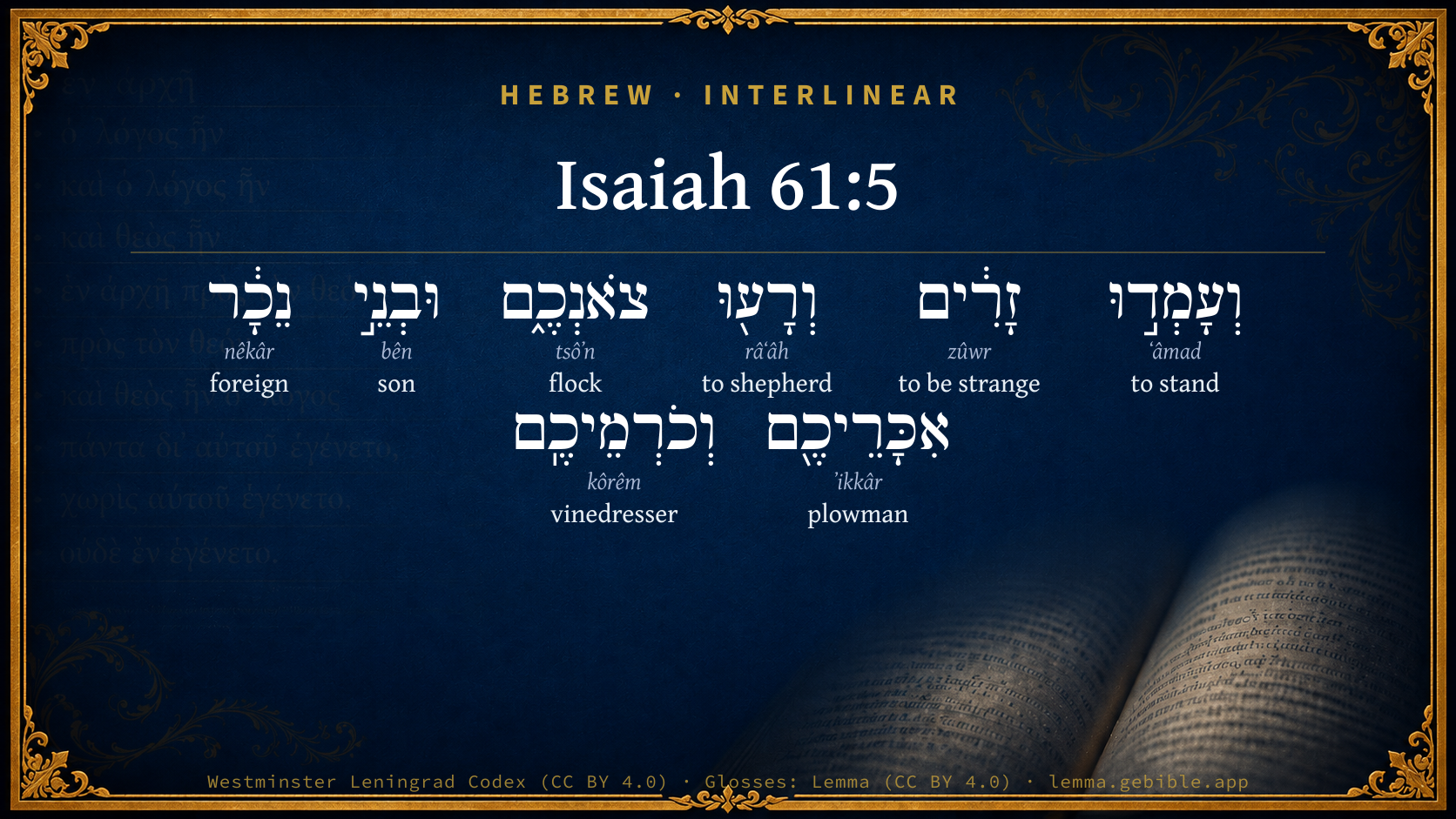
Isaiah 61:5

Hebrew (Westminster Leningrad Codex) Isaiah 61:5 appears in the Hebrew Old Testament. The text above is from the Westminster Leningrad Codex. Each word links to its Strong’s number, a concise gloss, and parsing drawn from the Open Scriptures Hebrew Bible morphology. Click any word for its full Brown-Driver-Briggs (BDB) entry.
Download image
Cite this verse

Isaiah 61:5 (World English Bible). Public Domain. Lemma interlinear Bible study tool, https://lemma.gebible.app/v/isaiah/61/5.

Show BibTeX & RIS
BibTeX
RIS
English Translation
Strangers shall stand and feed your flocks, and foreigners shall be your plowmen and your vine-dressers.
World English Bible · Public Domain
Download a study sheet

One document with this verse’s original text, its word-by-word gloss line, the meaning frame, cross-references with their text, attributed commentary, and full source and license credits — printable, and it pastes into notes with its structure intact.

This verse Autodidact and up

Study sheet (.html) Plain text (.txt)

A passage Seminary Student

Up to 50 verses in one chapter. A passage sheet keeps up to 6 commentary sources and 12 cross-references per verse, in the order this page ranks them, and says so on the sheet whenever that leaves anything out. Ask for a single verse and you get the Autodidact verse sheet above.

Everything on this page stays free to read, with no account — the sheet is a download of what is already on screen, not access to it.

Want to remove ads? Support Godless Engineer
Compare translations 3

The same verse in 3 English versions, stacked beneath the original-language interlinear above. Click any original word for its lexicon entry.

Each is an independent rendering of the whole verse — the interlinear is not word-aligned to these translations.

Highlighted words mark where these versions differ — a whole-verse word diff, not a word-by-word alignment.

  • World English Bible Public Domain
    Strangers shall stand and feed your flocks, and foreigners shall be your plowmen and your vine-dressers.
  • King James Version Public Domain
    And strangers shall stand and feed your flocks, and the sons of the alien shall be your plowmen and your vinedressers.
  • unfoldingWord Literal Text CC BY-SA 4.0
    And foreigners will stand and will shepherd your flocks, and sons of foreignness your farmers and your vinedressers.

unfoldingWord Literal Text — © unfoldingWord, licensed CC BY-SA 4.0. Word-aligned USFM3 via Door43 (git.door43.org/unfoldingWord/en_ult).

Versions to compare (up to 4)

3 of 4 selected

Show all 18 translations

Every available English version of this verse, each an independent rendering of the whole verse.

  • World English Bible Public Domain
    Strangers shall stand and feed your flocks, and foreigners shall be your plowmen and your vine-dressers.
  • Berean Standard Bible Public Domain
    Strangers will stand and feed your flocks, and foreigners will be your plowmen and vinedressers.
  • Majority Standard Bible Public Domain
    Strangers will stand and feed your flocks, and foreigners will be your plowmen and vinedressers.
  • King James Version Public Domain
    And strangers shall stand and feed your flocks, and the sons of the alien shall be your plowmen and your vinedressers.
  • American Standard Version (1901) Public Domain
    And strangers shall stand and feed your flocks, and foreigners shall be your plowmen and your vine-dressers.
  • Revised Version (1885) Public Domain
    And strangers shall stand and feed your flocks, and aliens shall be your plowmen and your vinedressers.
  • Geneva Bible (1599) Public Domain
    And the strangers shall stande and feede your sheepe, and the sonnes of the strangers shall be your plowmen and dressers of your vines.
  • Douay-Rheims (1899) Public Domain
    And strangers shall stand and shall feed your flocks: and the sons of strangers shall be your husbandmen, and the dressers of your vines.
  • Young's Literal Translation Public Domain
    And strangers have stood and fed your flock, Sons of a foreigner `are' your husbandmen, And your vine-dressers.
  • Literal Standard Version CC BY-SA 4.0
    And strangers have stood and fed your flock, || And the sons of a foreigner || [Are] your farmers and your vinedressers.
  • Unlocked Literal Bible CC BY-SA 4.0
    Foreigners will stand and feed your flocks, and sons of foreigners will work your fields and vineyards.
  • unfoldingWord Literal Text CC BY-SA 4.0
    And foreigners will stand and will shepherd your flocks, and sons of foreignness your farmers and your vinedressers.
  • Darby Bible Public Domain
    And strangers shall stand and feed your flocks, and the sons of the alien shall be your ploughmen and your vinedressers.
  • World Messianic Bible Public Domain
    Strangers will stand and feed your flocks. Foreigners will work your fields and your vineyards.
  • Webster's Bible Public Domain
    And strangers shall stand and feed your flocks, and the sons of the alien shall be your plowmen and your vine-dressers.
  • Free Bible Version CC BY-SA 4.0
    Foreigners will shepherd your flocks, and take care of your fields, and look after your vineyards.
  • Bible in Basic English Public Domain
    And men from strange countries will be your herdsmen, and those who are not Israelites will be your ploughmen and vine-keepers.
  • JPS Tanakh (1917) Public Domain
    And strangers shall stand and feed your flocks, and aliens shall be your plowmen and your vinedressers.

Literal Standard Version (2020), Covenant Press — licensed CC BY-SA 4.0. Text via the HelloAO Bible API (eBible.org). Unlocked Literal Bible (unfoldingWord) — licensed CC BY-SA 4.0. Text via the HelloAO Bible API (eBible.org). unfoldingWord Literal Text — © unfoldingWord, licensed CC BY-SA 4.0. Word-aligned USFM3 via Door43 (git.door43.org/unfoldingWord/en_ult). Free Bible Version, Dr. Jonathan Gallagher — licensed CC BY-SA 4.0. Text via the HelloAO Bible API (eBible.org).

Word by word

More ways to search: Search by grammar → Find every occurrence → Compare this word →

Practice this passage: Drill this verse → Learn its vocabulary →

וְכֹרְמֵיכֶֽם
kôrêm
H3755
“and · vinedressers · your”
Conjunction + Noun, Common, Masculine, Plural, Construct + Suffix, Personal, 2nd Person, Masculine, Plural
Part of Speech
Conjunction + Noun
Type
Common
Gender
Masculine
Number
Plural
State
Construct
Full BDB Definition

Origin: act. participle of an imaginary denominative from H3754

TWOT: 1040

to tend vines or vineyards, to dress vines or vineyards - (Qal) vinedressers (participle)
  1. וְעָמְד֣וּ ʻâmad H5975 “and · to stand” Conjunction + Verb, Qal, Sequential Perfect, 3rd Person, Common, Plural
  2. זָרִ֔ים zûwr H2114 “strange” Adjective, Adjective, Masculine, Plural, Absolute
  3. וְרָע֖וּ râʻâh H7462 “and · to shepherd” Conjunction + Verb, Qal, Sequential Perfect, 3rd Person, Common, Plural
  4. צֹאנְכֶ֑ם tsôʼn H6629 “flock · your” Noun, Common, Both, Singular, Construct + Suffix, Personal, 2nd Person, Masculine, Plural
  5. וּבְנֵ֣י bên H1121 “and · sons of” Conjunction + Noun, Common, Masculine, Plural, Construct
  6. נֵכָ֔ר nêkâr H5236 “foreign” Noun, Common, Masculine, Singular, Absolute
  7. אִכָּרֵיכֶ֖ם ʼikkâr H406 “plowmen · your” Noun, Common, Masculine, Plural, Construct + Suffix, Personal, 2nd Person, Masculine, Plural

About this verse

These counts appear in no published source. They are computed here, from the morphology-tagged text and Lemma’s own curated glosses. What Lemma adds →

8
words
8
distinct lemmas
Prophets
section

Notable vocabulary

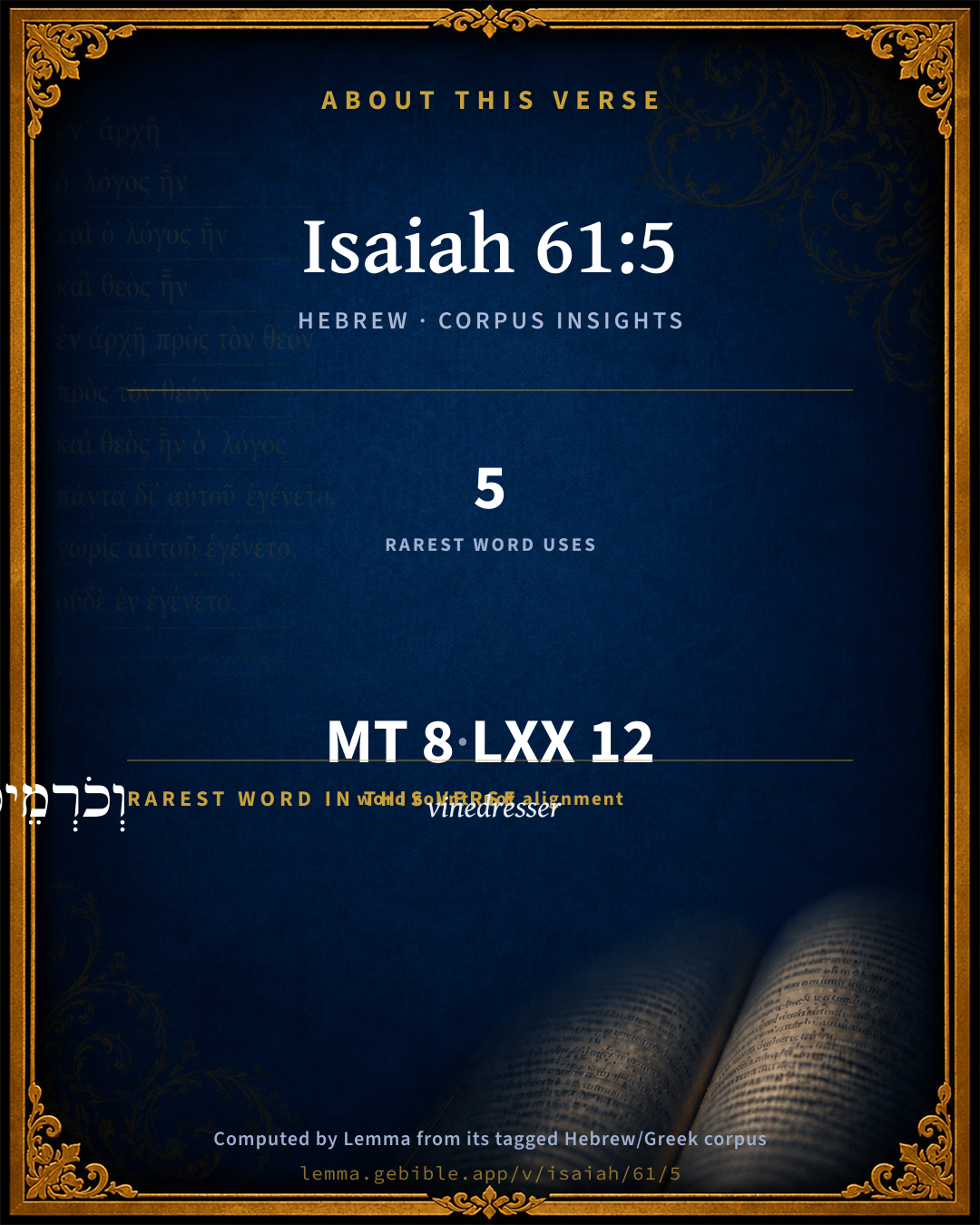
The rarest word here is וְכֹרְמֵיכֶֽם vinedresser H3755 — appearing just 5 times in the whole Hebrew Bible.

Shared distinctive vocabulary

וְכֹרְמֵיכֶֽם vinedresser H3755 occurs in 5 verses of the Hebrew Bible. Also found in:

Grammatical profile

  • 2 verbs
  • 5 nouns
  • 1 adjective

Verb forms

  • וְעָמְד֣וּ Qal · Sequential Perfect
  • וְרָע֖וּ Qal · Sequential Perfect

Hebrew & Septuagint length

In English translation the verse runs 16 words from the Hebrew and 16 from the Septuagint (LXX English) — the same length.

A rough comparison of the two English renderings, which tokenize alike — not a word-level alignment.

Word counts can differ between the Hebrew and the Greek without any difference in meaning — e.g. the Hebrew direct-object marker אֵת has no separate Greek word, and Greek often adds the article ὁ.

In the original languages it is 8 Hebrew tokens and 12 Greek tokens — but the two are counted differently (Hebrew bundles its prefixes and suffixes into one token; the Greek is in lemma form), so that isn’t a like-for-like length.

Cross-references

3

Topical passages linked to Isaiah 61:5 in the Treasury of Scripture Knowledge — connected by theme and wording, ordered by reader-vote popularity; previews shown in the World English Bible.

  • Isaiah 60:10–14 Foreigners shall build up your walls, and their kings shall minister to you: for in my wrath I struck you, but in my favor have I had mercy on you.
  • Isaiah 14:1–2 For Yahweh will have compassion on Jacob, and will yet choose Israel, and set them in their own land: and the foreigner shall join himself with them, and they shall cleave to the house of Jacob.
  • Ephesians 2:12–20 that you were at that time separate from Christ, alienated from the commonwealth of Israel, and strangers from the covenants of the promise, having no hope and without God in the world.

Cross-references courtesy of OpenBible.info (CC BY 4.0).

Hebrew and Greek witnesses Masoretic Hebrew ↔ Greek Septuagint

The same verse in the two great witnesses to the Old Testament, shown verse-for-verse.

These are two independent witnesses, not word-aligned to each other, and the Septuagint is shown in lemma (dictionary) form.

Hebrew Isaiah 61:5 Masoretic · Westminster Leningrad Codex

וְעָמְד֣וּ זָרִ֔ים וְרָע֖וּ צֹאנְכֶ֑ם וּבְנֵ֣י נֵכָ֔ר אִכָּרֵיכֶ֖ם וְכֹרְמֵיכֶֽם

Strangers shall stand and feed your flocks, and foreigners shall be your plowmen and your vine-dressers.

World English Bible · Public Domain

Greek LXX Isaiah 61:5 Septuagint · lemma form

καί ἥκω ἀλλογενής ποιμαίνω ὁ πρόβατον σύ καί ἀλλόφυλος ἀροτήρ καί ἀμπελουργός

And strangers shall come and feed your flocks, and aliens shall be your plowmen and vine-dressers.

LXX2012 (modern English Septuagint) · Public Domain

Hebrew: Westminster Leningrad Codex (CC BY 4.0). Greek: Septuagint (public domain); English from LXX2012 (modern English Septuagint) (Public Domain). How the Septuagint differs from the Hebrew →

Targum (Aramaic paraphrase)

1

The Targum is the ancient Jewish Aramaic paraphrase of the Hebrew Scriptures — an interpretive translation, not the Hebrew text itself. Onkelos (literal) and Pseudo-Jonathan (expansive) render the Torah, and Jonathan the Prophets. Coverage is partial: where no permissively-licensed English translation exists for a verse, only the Aramaic is shown. This is verse-level text, not a word-by-word alignment to the Hebrew.

  1. Targum Jonathan Prophets (Joshua–Malachi)
    וִיקוּמוּן נוּכְרָאִין וְיִרְעוּן עָנְכוֹן וּבְנֵי עַמְמַיָא אִכָּרֵיכוֹן וּמְפַלְחֵי כַּרְמֵיכוֹן:

    And strangers shall stand and feed your flocks, and the sons of the Gentiles shall be your plowmen, and they shall dress your vineyards.

    Targum Jonathan — Aramaic: “Mikraot Gedolot” (public domain). English: “Sefaria Community Translation” (CC0 1.0 (public-domain dedication)); “London "Chaldee Paraphrase," 1871” (public domain). Text via Sefaria.

Commentary

Notes on Isaiah 61:5 from classic Christian and Jewish commentators (each source and its license shown beneath its notes). The classic Christian expositions comment on the surrounding passage and are grouped to its opening verse, so a note may address several verses; the Jewish commentaries on the Tanakh (Rashi and others) are per-verse, so they appear only where the commentator wrote on this verse.

Lemma curates 59 commentaries, every one of them public domain or Creative Commons licensed, each selected and text-cleaned for this edition rather than reprinted as found. About our sources →

Trapp's Complete Commentary

John Trapp

Isa 61:5 And strangers shall stand and feed your flocks, and the sons of the alien [shall be] your plowmen and your vinedressers.

Ver. 5. And strangers shall stand and feed your flocks,] i.e., Shall be very well pleased to serve you, so they may serve the true God with you: yea, being proselyted, they shall become eminent pastors and teachers of the gospel; such as were Justin Martyr, Cyprian, Augustine, &c.

Shall be your ploughmen.] See 1Co 3:9.

John Trapp, A Commentary or Exposition upon All the Books of the Old and New Testament (1647–1656) — public domain. Text from a community e-Sword module.

Geneva Bible (1599)

Geneva Bible translators

They shall be ready to serve you in all your necessities.

Geneva Bible (1599) marginal notes — public domain. Text via Bolls.life.

Jamieson, Fausset & Brown

Robert Jamieson, A. R. Fausset & David Brown

stand--shall wait on you as servants (Isa 14:1-2; Isa 60:10).

Jamieson, Fausset & Brown — Commentary Critical and Explanatory on the Whole Bible (1871) — public domain (CC PDM 1.0). Text via the HelloAO Bible API.

Adam Clarke's Commentary

Verse 5. Strangers shall - feed your flocks] Gentiles shall first preach to you the salvation of Christ, and feed with Divine knowledge the Jewish congregations.

Adam Clarke's Commentary on the Bible (1810–1826) — public domain. Text from a community e-Sword/MySword module.

Ellicott's Commentary for English Readers

(5) Strangers shall stand . . .—i.e., like servants waiting for their master’s orders. The implied thought of the whole passage is, as in the next verse, that all Israel is raised to the dignity of a priestly caste, leaving the rough work of the world to be done by foreigners, who stood on a lower level. (Comp. Sir_38:31-34.)

A Bible Commentary for English Readers, edited by Charles John Ellicott (1878–1897) — public domain. Text from a community e-Sword module.

The Cambridge Bible for Schools and Colleges

gen. ed. J. J. S. Perowne

5. the sons of the alien] Render with R.V. aliens (as ch. Isa_56:3).

5, 6. Israel’s priesthood among the nations, and the services rendered to it by the latter. The meaning of course is not that all Israelites shall minister in the Temple or that a separate sacerdotal order shall not exist (see on the contrary ch. Isa_66:21) but simply that in relation to the Gentiles, Israel shall enjoy a position of privilege analogous to the relation between priests and laymen. The fundamental idea of priesthood in the O.T. being the right of approach to God, this idea is conceived as realised in a system which may be likened to a series of concentric circles,—priests, Levites, ordinary Israelites, Gentiles,—each grade standing nearer to God than the next. It was Israel’s calling to be a “kingdom of priests” (Exo_19:6), and in the latter days this destiny will be fulfilled in their mediatorial relation to the outer world. Although prophecy in general accords a position of supremacy to Israelites in the future kingdom of God, the distinction is perhaps nowhere so definitely formulated as here.

The Cambridge Bible for Schools and Colleges (gen. ed. J. J. S. Perowne; Cambridge University Press, 1878–1918) — public domain. Text from a community e-Sword module.

John Gill's Exposition

And strangers shall stand and feed your flocks,.... The several congregated churches of Christ, which shall be set among them, compared to flocks of sheep, as they often are; and which shall be fed with knowledge and understanding, with the words of faith and sound doctrine, by pastors of the Gentile race; who shall be raised up by Christ, and shall freely, and faithfully, and constantly perform the office they are called unto; see Act 20:28,

and the sons of the alien shall be your ploughmen, and your vinedressers: the sons of Gentiles, who were aliens from the commonwealth of Israel, and strangers to the covenants of promise, Eph 2:12, but now being converted and brought to the knowledge of Christ, and gifted by him, will be of eminent service in his church; which, as it is "God's husbandry", Co1 3:9 shall be filled and cultivated by them; the fallow ground of men's hearts shall be ploughed up by them, with the plough of the Gospel the Lord succeeding their labours; and the seed of the word sown in them, which, by the blessing of God, shall take root, spring up, and bring forth fruit. And whereas the church of God is compared to a vineyard, and particular churches of Christ to vines; such men as are called by grace from among the Gentiles, and have received gifts from Christ, shall be the keepers and dressers of these vines, plant, and prune, and water them, and do everything requisite unto them; see Sol 2:15.

John Gill's Exposition of the Whole Bible (1746–1763) — public domain (CC PDM 1.0). Text via the HelloAO Bible API.

Albert Barnes' Notes on the Bible

And strangers shall stand - (See the notes at Isa 14:1-2; Isa 60:10).

And feed your flocks - The keeping of flocks constituted a very considerable part of the husbandry of those who dwelt in Palestine. Of course, any considerable prosperity of a spiritual nature would be well represented by an accession of foreigners, who should come to relieve them in their toil. It is not necessary to suppose that this is to be taken literally, nor that it should be so spiritualized as to suppose that the prophet refers to churches and their pastors, and to the fact, that those churches would be put under the care of pastors from among the pagan. The idea is, that it would be a time of signal spiritual prosperity, and when the accession would be as great and important as if foreigners were to come in among a people, and take the whole labor of attending their flocks and cultivating their fields.

Your plowmen - Hebrew, אכר 'ikkâr, from which probably is derived the Greek ἀγρός agros; the Gothic akr; the German acker; and the English acre. It means properly a digger or cultivator of the soil, or farmer Jer 51:26; Amo 5:16.

And vine-dressers - The sense here accords with that which has been so repeatedly said before, that the pagan world would yet become tributary to the church (see the notes at Isa 9:5-7, Isa 9:9-10).

Albert Barnes' Notes on the Bible (1834–1885) — public domain. Text from a community e-Sword/MySword module.

Haydock's Catholic Bible Commentary

Vines. Bishops were soon chosen from among the Gentiles. The Machabees subdued the neighbouring nations, 1 Machabees xv. 28.

George Leo Haydock (1774–1849), Haydock's Catholic Family Bible and Commentary, 1859 edition — public domain. Excludes Psalms (Douay-Rheims chapter numbering differs from Protestant) and Deuterocanonical books (Catholic canon only).

Matthew Poole's English Annotations

Strangers, viz. Gentiles, such as are not of, the natural race of the Jews, but Gentile converts. Or such as shall have no more than an outward profession, strangers to tho true work of grace.

Shall stand; ready to be at thy service; a like expression Isa 48:13.

Feed your flocks, the churches, with, the word of God. The sons of the alien; the same with strangers, or their successors.

Shall be your ploughmen and your vine-dressers: as the words describe the prosperous estate of the Jews, the meaning of them is, that they should be in such a flourishing and prosperous condition, that without their own labour they should have all inferior offices executed, either by slaves taken in war, or by persons hired for reward, which they should have riches and wealth enough to accomplish; but as they principally relate to the spiritual state of the church, so probably by strangers we may understand converted Gentiles, with their successors, meant by the

sons of aliens, which should be ready to discharge all offices for the advantage of the church, feeding the flocks, viz. the churches of Christ, with the word of God, and should manage the whole work of God’s spiritual husbandry therein: see 1Co 3:6-9. Or by strangers may be meant members of the church only by an outward profession, even they shall be some way serviceable to her in ordinary and inferior matters: The earth shall help the woman, Rev 12:16.

Matthew Poole's English Annotations on the Holy Bible (1683–1685) — public domain. Text from a community e-Sword/MySword module.

Whedon's Commentary on the Bible

Daniel D. Whedon

5. Strangers… sons of the alien — That is, Gentiles converted to the true religion.

Your flocks — The keeping of flocks was a large husbandry in Palestine. The employment of Gentile keepers denotes a breaking down of “the middle wall of partition.” All have become Christians together. All are now strong and willing workers together in the world’s great pasture-field add vineyard. Other meaning than spiritual this verse has not.

Daniel D. Whedon (gen. ed.), Commentary on the Old and New Testaments (1874–1909) — public domain. Text from a community e-Sword module.

The Pulpit Commentary

Strangers shall stand and feed your flocks. (comp. Isa_14:1, 2 45:14 60:10) The Gentiles who join themselves with the Jews, and form with them one community, are constantly represented in the writings of Isaiah as occupying a subordinate position. In the New Testament, Jew and Gentile are put upon a par. Is the explanation that Isaiah assumes that the Jews generally will accept the gospel, and therefore, to some extent, retain their privileges in the new community, whereas, in fact, they rejected the gospel, and so lost their natural position? (Rom_11:7-20) Or does Isaiah look onward to a later date? And is there to be a restoration of "Israel according to the flesh" upon their conversion, and a reinstatement of them in a position of privilege? Such a condition of things seems glanced at in Rom_11:23-29, and in Rev_7:4-9 Rev_14:1. The sons of the alien shall be your ploughmen and your vinedressers. Not so much compelled, like the Gibeonites, (Jos_9:21-27) to perform menial offices, as undertaking them voluntarily out of good will.

The Pulpit Commentary (1880–1919), ed. H.D.M. Spence-Jones & Joseph S. Exell — public domain. Text from a community e-Sword module.

John Wesley's Explanatory Notes

Strangers - Gentiles, such as are not of the natural race of the Jews, but Gentile converts. Or, such as shall have no more than an outward profession. Stand - Ready to be at thy service. Flocks - The churches with the word of God. Plow-men - Shall manage the whole work of God's spiritual husbandry.

John Wesley, Explanatory Notes Upon the Whole Bible (1754–1765) — public domain. Text via the GEBible commentary corpus.

J. A. Alexander on Isaiah

Joseph Addison Alexander

“Then shall stand strangers and feed your flocks, and the children of out-land (shall be) your ploughmen and your vinedressers.” As to the meaning of this prophecy, interpreters are much divided. Some seem to take it in the strictest sense as a promise that the heathen should be slaves to the Jews. (See above, on Isa 14:2). Others understand it as meaning that the Jews should confine themselves to spiritual services, and leave mere secular pursuits to the Gentiles. Nearly allied to this is the explanation that the Jews and Gentiles are described as sustaining the relation of priests and laymen to each other. Some qualify it still more by describing the relation to be that of the Levites to the other tribes, and even this restricted by the promise in Isa 66:21. But that verse shows conclusively that no exclusive promise of Levitical or sacerdotal rank to the Jews, as distinguished from the Gentiles, can be here intended. This is confirmed by the language of Peter, who applies the promise of the next verse to the Christian church (1Pe 2:5). The only way in which all these seeming discrepancies can be reconciled, is by supposing, as we have done hitherto, that even in Exo 19:6 the promise is addressed to Israel not as a nation but a church; so that when the Jewish people ceased to bear this character, they lost all claim to the fulfillment of the promise, which is still in force and still endures to the benefit of those to whom it was originally given, namely, the Israel of God, that is to say, His church or chosen people. That the holders of this office might in strict accordance with the usage of Scripture and of this book be described as shepherds, husbandmen, and vinedressers, may be seen by a comparison of Isa 3:14; Isa 5:1; Isa 11:6; Isa 27:2; Isa 30:23-24; Isa 40:11 with Act 20:28; 1Co 3:9; 1Co 9:7, and with the imagery of our Savior’s parables. It does not follow necessarily, however, that the office here assigned to strangers and foreigners is that of spiritual guides, much less that they are doomed to a degrading servitude. The simplest explanation of the verse is that which understands it as descriptive not of subjugation but of intimate conjunction, as if he had said, those who are now strangers and foreigners shall yet be sharers in your daily occupations and entrusted with your dearest interests. By strangers we are then to understand not Gentiles as opposed to Jews, but all who have been aliens from the covenant of mercy and the church of God.

Joseph Addison Alexander, The Prophecies of Isaiah (1846–1847; New York: Scribner, 1870–1878) — public domain. Text from a community e-Sword module.

Rashi

Rabbi Shlomo Yitzchaki (Rashi)

your plowmen Heb. אִכָּרֵיכֶם, those who lead the plow.

Rashi on the Tanakh — English translations: “The Judaica Press complete Tanach with Rashi, translated by A. J. Rosenberg” (CC BY 4.0); “Pentateuch with Rashi's commentary by M. Rosenbaum and A.M. Silbermann, 1929-1934” (public domain); “The Metsudah Tanach series, Lakewood, N.J” (CC BY 4.0); and “The Book of Joshua, Metsudah Publications, 1997” (CC BY 4.0). Text via Sefaria.

Ibn Ezra

Rabbi Abraham ibn Ezra

And strangers shall stand before you like servants.

אבריכם Your ploughmen. אִבָּר is an adjective, meaning tilling the field.

Ibn Ezra on the Tanakh — English translations: “Sefaria Community Translation” (CC0 1.0 (public-domain dedication)); “Yalkut, Sifsei Chachomim Chumash, Metsudah Publications, 2009” (CC BY 4.0); and “Commentary of Ibn Ezra on Isaiah - trans. by M. Friedlander, 1873” (public domain). Text via Sefaria.

Lesson kit

Teaching starters — assembled from the data on this page, not authored interpretation. Every prompt links to the verse data it draws on. Edit before teaching.

Isaiah, in the Prophets, opens this verse with 8 words (8 distinct Hebrew lemmas). Its most distinctive word is kôrêm (“vinedresser”). A historical commentator’s framing appears above. Read the whole chapter for the surrounding context.

Discussion questions

  1. What does “vinedresser” (kôrêm) contribute to the verse as a whole?
  2. How does 2 Kings 25:12, which shares the word «vinedresser», read alongside this verse?
  3. These translations render this verse differently. What is at stake in choosing one wording over another?
  4. «וְעָמְד֣וּ» is a Qal Sequential Perfect verb. How does that grammatical form shape the action described?
  5. Compare how Trapp's Complete Commentary and Geneva Bible (1599) read this verse. Where do they agree or differ?

Things to notice

Reading settings

Reading text

Shown beneath each verse's original-language words.

Old Testament
Old Testament edition

Read the OT as the Masoretic Hebrew (MT) or the Greek Septuagint (LXX).

English shown for the Greek Septuagint (in the Hebrew ↔ Greek comparison).

Comparing translations? Open the Compare panel on any verse page to stack up to four side by side.