
1 Kings 1:9

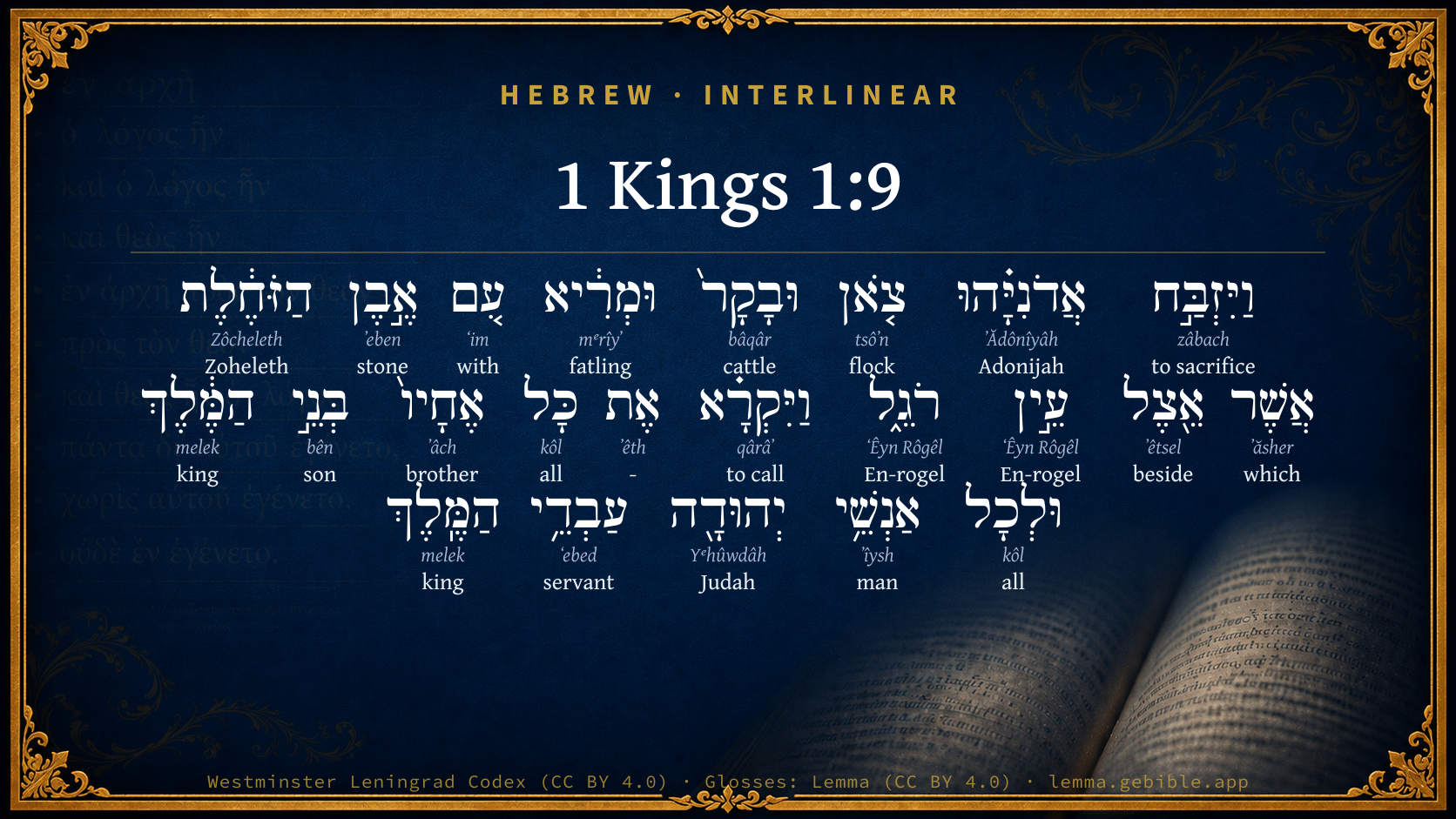
Hebrew (Westminster Leningrad Codex) 1 Kings 1:9 appears in the Hebrew Old Testament. The text above is from the Westminster Leningrad Codex. Each word links to its Strong’s number, a concise gloss, and parsing drawn from the Open Scriptures Hebrew Bible morphology. Click any word for its full Brown-Driver-Briggs (BDB) entry.
Download image
Cite this verse

1 Kings 1:9 (World English Bible). Public Domain. Lemma interlinear Bible study tool, https://lemma.gebible.app/v/1-kings/1/9.

Show BibTeX & RIS
BibTeX
RIS
English Translation
Adonijah killed sheep and oxen and fatlings by the stone of Zoheleth, which is beside En Rogel; and he called all his brothers, the king's sons, and all the men of Judah, the king's servants:
World English Bible · Public Domain
Highlights
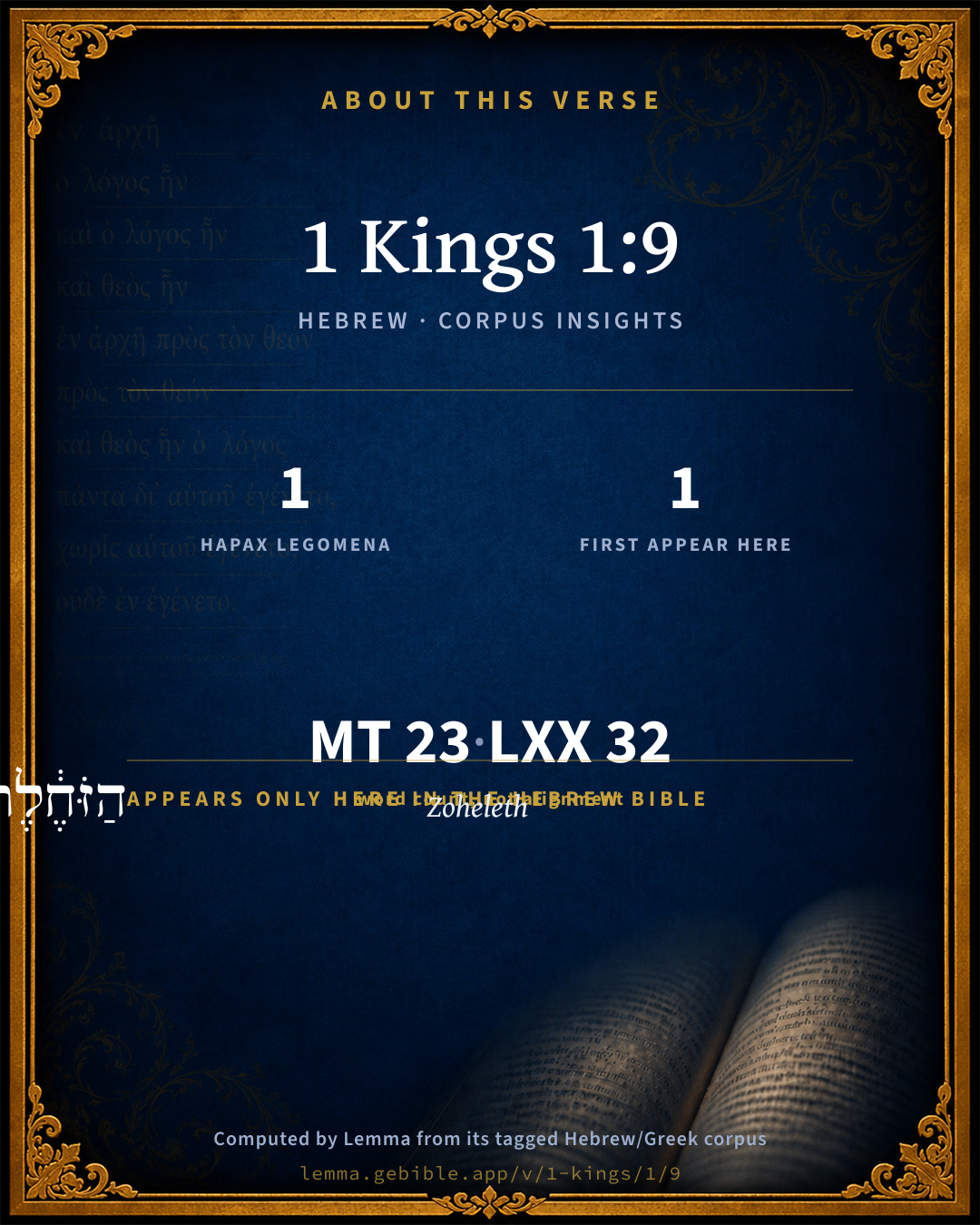
  • 1 hapax legomenon — only here in the Hebrew Bible
  • 1 first appearance in the Hebrew Bible
Full analysis ↓
Download a study sheet

One document with this verse’s original text, its word-by-word gloss line, the meaning frame, cross-references with their text, attributed commentary, and full source and license credits — printable, and it pastes into notes with its structure intact.

This verse Autodidact and up

Study sheet (.html) Plain text (.txt)

A passage Seminary Student

Up to 50 verses in one chapter. A passage sheet keeps up to 6 commentary sources and 12 cross-references per verse, in the order this page ranks them, and says so on the sheet whenever that leaves anything out. Ask for a single verse and you get the Autodidact verse sheet above.

Everything on this page stays free to read, with no account — the sheet is a download of what is already on screen, not access to it.

Want to remove ads? Support Godless Engineer
Compare translations 3

The same verse in 3 English versions, stacked beneath the original-language interlinear above. Click any original word for its lexicon entry.

Each is an independent rendering of the whole verse — the interlinear is not word-aligned to these translations.

Highlighted words mark where these versions differ — a whole-verse word diff, not a word-by-word alignment.

  • World English Bible Public Domain
    Adonijah killed sheep and oxen and fatlings by the stone of Zoheleth, which is beside En Rogel; and he called all his brothers, the king's sons, and all the men of Judah, the king's servants:
  • King James Version Public Domain
    And Adonijah slew sheep and oxen and fat cattle by the stone of Zoheleth, which is by Enrogel, and called all his brethren the king's sons, and all the men of Judah the king's servants:
  • unfoldingWord Literal Text CC BY-SA 4.0
    And Adonijah sacrificed sheep and cattle and fatling at the stone of Zoheleth, which near En Rogel. And he called all of his brothers, the sons of the king, and to all of the men of Judah, the servants of the king.

unfoldingWord Literal Text — © unfoldingWord, licensed CC BY-SA 4.0. Word-aligned USFM3 via Door43 (git.door43.org/unfoldingWord/en_ult).

Versions to compare (up to 4)

3 of 4 selected

Show all 18 translations

Every available English version of this verse, each an independent rendering of the whole verse.

  • World English Bible Public Domain
    Adonijah killed sheep and oxen and fatlings by the stone of Zoheleth, which is beside En Rogel; and he called all his brothers, the king's sons, and all the men of Judah, the king's servants:
  • Berean Standard Bible Public Domain
    And Adonijah sacrificed sheep, oxen, and fattened calves near the stone of Zoheleth, which is next to En-rogel. He invited all his royal brothers and all the men of Judah who were servants of the king.
  • Majority Standard Bible Public Domain
    And Adonijah sacrificed sheep, oxen, and fattened calves near the stone of Zoheleth, which is next to En-rogel. He invited all his royal brothers and all the men of Judah who were servants of the king.
  • King James Version Public Domain
    And Adonijah slew sheep and oxen and fat cattle by the stone of Zoheleth, which is by Enrogel, and called all his brethren the king's sons, and all the men of Judah the king's servants:
  • American Standard Version (1901) Public Domain
    And Adonijah slew sheep and oxen and fatlings by the stone of Zoheleth, which is beside En-rogel; and he called all his brethren, the king's sons, and all the men of Judah, the king's servants:
  • Revised Version (1885) Public Domain
    And Adonijah slew sheep and oxen and fatlings by the stone of Zoheleth, which is beside En-rogel; and he called all his brethren the king’s sons, and all the men of Judah the king’s servants:
  • Geneva Bible (1599) Public Domain
    Then Adoniiah sacrificed sheepe and oxen, and fat cattel by the stone of Zoheleth, which is by En-rogel, and called all his brethren the kings sonnes, and al the men of Iudah ye Kings seruants,
  • Douay-Rheims (1899) Public Domain
    And Adonias having slain rams and calves, and all fat cattle by the stone of Zoheleth, which was near the fountain Rogel, invited all his brethren the king's sons, and all the men of Juda, the king's servants:
  • Young's Literal Translation Public Domain
    And Adonijah sacrificeth sheep and oxen and fatlings near the stone of Zoheleth, that `is' by En-Rogel, and calleth all his brethren, sons of the king, and for all the men of Judah, servants of the king;
  • Literal Standard Version CC BY-SA 4.0
    And Adonijah sacrifices sheep and oxen and fatlings near the stone of Zoheleth that [is] by En-Rogel, and calls all his brothers, sons of the king, and for all the men of Judah, servants of the king;
  • Unlocked Literal Bible CC BY-SA 4.0
    Adonijah sacrificed sheep, oxen, and fattened calves by the stone of Zoheleth, which is beside En Rogel. He invited all his brothers, the king's sons, and all the men of Judah, the king's servants.
  • unfoldingWord Literal Text CC BY-SA 4.0
    And Adonijah sacrificed sheep and cattle and fatling at the stone of Zoheleth, which near En Rogel. And he called all of his brothers, the sons of the king, and to all of the men of Judah, the servants of the king.
  • Darby Bible Public Domain
    And Adonijah sacrificed sheep and oxen and fatted cattle by the stone of Zoheleth, which is by En-rogel, and invited all his brethren, the king's sons, and all the men of Judah, the king's servants;
  • World Messianic Bible Public Domain
    Adonijah killed sheep, cattle, and fatlings by the stone of Zoheleth, which is beside En Rogel; and he called all his brothers, the king’s sons, and all the men of Judah, the king’s servants;
  • Webster's Bible Public Domain
    And Adonijah slew sheep, and oxen, and fat cattle, by the stone of Zoheleth, which is by En-rogel, and called all his brethren the king's sons, and all the men of Judah the king's servants:
  • Free Bible Version CC BY-SA 4.0
    Adonijah invited all his brothers, the king's sons, and the king's officials of Judah, to come to the stone of Zoheleth, which is near En-rogel, where he sacrificed sheep, cattle and fattened calves.
  • Bible in Basic English Public Domain
    Then Adonijah put to death sheep and oxen and fat beasts by the stone of Zoheleth, by En-rogel; and he sent for all his brothers, the king's sons, and all the men of Judah, the king's servants, to come to him:
  • JPS Tanakh (1917) Public Domain
    And Adonijah slew sheep and oxen and fatlings by the stone of Zoheleth, which is beside En-rogel; and he called all his brethren the king's sons, and all the men of Judah the king's servants;

Literal Standard Version (2020), Covenant Press — licensed CC BY-SA 4.0. Text via the HelloAO Bible API (eBible.org). Unlocked Literal Bible (unfoldingWord) — licensed CC BY-SA 4.0. Text via the HelloAO Bible API (eBible.org). unfoldingWord Literal Text — © unfoldingWord, licensed CC BY-SA 4.0. Word-aligned USFM3 via Door43 (git.door43.org/unfoldingWord/en_ult). Free Bible Version, Dr. Jonathan Gallagher — licensed CC BY-SA 4.0. Text via the HelloAO Bible API (eBible.org).

Word by word

More ways to search: Search by grammar → Find every occurrence → Compare this word →

Practice this passage: Drill this verse → Learn its vocabulary →

הַזֹּחֶ֔לֶת
Zôcheleth
H2120
“Zoheleth”
Noun, Proper
Part of Speech
Noun
Type
Proper
Full BDB Definition

Origin: act. participle of H2119

TWOT: None

Zoheleth = "serpent" - a boundary stone near Jerusalem where Adonijah slew sheep and oxen
  1. וַיִּזְבַּ֣ח zâbach H2076 “and · to sacrifice” Conjunction + Verb, Qal, Sequential Imperfect, 3rd Person, Masculine, Singular
  2. אֲדֹנִיָּ֗הוּ ʼĂdônîyâh H138 “Adonijah” Noun, Proper
  3. צֹ֤אן tsôʼn H6629 “flock” Noun, Common, Both, Singular, Absolute
  4. וּבָקָר֙ bâqâr H1241 “and · cattle” Conjunction + Noun, Common, Both, Singular, Absolute
  5. וּמְרִ֔יא mᵉrîyʼ H4806 “and · fatling” Conjunction + Noun, Common, Masculine, Singular, Absolute
  6. עִ֚ם ʻim H5973 “with” Preposition
  7. אֶ֣בֶן ʼeben H68 “stone of” Noun, Common, Feminine, Singular, Construct
  8. אֲשֶׁר ʼăsher H834 “which” Particle, Relative
  9. אֵ֖צֶל ʼêtsel H681 “beside” Preposition
  10. עֵ֣ין ʻÊyn Rôgêl H5883 “En-rogel” Noun, Proper
  11. רֹגֵ֑ל ʻÊyn Rôgêl H5883 “En-rogel” Noun, Proper
  12. וַיִּקְרָ֗א qârâʼ H7121 “and · to call” Conjunction + Verb, Qal, Sequential Imperfect, 3rd Person, Masculine, Singular
  13. אֶת ʼêth H853 “-” Particle, Direct Object
  14. כָּל kôl H3605 “all of” Noun, Common, Masculine, Singular, Construct
  15. אֶחָיו֙ ʼâch H251 “brothers · his” Noun, Common, Masculine, Plural, Construct + Suffix, Personal, 3rd Person, Masculine, Singular
  16. בְּנֵ֣י bên H1121 “sons of” Noun, Common, Masculine, Plural, Construct
  17. הַמֶּ֔לֶךְ melek H4428 “the · king” Particle, Definite Article + Noun, Common, Masculine, Singular, Absolute
  18. וּלְכָל kôl H3605 “and · to/for · all of” Conjunction + Preposition + Noun, Common, Masculine, Singular, Construct
  19. אַנְשֵׁ֥י ʼîysh H376 “men of” Noun, Common, Masculine, Plural, Construct
  20. יְהוּדָ֖ה Yᵉhûwdâh H3063 “Judah” Noun, Proper
  21. עַבְדֵ֥י ʻebed H5650 “servants of” Noun, Common, Masculine, Plural, Construct
  22. הַמֶּֽלֶךְ melek H4428 “the · king” Particle, Definite Article + Noun, Common, Masculine, Singular, Absolute

About this verse

These counts appear in no published source. They are computed here, from the morphology-tagged text and Lemma’s own curated glosses. What Lemma adds →

23
words
20
distinct lemmas
Historical
section

Notable vocabulary

1 hapax legomenon — a word that appears only here in the entire Hebrew Bible:

  • הַזֹּחֶ֔לֶת Zoheleth H2120

First appearance in Scripture

This word makes its first canonical appearance in the Hebrew Bible here:

  • הַזֹּחֶ֔לֶת Zoheleth H2120

Shared distinctive vocabulary

וּמְרִ֔יא fatling H4806 occurs in 8 verses of the Hebrew Bible. Also found in:

Grammatical profile

  • 2 verbs
  • 17 nouns
  • 2 prepositions
  • 2 particles

Verb forms

  • וַיִּזְבַּ֣ח Qal · Sequential Imperfect
  • וַיִּקְרָ֗א Qal · Sequential Imperfect

Repetition

Words recur within this verse — often emphatic in Hebrew:

  • עֵ֣ין En-rogel H5883 ×2
  • כָּל all H3605 ×2
  • הַמֶּ֔לֶךְ king H4428 ×2

Hebrew & Septuagint length

In English translation the verse runs 35 words from the Hebrew and 34 from the Septuagint (LXX English) — closely comparable.

A rough comparison of the two English renderings, which tokenize alike — not a word-level alignment.

Word counts can differ between the Hebrew and the Greek without any difference in meaning — e.g. the Hebrew direct-object marker אֵת has no separate Greek word, and Greek often adds the article ὁ.

In the original languages it is 23 Hebrew tokens and 32 Greek tokens — but the two are counted differently (Hebrew bundles its prefixes and suffixes into one token; the Greek is in lemma form), so that isn’t a like-for-like length.

Cross-references

5

Topical passages linked to 1 Kings 1:9 in the Treasury of Scripture Knowledge — connected by theme and wording, ordered by reader-vote popularity; previews shown in the World English Bible.

  • 2 Samuel 17:17 Now Jonathan and Ahimaaz were staying by En Rogel; and a maid-servant used to go and tell them; and they went and told king David: for they might not be seen to come into the city.
  • Joshua 15:7 and the border went up to Debir from the valley of Achor, and so northward, looking toward Gilgal, that is over against the ascent of Adummim, which is on the south side of the river; and the border passed along to the waters of En Shemesh, and the goings out of it were at En Rogel;
  • 2 Samuel 13:23–27 It happened after two full years, that Absalom had sheep-shearers in Baal Hazor, which is beside Ephraim: and Absalom invited all the king's sons.
  • 2 Samuel 15:11–12 With Absalom went two hundred men out of Jerusalem, who were invited, and went in their simplicity; and they didn't know anything.
  • Proverbs 15:8 The sacrifice made by the wicked is an abomination to Yahweh, But the prayer of the upright is his delight.

Cross-references courtesy of OpenBible.info (CC BY 4.0).

Hebrew and Greek witnesses Masoretic Hebrew ↔ Greek Septuagint

The same verse in the two great witnesses to the Old Testament, shown verse-for-verse.

These are two independent witnesses, not word-aligned to each other, and the Septuagint is shown in lemma (dictionary) form.

Hebrew 1 Kings 1:9 Masoretic · Westminster Leningrad Codex

וַיִּזְבַּ֣ח אֲדֹנִיָּ֗הוּ צֹ֤אן וּבָקָר֙ וּמְרִ֔יא עִ֚ם אֶ֣בֶן הַזֹּחֶ֔לֶת אֲשֶׁר אֵ֖צֶל עֵ֣ין רֹגֵ֑ל וַיִּקְרָ֗א אֶת כָּל אֶחָיו֙ בְּנֵ֣י הַמֶּ֔לֶךְ וּלְכָל אַנְשֵׁ֥י יְהוּדָ֖ה עַבְדֵ֥י הַמֶּֽלֶךְ

Adonijah killed sheep and oxen and fatlings by the stone of Zoheleth, which is beside En Rogel; and he called all his brothers, the king's sons, and all the men of Judah, the king's servants:

World English Bible · Public Domain

Greek LXX 1 Kings 1:9 Septuagint · lemma form

καί θυσιάζω αδωνίας πρόβατον καί μόσχος καί ἀρνός μετά λίθος ὁ ζωελεθ ὅς εἰμί ἔχω ὁ πηγή ρωγηλ καί καλέω πᾶς ὁ ἀδελφός αὐτός καί πᾶς ὁ ἁδρός ιουδα παῖς ὁ βασιλεύς

And Adonias sacrificed sheep and calves and lambs by the stone of Zoelethi, which was near Rogel: and he called all his brethren, and all the adult men of Juda, servants of the king.

LXX2012 (modern English Septuagint) · Public Domain

On this verse, The Pulpit Commentary discusses the Septuagint’s reading. Read the note in Commentary ↓

Hebrew: Westminster Leningrad Codex (CC BY 4.0). Greek: Septuagint (public domain); English from LXX2012 (modern English Septuagint) (Public Domain). How the Septuagint differs from the Hebrew →

Targum (Aramaic paraphrase)

1

The Targum is the ancient Jewish Aramaic paraphrase of the Hebrew Scriptures — an interpretive translation, not the Hebrew text itself. Onkelos (literal) and Pseudo-Jonathan (expansive) render the Torah, and Jonathan the Prophets. Coverage is partial: where no permissively-licensed English translation exists for a verse, only the Aramaic is shown. This is verse-level text, not a word-by-word alignment to the Hebrew.

  1. Targum Jonathan Prophets (Joshua–Malachi)
    וּנְכֵיס אֲדוֹנִיָהוּ עָאן וְתוֹרִין וּפַטִימִין עִם אֶבֶן סְכוּתָא דִין בִּסְטַר עֵין קַצְרָא וְזַמִין יַת כָּל אֲחוֹהִי בְּנֵי מַלְכָּא וּלְכָל גַבְרֵי יְהוּדָה עַבְדֵי מַלְכָּא:

    (no public-domain English translation for this verse)

    Targum Jonathan — Aramaic: “Mikraot Gedolot” (public domain). English: “Sefaria Community Translation” (CC0 1.0 (public-domain dedication)); “London "Chaldee Paraphrase," 1871” (public domain). Text via Sefaria.

Commentary

Notes on 1 Kings 1:9 from classic Christian and Jewish commentators (each source and its license shown beneath its notes). The classic Christian expositions comment on the surrounding passage and are grouped to its opening verse, so a note may address several verses; the Jewish commentaries on the Tanakh (Rashi and others) are per-verse, so they appear only where the commentator wrote on this verse.

Lemma curates 59 commentaries, every one of them public domain or Creative Commons licensed, each selected and text-cleaned for this edition rather than reprinted as found. About our sources →

Trapp's Complete Commentary

John Trapp

1Ki 1:9 And Adonijah slew sheep and oxen and fat cattle by the stone of Zoheleth, which [is] by Enrogel, and called all his brethren the king’s sons, and all the men of Judah the king’s servants:

Ver. 9. And Adonijah slew sheep and oxen.] Hitherto all went ‘hail well’ with these gallants: and many a health, no doubt, was drunk to Adonijah: many a confident boast of their prosperous design, many a scorn of the despised faction of Solomon, &c. But the triumphing of the wicked is short. {Job 20:5} {See Trapp on "Job 20:5"}

John Trapp, A Commentary or Exposition upon All the Books of the Old and New Testament (1647–1656) — public domain. Text from a community e-Sword module.

The Pulpit Commentary

And Adonijah slew or sacrificed, LXX ejqusiasen. It was a sacrificial feast, like Absalom"s,. 2Sa_15:12 (where see Speaker"s note) Religious festivity, i.e., was the apparent object of their assembling: religion was invoked, not merely to cloke their designs, but to cement them together sheep and oxen and fat cattle by Hebrews with; same expression, 2Sa_20:8 the stone of Zoheleth, i.e. ,"the serpent" (Gesen.) "No satisfactory explanation has been given of this name" (Rawlinson). See Smith"s "Dict. Bible" sub voc., where the various interpretations are given. The stone, which served as "a natural altar for the sacrificial feast," the spring, which afforded "water for the necessary ablutions," and the situation with respect to the adjoining city recommended this place as a rendezvous which is by En-Rogel Jos_15:7 Jos_18:16; 2Sa_17:17. Perhaps "the spring of the spy." The Chald., Arab., and Syr. render "the spring, of the fuller the Orientals wash clothes, etc., by treading (rogel) them. Josephus says it was without the city, in the royal garden (ejn basilikw paradeisw). The authorities are divided between the "Fountain of the virgin" (Ain um ed-Deraj), and the "Well of Job" (Bir Eyub.) See the arguments in Bonar"s "Land of Promise," App. 5; Thomson"s "Land and Book," vol. 2 p. 528; and Mr. Grove"s Art. in Smith"s "Dict. Bib." Porter ("Handbook of Palestine") identifies En-Rogel with Bir Eyub without remark. There is much to be said on either side. The pool of Siloam ("Bib. Museum") has nothing in its favour and called all his brethren the king"s sons including, it would seem, even the elder sons of David and Bathsheba, who would bring up the number to fifteen. (1Ch_3:5) They too, if living, would naturally resent the preference of the youngest brother, and all the men of Judah, the king"s servants "all the Judeans who were serving at court, as being members of his own tribe" (Keil). The fierce jealousy between Ephraim and Judah would almost compel the king to surround himself with soldiers and attendants of the latter tribe. Some of the invited guests, no doubt, like Absalom"s two hundred, "went in their simplicity and knew not anything". (2Sa_15:11) Give therefore thy servant an understanding Heb. hearing. Cf. ver. 11 (Heb. "to hear judgment.") The idea is not docility, as the Vulg. (cor docile), but discrimination, penetration. Cf.; 2Sa_14:17 (Heb. Php_1:9, 10 (marg. heart i.e. , a judicial mind. The "hearing heart" was desired, not that it might "give heed to the law" (Keil), but to qualify him to Judge thy people The Hebrew king, like most ancient monarchs, was supreme judge as well as governor ("prince and judge," (Exo_5:14; and cf. Exo_18:16) The Jews desired a king that he might judge them. (1Sa_8:5) Their rulers so far had been purely "Judges" ( compare the Carthaginian name, suffetes. )

When they desired one who should, lead their armies, they still put his judicial functions in the first place (loc. cit. ver. 20). And what were the duties of a king in this respect, Absalom"s words (2Sa_15:4) show. In vers. 16-28 we see Solomon sitting as Chief Justice, that I may discern between good and bad i.e., right and wrong, true and false; cf.: Heb_5:14 for who is able to judge this thy so great Heb. heavy, i.e. , numerous; compare graves greges a people. The number of the Israelites at this period is referred to in 1Ki_4:20.

Vers. 9-13.

The wisdom of Solomon"s choice.

Solomon was never more kingly than when he made this choice. Subsequently he became enervated by prosperity, corrupted by heathen associations, etc., but now he ruled as a king over himself. The bright promise of life is often gradually overcast, till it ends in the gloom of a hopeless night. Examples from Scripture, e.g. , Saul the King, Esau. It is well to know the kind of choice that "pleased the Lord." In Solomon"s there was true wisdom, for it had these elements

I THE CHOICE WAS FOR THE GOOD OF OTHERS RATHER THAN FOR THE ADVANTAGE OF HIMSELF. It was not like asking for knowledge and wisdom that he might himself be admired as a sage. This followed, but this he did not seek. He wished to rule God"s people well for their good, and asked that he might do what was just in judgment, what was equitable in law. Such equity establishes any rule on a sure foundation. Our hold on India is chiefly due to the righteousness of our magistrates, and the trustworthiness of men like the Lawrences, Lord Mayo, etc. Natives would not hesitate to bring an action in one of our English law courts against an Englishman, so certain are they of even-handed justice. This Solomon sought, and the peace and prosperity of his kingdom (1Ki_4:25) arose from the fact that God gave it him. To ask God to make us wise and capable for the sake of others, is a prayer consonant with His will. Unselfishness is commended and exalted under the new dispensation as it never was under the old. Christ Himself came not to be ministered unto, but to minister, and to give His life "a ransom for many." The prayer of selfishness, greed, avarice, can never be put up in Christ"s name.

II THE CHOICE WAS MADE OF INWARD WORTH AND NOT OF OUTWARD SHOW. He did not ask for himself riches and honour. What will make us noble is always more readily given by God than what will make us wealthy. A wise father would rather that his son should be truthful than that he should win popularity among his schoolfellows by anything surreptitious and deceitful. So our heavenly Father cares little that we should make money, or win applause; but He cares much that we should be wise, and true, and loving; and these graces He will in no wise withhold from those who seek. Sometimes He answers our prayers for these inward blessings in modes we resent. The illness that throws us back upon Him, the failure that proves a man"s life does not consist in the abundance of things that he possesseth, etc., may work in us the peaceable fruits of righteousness. The Lord Jesus, who was at once the King of Glory and the village carpenter, showed us this; and in the inward gladness His disciples experienced amid their outward woes, we have confirmation of it. Show how, in New Testament history, and in the lives of the saints, the words which begin the Sermon on the Mount have been fulfilled. Blessedness of the highest kind comes to the poor in spirit, to them that mourn, to the meek, to them which do hunger and thirst after righteousness, to the merciful, to the pure in heart, to the peacemakers, and even to those who are persecuted for righteousness" sake.

III THE CHOICE MADE OF THE HIGHER BROUGHT WITH IT THE LOWER BLESSINGS, (Vers. 11-13) Because Solomon asked wisdom God gave him that, but added to it wealth and honour. If we ask grace to fulfil our mission, and rightly do our life work, our heavenly Father will see that we do not want for life"s necessities. "Seek ye first the kingdom of God, and his righteousness, and all these things shall be added unto you." The teaching of Christ (Mat_6:24-34) goes to show that a man who is chiefly concerned to please God need have no anxiety or care about lower things. If God feeds the birds, He will feed you; if He clothes the lilies, He will clothe you; if He gives the life, He will give the "meat" that is less than life. Ask God for the higher blessings: pardon, righteousness, reverence, wisdom, etc., and He will give you not only these, but all things necessary for us, and all the riches and honours that are good for us.

Solomon"s wisdom was great, but there has come into the world one greater than Solomon, more worthy far of our adoration and love. As the child in Nazareth, Jesus grew in wisdom, and in stature, and in favour with God and man. His wisdom was purer, deeper, truer than Solomon"s, because it was united with purity of life, with victory over sin, and with sacrifice of self. He is the true Shelomoh, "the Prince of Peace;" the true Jedidiah, "the well beloved of the Father;" and to Him now let us humbly bow the knee, as to One worthy to be exalted both as Prince and Saviour. A.R.

The Pulpit Commentary (1880–1919), ed. H.D.M. Spence-Jones & Joseph S. Exell — public domain. Text from a community e-Sword module.

Tyndale Open Study Notes

Tyndale Open Resources

1:9 En-rogel (modern Bir Ayyub, “Job’s well”) lay south of Jerusalem at the intersection of the Kidron and Hinnom valleys. Earlier, it harbored David’s two informants, Jonathan and Ahimaaz, during Absalom’s rebellion (see 2 Sam 17:17).

Tyndale Open Study Notes — © Tyndale Open Resources, licensed CC BY-SA 4.0. Text via the HelloAO Bible API.

Geneva Bible (1599)

Geneva Bible translators

Or, the fountains.

Geneva Bible (1599) marginal notes — public domain. Text via Bolls.life.

Jamieson, Fausset & Brown

Robert Jamieson, A. R. Fausset & David Brown

En-rogel--situated (Jos 15:7-10) east of Jerusalem, in a level place, just below the junction of the valley of Hinnom with that of Jehoshaphat. It is a very deep well, measuring one hundred twenty-five feet in depth; the water is sweet, but not very cold, and it is at times quite full to overflowing. The Orientals are fond of enjoying festive repasts in the open air at places which command the advantage of shade, water, and verdure; and those fetes champetres are not cold collations, but magnificent entertainments, the animals being killed and dressed on the spot. Adonijah's feast at En-rogel was one of this Oriental description, and it was on a large scale (Sa2 3:4-5; Sa2 5:14-16; Ch1 14:1-7). At the accession of a new king there were sacrifices offered (Sa1 11:15). But on such an occasion it was no less customary to entertain the grandees of the kingdom and even the populace in a public manner (1Ch. 12:23-40). There is the strongest probability that Adonijah's feast was purely political, to court popularity and secure a party to support his claim to the crown.

Jamieson, Fausset & Brown — Commentary Critical and Explanatory on the Whole Bible (1871) — public domain (CC PDM 1.0). Text via the HelloAO Bible API.

Adam Clarke's Commentary

Verse 9. Slew sheep and oven] Making a royal feast, in reference to his inauguration. As he had Abiathar the priest with him, no doubt these animals were offered sacrificially, and then the guests fed on the flesh of the victims. He had not only a splendid feast, but a great sacrifice; and he gave by this a popular colour to his pretensions, by affecting to receive his authority from God.

Adam Clarke's Commentary on the Bible (1810–1826) — public domain. Text from a community e-Sword/MySword module.

Ellicott's Commentary for English Readers

(9) The stone of Zoheleth.—The meaning is uncertain. The derivation seems to be from a root, meaning to “crawl,” or “steal on.” Some interpreters render, the “stone of the serpents;” the Targums make it “the rolling stone;” other authorities “the stone of the conduit,” which would suit well its position as here described.

En-rogel.—“The spring of the fuller.” (See Jos_15:7; Jos_18:16; 2Sa_17:17.) Its proximity would be useful for the purposes of sacrifice; for it appears to be the only natural spring near Jerusalem, situated not far from Siloam.

A Bible Commentary for English Readers, edited by Charles John Ellicott (1878–1897) — public domain. Text from a community e-Sword module.

The Cambridge Bible for Schools and Colleges

gen. ed. J. J. S. Perowne

9. Adonijah slew &c.] The verb is that which is constantly used for sacrificing. And here there was no doubt intended to be a certain solemnity connected with the feast held in honour of Adonijah’s proclamation. Beside its use in this chapter, where it is rendered ‘to slay’ in 1Ki_1:19; 1Ki_1:25, the verb is only so translated in 1Ki_19:21 of Elisha’s slaughter of his oxen, and 2Ki_23:20 of Josiah’s slaughter of the priests of the high places, both which acts partook of the nature of a solemn sacrifice.

by the stone of Zoheleth, which is by En-rogel] The name En-rogel signifies the ‘fountain of the fuller,’ a name probably given to it from the use to which the water was applied. They washed by stamping on the clothes with the foot (Heb. regel). From the other places where it is mentioned (Jos_15:7; Jos_18:16; 2Sa_17:17) it is clear that En-rogel lay on the south-east of Jerusalem, and formed one of the landmarks between the tribes of Judah and Benjamin. Attempts have been made to identify it with the ‘fountain of Job (or Joab),’ which is situate at the junction of the valleys of Kedron and Hinnom; while others are in favour of the ‘fountain of the Virgin,’ as it is now called, from whence comes the water to the pool of Siloam. It is in favour of the latter, that women still resort to it as a place for washing clothes. Of the ‘stone of Zoheleth’ we have no notice but in this passage.

The Cambridge Bible for Schools and Colleges (gen. ed. J. J. S. Perowne; Cambridge University Press, 1878–1918) — public domain. Text from a community e-Sword module.

John Gill's Exposition

And Adonijah slew sheep and oxen and fat cattle,.... To make a feast of for those that were of his party, which was numerous, and some of them persons of the first rank, and therefore a large and elegant entertainment was provided for them:

by the stone of Zoheleth, which is by Enrogel; or the fullers' fountain, as the Targum, where the fullers washed their clothes, using their feet in doing it, from whence it had its name; and which they laid upon this stone for the water to drain out of them, "Zoheleth" signifying a slow motion of waters, or on which they beat them to get out the spots; the Targum calls it the stone of a watchtower, on which they could stand and look to a great distance; or, as Jarchi and Ben Gersom suggest, it was a large smooth stone, which young men used to come to, and cast to and fro to try and exercise their strength; it was, as Josephus (e) says, in or near the king's gardens:

and called all his brethren the king's sons: which David by his wives and concubines had in Hebron and Jerusalem; who were all younger than he, and so had not the pretension he had, and who might be displeased at the appointment of Solomon as well as he; see Ch1 3:4;

and all the men of Judah the king's servants; excepting those in Kg1 1:8.

(e) Antiqu. l. 7. c. 14. sect. 4.

John Gill's Exposition of the Whole Bible (1746–1763) — public domain (CC PDM 1.0). Text via the HelloAO Bible API.

Albert Barnes' Notes on the Bible

Adonijah’s feast was probably of a sacrificial character, and intended to inaugurate him as king. Compare the “sacrifices” of Absalom 2Sa 15:12.

Zoheleth - No satisfactory explanation has been given of this name. Large blocks of stone always attract attention in the East, and receive names which are often drawn from some trivial circumstance. Sinai and Palestine are full of such “Hajars,” which correspond to the “Ebens” or “stones” of Holy Scripture. (Compare Gen 28:22; Jos 4:9; 1Sa 6:14.) For En-Rogel, see the margin reference.

Albert Barnes' Notes on the Bible (1834–1885) — public domain. Text from a community e-Sword/MySword module.

Haydock's Catholic Bible Commentary

Slain. Either for sacrifice, or simply for a feast; (Calmet) though it is probable that victims of peace would be offered, as on similar occasions, on which the guests would afterwards feast, 1 Kings xi. (Haydock) --- Rogel, east of Jerusalem, in the vale of Josaphat. (Menochius)

George Leo Haydock (1774–1849), Haydock's Catholic Family Bible and Commentary, 1859 edition — public domain. Excludes Psalms (Douay-Rheims chapter numbering differs from Protestant) and Deuterocanonical books (Catholic canon only).

Matthew Poole's English Annotations

Adonijah slew sheep and oxen and fat cattle; partly for a sacrifice; and partly for feasts, that he might engage God to be on his side, and draw a multitude of people after him.

By En-rogel, or, the fountain of Rogel, or, of the fuller; a place nigh to Jerusalem: see Jos 15:7; 18:16; 2Sa 17:17.

Called all his brethren the king’s sons; either because he knew they envied and were discontented with Solomon, and therefore would favour him; or that he might engage them so to do.

All the men of Judah the king’s servants; except these here excepted, 1Ki 1:10.

Matthew Poole's English Annotations on the Holy Bible (1683–1685) — public domain. Text from a community e-Sword/MySword module.

Whedon's Commentary on the Bible

Daniel D. Whedon

9. Adonijah slew sheep — “Thus also imitating Absalom, who, in order to cover his sin with the cloak of religion, and to ingratiate himself with those whom he invited to the banquet, began his rebellion with a sacrificial feast. 2Sa_15:12.” — Wordsworth.

Stone of Zoheleth — Hebrew, stone of the serpent, perhaps so called from the slaughter of a serpent by it. Or, stone of the conduit, so called from its proximity to some conduit where water flowed. It is identified by Mr. Ganneau with a rock in the Kedron valley near to the Fountain of the Virgin, which the Arabs still call Zehwele. Like the stone Ezel, (1Sa_20:19,) it was a spot familiar to the writer and his contemporaries.

Enrogel — Probably identical with the “Fountain of the Virgin,” in the valley of the Kedron. See note on Jos_15:7.

Daniel D. Whedon (gen. ed.), Commentary on the Old and New Testaments (1874–1909) — public domain. Text from a community e-Sword module.

unfoldingWord translationNotes

Door43 World Missions Community

fattened calves

"calves that were given plenty of food so that they would be fat" or "young cows that were specially prepared for sacrifice"

stone of Zoheleth

This is a rocky area near Jerusalem. (See: How to Translate Names)

En Rogel

This was the name of a spring where people got water. (See: How to Translate Names)

all his brothers ... all the men

This is a generalization. (See: Hyperbole and Generalization)

all his brothers, the king's sons

These two phrases refer to the same people.

men of Judah, the king's servants

These two phrases refer to the same people.

translationWords

sacrifice

ewe

cow

cow

stone

brother

Judah

might

Solomon

unfoldingWord translationNotes — © Distant Shores Media and the Door43 World Missions Community, licensed CC BY-SA 4.0. Source: git.door43.org/Door43/en_tn.

Rashi

Rabbi Shlomo Yitzchaki (Rashi)

And fattened [oxen]. Oxen which are [fattened by being] fed forcefully.

The stone of Zocheles. A huge stone used by the young men to test their strength by moving or dragging it. An expression similar to “moving [זוחלין]” water, or, “those that creep [זוחלי] on the earth.” [Targum] Yonoson rendered [אבן זוחלת as] אבן סכותא [=a lookout stone], upon which people stand and look far into the distance.

Ein-Rogel. [Targum] Yonoson rendered [עין רוגל as] עין קצרא, which is [a well] used by a clothes washer who would press the woolen clothes with his feet [=רגליו], by trampling [on them].

Rashi on the Tanakh — English translations: “The Judaica Press complete Tanach with Rashi, translated by A. J. Rosenberg” (CC BY 4.0); “Pentateuch with Rashi's commentary by M. Rosenbaum and A.M. Silbermann, 1929-1934” (public domain); “The Metsudah Tanach series, Lakewood, N.J” (CC BY 4.0); and “The Book of Joshua, Metsudah Publications, 1997” (CC BY 4.0). Text via Sefaria.

Lesson kit

Teaching starters — assembled from the data on this page, not authored interpretation. Every prompt links to the verse data it draws on. Edit before teaching.

1 Kings, in the Historical, opens this verse with 23 words (20 distinct Hebrew lemmas). Its most distinctive word is Zôcheleth (“Zoheleth”). A historical commentator’s framing appears above. Read the whole chapter for the surrounding context.

Discussion questions

  1. How does “Zoheleth” (Zôcheleth) shape what this verse is saying?
  2. 1 word here appears nowhere else in the Hebrew Bible. Why might the author reach for such rare wording?
  3. This is the first place “Zoheleth” appears in Scripture (first appears here). What does its debut here establish?
  4. How does 2 Samuel 6:13, which shares the word «fatling», read alongside this verse?
  5. What does the repetition of “En-rogel” (2× in this one verse) do in this verse?
  6. These translations render this verse differently. What is at stake in choosing one wording over another?
  7. «וַיִּזְבַּ֣ח» is a Qal Sequential Imperfect verb. How does that grammatical form shape the action described?
  8. Compare how Trapp's Complete Commentary and The Pulpit Commentary read this verse. Where do they agree or differ?

Things to notice

  • 1 word in this verse appears nowhere else in the Hebrew Bible.
  • 1 word makes its first canonical appearance in Scripture here.
  • This verse counts 23 Hebrew ↔ 32 Greek words.
  • These translations choose different wording for 17 words in this verse.
  • “En-rogel” occurs 2× in this single verse.

Reading settings

Reading text

Shown beneath each verse's original-language words.

Old Testament
Old Testament edition

Read the OT as the Masoretic Hebrew (MT) or the Greek Septuagint (LXX).

English shown for the Greek Septuagint (in the Hebrew ↔ Greek comparison).

Comparing translations? Open the Compare panel on any verse page to stack up to four side by side.