
1 Samuel 16:11

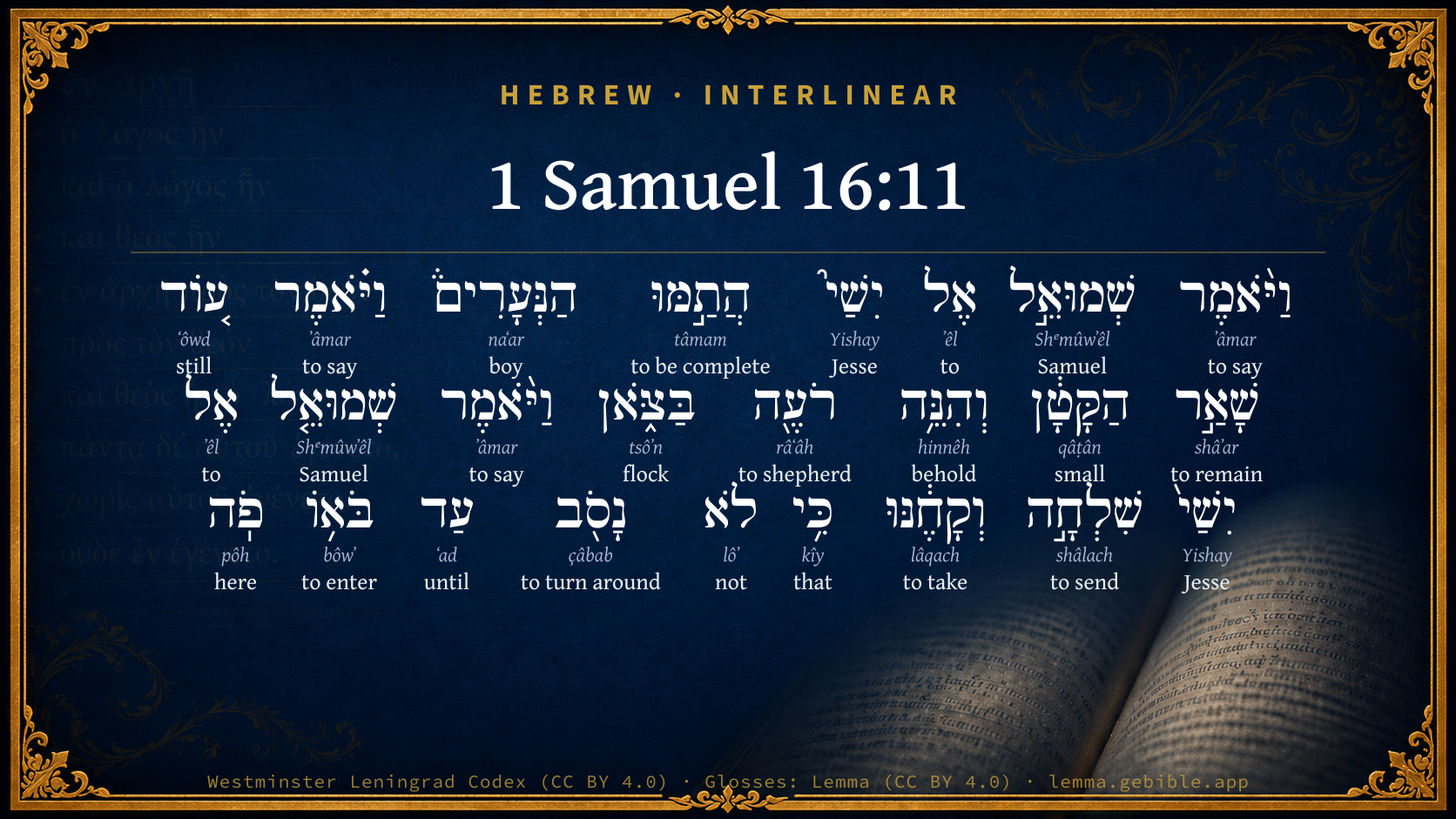
Hebrew (Westminster Leningrad Codex) 1 Samuel 16:11 appears in the Hebrew Old Testament. The text above is from the Westminster Leningrad Codex. Each word links to its Strong’s number, a concise gloss, and parsing drawn from the Open Scriptures Hebrew Bible morphology. Click any word for its full Brown-Driver-Briggs (BDB) entry.
Download image
Cite this verse

1 Samuel 16:11 (World English Bible). Public Domain. Lemma interlinear Bible study tool, https://lemma.gebible.app/v/1-samuel/16/11.

Show BibTeX & RIS
BibTeX
RIS
English Translation
Samuel said to Jesse, Are here all your children? He said, There remains yet the youngest, and, behold, he is keeping the sheep. Samuel said to Jesse, Send and get him; for we will not sit down until he come here.
World English Bible · Public Domain
Download a study sheet

One document with this verse’s original text, its word-by-word gloss line, the meaning frame, cross-references with their text, attributed commentary, and full source and license credits — printable, and it pastes into notes with its structure intact.

This verse Autodidact and up

Study sheet (.html) Plain text (.txt)

A passage Seminary Student

Up to 50 verses in one chapter. A passage sheet keeps up to 6 commentary sources and 12 cross-references per verse, in the order this page ranks them, and says so on the sheet whenever that leaves anything out. Ask for a single verse and you get the Autodidact verse sheet above.

Everything on this page stays free to read, with no account — the sheet is a download of what is already on screen, not access to it.

Want to remove ads? Support Godless Engineer
Compare translations 3

The same verse in 3 English versions, stacked beneath the original-language interlinear above. Click any original word for its lexicon entry.

Each is an independent rendering of the whole verse — the interlinear is not word-aligned to these translations.

Highlighted words mark where these versions differ — a whole-verse word diff, not a word-by-word alignment.

  • World English Bible Public Domain
    Samuel said to Jesse, Are here all your children? He said, There remains yet the youngest, and, behold, he is keeping the sheep. Samuel said to Jesse, Send and get him; for we will not sit down until he come here.
  • King James Version Public Domain
    And Samuel said unto Jesse, Are here all thy children? And he said, There remaineth yet the youngest, and, behold, he keepeth the sheep. And Samuel said unto Jesse, Send and fetch him: for we will not sit down till he come hither.
  • unfoldingWord Literal Text CC BY-SA 4.0
    So Samuel said to Jesse, “Are your young men complete?” And he said, “The youngest still remains, but behold, he is tending among the flock.” And Samuel said to Jesse, “Send and get him, for we will not go around until he comes here.”

unfoldingWord Literal Text — © unfoldingWord, licensed CC BY-SA 4.0. Word-aligned USFM3 via Door43 (git.door43.org/unfoldingWord/en_ult).

Versions to compare (up to 4)

3 of 4 selected

Show all 18 translations

Every available English version of this verse, each an independent rendering of the whole verse.

  • World English Bible Public Domain
    Samuel said to Jesse, Are here all your children? He said, There remains yet the youngest, and, behold, he is keeping the sheep. Samuel said to Jesse, Send and get him; for we will not sit down until he come here.
  • Berean Standard Bible Public Domain
    And Samuel asked him, “Are these all the sons you have?” “There is still the youngest,” Jesse replied, “but he is tending the sheep.” “Send for him,” Samuel replied. “For we will not sit down to eat until he arrives.”
  • Majority Standard Bible Public Domain
    And Samuel asked him, “Are these all the sons you have?” “There is still the youngest,” Jesse replied, “but he is tending the sheep.” “Send for him,” Samuel replied. “For we will not sit down to eat until he arrives.”
  • King James Version Public Domain
    And Samuel said unto Jesse, Are here all thy children? And he said, There remaineth yet the youngest, and, behold, he keepeth the sheep. And Samuel said unto Jesse, Send and fetch him: for we will not sit down till he come hither.
  • American Standard Version (1901) Public Domain
    And Samuel said unto Jesse, Are here all thy children? And he said, There remaineth yet the youngest, and, behold, he is keeping the sheep. And Samuel said unto Jesse, Send and fetch him; for we will not sit down till he come hither.
  • Revised Version (1885) Public Domain
    And Samuel said unto Jesse, Are here all thy children? And he said, There remaineth yet the youngest, and, behold, he keepeth the sheep. And Samuel said unto Jesse, Send and fetch him: for we will not sit down till he come hither.
  • Geneva Bible (1599) Public Domain
    Finally, Samuel said vnto Ishai, Are there no more children but these? And hee sayde, There remaineth yet a litle one behinde, that keepeth the sheepe. Then Samuel saide vnto Ishai, Sende and set him: for we will not sit downe, till he be come hither.
  • Douay-Rheims (1899) Public Domain
    And Samuel said to Isai: Are here all thy sons? He answered: There remaineth yet a young one, who keepeth the sheep. And Samuel said to Isai: Send, and fetch him, for we will not sit down till he come hither.
  • Young's Literal Translation Public Domain
    And Samuel saith unto Jesse, `Are the young men finished?' and he saith, `Yet hath been left the youngest; and lo, he delighteth himself among the flock;' and Samuel saith unto Jesse, `Send and take him, for we do not turn round till his coming in hither.'
  • Literal Standard Version CC BY-SA 4.0
    And Samuel says to Jesse, “Are the young men finished?” And he says, “Yet the youngest has been left; and behold, he delights himself among the flock”; and Samuel says to Jesse, “Send and take him, for we do not turn around until his coming in here.”
  • Unlocked Literal Bible CC BY-SA 4.0
    Then Samuel said to Jesse, “Are all of your sons here?” He replied, “There remains yet the youngest, but he is tending the sheep.” Samuel said to Jesse, “Send and get him; for we will not sit down until he comes here.”
  • unfoldingWord Literal Text CC BY-SA 4.0
    So Samuel said to Jesse, “Are your young men complete?” And he said, “The youngest still remains, but behold, he is tending among the flock.” And Samuel said to Jesse, “Send and get him, for we will not go around until he comes here.”
  • Darby Bible Public Domain
    And Samuel said to Jesse, Are these all the young men? And he said, There is yet the youngest remaining, and behold, he is feeding the sheep. And Samuel said to Jesse, Send and fetch him; for we will not sit at table till he come hither.
  • World Messianic Bible Public Domain
    Samuel said to Jesse, “Are all your children here?” He said, “There remains yet the youngest. Behold, he is keeping the sheep.” Samuel said to Jesse, “Send and get him, for we will not sit down until he comes here.”
  • Webster's Bible Public Domain
    And Samuel said to Jesse, Are here all thy children? And he said, There remaineth yet the youngest, and behold, he keepeth the sheep. And Samuel said to Jesse, Send and bring him: for we will not sit down till he hath come hither.
  • Free Bible Version CC BY-SA 4.0
    So he asked Jesse, “Don't you have any more sons?” “Well, there's still the youngest,” Jesse replied, “but he is out looking after the sheep.” “Send for him and bring him here because we will not sit down and eat until he gets here,” Samuel told Jesse.
  • Bible in Basic English Public Domain
    Then Samuel said to Jesse, Are all your children here? And he said, There is still the youngest, and he is looking after the sheep. And Samuel said to Jesse, Send and make him come here: for we will not take our seats till he is here.
  • JPS Tanakh (1917) Public Domain
    And Samuel said unto Jesse: 'Are here all thy children?' And he said: 'There remaineth yet the youngest, and, behold, he keepeth the sheep.' And Samuel said unto Jesse: 'Send and fetch him; for we will not sit down till he come hither.'

Literal Standard Version (2020), Covenant Press — licensed CC BY-SA 4.0. Text via the HelloAO Bible API (eBible.org). Unlocked Literal Bible (unfoldingWord) — licensed CC BY-SA 4.0. Text via the HelloAO Bible API (eBible.org). unfoldingWord Literal Text — © unfoldingWord, licensed CC BY-SA 4.0. Word-aligned USFM3 via Door43 (git.door43.org/unfoldingWord/en_ult). Free Bible Version, Dr. Jonathan Gallagher — licensed CC BY-SA 4.0. Text via the HelloAO Bible API (eBible.org).

Word by word

More ways to search: Search by grammar → Find every occurrence → Compare this word →

Practice this passage: Drill this verse → Learn its vocabulary →

יִשַׁי֮
Yishay
H3448
“Jesse”
Noun, Proper
Part of Speech
Noun
Type
Proper
Full BDB Definition

Origin: from the same as H3426

TWOT: 926

Jesse = "I possess" - son of Boaz and the father of king David
  1. וַיֹּ֨אמֶר ʼâmar H559 “and · to say” Conjunction + Verb, Qal, Sequential Imperfect, 3rd Person, Masculine, Singular
  2. שְׁמוּאֵ֣ל Shᵉmûwʼêl H8050 “Samuel” Noun, Proper
  3. אֶל ʼêl H413 “to” Preposition
  4. הֲתַ֣מּוּ tâmam H8552 “to be complete” Particle, Interrogative + Verb, Qal, Perfect, 3rd Person, Common, Plural
  5. הַנְּעָרִים֒ naʻar H5288 “the · boys” Particle, Definite Article + Noun, Common, Masculine, Plural, Absolute
  6. וַיֹּ֗אמֶר ʼâmar H559 “and · to say” Conjunction + Verb, Qal, Sequential Imperfect, 3rd Person, Masculine, Singular
  7. ע֚וֹד ʻôwd H5750 “still” Adverb
  8. שָׁאַ֣ר shâʼar H7604 “to remain” Verb, Qal, Perfect, 3rd Person, Masculine, Singular
  9. הַקָּטָ֔ן qâṭân H6996 “the · small” Particle, Definite Article + Adjective, Adjective, Masculine, Singular, Absolute
  10. וְהִנֵּ֥ה hinnêh H2009 “and · behold” Conjunction + Particle, Demonstrative
  11. רֹעֶ֖ה râʻâh H7462 “shepherding” Verb, Qal, Participle Active, Masculine, Singular, Absolute
  12. בַּצֹּ֑אן tsôʼn H6629 “in/at the · flock” Preposition, Determined + Noun, Common, Both, Singular, Absolute
  13. וַיֹּ֨אמֶר ʼâmar H559 “and · to say” Conjunction + Verb, Qal, Sequential Imperfect, 3rd Person, Masculine, Singular
  14. שְׁמוּאֵ֤ל Shᵉmûwʼêl H8050 “Samuel” Noun, Proper
  15. אֶל ʼêl H413 “to” Preposition
  16. יִשַׁי֙ Yishay H3448 “Jesse” Noun, Proper
  17. שִׁלְחָ֣ה shâlach H7971 “send” Verb, Qal, Imperative, 2nd Person, Masculine, Singular + Suffix, h
  18. וְקָחֶ֔נּוּ lâqach H3947 “and · take · him” Conjunction + Verb, Qal, Imperative, 2nd Person, Masculine, Singular + Suffix, Personal, 3rd Person, Masculine, Singular
  19. כִּ֥י kîy H3588 “that” Conjunction
  20. לֹא lôʼ H3808 “not” Particle, Negative
  21. נָסֹ֖ב çâbab H5437 “to turn around” Verb, Qal, Imperfect, 1st Person, Common, Plural
  22. עַד ʻad H5704 “until” Preposition
  23. בֹּא֥וֹ bôwʼ H935 “to enter · him” Verb, Qal, Infinitive Construct + Suffix, Personal, 3rd Person, Masculine, Singular
  24. פֹֽה pôh H6311 “here” Adverb

About this verse

These counts appear in no published source. They are computed here, from the morphology-tagged text and Lemma’s own curated glosses. What Lemma adds →

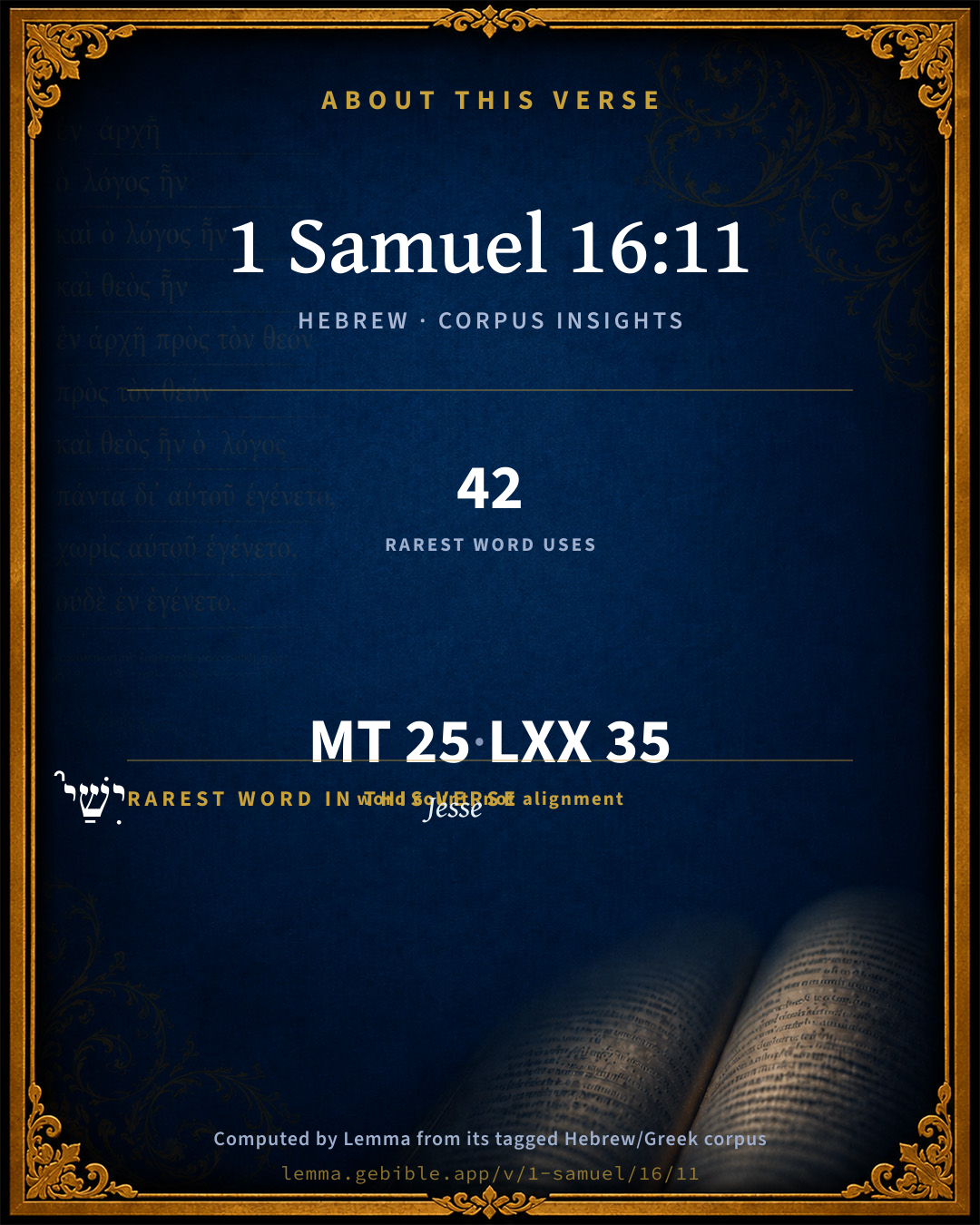
25
words
20
distinct lemmas
Historical
section

Shared distinctive vocabulary

יִשַׁי֮ Jesse H3448 occurs in 39 verses of the Hebrew Bible. Also found in:

Grammatical profile

  • 10 verbs
  • 6 nouns
  • 1 adjective
  • 3 prepositions
  • 1 conjunction
  • 2 adverbs
  • 2 particles

Verb forms

  • וַיֹּ֨אמֶר Qal · Sequential Imperfect
  • הֲתַ֣מּוּ Qal · Perfect
  • וַיֹּ֗אמֶר Qal · Sequential Imperfect
  • שָׁאַ֣ר Qal · Perfect
  • רֹעֶ֖ה Qal · Participle Active
  • וַיֹּ֨אמֶר Qal · Sequential Imperfect
  • שִׁלְחָ֣ה Qal · Imperative
  • וְקָחֶ֔נּוּ Qal · Imperative
  • נָסֹ֖ב Qal · Imperfect
  • בֹּא֥וֹ Qal · Infinitive Construct

Repetition

Words recur within this verse — often emphatic in Hebrew:

  • וַיֹּ֨אמֶר to say H559 ×3
  • שְׁמוּאֵ֣ל Samuel H8050 ×2
  • יִשַׁי֮ Jesse H3448 ×2
  • אֶל to H413 ×2

Hebrew & Septuagint length

In English translation the verse runs 41 words from the Hebrew and 42 from the Septuagint (LXX English) — closely comparable.

A rough comparison of the two English renderings, which tokenize alike — not a word-level alignment.

Word counts can differ between the Hebrew and the Greek without any difference in meaning — e.g. the Hebrew direct-object marker אֵת has no separate Greek word, and Greek often adds the article ὁ.

In the original languages it is 25 Hebrew tokens and 35 Greek tokens — but the two are counted differently (Hebrew bundles its prefixes and suffixes into one token; the Greek is in lemma form), so that isn’t a like-for-like length.

Cross-references

6

Topical passages linked to 1 Samuel 16:11 in the Treasury of Scripture Knowledge — connected by theme and wording, ordered by reader-vote popularity; previews shown in the World English Bible.

  • Psalms 78:70–71 He also chose David his servant, And took him from the sheepfolds;
  • 2 Samuel 7:8 Now therefore thus shall you tell my servant David, Thus says Yahweh of Hosts, I took you from the sheep pen, from following the sheep, that you should be prince over my people, over Israel;
  • 1 Samuel 17:28 Eliab his eldest brother heard when he spoke to the men; and Eliab's anger was kindled against David, and he said, Why are you come down? and with whom have you left those few sheep in the wilderness? I know your pride, and the naughtiness of your heart; for you have come down that you might see the battle.
  • 2 Samuel 13:3 But Amnon had a friend, whose name was Jonadab, the son of Shimeah, David's brother; and Jonadab was a very subtle man.
  • 1 Chronicles 17:7 Now therefore thus shall you tell my servant David, Thus says Yahweh of Hosts, I took you from the sheep pen, from following the sheep, that you should be prince over my people Israel:
  • 1 Samuel 17:12–15 Now David was the son of that Ephrathite of Bethlehem Judah, whose name was Jesse; and he had eight sons: and the man was an old man in the days of Saul, stricken [in years] among men.

Cross-references courtesy of OpenBible.info (CC BY 4.0).

Hebrew and Greek witnesses Masoretic Hebrew ↔ Greek Septuagint

The same verse in the two great witnesses to the Old Testament, shown verse-for-verse.

These are two independent witnesses, not word-aligned to each other, and the Septuagint is shown in lemma (dictionary) form.

Hebrew 1 Samuel 16:11 Masoretic · Westminster Leningrad Codex

וַיֹּ֨אמֶר שְׁמוּאֵ֣ל אֶל יִשַׁי֮ הֲתַ֣מּוּ הַנְּעָרִים֒ וַיֹּ֗אמֶר ע֚וֹד שָׁאַ֣ר הַקָּטָ֔ן וְהִנֵּ֥ה רֹעֶ֖ה בַּצֹּ֑אן וַיֹּ֨אמֶר שְׁמוּאֵ֤ל אֶל יִשַׁי֙ שִׁלְחָ֣ה וְקָחֶ֔נּוּ כִּ֥י לֹא נָסֹ֖ב עַד בֹּא֥וֹ פֹֽה

Samuel said to Jesse, Are here all your children? He said, There remains yet the youngest, and, behold, he is keeping the sheep. Samuel said to Jesse, Send and get him; for we will not sit down until he come here.

World English Bible · Public Domain

Greek LXX 1 Samuel 16:11 Septuagint · lemma form

καί εἶπον σαμουηλ πρός ιεσσαι ἐκλείπω ὁ παιδάριον καί εἶπον ἔτι ὁ μικρός ἰδού ποιμαίνω ἐν ὁ ποίμνιον καί εἶπον σαμουηλ πρός ιεσσαι ἀποστέλλω καί λαμβάνω αὐτός ὅτι οὐ μή κατακλίνω ἕως ὁ ἔρχομαι αὐτός

And Samuel said to Jessae, Have you no more sons? And Jessae said, There is yet a little one; behold, he tends the flock. And Samuel said to Jessae, Send and fetch him for we may not sit down till he comes.

LXX2012 (modern English Septuagint) · Public Domain

On this verse, The Pulpit Commentary discusses the Septuagint’s reading. Read the note in Commentary ↓

Hebrew: Westminster Leningrad Codex (CC BY 4.0). Greek: Septuagint (public domain); English from LXX2012 (modern English Septuagint) (Public Domain). How the Septuagint differs from the Hebrew →

Targum (Aramaic paraphrase)

1

The Targum is the ancient Jewish Aramaic paraphrase of the Hebrew Scriptures — an interpretive translation, not the Hebrew text itself. Onkelos (literal) and Pseudo-Jonathan (expansive) render the Torah, and Jonathan the Prophets. Coverage is partial: where no permissively-licensed English translation exists for a verse, only the Aramaic is shown. This is verse-level text, not a word-by-word alignment to the Hebrew.

  1. Targum Jonathan Prophets (Joshua–Malachi)
    וַאֲמַר שְׁמוּאֵל לְיִשַׁי הַשְׁלִימוּ עוּלֵימַיָא וַאֲמַר עוֹד אִשְׁתָּאַר זְעֵירָא וְהָא רָעֵי בְעָנָא וַאֲמַר שְׁמוּאֵל לְיִשַׁי שְׁלַח וְאַיְתִינֵיהּ אֲרֵי לָא נִסְתְּחַר עַד מֵיתוֹהִי הָכָא:

    (no public-domain English translation for this verse)

    Targum Jonathan — Aramaic: “Mikraot Gedolot” (public domain). English: “Sefaria Community Translation” (CC0 1.0 (public-domain dedication)); “London "Chaldee Paraphrase," 1871” (public domain). Text via Sefaria.

Commentary

Notes on 1 Samuel 16:11 from classic Christian and Jewish commentators (each source and its license shown beneath its notes). The classic Christian expositions comment on the surrounding passage and are grouped to its opening verse, so a note may address several verses; the Jewish commentaries on the Tanakh (Rashi and others) are per-verse, so they appear only where the commentator wrote on this verse.

Lemma curates 59 commentaries, every one of them public domain or Creative Commons licensed, each selected and text-cleaned for this edition rather than reprinted as found. About our sources →

Jamieson, Fausset & Brown

Robert Jamieson, A. R. Fausset & David Brown

HE ANOINTS DAVID. (Sa1 16:11-14)

There remaineth yet the youngest, and, behold, he keepeth the sheep--Jesse having evidently no idea of David's wisdom and bravery, spoke of him as the most unfit. God, in His providence, so ordered it, that the appointment of David might the more clearly appear to be a divine purpose, and not the design either of Samuel or Jesse. David having not been sanctified with the rest of his family, it is probable that he returned to his pastoral duties the moment the special business on which he had been summoned was done.

Jamieson, Fausset & Brown — Commentary Critical and Explanatory on the Whole Bible (1871) — public domain (CC PDM 1.0). Text via the HelloAO Bible API.

Trapp's Complete Commentary

John Trapp

1Sa 16:11 And Samuel said unto Jesse, Are here all [thy] children? And he said, There remaineth yet the youngest, and, behold, he keepeth the sheep. And Samuel said unto Jesse, Send and fetch him: for we will not sit down till he come hither.

Ver. 11. Are here all thy children?] God will say to such as make not a full confession of their sins, Are here all?

There remaineth yet the youngest, and, behold, he keepeth the sheep.] Him God called "from following the ewes great with young, to feed Jacob his people, and Israel his inheritance." {Psa 78:71} {See Trapp on "Psa 78:71"} Our vocation likewise to glory and virtue is gratuita, et inopinata {Eph 1:5}

John Trapp, A Commentary or Exposition upon All the Books of the Old and New Testament (1647–1656) — public domain. Text from a community e-Sword module.

The Biblical Illustrator

Joseph S. Exell

1Sa_16:11

Send and fetch him, for we will not sit down till he come hither.

Taken from the sheepcotes

The story of David opens with a dramatic contrast between the fresh hope of his young life and the rejection of the self-willed king Saul, whose course was rapidly descending towards the fatal field of Gilboa. No bad man drifts down the rapids unwarned, unwept; but the Divine purpose cannot stay till such pitying tears are dried. Nor must we cling to the grave of the dead past, whence the Spirit of God has fled; but arise to follow as He transfers the focus of His operation from the rocky heights of Benjamin to the breezy uplands of Bethlehem, and conducts us to the house of Jesse. In the selection of every man for high office in the service of God and man, there are two sides--the Divine and the human: the election of God, and its elaboration in history; the heavenly summons, and the earthly answer to its ringing notes. We must consider, therefore.

I. The root of David. Once in the prophecy by Isaiah, and twice in the Book of Revelation, our Lord is called the Root of David. The Lion of the Tribe of Judah, the Root of David, hath prevailed to open the Book and to loose the seven seals thereof. I, Jesus, am the Root and the Offspring of David; the Bright, the Morning Star. The idea suggested is of an old root, deep hidden in the earth, which sends up its green scions and sturdy stems. Davids character may be considered as an emanation from the life of the Son of God before He took on Himself the nature of man, and an anticipation of what He was to be and do in the fulness of time. Jesus was the Son of David, yet in another sense He was his progenitor (Mar_12:35-37). There are four great words about the choice of David, the last of which strikes deeply into the heart of that great mystery.

1. The Lord hath sought Him a man (1Sa_13:14). No one can know the day or hour when God passes by, seeking for chosen vessels and goodly pearls.

2. I have found David my servant (Psa_89:20). There is ecstasy in the voice, like the thrice repeated found of Luk_15:1-32. And was there not some secret glad response to the Masters call, like that which the disciples gave, when Jesus found them at their nets, and said, Follow Me?

3. He chose David to be His servant (Psa_78:70). The people chose Saul; but God chose David. This made him strong. We are immovable when we touch the bedrock of Gods choice, and hear Him say, He is a chosen vessel unto Me, to bear My name.

4. The Lord hath appointed him to be Prince (1Sa_13:14). Saul might chafe and fret; but from amid the ruins of his waning power the authority of David emerged as a sin from a wrack of clouds, because God willed it.

5. I have provided Me a King (1Sa_16:1). The Divine provision meets every need, silences every anxiety. In some unlikely quarter, in a shepherds hut, or in an artizans cottage, God has His prepared and appointed instrument. As yet the shaft is hidden in His quiver, in the shadow of His hand; but at the precise moment at which it will tell with the greatest effect, it will be produced and launched on the air.

II. The stem of Jesse. We turn for a moment to consider the formative influences of Davids young life. David says nothing of his father, but twice speaks of his mother as the handmaid of the Lord. From her he derived his poetic gift, his sensitive nature, his deeply religious character. To his father he was the lad that kept, the sheep, whom it was not worth while to summon to the religious feast; to his mother he was David the beloved, and probably she first heard the psalms which have charmed and soothed the world. The lad may have owed something to the schools of the prophets, established by Samuels wise prescience to maintain the knowledge of the law in Israel. They appear to have been to Israel what Iona was to the wild tribes of the North in later times. (F. B. Meyer, B. A.)

The shepherd foreshadowing the king

In the boyish days and deeds of distinguished men, biographers delight to illustrate the adage that the boy is father to the man. In sacred story, the younger child of Rebekah taking hold of his brother by the heel, as if with intent to supplant him; in classical mythology, the infant Hercules strangling in his cradle the serpents sent by Juno to destroy him; in modern history, the schoolboy Napoleon Bonaparte, rearing his snow fortifications in the playground, and teaching his school fellows to attack or defend them--are samples of the shadows of the future that are often projected on the childhood of great men. The early years of King David exhibited more than one instance of this foreshadowing of the future.

I. It, certainly was not by accident, that, when Samuel went to Bethlehem to anoint one of the sons of Jesse as king, the son on whom the Divine choice fell was at the very moment keeping his fathers sheep. His early employment had a direct and Divine bearing upon his later. In some of his psalms--the beautiful closing verses of the 78th, for example--the Divine connection is transparent. He chose David also His servant, and took him from the sheepfolds; from following the ewes great with young He brought him to feed Jacob his people, and Israel his inheritance. So he fed them according to the integrity of his heart, and guided them by the skilfulness of his hands.

1. As a shepherd, keeping his fathers sheep, the sense of responsibility to another was powerfully called into exercise. The flock was not his own. The servant-feeling thus beautifully called into play, was transferred, in full integrity, to the higher sphere of the kingdom. To the people of Israel he felt that he stood in the same relation as he had occupied to his fathers sheep, and to God in the same place in which he had stood to his father.

2. Further, the shepherd occupation of David led him, from its very nature, to seek the welfare of the flock. Suitable pasture had to be provided; shelter had to be found from the heat by day and from the cold by night; protection had to be secured from wolves and lions; the diseased had to be nursed, the wounded cared for, wanderers bad to be followed, rescued from danger, and brought back to the fold. These were the ideas of duty with which David became familiar as a shepherd. And when his charge was changed, these ideas of duty remaining in his heart, and influencing his public conduct, made him the eminent ruler be became. The welfare of his people was his constant aim. In the view of duty to the flock, all thoughts of fear and danger fled from Davids mind. Self-sacrifice for the welfare of others was the ruling principle at once of the shepherd and of the king.

3. Yet further:--In his office as a shepherd, David had constantly to study the increase and improvement of the flock. It was not enough for the shepherd to keep the flock as he got it. The flock was not properly kept, unless every season brought a great increase to its number, and a large addition to its value. The same thought manifestly influenced Davids kingly administration, he constantly consulted for the progressive improvement and elevation of his people. And in all the higher departments of progress, the same spirit of improvement prevailed. Great warrior though he was, the spirit most congenial to him was that of peaceful development and progress. We cannot omit to add, that the shepherd employment of David, by leading him to give special attention to the weak, the helpless, and the distressed of his flock, trained him for one of the most blessed and Christ-like functions of a godly ruler. What a contrast, the spirit of Davids pastoral and royal office, and of Christs blessed rule, to that of most earthly governors l What a contrast to the spirit of the well-known saying of the most Christian king--Letat, cest moi--I am the State! The Christian shepherd is not the flock, the Christian ruler is not the state. He is Gods servant, intrusted with the rod of authority for the true good of the flock. The more forgetful be is of self, in his anxiety to discharge his trust, and do good to his flock, the more worthy is he of the title of a Christian king. While we speak thus strongly of the devotion of King David to his own people, we must add that in its very intensity, that devotion was not unaccompanied by traces of human infirmity. His love was confined to his own people; and for all beyond that circle, he not only had no warm love, but hardly even the ordinary feelings of brotherhood. It would have been more difficult for a Jew to attain the happy medium, the right equipoise of feeling for the uncircumcised nations around, lying somewhere between brotherly love on the one hand, and bitter hatred on the other. But David gave himself no trouble to find this happy medium. It is a mystery how such tenderness, and such relentless severity, should have been found in the same man. Whatever may be urged in extenuation of his severity, rests on his position as a Jew. For our part, we must ever remember that to enlarge the sphere of kindly feeling is one of the great objects of the Christian dispensation. Let brotherly love continue for the members of the household, certainly; but if ye love the brethren only, what do ye more than others? (W. G. Blaikie, M. A.)

The call of David

David, the son of a man in humble life, and the youngest of his brethren, was chosen by Almighty God to be His special servant--to be a prophet, a king, a psalmist; he was anointed by Samuel to be all this; and in due time he was brought forward by Almighty God, and as a first act of might, slew the heathen giant Goliath. Now let, us apply all this to ourselves.

1. David seemed born to live and die among his sheep. Yet God took him from the sheepfolds to make him His servant and His friend. Now this is fulfilled in the case of all Christians. They are by nature poor, and mean; but God chooses them, and brings them near unto Himself. He looks not at outward things; He chooses and decrees according to His will, and why He chooses these men, and passes over those, we know not. Here we differ from David. He was chosen above his brethren, because he was better than they. It is expressly said, that when Samuel was going to choose one of his elder brethren, God said to him, I have refused him; for the Lord seeth not as man seeth; for man looketh on the outward appearance, but the Lord looketh on the heart; implying, that Davids heart was in a better state than his brothers, whom Samuel would have chosen. But this is act our case; ye are in nowise better by nature than they whom God did not choose. God hath chosen all of us to Salvation, not for our righteousness, but for His great mercies.

2. Observe, too, God chose him, whose occupation was that of a shepherd; for He chooses not the great men of the world; He passed by the rich and noble (Jam_2:5). The Angel appeared to the shepherds as they kept, watch over their sheep at night. The most solitary, the most unlearned, God hears, God looks upon, God visits, God blesses, God brings to glory, if he is but rich in faith. One person is a king and rules, another is a subject and obeys; but if both are Christians, both have in common a gift so great, that in the sight of it, the difference between ruling and obeying is as nothing. All Christians are kings in Gods sight; they are kings in His unseen kingdom, in the Communion of Saints.

3. Next, observe God chose David by means of the Prophet Samuel. He did not think it enough to choose him silently, but He called him by a voice. And, in like manner, when God calls us, He does so openly. He sent His minister, the Prophet Samuel to David; and He sends His ministers to us.

4. When Samuel had anointed David, observe what followed. Samuel took the horn of oil, and anointed him in the midst of his brethren: and the Spirit of the Lord came upon David from that day forward. Gods spirit did but come upon David, and visit him from time to time; but He vouchsafes to dwell within the Christian, so as to make His heart and body His temple.

5. Though David reached the gift of Gods Holy Spirit, yet nothing came of it all at once. He still seemed like any other man. He went back to the sheep. The Spirit of the Lord had come upon him, yet it did not at once make him a prophet or a king All was to come in good time, not at once. God the Holy Ghost leads on the heirs of grace marvellously. You recollect when our Saviour was baptised, immediately the Spirit of God led Him into the wilderness. What happened one way in our Saviours course, happens in ours also. Sooner or later that work of God is manifested, which was at first secret.

6. Lastly, then, let us inquire who is our Goliath? who is it we have to contend with? The answer is plain; the devil is our Goliath. By degrees our work comes upon us; as children we have to fight, with him a little; as time goes on the fight opens; and at length we have our great enemy marching against us with sword and spear, as Goliath came against David. And when this war has once begun, it lasts through life. (Plain sermons by contributors to the Tracts for the Times.)

Gods choice and preparation of men

Samuel is the light by which young David reads the handwriting of Jehovah upon the walls of his spirit, learns his destiny, and prepares for his high calling. So the living God in His marvellous mercy hides Himself behind man that not being overpowered by His splendours, we may be won to open our hearts to receive of His fulness and grace for grace. Who of you will be His anointing prophets this day, and go ca this blessed ministry! Care you not for the future of His kingdom? Is there no David whose spirit you can fire by the outshining of your conviction and the best of your enthusiasm for the salvation of men? Seize your privilege, and hand on to unborn generations the gifts of vision and power the Eternal has bestowed upon you!

1. We now ask, why is it that David of all the sons of Jesse, and of all the children of Israel, is elected by the prophet for this special consecration of kingly place and power? The answer, fortunately for us, is as near as it is definite, and as simple and authoritative as it is decisive and Divine. Speaking of Eliab, God says to Samuel, Look not on his countenance, or on the height of his stature; because I have refused him; for the Lord seeth not as man seeth; for man looketh on the outward appearance, but the Lord looketh on the heart. There is at once the principle of the Divine choice, and the condition of the prophetic inspiration. David has that inner consecration without which the outward anchoring is an utterly unmeaning and damaging ceremony. The unction of the Holy One has preceded the symbolical oil of the prophet. For though God accepts and adopts human meditation as the principal avenue along which He meets the souls of men, He has many other ways of finding us besides that of a faith-begetting human presence. The Idea of God grows unawares upon our inward sight, and we are learning more and more about Him when no visible teacher is near and no human voice is heard.

2. It were, indeed, the gravest of mistakes to regard this day of consecration as the first descent of the Spirit of the Lord on young Davids heart--

Let no man think that sudden in a minute

All is accomplished, and the work is done.

God does not anoint unprepared men for kingship. The boy is father to the man. Not as a vaunting soldier, not even as a brave patriot, does David go forth against Goliath of Gath; but that all the earth may know--for the fight is a missionarys evangel, and a soldier shepherds apology for God--that all the earth may know that there is a God in Israel, who does not give victory to mere bulk, or even to military prowess, but to sincerity of heart; to humility, purity, and largeness of soul. Evermore Gods unseen educating ministry goes forward. He is always preparing the worlds kings. True rulers are never absent. We indeed see not their crowns. No sceptre is in their hands. They neither wear kings clothing, nor sit in kings houses. They are with us in our families, despised by their elder brothers, and unrecognised by all; but when the clock of time strikes, and their hour is come, they take their place and do their work, and we are debtors all. The earliest stages of regeneration are unconscious. Visibility is not the measure of reality. The kingdom of God comes without observation. We live months and years before we talk in fluent English. We know not the day of our birth, and we cannot tell what we shall be. The issues of our acts are hidden from us. Alertness of vision, openness to receive the Spirit, will be surprised after a while by a God-sent Samuel anointing you for a higher vocation. But we are not right within. We know it. There is an aching inside us. Our sins look us full in the face. We want place rather than preparation, thrones rather than disciplined ability, glittering crowns rather than true and unfaltering obedience. We crave and pant to be thought somebody, instead of bending our whole will on being as God wills.

3. But David, we may be certain, were he guiding us, would take us another step backward in order to see the building work of God in its earlier stages; for nothing more ineradicably rooted itself in his mind, or found more pathetic expression in his songs, than the immense educational influence of his family and shepherd life. As a boy he was a keeper of sheep, and he never forgot it. The influence of that shepherd life was never exhausted. It was the salt of his career. It fed his humility and inspired his praise; purified his thinking, and sobered and deepened his emotion. It brought him face to face with reality; shut out the crowding and gossiping life of the city, threw him back on his own thoughts, gave him leisure and facility to strip off the shows of things, and get at their heart, developed an inwardness of being that brought peace and power for evermore. Thus David got his education, in the plain everyday uses of life, and was fitted for his consecration to kingship by patient, plodding, and loving service. As Moses led the sheep in the desert before he led Israel out of Egypt, as Gideon received his call to take charge of the hosts of God whilst be was threshing wheat, as the mantle of Elijah fell on Elisha at the plough, as Matthew heard the summons to the apostolate at the tollbooth, so David got his first training for his high place amid the lowly duties of his shepherd life. I suppose we shall learn some day, that the faithful doing of our actual work, the doing it for use, and not merely for gain, from love of God and love of men, is recognised by Heaven as the surest preparation for future promotion and enlarged service. Then we shall have no need to seek change of place, in order to be ready for Gods prophet with his horn of anointing oil, but only to keep our heart right. (J. Clifford, D. D.)

The unlikely selected

Dr. Isaac Barrow, when a lad, was most unpromising. Such was his misconduct, and so irreclaimable did he seem, that his father, in despair, used to say that if it pleased God to remove any of his children, he wished it might be his son Isaac. What became of the other and more hopeful children of the worthy linen draper, we cannot tell; but this unworthy son lived to be the happiness and pride of his fathers old age, to be one of the most illustrious members of the university to which he belonged, and one of the brightest ornaments of the church of which he became a minister. (C. H. Spurgeon.)

The Biblical Illustrator, edited by Joseph S. Exell (c. 1880s–1900s) — public domain. Text from a community e-Sword module.

Joseph Benson's Commentary

1Sa 16:11. Behold, he keepeth sheep — And consequently is the most unfit of all my sons for that high employment. Either, therefore, he did not understand David’s wisdom and valour, or he judged him unfit, by reason of his mean education. And God so ordered it by his providence, that the choice of David might plainly appear to be God’s work, and not Samuel’s or Jesse’s. David signifies beloved; a fit name for so eminent a type of God’s beloved Son. It is supposed David was now about twenty years old. If so, his troubles by Saul lasted near ten years; for he was thirty years old when Saul died. Samuel, having done this, went to Ramah. He retired to die in peace, since his eyes had seen the salvation, even the sceptre brought into the tribe of Judah.

Joseph Benson's Commentary on the Old and New Testaments (1811–1818) — public domain. Text from a community e-Sword module.

Geneva Bible (1599)

Geneva Bible translators

Hebrew, are the children ended?

Geneva Bible (1599) marginal notes — public domain. Text via Bolls.life.

Ellicott's Commentary for English Readers

(11) Are here all thy children?—For a moment the prophet is uncertain. The command from the Eternal Friend to come and anoint “the son of Jesse of Bethlehem” had been definite, but the sons of Jesse had passed before him, and no sign had been vouch-safed to him indicating that God had chosen one of these youths of whom the father was so fond; so the seer asks, “Are these all thy children?”

There remaineth yet the youngest.—Why David was kept in the background is uncertain. He, clearly, was different to the stalwart band of elder brothers who were grouped round their father. Although fair to look on, his beauty was of a very different type to that of his brothers, probably, compared with Saul and his own brothers, little of stature, with reddish-brown hair and a fair complexion. His father and the men in the village thought less of him than of his dark, tall brothers: at all events, Jesse thought him of too little account to present to Samuel. But, as so often, God’s thoughts are not our thoughts, and in a moment Samuel saw that in the ruddy shepherd boy—small of stature, and held of little account in his father’s house—he beheld the future king of Israel.

A Bible Commentary for English Readers, edited by Charles John Ellicott (1878–1897) — public domain. Text from a community e-Sword module.

The Cambridge Bible for Schools and Colleges

gen. ed. J. J. S. Perowne

11. we will not sit down] We will not sit round the table for the sacrificial feast.

The Cambridge Bible for Schools and Colleges (gen. ed. J. J. S. Perowne; Cambridge University Press, 1878–1918) — public domain. Text from a community e-Sword module.

John Gill's Exposition

And Samuel said unto Jesse, are here all thy children?.... For neither of these being the person God would have anointed king, and yet it was one of Jesse's sons that was to be anointed, he concluded he must have more, at least one more, and therefore puts this question to him:

and he said, there remaineth yet the youngest; or, "the little one" (c); not of a little diminutive stature, for he was a mighty man, a man of strength, courage, and valour, Sa1 16:18 or of a puerile age, for the Jews say (d) he was now twenty nine years of age; but that is not likely, he hardly exceeded more than twenty, or was so much; thereabout he might be; but he is so called because he was the youngest son, as we render it:

and, behold, he keepeth the sheep: and from following them, he was taken and anointed king; see Psa 78:70. Some of the greatest of men have been taken from rustic employment, as Moses, Gideon, Saul, and others:

and Samuel said unto Jesse, send and fetch him; out of the field by a messenger:

for we will not sit down till he come hither; that is, at table, to eat of that part of the peace offerings which belonged to the offerer Samuel, and which he had invited Jesse and his sons to partake of.

(c) "parvulus", V. L. (d) Seder Olam Rabba, c. 13. p. 36.

John Gill's Exposition of the Whole Bible (1746–1763) — public domain (CC PDM 1.0). Text via the HelloAO Bible API.

Albert Barnes' Notes on the Bible

We will not sit down ... - . literally, we will not turn round to sit at the table.

Albert Barnes' Notes on the Bible (1834–1885) — public domain. Text from a community e-Sword/MySword module.

Haydock's Catholic Bible Commentary

Young son, (parvulus,) "a little one;" (Haydock) or the youngest, who might be about 15, (Calmet) or 28. (Seder. olam. iii.) (Menochius)

George Leo Haydock (1774–1849), Haydock's Catholic Family Bible and Commentary, 1859 edition — public domain. Excludes Psalms (Douay-Rheims chapter numbering differs from Protestant) and Deuterocanonical books (Catholic canon only).

Matthew Poole's English Annotations

He keepeth the sheep; and consequently is the most unfit of all my sons for that high employment. Either therefore he did not thoroughly understand David’s great wisdom and valour, or he judgeth him unfit, by reason of his mean education. And God so ordered it by his providence, that David’s choice might plainly appear to be God’s work, and not Samuel’s or Jesse’s design.

We will not sit down, to wit, to the feast.

Quest. How could David be admitted to this feast, being, as it seems, not sanctified with the rest of his brethren?

Answ. 1. It is not strange if the prophet, by God’s direction, dispensed with the ordinary rule, in a person so extraordinary, both for his piety and the dignity to which he was chosen.

2. It is not affirmed that David did sit down with them to the feast, but only that they would not do so till he came. And when he was come, and Samuel had done what he intended with him, David, for aught we know, might depart, and the rest sit down to the feast; for David was not now actually raised to any higher degree, but returned to his former employment; as we read below, 1Sa 16:19.

Matthew Poole's English Annotations on the Holy Bible (1683–1685) — public domain. Text from a community e-Sword/MySword module.

The Pulpit Commentary

Vers. 11, 12. Are here all thy children? The word literally is lads, na"arim. The elder sons must have been nearly or quite grown up, but David was probably a mere boy, and as such had not been thought worthy of an invitation, but had been left with the servants keeping the sheep. The prophet now orders him to be summoned, and marks his value in God"s sight by saying, We will not sit down till he come hither. The verb literally means, we will not surround, i.e. the table, though at this time the Jews did sit at meals, instead of reclining on couches, as in the days of Amos and our Lord. We gather, moreover, from Samuel"s words that the selection of the son that was to be anointed took place while the preparations were being made for the feast. At the prophet"s command David is fetched from the flock, which was probably near the house, and on his arrival the prophet sees a ruddy boy, i.e. red-haired, correctly rendered in the Vulgate rufus, the colour loved by all painters of manly beauty, and, from the delicacy of complexion which accompanies it, especially admired in the East, where men are generally dark-haired and sallow-faced. Moreover, he was of a beautiful countenance. The Hebrew says, "with beautiful eyes," and so the Syriac and Septuagint rightly. He was also goodly to look to, i.e. to look at. These last words give the general idea of the beauty of his face and person, while his bright hair and delicate complexion and the beauty of his eyes are specially noticed in the Hebrew.

The Pulpit Commentary (1880–1919), ed. H.D.M. Spence-Jones & Joseph S. Exell — public domain. Text from a community e-Sword module.

John Wesley's Explanatory Notes

Keepeth sheep - And consequently is the most unfit of all my sons for that high employment. Either therefore he did not understand David's wisdom and valour, or he judged him unfit, by reason of his mean education. And God so ordered it by his providence, that David's choice might plainly appear to be God's work, and not Samuel's, or Jesse's. David signifies beloved: a fit name for so eminent a type of the Beloved Son. It is supposed, David was now about twenty years old. If so, his troubles by Saul lasted near ten years: for he was thirty years old when Saul died. Samuel having done this went to Ramah. He retired to die in peace, since his eyes had seen the salvation, even the scepter brought into the tribe of Judah.

John Wesley, Explanatory Notes Upon the Whole Bible (1754–1765) — public domain. Text via the GEBible commentary corpus.

unfoldingWord translationNotes

Door43 World Missions Community

There remains yet the youngest

"There is still my youngest son"

we will not sit down

It is understood that they were waiting to sit down and eat. AT: "we will not sit down to eat" (See: Ellipsis)

Now ... appearance

The word "Now" is used here to mark a break in the main story line. Here the narrator tells about a new person in the story.

this son was ruddy

The word "ruddy" means David was healthy looking.

translationWords

Samuel

Jesse

ewe

send

Yahweh

anoint

unfoldingWord translationNotes — © Distant Shores Media and the Door43 World Missions Community, licensed CC BY-SA 4.0. Source: git.door43.org/Door43/en_tn.

Rashi

Rabbi Shlomo Yitzchaki (Rashi)

The youngest one is still left. The youngest one is left.

We will not sit. We will not sit to eat; every instance of sitting for a meal is called הֲסִבׇּה [leaning].

Rashi on the Tanakh — English translations: “The Judaica Press complete Tanach with Rashi, translated by A. J. Rosenberg” (CC BY 4.0); “Pentateuch with Rashi's commentary by M. Rosenbaum and A.M. Silbermann, 1929-1934” (public domain); “The Metsudah Tanach series, Lakewood, N.J” (CC BY 4.0); and “The Book of Joshua, Metsudah Publications, 1997” (CC BY 4.0). Text via Sefaria.

Lesson kit

Teaching starters — assembled from the data on this page, not authored interpretation. Every prompt links to the verse data it draws on. Edit before teaching.

1 Samuel, in the Historical, opens this verse with 25 words (20 distinct Hebrew lemmas). Its most distinctive word is Yishay (“Jesse”). A historical commentator’s framing appears above. Read the whole chapter for the surrounding context.

Discussion questions

  1. How does “Jesse” (Yishay) shape what this verse is saying?
  2. How does Ruth 4:17, which shares the word «Jesse», read alongside this verse?
  3. What does the repetition of “to say” (3× in this one verse) do in this verse?
  4. These translations render this verse differently; the difference is in the English rendering, not the original. What questions does that raise?
  5. «וַיֹּ֨אמֶר» is a Qal Sequential Imperfect verb. How does that grammatical form shape the action described?
  6. Compare how Jamieson, Fausset & Brown and Trapp's Complete Commentary read this verse. Where do they agree or differ?

Things to notice

Reading settings

Reading text

Shown beneath each verse's original-language words.

Old Testament
Old Testament edition

Read the OT as the Masoretic Hebrew (MT) or the Greek Septuagint (LXX).

English shown for the Greek Septuagint (in the Hebrew ↔ Greek comparison).

Comparing translations? Open the Compare panel on any verse page to stack up to four side by side.