
2 Samuel 17:29

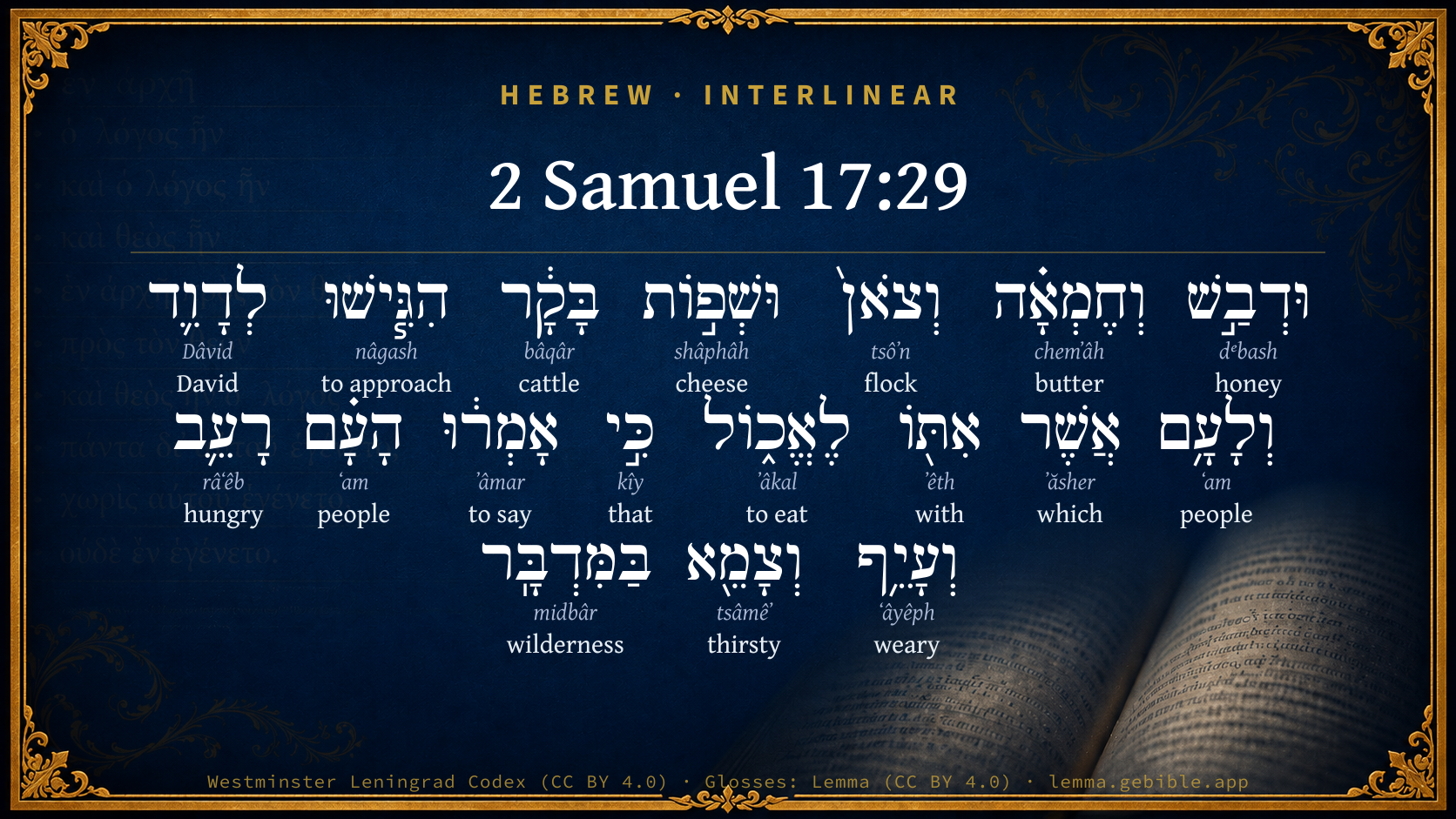
Hebrew (Westminster Leningrad Codex) 2 Samuel 17:29 appears in the Hebrew Old Testament. The text above is from the Westminster Leningrad Codex. Each word links to its Strong’s number, a concise gloss, and parsing drawn from the Open Scriptures Hebrew Bible morphology. Click any word for its full Brown-Driver-Briggs (BDB) entry.
Download image
Cite this verse

2 Samuel 17:29 (World English Bible). Public Domain. Lemma interlinear Bible study tool, https://lemma.gebible.app/v/2-samuel/17/29.

Show BibTeX & RIS
BibTeX
RIS
English Translation
and honey, and butter, and sheep, and cheese of the herd, for David, and for the people who were with him, to eat: for they said, The people are hungry, and weary, and thirsty, in the wilderness.
World English Bible · Public Domain
Highlights
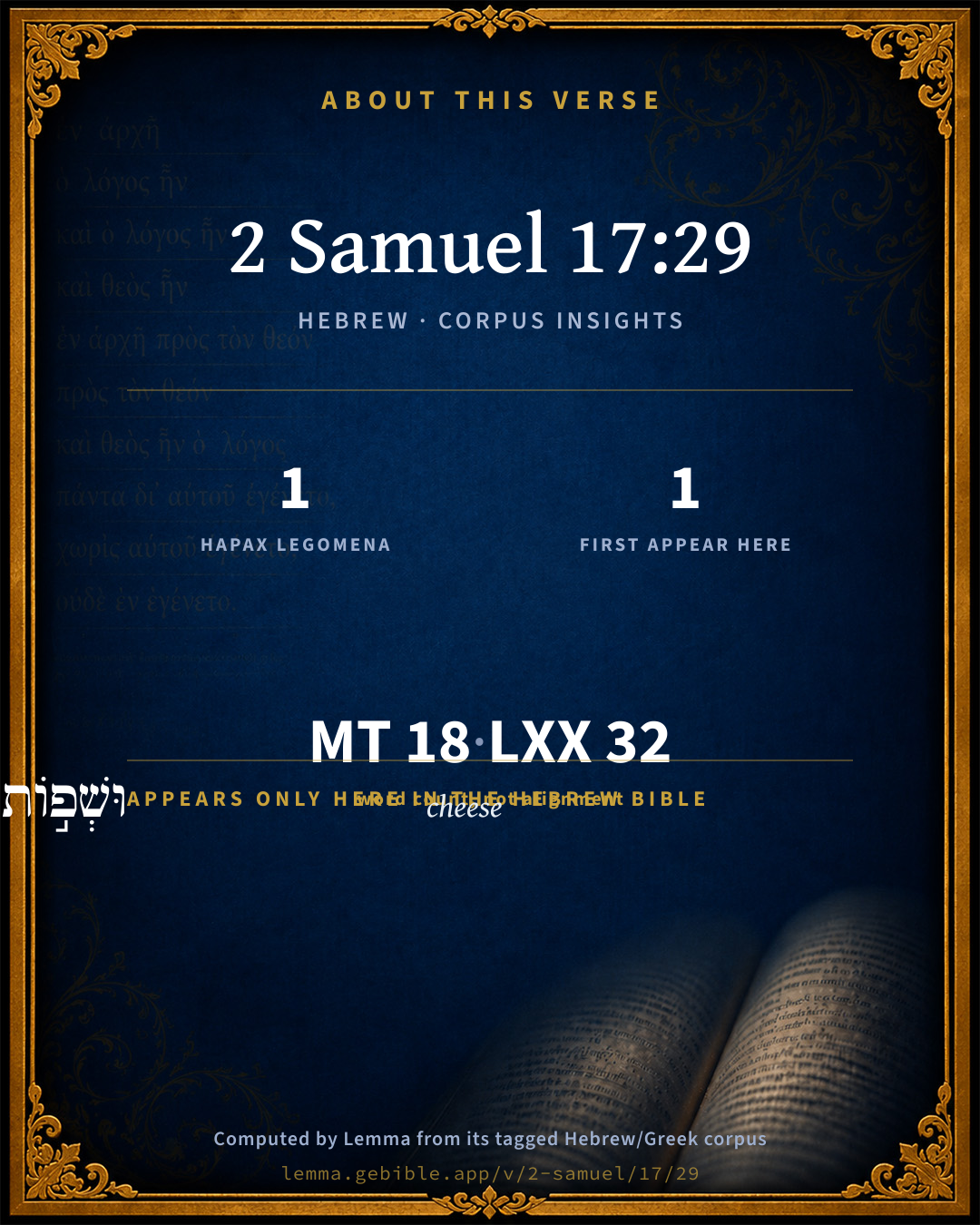
  • 1 hapax legomenon — only here in the Hebrew Bible
  • 1 first appearance in the Hebrew Bible
Full analysis ↓
Download a study sheet

One document with this verse’s original text, its word-by-word gloss line, the meaning frame, cross-references with their text, attributed commentary, and full source and license credits — printable, and it pastes into notes with its structure intact.

This verse Autodidact and up

Study sheet (.html) Plain text (.txt)

A passage Seminary Student

Up to 50 verses in one chapter. A passage sheet keeps up to 6 commentary sources and 12 cross-references per verse, in the order this page ranks them, and says so on the sheet whenever that leaves anything out. Ask for a single verse and you get the Autodidact verse sheet above.

Everything on this page stays free to read, with no account — the sheet is a download of what is already on screen, not access to it.

Want to remove ads? Support Godless Engineer
Compare translations 3

The same verse in 3 English versions, stacked beneath the original-language interlinear above. Click any original word for its lexicon entry.

Each is an independent rendering of the whole verse — the interlinear is not word-aligned to these translations.

Highlighted words mark where these versions differ — a whole-verse word diff, not a word-by-word alignment.

  • World English Bible Public Domain
    and honey, and butter, and sheep, and cheese of the herd, for David, and for the people who were with him, to eat: for they said, The people are hungry, and weary, and thirsty, in the wilderness.
  • King James Version Public Domain
    And honey, and butter, and sheep, and cheese of kine, for David, and for the people that were with him, to eat: for they said, The people is hungry, and weary, and thirsty, in the wilderness.
  • unfoldingWord Literal Text CC BY-SA 4.0
    and honey and curds and sheep and cheese of cattle, they brought to David and to the people who with him to eat, for they said, “The people hungry and weary and thirsty in the wilderness.”

unfoldingWord Literal Text — © unfoldingWord, licensed CC BY-SA 4.0. Word-aligned USFM3 via Door43 (git.door43.org/unfoldingWord/en_ult).

Versions to compare (up to 4)

3 of 4 selected

Show all 18 translations

Every available English version of this verse, each an independent rendering of the whole verse.

  • World English Bible Public Domain
    and honey, and butter, and sheep, and cheese of the herd, for David, and for the people who were with him, to eat: for they said, The people are hungry, and weary, and thirsty, in the wilderness.
  • Berean Standard Bible Public Domain
    honey, curds, sheep, and cheese from the herd for David and his people to eat. For they said, “The people have become hungry, exhausted, and thirsty in the wilderness.”
  • Majority Standard Bible Public Domain
    honey, curds, sheep, and cheese from the herd for David and his people to eat. For they said, “The people have become hungry, exhausted, and thirsty in the wilderness.”
  • King James Version Public Domain
    And honey, and butter, and sheep, and cheese of kine, for David, and for the people that were with him, to eat: for they said, The people is hungry, and weary, and thirsty, in the wilderness.
  • American Standard Version (1901) Public Domain
    and honey, and butter, and sheep, and cheese of the herd, for David, and for the people that were with him, to eat: for they said, The people are hungry, and weary, and thirsty, in the wilderness.
  • Revised Version (1885) Public Domain
    and honey, and butter, and sheep, and cheese of kine, for David, and for the people that were with him, to eat: for they said, The people is hungry, and weary, and thirsty, in the wilderness.
  • Geneva Bible (1599) Public Domain
    And they brought hony, and butter, and sheepe, and cheese of kine for Dauid and for the people that were with him, to eate: for they said, The people is hungry, and wearie, and thirstie in the wildernesse.
  • Douay-Rheims (1899) Public Domain
    And honey, and butter, and sheep, and fat calves, and they gave to David and the people that were with him, to eat: for they suspected that the people were faint with hunger and thirst in the wilderness.
  • Young's Literal Translation Public Domain
    and honey, and butter, and sheep, and cheese of kine, have brought nigh for David, and for the people who `are' with him to eat, for they said, `Thy people `is' hungry, and weary, and thirsty, in the wilderness.'
  • Literal Standard Version CC BY-SA 4.0
    and honey, and butter, and sheep, and cheese of cows; they have brought [these] near for David, and for the people who [are] with him to eat, for they said, “Your people [are] hungry, and weary, and thirsty, in the wilderness.”
  • Unlocked Literal Bible CC BY-SA 4.0
    honey, butter, sheep, and milk curds, so that David and the people with him could eat. These men had said, “The people are hungry, weary, and thirsty in the wilderness.”
  • unfoldingWord Literal Text CC BY-SA 4.0
    and honey and curds and sheep and cheese of cattle, they brought to David and to the people who with him to eat, for they said, “The people hungry and weary and thirsty in the wilderness.”
  • Darby Bible Public Domain
    and honey, and cream, and sheep, and cheese of kine to David, and to the people that were with him, to eat; for they said, The people is hungry, and weary, and thirsty in the wilderness.
  • World Messianic Bible Public Domain
    honey, butter, sheep, and cheese of the herd, for David and for the people who were with him to eat; for they said, “The people are hungry, weary, and thirsty in the wilderness.”
  • Webster's Bible Public Domain
    And honey, and butter, and sheep, and cheese of cows, for David, and for the people that were with him, to eat: for they said, The people are hungry, and weary, and thirsty, in the wilderness.
  • Free Bible Version CC BY-SA 4.0
    honey, curds, sheep, and cheese made from cow's milk for David and the people with him to eat. For they said, “The people are hungry, tired, and thirsty from their time in the wilderness.”
  • Bible in Basic English Public Domain
    And honey and butter and sheep and milk-cheeses, for David and his people: for they said, This people is in the waste land, needing food and drink and rest.
  • JPS Tanakh (1917) Public Domain
    and honey, and curd, and sheep, and cheese of kine, for David, and for the people that were with him, to eat; for they said: 'The people is hungry, and faint, and thirsty, in the wilderness.'

Literal Standard Version (2020), Covenant Press — licensed CC BY-SA 4.0. Text via the HelloAO Bible API (eBible.org). Unlocked Literal Bible (unfoldingWord) — licensed CC BY-SA 4.0. Text via the HelloAO Bible API (eBible.org). unfoldingWord Literal Text — © unfoldingWord, licensed CC BY-SA 4.0. Word-aligned USFM3 via Door43 (git.door43.org/unfoldingWord/en_ult). Free Bible Version, Dr. Jonathan Gallagher — licensed CC BY-SA 4.0. Text via the HelloAO Bible API (eBible.org).

Word by word

More ways to search: Search by grammar → Find every occurrence → Compare this word →

Practice this passage: Drill this verse → Learn its vocabulary →

וּשְׁפ֣וֹת
shâphâh
H8194
“and · cheeses of”
Conjunction + Noun, Common, Feminine, Plural, Construct
Part of Speech
Conjunction + Noun
Type
Common
Gender
Feminine
Number
Plural
State
Construct
Full BDB Definition

Origin: from H8192 in the sense of clarifying

TWOT: 2440a

cream, cheese - meaning dubious
  1. וּדְבַ֣שׁ dᵉbash H1706 “and · honey” Conjunction + Noun, Common, Masculine, Singular, Absolute
  2. וְחֶמְאָ֗ה chemʼâh H2529 “and · butter” Conjunction + Noun, Common, Feminine, Singular, Absolute
  3. וְצֹאן֙ tsôʼn H6629 “and · flock” Conjunction + Noun, Common, Both, Singular, Absolute
  4. בָּקָ֔ר bâqâr H1241 “cattle” Noun, Common, Both, Singular, Absolute
  5. הִגִּ֧ישׁוּ nâgash H5066 “to approach” Verb, Hiphil, Perfect, 3rd Person, Common, Plural
  6. לְדָוִ֛ד Dâvid H1732 “to/for · David” Preposition + Noun, Proper
  7. וְלָעָ֥ם ʻam H5971 “and · to/for the · people” Conjunction + Preposition, Determined + Noun, Common, Masculine, Singular, Absolute
  8. אֲשֶׁר ʼăsher H834 “which” Particle, Relative
  9. אִתּ֖וֹ ʼêth H854 “with · him” Preposition + Suffix, Personal, 3rd Person, Masculine, Singular
  10. לֶאֱכ֑וֹל ʼâkal H398 “to eat” Preposition + Verb, Qal, Infinitive Construct
  11. כִּ֣י kîy H3588 “that” Conjunction
  12. אָמְר֔וּ ʼâmar H559 “to say” Verb, Qal, Perfect, 3rd Person, Common, Plural
  13. הָעָ֗ם ʻam H5971 “the · people” Particle, Definite Article + Noun, Common, Masculine, Singular, Absolute
  14. רָעֵ֛ב râʻêb H7457 “hungry” Adjective, Adjective, Masculine, Singular, Absolute
  15. וְעָיֵ֥ף ʻâyêph H5889 “and · weary” Conjunction + Adjective, Adjective, Masculine, Singular, Absolute
  16. וְצָמֵ֖א tsâmêʼ H6771 “and · thirsty” Conjunction + Adjective, Adjective, Masculine, Singular, Absolute
  17. בַּמִּדְבָּֽר midbâr H4057 “in/at the · wilderness” Preposition, Determined + Noun, Common, Masculine, Singular, Absolute

About this verse

These counts appear in no published source. They are computed here, from the morphology-tagged text and Lemma’s own curated glosses. What Lemma adds →

18
words
17
distinct lemmas
Historical
section

Notable vocabulary

1 hapax legomenon — a word that appears only here in the entire Hebrew Bible:

  • וּשְׁפ֣וֹת cheese H8194

First appearance in Scripture

This word makes its first canonical appearance in the Hebrew Bible here:

  • וּשְׁפ֣וֹת cheese H8194

Shared distinctive vocabulary

וְצָמֵ֖א thirsty H6771 occurs in 9 verses of the Hebrew Bible. Also found in:

Grammatical profile

  • 3 verbs
  • 9 nouns
  • 3 adjectives
  • 1 preposition
  • 1 conjunction
  • 1 particle

Verb forms

  • הִגִּ֧ישׁוּ Hiphil · Perfect
  • לֶאֱכ֑וֹל Qal · Infinitive Construct
  • אָמְר֔וּ Qal · Perfect

Repetition

A word recurs within this verse — often emphatic in Hebrew:

  • וְלָעָ֥ם people H5971 ×2

Hebrew & Septuagint length

In English translation the verse runs 37 words from the Hebrew and 38 from the Septuagint (LXX English) — closely comparable.

A rough comparison of the two English renderings, which tokenize alike — not a word-level alignment.

Word counts can differ between the Hebrew and the Greek without any difference in meaning — e.g. the Hebrew direct-object marker אֵת has no separate Greek word, and Greek often adds the article ὁ.

In the original languages it is 18 Hebrew tokens and 32 Greek tokens — but the two are counted differently (Hebrew bundles its prefixes and suffixes into one token; the Greek is in lemma form), so that isn’t a like-for-like length.

Cross-references

13

Topical passages linked to 2 Samuel 17:29 in the Treasury of Scripture Knowledge — connected by theme and wording, ordered by reader-vote popularity; previews shown in the World English Bible.

  • 2 Samuel 16:2 The king said to Ziba, What do you mean by these? Ziba said, The donkeys are for the king's household to ride on; and the bread and summer fruit for the young men to eat; and the wine, that such as are faint in the wilderness may drink.
  • 2 Samuel 16:14 The king, and all the people who were with him, came weary; and he refreshed himself there.
  • Isaiah 21:14 To him who was thirsty they brought water; the inhabitants of the land of Tema did meet the fugitives with their bread.
  • Judges 8:4–6 Gideon came to the Jordan, [and] passed over, he, and the three hundred men who were with him, faint, yet pursuing.
  • 1 Samuel 17:18 and bring these ten cheeses to the captain of their thousand, and look how your brothers fare, and take their pledge.
  • 2 Samuel 17:2 and I will come on him while he is weary and weak-handed, and will make him afraid; and all the people who are with him shall flee; and I will strike the king only;
  • Psalms 34:8–10 Oh taste and see that Yahweh is good. Blessed is the man who takes refuge in him.
  • Psalms 84:11 For Yahweh God is a sun and a shield. Yahweh will give grace and glory. He withholds no good thing from those who walk blamelessly.
  • Ecclesiastes 11:1–2 Cast your bread on the waters; For you shall find it after many days.
  • Isaiah 58:7 Isn't it to deal your bread to the hungry, and that you bring the poor who are cast out to your house? when you see the naked, that you cover him; and that you not hide yourself from your own flesh?
  • Luke 8:3 and Joanna, the wife of Chuzas, Herod's steward; Susanna; and many others; who ministered to them from their possessions.
  • Romans 12:13 contributing to the needs of the saints; given to hospitality.
  • Philippians 4:15–19 You yourselves also know, you Philippians, that in the beginning of the Gospel, when I departed from Macedonia, no assembly shared with me in the matter of giving and receiving but you only.

Cross-references courtesy of OpenBible.info (CC BY 4.0).

Hebrew and Greek witnesses Masoretic Hebrew ↔ Greek Septuagint

The same verse in the two great witnesses to the Old Testament, shown verse-for-verse.

These are two independent witnesses, not word-aligned to each other, and the Septuagint is shown in lemma (dictionary) form.

Hebrew 2 Samuel 17:29 Masoretic · Westminster Leningrad Codex

וּדְבַ֣שׁ וְחֶמְאָ֗ה וְצֹאן֙ וּשְׁפ֣וֹת בָּקָ֔ר הִגִּ֧ישׁוּ לְדָוִ֛ד וְלָעָ֥ם אֲשֶׁר אִתּ֖וֹ לֶאֱכ֑וֹל כִּ֣י אָמְר֔וּ הָעָ֗ם רָעֵ֛ב וְעָיֵ֥ף וְצָמֵ֖א בַּמִּדְבָּֽר

and honey, and butter, and sheep, and cheese of the herd, for David, and for the people who were with him, to eat: for they said, The people are hungry, and weary, and thirsty, in the wilderness.

World English Bible · Public Domain

Greek LXX 2 Samuel 17:29 Septuagint · lemma form

καί μέλι καί βούτυρον καί πρόβατον καί σαφφωθ βοῦς καί προςφέρω ὁ δαυίδ καί ὁ λαός ὁ μετά αὐτός ἐσθίω ὅτι εἶπον ὁ λαός πεινάω καί ἐκλύω καί δίψος ἐν ὁ ἐρῆμος

and honey, and butter, and sheep, and cheeses of kine: and they brought them to David and to his people with him to eat; for one said, The people is faint and hungry and thirsty in the wilderness.

LXX2012 (modern English Septuagint) · Public Domain

Hebrew: Westminster Leningrad Codex (CC BY 4.0). Greek: Septuagint (public domain); English from LXX2012 (modern English Septuagint) (Public Domain). How the Septuagint differs from the Hebrew →

Targum (Aramaic paraphrase)

1

The Targum is the ancient Jewish Aramaic paraphrase of the Hebrew Scriptures — an interpretive translation, not the Hebrew text itself. Onkelos (literal) and Pseudo-Jonathan (expansive) render the Torah, and Jonathan the Prophets. Coverage is partial: where no permissively-licensed English translation exists for a verse, only the Aramaic is shown. This is verse-level text, not a word-by-word alignment to the Hebrew.

  1. Targum Jonathan Prophets (Joshua–Malachi)
    וּדְבַשׁ וּשְׁמָן וְעָאן וְגוּבְנִין דַחֲלַב תּוֹרִין קָרִיבוּ לְדָוִד וּלְעַמָא דִי עִמֵיהּ לְמֵיכַל אֲרֵי אֲמָרוּ עַמָא כָּפִין וּמְשַׁלְהִין וְצָחֵי בְּמַדְבְּרָא:

    (no public-domain English translation for this verse)

    Targum Jonathan — Aramaic: “Mikraot Gedolot” (public domain). English: “Sefaria Community Translation” (CC0 1.0 (public-domain dedication)); “London "Chaldee Paraphrase," 1871” (public domain). Text via Sefaria.

Commentary

Notes on 2 Samuel 17:29 from classic Christian and Jewish commentators (each source and its license shown beneath its notes). The classic Christian expositions comment on the surrounding passage and are grouped to its opening verse, so a note may address several verses; the Jewish commentaries on the Tanakh (Rashi and others) are per-verse, so they appear only where the commentator wrote on this verse.

Lemma curates 59 commentaries, every one of them public domain or Creative Commons licensed, each selected and text-cleaned for this edition rather than reprinted as found. About our sources →

Jamieson, Fausset & Brown

Robert Jamieson, A. R. Fausset & David Brown

in the wilderness--spread out beyond the cultivated tablelands into the steppes of Hauran.

Next: 2 Samuel Chapter 18

Jamieson, Fausset & Brown — Commentary Critical and Explanatory on the Whole Bible (1871) — public domain (CC PDM 1.0). Text via the HelloAO Bible API.

Ellicott's Commentary for English Readers

(29) Cheese of kine.—A word occurring only here, and of uncertain meaning. The English follows the Chald., Syr., and Rabbinic interpretation; the Vulg. has “fat calves,” and Theod. “sucking calves.”

A Bible Commentary for English Readers, edited by Charles John Ellicott (1878–1897) — public domain. Text from a community e-Sword module.

The Cambridge Bible for Schools and Colleges

gen. ed. J. J. S. Perowne

29. butter] Curdled milk is probably meant, called leben by the modern Arabs, and greatly esteemed as a refreshing drink. Cp. Jdg_5:25.

cheese of kine] So the Targum explains a word which occurs here only. The Vulg. gives fat calves, which agrees better with the position of the word after sheep.

The people is hungry] The people hath got hungry, &c., in their passage through the wilderness.

The Cambridge Bible for Schools and Colleges (gen. ed. J. J. S. Perowne; Cambridge University Press, 1878–1918) — public domain. Text from a community e-Sword module.

Albert Barnes' Notes on the Bible

Cheese of kine - Or, as others, “milch cows,” which is more in accordance with the context, being coupled with “sheep,” and is more or less borne out etymologically by the Arabic. God’s care for David was evident in the kindness of these people.

Albert Barnes' Notes on the Bible (1834–1885) — public domain. Text from a community e-Sword/MySword module.

Haydock's Catholic Bible Commentary

Calves. Many translate the Hebrew, "cheese of kine." (Theodotion) --- "Calves fed with milk." (Haydock) --- Wilderness, where they had been; unless this be placed out of its natural order. (Calmet) --- The value of a present depends greatly on the time when it is made. (Haydock) --- "How much dost thou esteem a hospitable reception in a wilderness?" &c. (Seneca, Ben. vi. 15.)

George Leo Haydock (1774–1849), Haydock's Catholic Family Bible and Commentary, 1859 edition — public domain. Excludes Psalms (Douay-Rheims chapter numbering differs from Protestant) and Deuterocanonical books (Catholic canon only).

Matthew Poole's English Annotations

i.e. Having been

in the wilderness; which is an easy and common ellipsis. Or, because of (so the Hebrew particle beth is oft used) the wilderness, which they have passed through, in which provisions are very scarce.

Matthew Poole's English Annotations on the Holy Bible (1683–1685) — public domain. Text from a community e-Sword/MySword module.

The Pulpit Commentary

Sheep. This is the only kind of flesh food mentioned. The change in the meaning of the word "meat," which still in America is used simply for "food," as in the Authorized Version, bears witness to the great change in our diet which has taken place in recent times. Cheese of kine. The word occurs only here, but the Syriac and the Targum both support the rendering of the Authorized Version. The Bedaween, after removing the butter, make a kind of cheese from the remaining milk. It is as hard as the cheese made from skimmed milk in Dorsetshire, but wholesome. It must, however, be soaked before eating, or softened with butter. Generally in the East, cow"s milk is regarded as coarse, and camel"s milk is used for drinking, while that of sheep and goats, and cheese made from it, holds the next place in general estimation. It is curious that "butter" literally means "cheese of kine."

The Pulpit Commentary (1880–1919), ed. H.D.M. Spence-Jones & Joseph S. Exell — public domain. Text from a community e-Sword module.

John Wesley's Explanatory Notes

In - Having been in the wilderness. Thus God sometimes makes up to his people that comfort from strangers, which they are disappointed of in their own families.

John Wesley, Explanatory Notes Upon the Whole Bible (1754–1765) — public domain. Text via the GEBible commentary corpus.

Rashi

Rabbi Shlomo Yitzchaki (Rashi)

And cow's cheese. [Yonoson translates:] "And cheese made from milk."

Rashi on the Tanakh — English translations: “The Judaica Press complete Tanach with Rashi, translated by A. J. Rosenberg” (CC BY 4.0); “Pentateuch with Rashi's commentary by M. Rosenbaum and A.M. Silbermann, 1929-1934” (public domain); “The Metsudah Tanach series, Lakewood, N.J” (CC BY 4.0); and “The Book of Joshua, Metsudah Publications, 1997” (CC BY 4.0). Text via Sefaria.

Lesson kit

Teaching starters — assembled from the data on this page, not authored interpretation. Every prompt links to the verse data it draws on. Edit before teaching.

2 Samuel, in the Historical, opens this verse with 18 words (17 distinct Hebrew lemmas). Its most distinctive word is shâphâh (“cheese”). A historical commentator’s framing appears above. Read the whole chapter for the surrounding context.

Discussion questions

  1. What does “cheese” (shâphâh) contribute to the verse as a whole?
  2. This verse holds 1 word here found nowhere else in the Hebrew Bible. What might the rare word draw attention to?
  3. The word “cheese” first appears here in Scripture. What is being introduced at this debut?
  4. Deuteronomy 29:19 shares the word «thirsty» with this verse. How do the two illuminate each other?
  5. “people” occurs 2× in this one verse. What is the effect of the repetition?
  6. These translations render this verse differently; the difference is in the English rendering, not the original. What questions does that raise?
  7. The verb «הִגִּ֧ישׁוּ» is Hiphil Perfect. How does its form color the action?
  8. Reading how Jamieson, Fausset & Brown and Ellicott's Commentary for English Readers read this verse, where do the two commentators agree and where do they part?

Things to notice

  • 1 word in this verse appears nowhere else in the Hebrew Bible.
  • 1 word makes its first canonical appearance in Scripture here.
  • This verse counts 18 Hebrew ↔ 32 Greek words.
  • These translations choose different wording for 7 words in this verse.
  • “people” occurs 2× in this single verse.

Reading settings

Reading text

Shown beneath each verse's original-language words.

Old Testament
Old Testament edition

Read the OT as the Masoretic Hebrew (MT) or the Greek Septuagint (LXX).

English shown for the Greek Septuagint (in the Hebrew ↔ Greek comparison).

Comparing translations? Open the Compare panel on any verse page to stack up to four side by side.