
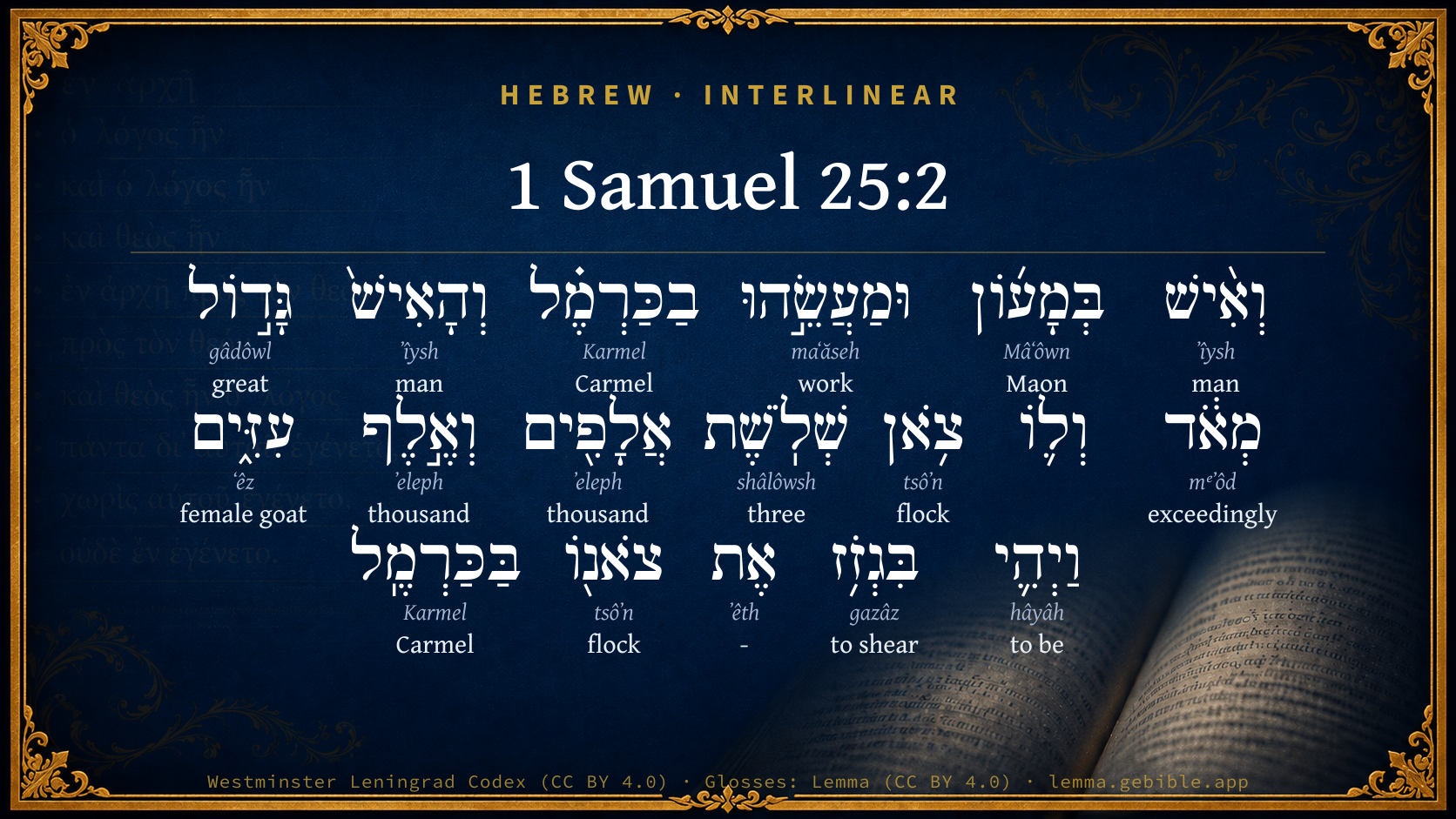
1 Samuel 25:2

Hebrew (Westminster Leningrad Codex) 1 Samuel 25:2 appears in the Hebrew Old Testament. The text above is from the Westminster Leningrad Codex. Each word links to its Strong’s number, a concise gloss, and parsing drawn from the Open Scriptures Hebrew Bible morphology. Click any word for its full Brown-Driver-Briggs (BDB) entry.
Download image
Cite this verse

1 Samuel 25:2 (World English Bible). Public Domain. Lemma interlinear Bible study tool, https://lemma.gebible.app/v/1-samuel/25/2.

Show BibTeX & RIS
BibTeX
RIS
English Translation
There was a man in Maon, whose possessions were in Carmel; and the man was very great, and he had three thousand sheep, and a thousand goats: and he was shearing his sheep in Carmel.
World English Bible · Public Domain
Download a study sheet

One document with this verse’s original text, its word-by-word gloss line, the meaning frame, cross-references with their text, attributed commentary, and full source and license credits — printable, and it pastes into notes with its structure intact.

This verse Autodidact and up

Study sheet (.html) Plain text (.txt)

A passage Seminary Student

Up to 50 verses in one chapter. A passage sheet keeps up to 6 commentary sources and 12 cross-references per verse, in the order this page ranks them, and says so on the sheet whenever that leaves anything out. Ask for a single verse and you get the Autodidact verse sheet above.

Everything on this page stays free to read, with no account — the sheet is a download of what is already on screen, not access to it.

Want to remove ads? Support Godless Engineer
Compare translations 3

The same verse in 3 English versions, stacked beneath the original-language interlinear above. Click any original word for its lexicon entry.

Each is an independent rendering of the whole verse — the interlinear is not word-aligned to these translations.

Highlighted words mark where these versions differ — a whole-verse word diff, not a word-by-word alignment.

  • World English Bible Public Domain
    There was a man in Maon, whose possessions were in Carmel; and the man was very great, and he had three thousand sheep, and a thousand goats: and he was shearing his sheep in Carmel.
  • King James Version Public Domain
    And there was a man in Maon, whose possessions were in Carmel; and the man was very great, and he had three thousand sheep, and a thousand goats: and he was shearing his sheep in Carmel.
  • unfoldingWord Literal Text CC BY-SA 4.0
    Now a man in Maon, and his work in Carmel. And the man very great. For to him 3,000 sheep and 1,000 goats. And he was shearing his sheep in Carmel.

unfoldingWord Literal Text — © unfoldingWord, licensed CC BY-SA 4.0. Word-aligned USFM3 via Door43 (git.door43.org/unfoldingWord/en_ult).

Versions to compare (up to 4)

3 of 4 selected

Show all 18 translations

Every available English version of this verse, each an independent rendering of the whole verse.

  • World English Bible Public Domain
    There was a man in Maon, whose possessions were in Carmel; and the man was very great, and he had three thousand sheep, and a thousand goats: and he was shearing his sheep in Carmel.
  • Berean Standard Bible Public Domain
    Now there was a man in Maon whose business was in Carmel. He was a very wealthy man with a thousand goats and three thousand sheep, which he was shearing in Carmel.
  • Majority Standard Bible Public Domain
    Now there was a man in Maon whose business was in Carmel. He was a very wealthy man with a thousand goats and three thousand sheep, which he was shearing in Carmel.
  • King James Version Public Domain
    And there was a man in Maon, whose possessions were in Carmel; and the man was very great, and he had three thousand sheep, and a thousand goats: and he was shearing his sheep in Carmel.
  • American Standard Version (1901) Public Domain
    And there was a man in Maon, whose possessions were in Carmel; and the man was very great, and he had three thousand sheep, and a thousand goats: and he was shearing his sheep in Carmel.
  • Revised Version (1885) Public Domain
    And there was a man in Maon, whose possessions were in Carmel; and the man was very great, and he had three thousand sheep, and a thousand goats: and he was shearing his sheep in Carmel.
  • Geneva Bible (1599) Public Domain
    Now in Maon was a man, who had his possessio in Carmel, and the man was exceeding mightie and had three thousand sheepe, and a thousand goates: and he was shering his sheepe in Carmel.
  • Douay-Rheims (1899) Public Domain
    Now there was a certain man in the wilderness of Maon, and his possessions were in Carmel, and the man was very great: and he had three thousand sheep, and a thousand goats: and it happened that he was shearing his sheep in Carmel.
  • Young's Literal Translation Public Domain
    And `there is' a man in Maon, and his work `is' in Carmel; and the man `is' very great, and he hath three thousand sheep, and a thousand goats; and he is shearing his flock in Carmel.
  • Literal Standard Version CC BY-SA 4.0
    And [there is] a man in Maon, and his work [is] in Carmel; and the man [is] very great, and he has three thousand sheep and one thousand goats; and he is shearing his flock in Carmel.
  • Unlocked Literal Bible CC BY-SA 4.0
    There was a man in Maon, whose possessions were in Carmel. The man was very wealthy. He had three thousand sheep and one thousand goats. He was shearing his sheep in Carmel.
  • unfoldingWord Literal Text CC BY-SA 4.0
    Now a man in Maon, and his work in Carmel. And the man very great. For to him 3,000 sheep and 1,000 goats. And he was shearing his sheep in Carmel.
  • Darby Bible Public Domain
    And there was a man at Maon, whose business was at Carmel; and the man was very great, and he had three thousand sheep and a thousand goats; and he was shearing his sheep at Carmel.
  • World Messianic Bible Public Domain
    There was a man in Maon whose possessions were in Carmel; and the man was very great. He had three thousand sheep and a thousand goats; and he was shearing his sheep in Carmel.
  • Webster's Bible Public Domain
    And there was a man in Maon, whose possessions were in Carmel; and the man was very great, and he had three thousand sheep, and a thousand goats: and he was shearing his sheep in Carmel.
  • Free Bible Version CC BY-SA 4.0
    A man from Maon was very wealthy. He had property in Carmel and owned one thousand goats and three thousand sheep. He was in Carmel shearing them.
  • Bible in Basic English Public Domain
    Now there was a man in Maon whose business was in Carmel; he was a great man and had three thousand sheep and a thousand goats: and he was cutting the wool of his sheep in Carmel.
  • JPS Tanakh (1917) Public Domain
    And there was a man in Maon, whose possessions were in Carmel; and the man was very great, and he had three thousand sheep, and a thousand goats; and he was shearing his sheep in Carmel.

Literal Standard Version (2020), Covenant Press — licensed CC BY-SA 4.0. Text via the HelloAO Bible API (eBible.org). Unlocked Literal Bible (unfoldingWord) — licensed CC BY-SA 4.0. Text via the HelloAO Bible API (eBible.org). unfoldingWord Literal Text — © unfoldingWord, licensed CC BY-SA 4.0. Word-aligned USFM3 via Door43 (git.door43.org/unfoldingWord/en_ult). Free Bible Version, Dr. Jonathan Gallagher — licensed CC BY-SA 4.0. Text via the HelloAO Bible API (eBible.org).

Word by word

More ways to search: Search by grammar → Find every occurrence → Compare this word →

Practice this passage: Drill this verse → Learn its vocabulary →

בְּמָע֜וֹן
Mâʻôwn
H4584
“in/at · Maon”
Preposition + Noun, Proper
Part of Speech
Preposition + Noun
Type
Proper
Full BDB Definition

Origin: the same as H4583

TWOT: None

Maon or Maonites = "habitation" - a man of Judah (noun proper masculine) - the inhabitants of the city of Maon (noun proper masculine) - a city of Judah located 8 miles south of Hebron (noun proper locative)
  1. וְאִ֨ישׁ ʼîysh H376 “and · man” Conjunction + Noun, Common, Masculine, Singular, Absolute
  2. וּמַעֲשֵׂ֣הוּ maʻăseh H4639 “and · work · his” Conjunction + Noun, Common, Masculine, Singular, Construct + Suffix, Personal, 3rd Person, Masculine, Singular
  3. בַכַּרְמֶ֗ל Karmel H3760 “in/at the · Carmel” Preposition, Determined + Noun, Proper
  4. וְהָאִישׁ֙ ʼîysh H376 “and · the · man” Conjunction + Particle, Definite Article + Noun, Common, Masculine, Singular, Absolute
  5. גָּד֣וֹל gâdôwl H1419 “great” Adjective, Adjective, Masculine, Singular, Absolute
  6. מְאֹ֔ד mᵉʼôd H3966 “exceedingly” Adverb
  7. צֹ֥אן tsôʼn H6629 “flock” Noun, Common, Both, Singular, Absolute
  8. שְׁלֹֽשֶׁת shâlôwsh H7969 “three” Adjective, Cardinal number, Masculine, Singular, Construct
  9. אֲלָפִ֖ים ʼeleph H505 “thousand” Adjective, Cardinal number, Both, Plural, Absolute
  10. וְאֶ֣לֶף ʼeleph H505 “and · thousand” Conjunction + Adjective, Cardinal number, Both, Singular, Absolute
  11. עִזִּ֑ים ʻêz H5795 “female goats” Noun, Common, Feminine, Plural, Absolute
  12. וַיְהִ֛י hâyâh H1961 “and · to be” Conjunction + Verb, Qal, Sequential Imperfect, 3rd Person, Masculine, Singular
  13. בִּגְזֹ֥ז gazâz H1494 “in/at · to shear” Preposition + Verb, Qal, Infinitive Construct
  14. אֶת ʼêth H853 “-” Particle, Direct Object
  15. צֹאנ֖וֹ tsôʼn H6629 “flock · his” Noun, Common, Both, Singular, Construct + Suffix, Personal, 3rd Person, Masculine, Singular
  16. בַּכַּרְמֶֽל Karmel H3760 “in/at the · Carmel” Preposition, Determined + Noun, Proper

About this verse

These counts appear in no published source. They are computed here, from the morphology-tagged text and Lemma’s own curated glosses. What Lemma adds →

18
words
13
distinct lemmas
Historical
section

Notable vocabulary

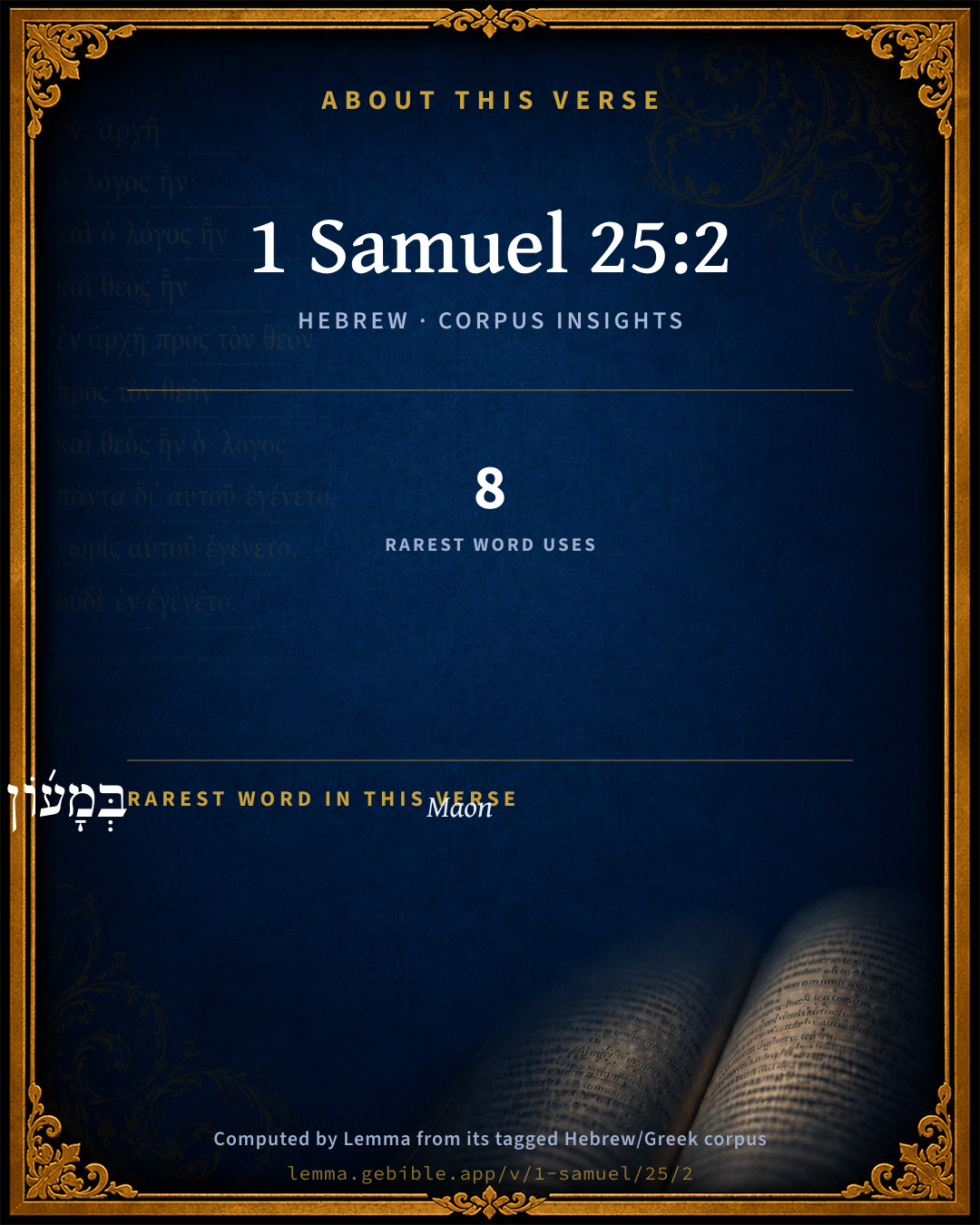
The rarest word here is בְּמָע֜וֹן Maon H4584 — appearing just 8 times in the whole Hebrew Bible.

Shared distinctive vocabulary

בְּמָע֜וֹן Maon H4584 occurs in 6 verses of the Hebrew Bible. Also found in:

Grammatical profile

  • 2 verbs
  • 9 nouns
  • 4 adjectives
  • 1 preposition
  • 1 adverb
  • 1 particle

Verb forms

  • וַיְהִ֛י Qal · Sequential Imperfect
  • בִּגְזֹ֥ז Qal · Infinitive Construct

Repetition

Words recur within this verse — often emphatic in Hebrew:

  • וְאִ֨ישׁ man H376 ×2
  • בַכַּרְמֶ֗ל Carmel H3760 ×2
  • צֹ֥אן flock H6629 ×2
  • אֲלָפִ֖ים thousand H505 ×2

Hebrew & Septuagint length

In English translation the verse runs 35 words from the Hebrew and 40 from the Septuagint (LXX English) — closely comparable.

A rough comparison of the two English renderings, which tokenize alike — not a word-level alignment.

Word counts can differ between the Hebrew and the Greek without any difference in meaning — e.g. the Hebrew direct-object marker אֵת has no separate Greek word, and Greek often adds the article ὁ.

Cross-references

13

Topical passages linked to 1 Samuel 25:2 in the Treasury of Scripture Knowledge — connected by theme and wording, ordered by reader-vote popularity; previews shown in the World English Bible.

  • Genesis 38:13 It was told Tamar, saying, "Behold, your father-in-law is going up to Timnah to shear his sheep."
  • Joshua 15:55 Maon, Carmel, and Ziph, and Jutah,
  • 1 Samuel 23:24 They arose, and went to Ziph before Saul: but David and his men were in the wilderness of Maon, in the Arabah on the south of the desert.
  • Luke 16:19–25 "Now there was a certain rich man, and he was clothed in purple and fine linen, living in luxury every day.
  • Genesis 13:2 Abram was very rich in cattle, in silver, and in gold.
  • Genesis 26:13 The man grew great, and grew more and more until he became very great.
  • 1 Samuel 30:5 David's two wives were taken captive, Ahinoam the Jezreelitess, and Abigail the wife of Nabal the Carmelite.
  • 2 Samuel 13:23–24 It happened after two full years, that Absalom had sheep-shearers in Baal Hazor, which is beside Ephraim: and Absalom invited all the king's sons.
  • 2 Samuel 19:32 Now Barzillai was a very aged man, even eighty years old: and he had provided the king with sustenance while he lay at Mahanaim; for he was a very great man.
  • Job 1:3 His possessions also were seven thousand sheep, three thousand camels, five hundred yoke of oxen, five hundred she-donkeys, and a very great household; so that this man was the greatest of all the children of the east.
  • Job 42:12 So Yahweh blessed the latter end of Job more than his beginning. He had fourteen thousand sheep, six thousand camels, one thousand yoke of oxen, and a thousand female donkeys.
  • Psalms 73:3–7 For I was envious of the arrogant, When I saw the prosperity of the wicked.
  • Psalms 17:14 From men by your hand, Yahweh, From men of the world, whose portion is in this life. You fill the belly of your cherished ones. Your sons have plenty, And they store up wealth for their children.

Cross-references courtesy of OpenBible.info (CC BY 4.0).

Hebrew and Greek witnesses Masoretic Hebrew ↔ Greek Septuagint

The same verse in the two great witnesses to the Old Testament, shown verse-for-verse.

These are two independent witnesses, not word-aligned to each other, and the Septuagint is shown in lemma (dictionary) form.

Hebrew 1 Samuel 25:2 Masoretic · Westminster Leningrad Codex

וְאִ֨ישׁ בְּמָע֜וֹן וּמַעֲשֵׂ֣הוּ בַכַּרְמֶ֗ל וְהָאִישׁ֙ גָּד֣וֹל מְאֹ֔ד וְל֛וֹ צֹ֥אן שְׁלֹֽשֶׁת אֲלָפִ֖ים וְאֶ֣לֶף עִזִּ֑ים וַיְהִ֛י בִּגְזֹ֥ז אֶת צֹאנ֖וֹ בַּכַּרְמֶֽל

There was a man in Maon, whose possessions were in Carmel; and the man was very great, and he had three thousand sheep, and a thousand goats: and he was shearing his sheep in Carmel.

World English Bible · Public Domain

Greek LXX 1 Samuel 25:2 Septuagint · lemma form

καί εἰμί ἄνθρωπος ἐν ὁ μααν καί ὁ ποίμνιον αὐτός ἐν ὁ κάρμηλος καί ὁ ἄνθρωπος μέγας σφόδρα καί οὗτος ποίμνιον τρισχίλιοι καί αἴξ χίλιοι καί γίγνομαι ἐν ὁ κείρω ὁ ποίμνιον αὐτός ἐν ὁ κάρμηλος

And there was a man in Maon, and his flocks were in Carmel, and he was a very great man; and he had three thousand sheep, and a thousand she-goats: and he happened to be shearing his flock in Carmel.

LXX2012 (modern English Septuagint) · Public Domain

On this verse, Matthew Henry's Commentary discusses the Septuagint’s reading. Read the note in Commentary ↓

Hebrew: Westminster Leningrad Codex (CC BY 4.0). Greek: Septuagint (public domain); English from LXX2012 (modern English Septuagint) (Public Domain). How the Septuagint differs from the Hebrew →

Targum (Aramaic paraphrase)

1

The Targum is the ancient Jewish Aramaic paraphrase of the Hebrew Scriptures — an interpretive translation, not the Hebrew text itself. Onkelos (literal) and Pseudo-Jonathan (expansive) render the Torah, and Jonathan the Prophets. Coverage is partial: where no permissively-licensed English translation exists for a verse, only the Aramaic is shown. This is verse-level text, not a word-by-word alignment to the Hebrew.

  1. Targum Jonathan Prophets (Joshua–Malachi)
    וְגַבְרָא בְמָעוֹן וְנִכְסוֹהִי בְכַרְמְלָא וְגַבְרָא רַב לַחֲדָא וְלֵיהּ עָאן תְּלָתָא אַלְפִין וְאֶלֶף עִזִין וַהֲוָה בְּמֵיגַז יַת עָנֵיהּ בְּכַרְמְלָא:

    (no public-domain English translation for this verse)

    Targum Jonathan — Aramaic: “Mikraot Gedolot” (public domain). English: “Sefaria Community Translation” (CC0 1.0 (public-domain dedication)); “London "Chaldee Paraphrase," 1871” (public domain). Text via Sefaria.

Commentary

Notes on 1 Samuel 25:2 from classic Christian and Jewish commentators (each source and its license shown beneath its notes). The classic Christian expositions comment on the surrounding passage and are grouped to its opening verse, so a note may address several verses; the Jewish commentaries on the Tanakh (Rashi and others) are per-verse, so they appear only where the commentator wrote on this verse.

Lemma curates 59 commentaries, every one of them public domain or Creative Commons licensed, each selected and text-cleaned for this edition rather than reprinted as found. About our sources →

Matthew Henry's Commentary

Here begins the story of Nabal.

I. A short account of him, who and what he was (Sa1 25:2, Sa1 25:3), a man wee should never have heard of if there had not happened some communication between him and David. Observe, 1. His name: Nabal - a fool; so it signifies. It was a wonder that his parents would give him that name and an ill omen of what proved to be this character. Yet indeed we all of us deserve to be so called when we come into the world, for man is born like the wild ass's colt and foolishness is bound up in our hearts. 2. His family: He was of the house of Caleb, but was indeed of another spirit. He inherited Caleb's estate; for Maon and Carmel lay near Hebron, which was given to Caleb (Jos 15:54, Jos 15:55; Jos 14:14), but he was far from inheriting his virtues. He was a disgrace to his family, and then it was no honour to him. Degeneranti genus opprobrium - A Good extraction is a reproach to him who degenerates from it. The Septuagint, and some other ancient versions, read it appellatively, not, He was a Calebite, but He was a dogged man, of a currish disposition, surly and snappish, and always snarling. He was anthrōpos kunikos - a man that was a cynic. 3. His wealth: He was very great, that is, very rich (for riches make men look great in the eye of the world), otherwise, to one that takes his measures aright, he really looked very mean. Riches are common blessings, which God often gives to Nabals, to whom he gives neither wisdom nor grace. 4. His wife - Abigail, a woman of great understanding. Her name signifies, the joy of her father; yet he could not promise himself much joy of her when he married her to such a husband, enquiring more after his wealth than after his wisdom. Many a child is thrown away upon a great heap of the dirt of worldly wealth, married to that, and to nothing else that is desirable. Wisdom is good with an inheritance, but an inheritance is good for little without wisdom. Many an Abigail is tied to a Nabal; and if it be so, be her understanding, like Abigail's, ever so great, it will be little enough for her exercises. 5. His character. He had no sense either of honour or honesty; not of honour, for he was churlish, cross, and ill-humoured; not of honesty, for he was evil in his doings, hard and oppressive, and a man that cared not what fraud and violence he used in getting and saving, so he could but get and save. This is the character given of Nabal by him who knows what every man is.

II. David's humble request to him, that he would send him some victuals for himself and his men.

1. David, it seems, was in such distress that he would be glad to be beholden to him, and did in effect come a begging to his door. What little reason have we to value the wealth of this world when so great a churl as Nabal abounds and so great a saint as David suffers want! Once before we had David begging his bread, but then it was of Ahimelech the high priest, to whom one would not grudge to stoop. But to send a begging to Napal was what such a spirit as David had could not admit without some reluctancy; yet, if Providence bring him to these straits, he will not say that to beg he is ashamed. Yet see Psa 37:25.

2. He chose a good time to send to Nabal, when he had many hands employed about him in shearing his sheep, for whom he was to make a plentiful entertainment, so that good cheer was stirring. Had he sent at another time, Nabal would have pretended he had nothing to spare, but now he could not have that excuse. It was usual to make feasts at their sheep-shearings, as appears by Absalom's feast on that occasion (Sa2 13:24), for wool was one of the staple commodities of Canaan.

3. David ordered his men to deliver their message to him with a great deal of courtesy and respect: "Go to Nabal, and greet him in my name. Tell him I sent you to present my service to him, and to enquire how he does and his family," Sa1 25:5. He puts words in their mouths (Sa1 25:6): Thus shall you say to him that liveth; our translators add, in prosperity, as if those live indeed that live as Nabal did, with abundance of the wealth of this world about them; whereas, in truth, those that live in pleasure are dead while they live, Ti1 5:6. This was, methinks too high a compliment to pass upon Nabal, to call him the man that liveth. David knew better things, that in God's favour is life, not in the world's smiles; and by the rough answer he was well enough served, for this too smooth address to such a muck-worm. Yet his good wishes were very commendable. "Peace be to thee, all good both to soul and body. Peace be to thy house and to all that thou hast." Tell him I am a hearty well-wisher to his health and prosperity. He bids them call him his son David (Sa1 25:8), intimating that, for his age and estate, David honoured him as a father, and therefore hoped to receive some fatherly kindness from him.

4. He pleaded the kindness which Nabal's shepherds had received from David and his men; and one good turn requires another. He appeals to Nabal's own servants, and shows that when David's soldiers were quartered among Nabal's shepherds, (1.) They did not hurt them themselves, did them no injury, gave them no disturbance, were not a terror to them, nor took any of the lambs out of the flock. Yet, considering the character of David's men, men in distress, and debt, and discontented, and the scarcity of provisions in his camp, it was not without a great deal of care and good management that they were kept from plundering. (2.) They protected them from being hurt by others. David himself does but intimate this, for he would not boast of his good offices: Neither was there aught missing to them, Sa1 25:7. But Nabal's servants, to whom he appealed, went further (Sa1 25:16): They were a wall unto us, both by night and day. David's soldiers were a guard to Nabal's shepherds when the bands of the Philistines robbed the threshing-floors (Sa1 23:1) and would have robbed the sheep-folds. From those plunderers Nabal's flocks were protected by David's care, and therefore he says, Let us find favour in thy eyes. Those that have shown kindness may justly expect to receive kindness.

5. He was very modest in his request. Though David was anointed king, he insisted not upon royal dainties, but, "Give whatsoever comes to thy hand, and we will be thankful for it." Beggars must not be choosers. Those that deserved to have been served first will now be glad of what is left. They plead, We come in a good day, a festival, when not only the provision is more plentiful, but the heart and hand are usually more open and free than at other times, when much may be spared and yet not be missed. David demands not what he wanted as a debt, either by way of tribute as he was a king, or by way of contribution as he was a general, but asks it as a boon to a friend, that was his humble servant. David's servants delivered their message faithfully and very handsomely, not doubting but to go back well laden with provisions.

III. Nabal's churlish answer to this modest petition, Sa1 25:10, Sa1 25:11. One could not have imagined it possible that any man should be so very rude and ill-conditioned as Nabal was. David called himself his son, and asked bread and a fish, but, instead thereof, Nabal gave him a stone and a scorpion; not only denied him, but abused him. If he had not thought fit to send him any supplies for fear of Ahimelech's fate, who paid dearly for his kindness to David; yet he might have given a civil answer, and made the denial as modest as the request was. But, instead of that, he falls into a passion, as covetous men are apt to do when they are asked for any thing, thinking thus to cover one sin with another, and by abusing the poor to excuse themselves from relieving them. But God will not thus be mocked. 1. He speaks scornfully of David as an insignificant man, not worth taking notice of. The Philistines could say of him, This is David the king of the land, that slew his ten thousands (Sa1 21:11), yet Nabal his near neighbour, and one of the same tribe, affects not to know him, or not to know him to be a man of any merit or distinction: Who is David? And who is the son of Jesse? He could not be ignorant how much the country was obliged to David for his public services, but his narrow soul thinks not of paying any part of that debt, nor so much as of acknowledging it; he speaks of David as an inconsiderable man, obscure, and not to be regarded. Think it not strange if great men and great merits be thus disgraced. 2. He upbraids him with his present distress, and takes occasion from it to represent him as a bad man, that was fitter to be set in the stocks for a vagrant than to have any kindness shown him. How naturally does he speak the churlish clownish language of those that hate to give alms! There are many servants now-a-days (as if there had been none such in former days) that break every man from his master, suggesting that David was one of them himself ("He might have kept his place with his master Saul, and then he needed not have sent to me for provisions"), and also that he entertained and harboured those that were fugitives like himself. It would make one's blood rise to hear so great and good a man as David thus vilified and reproached by such a base churl as Nabal. But the vile person will speak villany, Isa 32:5-7. If men bring themselves into straits by their own folly, yet they are to be pitied and helped, and not trampled upon and starved. But David was reduced to this distress, not by any fault, no, nor any indiscretion, of his own, but purely by the good services he had done to his country and the honours which his God had put upon him; and yet he was represented as a fugitive and runagate. Let this help us to bear such reproaches and misrepresentations of us with patience and cheerfulness, and make us easy under them, that it has often been the lot of the excellent ones of the earth. Some of the best men that ever the world was blest with were counted as the off-scouring of all things, Co1 4:13. 3. He insists much upon the property he had in the provisions of his table, and will by no means admit any body to share in them. "It is my bread and my flesh, yes, and my water too (though usus communis aquarum - water is every one's property), and it is prepared for my shearers," priding himself in it that it was all his own; and who denied it? Who offered to dispute his title? But this, he thinks, will justify him in keeping it all to himself, and giving David none; for may he not do what he will with his own? Whereas we mistake if we think we are absolute lords of what we have and may do what we please with it. No, we are but stewards, and must use it as we are directed, remembering it is not our own, but his that entrusted us with it. Riches are ta allotria (Luk 16:12); they are another's, and we ought not to talk too much of their being our own.

Matthew Henry's Commentary on the Whole Bible (1708–1710) — public domain (CC PDM 1.0). Text via the HelloAO Bible API.

Trapp's Complete Commentary

John Trapp

1Sa 25:2 And [there was] a man in Maon, whose possessions [were] in Carmel; and the man [was] very great, and he had three thousand sheep, and a thousand goats: and he was shearing his sheep in Carmel.

Ver. 2. And there was a man.] Or rather, A golden brute, χρυσουν προβατον, {a} - as Caligula called that rich wretch, his father-in-law, Syllanus, - or a great Colosse full of rubbish.

And he had three thousand sheep.] Men’s wealth of old consisted most in their herds of cattle; whence money also in Latin hath its name: Omnis enim pecuniae pecus fuit fundamentum, saith Columella. {b}

{a} Dion.

{b} A pecudibus pecunia, et peculium. - Liv. vi.

John Trapp, A Commentary or Exposition upon All the Books of the Old and New Testament (1647–1656) — public domain. Text from a community e-Sword module.

Joseph Benson's Commentary

1Sa 25:2. Whose possessions were in Carmel — In some part of this wilderness Israel wandered, when they came out of Egypt. The place would bring to David’s mind God’s care over them, which he might now improve for his own encouragement.

Joseph Benson's Commentary on the Old and New Testaments (1811–1818) — public domain. Text from a community e-Sword module.

The Preacher's Complete Homiletical Commentary

Joseph S. Exell (gen. ed.)

CRITICAL AND EXPOSITORY NOTES—

1Sa_25:2. “Maon.” A city of Judah (Jos_15:55), situated on a hill now called Tell Main, about seven or eight miles south of Hebron. It is now in ruins. “Carmel.” This word literally means a fertile region, and is applied also to the promontory on the north-east of Palestine, famous in the history of Elijah. The place here so named is the present Kurmul and its neighbourhood, about a mile north-west of Maon. David had before taken shelter near Maon. (See the notes on chapter 1Sa_23:24.)

1Sa_25:3. “Nabal,” i.e., fool. (See 1Sa_25:25.) Keil thinks it could hardly have been this man’s proper name, but was a popular designation on account of his folly. “Of the house of Caleb.” Literally he was a Calebite (Wordsworth), and as the word means “a dog man,” and Josephus, among others, understand it to mean “a doggish, cynical man. But Caleb’s possession lay in this region, and, as Erdmann remarks, the two former statements sufficiently characterise his disposition, and a third would be out of keeping with the simplicity of the description. Moreover, “the statement of his origin accords with this importance, as a man ‘great’ by his riches, and it is introduced as something new by the words ‘and he,’ which would not suit the continuation of his moral portraiture.” We may therefore conclude that Nabal was descended from the ancient hero of Israel, and he was, then, of the same tribe as David.

1Sa_25:5. “Go to Nabal and greet him,” etc. “In all these particulars, when we were at Kermul and were in the midst of scenes memorable for the adventures of David, we were deeply struck with the truth and strength of the biblical description of manners and customs, almost identically the same as those that exist at the present day. On such a festive occasion as a sheepshearing near a town or village, an Arab Sheikh of the neighbouring desert would hardly fail to put in a word either in person or by message, and his message would be a transcript of that of David to Nabal.” (Dr. Robinson.)

1Sa_25:6. “To him that liveth.” The words in prosperity it will be seen are supplied by our translators. The Hebrew phrase is obscure and has been very variously rendered, but the most satisfactory explanation seems to be that in which the word translated liveth is taken as a substantive, and the whole understood as a salutation. So Keil, Luther, etc.

1Sa_25:7. “Neither was there aught missing,” etc. “These words may refer to the protection afforded the herdsmen by David’s people against the predatory desert tribes; for such protection against thieving attacks (which came expressly from the south) is expressly affirmed in 1Sa_25:16; 1Sa_25:21. (Erdmann.) “Thus, even in his outlawry, David showed himself the protector of his people.” (Keil.)

1Sa_25:8. A good day, i.e., a festive day. Sheepshearing was conducted as a festival (comp. Gen_38:12; 2Sa_13:23), when strangers and the poor were feasted.

1Sa_25:9. “Ceased,” rather, rested or sat down, to await the fulfilment of their request.

1Sa_25:11. “My bread and my water,” etc. “The mention of water indicates a country where water was scarce. Compare the earnestness with which Caleb’s daughter in this very country begged of her father the springs of water.” Jos_15:19. (Biblical Commentary.)

1Sa_25:18. “Bottles,” i.e., goatskins, capable of holding a large quantity. “Clusters of raisins,” rather, raisin cakes. “Fig cakes,” “pressed figs joined together.” (Keil.)

1Sa_25:20. “By the covert.” “Probably a hollow between two peaks of a mountain. This would explain the use of the word to come down, with reference both to Abigail, who approached on one side, and David, who came on the other.” (Keil.)

1Sa_25:22. “This oath, in which the punishment of God is not called down upon the swearer himself (God do so to me), as it generally is, but upon the enemies of David, is analogous to that in 1Sa_3:17, where punishment is threatened upon the person addressed, who is there made to swear; except that here, as the oath could not be uttered in the ears of the person addressed, upon whom it was to fall, the enemies generally are mentioned instead of to thee. There is no doubt, therefore, as to the correctness of the text.” (Keil.)

1Sa_25:26. “Let thine enemies,” etc. “That is, thou standest under God’s protection and guidance, so that all who as thine enemies will, like Nabal, do thee evil, shall, like him, become fools and fall under God’s punishment.” (Erdmann.) “She reminds David of the promise of God. Not that she prophesies, but that she has gathered it from the general promises of the word of God. The promise referred to is that whoever does good to his enemies and takes no vengeance upon them, God Himself will avenge him upon his enemies, according to the saying, Vengeance is mine, I will repay.” (Seb. Schmidt.)

1Sa_25:28. “Evil hath not been found,” i.e., misfortune, not wickedness; that thought is not expressed until 1Sa_25:31.

1Sa_25:29. “Bundle of life,” rather, the bundle of the living. “The metaphor is taken from the custom of binding up valuable things in a bundle to prevent their being injured,” (Keil.) “The middle of the sling,” literally, the cup of the sling, the cavity in which the stone was placed. This figure is adopted in Jer_10:18, “I will sling out the inhabitants of the land at this once.” (Wordsworth.)

1Sa_25:30. “When the Lord shall have done.” “From these words it appears to follow that Abigail had received certain information of the anointing of David, and his designation to be the future king, probably through Samuel or one of the pupils of the prophets. There is nothing to preclude this assumption, even if it cannot be historically sustained. Abigail manifests such an advance and maturity in the life of faith as could only have been derived from intercourse with the prophets. It is expressly stated with regard to Elijah and Elisha, that at certain times the pious assembled together around the prophets. What prevents us from assuming the same with regard to Samuel? The absence of any distinct testimony to that effect is amply compensated for by the brief, and for the most part casual notices that are given of the influence which Samuel exerted upon all Israel.” (Keil.)

1Sa_25:31. “That this shall be no grief unto thee.” “Like a wise woman, she reserves her strongest arguments till the last.” (Wordsworth.)

1Sa_25:36. “Merry with him,” literally, therewith, i.e., on account of the feast.

1Sa_25:37. “A stone.” Anger, or fear, or both combined with the excesses of the debauch, probably brought on a stroke of apoplexy, although his subsequent death is said to have been by the hand of the Lord (1Sa_25:38).

1Sa_25:39. “Pleaded the cause,” etc. “The figure is of a case in law, which is settled by the judicial decision. The ‘law-cause of my reproach,’ that is, the reproach offered to me, on account of which the Lord had to appear against Nabal as Judge and Avenger. Connect ‘from the hand’ with ‘pleaded,’ not with ‘my reproach,’ and render pregnantly ‘he has conducted my cause to a conclusion out of the hand,’ that is, he has collected the costs from the condemned person, and has settled the matter by the infliction of the proper punishment.” (Erdmann.) “And David sent,” etc. “This unceremonious proceeding was quite in the style of Eastern monarchs, who no sooner take a fancy for a lady than they despatch a messenger to intimate their royal wishes that she should henceforth reside in the palace, and her duty is implicitly to obey. David’s conduct shows that the manner of the Eastern nations were already imitated by the great men in Israel, and that the morality of the times, which God permitted, gave its sanction to the practice of polygamy.… The fact of a woman in her wealthy circumstances so willingly forming a matrimonial alliance with David, shows that the position he occupied, while expatriated in the wilderness, was far more elevated and comfortable than is generally imagined.” (Jamieson)

1Sa_25:43. “David took.” rather, had taken. “The expression also points to David’s marriage with Michal, the daughter of Saul.” (Keil.) “Jezreel.” Not Jezreel in the tribe of Issachar (Jos_19:18), but the one mentioned in Jos_15:56, not far from Maon.

1Sa_25:44. “Phalti.” Called Phaltiel in 2Sa_3:15. But Michal returned to David after Saul’s death. “Gallim.” A place between Gibeah of Saul and Jerusalem (Isa_10:30).

Note.—Delany draws an analogy between the character and history of David at this time and the legend of Orpheus in Thrace. He says: “I beg only to premise and to submit to the reader’s consideration whether, if he saw two historical pictures (the only two of the kind extant in the world), all whose outlines, parts, proportions, principal figures, actions, and attitudes, were exactly the same, but the colouring and other circumstantials different, and one of these confessedly ancient and a true original, and the other demonstrably later, but the date and the author uncertain—whether he would not conclude the later to be in truth no other than a copy of the original.” He quotes ancient writers to prove that Orpheus was not a Thracian, and instances his traditional beauty, his skill in music and song, his success in softening the infernal king, etc., as so many points of agreement between the two. Referring Psalms 120 to David’s sojourn at this time in or near the country of the Edomites, he quotes the Arab tradition that stones and birds were obedient to him, though he could not reclaim the wild men of the desert (Psalms 120.), and the legend concerning Orpheus, which pictures the rocks, beasts, and birds as obedient to him, although he could not civilise the Thracians. For the full argument in favour of this view see Delany’s “Life of David”.

MAIN HOMILETICS OF THE PARAGRAPH.—1Sa_25:2-43

NABAL, DAVID, AND ABIGAIL

In this narrative we have—

I. Selfishness refusing to acknowledge the rights of others. As in the human body no member or organ exists for itself but each for the good of the other and to contribute its part to the wellbeing of the whole, so in the Divine ideal of the human family each member is intended to live, not to minister to his personal gratification, but to do his or her part in promoting the welfare of the entire race. And as the health and consequent comfort of each bodily member is the reward of this rightful discharge of relative functions, so every man and woman who recognises and strives to discharge his or her relative duties will reap the recompense in individual comfort and peace of soul. Differences and inequalities of gifts and varieties of providential dealings make such a mutual ministry absolutely necessary, and doubtless have this end in view among others, to bind men more closely to each other by compelling a mutual dependence and obligation. But Nabal here stands before us as the impersonation of that large majority of mankind who deny such obligations, and refuse to recognise their position as that of stewards of the gifts with which God has entrusted them. Nabal here looks upon his abundance as his own peculiar and rightful possession; “he says,” remarks Wordsworth, “my bread, my meat, my water, my shearers, as if anything were really his own and not lent him by God;” and men generally forget that each human creature has some right to the produce of that earth which was given by God to the children of men (Psa_115:16) for their sustenance and enjoyment. This churlish sheepmaster was really indebted to David and his men for services actually rendered; if they had not been “a wall” unto Nabal’s men “night and day, while they were keeping the sheep,” (1Sa_25:16) he would have had a smaller flock to shear and perhaps the loss of useful servants to deplore, but he was not at a loss for an excuse for refusing to consider these services. He makes the very condition of need which strengthened David’s claim an excuse for refusing to satisfy it, and insinuating that David’s present untoward circumstances are the fruit of misconduct, disclaims all knowledge of him, and implies that this in itself is a sufficient reason for letting him and his followers suffer. These hare always been favourite arguments in the mouth of selfishness against helping those in need. If a man is poor, it is convenient to assume that it is the consequence of crime, and even if that fact cannot be proved, ignorance of who he is or whence he came is held to be sufficient to absolve from all obligations in relation to him. But God will not admit such pleas. He has both in word and deed declared them null and void. In the laws given for the government of the Hebrew commonwealth, special arrangements were made to ensure to each and all a due proportion of material good. The enactments connected with the year of jubilee were doubtless intended to secure this end and to prevent families from sinking into a condition of permanent and hopeless poverty. And although misfortune and trials are inseparable from the conditions of the present life, and were the lot of some of God’s chosen people as well as of others, he who had waxen poor was still to be regarded as a brother and treated as such (Lev_25:25), and the stranger, the fatherless, and the widow were to be provided for at the penalty of forfeiting the Divine blessing (Deu_24:19-21). In the instance before us, God, by a special visitation of judgment, made it manifest that His commands cannot be set at nought with impunity.

II. Righteous indignation at wrong degenerating into an unrighteous spirit of retaliation. It has been well said that there are no errors so mischievous as those which are the perversions of truth, and it is also true that no sinful emotions are so dangerous as those which have their origin in feelings which are natural and right. Affection, for instance, is a God-implanted instinct of the soul, but it may run into idolatry of the beloved object. And careful provision for one’s own house is enjoined by Paul (1Ti_5:8), but it may degenerate into worldliness and covetousness, and it is often difficult for erring human creatures to hold the balance between the right and the wrong in these and other cases. David found it so at this time. Indignation at Nabal’s injustice was lawful, but he did not stop there. No doubt the suddenness of the provocation had something to do with his hasty and sinful resolve. The vessel that is struck in a sudden squall is in greater danger than one in which the captain has foreseen the storm and has therefore prepared for it. After all, Nabal had not wronged David so much as Saul had, and yet there is more of vindictive feeling in this utterance against the foolish sheepmaster than he ever manifested against his royal father-in-law. But then he knew what to expect from Saul, whereas he probably expected quite different treatment from Nabal. Apart from the fact that sheepshearing was the customary season of large and generous entertainment of all comers, it is plain that Nabal was indebted to David and his men, and it seems impossible, too, seeing that his wife was evidently well acquainted with David’s history and character, that he could have been so ignorant of them as he pretended to be. Therefore David had good reason to look for a different reception of his message, and was fully justified in feeling himself wronged. But he was not justified in giving way to a spirit of revenge and still less in purposing to make many innocent people suffer for the guilt of one person. In this, as in other seasons of trial, the man after God’s own heart shows himself to be of “like passions as we are” (Jas_5:17), and apt to allow lawful desire and virtuous emotion to drift into very positive and even great transgression.

III. Godly prudence averting the consequences of selfishness. Prudence has been defined as “right knowledge in special cases—the practical realisation of the higher principle of knowledge found in wisdom.” When wisdom decrees that a certain things is to be done, or a certain word spoken, prudence decides upon the best time and place and manner of doing the deed or speaking the word. If we apply this definition to Abigail’s action at this time we shall find it is characterised by a rare prudence as to choice of time and place. Many a one can see what ought to have been done when the time is past for doing it. Many can act wisely and well after time for mature deliberation, but there are emergencies which admit of no delay for maturing plans. Abigail was in such an emergency now. There could be no delay if her household were to be saved from slaughter, and David from the commission of a great crime. She had to “make haste” in all her preparations, and to decide upon her line of argument with David while on her way to meet him, and she doubtless desired to encounter him on ground where he was in possession rather than on her own domain. She would thus come before him in the character of a suppliant, throwing herself more entirely on his generosity than if she had awaited his arrival nearer home, and it would be less humiliating to him and to his men to yield to her demands in such circumstances than if they had turned back when already at her gate. Many a good intention has failed of success, and many a wise word has fallen unheeded to the ground, because there has not been a due regard to the place as well as the time of executing the one or uttering the other. But Abigail did not err in this respect. Her prudence was most conspicuous, however, in the arguments she used to turn David from his purpose. There is no surer way of winning over an enemy than to recognise and acknowledge that he has good ground of displeasure. When he sees that we can to some extent excuse, and even justify him, he feels that he has a fair foe to deal with, and a great part of the gulf that separated us is bridged over at once. Abigail begins her address to David by freely admitting that he had been very badly treated by her husband, and that he had just cause of displeasure. This must have had a powerful influence upon him, and he must have quickly discerned that she was of a spirit quite different from that of her foolish husband. She then appeals to the deepest emotions and strongest motives of her adversary. She was happy in having to contend with a man who, although liable to err in word and action, was, like herself, a true servant of Jehovah, who would not deliberately be guilty of transgressing the Divine law. When a godly person has such a one to deal with, they know from their own experience what arguments will be of most weight. They know that such a man or woman is in the habit of committing his or her cause to God, and that in their inmost soul they are assured that it is safe with Him. They know how bitter to such are the upbraidings of conscience after wrong done, and how one such act of a good man, although repented of and forgiven, will sometimes sadden all his future life. Abigail, by reminding David of all these things, recalled his better self, and enabled his reason and conscience and faith to re-assume their mastery over him. He would have been a hardened man who could have resisted such an appeal—with a man of David’s devout spirit it was impossible. His words of gratitude to this good woman and to the God whose messenger she was, shows how complete was the conquest.

OUTLINES AND SUGGESTIVE COMMENTS

1Sa_25:3. Even the line of faithful Caleb will afford an ill-conditioned Nabal. Virtue is not, like unto lands, inheritable.—Bp. Hall.

1Sa_25:11. Our Lord describing the Nabal (or fool) of the gospel; who had said “I have no room where to bestow my fruits; I will pull down my barns, etc., adds that God said unto him, “Thou fool (thou second Nabal), this night shall thy soul be required of thee, and then whose shall those things be which thou hast provided” (Luk_12:17-20.—Wordsworth.

1Sa_25:12. Some understand this verse, that all the righteous are bound together as in a bundle, being of the same faith, religion, affection; whereas the wicked do fall off from one another, are never soundly conjoined and coupled together.

2. Some refer it unto the next life, that David should be bound up with the Lord among His saints.

3. Some, that he should have a sure house to him and his posterity, who should be as fast bound to continue as a bundle surely tied together.

4. But it is rather to be understood of David’s preservation, even in this life, as the words show both going before and following; for before Abigail spake of Saul’s rising against David, and after she saith that God shall cast out his enemies.… Yet the words have also a fit relation unto eternal life.—Willet.

1Sa_25:31. There was no need that Abigail should add to her words the prayer, “Remember thine handmaid.” The impression which her address produced in the soul of David was powerful and decisive. Like one walking in a dream, who wakens up at the sound of his name, and suddenly, with horror, sees himself on the brink of a giddy precipice, and overflowing with thanks towards his deliverer, retraces his steps,—such was now the state of David’s mind. Besides, he had learned to his humiliation, as well as also to his safety, to know one side of his temperament, which till now he had not been so clearly conscious of. As long as life lasts he will not forget this march towards Carmel. And we, perhaps, do not err if we suppose that what he once experienced at Carmel hovered before his soul, as often as in his psalms, particularly in the seventeenth, the eighteenth, the thirty-seventh, and the sixty-sixth, he raised his cry to the Lord as a God who “holdeth our soul in life, and suffereth not our feet to be moved.”—Krummacher.

1Sa_25:38. Let us note the suggestive contrast which is here presented in the deaths of Samuel and Nabal. On the one hand, we have a good man, taken to his reward after a long life spent in the service of his God, and a whole nation gathers to weep around his tomb. On the other, we have a surly, selfish, sottish man called to his account, and no tear is shed over his grave; but instead, a feeling of relief is experienced by all who were connected with him, for they are all conscious that they will be the happier for his absence. In the one case, the life on earth was but the prelude to a higher, holier, and more useful existence in the heavenly world; in the other, the earthly character was but the germ out of which would spring, in the state beyond, a deeper, darker, and more repulsive wickedness even than that which he had manifested here. I do not think that David wrote the 37th Psalm at this particular date, since, from one expression which it contains, he seems to have penned that ode in his old age; but, whensoever it was written, it is hard for me to believe that he had not before his mind at the time the contrast between Nabal and Samuel which this history so vividly presents. What could be more appropriate to Nabal than these words: “I have seen the wicked in great power, and spreading himself like a green bay tree. Yet he passed away, and lo, he was not: yea, I sought him, but he could not be found.” And surely David thought of Samuel when he wrote this verse: “Mark the perfect man, and behold the upright: for the end of that man is peace.”

Now, the practical question for us is, To which of these two classes do we belong? Alas, there are many in these days whose lives are inflicting a constant martyrdom on all who have the misfortune to be nearly related to them, and whose deaths, while full of sadness to themselves, would yet be a blessing and a relief to their friends as ridding them of a constant and fearful misery. “A living cross is heavier than a dead one; “and there are few who have to carry a weightier or sharper cross than the wives and families of these Nabals, whose intemperance has brutified them into harsh, unfeeling cruelty.—Dr. W. M. Taylor.

1Sa_25:32. A good heart is easily stayed from sinning, and is glad when it finds occasion to be crossed in ill purposes. Those secret checks, which are raised within itself, do readily conspire with all outward retentives: it never yielded to a wicked motion without much reluctation; and when it is overcome it is but with half a consent: whereas perverse and obdurate sinners, by reason they take full delight in evil, and have already in their conceit swallowed the pleasure of sin, abide not to be resisted, running on headily in those wicked courses they have propounded, in spite of opposition; and, if they be forcibly stopped in their way, they grow sullen and mutinous. David had not only vowed, but deeply sworn, the death of Nabal, and all his family, to the very dog that lay at his door; yet now he praiseth God, that hath given the occasion and grace to violate it. Wicked vows are ill made, but worse kept. Our tongue cannot tie us to commit sin. Good men think themselves happy, that since they had not the grace to deny sin, yet they had not the opportunity to accomplish it.—Bp. Hall.

Observe the contrast between David and Herod. David is deterred by the expostulations of Abigail, a prudent and fair woman, from keeping his oath and putting to death an evil man, Nabal, and he blesses God for it, Herod is urged by Herodias and her mother, two fair women in countenance but foul in heart, to keep his rash oath, and to put to death a holy man, John the Baptist; and he suffered remorse for doing so, and afterwards fell into a greater sin, and mocked the Divine David (Luk_23:11), and came to a miserable end.—Wordsworth.

1Sa_25:2-40. The history of David’s collision with Nabal—not a very flattering chapter in the history of his life—is inserted between the history of his two great victories over the spirit of revenge and impatience; and by the guidance of the Divine Spirit the historian seems so to have arranged the narrative, for the purpose of showing us how the servant of God may conquer in a great fight and yet be overcome in a small. The history of all warfare is full of such cases. In the presence of a great enemy the utmost vigilance is maintained; every effort is strained, every stimulus is applied. In the presence of a small foe the spirit of confidence and security leaves every position unguarded, and often paves the way for signal defeat. In the spiritual warfare nothing can be more common.—Blaikie.

1Sa_25:32-33. Prevention of sin is one of the greatest mercies that God can vouchsafe a man in this world.

1. From the deplorable condition of the sinner, before that mercy prevents him. He is in the direct way of death and destruction, and wholly unable to help himself.… A man under the drift of any passion will still follow the impulse of it until something interpose, and by a stronger impulse turn him another way; but in this case we can find no principle within him strong enough … for if it be any, it must be either

(1) the judgment of his reason, or

(2) the free choice of his will, and while a man is engaged in any sinful purpose, through the prevalence of passion, he fully approves of whatsoever he is carried on to do in the full strength of it. While David’s heart was full of his revengeful design, it had blinded and perverted his reason so far that it told him that the bloody purpose he was going to execute was just and becoming.…

2. It is perfectly free grace … for if things concur, and providence cuts not off the opportunity, the act of sin must needs follow.… Because every commission of sin introduces into the soul a certain degree of hardness, and an aptness to continue in it. It is much more difficult to throw out than not to let in.… Sin taken into the soul is like liquor poured into a vessel; so much of it as it fills, it also seasons. The touch and tincture go together. So that although the body of the liquor should be poured out again, yet still it leaves that tang behind it which makes the vessel fitter for that, than for any other.… And every commission imprints upon the soul a further proneness to sin as drinking both quenches the present thirst and provokes it for the future.

3. The only thing that can entitle to pardon—repentance—is not in the sinner’s power … for this is the sinner’s hard lot, that the same thing that makes him need repentance makes him also in danger of not obtaining it.

4. The greatness of this preventing mercy is eminently proved from those advantages accruing to the soul from the prevention of sin above what can be had from the bare pardon of it. First: Of the clearing of a man’s condition; and secondly: Of the satisfaction of his mind.… So much of prevention, so much of innocence.… Sometimes God may suffer the soul but just to begin the sinful production by reflecting upon a sin suggested with some complacency; which is to conceive sin, and then He may extinguish it.… Or He may permit it to pass into purpose and then make it prove abortive by stifling it.… Or He may let it come even to the birth, by strong endeavour to commit it, and yet then deny it strength to bring forth. Or God may suffer it to be born, and pass from endeavour into commission; and this is the last step but one, and that is, the frequent repetition which settles into a habit of sin.… But wherever God may turn the fatal stream it is a vast mercy.… Now, when grace keeps a man from sin he certainly knows that it is so … but grace may seal the sinner’s pardon and yet have left no transcript of that pardon in his breast. The handwriting may be cancelled in the court of heaven, and yet the indictment run on in the court of conscience … so that though the pardoned and the innocent may be equally safe, they cannot, without rare privilege, be equally cheerful Here is an unfailing criterion by which every man may discover the disposition of his own heart.… David overlooks the rich and seasonable present of Abigail, though pressed with hunger and travel; but her advice, which disarmed his rage and calmed his revenge, draws forth his high gratulations.—South.

This is one of the earliest cases recorded in the Bible in which the interests of the employer and the employed—the man of wealth and the man of work—stood, or seemed to stand, in antagonism to each other. It was a period in which an old system of things was breaking up; and the new one was not yet established, but a kind of right had grown up, irregular enough, but sufficient to establish a claim on Nabal for remuneration—a new claim, not admitted by him, reckoned by him an exaction, which could be enforced by no law, only by that law which is above all statute law, deciding according to emergencies, an undefinable instinctive sense of fairness and justice. In modern language the rights of labour were in conflict with the rights of property. Observe the fearful hopeless character of the struggle. The question had come to this: Whether David, with his ferocious six hundred mountaineers, united by the sense of wrong, or Nabal with his well fed and trained hirelings, bound by interest, not love, to his cause, were stronger? Which was the more powerful, want whetted by insult, or selfishness pampered by indulgence: they who wished to keep by force or they who wished to take? An awful and uncertain spectacle, but the spectacle which is exhibited in every country where rights are keenly felt and duties lightly.

I. The causes of this false social state.

1. False basis upon which social superiority was supposed to rest. Throughout Nabal’s conduct was built upon an assumption of his own superiority. He was a man of wealth. David was dependent upon his own daily efforts. Was not this enough to settle the question of inferiority and superiority? The evils of poverty are comparative—they depend on climate—they depend on contrast. Where all suffer equally, men bear hardship with cheerfulness; but where the luxury of enjoyment is out of all proportion monopolised by the few, when wealth or rank assumes an insulting domineering character, then the falsehood of superiority can be tolerated no longer. It was this which here brought matters to a crisis.

2. A false conception concerning rights. It would be unjust to Nabal to represent this as an act of wilful oppression. David’s demand appeared an invasion of his rights—a dictation with respect to that which was his own. There was something to be said for him. It was the view of his class, had descended to him from his parents, and it is hard to see through the falsehood of any system by which we profit and which is upheld by general consent, especially when good men, too, uphold it. On the other hand, David and his men were not slow to perceive that they had their rights over that property of Nabal’s. The harvest was in part David’s harvest, for without David it never could have been reaped. The sheep were in part David’s sheep, for without David not a sheep would have been spared by the marauders of the hill. The right which the soldier has by law to his pay was the right which David had by unwritten law, a right resting on the fact that his services were indispensable. Now when it comes to this, rights against rights, there is no determination of the question but by overwhelming numbers, or blood, and it is difficult to say to which side in such a quarrel we should wish well. If the rich man succeeds he will bind the chain more severely and surely upon the crushed serf, and the victory of the lawless with the memory of past wrongs to avenge is almost more sanguinary than the victory of those who have had power long and whose power has been defied.

II. The message of the Church to the man of wealth. It contains those principles which, carried out, realise the Divine Order of Society—not creating the facts of our humanity—simply making them known. And because these principles are externally true we find in Abigail’s conduct towards David the very principles which the Church of Christ has given to the world.

1. The spiritual dignity of man as man. David was the poor man, but the highborn lady admits his worth. Here is a truth revealed. Worth does not mean what a man is worth—you must find some better definition. This is the very truth revealed in the Incarnation. Christ, the King of humanity, is the poor woman’s Song of Solomon 2. The law of sacrifice. Abigail did not heal the grievance with smooth words. You might have said half of her provision would have been enough. But liberality is a most real economy. We wrong Abigail, however, if we call this economy or calculation; it would have failed on this principle. Ten times this sum from Nabal would not have arrested the revenge, but David felt that these were not the gifts of a sordid calculation, but of a generous heart. This is the attractive power of that great law whose highest expression is the cross.

3. The matter of rightful influence. Very remarkable is David’s demeanour towards Nabal as contrasted with his demeanour towards Abigail. It was not, therefore, against the wealthy class, but against individuals of the class, that the wrath of these men burned. There is reverence for superiors, if only it can be shown that they are superiors. It is deeply rooted in the heart of humanity—you cannot tear it out. Civilisation, science, progress, only change its direction: they do not weaken its force. Emancipation from false lords only sets the heart free to honour true ones. The free-born David will not do honour to Nabal. But behold, he has found a something nobler than himself, and in gratitude and profound respect he bows to that. To conclude. Doubtless David was wrong, and yet for one text in the Bible which requires submission and patience from the poor, you will find a hundred which denounce the vices of the rich, and woe to us if we have forgotten that David’s, not Nabal’s, is the cause of God.—Abridged from F. W. Robertson’s Sermons, Vol. I.

1Sa_25:40-44. Abigail’s meeting with David under the covert of the hill; … and David’s chivalrous answer to her chivalrous appeal—all the scene, which painters have so often delighted to draw, is a forefeeling, a prophecy, as it were, of the Christian chivalry of after ages. The scene is most human and most divine; and we are not shocked to hear that after Nabal’s death the fair and rich lady joins her fortune to that of the wild outlaw, and becomes his wife, to wander by wood and wold. But, amid all the simple and sacred beauty of that scene, we cannot forget, we must not forget, that Abigail is but one wife of many, that there is an element of pure, single, all-absorbing love absent, at least in David’s heart, which was present in the hearts of our forefathers in many a like case, and which they have handed down to us as a heirloom, as precious as that of our laws and liberties. And all this was sin unto David, and, like all sin, brought with it its own punishment. I do not mean to assign his exact amount of moral responsibility. Our Lord forbids us to do that, and least of all, to a man who only acted according to his light, and the fashion of his race and age. But we must fix it very clearly in our minds, that sins may be punished in this life, even though he who commits them is not aware that they are sins. If you are ignorant that fire burns, your ignorance will not prevent your hand from suffering if you put it into the fire … Sin, άμάρτια, means first, it seems to me, a missing of the mark, end, or aim of our existence; a falling short of the law, the ideal, the good works which God has prepared beforehand for us to walk in, and every such sin, conscious or unconscious, must avenge itself by the Divine laws of the universe.… No miracle is needed.… God’s laws are far too well made for Him to need to break them a second time because a sinner has broken them already. They avenge themselves. And so does polygamy. It did in the case of David. Look at what he might have been … living together with a helpmate worthy of him in godly love to his life’s end … and what was the fact? The indulgence of his passions—seemingly harmless at first—becomes most harmful and he commits a complication of crimes.—Kingsley.

The Preacher's Complete Homiletical Commentary (gen. ed. Joseph S. Exell; Funk & Wagnalls, c. 1892) — public domain (pre-1929). A full-Bible homiletical/sermon-outline anthology covering 65 of 66 books (2 John is absent from the source module). Text from a community e-Sword module.

Keil & Delitzsch

C. F. Keil & F. Delitzsch

The following history of Nabal's folly, and of the wise and generous behaviour of his pious and intelligent wife Abigail towards David, shows how Jehovah watched over His servant David, and not only preserved him from an act of passionate excitement, which might have endangered his calling to be king of Israel, but turned the trouble into which he had been brought into a source of prosperity and salvation.

Sa1 25:2-3

At Maon, i.e., Main or the mountains of Judah (see at Jos 15:55), there lived a rich man (גּדול, great through property and riches), who had his establishment at Carmel. מעשׂה, work, occupation, then establishment, possessions (vid., Exo 23:15). Carmel is not the promontory of that name (Thenius), but the present Kurmul on the mountains of Judah, scarcely half an hour's journey to the north-west of Maon (see at Jos 15:55). This man possessed three thousand sheep and a thousand goats, and was at the sheep-shearing at Carmel. His name was Nabal (i.e., fool): this was hardly his proper name, but was a surname by which he was popularly designated on account of his folly. His wife Abigail was "of good understanding," i.e., intelligent, "and of beautiful figure;" but the husband was "harsh and evil in his doings." He sprang from the family of Caleb. This is the rendering adopted by the Chaldee and Vulgate, according to the Keri כּלבּי. The Chethibh is to be read כּלבּו, "according to his heart;" though the lxx (ἄνθρωπος κυνικός) and Josephus, as well as the Arabic and Syriac, derive it from כּלב, and understand it as referring to the dog-like, or shameless, character of the man.

Sa1 25:4-8

When David heard in the desert (cf. Sa1 25:1) that Nabal was shearing his sheep, which was generally accompanied with a festal meal (see at Gen 38:12), he sent ten young men up to Carmel to him, and bade them wish him peace and prosperity in his name, and having reminded him of the friendly services rendered to his shepherds, solicit a present for himself and his people. לשׁלום לו שׁאל, ask him after his welfare, i.e., greet him in a friendly manner (cf. Exo 18:7). The word לחי is obscure, and was interpreted by the early translators merely according to uncertain conjectures. The simplest explanation is apparently in vitam, long life, understood as a wish in the sense of "good fortune to you" (Luther, Maurer, etc.); although the word חי in the singular can only be shown to have the meaning life in connection with the formula used in oaths, נפשׁך חי, etc. But even if חי must be taken as an adjective, it is impossible to explain לחי in any other way than as an elliptical exclamation meaning "good fortune to the living man." For the idea that the word is to be connected with אמרתּם, "say to the living man," i.e., to the man if still alive, is overthrown by the fact that David had no doubt that Nabal was still living. The words which follow are also to be understood as a wish, "May thou and thy house, and all that is thine, be well!" After this salutation they were to proceed with the object of their visit: "And now I have heard that thou hast sheep-shearers. Now thy shepherds have been with us; we have done them no harm (הכלים, as in Jdg 18:7 : on the form, see Ges. 53, 3, Anm. 6), and nothing was missed by them so long as they were in Carmel." When living in the desert, David's men had associated with the shepherds of Nabal, rendered them various services, and protected them and their flocks against the southern inhabitants of the desert (the Bedouin Arabs); in return for which they may have given them food and information. Thus David proved himself a protector of his people even in his banishment. וימצאוּ, "so may the young men (those sent by David) find favour in thine eyes! for we have come to a good (i.e., a festive) day. Give, I pray, what thy hand findeth (i.e., as much as thou canst) to thy servant, and to thy son David." With the expression "thy son" David claims Nabal's fatherly goodwill. So far as the fact itself is concerned, "on such a festive occasion near a town or village even in our own time, an Arab sheikh of the neighbouring desert would hardly fail to put in a word either in person or by message; and his message both in form and substance would be only the transcript of that of David" (Robinson, Palestine, p. 201).

Sa1 25:9

David's messengers delivered their message to Nabal, ויּנוּחוּ, "and sat down," sc., awaiting the fulfilment of their request. The rendering given by the Chaldee (פּסקוּ, cessaverunt loqui) and the Vulgate (siluerunt) is less suitable, and cannot be philologically sustained. The Septuagint, on the other hand, has καὶ ἀνεπήδησε, "and he (Nabal) sprang up," as if the translators had read ויּקם (vid., lxx at Sa1 20:34). This rendering, according to which the word belongs to the following clause, gives a very appropriate sense, if only, supposing that ויּקם really did stand in the text, the origin and general adoption of ויּנוּחוּ could in any way be explained.

Sa1 25:10

Nabal refused the petitioners in the most churlish manner: "Who is David? who the son of Jesse?" i.e., what have I to do with David? "There by many servants now-a-days who tear away every one from his master." Thus, in order to justify his own covetousness, he set down David as a vagrant who had run away from his master.

Sa1 25:11

"And I should take my bread and my water (i.e., my food and drink), and my cattle, ... and give them to men whom I do not know whence they are?" ולקחתּי is a perfect with vav consec., and the whole sentence is to be taken as a question.

Sa1 25:12-13

The messengers returned to David with this answer. The churlish reply could not fail to excite his anger. He therefore commanded his people to gird on the sword, and started with 400 men to take vengeance upon Nabal, whilst 200 remained behind with the things.

1 Samuel 25:14-31

However intelligible David's wrath may appear in the situation in which he was placed, it was not right before God, but a sudden burst of sinful passion, which was unseemly in a servant of God. By carrying out his intention, he would have sinned against the Lord and against His people. But the Lord preserved him from this sin by the fact that, just at the right time, Abigail, the intelligent and pious wife of Nabal, heard of the affair, and was able to appease the wrath of David by her immediate and kindly interposition.

Sa1 25:14-16

Abigail heard from one of (Nabal's) servants what had taken place (בּרך, to wish any one prosperity and health, i.e., to salute, as in Sa1 13:10; and יעט, from עיט, to speak wrathfully: on the form, see at Sa1 15:19 and Sa1 14:32), and also what had been praiseworthy in the behaviour of David's men towards Nabal's shepherds; how they had not only done them no injury, had not robbed them of anything, but had defended them all the while. "They were a wall (i.e., a firm protection) round us by night and by day, as long as we were with them feeding the sheep," i.e., a wall of defence against attacks from the Bedouins living in the desert.

Sa1 25:17

"And now," continued the servant, "know and see what thou doest; for evil is determined (cf. Sa1 20:9) against our master and all his house: and he (Nabal) is a wicked man, that one cannot address him."

Sa1 25:18-19

Then Abigail took as quickly as possible a bountiful present of provisions, - two hundred loaves, two bottles of wine, five prepared (i.e., slaughtered) sheep (עשׁוּות, a rare form for עשׂוּית: see Ewald, 189, a.), five seahs (an ephah and two-thirds) of roasted grains (Kali: see Sa1 17:17), a hundred צמּקים (dried grapes, i.e., raisin-cakes: Ital. simmuki), and two hundred fig-cakes (consisting of pressed figs joined together), - and sent these gifts laden upon asses on before her to meet David whilst she herself followed behind to appease his anger by coming to meet him in a friendly manner, but without saying a word to her husband about what she intended to do.

Sa1 25:20

When she came down riding upon the ass by a hidden part of the mountain, David and his men came to meet her, so that she lighted upon them. ההר סתר, a hidden part of the mountain, was probably a hollow between two peaks of a mountain. This would explain the use of the word ירד, to come down, with reference both to Abigail, who approached on the one side, and David, who came on the other.

Sa1 25:21-22

Sa1 25:21 and Sa1 25:22 contain a circumstantial clause introduced parenthetically to explain what follows: but David had said, Only for deception (i.e., for no other purpose than to be deceived in my expectation) have I defended all that belongs to this man (Nabal) in the desert, so that nothing of his was missed, and (for) he hath repaid me evil for good. God do so to the enemies of David, if I leave, etc.; i.e., "as truly as God will punish the enemies of David, so certainly will I not leave till the morning light, of all that belongeth to him, one that pisseth against the wall." This oath, in which the punishment of God is not called down upon the swearer himself (God do so to me), as it generally is, but upon the enemies of David, is analogous to that in Sa1 3:17, where punishment is threatened upon the person addressed, who is there made to swear; except that here, as the oath could not be uttered in the ears of the person addressed, upon whom it was to fall, the enemies generally are mentioned instead of "to thee." There is no doubt, therefore, as to the correctness of the text. The substance of this imprecation may be explained from the fact that David is so full of the consciousness of fighting and suffering for the cause of the kingdom of God, that he discerns in the insult heaped upon him by Nabal an act of hostility to the Lord and the cause of His kingdom. The phrase בּקיר משׁתּין, mingens in parietem, is only met with in passages which speak of the destruction of a family or household to the very last man (viz., besides this passage, Kg1 14:10; Kg1 16:11; Kg1 21:21; Kg2 9:8), and neither refers primarily to dogs, as Ephraem Syrus, Juda ben Karish, and others maintain; nor to the lowest class of men, as Winer, Maurer, and others imagine; nor to little boys, as L. de Dieu, Gesenius, etc., suppose; but, as we may see from the explanatory clause appended to Kg1 14:10; Kg1 21:21; Kg2 9:8, to every male (quemcumque masculi generis hominem: vid., Bochart, Hieroz. i. pp. 776ff., and Rdiger on Ges. Thes. pp. 1397-8).

Sa1 25:23-24

Sa1 25:23 is connected with Sa1 25:20. When Abigail saw David, she descended hastily from the ass, fell upon her face before him, bowed to the ground, and fell at his feet, saying, "Upon me, me, my lord, be the guilt; allow thy handmaid to reveal the thing to thee." She takes the guilt upon herself, because she hopes that David will not avenge it upon her.

Sa1 25:25-26

She prayed that David would take no notice of Nabal, for he was what his name declared - a fool, and folly in him; but she (Abigail) had not seen the messengers of David. "The prudent woman uses a good argument; for a wise man should pardon a fool" (Seb. Schmidt). She then endeavours to bring David to a friendly state of mind by three arguments, introduced with ועתּה (Sa1 25:26, Sa1 25:27), before asking for forgiveness (Sa1 25:28). She first of all pointed to the leadings of God, by which David had been kept from committing murder through her coming to meet him.

(Note: "She founds her argument upon their meeting, which was so marvellously seasonable, that it might be easily and truly gathered from this fact that it had taken place through the providence of God; i.e., And now, because I meet thee so seasonably, do thou piously acknowledge with me the providence of God, which has so arranged all this, that innocent blood might not by change be shed by thee." - Seb. Schmidt.)

"As truly as Jehovah liveth, and by the life of thy soul! yea, the Lord hath kept thee, that thou camest not into blood-guiltiness, and thy hand helped thee" (i.e., and with thy hand thou didst procure thyself help). אשׁר, introducing her words, as in Sa1 15:20, lit. "as truly as thou livest, (so true is it) that," etc. In the second place, she points to the fact that God is the avenger of the wicked, by expressing the wish that all the enemies of David may become fools like Nabal; in connection with which it must be observed, in order to understand her words fully, that, according to the Old Testament representation, folly is a correlate of ungodliness, which inevitably brings down punishment.

(Note: Seb. Schmidt has justly observed, that "she reminds David of the promise of God. Not that she prophesies, but that she has gathered it from the general promises of the word of God. The promise referred to is, that whoever does good to his enemies, and takes no vengeance upon them, God himself will avenge him upon his enemies; according to the saying, Vengeance is mine, I will repay. And this is what Abigail says: And now thine enemies shall be as Nabal.")

The predicate to the sentence "and they that seek evil to my lord" must be supplied from the preceding words, viz., "may they become just such fools."

Sa1 25:27

It is only in the third line that she finally mentions the present, but in such a manner that she does not offer it directly to David, but describes it as a gift for the men in his train. "And now this blessing (בּרכה here and Sa1 30:26, as in Gen 33:11 : cf. ἡ εὐλογία, Co2 9:5-6), which thine handmaid hath brought, let it be given to the young men in my lord's train" (lit. "at the feet of:" cf. Exo 11:8; Jdg 4:10, etc.).

Sa1 25:28

The shrewd and pious woman supports her prayer for forgiveness of the wrong, which she takes upon herself, by promises of the rich blessing with which the Lord would recompense David. She thereby gives such clear and distinct expression to her firm belief in the divine election of David as king of Israel, that her words almost amount to prophecy: "For Jehovah will make my lord a lasting house (cf. Sa1 2:35; and for the fact itself, Sa2 7:8., where the Lord confirms this pious wish by His own promises to David himself); for my lord fighteth the wars of Jehovah (vid., Sa1 18:17), and evil is not discovered in thee thy whole life long." רעה, evil, i.e., misfortune, mischief; for the thought that he might also be preserved from wrong-doing is not expressed till Sa1 25:31. "All thy days," lit. "from thy days," i.e., from the beginning of thy life.

Sa1 25:29

"And should any one rise up to pursue thee, ... the soul of my lord will be bound up in the bundle of the living with the Lord thy God." The metaphor is taken from the custom of binding up valuable things in a bundle, to prevent their being injured. The words do not refer primarily to eternal life with God in heaven, but only to the safe preservation of the righteous on this earth in the grace and fellowship of the Lord. But whoever is so hidden in the gracious fellowship of the Lord in this life, that no enemy can harm him or injure his life, the Lord will not allow to perish, even though temporal death should come, but will then receive him into eternal life. "But the soul of thine enemies, He will hurl away in the cup of the sling." "The cup (caph: cf. Gen 32:26) of the sling" was the cavity in which the stone was placed for the purpose of hurling.

Sa1 25:30-31

Abigail concluded her intercession with the assurance that the forgiveness of Nabal's act would be no occasion of anguish of heart to David when he should have become prince over Israel, on account of his having shed innocent blood and helped himself, and also with the hope that he would remember her. From the words, "When Jehovah shall do to my lord according to all the good that He hath spoken concerning him, and shall make thee prince over Israel," it appears to follow that Abigail had received certain information of the anointing of David, and his designation to be the future king, probably through Samuel, or one of the pupils of the prophets. There is nothing to preclude this assumption, even if it cannot be historically sustained. Abigail manifests such an advance and maturity in the life of faith, as could only have been derived from intercourse with prophets. It is expressly stated with regard to Elijah and Elisha, that at certain times the pious assembled together around the prophets. What prevents us from assuming the same with regard to Samuel? The absence of any distinct testimony to that effect is amply compensated for by the brief, and for the most part casual, notices that are given of the influence which Samuel exerted upon all Israel.

Sa1 25:31

Sa1 25:31 introduces the apodosis to Sa1 25:30 : "So will this (i.e., the forgiveness of Nabal's folly, for which she had prayed in Sa1 25:28) not be a stumbling-block (pukah: anything in the road which causes a person to stagger) and anguish of heart (i.e., conscientious scruple) to thee, and shedding innocent blood, and that my lord helps himself. וגו ולשׁפּך is perfectly parallel to וגו לפוּקה, and cannot be taken as subordinate, as it is in the Vulgate, etc., in the sense of "that thou hast not shed blood innocently," etc. In this rendering not only is the vav cop. overlooked, but "not" is arbitrarily interpolated, to obtain a suitable sense, which the Vulgate rendering, quod effuderis sanguinem innoxiam, does not give. והיטיב is to be taken conditionally: "and if Jehovah shall deal well with my lord, then," etc.

Sa1 25:32-34

These words could not fail to appease David's wrath. In his reply he praised the Lord for having sent Abigail to meet him (Sa1 25:32), and then congratulated Abigail upon her understanding and her actions, that she had kept him from bloodshed (Sa1 25:33); otherwise he would certainly have carried out the revenge which he had resolved to take upon Nabal (Sa1 25:34). ואוּלם is strongly adversative: nevertheless. מהרע, inf. constr. Hiph. of רעע. כּי, ὅτι, introduces the substance of the affirmation, and is repeated before the oath: אם כּי ... לוּלי כּי, (that) if thou hadst not, etc., (that) truly there would not have been left (cf. Sa2 2:27). The very unusual form תּבאתי, an imperfect with the termination of the perfect, might indeed possibly be a copyist's error for תּבאי (Olsh. Gr. pp. 452, 525), but in all probability it is only an intensified form of the second pers. fem. imperf., like תּבואתה (Deu 33:16; cf. Ewald, 191, c.).

Sa1 25:35

David then received the gifts brought for him, and bade Abigail return to her house, with the assurance that he had granted her request for pardon. פּנים נשׂא, as in Gen 19:21, etc.

Sa1 25:36

When Abigail returned home, she found her husband at a great feast, like a king's feast, very merry (עליו, "therewith," refers to משׁתּה: cf. Pro 23:30), and drunken above measure, so that she told him nothing of what had occurred until the break of day.

Sa1 25:37

Then, "when the wine had gone from Nabal," i.e., when he had become sober, she related the matter to him; whereat he was so terrified, that he was smitten with a stroke. This is the meaning of the words, "his heart died within him, and it became as stone." The cause of it was not his anger at the loss he had sustained, or merely his alarm at the danger to which he had been exposed, and which he did not believe to be over yet, but also his vexation that his wife should have made him humble himself in such a manner; for he is described as a hard, i.e., an unbending, self-willed man.

Sa1 25:38

About ten days later the Lord smote him so that he died, i.e., the Lord put an end to his life by a second stroke.

Sa1 25:39-44

When David heard of Nabal's death, he praised Jehovah that He had avenged his shame upon Nabal, and held him back from self-revenge. וגו רב עשׁר, "who hath pleaded the cause of my reproach (the disgrace inflicted upon me) against Nabal." "Against Nabal" does not belong to "my reproach," but to "pleaded the cause." The construction of ריב with מן is a pregnant one, to fight (and deliver) out of the power of a person (vid., Psa 43:1); whereas here the fundamental idea is that of taking vengeance upon a person.

Sa1 25:40-41

He then sent messengers to Abigail, and conveyed to her his wish to marry her, to which she consented without hesitation. With deep reverence she said to the messengers (Sa1 25:41), "Behold, thy handmaid as servant (i.e., is ready to become thy servant) to wash the feet of the servants of my lord;" i.e., in the obsequious style of the East, "I am ready to perform the humblest possible services for thee."

Sa1 25:42

She then rose up hastily, and went after the messengers to David with five damsels in her train, and became his wife.

Sa1 25:43

The historian appends a few notices here concerning David's wives: "And David had taken Ahinoam from Jezreel; thus they also both became his wives." The expression "also" points to David's marriage with Michal, the daughter of Saul (Sa1 18:28). Jezreel is not the city of that name in the tribe of Issachar (Jos 19:18), but the one in the mountains of Judah (Jos 15:56).

Sa1 25:44

But Saul had taken his daughter Michal away from David, and given her to Palti of Gallim. Palti is called Paltiel in Sa2 3:15. According to Isa 10:30, Gallim was a place between Gibeah of Saul and Jerusalem. Valentiner supposes it to be the hill to the south of Tuleil el Phul (Gibeah of Saul) called Khirbet el Jisr. After the death of Saul, however, David persuaded Ishbosheth to give him Michal back again (see Sa2 3:14.).

Keil & Delitzsch — Biblical Commentary on the Old Testament (1861–1891) — public domain (CC PDM 1.0). Text via the HelloAO Bible API. (Old Testament only.)

Tyndale Open Study Notes

Tyndale Open Resources

25:2 Carmel was a village near Maon, not to be confused with the famous mountain from the Elijah narrative in 1 Kgs 18. It was in this village that Saul had erected his monument to celebrate victory over the Amalekites (1 Sam 15:12).

Tyndale Open Study Notes — © Tyndale Open Resources, licensed CC BY-SA 4.0. Text via the HelloAO Bible API.

Geneva Bible (1599)

Geneva Bible translators

Maon and Carmel were cities in the tribe of Judah. Carmel the mountain was in Galilee.

Geneva Bible (1599) marginal notes — public domain. Text via Bolls.life.

Jamieson, Fausset & Brown

Robert Jamieson, A. R. Fausset & David Brown

in Carmel--now Kurmul. The district takes its name from this town, now a mass of ruins; and about a mile from it is Tell Main, the hillock on which stood ancient Maon.

the man was very great--His property consisted in cattle, and he was considered wealthy, according to the ideas of that age.

Jamieson, Fausset & Brown — Commentary Critical and Explanatory on the Whole Bible (1871) — public domain (CC PDM 1.0). Text via the HelloAO Bible API.

Ellicott's Commentary for English Readers

(2) Maon.—Maon mentioned above was in the hill country of Judah. The Carmel here mentioned is not the famous Mount Carmel in the north, but the small town, the modern Kurmeel, near Maon, of which we read in 1Sa_15:12, when Saul set up a place or monument after the war with Amalek.

And the man was very great.—The wealthy chief—the subject of the story—was a descendant of Caleb, the friend and comrade of Joshua, who at the time of the conquest of Canaan obtained vast possessions in the valley of Hebron and in the south of Judah. The tradition even has preserved to us the exact number of his flocks, probably to enhance the churlishness of his reply to David when he asked him for some return for the protection his armed bands had afforded to these vast flocks in their pasturage on the edge of the desert. The occasion of David’s mission to Nabal was the annual sheep-shearing of the rich sheep-master—always a great occasion, and accompanied usually on large estates by festivities.

A Bible Commentary for English Readers, edited by Charles John Ellicott (1878–1897) — public domain. Text from a community e-Sword module.

The Cambridge Bible for Schools and Colleges

gen. ed. J. J. S. Perowne

2–13. Nabal’s churlish behaviour to David

2. a man in Maon] Nabal’s home was in the city of Maon, and his possessions (or, his business) about a mile to the north at Carmel. These places are mentioned together in Jos_15:55. See also note on ch. 1Sa_15:12.

very great] i.e. very rich. The same epithet is applied to (2Sa_19:32).

The Cambridge Bible for Schools and Colleges (gen. ed. J. J. S. Perowne; Cambridge University Press, 1878–1918) — public domain. Text from a community e-Sword module.

John Gill's Exposition

And there was a man in Maon,.... A city of the tribe of Judah, from whence the wilderness had its name before mentioned; of which place, see Jos 15:55; though Ben Gersom takes it to signify a dwelling place; and that this is observed to show, that he did not dwell in a city, but had his habitation where his business lay, which was in Carmel, where his fields, gardens, and vineyards were: wherefore it follows:

whose possessions were in Carmel; not Carmel in the tribe of Issachar, but in the tribe of Judah, not far from Maon, and are mentioned together; see Gill on Jos 15:55; his cattle were there, his sheep particularly, for they are afterwards said to be shorn there; or "his work" (r); his agriculture, his farming, where he was employed, or employed others in sowing seed, and planting trees:

and the man was very great; in worldly substance, though not in natural wisdom and knowledge, and especially in true religion and piety:

and he had three thousand sheep, and a thousand goats; so the substance of men in those times was generally described by the cattle they had, whether of the herd or flock, in which it chiefly lay:

and he was shearing his sheep in Carmel; which was the custom in Judea and Syria, and was a very ancient one, as early as the times of Judah, yea, of Laban, see Gen 31:19; though the old Romans used to pluck off the wool from the sheep's backs; hence a fleece of wool was called "vellus a vellendo", from the plucking it off; and Pliny says (s), in his time, that sheep were not shorn everywhere, but in some places the custom of plucking off the wool continued; and who elsewhere observes (t), that the time of shearing was in June or July, or thereabouts; at which times a feast was made, and it is for the sake of that this is observed.

(r) "opus ejus", Montanus, Vatablus; "eujus opus", Junius & Tremellius, Piscator. (s) Nat. Hist. l. 8. c. 48. (t) Ibid. l. 18. c. 27.

John Gill's Exposition of the Whole Bible (1746–1763) — public domain (CC PDM 1.0). Text via the HelloAO Bible API.

Albert Barnes' Notes on the Bible

Carmel - Not Mount Carmel on the west of the plain of Esdraelon, but the Carmel close to Maon (marginal references).

Shearing his sheep - Which was always a time of open-handed hospitality among flock-masters Gen 38:12-13; 2Sa 13:23-24.

Albert Barnes' Notes on the Bible (1834–1885) — public domain. Text from a community e-Sword/MySword module.

Haydock's Catholic Bible Commentary

Maon. Vatican Septuagint has the same word in the preceding verse, instead of Pharan. (Haydock) --- Possessions. Hebrew, "work." Cattle then formed the chief source of riches. Carmel and Maon were not far from Pharan, in Arabia. (Calmet)

George Leo Haydock (1774–1849), Haydock's Catholic Family Bible and Commentary, 1859 edition — public domain. Excludes Psalms (Douay-Rheims chapter numbering differs from Protestant) and Deuterocanonical books (Catholic canon only).

Matthew Poole's English Annotations

Maon; a place in or near to the wilderness of Paran. See 1Sa 23:24.

Carmel; not that Carmel in Issachar, of which see 1Sa 15:12; 1Ki 18:19; but another in the tribe of Judah, near unto Maon, as appears from Jos 15:55.

Matthew Poole's English Annotations on the Holy Bible (1683–1685) — public domain. Text from a community e-Sword/MySword module.

Whedon's Commentary on the Bible

Daniel D. Whedon

2. Carmel — Not the noted promontory of this name in Central Palestine, on the seacoast of the Mediterranean; but one of the cities of Judah about six miles, south of Hebron and one mile northwest of Maon, where Saul erected his monument. 1Sa_15:12. See also Jos_15:55. Nabal’s work kept him most of the time at Carmel, though his residence was at Maon, and therefore it was at Carmel that David sent his young men to greet him. 1Sa_25:5.

Daniel D. Whedon (gen. ed.), Commentary on the Old and New Testaments (1874–1909) — public domain. Text from a community e-Sword module.

The Pulpit Commentary

A man in Maon. Though strictly by descent belonging to Maon, (for which see on 1Sa_23:24) his possessions rather, "his business," "occupation" (see Gen_47:3, and Ecc_4:3, where it is translated work) were in Carmel, the small town just north of Maon, where Saul set up a trophy at the end of the Amalekite war, (1Sa_15:12) and to which Abigail belonged. (1Sa_27:3) He is described as very great because of his wealth arising from his large flocks of sheep and goats, which fed upon the pasture land which forms the elevated plateau of Carmel, where he was shearing his sheep, usually a time of lavish hospitality. (2Sa_13:23, 2Sa_13:24)

Vers. 2-39. (MAON, CARMEL)

The prosperous fool.

the name of the man was Nabal (ver. 3; "a son of Belial," ver. 17; "Nabal is his name, and folly is with him," ver. 25). This chapter is like a picture gallery in which are exhibited the portraits of Samuel and the elders of Israel, David and his men, with the Bedouin marauders in the background; Nabal, the wealthy sheep owner, his sheep shearers and boon companions, Abigail and her maidens, and Ahinoam of Jezreel (mother of Amnon, the eldest son of David). Let us pause and look at one of them Nabal. "As his name is, so is he;" a fool, i.e. a stupid, wicked, and godless man. "According to the Old Testament representation folly is a correlate of ungodliness which inevitably brings down punishment" (Keil). He is such a one as is described by the Psalmist, (Psa_14:1) often mentioned by the wise man, (Pro_17:16 Pro_19:1 Pro_21:24) called a churl by the prophet, (Isa_32:5-7) and referred to by our Lord in the parable. (Luk_12:13-21) What a contrast between his appearance and that of Samuel!

I HIS ADVANTAGES WERE GREAT.

1. He belonged to a good family. "He was of the house of Caleb," who "wholly followed Jehovah God of Israel," and had "a part among the children of Judah." But he inherited none of the better qualities of his illustrious ancestor. "A good extraction is a reproach to him who degenerates from it." Religious privileges also (such as he enjoyed from his connection with Israel), unless rightly used, only serve to increase condemnation.

2. He possessed an excellent wife; "a woman of good understanding and of a beautiful countenance," prudent, generous, and devout. "A prudent wife is from the Lord". (Pro_19:14) But many a man is little benefited by the gift. His worldly prosperity may be increased by her skilful management of his household (vers. 14, 25), whilst his spiritual condition is not improved by her example, counsel, and prayers. The persistently bad are hardened by their intimate intercourse with the good.

3 . He enjoyed immense prosperity. "The man was very great (wealthy), and he had three thousand sheep, and a thousand goats," a palatial residence in Maon, and a house at Carmel (Kurmul), where his business lay (vers. 2, 36). He may have inherited his wealth, or he may have had wisdom enough to know how to make and keep it, industrious himself, and profiting by the industry of others; it is not improbable from his language concerning slaves (ver. 10) that he was one of those usurers and oppressors from whose exactions many of David"s men sought to free themselves by flight. (1Sa_22:2) "Here we may see the fickle and uncertain state of the world" (Willet); "the wicked in great power", (Psa_37:35) and the good oppressed. (Psa_73:10) But "a man"s life consisteth not in the abundance of the things which he possesseth". (Luk_12:15) His abundance should make him thankful to God and generous to men. It has often, however, the reverse effect, and "the prosperity of fools shall destroy them". (Deu_8:10-20; Pro_1:32)

II HIS CHARACTER WAS WORTHLESS. "The man was churlish" (hard and harsh) and evil in his doings (ver. 3).

1. He had evidently no thought of God as the living, ever-present One, the true King of Israel, the Author and Preserver of his life, the Giver of all his blessings, the moral Ruler to whom he was responsible for their proper employment. What was material and sensible was to him the only reality. He recognised in practice no will superior to his own, and lived "without God in the world.

2. He was regardless of the claims of other people; despising those who were beneath him in social position, headstrong, and resentful of every word which his servants might say to him in opposition to his way and for his good (ver. 17); illiberal toward the needy, unjust and ungrateful, "requiting evil for good" (ver. 21); disparaging the character and conduct of others (vers. 10-12), and railing upon them (ver. 14) in coarse and insulting language. "His wealth had not endowed him with common sense; but, like many in our own day, he imagined that because he was in affluent circumstances he might with impunity indulge in rude, ill-mannered sneers at all who were around him" (W.M. Taylor).

3. He lived for himself alone; regarding his wealth as his own (my bread and my water," etc.), using it only for himself; making an ostentatious display ("the feast of a king"), and indulging in intemperance, "the voluntary extinction of reason." "So is he that layeth up treasure for himself, and is not rich toward God.

III HIS END WAS MISERABLE (vers. 36-39).

1. He was overtaken by death very suddenly and unexpectedly, and when he was unprepared for it. "Thou fool, this night thy soul shall be required of thee," etc.

2. He suffered the natural penalty of the course which he had pursued.

3. He was consigned to his grave without honour. Whilst "all Israel mourned" for Samuel, none lamented him.

Learn that

1. The worth of a man consists not in what he has, but in what he is.

2. Wealth entails on its possessor a serious responsibility for its proper use.

3. The inequalities of men"s earthly position disappear in the light of truthand eternity. D.

The Pulpit Commentary (1880–1919), ed. H.D.M. Spence-Jones & Joseph S. Exell — public domain. Text from a community e-Sword module.

John Wesley's Explanatory Notes

Carmel - In some part of this wilderness Israel wandered, when they came out of Egypt. The place would bring to mind God's care concerning them, which David might now improve for his own encouragement.

John Wesley, Explanatory Notes Upon the Whole Bible (1754–1765) — public domain. Text via the GEBible commentary corpus.

unfoldingWord translationNotes

Door43 World Missions Community

There was a man in Maon, whose possessions were in Carmel. The man was very wealthy. He had three thousand sheep and one thousand goats. He was shearing his sheep in Carmel. The man's name was Nabal, and the name of his wife was Abigail. The woman was intelligent and beautiful in appearance. But the man was harsh and evil in his dealings. He was a descendant of the house of Caleb.

Some translators may need to put the ideas in these verses in a different order. AT: "There was a man whose name was Nabal, a descendant of the house of Caleb, who was very wealthy. He lived in Maon, but his possessions were in Carmel. He had three thousand sheep and one thousand goats. The man was harsh and evil in his dealings. The name of his wife was Abigail. The woman was intelligent and beautiful in appearance. Now he was shearing his sheep in Carmel." (See: Verse Bridges)

Maon

This is the name of a town. (See: How to Translate Names)

Carmel

This is the name of a town. This is different from Mount Carmel. (See: How to Translate Names)

three thousand

3,000 (See: Numbers)

one thousand

1,000 (See: Numbers)

shearing his sheep

"shaving the wool off his sheep"

Nabal

This is the name of a man. (See: How to Translate Names)

Abigail

This is the name of a woman. (See: How to Translate Names)

He was a descendant of the house of Caleb

Here "house" represents family. AT: "He was a descendant of the family of Caleb" or "He was a descendant of Caleb" (See: Metonymy)

translationWords

possess

Carmel

ewe

goat

name

evil

descend

house

Caleb

unfoldingWord translationNotes — © Distant Shores Media and the Door43 World Missions Community, licensed CC BY-SA 4.0. Source: git.door43.org/Door43/en_tn.

Rashi

Rabbi Shlomo Yitzchaki (Rashi)

There was a man in Ma'on. The name of the city.

Whose business. His cattle and possessions.

Wealthy. [Literally 'very great'], meaning wealthy.

It was the time when he was shearing his sheep in Carmel. One day, when the time of his sheep shearing came around, he was in Carmel. His custom was to make a party and a festive day for the sheep shearers.

Rashi on the Tanakh — English translations: “The Judaica Press complete Tanach with Rashi, translated by A. J. Rosenberg” (CC BY 4.0); “Pentateuch with Rashi's commentary by M. Rosenbaum and A.M. Silbermann, 1929-1934” (public domain); “The Metsudah Tanach series, Lakewood, N.J” (CC BY 4.0); and “The Book of Joshua, Metsudah Publications, 1997” (CC BY 4.0). Text via Sefaria.

Lesson kit

Teaching starters — assembled from the data on this page, not authored interpretation. Every prompt links to the verse data it draws on. Edit before teaching.

1 Samuel, in the Historical, opens this verse with 18 words (13 distinct Hebrew lemmas). Its most distinctive word is Mâʻôwn (“Maon”). A historical commentator’s framing appears above. Read the whole chapter for the surrounding context.

Discussion questions

  1. What does “Maon” (Mâʻôwn) contribute to the verse as a whole?
  2. How does Joshua 15:55, which shares the word «Maon», read alongside this verse?
  3. What does the repetition of “man” (2× in this one verse) do in this verse?
  4. These translations render this verse differently. What is at stake in choosing one wording over another?
  5. «וַיְהִ֛י» is a Qal Sequential Imperfect verb. How does that grammatical form shape the action described?
  6. Compare how Matthew Henry's Commentary and Trapp's Complete Commentary read this verse. Where do they agree or differ?

Things to notice

Reading settings

Reading text

Shown beneath each verse's original-language words.

Old Testament
Old Testament edition

Read the OT as the Masoretic Hebrew (MT) or the Greek Septuagint (LXX).

English shown for the Greek Septuagint (in the Hebrew ↔ Greek comparison).

Comparing translations? Open the Compare panel on any verse page to stack up to four side by side.