
Genesis 32:7

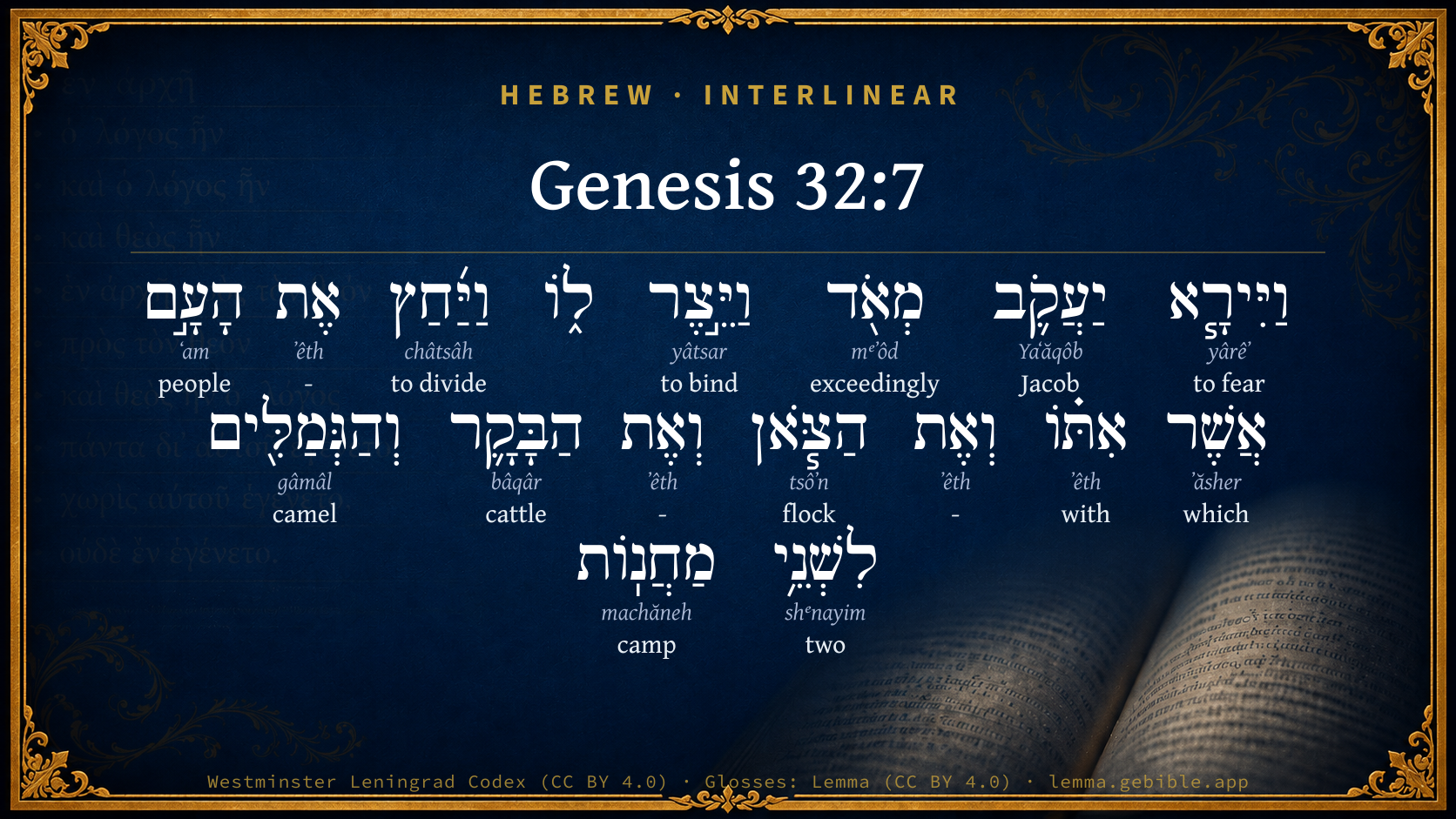
Hebrew (Westminster Leningrad Codex) Genesis 32:7 appears in the Hebrew Old Testament. The text above is from the Westminster Leningrad Codex. Each word links to its Strong’s number, a concise gloss, and parsing drawn from the Open Scriptures Hebrew Bible morphology. Click any word for its full Brown-Driver-Briggs (BDB) entry.
Download image
Cite this verse

Genesis 32:7 (World English Bible). Public Domain. Lemma interlinear Bible study tool, https://lemma.gebible.app/v/genesis/32/7.

Show BibTeX & RIS
BibTeX
RIS
English Translation
Then Jacob was greatly afraid and was distressed: and he divided the people who were with him, and the flocks, and the herds, and the camels, into two companies;
World English Bible · Public Domain
Highlights
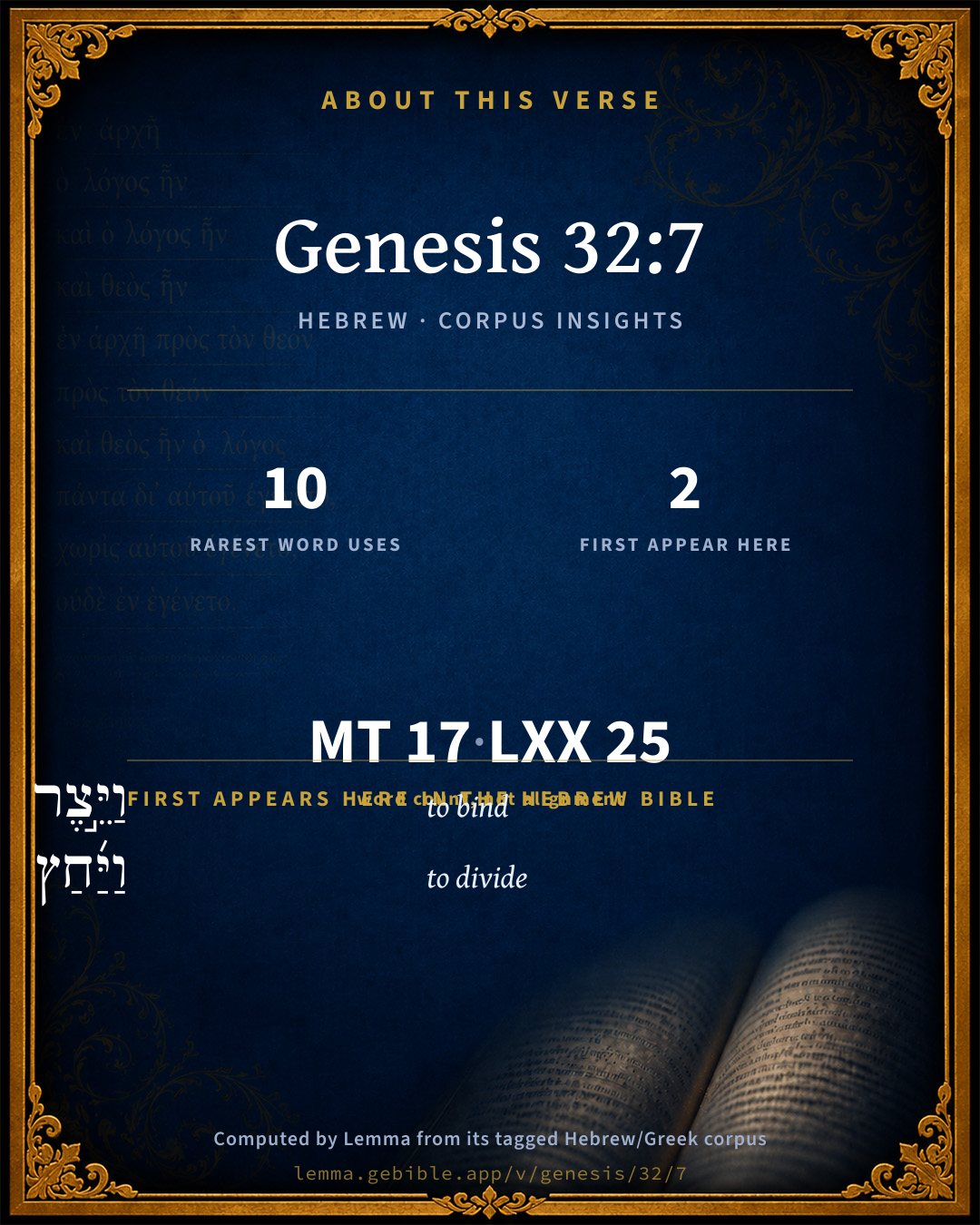
  • 2 first appearances in the Hebrew Bible
Full analysis ↓
Download a study sheet

One document with this verse’s original text, its word-by-word gloss line, the meaning frame, cross-references with their text, attributed commentary, and full source and license credits — printable, and it pastes into notes with its structure intact.

This verse Autodidact and up

Study sheet (.html) Plain text (.txt)

A passage Seminary Student

Up to 50 verses in one chapter. A passage sheet keeps up to 6 commentary sources and 12 cross-references per verse, in the order this page ranks them, and says so on the sheet whenever that leaves anything out. Ask for a single verse and you get the Autodidact verse sheet above.

Everything on this page stays free to read, with no account — the sheet is a download of what is already on screen, not access to it.

Want to remove ads? Support Godless Engineer
Compare translations 3

The same verse in 3 English versions, stacked beneath the original-language interlinear above. Click any original word for its lexicon entry.

Each is an independent rendering of the whole verse — the interlinear is not word-aligned to these translations.

Highlighted words mark where these versions differ — a whole-verse word diff, not a word-by-word alignment.

  • World English Bible Public Domain
    Then Jacob was greatly afraid and was distressed: and he divided the people who were with him, and the flocks, and the herds, and the camels, into two companies;
  • King James Version Public Domain
    Then Jacob was greatly afraid and distressed: and he divided the people that was with him, and the flocks, and herds, and the camels, into two bands;
  • unfoldingWord Literal Text CC BY-SA 4.0
    And Jacob was exceedingly afraid, and it was distressing for him, so he divided the people who with him and the flock and the herd and the camels into two camps.

unfoldingWord Literal Text — © unfoldingWord, licensed CC BY-SA 4.0. Word-aligned USFM3 via Door43 (git.door43.org/unfoldingWord/en_ult).

Versions to compare (up to 4)

3 of 4 selected

Show all 18 translations

Every available English version of this verse, each an independent rendering of the whole verse.

  • World English Bible Public Domain
    Then Jacob was greatly afraid and was distressed: and he divided the people who were with him, and the flocks, and the herds, and the camels, into two companies;
  • Berean Standard Bible Public Domain
    In great fear and distress, Jacob divided his people into two camps, as well as the flocks and herds and camels.
  • Majority Standard Bible Public Domain
    In great fear and distress, Jacob divided his people into two camps, as well as the flocks and herds and camels.
  • King James Version Public Domain
    Then Jacob was greatly afraid and distressed: and he divided the people that was with him, and the flocks, and herds, and the camels, into two bands;
  • American Standard Version (1901) Public Domain
    Then Jacob was greatly afraid and was distressed: and he divided the people that were with him, and the flocks, and the herds, and the camels, into two companies;
  • Revised Version (1885) Public Domain
    Then Jacob was greatly afraid and was distressed: and he divided the people that was with him, and the flocks, and the herds, and the camels, into two companies;
  • Geneva Bible (1599) Public Domain
    Then Iaakob was greatly afraid, and was sore troubled, and deuided the people that was with him, and the sheepe, and the beeues, and the camels into two companies.
  • Douay-Rheims (1899) Public Domain
    Then Jacob was greatly afraid; and in his fear divided the people that was with him, and the flocks, and the sheep, and the oxen, and the camels, into two companies,
  • Young's Literal Translation Public Domain
    and Jacob feareth exceedingly, and is distressed, and he divideth the people who `are' with him, and the flock, and the herd, and the camels, into two camps,
  • Literal Standard Version CC BY-SA 4.0
    and Jacob fears exceedingly, and is distressed, and he divides the people who [are] with him, and the flock, and the herd, and the camels, into two camps,
  • Unlocked Literal Bible CC BY-SA 4.0
    Then Jacob was very afraid and upset. So he divided the people who were with him into two camps, and also the flocks, the herds, and the camels.
  • unfoldingWord Literal Text CC BY-SA 4.0
    And Jacob was exceedingly afraid, and it was distressing for him, so he divided the people who with him and the flock and the herd and the camels into two camps.
  • Darby Bible Public Domain
    Then Jacob was greatly afraid, and was distressed; and he divided the people that were with him, and the sheep and the cattle and the camels, into two troops.
  • World Messianic Bible Public Domain
    Then Jacob was greatly afraid and was distressed. He divided the people who were with him, along with the flocks, the herds, and the camels, into two companies.
  • Webster's Bible Public Domain
    Then Jacob was greatly afraid, and distressed: and he divided the people that were with him, and the flocks, and herds, and camels, into two bands;
  • Free Bible Version CC BY-SA 4.0
    When Jacob heard this, he was absolutely terrified. He split all the people with him, along with the sheep, goats, cattle, and camels, into two groups,
  • Bible in Basic English Public Domain
    Then Jacob was in great fear and trouble of mind: and he put all the people and the flocks and the herds and the camels into two groups;
  • JPS Tanakh (1917) Public Domain
    (32-8) Then Jacob was greatly afraid and was distressed. And he divided the people that was with him, and the flocks, and the herds, and the camels, into two camps.

Literal Standard Version (2020), Covenant Press — licensed CC BY-SA 4.0. Text via the HelloAO Bible API (eBible.org). Unlocked Literal Bible (unfoldingWord) — licensed CC BY-SA 4.0. Text via the HelloAO Bible API (eBible.org). unfoldingWord Literal Text — © unfoldingWord, licensed CC BY-SA 4.0. Word-aligned USFM3 via Door43 (git.door43.org/unfoldingWord/en_ult). Free Bible Version, Dr. Jonathan Gallagher — licensed CC BY-SA 4.0. Text via the HelloAO Bible API (eBible.org).

Word by word

More ways to search: Search by grammar → Find every occurrence → Compare this word →

Practice this passage: Drill this verse → Learn its vocabulary →

וַיֵּ֣צֶר
yâtsar
H3334
“and · to bind”
Conjunction + Verb, Qal, Sequential Imperfect, 3rd Person, Masculine, Singular
Part of Speech
Conjunction + Verb
Stem
Qal
Form
Sequential Imperfect
Person
3rd Person
Gender
Masculine
Number
Singular
Full BDB Definition

Origin: a primitive root

TWOT: 1973

to bind, be distressed, be in distress, be cramped, be narrow, be scant, be in straits, make narrow, cause distress, beseige - (Qal) to suffer distress
  1. וַיִּירָ֧א yârêʼ H3372 “and · to fear” Conjunction + Verb, Qal, Sequential Imperfect, 3rd Person, Masculine, Singular
  2. יַעֲקֹ֛ב Yaʻăqôb H3290 “Jacob” Noun, Proper
  3. מְאֹ֖ד mᵉʼôd H3966 “exceedingly” Adverb
  4. וַיַּ֜חַץ châtsâh H2673 “and · to divide” Conjunction + Verb, Qal, Sequential Imperfect, 3rd Person, Masculine, Singular
  5. אֶת ʼêth H853 “-” Particle, Direct Object
  6. הָעָ֣ם ʻam H5971 “the · people” Particle, Definite Article + Noun, Common, Masculine, Singular, Absolute
  7. אֲשֶׁר ʼăsher H834 “which” Particle, Relative
  8. אִתּ֗וֹ ʼêth H854 “with · him” Preposition + Suffix, Personal, 3rd Person, Masculine, Singular
  9. וְאֶת ʼêth H853 “and · -” Conjunction + Particle, Direct Object
  10. הַצֹּ֧אן tsôʼn H6629 “the · flock” Particle, Definite Article + Noun, Common, Both, Singular, Absolute
  11. וְאֶת ʼêth H853 “and · -” Conjunction + Particle, Direct Object
  12. הַבָּקָ֛ר bâqâr H1241 “the · cattle” Particle, Definite Article + Noun, Common, Both, Singular, Absolute
  13. וְהַגְּמַלִּ֖ים gâmâl H1581 “and · the · camels” Conjunction + Particle, Definite Article + Noun, Common, Masculine, Plural, Absolute
  14. לִשְׁנֵ֥י shᵉnayim H8147 “to/for · two” Preposition + Adjective, Cardinal number, Masculine, Dual, Construct
  15. מַחֲנֽוֹת machăneh H4264 “camps” Noun, Common, Both, Plural, Absolute

About this verse

These counts appear in no published source. They are computed here, from the morphology-tagged text and Lemma’s own curated glosses. What Lemma adds →

17
words
14
distinct lemmas
Pentateuch
section

Notable vocabulary

The rarest word here is וַיֵּ֣צֶר to bind H3334 — appearing just 10 times in the whole Hebrew Bible.

First appearance in Scripture

These words make their first canonical appearance in the Hebrew Bible here:

  • וַיֵּ֣צֶר to bind H3334
  • וַיַּ֜חַץ to divide H2673

Shared distinctive vocabulary

וַיֵּ֣צֶר to bind H3334 occurs in 10 verses of the Hebrew Bible. Also found in:

Grammatical profile

  • 3 verbs
  • 6 nouns
  • 1 adjective
  • 2 prepositions
  • 1 adverb
  • 4 particles

Verb forms

  • וַיִּירָ֧א Qal · Sequential Imperfect
  • וַיֵּ֣צֶר Qal · Sequential Imperfect
  • וַיַּ֜חַץ Qal · Sequential Imperfect

Hebrew & Septuagint length

In English translation the verse runs 29 words from the Hebrew and 29 from the Septuagint (LXX English) — the same length.

A rough comparison of the two English renderings, which tokenize alike — not a word-level alignment.

Word counts can differ between the Hebrew and the Greek without any difference in meaning — e.g. the Hebrew direct-object marker אֵת has no separate Greek word, and Greek often adds the article ὁ.

In the original languages it is 17 Hebrew tokens and 25 Greek tokens — but the two are counted differently (Hebrew bundles its prefixes and suffixes into one token; the Greek is in lemma form), so that isn’t a like-for-like length.

Cross-references

19

Topical passages linked to Genesis 32:7 in the Treasury of Scripture Knowledge — connected by theme and wording, ordered by reader-vote popularity; previews shown in the World English Bible.

  • Genesis 35:3 Let us arise, and go up to Bethel. I will make there an altar to God, who answered me in the day of my distress, and was with me in the way which I went."
  • Genesis 32:11 Please deliver me from the hand of my brother, from the hand of Esau: for I fear him, lest he come and strike me, and the mothers with the children.
  • Exodus 14:10 When Pharaoh drew near, the children of Israel lifted up their eyes, and behold, the Egyptians were marching after them; and they were very afraid. The children of Israel cried out to Yahweh.
  • Psalms 18:4–5 The cords of death surrounded me. The floods of ungodliness made me afraid.
  • Psalms 31:13 For I have heard the slander of many, terror on every side, While they conspire together against me, They plot to take away my life.
  • Psalms 55:4–5 My heart is severely pained within me. The terrors of death have fallen on me.
  • Psalms 61:2 From the end of the earth, I will call to you, when my heart is overwhelmed. Lead me to the rock that is higher than I.
  • Psalms 107:6 Then they cried to Yahweh in their trouble, And he delivered them out of their distresses,
  • Psalms 142:4 Look on my right, and see; For there is no one who is concerned for me. Refuge has fled from me. No one cares for my soul.
  • Proverbs 2:11 Discretion will watch over you. Understanding will keep you,
  • Isaiah 28:26 For his God does instruct him aright, [and] does teach him.
  • Matthew 8:26 He said to them, "Why are you fearful, oh you of little faith?" Then he got up, rebuked the wind and the sea, and there was a great calm.
  • Matthew 10:16 "Behold, I send you out as sheep in the midst of wolves. Therefore be wise as serpents, and harmless as doves.
  • John 16:33 I have told you these things, that in me you may have peace. In the world you have oppression; but cheer up! I have overcome the world."
  • Acts 14:22 confirming the souls of the disciples, exhorting them to continue in the faith, and that through many afflictions we must enter into the Kingdom of God.
  • 2 Corinthians 1:4 who comforts us in all our affliction, that we may be able to comfort those who are in any affliction, through the comfort with which we ourselves are comforted by God.
  • 2 Corinthians 1:8–10 For we don't desire to have you uninformed, brothers, concerning our affliction which happened to us in Asia, that we were weighed down exceedingly, beyond our power, so much that we despaired even of life.
  • 2 Timothy 3:12 Yes, and all who desire to live godly in Christ Jesus will suffer persecution.
  • Psalms 112:5 It is well with the man who deals graciously and lends. He will maintain his cause in judgment.

Cross-references courtesy of OpenBible.info (CC BY 4.0).

Hebrew and Greek witnesses Masoretic Hebrew ↔ Greek Septuagint

The same verse in the two great witnesses to the Old Testament, shown verse-for-verse.

These are two independent witnesses, not word-aligned to each other, and the Septuagint is shown in lemma (dictionary) form.

Hebrew Genesis 32:7 Masoretic · Westminster Leningrad Codex

וַיִּירָ֧א יַעֲקֹ֛ב מְאֹ֖ד וַיֵּ֣צֶר ל֑וֹ וַיַּ֜חַץ אֶת הָעָ֣ם אֲשֶׁר אִתּ֗וֹ וְאֶת הַצֹּ֧אן וְאֶת הַבָּקָ֛ר וְהַגְּמַלִּ֖ים לִשְׁנֵ֥י מַחֲנֽוֹת

Then Jacob was greatly afraid and was distressed: and he divided the people who were with him, and the flocks, and the herds, and the camels, into two companies;

World English Bible · Public Domain

Greek LXX Genesis 32:7 Septuagint · lemma form

καί ἀναστρέφω ὁ ἄγγελος πρός ἰακώβ λέγω ἔρχομαι πρός ὁ ἀδελφός σύ ησαυ καί ἰδού αὐτός ἔρχομαι εἰς συνάντησις σύ καί τετρακόσιοι ἀνήρ μετά αὐτός

And Jacob was greatly terrified, and was perplexed; and he divided the people that was with him, and the cows, and the camels, and the sheep, into two camps.

LXX2012 (modern English Septuagint) · Public Domain

Hebrew: Westminster Leningrad Codex (CC BY 4.0). Greek: Septuagint (public domain); English from LXX2012 (modern English Septuagint) (Public Domain). How the Septuagint differs from the Hebrew →

Targum (Aramaic paraphrase)

2

The Targum is the ancient Jewish Aramaic paraphrase of the Hebrew Scriptures — an interpretive translation, not the Hebrew text itself. Onkelos (literal) and Pseudo-Jonathan (expansive) render the Torah, and Jonathan the Prophets. Coverage is partial: where no permissively-licensed English translation exists for a verse, only the Aramaic is shown. This is verse-level text, not a word-by-word alignment to the Hebrew.

  1. Targum Onkelos Torah (Genesis–Deuteronomy)
    וְתָבוּ אִזְגַּדַּיָּא לְוַת יַעֲקֹב לְמֵימָר אֲתֵינָא לְוַת אָחוּךְ לְוַת עֵשָׂו וְאַף אָתֵי לְקַדָּמוּתָךְ וְאַרְבַּע מְאָה גַּבְרָא עִמֵּהּ

    (no public-domain English translation for this verse)

    Targum Onkelos — Aramaic: “Onkelos Genesis” (public domain); “Onkelos Exodus” (public domain); “Onkelos Leviticus” (public domain); “Onkelos Numbers” (public domain); “Onkelos Deuteronomy” (public domain). English: “Sefaria Community Translation” (CC0 1.0 (public-domain dedication)); “J.W. Etheridge. The Targums of Onkelos and Jonathan Ben Uzziel on the Pentateuch. London: Longmans, Green, 1862” (public domain). Text via Sefaria.

  2. Targum Pseudo-Jonathan Torah (Genesis–Deuteronomy)
    וְתָבוּ אִזְגַדַיָא לְוַת יַעֲקב לְמֵימַר אָתֵינָא לְוַת אָחוּךְ לְעֵשָו וְאוּף אָתֵי לִקְדָמוּתָךְ וְאַרְבַּע מְאָה גוּבְרִין פּוּלְמַרְכִין עִמֵיהּ

    And the messengers returned to Jakob, saying, We came to thy brother, to Esau, and he also cometh to meet thee, and four hundred chief--warriors with him.

    Targum Pseudo-Jonathan — Aramaic: “Targum Jonathan on Genesis” (public domain); “Targum Jonathan on Exodus” (public domain); “Targum Jonathan on Leviticus” (public domain); “Targum Jonathan on Numbers” (public domain); “Targum Jonathan on Deuteronomy” (public domain). English: “The Targum of Jonathan ben Uzziel, trans. J. W. Etheridge, London, 1862” (public domain). Text via Sefaria.

Commentary

Notes on Genesis 32:7 from classic Christian and Jewish commentators (each source and its license shown beneath its notes). The classic Christian expositions comment on the surrounding passage and are grouped to its opening verse, so a note may address several verses; the Jewish commentaries on the Tanakh (Rashi and others) are per-verse, so they appear only where the commentator wrote on this verse.

Lemma curates 59 commentaries, every one of them public domain or Creative Commons licensed, each selected and text-cleaned for this edition rather than reprinted as found. About our sources →

Trapp's Complete Commentary

John Trapp

Gen 32:7 Then Jacob was greatly afraid and distressed: and he divided the people that [was] with him, and the flocks, and herds, and the camels, into two bands;

Ver. 7. Then Jacob was greatly afraid.] This was his weakness, and may be ours in like case, as looking to the present peril, and "forgetting the consolation," as the apostle speaketh, Heb 12:5, that he might have drawn from the promise of God, and presence of angels. Faith quelleth and killeth distrustful fears: but Satan, in a distress, hides from us that which should support us, and greatens that that may appal us. But what saith the Spanish proverb? The lion is not so fierce as he is painted; nor danger, usually, so great as it is represented. Some hold that Esau was here wronged, by being presumed an enemy, when he was a friend. Pessimus in dubiis augur Timor.

John Trapp, A Commentary or Exposition upon All the Books of the Old and New Testament (1647–1656) — public domain. Text from a community e-Sword module.

Tyndale Open Study Notes

Tyndale Open Resources

32:7-8 Jacob divided his company into two groups or camps (Hebrew makhanoth, related to “Mahanaim” in 32:2) because he was afraid, remembering Esau’s character and his threat to kill Jacob (see 25:25; 27:41).

Tyndale Open Study Notes — © Tyndale Open Resources, licensed CC BY-SA 4.0. Text via the HelloAO Bible API.

Geneva Bible (1599)

Geneva Bible translators

Albeit he was comforted by the Angels, yet the infirmity of the flesh doth appear.

Geneva Bible (1599) marginal notes — public domain. Text via Bolls.life.

Adam Clarke's Commentary

Verse 7. He divided the people, &c.] His prudence and cunning were now turned into a right channel, for he took the most effectual method to appease his brother, had he been irritated, and save at least a part of his family. This dividing and arranging of his flocks, family, and domestics, has something in it highly characteristic. To such a man as Jacob such expedients would naturally present themselves.

Adam Clarke's Commentary on the Bible (1810–1826) — public domain. Text from a community e-Sword/MySword module.

John Calvin's Commentaries

7. And he divided the people. Moses relates that Jacob formed his plans according to the existing state of affairs. He divides his family into two parts, and puts his maids in the foremost place, that they may bear the first assault, if necessary; but he places his free wives further from the danger. Hence indeed we gather, that Jacob was not so overcome with fear as to be unable to arrange his plans. We know that when a panic seizes the mind, it is deprived of discretion; and they who ought to look after their own concerns, become stupid and inanimate. Therefore it proceeded from the spirit of faith that Jacob interposed a certain space between the two parts of his family, in order that if any destruction approached, the whole seed of the Church might not perish. For by this scheme, he offered the half of his family to the slaughter, that, at length, the promised inheritance might come to the remainder who survived.

John Calvin's Commentaries (1540-1563) — public domain. Text from the Calvin Translation Society English edition (1840s-50s) via the Christian Classics Ethereal Library (ccel.org). Calvin's coverage is partial (roughly two-thirds of the Bible); uncommented books and verses are honest gaps, never fabricated. The 19th-century editor's footnotes and remarks are omitted so the notes are faithfully Calvin's own voice.

Ellicott's Commentary for English Readers

(7) Jacob was greatly afraid.—Jacob’s message to his brother had been very humble, for he calls Esau his lord, and himself a servant. He hopes also to “find grace in his sight,” and by enumerating his wealth shows that he required no aid, nor need claim even a share of Isaac’s property. But Esau had given no answer, being probably undecided as to the manner in which he would receive his brother. The “four hundred men with him” formed probably only a part of the little army with which he had invaded the Horite territory. Some would be left with the spoil which he had gathered, but he took so many with him as to place Jacob completely in his power. And Jacob’s extreme distress, in spite of the Divine encouragement repeatedly given him, shows that his faith was very feeble; but it was real, and therefore he sought refuge from his terror in prayer.

A Bible Commentary for English Readers, edited by Charles John Ellicott (1878–1897) — public domain. Text from a community e-Sword module.

The Cambridge Bible for Schools and Colleges

gen. ed. J. J. S. Perowne

7. two companies] The word for “companies” is the same as that rendered “host” in Gen_32:2, except that it occurs in the plural (mahanoth). This is evidently another explanation of the origin of the name Mahanaim. It is a pity that the same word, “camp,” has not been used here and in Gen_32:2; Gen_32:8; Gen_32:10; Gen_32:21, in order to bring out the two etymologies that were current.

The Cambridge Bible for Schools and Colleges (gen. ed. J. J. S. Perowne; Cambridge University Press, 1878–1918) — public domain. Text from a community e-Sword module.

John Gill's Exposition

Then Jacob was greatly afraid and distressed,.... Knowing what he had done to his brother in getting the birthright and blessing from him, and what an enmity he had conceived in his mind against him on that account, and remembering what he had said he would do to him; and therefore might fear that all his professions of respect to him were craftily and cunningly made to take him off of his guard, and that he might the more easily fall into his hands, and especially when he heard there were four hundred men with him; this struck a terror into him, and made him suspicious of an ill design against him; though herein Jacob betrayed much weakness and want of faith, when God has promised again and again that he would he with him, and keep him, and protect him, and return him safe to the land of Canaan; and when he had just had such an appearance of angels to be his helpers, guardians, and protectors:

and he divided the people that was with him, and the flocks, and the herds, and the camels, into two bands: some of his servants and shepherds, with a part of the flocks and herds, in one band or company, and some with the rest of them, and the camels, and his wives, and his children, in the other.

John Gill's Exposition of the Whole Bible (1746–1763) — public domain (CC PDM 1.0). Text via the HelloAO Bible API.

Matthew Poole's English Annotations

Notwithstanding the renewed promise of God, and the late apparition of angels,

Jacob was greatly afraid; wherein he showed the weakness of his faith, to which God left him for his trial and exercise, and to quicken him to prayer, that so God might have more glory, and he more comfort in the mercy.

Matthew Poole's English Annotations on the Holy Bible (1683–1685) — public domain. Text from a community e-Sword/MySword module.

Whedon's Commentary on the Bible

Daniel D. Whedon

7. Jacob was greatly afraid — The report of his messengers might naturally have this effect on Jacob. He had fled from his brother because of his threat to kill him, (Gen_27:41,) and now his coming with a body of four hundred men seemed ominous of a purpose of vengeance. “His excited imagination saw his wives and children murdered; his ill-gotten flocks destroyed; and himself struck by the fatal blow or chained in ignominious fetters. Agony and fear overpowered him, but that agony was his atonement; it was a suffering commensurate with his guilt; it was at once his retribution and his justification. But though it was a torture to his heart, it did not unbend his energy. All his faculties, feelings, and affections were roused to their utmost power, and his whole nature was quickened into vigorous activity.” — Kalisch.

Daniel D. Whedon (gen. ed.), Commentary on the Old and New Testaments (1874–1909) — public domain. Text from a community e-Sword module.

The Pulpit Commentary

Vers. 7, 8. Then Jacob was greatly afraid and distressed: literally, it was narrow to him; i.e. he was perplexed. Clearly the impression left on Jacob"s mind by the report of his ambassadors was that he had nothing to expect but hostilityand he divided the people that was with him, and the flocks, and herds, and the camels, into two bands; according to Gerlach, caravans are frequently divided thus in the present day, and for the same reason as Jacob assignsAnd said, If Esau come to the one company, and smite it, then the other company which is left shall escape. It is easy to blame Jacob for want of faith in not trusting to God instead of resorting to his own devices (Candlish), but his behavior in the circumstances evinced great self-possession, non ita expavefactum fuisse Jacob quin res suns eomponeret (Calvin), considerable prudence (Lange), if not exalted chivalry (Candlish), a peaceful disposition which did not wish vim armata repellere (Rosenm and a truly-religious spirit ("Speaker"s Commentary"), since in his terror he betakes himself to prayer.

The Pulpit Commentary (1880–1919), ed. H.D.M. Spence-Jones & Joseph S. Exell — public domain. Text from a community e-Sword module.

John Wesley's Explanatory Notes

Then Jacob was greatly afraid and distressed - A lively apprehension of danger, may very well consist with a humble confidence in God's power and promise.

John Wesley, Explanatory Notes Upon the Whole Bible (1754–1765) — public domain. Text via the GEBible commentary corpus.

Rashi

Rabbi Shlomo Yitzchaki (Rashi)

באנו אל אחיך אל עשו WE CAME TO THY BROTHER, TO ESAU — to him of whom you said he is my brother, but he behaves towards you as Esau, the wicked — he is still harbouring hatred (Genesis Rabbah 75:7).

Rashi on the Tanakh — English translations: “The Judaica Press complete Tanach with Rashi, translated by A. J. Rosenberg” (CC BY 4.0); “Pentateuch with Rashi's commentary by M. Rosenbaum and A.M. Silbermann, 1929-1934” (public domain); “The Metsudah Tanach series, Lakewood, N.J” (CC BY 4.0); and “The Book of Joshua, Metsudah Publications, 1997” (CC BY 4.0). Text via Sefaria.

Ramban (Nachmanides)

Rabbi Moshe ben Nachman (Ramban / Nachmanides)

AND THE MESSENGERS RETURNED TO JACOB, SAYING. These messengers had fulfilled their mission, but Scripture did not relate this for it would serve no purpose. The meaning of the expression, And moreover he cometh to meet thee, is that “even as you go to meet him, so he goes to meet you, and you will quickly encounter one another.”

Ramban (Nachmanides) on the Tanakh — English translation: “Commentary on the Torah by Ramban (Nachmanides). Translated and annotated by Charles B. Chavel. New York, Shilo Pub. House, 1971-1976” (CC BY 4.0). Text via Sefaria.

Radak

Rabbi David Kimhi (Radak)

וישובו...אל אחיך אל עשו, they mentioned the name Esau after having referred to him as אחיך, “your brother.” They meant that “Esau still holds the old grudge against you.”

וגם הולך לקראתך, he also reveals his hatred of you by marching with 400 men against you now that he knows you are in the vicinity. וארבע מאות איש עמו, he does not walk toward you with peaceful intentions but he is on his way in order to fight you.

Radak on the Tanakh — English translations: “Sefaria Community Translation” (CC0 1.0 (public-domain dedication)); “Eliyahu Munk, HaChut Hameshulash” (CC BY 4.0); “Rabbi Mike Feuer, Jerusalem Anthology” (CC BY 4.0); and “R. David Kimhi on the first book of Psalms, Translated by R.G. Finch, London, 1919” (public domain). Text via Sefaria.

Lesson kit

Teaching starters — assembled from the data on this page, not authored interpretation. Every prompt links to the verse data it draws on. Edit before teaching.

Genesis, in the Pentateuch, opens this verse with 17 words (14 distinct Hebrew lemmas). Its most distinctive word is yâtsar (“to bind”). A historical commentator’s framing appears above. Read the whole chapter for the surrounding context.

Discussion questions

  1. The word yâtsar carries the sense “to bind.” How does it shape the verse?
  2. 2 words here appear for the first time in Scripture. What is being introduced at this debut?
  3. Judges 2:15 shares the word «to bind» with this verse. How do the two illuminate each other?
  4. The translations on this page render this verse differently — a whole-verse word diff, not a word-by-word alignment. What might account for the different wordings?
  5. The verb «וַיִּירָ֧א» is Qal Sequential Imperfect. How does its form color the action?
  6. Reading how Trapp's Complete Commentary and Tyndale Open Study Notes read this verse, where do the two commentators agree and where do they part?

Things to notice

Reading settings

Reading text

Shown beneath each verse's original-language words.

Old Testament
Old Testament edition

Read the OT as the Masoretic Hebrew (MT) or the Greek Septuagint (LXX).

English shown for the Greek Septuagint (in the Hebrew ↔ Greek comparison).

Comparing translations? Open the Compare panel on any verse page to stack up to four side by side.