Deuteronomy 18:4

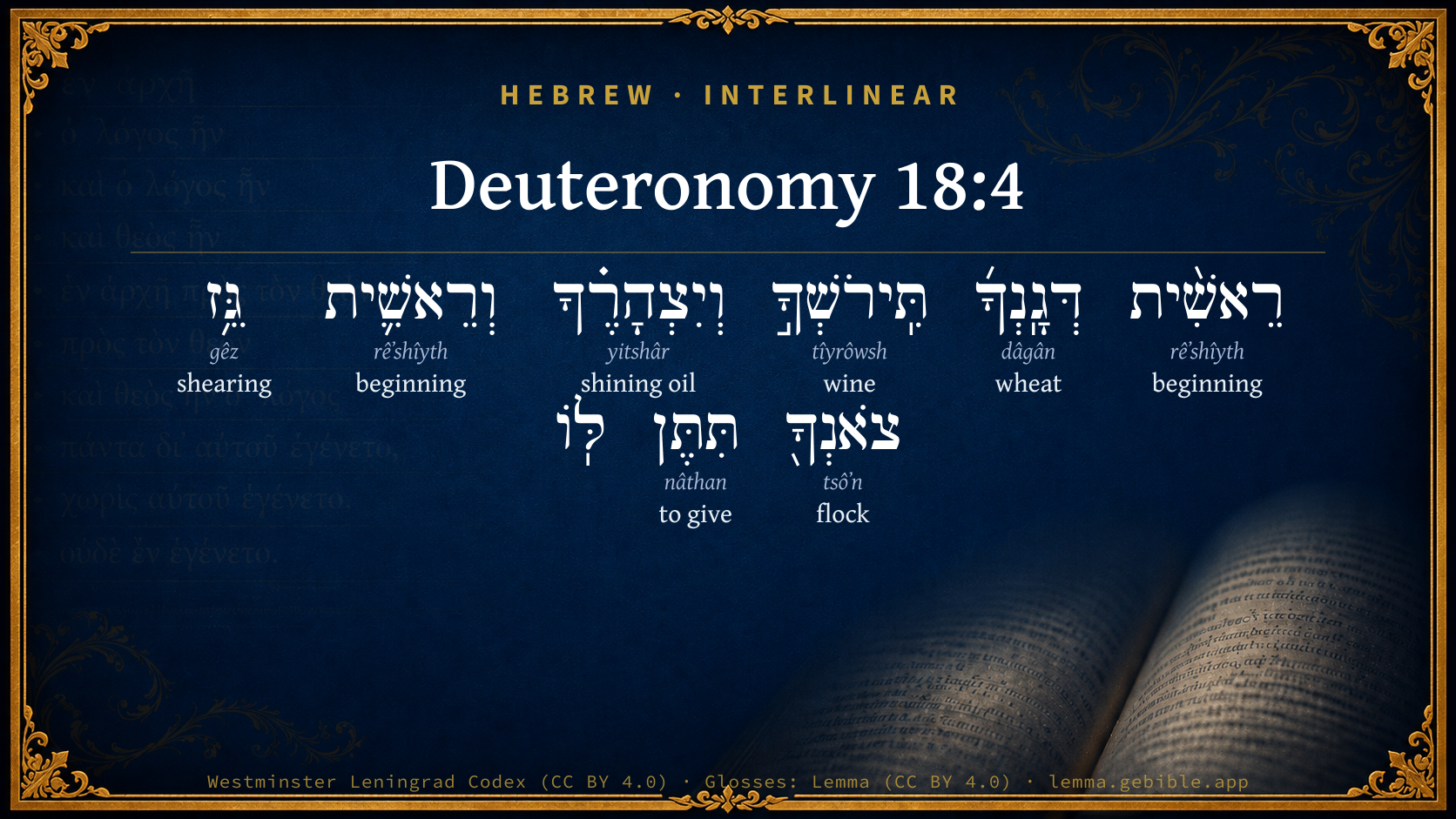
Hebrew (Westminster Leningrad Codex) Deuteronomy 18:4 appears in the Hebrew Old Testament. The text above is from the Westminster Leningrad Codex. Each word links to its Strong’s number, a concise gloss, and parsing drawn from the Open Scriptures Hebrew Bible morphology. Click any word for its full Brown-Driver-Briggs (BDB) entry.
Download image
Cite this verse

Deuteronomy 18:4 (World English Bible). Public Domain. Lemma interlinear Bible study tool, https://lemma.gebible.app/v/deuteronomy/18/4.

Show BibTeX & RIS
BibTeX
RIS
English Translation
The first fruits of your grain, of your new wine, and of your oil, and the first of the fleece of your sheep, shall you give him.
World English Bible · Public Domain
Highlights
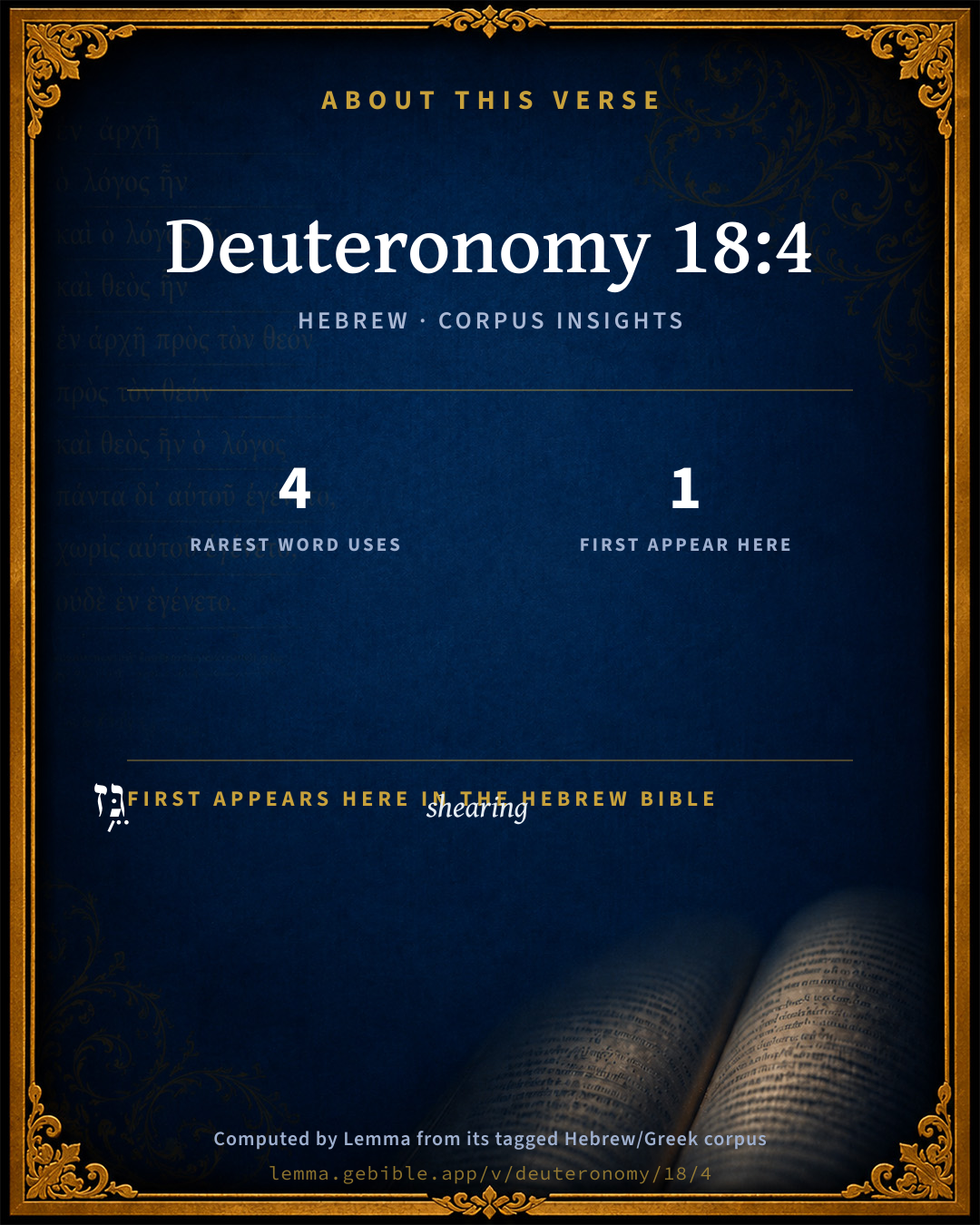
  • 1 first appearance in the Hebrew Bible
Full analysis ↓
Download a study sheet

One document with this verse’s original text, its word-by-word gloss line, the meaning frame, cross-references with their text, attributed commentary, and full source and license credits — printable, and it pastes into notes with its structure intact.

This verse Autodidact and up

Study sheet (.html) Plain text (.txt)

A passage Seminary Student

Up to 50 verses in one chapter. A passage sheet keeps up to 6 commentary sources and 12 cross-references per verse, in the order this page ranks them, and says so on the sheet whenever that leaves anything out. Ask for a single verse and you get the Autodidact verse sheet above.

Everything on this page stays free to read, with no account — the sheet is a download of what is already on screen, not access to it.

Want to remove ads? Support Godless Engineer
Compare translations 3

The same verse in 3 English versions, stacked beneath the original-language interlinear above. Click any original word for its lexicon entry.

Each is an independent rendering of the whole verse — the interlinear is not word-aligned to these translations.

Highlighted words mark where these versions differ — a whole-verse word diff, not a word-by-word alignment.

  • World English Bible Public Domain
    The first fruits of your grain, of your new wine, and of your oil, and the first of the fleece of your sheep, shall you give him.
  • King James Version Public Domain
    The firstfruit also of thy corn, of thy wine, and of thine oil, and the first of the fleece of thy sheep, shalt thou give him.
  • unfoldingWord Literal Text CC BY-SA 4.0
    The firstfruits of your grain, your new wine and your oil and the first of the fleece of your sheep you shall give to him.

unfoldingWord Literal Text — © unfoldingWord, licensed CC BY-SA 4.0. Word-aligned USFM3 via Door43 (git.door43.org/unfoldingWord/en_ult).

Versions to compare (up to 4)

3 of 4 selected

Show all 18 translations

Every available English version of this verse, each an independent rendering of the whole verse.

  • World English Bible Public Domain
    The first fruits of your grain, of your new wine, and of your oil, and the first of the fleece of your sheep, shall you give him.
  • Berean Standard Bible Public Domain
    You are to give them the firstfruits of your grain, new wine, and oil, and the first wool sheared from your flock.
  • Majority Standard Bible Public Domain
    You are to give them the firstfruits of your grain, new wine, and oil, and the first wool sheared from your flock.
  • King James Version Public Domain
    The firstfruit also of thy corn, of thy wine, and of thine oil, and the first of the fleece of thy sheep, shalt thou give him.
  • American Standard Version (1901) Public Domain
    The first-fruits of thy grain, of thy new wine, and of thine oil, and the first of the fleece of thy sheep, shalt thou give him.
  • Revised Version (1885) Public Domain
    The firstfruits of thy corn, of thy wine, and of thine oil, and the first of the fleece of thy sheep, shalt thou give him.
  • Geneva Bible (1599) Public Domain
    The first fruites also of thy corne, of thy wine, and of thine oyle, and the first of the fleece of thy sheepe shalt thou giue him.
  • Douay-Rheims (1899) Public Domain
    The firstfruits also of corn, of wine, and of oil, and a part of the wool from the shearing of their sheep.
  • Young's Literal Translation Public Domain
    the first of thy corn, of thy new wine, and of thine oil, and the first of the fleece of thy flock, thou dost give to him;
  • Literal Standard Version CC BY-SA 4.0
    you give to him the first of your grain, of your new wine, and of your oil, and the first of the fleece of your flock;
  • Unlocked Literal Bible CC BY-SA 4.0
    The firstfruits of your grain, of your new wine, and of your oil, and the first of the fleece of your sheep, you must give him.
  • unfoldingWord Literal Text CC BY-SA 4.0
    The firstfruits of your grain, your new wine and your oil and the first of the fleece of your sheep you shall give to him.
  • Darby Bible Public Domain
    The firstfruits [also] of thy corn, of thy new wine, and of thine oil, and the firstfruits of the shearing of thy sheep, shalt thou give him;
  • World Messianic Bible Public Domain
    You shall give him the first fruits of your grain, of your new wine, and of your oil, and the first of the fleece of your sheep.
  • Webster's Bible Public Domain
    The first-fruit also of thy corn, of thy wine, and of thy oil, and the first of the fleece of thy sheep, shalt thou give him.
  • Free Bible Version CC BY-SA 4.0
    You are to provide them with the firstfruits of your grain, new wine, and olive oil, as well as the first wool sheared from your flock.
  • Bible in Basic English Public Domain
    And in addition you are to give him the first of your grain and wine and oil, and the first wool cut from your sheep.
  • JPS Tanakh (1917) Public Domain
    The first-fruits of thy corn, of thy wine, and of thine oil, and the first of the fleece of thy sheep, shalt thou give him.

Literal Standard Version (2020), Covenant Press — licensed CC BY-SA 4.0. Text via the HelloAO Bible API (eBible.org). Unlocked Literal Bible (unfoldingWord) — licensed CC BY-SA 4.0. Text via the HelloAO Bible API (eBible.org). unfoldingWord Literal Text — © unfoldingWord, licensed CC BY-SA 4.0. Word-aligned USFM3 via Door43 (git.door43.org/unfoldingWord/en_ult). Free Bible Version, Dr. Jonathan Gallagher — licensed CC BY-SA 4.0. Text via the HelloAO Bible API (eBible.org).

Word by word

More ways to search: Search by grammar → Find every occurrence → Compare this word →

Practice this passage: Drill this verse → Learn its vocabulary →

גֵּ֥ז
gêz
H1488
“shearing of”
Noun, Common, Masculine, Singular, Construct
Part of Speech
Noun
Type
Common
Gender
Masculine
Number
Singular
State
Construct
Full BDB Definition

Origin: from H1494

TWOT: 336a

a shearing, mowing - shearing, that sheared off - a mowing, mown grass
  1. רֵאשִׁ֨ית rêʼshîyth H7225 “beginning of” Noun, Common, Feminine, Singular, Construct
  2. דְּגָֽנְךָ֜ dâgân H1715 “wheat · your” Noun, Common, Masculine, Singular, Construct + Suffix, Personal, 2nd Person, Masculine, Singular
  3. תִּֽירֹשְׁךָ֣ tîyrôwsh H8492 “wine · your” Noun, Common, Masculine, Singular, Construct + Suffix, Personal, 2nd Person, Masculine, Singular
  4. וְיִצְהָרֶ֗ךָ yitshâr H3323 “and · shining oil · your” Conjunction + Noun, Common, Masculine, Singular, Construct + Suffix, Personal, 2nd Person, Masculine, Singular
  5. וְרֵאשִׁ֛ית rêʼshîyth H7225 “and · beginning of” Conjunction + Noun, Common, Feminine, Singular, Construct
  6. צֹאנְךָ֖ tsôʼn H6629 “flock · your” Noun, Common, Both, Singular, Construct + Suffix, Personal, 2nd Person, Masculine, Singular
  7. תִּתֶּן nâthan H5414 “to give” Verb, Qal, Imperfect, 2nd Person, Masculine, Singular

About this verse

These counts appear in no published source. They are computed here, from the morphology-tagged text and Lemma’s own curated glosses. What Lemma adds →

9
words
7
distinct lemmas
Pentateuch
section

Notable vocabulary

The rarest word here is גֵּ֥ז shearing H1488 — appearing just 4 times in the whole Hebrew Bible.

First appearance in Scripture

This word makes its first canonical appearance in the Hebrew Bible here:

  • גֵּ֥ז shearing H1488

Shared distinctive vocabulary

גֵּ֥ז shearing H1488 occurs in 4 verses of the Hebrew Bible. Also found in:

Grammatical profile

  • 1 verb
  • 7 nouns
  • 1 preposition

Verb forms

  • תִּתֶּן Qal · Imperfect

Repetition

A word recurs within this verse — often emphatic in Hebrew:

  • רֵאשִׁ֨ית beginning H7225 ×2

Hebrew & Septuagint length

In English translation the verse runs 27 words from the Hebrew and 30 from the Septuagint (LXX English) — closely comparable.

A rough comparison of the two English renderings, which tokenize alike — not a word-level alignment.

Word counts can differ between the Hebrew and the Greek without any difference in meaning — e.g. the Hebrew direct-object marker אֵת has no separate Greek word, and Greek often adds the article ὁ.

Cross-references

9

Topical passages linked to Deuteronomy 18:4 in the Treasury of Scripture Knowledge — connected by theme and wording, ordered by reader-vote popularity; previews shown in the World English Bible.

  • Exodus 22:29 "You shall not delay to offer from your harvest and from the outflow of your presses. "You shall give the firstborn of your sons to me.
  • Exodus 23:19 The first of the first fruits of your ground you shall bring into the house of Yahweh your God. "You shall not boil a kid in its mother's milk.
  • Leviticus 23:10 "Speak to the children of Israel, and tell them, 'When you have come into the land which I give to you, and shall reap its the harvest, then you shall bring the sheaf of the first fruits of your harvest to the priest:
  • Leviticus 23:17 You shall bring out of your habitations two wave-loaves of two tenth parts of an ephah: they shall be of fine flour, they shall be baked with yeast, for first fruits to Yahweh.
  • Numbers 18:12–24 All the best of the oil, and all the best of the vintage, and of the grain, the first fruits of them which they give to Yahweh, to you have I given them.
  • 2 Chronicles 31:4–10 Moreover he commanded the people who lived in Jerusalem to give the portion of the priests and the Levites, that they might give themselves to the law of Yahweh.
  • Nehemiah 12:44–47 On that day were men appointed over the chambers for the treasures, for the heave-offerings, for the first fruits, and for the tithes, to gather into them, according to the fields of the cities, the portions appointed by the law for the priests and Levites: for Judah rejoiced for the priests and for the Levites who waited.
  • Deuteronomy 26:9–10 and he has brought us into this place, and has given us this land, a land flowing with milk and honey.
  • Job 21:20 Let his own eyes see his destruction. Let him drink of the wrath of the Almighty.

Cross-references courtesy of OpenBible.info (CC BY 4.0).

Hebrew and Greek witnesses Masoretic Hebrew ↔ Greek Septuagint

The same verse in the two great witnesses to the Old Testament, shown verse-for-verse.

These are two independent witnesses, not word-aligned to each other, and the Septuagint is shown in lemma (dictionary) form.

Hebrew Deuteronomy 18:4 Masoretic · Westminster Leningrad Codex

רֵאשִׁ֨ית דְּגָֽנְךָ֜ תִּֽירֹשְׁךָ֣ וְיִצְהָרֶ֗ךָ וְרֵאשִׁ֛ית גֵּ֥ז צֹאנְךָ֖ תִּתֶּן לּֽוֹ

The first fruits of your grain, of your new wine, and of your oil, and the first of the fleece of your sheep, shall you give him.

World English Bible · Public Domain

Greek LXX Deuteronomy 18:4 Septuagint · lemma form

καί ὁ ἀπαρχή ὁ σῖτος σύ καί ὁ οἶνος σύ καί ὁ ἔλαιον σύ καί ὁ ἀπαρχή ὁ κουρέω ὁ πρόβατον σύ δίδωμι αὐτός

and the first fruits of your corn, and of your wine, and of your oil; and you shall give to him the first fruits of the fleeces of your sheep:

LXX2012 (modern English Septuagint) · Public Domain

Hebrew: Westminster Leningrad Codex (CC BY 4.0). Greek: Septuagint (public domain); English from LXX2012 (modern English Septuagint) (Public Domain). How the Septuagint differs from the Hebrew →

Targum (Aramaic paraphrase)

2

The Targum is the ancient Jewish Aramaic paraphrase of the Hebrew Scriptures — an interpretive translation, not the Hebrew text itself. Onkelos (literal) and Pseudo-Jonathan (expansive) render the Torah, and Jonathan the Prophets. Coverage is partial: where no permissively-licensed English translation exists for a verse, only the Aramaic is shown. This is verse-level text, not a word-by-word alignment to the Hebrew.

  1. Targum Onkelos Torah (Genesis–Deuteronomy)
    רֵישׁ עִבוּרָךְ חַמְרָךְ וּמִשְׁחָךְ וְרֵישׁ גִזָא דְעָנָךְ תַּפְרֵשׁ לֵהּ

    (no public-domain English translation for this verse)

    Targum Onkelos — Aramaic: “Onkelos Genesis” (public domain); “Onkelos Exodus” (public domain); “Onkelos Leviticus” (public domain); “Onkelos Numbers” (public domain); “Onkelos Deuteronomy” (public domain). English: “Sefaria Community Translation” (CC0 1.0 (public-domain dedication)); “J.W. Etheridge. The Targums of Onkelos and Jonathan Ben Uzziel on the Pentateuch. London: Longmans, Green, 1862” (public domain). Text via Sefaria.

  2. Targum Pseudo-Jonathan Torah (Genesis–Deuteronomy)
    שֵׁירוּי עִיבּוּרֵיכוֹן חַמְרֵיכוֹן וּמִשְׁחֵיכוֹן וְשֵׁירוּי גִּיזַת עָנֵיכוֹן כְּמִסַת קָטוֹרָא תִּתְּנוּן לֵיהּ

    the firsts of your corn, wine, and oil, the first of the fleece of your sheep, as much as a girdle measureth shall you give to him:

    Targum Pseudo-Jonathan — Aramaic: “Targum Jonathan on Genesis” (public domain); “Targum Jonathan on Exodus” (public domain); “Targum Jonathan on Leviticus” (public domain); “Targum Jonathan on Numbers” (public domain); “Targum Jonathan on Deuteronomy” (public domain). English: “The Targum of Jonathan ben Uzziel, trans. J. W. Etheridge, London, 1862” (public domain). Text via Sefaria.

Commentary

Notes on Deuteronomy 18:4 from classic Christian and Jewish commentators (each source and its license shown beneath its notes). The classic Christian expositions comment on the surrounding passage and are grouped to its opening verse, so a note may address several verses; the Jewish commentaries on the Tanakh (Rashi and others) are per-verse, so they appear only where the commentator wrote on this verse.

Lemma curates 59 commentaries, every one of them public domain or Creative Commons licensed, each selected and text-cleaned for this edition rather than reprinted as found. About our sources →

Trapp's Complete Commentary

John Trapp

Deu 18:4 The firstfruit [also] of thy corn, of thy wine, and of thine oil, and the first of the fleece of thy sheep, shalt thou give him.

Ver. 4. The firstfruits also.] Pliny tells us, {a} that among the Romans also no man might taste of his own corn, wine, or other fruits, priusquam Sacerdotes primitias libassent, till the priests had offered the firstfruits, and made their use of them.

{a} Plin., Hist., lib. xviii.

John Trapp, A Commentary or Exposition upon All the Books of the Old and New Testament (1647–1656) — public domain. Text from a community e-Sword module.

Adam Clarke's Commentary

Verse 4. The first-fruit also of thy corn, of thy wine, and of thine oil, &c.] All these firstfruits and firstlings were the Lord's portion, and these he gave to the priests.

Adam Clarke's Commentary on the Bible (1810–1826) — public domain. Text from a community e-Sword/MySword module.

The Cambridge Bible for Schools and Colleges

gen. ed. J. J. S. Perowne

4. the firstfruits] or, it may be, the best. Heb. reshîth, not bikkûrim (Deu_12:6). See Deu_26:2 f.; cp. E, Exo_23:19, J, Exo_34:26, and P, Num_18:12. On corn, wine and oil, see Deu_7:13, Deu_12:17, Deu_14:23, Deu_25:19-19. The first or best, of the fleece is mentioned only here.

The Cambridge Bible for Schools and Colleges (gen. ed. J. J. S. Perowne; Cambridge University Press, 1878–1918) — public domain. Text from a community e-Sword module.

John Gill's Exposition

The firstfruit also of thy corn, and of thy wine, and of thy oil,.... This is the "terumah", or heave offering, the offering of the firstfruits; what the measure or quantity was is not declared, but is fixed by the Jews; See Gill on Exo 22:29,

and the first of the fleece of thy sheep shall thou give him: concerning which in the Misnah (r) it is said, the first of the fleece is used in the land and without the land, of which they give the weight of five shekels in Judea, which are ten shekels in Galilee; and they give white wool, and not defiled, enough to make of it a little garment. He that buys a fleece of the sheep of a Gentile, he is free from the first of the fleece; but if he buys it of his neighbour, if he leaves any of it, the seller is bound, if none the buyer is bound; if there are two sorts, russet and white, and he sells the russet but not the white, the males but not the females, everyone gives for himself. It may be observed in this account, that as much wool was to be given as would make a small garment; enough, says one of the commentators (s), to make a little garment to minister in; and the least garment fit for a priest to minister in is a girdle. Jarchi's paraphrase of it is,"when thou shearest thy flock every year, give the first of it to the priest; it does not determine the quantity, but our Rabbins fix it to the sixtieth part;''with which agrees the observation of another writer (t), that there is no quantity fixed for the first of the fleece from the law, but from the words of the Scribes it must not be less than the sixtieth part. There is no obligation to the first of the fleece until five sheep are shorn, and the fleece of everyone of the five must not be less than twelve shekels' weight; but if there is one fleece of them less than twelve shekels, though the five fleeces are more than sixty shekels, lo, this is free; so that, as Maimonides (u) says, the first of the fleece is not less than the weight of a shekel.

(r) Cholin, c. 11. sect. 1, 2. (s) Bartenora in ib. (t) Ibid. (u) In Misn. ib.

John Gill's Exposition of the Whole Bible (1746–1763) — public domain (CC PDM 1.0). Text via the HelloAO Bible API.

Haydock's Catholic Bible Commentary

Corn, besides those which were offered to the Lord at the feast of Pentecost. Each landholder was bound to give between the 40th and the 60th part of his produce. (St. Jerome) See Exodus xxii. 29.

George Leo Haydock (1774–1849), Haydock's Catholic Family Bible and Commentary, 1859 edition — public domain. Excludes Psalms (Douay-Rheims chapter numbering differs from Protestant) and Deuterocanonical books (Catholic canon only).

Whedon's Commentary on the Bible

Daniel D. Whedon

4. Fleece — In this verse, in addition to the perquisites enumerated in Num_18:12, there is added the regulation with regard to the fleece of the sheep.

Daniel D. Whedon (gen. ed.), Commentary on the Old and New Testaments (1874–1909) — public domain. Text from a community e-Sword module.

The Pulpit Commentary

In addition to the firstfruits already prescribed by the Law to be given to the priests, (Num_18:12, Num_18:13) Moses here enacts that the first fleece of the sheep shall be given. All these, though legally prescribed, were free gifts on the part of the people; the neglect of the prescription incurred only moral blame, not judicial penalty.

The Pulpit Commentary (1880–1919), ed. H.D.M. Spence-Jones & Joseph S. Exell — public domain. Text from a community e-Sword module.

Rashi

Rabbi Shlomo Yitzchaki (Rashi)

ראשית דגנך THE FIRST-FRUIT [ALSO] OF THY CORN … [THOU SHALT GIVE HIM] — This refers to the heave-offering. Scripture, however, does not state any minimum quantity, but our Rabbis fixed a quantity for it from a sixtieth to a fortieth: a benevolent eye (a generous person) gives one fortieth of the crop, a niggard at least one sixtieth, a person of average generosity one fiftieth. They found a support in Scripture that one should not give less than one sixtieth, because it is said, (Ezekiel 45:13) “[This is the heave-offering which ye shall offer:] the sixth part of an ephah of an homer of wheat”. Now the sixth part of an ephah is a half Seah; if therefore you give half a Seah as Terumah from a Kor (which is another term for a Homer), that is a sixtieth part, for a Kor is thirty Seahs (Talmud Yerushalmi Terumot 4:3).

וראשית גז צאנך AND THE FIRST OF THE FLEECE OF THY FLOCK [SHALT THOU GIVE HIM] — i.e. each year when you sheer your sheep (not when you shear a particular animal for the first time) give the first of it (the wool) to the priest. Scripture mentions no minimum quantity for it, but our Rabbis assigned a quantity for it, viz., one sixtieth part. And how many sheep must there be in the flock that they should come under the law of ראשית הגז (of “giving the first shearing as a gift to the priest”)? At least five sheep, as it is said, (I Samuel 25:18) “[Then Abigail made haste and … took] five sheep ready dressed (עשויות). Rabbi Akiba says: we may derive it from our text itself, as follows: ראשית גז suggests two, צאנך also two, together four, תתן לו one, — altogether five (Chullin 137a; Sifrei Devarim 166:9).

Rashi on the Tanakh — English translations: “The Judaica Press complete Tanach with Rashi, translated by A. J. Rosenberg” (CC BY 4.0); “Pentateuch with Rashi's commentary by M. Rosenbaum and A.M. Silbermann, 1929-1934” (public domain); “The Metsudah Tanach series, Lakewood, N.J” (CC BY 4.0); and “The Book of Joshua, Metsudah Publications, 1997” (CC BY 4.0). Text via Sefaria.

Lesson kit

Teaching starters — assembled from the data on this page, not authored interpretation. Every prompt links to the verse data it draws on. Edit before teaching.

Deuteronomy, in the Pentateuch, opens this verse with 9 words (7 distinct Hebrew lemmas). Its most distinctive word is gêz (“shearing”). A historical commentator’s framing appears above. Read the whole chapter for the surrounding context.

Discussion questions

  1. How does “shearing” (gêz) shape what this verse is saying?
  2. The word “shearing” first appears here in Scripture. What is being introduced at this debut?
  3. Job 31:20 shares the word «shearing» with this verse. How do the two illuminate each other?
  4. “beginning” occurs 2× in this one verse. What is the effect of the repetition?
  5. The translations on this page render this verse differently — a whole-verse word diff, not a word-by-word alignment. What might account for the different wordings?
  6. The verb «תִּתֶּן» is Qal Imperfect. How does its form color the action?
  7. Reading how Trapp's Complete Commentary and Adam Clarke's Commentary read this verse, where do the two commentators agree and where do they part?

Things to notice

  • 1 word makes its first canonical appearance in Scripture here.
  • These translations choose different wording for 9 words in this verse.
  • “beginning” occurs 2× in this single verse.
  • 7 distinct Hebrew lemmas span 9 words in this verse.

Reading settings

Reading text

Shown beneath each verse's original-language words.

Old Testament
Old Testament edition

Read the OT as the Masoretic Hebrew (MT) or the Greek Septuagint (LXX).

English shown for the Greek Septuagint (in the Hebrew ↔ Greek comparison).

Comparing translations? Open the Compare panel on any verse page to stack up to four side by side.