
Numbers 31:28

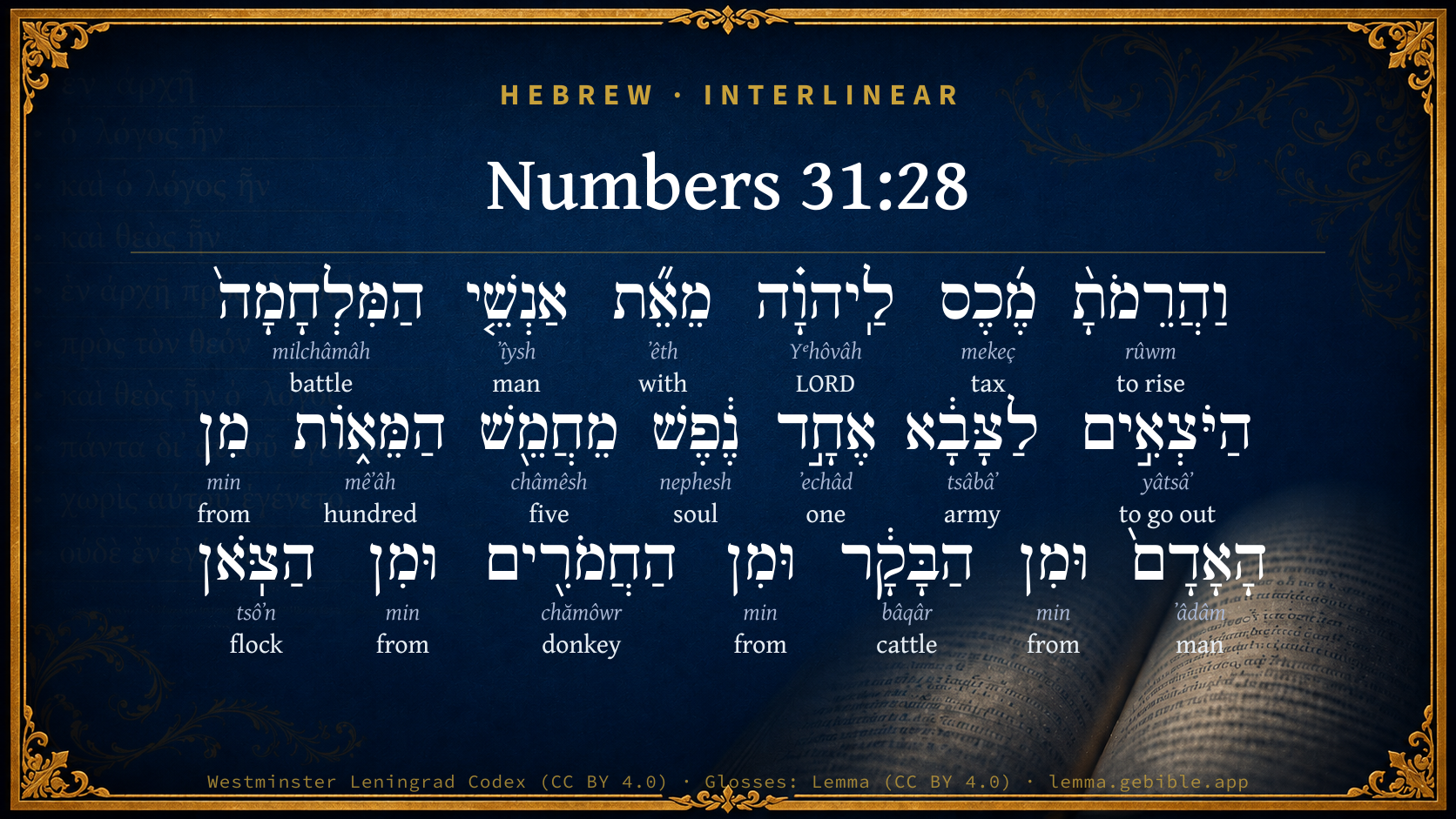
Hebrew (Westminster Leningrad Codex) Numbers 31:28 appears in the Hebrew Old Testament. The text above is from the Westminster Leningrad Codex. Each word links to its Strong’s number, a concise gloss, and parsing drawn from the Open Scriptures Hebrew Bible morphology. Click any word for its full Brown-Driver-Briggs (BDB) entry.
Download image
Cite this verse

Numbers 31:28 (World English Bible). Public Domain. Lemma interlinear Bible study tool, https://lemma.gebible.app/v/numbers/31/28.

Show BibTeX & RIS
BibTeX
RIS
English Translation
Levy a tribute to Yahweh of the men of war who went out to battle: one soul of five hundred, [both] of the persons, and of the oxen, and of the donkeys, and of the flocks:
World English Bible · Public Domain
Highlights
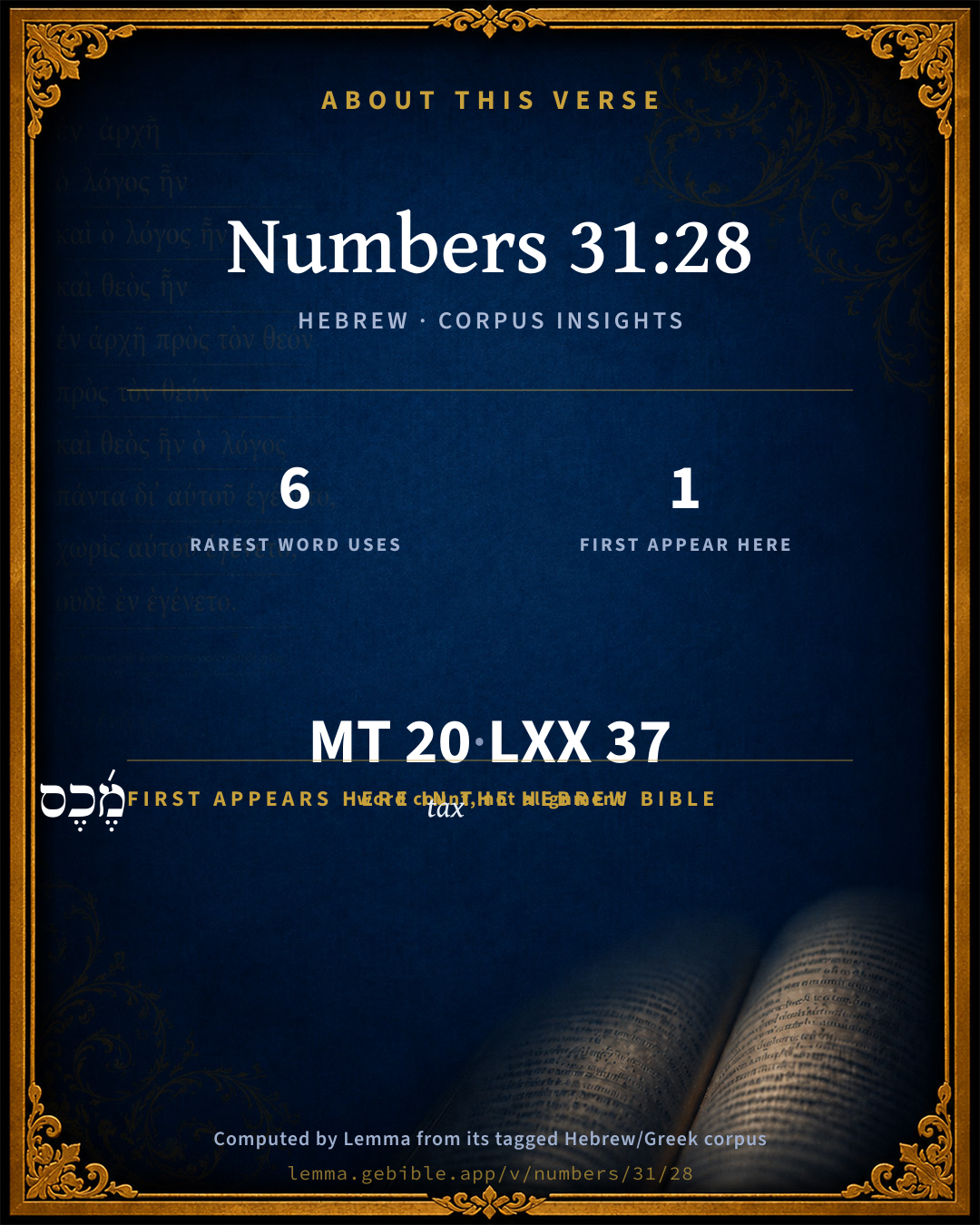
  • 1 first appearance in the Hebrew Bible
Full analysis ↓
Download a study sheet

One document with this verse’s original text, its word-by-word gloss line, the meaning frame, cross-references with their text, attributed commentary, and full source and license credits — printable, and it pastes into notes with its structure intact.

This verse Autodidact and up

Study sheet (.html) Plain text (.txt)

A passage Seminary Student

Up to 50 verses in one chapter. A passage sheet keeps up to 6 commentary sources and 12 cross-references per verse, in the order this page ranks them, and says so on the sheet whenever that leaves anything out. Ask for a single verse and you get the Autodidact verse sheet above.

Everything on this page stays free to read, with no account — the sheet is a download of what is already on screen, not access to it.

Want to remove ads? Support Godless Engineer
Compare translations 3

The same verse in 3 English versions, stacked beneath the original-language interlinear above. Click any original word for its lexicon entry.

Each is an independent rendering of the whole verse — the interlinear is not word-aligned to these translations.

Highlighted words mark where these versions differ — a whole-verse word diff, not a word-by-word alignment.

  • World English Bible Public Domain
    Levy a tribute to Yahweh of the men of war who went out to battle: one soul of five hundred, [both] of the persons, and of the oxen, and of the donkeys, and of the flocks:
  • King James Version Public Domain
    And levy a tribute unto the LORD of the men of war which went out to battle: one soul of five hundred, both of the persons, and of the beeves, and of the asses, and of the sheep:
  • unfoldingWord Literal Text CC BY-SA 4.0
    And you shall raise a tax for Yahweh from with the men of the war who went out to the battle, one life from 500, from human and from cattle and from the donkeys and from the flock.

unfoldingWord Literal Text — © unfoldingWord, licensed CC BY-SA 4.0. Word-aligned USFM3 via Door43 (git.door43.org/unfoldingWord/en_ult).

Versions to compare (up to 4)

3 of 4 selected

Show all 18 translations

Every available English version of this verse, each an independent rendering of the whole verse.

  • World English Bible Public Domain
    Levy a tribute to Yahweh of the men of war who went out to battle: one soul of five hundred, [both] of the persons, and of the oxen, and of the donkeys, and of the flocks:
  • Berean Standard Bible Public Domain
    Set aside a tribute for the LORD from what belongs to the soldiers who went into battle: one out of every five hundred, whether persons, cattle, donkeys, or sheep.
  • Majority Standard Bible Public Domain
    Set aside a tribute for the LORD from what belongs to the soldiers who went into battle: one out of every five hundred, whether persons, cattle, donkeys, or sheep.
  • King James Version Public Domain
    And levy a tribute unto the LORD of the men of war which went out to battle: one soul of five hundred, both of the persons, and of the beeves, and of the asses, and of the sheep:
  • American Standard Version (1901) Public Domain
    And levy a tribute unto Jehovah of the men of war that went out to battle: one soul of five hundred, `both' of the persons, and of the oxen, and of the asses, and of the flocks:
  • Revised Version (1885) Public Domain
    and levy a tribute unto the LORD of the men of war that went out to battle: one soul of five hundred, both of the persons, and of the beeves, and of the asses, and of the flocks:
  • Geneva Bible (1599) Public Domain
    And thou shalt take a tribute vnto ye Lord of the men of warre, which went out to battel: one person of fiue hundreth, both of the persons, and of the beeues, and of the asses, and of the sheepe.
  • Douay-Rheims (1899) Public Domain
    And thou shalt separate a portion to the Lord from them that fought and were in the battle, one soul of five hundred as well of persons as of oxen and asses and sheep.
  • Young's Literal Translation Public Domain
    and thou hast raised a tribute to Jehovah from the men of war, who go out to the host, one body out of five hundred, of man, and of the herd, and of the asses, and of the flock;
  • Literal Standard Version CC BY-SA 4.0
    and you have raised a tribute to YHWH from the men of battle, who go out to the war, one body out of five hundred, of man, and of the herd, and of the donkeys, and of the flock;
  • Unlocked Literal Bible CC BY-SA 4.0
    Then levy a tax to be given to me from the soldiers who went out to battle. This tax must be one out of every five hundred, whether persons, cattle, donkeys, sheep, or goats.
  • unfoldingWord Literal Text CC BY-SA 4.0
    And you shall raise a tax for Yahweh from with the men of the war who went out to the battle, one life from 500, from human and from cattle and from the donkeys and from the flock.
  • Darby Bible Public Domain
    And thou shalt levy a tribute for Jehovah of the men of war who went out to the army, one soul of five hundred of the persons, and of the oxen, and of the asses, and of the small cattle.
  • World Messianic Bible Public Domain
    Levy a tribute to the LORD of the men of war who went out to battle: one soul of five hundred; of the persons, of the cattle, of the donkeys, and of the flocks.
  • Webster's Bible Public Domain
    And levy a tribute to the LORD of the men of war who went out to battle: one soul of five hundred, both of the persons, and of the beeves, and of the asses, and of the sheep:
  • Free Bible Version CC BY-SA 4.0
    Take as a contribution to the Lord from what is allocated to the troops who went into battle one out of every five hundred people, cattle, donkeys, or sheep.
  • Bible in Basic English Public Domain
    And from the men of war who went out let there be offered to the Lord one out of every five hundred, from the persons, and from the oxen and asses and sheep:
  • JPS Tanakh (1917) Public Domain
    and levy a tribute unto the LORD of the men of war that went out to battle: one soul of five hundred, both of the persons, and of the beeves, and of the asses, and of the flocks;

Literal Standard Version (2020), Covenant Press — licensed CC BY-SA 4.0. Text via the HelloAO Bible API (eBible.org). Unlocked Literal Bible (unfoldingWord) — licensed CC BY-SA 4.0. Text via the HelloAO Bible API (eBible.org). unfoldingWord Literal Text — © unfoldingWord, licensed CC BY-SA 4.0. Word-aligned USFM3 via Door43 (git.door43.org/unfoldingWord/en_ult). Free Bible Version, Dr. Jonathan Gallagher — licensed CC BY-SA 4.0. Text via the HelloAO Bible API (eBible.org).

Word by word

More ways to search: Search by grammar → Find every occurrence → Compare this word →

Practice this passage: Drill this verse → Learn its vocabulary →

מֶ֜כֶס
mekeç
H4371
“tax”
Noun, Common, Masculine, Singular, Absolute
Part of Speech
Noun
Type
Common
Gender
Masculine
Number
Singular
State
Absolute
Full BDB Definition

Origin: probably from an unused root meaning to enumerate

TWOT: 1014a

computation, proportion to be paid, tribute, tax
  1. וַהֲרֵמֹתָ֨ rûwm H7311 “and · to rise” Conjunction + Verb, Hiphil, Sequential Perfect, 2nd Person, Masculine, Singular
  2. לַֽיהוָ֗ה Yᵉhôvâh H3068 “to/for · LORD” Preposition + Noun, Proper
  3. מֵאֵ֞ת ʼêth H854 “from · with” Preposition + Preposition
  4. אַנְשֵׁ֤י ʼîysh H376 “men of” Noun, Common, Masculine, Plural, Construct
  5. הַמִּלְחָמָה֙ milchâmâh H4421 “the · battle” Particle, Definite Article + Noun, Common, Feminine, Singular, Absolute
  6. הַיֹּצְאִ֣ים yâtsâʼ H3318 “the · going out” Particle, Definite Article + Verb, Qal, Participle Active, Masculine, Plural, Absolute
  7. לַצָּבָ֔א tsâbâʼ H6635 “to/for the · army” Preposition, Determined + Noun, Common, Both, Singular, Absolute
  8. אֶחָ֣ד ʼechâd H259 “one” Adjective, Cardinal number, Masculine, Singular, Absolute
  9. נֶ֔פֶשׁ nephesh H5315 “soul” Noun, Common, Both, Singular, Absolute
  10. מֵחֲמֵ֖שׁ châmêsh H2568 “from · five” Preposition + Adjective, Cardinal number, Feminine, Singular, Absolute
  11. הַמֵּא֑וֹת mêʼâh H3967 “the · hundred” Particle, Definite Article + Adjective, Cardinal number, Both, Plural, Absolute
  12. מִן min H4480 “from” Preposition
  13. הָאָדָם֙ ʼâdâm H120 “the · man” Particle, Definite Article + Noun, Common, Masculine, Singular, Absolute
  14. וּמִן min H4480 “and · from” Conjunction + Preposition
  15. הַבָּקָ֔ר bâqâr H1241 “the · cattle” Particle, Definite Article + Noun, Common, Both, Singular, Absolute
  16. וּמִן min H4480 “and · from” Conjunction + Preposition
  17. הַחֲמֹרִ֖ים chămôwr H2543 “the · donkeys” Particle, Definite Article + Noun, Common, Both, Plural, Absolute
  18. וּמִן min H4480 “and · from” Conjunction + Preposition
  19. הַצֹּֽאן tsôʼn H6629 “the · flock” Particle, Definite Article + Noun, Common, Both, Singular, Absolute

About this verse

These counts appear in no published source. They are computed here, from the morphology-tagged text and Lemma’s own curated glosses. What Lemma adds →

20
words
17
distinct lemmas
Pentateuch
section

Notable vocabulary

The rarest word here is מֶ֜כֶס tax H4371 — appearing just 6 times in the whole Hebrew Bible.

First appearance in Scripture

This word makes its first canonical appearance in the Hebrew Bible here:

Shared distinctive vocabulary

מֶ֜כֶס tax H4371 occurs in 6 verses of the Hebrew Bible. Also found in:

Grammatical profile

  • 2 verbs
  • 10 nouns
  • 3 adjectives
  • 5 prepositions

Verb forms

  • וַהֲרֵמֹתָ֨ Hiphil · Sequential Perfect
  • הַיֹּצְאִ֣ים Qal · Participle Active

Repetition

A word recurs within this verse — often emphatic in Hebrew:

Hebrew & Septuagint length

In English translation the verse runs 36 words from the Hebrew and 49 from the Septuagint (LXX English) — closely comparable.

A rough comparison of the two English renderings, which tokenize alike — not a word-level alignment.

Word counts can differ between the Hebrew and the Greek without any difference in meaning — e.g. the Hebrew direct-object marker אֵת has no separate Greek word, and Greek often adds the article ὁ.

In the original languages it is 20 Hebrew tokens and 37 Greek tokens — but the two are counted differently (Hebrew bundles its prefixes and suffixes into one token; the Greek is in lemma form), so that isn’t a like-for-like length.

Cross-references

15

Topical passages linked to Numbers 31:28 in the Treasury of Scripture Knowledge — connected by theme and wording, ordered by reader-vote popularity; previews shown in the World English Bible.

  • Numbers 18:26 Moreover you shall speak to the Levites, and tell them, When you take of the children of Israel the tithe which I have given you from them for your inheritance, then you shall offer up a heave-offering of it for Yahweh, a tithe of the tithe.
  • Numbers 31:30 Of the children of Israel's half, you shall take one drawn out of every fifty, of the persons, of the oxen, of the donkeys, and of the flocks, [even] of all the cattle, and give them to the Levites, who keep the charge of the tent of Yahweh.
  • Numbers 31:47 even of the children of Israel's half, Moses took one drawn out of every fifty, both of man and of animal, and gave them to the Levites, who kept the charge of the tent of Yahweh; as Yahweh commanded Moses.
  • Genesis 14:20 and blessed be God Most High, who has delivered your enemies into your hand." Abram gave him a tenth of all.
  • Numbers 18:21 To the children of Levi, behold, I have given all the tithe in Israel for an inheritance, in return for their service which they serve, even the service of the tent of meeting.
  • Joshua 6:19 But all the silver, and gold, and vessels of brass and iron, are holy to Yahweh: they shall come into the treasury of Yahweh.
  • Joshua 6:24 They burnt the city with fire, and all that was therein; only the silver, and the gold, and the vessels of brass and of iron, they put into the treasury of the house of Yahweh.
  • 2 Samuel 8:11–12 These also did king David dedicate to Yahweh, with the silver and gold that he dedicated of all the nations which he subdued;
  • 1 Chronicles 18:11 These also did king David dedicate to Yahweh, with the silver and the gold that he carried away from all the nations; from Edom, and from Moab, and from the children of Ammon, and from the Philistines, and from Amalek.
  • 1 Chronicles 26:26–27 This Shelomoth and his brothers were over all the treasures of the dedicated things, which David the king, and the heads of the fathers' [houses], the captains over thousands and hundreds, and the captains of the host, had dedicated.
  • Proverbs 3:9–10 Honor Yahweh with your substance, With the first fruits of all your increase:
  • Isaiah 18:7 In that time shall a present be brought to Yahweh of Hosts [from] a people tall and smooth, even from a people awesome from their beginning onward, a nation that measures out and treads down, whose land the rivers divide, to the place of the name of Yahweh of Hosts, Mount Zion.
  • Isaiah 23:18 Her merchandise and her hire shall be holiness to Yahweh: it shall not be treasured nor laid up; for her merchandise shall be for those who dwell before Yahweh, to eat sufficiently, and for durable clothing.
  • Isaiah 60:9 Surely the isles shall wait for me, and the ships of Tarshish first, to bring your sons from far, their silver and their gold with them, for the name of Yahweh your God, and for the Holy One of Israel, because he has glorified you.
  • Matthew 22:21 They said to him, "Caesar's." Then he said to them, "Give therefore to Caesar the things that are Caesar's, and to God the things that are God's."

Cross-references courtesy of OpenBible.info (CC BY 4.0).

Hebrew and Greek witnesses Masoretic Hebrew ↔ Greek Septuagint

The same verse in the two great witnesses to the Old Testament, shown verse-for-verse.

These are two independent witnesses, not word-aligned to each other, and the Septuagint is shown in lemma (dictionary) form.

Hebrew Numbers 31:28 Masoretic · Westminster Leningrad Codex

וַהֲרֵמֹתָ֨ מֶ֜כֶס לַֽיהוָ֗ה מֵאֵ֞ת אַנְשֵׁ֤י הַמִּלְחָמָה֙ הַיֹּצְאִ֣ים לַצָּבָ֔א אֶחָ֣ד נֶ֔פֶשׁ מֵחֲמֵ֖שׁ הַמֵּא֑וֹת מִן הָאָדָם֙ וּמִן הַבָּקָ֔ר וּמִן הַחֲמֹרִ֖ים וּמִן הַצֹּֽאן

Levy a tribute to Yahweh of the men of war who went out to battle: one soul of five hundred, [both] of the persons, and of the oxen, and of the donkeys, and of the flocks:

World English Bible · Public Domain

Greek LXX Numbers 31:28 Septuagint · lemma form

καί ἀποαἱρέω τέλος κύριος παρά ὁ ἄνθρωπος ὁ πολεμιστής ὁ ἐκπορεύομαι εἰς ὁ παράταξις εἷς ψυχή ἀπό πεντακόσιοι ἀπό ὁ ἄνθρωπος καί ἀπό ὁ κτῆνος καί ἀπό ὁ βοῦς καί ἀπό ὁ πρόβατον καί ἀπό ὁ αἴξ

And you⌃ shall take a tribute for the Lord from the warriors that went out to battle; one soul out of five hundred, from the men, and from the cattle, even from the oxen, and from the sheep, and from the asses; and you⌃ shall take from their half.

LXX2012 (modern English Septuagint) · Public Domain

Hebrew: Westminster Leningrad Codex (CC BY 4.0). Greek: Septuagint (public domain); English from LXX2012 (modern English Septuagint) (Public Domain). How the Septuagint differs from the Hebrew →

Targum (Aramaic paraphrase)

2

The Targum is the ancient Jewish Aramaic paraphrase of the Hebrew Scriptures — an interpretive translation, not the Hebrew text itself. Onkelos (literal) and Pseudo-Jonathan (expansive) render the Torah, and Jonathan the Prophets. Coverage is partial: where no permissively-licensed English translation exists for a verse, only the Aramaic is shown. This is verse-level text, not a word-by-word alignment to the Hebrew.

  1. Targum Onkelos Torah (Genesis–Deuteronomy)
    וְתַפְרֵשׁ נְסִיבָא קֳדָם יְיָ מִן גַבְרֵי מְגִיחֵי קְרָבָא דִנְפָקוּ לְחֵילָא חָד נַפְשָׁא מֵחֲמֵשׁ מְאָה מִן אֱנָשָׁא וּמִן תּוֹרֵי וּמִן חֲמָרֵי וּמִן עָנָא

    (no public-domain English translation for this verse)

    Targum Onkelos — Aramaic: “Onkelos Genesis” (public domain); “Onkelos Exodus” (public domain); “Onkelos Leviticus” (public domain); “Onkelos Numbers” (public domain); “Onkelos Deuteronomy” (public domain). English: “Sefaria Community Translation” (CC0 1.0 (public-domain dedication)); “J.W. Etheridge. The Targums of Onkelos and Jonathan Ben Uzziel on the Pentateuch. London: Longmans, Green, 1862” (public domain). Text via Sefaria.

  2. Targum Pseudo-Jonathan Torah (Genesis–Deuteronomy)
    וְתַפְרֵישׁ נְסִיבָא לִשְׁמָא דַיְיָ מִן גוּבְרֵי מְגִיחֵי קְרָבָא דִנְפָקוּ לְחֵילָא חֲדָא בַּת נְשָׁא מֵחֲמֵשׁ מְאָה הֵיכְדֵין מֵאֱנָשָׁא מִן תּוֹרֵי וּמִן חַמְרֵי וּמִן עָנָא

    and separate that which is to be given up to the Name of the Lord by the men of war who went forth with the host: one woman out of five hundred; so, likewise, of oxen, asses, and sheep.

    Targum Pseudo-Jonathan — Aramaic: “Targum Jonathan on Genesis” (public domain); “Targum Jonathan on Exodus” (public domain); “Targum Jonathan on Leviticus” (public domain); “Targum Jonathan on Numbers” (public domain); “Targum Jonathan on Deuteronomy” (public domain). English: “The Targum of Jonathan ben Uzziel, trans. J. W. Etheridge, London, 1862” (public domain). Text via Sefaria.

Commentary

Notes on Numbers 31:28 from classic Christian and Jewish commentators (each source and its license shown beneath its notes). The classic Christian expositions comment on the surrounding passage and are grouped to its opening verse, so a note may address several verses; the Jewish commentaries on the Tanakh (Rashi and others) are per-verse, so they appear only where the commentator wrote on this verse.

Lemma curates 59 commentaries, every one of them public domain or Creative Commons licensed, each selected and text-cleaned for this edition rather than reprinted as found. About our sources →

Geneva Bible (1599)

Geneva Bible translators

Of the prey that falleth to the soldiers.

Geneva Bible (1599) marginal notes — public domain. Text via Bolls.life.

Adam Clarke's Commentary

Verse 28. And levy a tribute unto the Lord - one soul of five hundred, &c.] The person to be employed in the Lord's service, under the Levites-the cattle either for sacrifice, or for the use of the Levites, Nu 31:30. Some monsters have supposed that one out of every five hundred of the captives was offered in sacrifice to the Lord! but this is abominable. When God chose to have the life of a man, he took it in the way of justice, as in the case of Midianites above, but never in the way of sacrifice.

Adam Clarke's Commentary on the Bible (1810–1826) — public domain. Text from a community e-Sword/MySword module.

Ellicott's Commentary for English Readers

(28) And levy a tribute unto the Lord.—Literally, and thou shalt lift up (or, heave), &c. The portion assigned to the priests, which was taken from the prey that fell to the lot of the warriors, and which is described in Num_31:29 as “the heave offering of the Lord,” was one-five-hundredth part of the maidens and of the cattle which had fallen to their share. The maidens were probably employed as slaves, and the cattle used for the maintenance of the priests. Inasmuch, then, as the entire booty consisted of 32,000 maidens, 675,000 small cattle, 72,000 oxen, and 61,000 asses, the portion which fell to the lot of the 12,000 warriors was 16,000 maidens, 337,500 sheep and goats, 36,000 oxen, and 30,500 asses, of which the portion of the priests was 32 maidens, 675 sheep and goats, 72 oxen, and 61 asses.

A Bible Commentary for English Readers, edited by Charles John Ellicott (1878–1897) — public domain. Text from a community e-Sword module.

The Cambridge Bible for Schools and Colleges

gen. ed. J. J. S. Perowne

28. levy a tribute] lit. ‘lift off a fixed proportion.’ The verb has the technical sense which is more often found in the corresponding subst. terûmâh (Num_31:29); see on Num_31:9.

one soul out of (every) five hundred] The word nephesh (‘soul’) denotes the life or animating principle of every living creature, man or beast, and here stands for an ‘individual’ person or a ‘head’ of cattle.

the beeves] an archaic plural of ‘beef,’ used for the live animals; cf. Shakespeare, Merch. of Venice, 1. iii. 68, ‘flesh of muttons, beefs or goats.’ The word occurs in R.V. and A.V. five times in this chapter, and in Lev_22:19; Lev_22:21 (R.V. in the latter verse ‘herd’).

The Cambridge Bible for Schools and Colleges (gen. ed. J. J. S. Perowne; Cambridge University Press, 1878–1918) — public domain. Text from a community e-Sword module.

John Gill's Exposition

And Moses and Eleazar the priest did as the Lord commanded Moses. Took an account of the booty, divided it equally between the soldiers and the congregation of Israel, and levied a part out of each as a tribute for the Lord, which was given to the priests and Levites.

And Moses and Eleazar the priest did as the Lord commanded Moses. Took an account of the booty, divided it equally between the soldiers and the congregation of Israel, and levied a part out of each as a tribute for the Lord, which was given to the priests and Levites.

Numbers 31:32

num 31:32

num 31:32

num 31:32And the booty, being the rest of the prey which the men of war had caught,.... The remainder of it, besides what they had eaten in their return from the war, and during their seven days' stay without the camp: from hence to the end of Num 31:47 is only an account of the prey or booty taken, which in general were 675,000 sheep, 72,000 beeves or oxen, 61,000 asses, and 32,000 females who had never known man; the half out of these, which fell to the share of the soldiers, were 337,500 sheep, 36,000 beeves or oxen, 30,500 asses, and 16,000 females, out of which were given as an heave offering to the Lord six hundred and seventy five sheep, seventy two beeves or oxen, sixty one asses, and thirty two women: the half divided unto the children of Israel consisted of 337,500 sheep, 36,000 beeves or oxen, 30,500 asses, and 16,000 women, out of which one in fifty, both of women and cattle, were given to the Levites; what that amounted to is not expressed, but may be easily reckoned.

John Gill's Exposition of the Whole Bible (1746–1763) — public domain (CC PDM 1.0). Text via the HelloAO Bible API.

Matthew Poole's English Annotations

One soul, i.e. one person, as it follows here and Num 31:30.

Matthew Poole's English Annotations on the Holy Bible (1683–1685) — public domain. Text from a community e-Sword/MySword module.

Whedon's Commentary on the Bible

Daniel D. Whedon

28. Levy a tribute — One fifth of one per cent. of the portion of the army of the human captives and animals was to be set apart for the Lord in acknowledgment of him as the God of battles and the author of victory.

Daniel D. Whedon (gen. ed.), Commentary on the Old and New Testaments (1874–1909) — public domain. Text from a community e-Sword module.

unfoldingWord translationNotes

Door43 World Missions Community

General Information:

Yahweh continues speaking to Moses.

General Information:

"me" refers to Yahweh.

Then levy a tax to be given to me from the soldiers who went out to battle

This can be stated in active form. AT: "Collect a tax from the soldiers' plunder and give it to me" (See: Active or Passive)

every five hundred

"every 500" (See: Numbers)

from their half

"from the soldiers' half"

to be presented to me

This can be stated in active form. AT: "which he will present to me" (See: Active or Passive)

translationWords

tax

cow

donkey

ewe

goat

Eleazar

sacrifice

unfoldingWord translationNotes — © Distant Shores Media and the Door43 World Missions Community, licensed CC BY-SA 4.0. Source: git.door43.org/Door43/en_tn.

Ramban (Nachmanides)

Rabbi Moshe ben Nachman (Ramban / Nachmanides)

AND THOU SHALT LEVY A TRIBUTE UNTO THE ETERNAL. The reason for this tribute [given to the priests and Levites] was also because this spoil was taken from [a war constituting] the vengeance of the Eternal on a land that was not theirs. But [from the spoil taken] in the lands of Sihon and Og they did not give any part at all to the priests and Levites; [on the contrary], they were even warned against [taking of] it, as it is said, neither shalt thou [Aaron] have ‘any’ portion among them, even in the spoil., 18:20, according to the explanation of the Sifre, Korach 119.

Ramban (Nachmanides) on the Tanakh — English translation: “Commentary on the Torah by Ramban (Nachmanides). Translated and annotated by Charles B. Chavel. New York, Shilo Pub. House, 1971-1976” (CC BY 4.0). Text via Sefaria.

Lesson kit

Teaching starters — assembled from the data on this page, not authored interpretation. Every prompt links to the verse data it draws on. Edit before teaching.

Numbers, in the Pentateuch, opens this verse with 20 words (17 distinct Hebrew lemmas). Its most distinctive word is mekeç (“tax”). A historical commentator’s framing appears above. Read the whole chapter for the surrounding context.

Discussion questions

  1. What does “tax” (mekeç) contribute to the verse as a whole?
  2. The word “tax” first appears here in Scripture. What is being introduced at this debut?
  3. Numbers 31:37 shares the word «tax» with this verse. How do the two illuminate each other?
  4. “from” occurs 4× in this one verse. What is the effect of the repetition?
  5. The translations on this page render this verse differently — a whole-verse word diff, not a word-by-word alignment. What might account for the different wordings?
  6. The verb «וַהֲרֵמֹתָ֨» is Hiphil Sequential Perfect. How does its form color the action?
  7. Reading how Geneva Bible (1599) and Adam Clarke's Commentary read this verse, where do the two commentators agree and where do they part?

Things to notice

Reading settings

Reading text

Shown beneath each verse's original-language words.

Old Testament
Old Testament edition

Read the OT as the Masoretic Hebrew (MT) or the Greek Septuagint (LXX).

English shown for the Greek Septuagint (in the Hebrew ↔ Greek comparison).

Comparing translations? Open the Compare panel on any verse page to stack up to four side by side.