Jeremiah 3:24

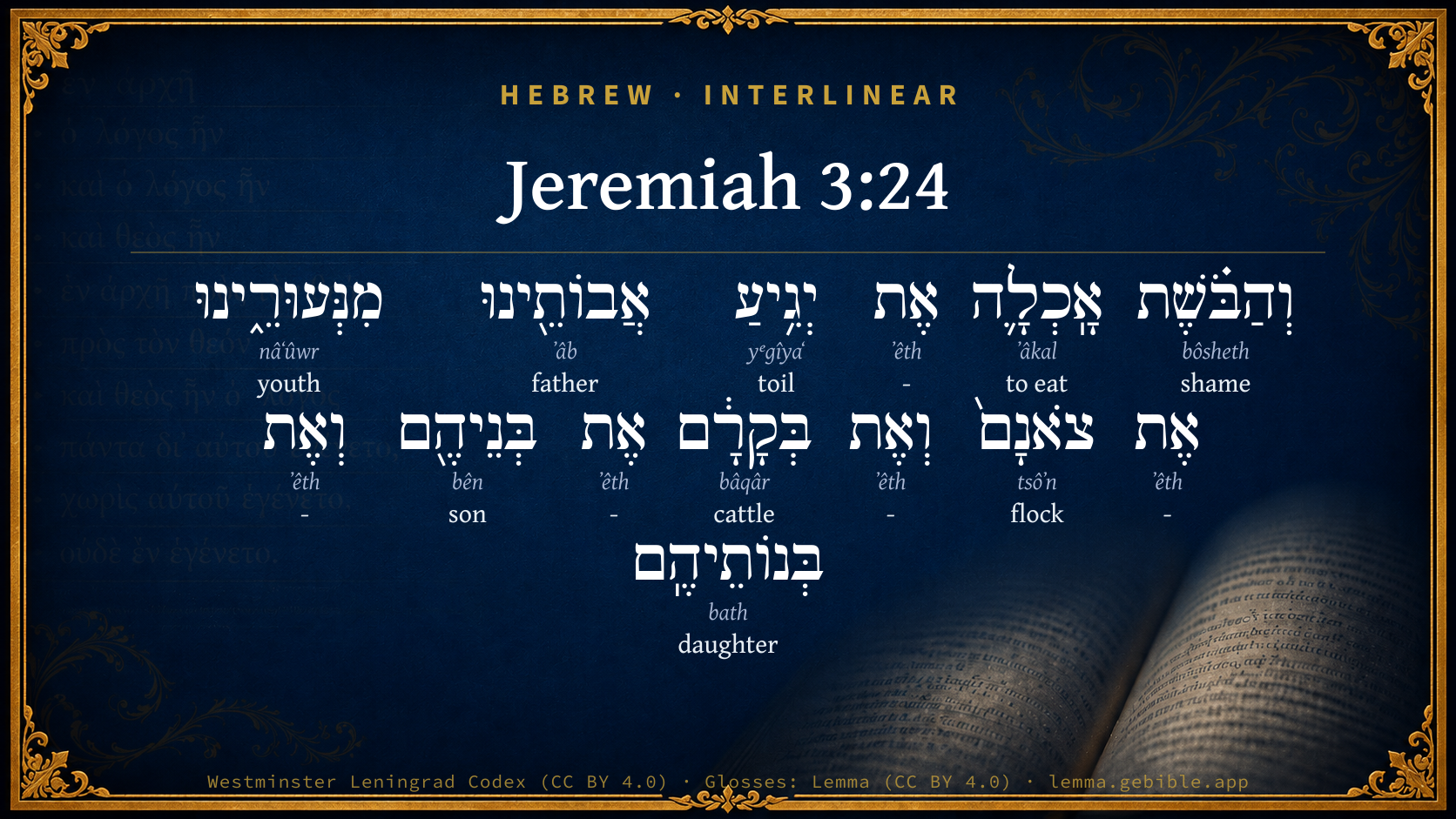
Hebrew (Westminster Leningrad Codex) Jeremiah 3:24 appears in the Hebrew Old Testament. The text above is from the Westminster Leningrad Codex. Each word links to its Strong’s number, a concise gloss, and parsing drawn from the Open Scriptures Hebrew Bible morphology. Click any word for its full Brown-Driver-Briggs (BDB) entry.
Download image
Cite this verse

Jeremiah 3:24 (World English Bible). Public Domain. Lemma interlinear Bible study tool, https://lemma.gebible.app/v/jeremiah/3/24.

Show BibTeX & RIS
BibTeX
RIS
English Translation
But the shameful thing has devoured the labor of our fathers from our youth, their flocks and their herds, their sons and their daughters.
World English Bible · Public Domain
Download a study sheet

One document with this verse’s original text, its word-by-word gloss line, the meaning frame, cross-references with their text, attributed commentary, and full source and license credits — printable, and it pastes into notes with its structure intact.

This verse Autodidact and up

Study sheet (.html) Plain text (.txt)

A passage Seminary Student

Up to 50 verses in one chapter. A passage sheet keeps up to 6 commentary sources and 12 cross-references per verse, in the order this page ranks them, and says so on the sheet whenever that leaves anything out. Ask for a single verse and you get the Autodidact verse sheet above.

Everything on this page stays free to read, with no account — the sheet is a download of what is already on screen, not access to it.

Want to remove ads? Support Godless Engineer
Compare translations 3

The same verse in 3 English versions, stacked beneath the original-language interlinear above. Click any original word for its lexicon entry.

Each is an independent rendering of the whole verse — the interlinear is not word-aligned to these translations.

Highlighted words mark where these versions differ — a whole-verse word diff, not a word-by-word alignment.

  • World English Bible Public Domain
    But the shameful thing has devoured the labor of our fathers from our youth, their flocks and their herds, their sons and their daughters.
  • King James Version Public Domain
    For shame hath devoured the labour of our fathers from our youth; their flocks and their herds, their sons and their daughters.
  • unfoldingWord Literal Text CC BY-SA 4.0
    Yet from our youth the shame has consumed the toil of our fathers— their flock and their cattle, their sons and their daughters!

unfoldingWord Literal Text — © unfoldingWord, licensed CC BY-SA 4.0. Word-aligned USFM3 via Door43 (git.door43.org/unfoldingWord/en_ult).

Versions to compare (up to 4)

3 of 4 selected

Show all 18 translations

Every available English version of this verse, each an independent rendering of the whole verse.

  • World English Bible Public Domain
    But the shameful thing has devoured the labor of our fathers from our youth, their flocks and their herds, their sons and their daughters.
  • Berean Standard Bible Public Domain
    From our youth, that shameful god has consumed what our fathers have worked for—their flocks and herds, their sons and daughters.
  • Majority Standard Bible Public Domain
    From our youth, that shameful god has consumed what our fathers have worked for—their flocks and herds, their sons and daughters.
  • King James Version Public Domain
    For shame hath devoured the labour of our fathers from our youth; their flocks and their herds, their sons and their daughters.
  • American Standard Version (1901) Public Domain
    But the shameful thing hath devoured the labor of our fathers from our youth, their flocks and their herds, their sons and their daughters.
  • Revised Version (1885) Public Domain
    But the shameful thing hath devoured the labour of our fathers from our youth; their flocks and their herds, their sons and their daughters.
  • Geneva Bible (1599) Public Domain
    For confusion hath deuoured our fathers labour, from our youth their sheepe and their bullocks, their sonnes and their daughters.
  • Douay-Rheims (1899) Public Domain
    Confusion hath devoured the labor of our fathers from our youth, their flocks and their herds, their sons and their daughters.
  • Young's Literal Translation Public Domain
    And the shameful thing hath devoured The labour of our fathers from our youth, Their flock and their herd, Their sons and their daughters.
  • Literal Standard Version CC BY-SA 4.0
    And the shameful thing has devoured || The labor of our fathers from our youth, || Their flock and their herd, || Their sons and their daughters.
  • Unlocked Literal Bible CC BY-SA 4.0
    Yet shameful idols have consumed what our ancestors have worked for— their flocks and cattle, their sons and daughters!
  • unfoldingWord Literal Text CC BY-SA 4.0
    Yet from our youth the shame has consumed the toil of our fathers— their flock and their cattle, their sons and their daughters!
  • Darby Bible Public Domain
    But shame hath devoured the labour of our fathers from our youth; their flocks and their herds, their sons and their daughters.
  • World Messianic Bible Public Domain
    But the shameful thing has devoured the labor of our fathers from our youth, their flocks and their herds, their sons and their daughters.
  • Webster's Bible Public Domain
    For shame hath devoured the labor of our fathers from our youth; their flocks and their herds, their sons and their daughters.
  • Free Bible Version CC BY-SA 4.0
    All our lives pagan idolatry has destroyed what our fathers worked so hard for: their flocks and herds, their sons and daughters.
  • Bible in Basic English Public Domain
    But the Baal has taken all the work of our fathers from our earliest days; their flocks and their herds, their sons and their daughters.
  • JPS Tanakh (1917) Public Domain
    But the shameful thing hath devoured the labour of our fathers from our youth; their flocks and their herds, their sons and their daughters.

Literal Standard Version (2020), Covenant Press — licensed CC BY-SA 4.0. Text via the HelloAO Bible API (eBible.org). Unlocked Literal Bible (unfoldingWord) — licensed CC BY-SA 4.0. Text via the HelloAO Bible API (eBible.org). unfoldingWord Literal Text — © unfoldingWord, licensed CC BY-SA 4.0. Word-aligned USFM3 via Door43 (git.door43.org/unfoldingWord/en_ult). Free Bible Version, Dr. Jonathan Gallagher — licensed CC BY-SA 4.0. Text via the HelloAO Bible API (eBible.org).

Word by word

More ways to search: Search by grammar → Find every occurrence → Compare this word →

Practice this passage: Drill this verse → Learn its vocabulary →

יְגִ֥יעַ
yᵉgîyaʻ
H3018
“toil of”
Noun, Common, Masculine, Singular, Construct
Part of Speech
Noun
Type
Common
Gender
Masculine
Number
Singular
State
Construct
Full BDB Definition

Origin: from H3021

TWOT: 842e

toil, work - product, produce, acquired property (as a result of work)
  1. וְהַבֹּ֗שֶׁת bôsheth H1322 “and · the · shame” Conjunction + Particle, Definite Article + Noun, Common, Feminine, Singular, Absolute
  2. אָֽכְלָ֛ה ʼâkal H398 “to eat” Verb, Qal, Perfect, 3rd Person, Feminine, Singular
  3. אֶת ʼêth H853 “-” Particle, Direct Object
  4. אֲבוֹתֵ֖ינוּ ʼâb H1 “fathers · our” Noun, Common, Masculine, Plural, Construct + Suffix, Personal, 1st Person, Common, Plural
  5. מִנְּעוּרֵ֑ינוּ nâʻûwr H5271 “from · youth · our” Preposition + Noun, Common, Both, Plural, Construct + Suffix, Personal, 1st Person, Common, Plural
  6. אֶת ʼêth H853 “-” Particle, Direct Object
  7. צֹאנָם֙ tsôʼn H6629 “flock · their” Noun, Common, Both, Singular, Construct + Suffix, Personal, 3rd Person, Masculine, Plural
  8. וְאֶת ʼêth H853 “and · -” Conjunction + Particle, Direct Object
  9. בְּקָרָ֔ם bâqâr H1241 “cattle · their” Noun, Common, Both, Singular, Construct + Suffix, Personal, 3rd Person, Masculine, Plural
  10. אֶת ʼêth H853 “-” Particle, Direct Object
  11. בְּנֵיהֶ֖ם bên H1121 “sons · their” Noun, Common, Masculine, Plural, Construct + Suffix, Personal, 3rd Person, Masculine, Plural
  12. וְאֶת ʼêth H853 “and · -” Conjunction + Particle, Direct Object
  13. בְּנוֹתֵיהֶֽם bath H1323 “daughters · their” Noun, Common, Feminine, Plural, Construct + Suffix, Personal, 3rd Person, Masculine, Plural

About this verse

These counts appear in no published source. They are computed here, from the morphology-tagged text and Lemma’s own curated glosses. What Lemma adds →

14
words
10
distinct lemmas
Prophets
section

Notable vocabulary

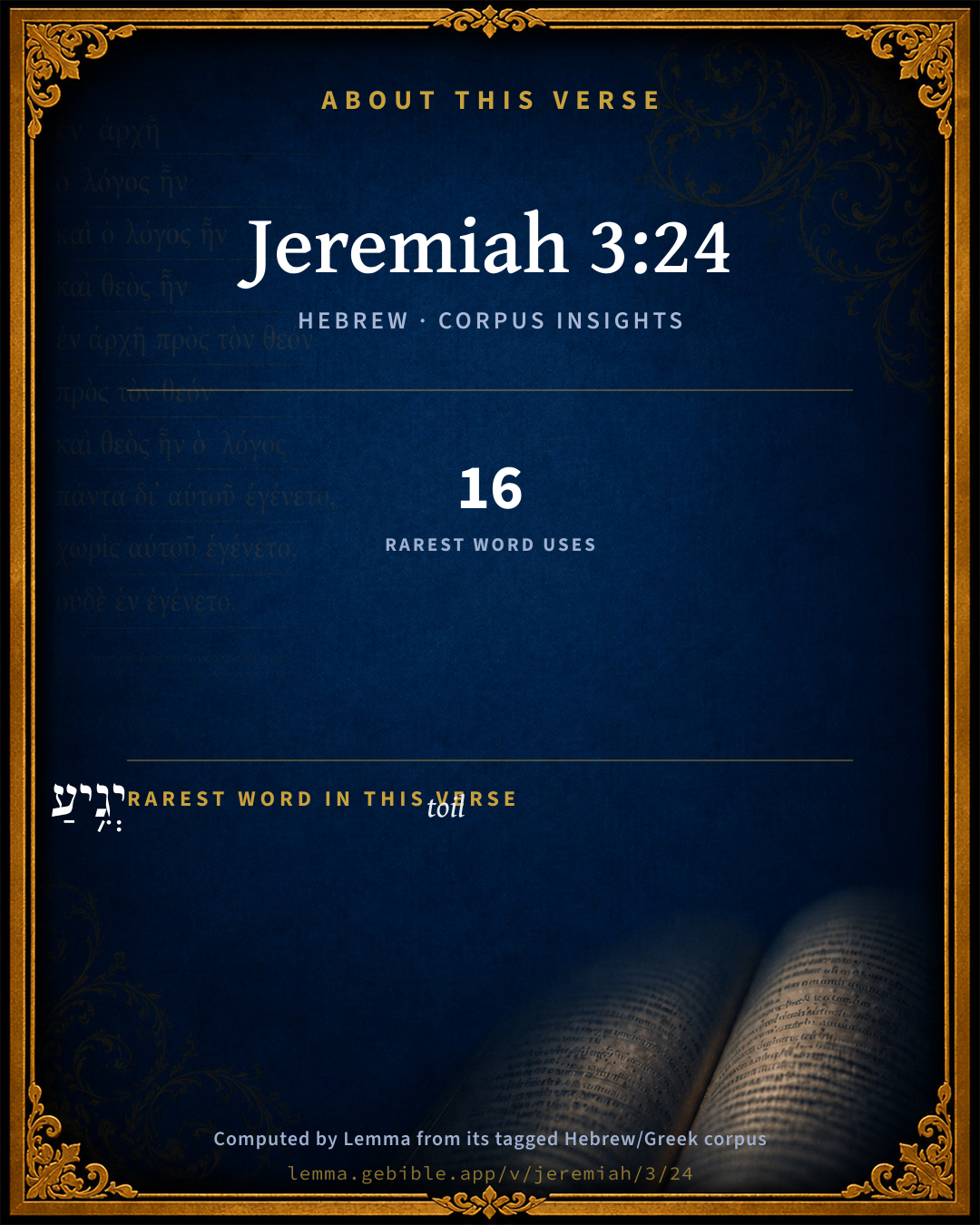
The rarest word here is יְגִ֥יעַ toil H3018 — appearing just 16 times in the whole Hebrew Bible.

Shared distinctive vocabulary

יְגִ֥יעַ toil H3018 occurs in 16 verses of the Hebrew Bible. Also found in:

Grammatical profile

  • 1 verb
  • 8 nouns
  • 5 particles

Verb forms

  • אָֽכְלָ֛ה Qal · Perfect

Cross-references

6

Topical passages linked to Jeremiah 3:24 in the Treasury of Scripture Knowledge — connected by theme and wording, ordered by reader-vote popularity; previews shown in the World English Bible.

  • Hosea 9:10 I found Israel like grapes in the wilderness. I saw your fathers as the first ripe in the fig tree at its first season; But they came to Baal Peor, and consecrated themselves to the shameful thing, And became abominable like that which they loved.
  • Jeremiah 11:13 For according to the number of your cities are your gods, Judah; and according to the number of the streets of Jerusalem have you set up altars to the shameful thing, even altars to burn incense to Baal.
  • Ezekiel 16:61 Then shall you remember your ways, and be ashamed, when you shall receive your sisters, your elder [sisters] and your younger; and I will give them to you for daughters, but not by your covenant.
  • Ezekiel 16:63 that you may remember, and be confounded, and never open your mouth any more, because of your shame, when I have forgiven you all that you have done, says the Lord Yahweh.
  • Hosea 2:8 For she did not know that I gave her the grain, the new wine, and the oil, And multiplied to her silver and gold, which they used for Baal.
  • Hosea 10:6 It also will be carried to Assyria for a present to a great king. Ephraim will receive shame, And Israel will be ashamed of his own counsel.

Cross-references courtesy of OpenBible.info (CC BY 4.0).

Hebrew and Greek witnesses Masoretic Hebrew ↔ Greek Septuagint

The same verse in the two great witnesses to the Old Testament, shown verse-for-verse.

These are two independent witnesses, not word-aligned to each other, and the Septuagint is shown in lemma (dictionary) form.

Hebrew Jeremiah 3:24 Masoretic · Westminster Leningrad Codex

וְהַבֹּ֗שֶׁת אָֽכְלָ֛ה אֶת יְגִ֥יעַ אֲבוֹתֵ֖ינוּ מִנְּעוּרֵ֑ינוּ אֶת צֹאנָם֙ וְאֶת בְּקָרָ֔ם אֶת בְּנֵיהֶ֖ם וְאֶת בְּנוֹתֵיהֶֽם

But the shameful thing has devoured the labor of our fathers from our youth, their flocks and their herds, their sons and their daughters.

World English Bible · Public Domain

Greek LXX Structure differs

In the Septuagint, Jeremiah is about an eighth shorter than the Hebrew and arranges its material differently — the Oracles Against the Nations (Hebrew chapters 46–51) appear in the middle of the Greek book, after 25:13. Because the chapter and verse boundaries do not line up, a verse-for-verse comparison with the Hebrew is not shown.

A verse-for-verse comparison isn’t shown here because the chapters and verses don’t line up. Switch to the LXX edition with the MT / LXX toggle above to read the Greek directly.

Hebrew: Westminster Leningrad Codex (CC BY 4.0). Greek: Septuagint (public domain); English from a public-domain English Septuagint. How the Septuagint differs from the Hebrew →

Targum (Aramaic paraphrase)

1

The Targum is the ancient Jewish Aramaic paraphrase of the Hebrew Scriptures — an interpretive translation, not the Hebrew text itself. Onkelos (literal) and Pseudo-Jonathan (expansive) render the Torah, and Jonathan the Prophets. Coverage is partial: where no permissively-licensed English translation exists for a verse, only the Aramaic is shown. This is verse-level text, not a word-by-word alignment to the Hebrew.

  1. Targum Jonathan Prophets (Joshua–Malachi)
    וּבַהֲתַת חוֹבִין אֲסִיפַת יַת לֵיאוּת אֲבָהָתָנָא מִזְעוּרָנָא יַת עָנְהוֹן וְיַת בְּנָתֵיהוֹן:

    (no public-domain English translation for this verse)

    Targum Jonathan — Aramaic: “Mikraot Gedolot” (public domain). English: “Sefaria Community Translation” (CC0 1.0 (public-domain dedication)); “London "Chaldee Paraphrase," 1871” (public domain). Text via Sefaria.

Commentary

Notes on Jeremiah 3:24 from classic Christian and Jewish commentators (each source and its license shown beneath its notes). The classic Christian expositions comment on the surrounding passage and are grouped to its opening verse, so a note may address several verses; the Jewish commentaries on the Tanakh (Rashi and others) are per-verse, so they appear only where the commentator wrote on this verse.

Lemma curates 59 commentaries, every one of them public domain or Creative Commons licensed, each selected and text-cleaned for this edition rather than reprinted as found. About our sources →

Trapp's Complete Commentary

John Trapp

Jer 3:24 For shame hath devoured the labour of our fathers from our youth; their flocks and their herds, their sons and their daughters.

Ver. 24. For shame hath devoured the labour of our fathers.] That shameful thing, Baal hath done it; {Jer 11:13 Hos 9:10} he hath even eaten up our cattle and our children, of whom, if any be left, yet there is nothing left for them. And this we now see, long and last, paenitentia ducti, et nostro male edocti, having bought our wit, and paid dear for our learning. And may not many ill husbands among us say as much of their drunkenness and wantonness? See Pro 5:9-12. {See Trapp on "Pro 5:9"} {See Trapp on "Pro 5:10"} {See Trapp on "Pro 5:11"} {See Trapp on "Pro 5:12"}

John Trapp, A Commentary or Exposition upon All the Books of the Old and New Testament (1647–1656) — public domain. Text from a community e-Sword module.

Joseph Benson's Commentary

Jer 3:24-25. For shame hath devoured the labour of our fathers — That is, the fruit of their labour, יגיע, which properly signifies labour and toil, being here put by a metonymy for the substance acquired by toil; that is, their labours have been followed by disappointment and shame; they have not reaped the expected fruit of them. Or sin, which causes shame, especially the sin of idolatry, has brought all our calamities upon us, the loss of our goods and substance, the dispersion of our families and nearest relations, and all the other miseries of our captivity: all these evils, which we and our forefathers have felt, are the effects of our idolatry, of which we are now heartily ashamed, and which had brought shame and confusion upon us. Blaney renders הבשׁת, (which we translate shame,) that thing of shame, meaning the idol which they worshipped, called by the same name, chap. Jer 11:13; Hos 10:10; “and with good reason,” says he, “because, in return for all the expense and pains bestowed upon it, it only frustrated the hopes of its votaries, and, as it follows in the next verse, left them mortified with disappointment, and overwhelmed with disgrace, for having deserted the service of a Being that could have saved them, in pursuit of so vile and worthless an object.” We lie down in our shame — Being unable to bear it. Our confusion covereth us — On account both of our sins and sufferings. Sin hath laid us under such rebukes of God’s providence, and such reproaches of our own consciences, as surround us and fill us with shame. These expressions, which set forth the greatness of their repentance and sorrow, are taken from those who cast themselves down upon the ground, and cover themselves with dust or ashes, out of grief and anguish of mind.

Joseph Benson's Commentary on the Old and New Testaments (1811–1818) — public domain. Text from a community e-Sword module.

Geneva Bible (1599)

Geneva Bible translators

For their idolatry God’s vengeance hath light upon them and theirs.

Geneva Bible (1599) marginal notes — public domain. Text via Bolls.life.

Jamieson, Fausset & Brown

Robert Jamieson, A. R. Fausset & David Brown

shame--that is, the idols, whose worship only covers us with shame (Jer 11:13; Hos 9:10). So far from bringing us "salvation," they have cost us our cattle and even our children, whom we have sacrificed to them.

Jamieson, Fausset & Brown — Commentary Critical and Explanatory on the Whole Bible (1871) — public domain (CC PDM 1.0). Text via the HelloAO Bible API.

Adam Clarke's Commentary

Verse 24. For shame hath devoured] The word shame, here and in Jer 11:13; Ho 9:10, is supposed to signify Baal, the idol which they worshipped. That thing or shame which has brought you into contempt, confusion, and ruin. Sooner or later every sinner must be ashamed of his conduct; next, confounded; and, lastly, ruined by it, unless by true faith and hearty repentance he returns to the Lord.

Adam Clarke's Commentary on the Bible (1810–1826) — public domain. Text from a community e-Sword/MySword module.

John Calvin's Commentaries

They confirm more fully the same complaint, — That God had by manifest proofs shewed the sins of the nation; for he had consumed their labor, that is, whatever they had acquired by labor. He also adds sheep and cattle, and then sons and daughters He does not indeed ascribe this consumption to God; but the mode of speaking is more emphatic, when he says, Shame has consumed the labor of our fathers from our childhood: for by shame he understands wickedness, of which they ought to have been ashamed. The meaning then is, that all the evils they had endured could in no other way be accounted for, inasmuch as the whole was to be ascribed to their wickedness. Our shame, then, that is, our wickedness, has consumed the labor of our fathers It follows —

John Calvin's Commentaries (1540-1563) — public domain. Text from the Calvin Translation Society English edition (1840s-50s) via the Christian Classics Ethereal Library (ccel.org). Calvin's coverage is partial (roughly two-thirds of the Bible); uncommented books and verses are honest gaps, never fabricated. The 19th-century editor's footnotes and remarks are omitted so the notes are faithfully Calvin's own voice.

Ellicott's Commentary for English Readers

(24) Shame.—The Hebrew noun has the article, “the shame,” and is the word constantly used as the interchangeable synonym for Baal, as in Jerubbaal and Jerubbesheth (Jdg_6:32; 2Sa_11:21), Mephibosheth and Merib-baal (2Sa_4:4; 1Ch_8:34). The words point accordingly to the prodigal waste of victims, possibly of human life also, in the worship of Baal and that of Molech, which in the prophet’s mind was identified with it, and which had brought with it nothing but a lasting shame. This also forms part of the confession of the repentant people (comp. Jer_11:13).

A Bible Commentary for English Readers, edited by Charles John Ellicott (1878–1897) — public domain. Text from a community e-Sword module.

The Cambridge Bible for Schools and Colleges

gen. ed. J. J. S. Perowne

24. Vain was the boisterous service spoken of in Jer_3:23. It is not merely without profit, but most hurtful.

the shameful thing] Heb. Bosheth (shame), a word frequently substituted for Baal, when the latter had come to have idolatrous and therefore shameful associations. Cp. Jer_11:13, where the two are identified, also Hos_9:10; so too Jerubbaal (Jdg_6:32) = Jerubbesheth (2Sa_11:21); Eshbaal (1Ch_8:33) = Ishbosheth (2Sa_2:8).

their sons and their daughters] See on Jer_5:17, and cp. 2Ki_16:3; 2Ki_21:6.

The Cambridge Bible for Schools and Colleges (gen. ed. J. J. S. Perowne; Cambridge University Press, 1878–1918) — public domain. Text from a community e-Sword module.

John Gill's Exposition

For shame hath devoured the labour of our fathers from our youth,.... That is, sin, which is the cause of shame, and of which sinners ought to be ashamed, and will be sooner or later; so the Targum renders it, "the confusion of sins"; and the Jewish writers generally interpret it of idolatry, and of the idol Baal, as Kimchi and others, called "shame", or that "shameful thing", Jer 11:13, this idol, because of the multitude of the sacrifices offered to it, consumed what their fathers laboured for, ever since they had known them; or, for their worshipping of this idol, such judgments came upon them as consumed all they got by hard labour; or rather it may regard their shameful sin of rejecting the Messiah, and crucifying him; which they will be ashamed of at the time of their conversion, when they shall look on him whom they have pierced, and on account of which they suffer the many calamities they now do:

their flocks and their herds, their sons and their daughters; whatever evils have befallen them in their persons, families, and estates, they will confess are owing to sin they have committed, of which they will now be ashamed; hence it follows:

John Gill's Exposition of the Whole Bible (1746–1763) — public domain (CC PDM 1.0). Text via the HelloAO Bible API.

Albert Barnes' Notes on the Bible

For ... - And. It is the continuation of the thought in Jer 3:23. Idolatry was there described as unprofitable, here as ruinous and hurtful.

Shame - literally, the shame (Bosheth, personified), that is, “Baal.” The names “Bosheth” and “Baal” are constantly interchanged. Compare Jdg 6:31-32.

Their flocks and their herds - The temperate and sober enjoyments connected with Yahweh’s sacrifices led to no excess, whereas in idol-worship the people, after sitting down “to eat and drink, rose up to play,” and wasted both health and substance in licentious revelry.

Their sons ... - This probably refers to human sacrifices.

Albert Barnes' Notes on the Bible (1834–1885) — public domain. Text from a community e-Sword/MySword module.

Haydock's Catholic Bible Commentary

Confusion. Thus Baal was styled Boseth, contemptuously, Jeremias xi. 13.

George Leo Haydock (1774–1849), Haydock's Catholic Family Bible and Commentary, 1859 edition — public domain. Excludes Psalms (Douay-Rheims chapter numbering differs from Protestant) and Deuterocanonical books (Catholic canon only).

Matthew Poole's English Annotations

Shame; either in general put for sin, which causeth shame, a metonymy of the effect; for that brought shame first into the world, Gen 2:25. Or in particular the idol Baal, called the shameful thing, Jer 11:13; Hos 9:10. Hath devoured the labour of our fathers: q.d. This hath been the fruit of our idolatry, to have all things go to ruin, both in respect of expense; that which our fathers having got for themselves and us by their industry, they have expended upon Baal, and other idols, Eze 16:16-21; and also of the heavy judgments that God brought upon us for it, Jer 5:17.

From our youth; either with reference to the nation, ever since they began first to be a people unto God, and followed him in the wilderness, Jer 2:2; or rather, ever since we were born, or took notice of any thing, thus it was from time to time; we find from our childhood that our fathers have laboured in vain, and all things have succeeded ill with us, because of their departure from God. Their flocks and their herds, their sons and their daughters: all these things are mentioned to show that they did thrive in nothing; but either a blast upon all from God, Hos 9:11, to the end; Mal 2:2,3; or idolatrous sacrifices, consumed all, Amo 4:4,5, the idols not sparing even their very children, Psa 106:37; or the enemy spoiled them of all, Jer 5:17; and all this as the sad effect of their idolatries.

Matthew Poole's English Annotations on the Holy Bible (1683–1685) — public domain. Text from a community e-Sword/MySword module.

Whedon's Commentary on the Bible

Daniel D. Whedon

24. Shame hath devoured, etc. — Literally, the shame, namely, the shame-god, an opprobrious epithet for Baal, whose worship had eaten up the substance of the people and even devoured their children.

Daniel D. Whedon (gen. ed.), Commentary on the Old and New Testaments (1874–1909) — public domain. Text from a community e-Sword module.

The Pulpit Commentary

For shame; rather, and the Shame (i.e. the Baal). The words Bosheth ("Shame") and Baal are frequently interchanged; so again in Jer_11:13. (comp. Hos_9:10) So, too, Jerubbesheth stands for Jerubbaal; (2Sa_11:21; comp. Jud_1:6:32) Ishbosheth for Eshbaal. (2Sa_2:8; comp. 1Ch_8:33) Hath devoured the labor of our fathers, etc.; a condensed way of saying that Baal-worship has brought the judgments" of God upon us, our flocks, and herds, and all the other labor (or rather "wealth;" i.e. fruit of labor) of our fathers, being destroyed as the punishment of our sins. (comp. Deu_28:30-32) Another view is that the "devouring" had to do with the sacrifices, but it is improbable that the sacrificial worship of Baal bad developed to such a portentous extent, and the former explanation is in itself more suitable to the context.

Vers. 24, 25. Shame.

I SHAME IS A NATURAL ACCOMPANIMENT OF GUILT.

1. Distinguish shame from modesty. Modesty is the fear of shame. Modesty shrinks from doing the thing which when done will result, or ought to result, in shame. Thus modesty pertains to innocence, shame to guilt.

2. Distinguish natural shame from guilty shame. Natural shame results from the exposure of what should be kept private but is pure in itself this applies to spiritual as well as bodily delicacy; guilty shame is associated with that which, whether revealed or not, is morally bad.

3. Distinguish false from true shame. The blush of innocence when falsely accused, the shrinking from the disapproval by others of conduct which we feel conscientiously bound to pursue, and similar feelings, are instances of the former. They simply result from weakness. Such shame is a needless pain, but it is only culpable when it leads to weak subserviency to what we know is not right the fear of man which bringeth a snare. True shame is not simply the distressing consciousness of the disapproval of others, but the consciousness that this is well deserved.

II REPENTANCE LEADS US TO REGARD SIN WITH SHAME. Israel then names Baal, the god of her former worship, "Shame." To the penitent "all things are new." The sins in which he gloried are now objects of the deepest shame.

1. Men must see sin in a true light to regard it with shame. The Israelites are here represented as confessing sin; they feel it is their Own act: "We have sinned;" they feel that their fathers" sin does not extenuate the guilt of the new sin of the children, but, on the contrary, adds to the cumulative guilt of the nation.

2. When sin is thus regarded, the shame is overpowering and overwhelming: overpowering, for Israel says, Let us lie down in our shame," there is no resisting the influence of it, it crushes to the dust in humiliation; and it is overwhelming, "let our confusion cover us;" such shame is no superficial and transient emotion. It is all-absorbing.

III THE SHAME FOR SIN IS A WHOLESOME CORRECTIVE. Nothing is more painful. Self-love, self-conceit, and self-respect are all cruelly wounded. Yet the bitter medicine is a true antidote to the sweet poison of sin.

1. It opens our eyes to the fatal conse quences of wickedness. In regarding Baal as "shame," the people seem to discover for the first time that he had "devoured the labor of their fathers from their youth." The passion of sin throws a false glamour about it and its effects which shame dissolves.

2. It serves as a strong deferrer from future sin. It makes our old ways look horrible, disgusting, contemptible. We wonder how we could have loved them, and so long as the shame lasts nothing could induce us to return to them. Unfortunately, shame soon dies away, and if disregarded leaves men harder than before. Therefore it should not be trusted in by itself, but used as a means to lead us to the enduring security against sin in Christ. (Rom_8:1-5)

The Pulpit Commentary (1880–1919), ed. H.D.M. Spence-Jones & Joseph S. Exell — public domain. Text from a community e-Sword module.

John Wesley's Explanatory Notes

Shame - Sin, which causes shame, for that brought shame first into the world. Devoured - This hath been the fruit of our labour.

John Wesley, Explanatory Notes Upon the Whole Bible (1754–1765) — public domain. Text via the GEBible commentary corpus.

Rashi

Rabbi Shlomo Yitzchaki (Rashi)

But the shameful thing The idolatry with which we occupied ourselves, as Scripture states. “And they turned aside to the shameful thing” (Hosea 9:10).

consumed the toil of our fathers Because of the iniquity of its worship, our toil was pillaged.

Rashi on the Tanakh — English translations: “The Judaica Press complete Tanach with Rashi, translated by A. J. Rosenberg” (CC BY 4.0); “Pentateuch with Rashi's commentary by M. Rosenbaum and A.M. Silbermann, 1929-1934” (public domain); “The Metsudah Tanach series, Lakewood, N.J” (CC BY 4.0); and “The Book of Joshua, Metsudah Publications, 1997” (CC BY 4.0). Text via Sefaria.

Lesson kit

Teaching starters — assembled from the data on this page, not authored interpretation. Every prompt links to the verse data it draws on. Edit before teaching.

Jeremiah, in the Prophets, opens this verse with 14 words (10 distinct Hebrew lemmas). Its most distinctive word is yᵉgîyaʻ (“toil”). A historical commentator’s framing appears above. Read the whole chapter for the surrounding context.

Discussion questions

  1. What does “toil” (yᵉgîyaʻ) contribute to the verse as a whole?
  2. Genesis 31:42 shares the word «toil» with this verse. How do the two illuminate each other?
  3. These translations render this verse differently; the difference is in the English rendering, not the original. What questions does that raise?
  4. The verb «אָֽכְלָ֛ה» is Qal Perfect. How does its form color the action?
  5. Reading how Trapp's Complete Commentary and Joseph Benson's Commentary read this verse, where do the two commentators agree and where do they part?

Things to notice

Reading settings

Reading text

Shown beneath each verse's original-language words.

Old Testament
Old Testament edition

Read the OT as the Masoretic Hebrew (MT) or the Greek Septuagint (LXX).

English shown for the Greek Septuagint (in the Hebrew ↔ Greek comparison).

Comparing translations? Open the Compare panel on any verse page to stack up to four side by side.