Genesis 31:38

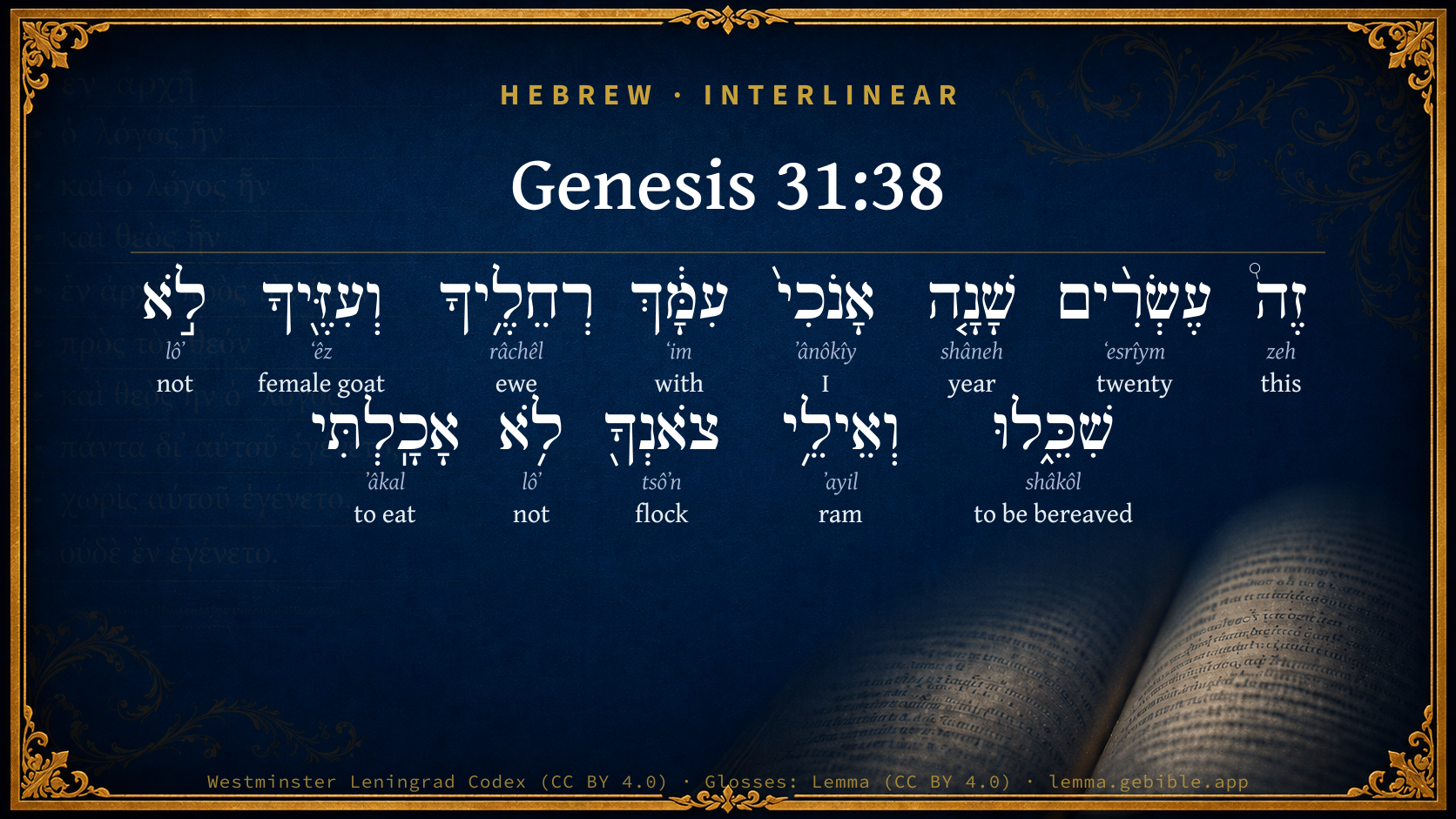
Hebrew (Westminster Leningrad Codex) Genesis 31:38 appears in the Hebrew Old Testament. The text above is from the Westminster Leningrad Codex. Each word links to its Strong’s number, a concise gloss, and parsing drawn from the Open Scriptures Hebrew Bible morphology. Click any word for its full Brown-Driver-Briggs (BDB) entry.
Download image
Cite this verse

Genesis 31:38 (World English Bible). Public Domain. Lemma interlinear Bible study tool, https://lemma.gebible.app/v/genesis/31/38.

Show BibTeX & RIS
BibTeX
RIS
English Translation
These twenty years have I been with you. Your ewes and your female goats have not cast their young, and I haven't eaten the rams of your flocks.
World English Bible · Public Domain
Highlights
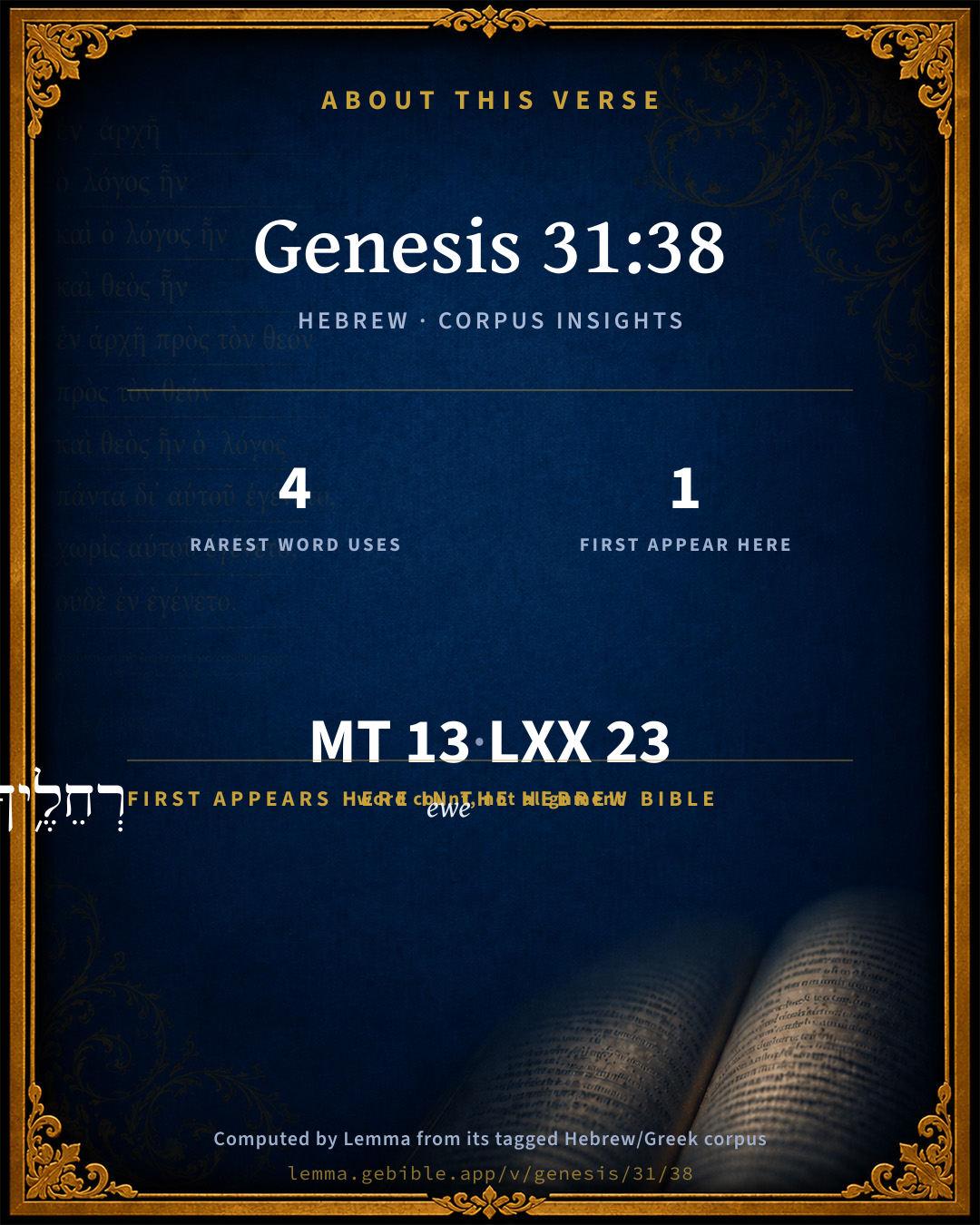
  • 1 first appearance in the Hebrew Bible
Full analysis ↓
Download a study sheet

One document with this verse’s original text, its word-by-word gloss line, the meaning frame, cross-references with their text, attributed commentary, and full source and license credits — printable, and it pastes into notes with its structure intact.

This verse Autodidact and up

Study sheet (.html) Plain text (.txt)

A passage Seminary Student

Up to 50 verses in one chapter. A passage sheet keeps up to 6 commentary sources and 12 cross-references per verse, in the order this page ranks them, and says so on the sheet whenever that leaves anything out. Ask for a single verse and you get the Autodidact verse sheet above.

Everything on this page stays free to read, with no account — the sheet is a download of what is already on screen, not access to it.

Want to remove ads? Support Godless Engineer
Compare translations 3

The same verse in 3 English versions, stacked beneath the original-language interlinear above. Click any original word for its lexicon entry.

Each is an independent rendering of the whole verse — the interlinear is not word-aligned to these translations.

Highlighted words mark where these versions differ — a whole-verse word diff, not a word-by-word alignment.

  • World English Bible Public Domain
    These twenty years have I been with you. Your ewes and your female goats have not cast their young, and I haven't eaten the rams of your flocks.
  • King James Version Public Domain
    This twenty years have I been with thee; thy ewes and thy she goats have not cast their young, and the rams of thy flock have I not eaten.
  • unfoldingWord Literal Text CC BY-SA 4.0
    These twenty years I with you! Your ewes and your she-goats did not miscarry, and I have not eaten rams from your flocks.

unfoldingWord Literal Text — © unfoldingWord, licensed CC BY-SA 4.0. Word-aligned USFM3 via Door43 (git.door43.org/unfoldingWord/en_ult).

Versions to compare (up to 4)

3 of 4 selected

Show all 18 translations

Every available English version of this verse, each an independent rendering of the whole verse.

  • World English Bible Public Domain
    These twenty years have I been with you. Your ewes and your female goats have not cast their young, and I haven't eaten the rams of your flocks.
  • Berean Standard Bible Public Domain
    I have been with you for twenty years now. Your sheep and goats have not miscarried, nor have I eaten the rams of your flock.
  • Majority Standard Bible Public Domain
    I have been with you for twenty years now. Your sheep and goats have not miscarried, nor have I eaten the rams of your flock.
  • King James Version Public Domain
    This twenty years have I been with thee; thy ewes and thy she goats have not cast their young, and the rams of thy flock have I not eaten.
  • American Standard Version (1901) Public Domain
    These twenty years have I been with thee; thy ewes and thy she-goats have not cast their young, and the rams of thy flocks have I not eaten.
  • Revised Version (1885) Public Domain
    This twenty years have I been with thee; thy ewes and thy she-goats have not cast their young, and the rams of thy flocks have I not eaten.
  • Geneva Bible (1599) Public Domain
    This twenty yere I haue bin with thee: thine ewes and thy goates haue not cast their yong, and the rammes of thy flocke haue I not eaten.
  • Douay-Rheims (1899) Public Domain
    Have I therefore been with thee twenty years? thy ewes and goats were not barren, the rams of thy flocks I did not eat:
  • Young's Literal Translation Public Domain
    `These twenty years I `am' with thee: thy ewes and thy she-goats have not miscarried, and the rams of thy flock I have not eaten;
  • Literal Standard Version CC BY-SA 4.0
    These twenty years I [am] with you: your ewes and your female goats have not miscarried, and the rams of your flock I have not eaten;
  • Unlocked Literal Bible CC BY-SA 4.0
    For twenty years I have been with you. Your ewes and your female goats have not miscarried, nor have I eaten any rams from your flocks.
  • unfoldingWord Literal Text CC BY-SA 4.0
    These twenty years I with you! Your ewes and your she-goats did not miscarry, and I have not eaten rams from your flocks.
  • Darby Bible Public Domain
    These twenty years have I been with thee: thy ewes and thy she-goats have not cast their young, and the rams of thy flock I have not eaten.
  • World Messianic Bible Public Domain
    “These twenty years I have been with you. Your ewes and your female goats have not cast their young, and I haven’t eaten the rams of your flocks.
  • Webster's Bible Public Domain
    These twenty years have I been with thee: thy ewes and thy she-goats have not cast their young, and the rams of thy flock have I not eaten.
  • Free Bible Version CC BY-SA 4.0
    I've worked for you for these past twenty years. During that time none of your sheep and goats miscarried, and I haven't eaten a single ram from your flock.
  • Bible in Basic English Public Domain
    These twenty years I have been with you; your sheep and your goats have had young without loss, not one of your he-goats have I taken for food.
  • JPS Tanakh (1917) Public Domain
    These twenty years have I been with thee; thy ewes and thy she-goats have not cast their young, and the rams of thy flocks have I not eaten.

Literal Standard Version (2020), Covenant Press — licensed CC BY-SA 4.0. Text via the HelloAO Bible API (eBible.org). Unlocked Literal Bible (unfoldingWord) — licensed CC BY-SA 4.0. Text via the HelloAO Bible API (eBible.org). unfoldingWord Literal Text — © unfoldingWord, licensed CC BY-SA 4.0. Word-aligned USFM3 via Door43 (git.door43.org/unfoldingWord/en_ult). Free Bible Version, Dr. Jonathan Gallagher — licensed CC BY-SA 4.0. Text via the HelloAO Bible API (eBible.org).

Word by word

More ways to search: Search by grammar → Find every occurrence → Compare this word →

Practice this passage: Drill this verse → Learn its vocabulary →

רְחֵלֶ֥יךָ
râchêl
H7353
“ewes · your”
Noun, Common, Feminine, Plural, Construct + Suffix, Personal, 2nd Person, Masculine, Singular
Part of Speech
Noun
Type
Common
Gender
Feminine
Number
Plural
State
Construct
Full BDB Definition

Origin: from an unused root meaning to journey

TWOT: 2145a

ewe
  1. זֶה֩ zeh H2088 “this” Pronoun, Demonstrative, Masculine, Singular
  2. עֶשְׂרִ֨ים ʻesrîym H6242 “twenty” Adjective, Cardinal number, Both, Plural, Absolute
  3. שָׁנָ֤ה shâneh H8141 “year” Noun, Common, Feminine, Singular, Absolute
  4. אָנֹכִי֙ ʼânôkîy H595 “I” Pronoun, Personal, 1st Person, Common, Singular
  5. עִמָּ֔ךְ ʻim H5973 “with · you” Preposition + Suffix, Personal, 2nd Person, Masculine, Singular
  6. וְעִזֶּ֖יךָ ʻêz H5795 “and · female goats · your” Conjunction + Noun, Common, Feminine, Plural, Construct + Suffix, Personal, 2nd Person, Masculine, Singular
  7. לֹ֣א lôʼ H3808 “not” Particle, Negative
  8. שִׁכֵּ֑לוּ shâkôl H7921 “to be bereaved” Verb, Piel, Perfect, 3rd Person, Common, Plural
  9. וְאֵילֵ֥י ʼayil H352 “and · rams of” Conjunction + Noun, Common, Masculine, Plural, Construct
  10. צֹאנְךָ֖ tsôʼn H6629 “flock · your” Noun, Common, Both, Singular, Construct + Suffix, Personal, 2nd Person, Masculine, Singular
  11. לֹ֥א lôʼ H3808 “not” Particle, Negative
  12. אָכָֽלְתִּי ʼâkal H398 “to eat” Verb, Qal, Perfect, 1st Person, Common, Singular

About this verse

These counts appear in no published source. They are computed here, from the morphology-tagged text and Lemma’s own curated glosses. What Lemma adds →

13
words
12
distinct lemmas
Pentateuch
section

Notable vocabulary

The rarest word here is רְחֵלֶ֥יךָ ewe H7353 — appearing just 4 times in the whole Hebrew Bible.

First appearance in Scripture

This word makes its first canonical appearance in the Hebrew Bible here:

  • רְחֵלֶ֥יךָ ewe H7353

Shared distinctive vocabulary

רְחֵלֶ֥יךָ ewe H7353 occurs in 4 verses of the Hebrew Bible. Also found in:

Grammatical profile

  • 2 verbs
  • 5 nouns
  • 1 adjective
  • 2 pronouns
  • 1 preposition
  • 2 particles

Verb forms

  • שִׁכֵּ֑לוּ Piel · Perfect
  • אָכָֽלְתִּי Qal · Perfect

Repetition

A word recurs within this verse — often emphatic in Hebrew:

Hebrew & Septuagint length

In English translation the verse runs 28 words from the Hebrew and 26 from the Septuagint (LXX English) — closely comparable.

A rough comparison of the two English renderings, which tokenize alike — not a word-level alignment.

Word counts can differ between the Hebrew and the Greek without any difference in meaning — e.g. the Hebrew direct-object marker אֵת has no separate Greek word, and Greek often adds the article ὁ.

In the original languages it is 13 Hebrew tokens and 23 Greek tokens — but the two are counted differently (Hebrew bundles its prefixes and suffixes into one token; the Greek is in lemma form), so that isn’t a like-for-like length.

Cross-references

5

Topical passages linked to Genesis 31:38 in the Treasury of Scripture Knowledge — connected by theme and wording, ordered by reader-vote popularity; previews shown in the World English Bible.

  • Genesis 30:27 Laban said to him, "If now I have found favor in your eyes, stay here, for I have divined that Yahweh has blessed me for your sake."
  • Genesis 30:30 For it was little which you had before I came, and it has increased to a multitude. Yahweh has blessed you wherever I turned. Now when will I provide for my own house also?"
  • Exodus 23:26 No one will miscarry or be barren in your land. I will fulfill the number of your days.
  • Deuteronomy 28:4 Blessed shall be the fruit of your body, and the fruit of your ground, and the fruit of your animals, the increase of your cattle, and the young of your flock.
  • Ezekiel 34:2–4 Son of man, prophesy against the shepherds of Israel, prophesy, and tell them, even to the shepherds, Thus says the Lord Yahweh: Woe to the shepherds of Israel who feed themselves! Shouldn't the shepherds feed the sheep?

Cross-references courtesy of OpenBible.info (CC BY 4.0).

Hebrew and Greek witnesses Masoretic Hebrew ↔ Greek Septuagint

The same verse in the two great witnesses to the Old Testament, shown verse-for-verse.

These are two independent witnesses, not word-aligned to each other, and the Septuagint is shown in lemma (dictionary) form.

Hebrew Genesis 31:38 Masoretic · Westminster Leningrad Codex

זֶה֩ עֶשְׂרִ֨ים שָׁנָ֤ה אָנֹכִי֙ עִמָּ֔ךְ רְחֵלֶ֥יךָ וְעִזֶּ֖יךָ לֹ֣א שִׁכֵּ֑לוּ וְאֵילֵ֥י צֹאנְךָ֖ לֹ֥א אָכָֽלְתִּי

These twenty years have I been with you. Your ewes and your female goats have not cast their young, and I haven't eaten the rams of your flocks.

World English Bible · Public Domain

Greek LXX Genesis 31:38 Septuagint · lemma form

οὗτος ἐγώ εἴκοσι ἔτος ἐγώ εἰμί μετά σύ ὁ πρόβατον σύ καί ὁ αἴξ σύ οὐ ἀτεκνόω κριός ὁ πρόβατον σύ οὐ καταἐσθίω

These twenty years have I been with you; your sheep, and your she-goats have not failed in bearing; I devoured not the rams of your cattle.

LXX2012 (modern English Septuagint) · Public Domain

Hebrew: Westminster Leningrad Codex (CC BY 4.0). Greek: Septuagint (public domain); English from LXX2012 (modern English Septuagint) (Public Domain). How the Septuagint differs from the Hebrew →

Targum (Aramaic paraphrase)

2

The Targum is the ancient Jewish Aramaic paraphrase of the Hebrew Scriptures — an interpretive translation, not the Hebrew text itself. Onkelos (literal) and Pseudo-Jonathan (expansive) render the Torah, and Jonathan the Prophets. Coverage is partial: where no permissively-licensed English translation exists for a verse, only the Aramaic is shown. This is verse-level text, not a word-by-word alignment to the Hebrew.

  1. Targum Onkelos Torah (Genesis–Deuteronomy)
    דְּנַן עֶסְרִין שְׁנִין אֲנָא עִמָּךְ רְחֵלָיךְ וְעִזָּיךְ לָא אַתְכִּילוּ וְדִכְרֵי עָנָךְ לָא אֲכָלִית

    (no public-domain English translation for this verse)

    Targum Onkelos — Aramaic: “Onkelos Genesis” (public domain); “Onkelos Exodus” (public domain); “Onkelos Leviticus” (public domain); “Onkelos Numbers” (public domain); “Onkelos Deuteronomy” (public domain). English: “Sefaria Community Translation” (CC0 1.0 (public-domain dedication)); “J.W. Etheridge. The Targums of Onkelos and Jonathan Ben Uzziel on the Pentateuch. London: Longmans, Green, 1862” (public domain). Text via Sefaria.

  2. Targum Pseudo-Jonathan Torah (Genesis–Deuteronomy)
    דְנַן עֶשְרִין שְׁנִין אֲנָא גַבָּךְ רֵיחַלַיִךְ וְעִיזַיִךְ לָא אִתְכָּלוּ וַאֲגַר דִיכְרֵי עָנָךְ לָא אֲכָלִית

    These twenty years have I been with thee: thy ewes and thy goats have not failed, and the price of the rams of the flock I have not eaten.

    Targum Pseudo-Jonathan — Aramaic: “Targum Jonathan on Genesis” (public domain); “Targum Jonathan on Exodus” (public domain); “Targum Jonathan on Leviticus” (public domain); “Targum Jonathan on Numbers” (public domain); “Targum Jonathan on Deuteronomy” (public domain). English: “The Targum of Jonathan ben Uzziel, trans. J. W. Etheridge, London, 1862” (public domain). Text via Sefaria.

Commentary

Notes on Genesis 31:38 from classic Christian and Jewish commentators (each source and its license shown beneath its notes). The classic Christian expositions comment on the surrounding passage and are grouped to its opening verse, so a note may address several verses; the Jewish commentaries on the Tanakh (Rashi and others) are per-verse, so they appear only where the commentator wrote on this verse.

Lemma curates 59 commentaries, every one of them public domain or Creative Commons licensed, each selected and text-cleaned for this edition rather than reprinted as found. About our sources →

Trapp's Complete Commentary

John Trapp

Gen 31:38 This twenty years [have] I [been] with thee; thy ewes and thy she goats have not cast their young, and the rams of thy flock have I not eaten.

Ver. 38. The rams of thy flock have I not eaten.] A lively picture of a careful pastor. {2Co 11:9} He fats not himself, but feeds the flock; he seeks not theirs, neither fleece nor flesh, but them and their welfare. He takes not to him "the instruments of a foolish shepherd"; {Zec 11:15} that is, forcipes et mulctram, that he may carry away lac et lanam; but feeds the flock of God, and takes care of the cure, as Peter bids; "not for filthy lucre, but of a ready mind," &c. {1Pe 5:2} About the year of Christ 1260, the people and clergy of England, the Pope’s ass, as it was called, opposed themselves to the legate’s exactions. And when Rustandus, the legate, alleged that all churches were the Pope’s, Leonard, a learned man of those times, answered, Tuitione, non fruitione; defensione, non dissipatione. {a}

{a} Jac. Revius, De Vitis Pontif., p. 178.

John Trapp, A Commentary or Exposition upon All the Books of the Old and New Testament (1647–1656) — public domain. Text from a community e-Sword module.

Geneva Bible (1599)

Geneva Bible translators

Or, been barren.

Geneva Bible (1599) marginal notes — public domain. Text via Bolls.life.

Jamieson, Fausset & Brown

Robert Jamieson, A. R. Fausset & David Brown

The rams of thy flock have I not eaten--Eastern people seldom kill the females for food except they are barren.

Jamieson, Fausset & Brown — Commentary Critical and Explanatory on the Whole Bible (1871) — public domain (CC PDM 1.0). Text via the HelloAO Bible API.

The Cambridge Bible for Schools and Colleges

gen. ed. J. J. S. Perowne

38. This twenty years] Jacob’s indignant protest proclaims (1) his length of service, (2) his perfect honesty, (3) his uncomplaining endurance of hardship, in spite of capricious changes in his wage. And now that he has left Haran, it was only because of God’s mercy, and not through Laban’s kindness, that he did not go empty-handed.

The Cambridge Bible for Schools and Colleges (gen. ed. J. J. S. Perowne; Cambridge University Press, 1878–1918) — public domain. Text from a community e-Sword module.

John Gill's Exposition

Thus I was,.... In such a situation, as well as in the following uncomfortable plight and condition:

in the day the drought consumed me, and the frost by night: the violent heat in the daytime scorched him, and the severe frosts in the night pinched him: that is, in the different seasons of the year, the heat of the day in the summertime, and the cold of the night in the wintertime; for it cannot well be thought that there should be excessive heat in the day and sharp frosts in the night, in the same season of the year: it looks as if Laban did not allow Jacob the proper conveniencies of clothes, and of tents to secure him from the inclemency of the weather, which other shepherds usually had:

and my sleep departed from mine eyes; through diligent care and watchfulness of the flocks in the night season, which on some occasions were necessary; see Luk 2:8.

John Gill's Exposition of the Whole Bible (1746–1763) — public domain (CC PDM 1.0). Text via the HelloAO Bible API.

Matthew Poole's English Annotations

Thy she-goats have not cast their young, which thou owest in a great measure to my care and diligence in ordering them, and principally to God’s blessing given to thee for my sake, by thy own confession, Gen 30:27.

Matthew Poole's English Annotations on the Holy Bible (1683–1685) — public domain. Text from a community e-Sword/MySword module.

unfoldingWord translationNotes

Door43 World Missions Community

General Information:

Jacob continues to speak to Laban.

twenty years

"20 years" (See: Numbers)

ewes

female sheep

have not miscarried

This means they have not had a pregnancy end early and unexpectedly with the lamb or kid born dead.

What was torn by beasts I did not bring to you

This can be stated in active form. AT: "When a wild animal killed one of your animals I did not bring it to you" (See: Active or Passive)

Instead, I bore the loss of it

For Jacob to count Laban's dead animals as a loss from his own flock is spoken of as if it was a burden he would bear on his shoulders. AT: "Instead of counting it a loss from your flock, I counted it as a loss from my flock" (See: Metaphor)

There I was; in the day the heat consumed me, and the frost by night

Suffering in the hot and cold temperatures is spoken of as if the temperatures were animals that were eating Jacob. AT: "I stayed with your flocks even during hottest part of the day and the coldest part of the night" (See: Metaphor)

translationWords

year

goat

ewe

flocks

consume

unfoldingWord translationNotes — © Distant Shores Media and the Door43 World Missions Community, licensed CC BY-SA 4.0. Source: git.door43.org/Door43/en_tn.

Rashi

Rabbi Shlomo Yitzchaki (Rashi)

לא שכלו means HAVE NOT MISCARRIED — Similar are: (Hosea 9:14) ‘‘a miscarrying (משכיל) womb”; (Job 21:10) “his cow calveth and casteth (תשכל) not her calf”.

ואילי צאנך AND THE RAMS OF THY FLOCK — From this phrase they (the Rabbis) inferred (Bava Kamma 65b) that a male sheep even when one day old is called a ram; for if this be not so, how was this creditable to him? Did he mean that he had not eaten rams (i. e. the larger animals), but that he had eaten the smaller sheep? If so, he was a thief! (39).

Rashi on the Tanakh — English translations: “The Judaica Press complete Tanach with Rashi, translated by A. J. Rosenberg” (CC BY 4.0); “Pentateuch with Rashi's commentary by M. Rosenbaum and A.M. Silbermann, 1929-1934” (public domain); “The Metsudah Tanach series, Lakewood, N.J” (CC BY 4.0); and “The Book of Joshua, Metsudah Publications, 1997” (CC BY 4.0). Text via Sefaria.

Radak

Rabbi David Kimhi (Radak)

זה עשרים שנה...לא שכלת, because of G’d’s blessing for me.

ואילי צאנך לא אכלתי. I did not eat from a single one of the male sheep. The letter מ in front of the word אילי is missing, just as it is missing in Samuel II 23,24 in the line אלחנן בן דודו בית לחם where we would have expected מבית לחם. Another example of such a missing prefix מ is found In Joshua 10,13 עד יקום גוי אויביו, where we would have expected עד יקום גוי מאויביו, “until a nation arises from its enemies.” There are more such examples throughout Scripture. The reason Yaakov made a point of saying that he had not eaten of any of the male sheep was that it was widely accepted that the shepherds who were far from home would eat the meat of such animals. Yaakov made the point that far from following accepted practice, he had only eaten things that had belonged to him outright. Male sheep are worth less in the marketplace than their female counterparts. Their meat is also less tasty.

Radak on the Tanakh — English translations: “Sefaria Community Translation” (CC0 1.0 (public-domain dedication)); “Eliyahu Munk, HaChut Hameshulash” (CC BY 4.0); “Rabbi Mike Feuer, Jerusalem Anthology” (CC BY 4.0); and “R. David Kimhi on the first book of Psalms, Translated by R.G. Finch, London, 1919” (public domain). Text via Sefaria.

Lesson kit

Teaching starters — assembled from the data on this page, not authored interpretation. Every prompt links to the verse data it draws on. Edit before teaching.

Genesis, in the Pentateuch, opens this verse with 13 words (12 distinct Hebrew lemmas). Its most distinctive word is râchêl (“ewe”). A historical commentator’s framing appears above. Read the whole chapter for the surrounding context.

Discussion questions

  1. The word râchêl carries the sense “ewe.” How does it shape the verse?
  2. This is the first place “ewe” appears in Scripture (first appears here). What does its debut here establish?
  3. How does Genesis 32:14, which shares the word «ewe», read alongside this verse?
  4. What does the repetition of “not” (2× in this one verse) do in this verse?
  5. These translations render this verse differently; the difference is in the English rendering, not the original. What questions does that raise?
  6. «שִׁכֵּ֑לוּ» is a Piel Perfect verb. How does that grammatical form shape the action described?
  7. Compare how Trapp's Complete Commentary and Geneva Bible (1599) read this verse. Where do they agree or differ?

Things to notice

Reading settings

Reading text

Shown beneath each verse's original-language words.

Old Testament
Old Testament edition

Read the OT as the Masoretic Hebrew (MT) or the Greek Septuagint (LXX).

English shown for the Greek Septuagint (in the Hebrew ↔ Greek comparison).

Comparing translations? Open the Compare panel on any verse page to stack up to four side by side.