
Psalms 78:70

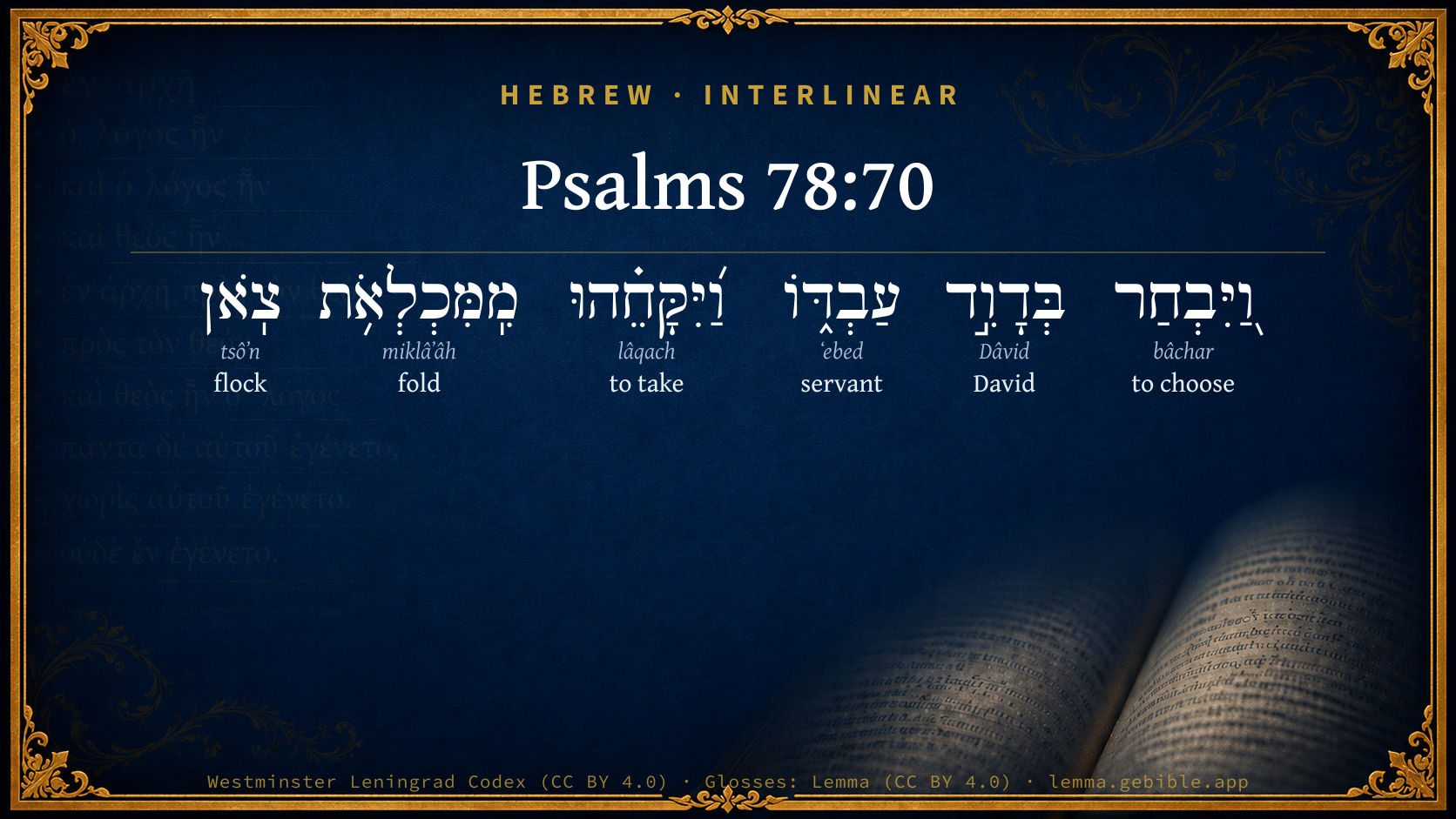
Hebrew (Westminster Leningrad Codex) Psalms 78:70 appears in the Hebrew Old Testament. The text above is from the Westminster Leningrad Codex. Each word links to its Strong’s number, a concise gloss, and parsing drawn from the Open Scriptures Hebrew Bible morphology. Click any word for its full Brown-Driver-Briggs (BDB) entry.
Download image
Cite this verse

Psalms 78:70 (World English Bible). Public Domain. Lemma interlinear Bible study tool, https://lemma.gebible.app/v/psalms/78/70.

Show BibTeX & RIS
BibTeX
RIS
English Translation
He also chose David his servant, And took him from the sheepfolds;
World English Bible · Public Domain
Download a study sheet

One document with this verse’s original text, its word-by-word gloss line, the meaning frame, cross-references with their text, attributed commentary, and full source and license credits — printable, and it pastes into notes with its structure intact.

This verse Autodidact and up

Study sheet (.html) Plain text (.txt)

A passage Seminary Student

Up to 50 verses in one chapter. A passage sheet keeps up to 6 commentary sources and 12 cross-references per verse, in the order this page ranks them, and says so on the sheet whenever that leaves anything out. Ask for a single verse and you get the Autodidact verse sheet above.

Everything on this page stays free to read, with no account — the sheet is a download of what is already on screen, not access to it.

Want to remove ads? Support Godless Engineer
Compare translations 3

The same verse in 3 English versions, stacked beneath the original-language interlinear above. Click any original word for its lexicon entry.

Each is an independent rendering of the whole verse — the interlinear is not word-aligned to these translations.

Highlighted words mark where these versions differ — a whole-verse word diff, not a word-by-word alignment.

  • World English Bible Public Domain
    He also chose David his servant, And took him from the sheepfolds;
  • King James Version Public Domain
    He chose David also his servant, and took him from the sheepfolds:
  • unfoldingWord Literal Text CC BY-SA 4.0
    And he chose David his servant and took him from the folds of the flock.

unfoldingWord Literal Text — © unfoldingWord, licensed CC BY-SA 4.0. Word-aligned USFM3 via Door43 (git.door43.org/unfoldingWord/en_ult).

Versions to compare (up to 4)

3 of 4 selected

Show all 18 translations

Every available English version of this verse, each an independent rendering of the whole verse.

  • World English Bible Public Domain
    He also chose David his servant, And took him from the sheepfolds;
  • Berean Standard Bible Public Domain
    He chose David His servant and took him from the sheepfolds;
  • Majority Standard Bible Public Domain
    He chose David His servant and took him from the sheepfolds;
  • King James Version Public Domain
    He chose David also his servant, and took him from the sheepfolds:
  • American Standard Version (1901) Public Domain
    He chose David also his servant, And took him from the sheepfolds:
  • Revised Version (1885) Public Domain
    He chose David also his servant, and took him from the sheepfolds:
  • Geneva Bible (1599) Public Domain
    He chose Dauid also his seruant, and tooke him from the shepefolds.
  • Douay-Rheims (1899) Public Domain
    And he chose his servant David, and took him from the hocks of sheep: he brought him from following the ewes great with young,
  • Young's Literal Translation Public Domain
    And He fixeth on David His servant, And taketh him from the folds of a flock,
  • Literal Standard Version CC BY-SA 4.0
    And He fixes on His servant David, || And takes him from the folds of a flock,
  • Unlocked Literal Bible CC BY-SA 4.0
    He chose David, his servant, and took him from the sheepfolds.
  • unfoldingWord Literal Text CC BY-SA 4.0
    And he chose David his servant and took him from the folds of the flock.
  • Darby Bible Public Domain
    And he chose David his servant, and took him from the sheepfolds:
  • World Messianic Bible Public Domain
    He also chose David his servant, and took him from the sheepfolds;
  • Webster's Bible Public Domain
    He chose David also his servant, and took him from the sheep-folds:
  • Free Bible Version CC BY-SA 4.0
    He chose his servant David, taking him from the sheep pens,
  • Bible in Basic English Public Domain
    He took David to be his servant, taking him from the place of the flocks;
  • JPS Tanakh (1917) Public Domain
    He chose David also His servant, and took him from the sheepfolds;

Literal Standard Version (2020), Covenant Press — licensed CC BY-SA 4.0. Text via the HelloAO Bible API (eBible.org). Unlocked Literal Bible (unfoldingWord) — licensed CC BY-SA 4.0. Text via the HelloAO Bible API (eBible.org). unfoldingWord Literal Text — © unfoldingWord, licensed CC BY-SA 4.0. Word-aligned USFM3 via Door43 (git.door43.org/unfoldingWord/en_ult). Free Bible Version, Dr. Jonathan Gallagher — licensed CC BY-SA 4.0. Text via the HelloAO Bible API (eBible.org).

Word by word

More ways to search: Search by grammar → Find every occurrence → Compare this word →

Practice this passage: Drill this verse → Learn its vocabulary →

About this verse

These counts appear in no published source. They are computed here, from the morphology-tagged text and Lemma’s own curated glosses. What Lemma adds →

6
words
6
distinct lemmas
Wisdom
section

Notable vocabulary

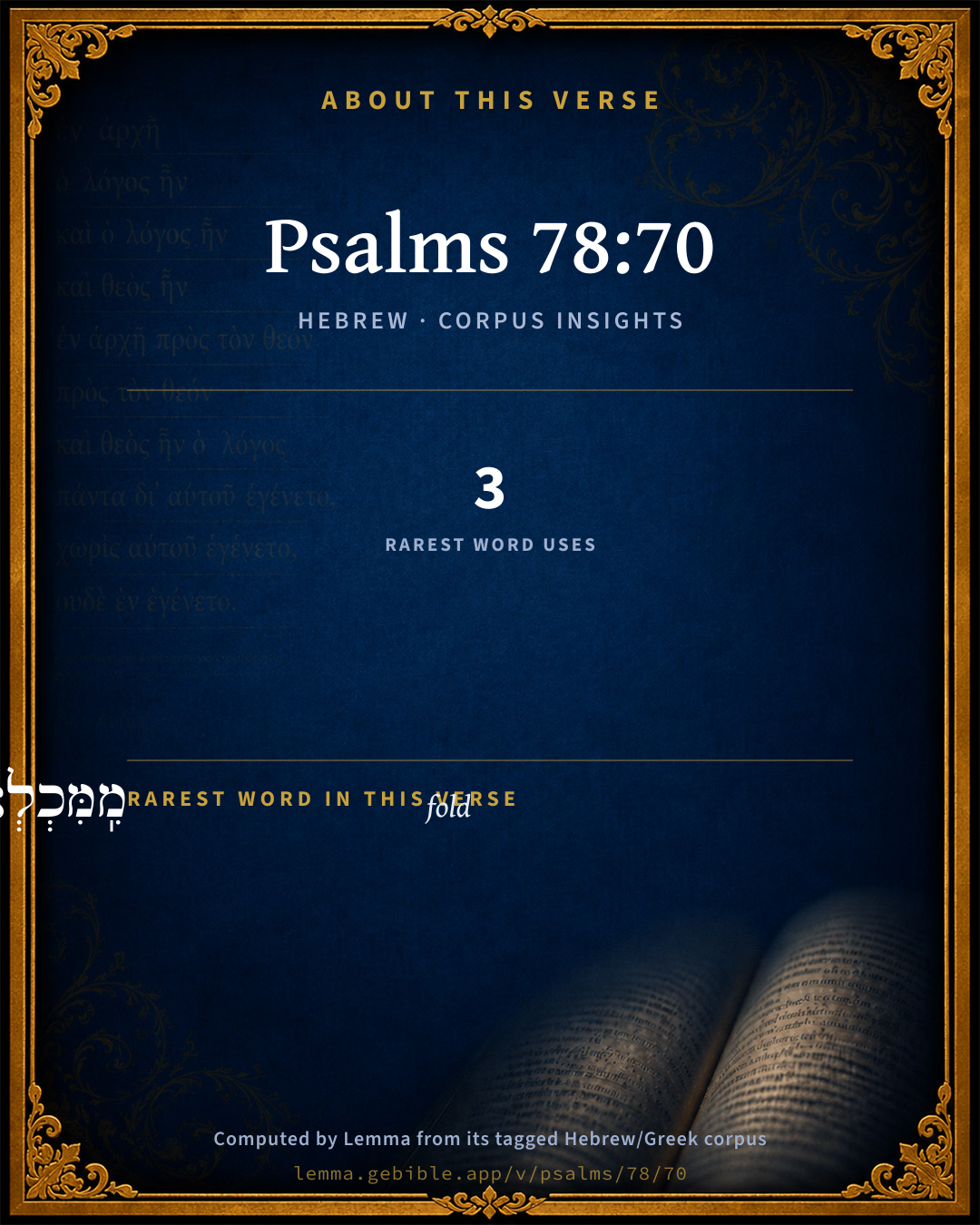
The rarest word here is מִֽמִּכְלְאֹ֥ת fold H4356 — appearing just 3 times in the whole Hebrew Bible.

Shared distinctive vocabulary

מִֽמִּכְלְאֹ֥ת fold H4356 occurs in 3 verses of the Hebrew Bible. Also found in:

Grammatical profile

  • 2 verbs
  • 4 nouns

Verb forms

  • וַ֭יִּבְחַר Qal · Sequential Imperfect
  • וַ֝יִּקָּחֵ֗הוּ Qal · Sequential Imperfect

Hebrew & Septuagint length

In English translation the verse runs 12 words from the Hebrew and 15 from the Septuagint (LXX English) — closely comparable.

A rough comparison of the two English renderings, which tokenize alike — not a word-level alignment.

Word counts can differ between the Hebrew and the Greek without any difference in meaning — e.g. the Hebrew direct-object marker אֵת has no separate Greek word, and Greek often adds the article ὁ.

Cross-references

12

Topical passages linked to Psalms 78:70 in the Treasury of Scripture Knowledge — connected by theme and wording, ordered by reader-vote popularity; previews shown in the World English Bible.

  • 1 Samuel 16:11–12 Samuel said to Jesse, Are here all your children? He said, There remains yet the youngest, and, behold, he is keeping the sheep. Samuel said to Jesse, Send and get him; for we will not sit down until he come here.
  • Acts 13:22 When he had removed him, he raised up David to be their king, to whom he also testified, 'I have found David the son of Jesse, a man after my heart, who will do all my will.'
  • Exodus 3:1 Now Moses was keeping the flock of Jethro, his father-in-law, the priest of Midian, and he led the flock to the back of the wilderness, and came to God's mountain, to Horeb.
  • Exodus 3:10 Come now therefore, and I will send you to Pharaoh, that you may bring forth my people, the children of Israel, out of Egypt."
  • 1 Samuel 17:15–54 Now David went back and forth from Saul to feed his father's sheep at Bethlehem.
  • 2 Samuel 3:18 now then do it; for Yahweh has spoken of David, saying, By the hand of my servant David I will save my people Israel out of the hand of the Philistines, and out of the hand of all their enemies.
  • 2 Samuel 6:21 David said to Michal, [It was] before Yahweh, who chose me above your father, and above all his house, to appoint me prince over the people of Yahweh, over Israel: therefore will I play before Yahweh.
  • 2 Samuel 7:8 Now therefore thus shall you tell my servant David, Thus says Yahweh of Hosts, I took you from the sheep pen, from following the sheep, that you should be prince over my people, over Israel;
  • 1 Kings 19:19–20 So he departed there, and found Elisha the son of Shaphat, who was plowing, with twelve yoke [of oxen] before him, and he with the twelfth: and Elijah passed over to him, and cast his mantle on him.
  • Psalms 89:19–20 Then you spoke in vision to your saints, And said, "I have bestowed strength on the warrior. I have exalted a young man from the people.
  • Amos 7:14–15 Then Amos answered Amaziah, "I was no prophet, neither was I a prophet's son; but I was a herdsman, and a farmer of sycamore trees;
  • Matthew 4:18–22 Walking by the sea of Galilee, he saw two brothers: Simon, who is called Peter, and Andrew, his brother, casting a net into the sea; for they were fishermen.

Cross-references courtesy of OpenBible.info (CC BY 4.0).

Hebrew and Greek witnesses Masoretic Hebrew ↔ Greek Septuagint

The same verse in the two great witnesses to the Old Testament, shown verse-for-verse.

You’re reading Greek Psalm 77 (Hebrew Psalm 78). The Septuagint counts the superscription, so verse numbers can differ from the Hebrew — chapter-level alignment, not verse-by-verse. Numbering follows Rahlfs.

These are two independent witnesses, not word-aligned to each other, and the Septuagint is shown in lemma (dictionary) form.

Hebrew Psalms 78:70 Masoretic · Westminster Leningrad Codex

וַ֭יִּבְחַר בְּדָוִ֣ד עַבְדּ֑וֹ וַ֝יִּקָּחֵ֗הוּ מִֽמִּכְלְאֹ֥ת צֹֽאן

He also chose David his servant, And took him from the sheepfolds;

World English Bible · Public Domain

Greek LXX Greek Psalm 77:70 Septuagint · lemma form

καί ἐκλέγω δαυίδ ὁ δοῦλος αὐτός καί ἀναλαμβάνω αὐτός ἐκ ὁ ποίμνιον ὁ πρόβατον

He chose David also his servant, and took him up from the flocks of sheep.

LXX2012 (modern English Septuagint) · Public Domain

Hebrew: Westminster Leningrad Codex (CC BY 4.0). Greek: Septuagint (public domain); English from LXX2012 (modern English Septuagint) (Public Domain). How the Septuagint differs from the Hebrew →

Commentary

Notes on Psalms 78:70 from classic Christian and Jewish commentators (each source and its license shown beneath its notes). The classic Christian expositions comment on the surrounding passage and are grouped to its opening verse, so a note may address several verses; the Jewish commentaries on the Tanakh (Rashi and others) are per-verse, so they appear only where the commentator wrote on this verse.

Lemma curates 59 commentaries, every one of them public domain or Creative Commons licensed, each selected and text-cleaned for this edition rather than reprinted as found. About our sources →

Trapp's Complete Commentary

John Trapp

Psa 78:70 He chose David also his servant, and took him from the sheepfolds:

Ver. 70. He chose David also] God chooseth not as man doth, 1Co 1:26, yet Alexander the Great advanced Abdolominus, a poor gardener, to be king in Sidon.

And took him from the sheepfolds] The art of feeding cattle and the art of ruling men are sisters, saith Basil.

John Trapp, A Commentary or Exposition upon All the Books of the Old and New Testament (1647–1656) — public domain. Text from a community e-Sword module.

The Biblical Illustrator

Joseph S. Exell

Psa_78:70-72

He chose David also His servant, and took him from the sheepfolds.

David, the shepherd, called to be king

A keeper of sheep, suddenly becoming conscious that he was chosen for a great yet terrible destiny; being gradually fitted among the quiet hill-sides to meet this mighty calling; and then, rising to the throne, so gifted with kingly power that he guided the people through their days of peril, and established them in a strength that outlived the wear of centuries--this man (so called) seems to stand far off from ourselves in a distant world of wonder. And yet, if we ask how he was trained unconsciously for his calling--how he was strengthened to discharge it, we shall find that the same Divine hand is shaping our career; the same Divine voice calling us; and the same Divine Spirit willing to fit us for our part in the battle of life.

I. The Divine calling of David.

1. How was Davids shepherd-life an unconscious preparation for his calling? Amid the stillness of the ancient hills, David, the shepherd youth, was learning to feel a presence which surrounded him behind and before, and to realize the nearness of One who read his thoughts in the silence, when the beatings of his own heart were audible, and who watched over him when the great night with its gleaming worlds gathered over valley and hill.

2. How did the Divine summons fit him for his vocation? The hour came when he was to know that through all his years he had been trained for it, when the Spirit of the Lord came upon him from that day forward. And now observe--he was sent back to his flocks; in the full knowledge of his grand destiny, sent to pass years of silent waiting. He knew that a Heavenly will had chosen him for his work; that a Heavenly eye was marking his way; that a Heavenly hand had arranged every trifle in his destiny; and therefore, let the future threaten and storm as it might, he could stand firmly on that rock of belief, amid the whirling tides of trouble.

II. Its modern lessons.

1. There is a Divine plan in every life. We cannot guide ourselves. Great events which we never foresee, or trifles which we despise, are the powers that seem to influence irresistibly the current of our earthly years. And, even when our cherished schemes succeed, they are never what are expected. Now, behind these mysterious forces, and acting through them--controlling these strange disappointments, and rendering them blessings--is the plan of God; which plan, proceeding from the everlasting past to the everlasting future, makes the individual life of every man, as it made that of David, a Divine education.

2. There is a Divine vocation for every man. A Heavenly Spirit is near us all. There are hours when His light flashes consciously across the soul, calling it to arise. Like David, every man was meant to be a king--to be a king in heaven, by becoming on earth a priest in the sacrifice of himself.

3. There is a Divine Shepherd for every man. He gave His life for the sheep That tells us who was the Shepherd whose presence David felt--the Christ, who came into this wild wilderness to seek and to save the lost. (E. L. Hull, B. A.)

Davids training

I look on David as an all but ideal king, educated for his office by an all but ideal training. A shepherd first; a life--be it remembered--full of danger in those times and lands; then captain of a band of outlaws; and lastly a king, gradually and with difficulty fighting his way to a secure throne. This was his course. But the most important stage of it was probably the first. Among the dumb animals he learnt experience which he afterwards put into practice among human beings. The shepherd of the sheep became the shepherd of men. He who had slain the lion and the bear became the champion of his native land. He who followed the ewes great with young, fed Gods oppressed and weary people with a faithful and true heart, till he raised them into a great and strong nation. So both sides of the true kingly character, the masculine and the feminine, are brought out in David. For the greedy and tyrannous, he has indignant defiance; for the weak and helpless, patient tenderness. For there is in this man (as there is said to be in all great geniuses) a feminine as well as a masculine vein; a passionate tenderness; a keen sensibility; a vast capacity of sympathy, sadness, and suffering, which makes him truly the type of Christ, the Man of sorrows; which makes his psalms to this day the text-book of the afflicted, of tens of thousands who have not a particle of his beauty, courage, genius; but yet can fool, in mean hovels and workhouse sick-beds, that the warrior-poet speaks to their human hearts, and for their human hearts, as none other can speak, save Christ Himself, the Son of David and the Son of Man. A man, I say, of intense sensibilities; and therefore capable, as is but too notorious, of great crimes, as well as of great virtues. We may pervert, or rather mistake the fact in more than one way, to our own hurt. We may say cynically, David had his good points and his bad ones, as all your great saints have. Look at them closely, and in spite of all their pretensions you will find them no better than their neighbours. And so we may comfort ourselves, in our own mediocrity and laziness, by denying the existence of all greatness and goodness. Again, we may say, sentimentally, that these great weaknesses are on the whole the necessary concomitants of great strength; that such highly organized and complex characters must not be judged by the rule of common respectability; and that it is a more or less fine thing to be capable at once of great virtues and great vices. But if we do say this, or anything like this, we say it on our own responsibility. Davids biographers say nothing of the kind. David himself says nothing of the kind. He never represents himself as a compound of strength and weakness. He represents himself as weakness itself--as incapacity utter and complete. To overlook that startling fact is to overlook the very element which has made Davids psalms the text-book for all human weaknesses, penitences, sorrows, struggles, aspirations, for nigh three thousand years. (C. Kingsley, M. A.)

.

Psa_79:1-13

The Biblical Illustrator, edited by Joseph S. Exell (c. 1880s–1900s) — public domain. Text from a community e-Sword module.

The Treasury of David

Charles H. Spurgeon

Ver. 70. He chose David also his servant. It was an election of a sovereignly gracious kind, and it operated practically by making the chosen man a willing servant of the Lord. He was not chosen because he was a servant, but in order that he might be so. David always esteemed it to be a high honour that he was both elect of God, and a servant of God.

And took him from the sheepfolds. A shepherd of sheep he had been, and this was a fit school for a shepherd of men. Lowliness of occupation will debar no man from such honours as the Lord's election confers, the Lord seeth not as man seeth. He delights to bless those who are of low estate.

Ver. 70. He took him from the sheepfolds. The art of feeding cattle, and the art of ruling men are sisters, saith Basil. John Trapp.

Ver. 70-71.

1. David's calling. Two questions present themselves.

1. How was David's shepherd life an unconscious preparation for his calling?

2. How did the divine summons, when it came, fit him for his mighty destiny?

Observehe was sent back to his flocks. Nothing could train him more perfectly than that waiting. Two great convictions awakened in him then, that formed in him elements of strength.

1. The belief in a divine leader (see Ps 23:1-6).

2. The belief in a divine choice.

2. Its modern lessons.

1. There is a divine plan in every life.

2. There is a divine vocation for every man.

3. There is a divine Shepherd for every man. E. L. Hull.

Ver. 70-72. Spiritual promotions.

1. Analogies between lower and higher service, Ps 78:71.

2. Humbler work, a preparation for higher, Ps 78:71-72.

3. Promotion the act of the Divine will, Ps 78:70-71.

4. Our powers shall be equal to the position to which God promotes us.

Ver. 70-71. See Psalms on "Ps 78:70" for further information.

Ver. 70-72. Spiritual promotions. See Psalms on "Ps 78:70" for further information.

Charles H. Spurgeon's The Treasury of David (1869–1885) — public domain. Psalms only. Text from a community e-Sword/MySword module.

Joseph Benson's Commentary

Psa 78:70-71. He chose David also his servant — Out of all the thousands of Israel, and put the sceptre into his hand, out of whose loins Christ was to come, and who was to be a type of him. And took him from the sheepfold — As Moses also was taken. For he delights to put honour on the humble and diligent, and to raise the poor out of the dust, and to set them among princes. And he often finds those most fit for public action that have spent the beginning of their time in solitude and contemplation. From following the ewes great with young — By which employment he was inured to that care, and diligence, and self-denial which are necessary qualifications in a king or governor; and instructed to rule his people with all gentleness and tenderness; to feed Jacob his people, &c. — To be king over God’s peculiar people, who were near and dear to him, which was both a great honour put upon David, and a great trust reposed in him, as he was thus charged with the care and conduct of those that were God’s own inheritance. God, we must observe, advanced him to the throne, that he might feed them, not that he might feed himself; that he might do good, not that he might make his family great. It is the charge given to all under- shepherds, both magistrates and ministers, that they feed the flock of God.

Joseph Benson's Commentary on the Old and New Testaments (1811–1818) — public domain. Text from a community e-Sword module.

J. A. Alexander on Psalms

Joseph Addison Alexander

70. (Psa 78:70) And chose David (as) his servant, and took him from the sheep-folds. Having spoken of the tribe and the particular locality preferred to Ephraim and Shiloh, he now brings into view the personal instrument or agent, by whom it pleased God that the theocratic kingdom should be founded. He did not choose David because he was his servant, i.e. a good man, but to be his servant, in the same pregnant and emphatic sense in which the title is applied to him in Psa 18:1. The sovereignty of the choice is indicated by the humble occupation and condition from which he was promoted.

Joseph Addison Alexander, The Psalms Translated and Explained (1850) — public domain. Text from a community e-Sword module.

Tyndale Open Study Notes

Tyndale Open Resources

78:70-72 The God who had turned against his own people (78:62) chose David, a shepherd (Gen 46:34; 1 Sam 16:10-11), to become their shepherd (Ps 78:52; cp. 23:1).

Tyndale Open Study Notes — © Tyndale Open Resources, licensed CC BY-SA 4.0. Text via the HelloAO Bible API.

Adam Clarke's Commentary

Verse 70. He chose David] See the account, Clarke, "1Sa 16:11", &c.

Adam Clarke's Commentary on the Bible (1810–1826) — public domain. Text from a community e-Sword/MySword module.

John Calvin's Commentaries

70. And he chose David his servant. After having made mention of the temple, the prophet now proceeds to speak of the kingdom; for these two things were the chief signs of God’s choice of his ancient people, and of his favor towards them; and Christ also hath appeared as our king and priest to bring a full and perfect salvation to us. He proves that David was made king by God, who elevated him from the sheepfold, and from the keeping of cattle, to the royal throne. It serves in no small degree to magnify the grace of God, that a peasant was taken from his mean shepherd’s cot, and exalted to the dignity of a king. Nor is this grace limited to the person of David. We are taught that whatever worth there was in the children of Abraham, flowed from the fountain of God’s mercy. The whole glory and felicity of the people consisted in the kingdom and priesthood; and both these are attributed to the pure grace and good pleasure of God. And it was requisite that the commencement of the kingdom of Christ should be lowly and contemptible, that it might correspond with its type, and that God might clearly show that he did not make use of external aids in order to accomplish our salvation.

John Calvin's Commentaries (1540-1563) — public domain. Text from the Calvin Translation Society English edition (1840s-50s) via the Christian Classics Ethereal Library (ccel.org). Calvin's coverage is partial (roughly two-thirds of the Bible); uncommented books and verses are honest gaps, never fabricated. The 19th-century editor's footnotes and remarks are omitted so the notes are faithfully Calvin's own voice.

The Cambridge Bible for Schools and Colleges

gen. ed. J. J. S. Perowne

70. David his servant] Though any Israelite might profess himself Jehovah’s servant in addressing Him, only a few who were raised up to do special service or who stood in a special relation to Jehovah, such as Abraham, Moses, Joshua, David, Job, are distinguished by this title of honour. Cp. 2Sa_3:18; 2Sa_7:5; 2Sa_7:8; 1Ki_8:24; Psa_89:3; Psa_89:20; Psa_132:10.

70–72. The choice of David as king.

The Cambridge Bible for Schools and Colleges (gen. ed. J. J. S. Perowne; Cambridge University Press, 1878–1918) — public domain. Text from a community e-Sword module.

John Gill's Exposition

From following the ewes great with young,.... Or, "from after" them (a); it was usual with the shepherd to put them before him, and to follow them, and gently drive them, which is expressive of his care and tenderness of them; see Gen 33:13, the same is observed of David's antitype, the great and good Shepherd of the sheep, Isa 40:11. David was a type of Christ as a shepherd; as he kept his father's sheep, so Christ keeps those that the Father has given him, Joh 10:29, as David kept his flock with great care and courage, and in safety, Sa1 17:34, so does the Lord Jesus Christ keep his flock in safety, and preserves it from Satan, the roaring lion, and from grievous wolves that enter into it, and every beast of prey that would devour it; and particularly as David took special care of those that were with young, so does the Lord take special care of such that are newborn babes, that have Christ formed in them, and are big with desires after him, carry a burden, and are weary, and heavy laden: the Targum, Jarchi, and Kimchi, interpret the word (b) of such that give suck, and so it most properly signifies:

he brought him to feed Jacob his people, and Israel his inheritance; that is, to rule over them: this is said in allusion to his having been a shepherd; and nothing is more common than for kings to be represented as shepherds, and their acts of government by leading and feeding; and one and the same word in the Greek language signifies to feed and rule: and so the Targum,

"he brought him to rule over Jacob his people:''

this was a great honour indeed, to be the governor of the Lord's people, a special people above all people on the face of the earth, and whom he had chosen to be his inheritance; and in this also he was a type of Christ, who has the throne of his father David given him, and who reigns over the house of Jacob, one of whose titles is King of saints; for as the government of the world in general, so of the church in particular, is on his shoulders, Luk 1:32.

(a) "de post", Montanus, Vatablus, Gejerus; "a post", Michaelis. (b) "lactantes", Vatablus, Gejerus, Michaelis.

John Gill's Exposition of the Whole Bible (1746–1763) — public domain (CC PDM 1.0). Text via the HelloAO Bible API.

Albert Barnes' Notes on the Bible

He chose David also his servant - He chose him that he might set him over his people as their king. The idea is, that David was selected when he had no natural pretensions to the office, as he did not pertain to a royal family, and could have no claim to such a distinction. The account of this choice is contained in 1 Sam. 15:1-30.

And took him from the sheep-folds - From the humble occupation of a shepherd. 1Sa 16:11; 2Sa 7:8.

Albert Barnes' Notes on the Bible (1834–1885) — public domain. Text from a community e-Sword/MySword module.

The Pulpit Commentary

He chose David also his servant. (see 1Sa_16:1, 1Sa_16:12) And took him from the sheepfolds. (comp. 1Sa_16:11, 19 2Sa_7:8)

The grace of Divine selections.

"He chose David also his servant, and took him from the sheepfolds." The selection of David may be. viewed from two sides. It was an act of Divine grace toward David himself; and an act of Divine grace in providing such a king for the people.

I DIVINE GRACE TOWARD DAVID HIMSELF. A careful study of David"s early life brings out the fact that he was, in some sense, the despised one of the family. He was evidently much younger than his brothers; probably the child of another mother, who was brought into the family under somewhat peculiar circumstances. While all the brothers went to the war, David was kept at home. When Jesse called all his sons before Samuel, he left David out, as if he hardly came into the family reckoning. It was, then, the despised one, who had been sent to the sheepfolds with the women, who was selected by God for the highest place in the new state. God constantly makes the "poor of this world to confound the wise." But not arbitrarily. Only because he seeks to fit men to places, on the ground of their endowments and character and fitness for their positions. There is "no respect of persons with God." David was selected as the fitting man.

II DIVINE GRACE PROVIDING SUCH A KING FOR THE PEOPLE. He was selected on the Divine judgment as to what was best for the people. Compare Saul, selected as meeting the people"s idea of what was best for them. Kingsley says, "I look on David as an all but ideal king, educated for his office by an all but ideal training. Among the dumb animals he learnt experience which he afterwards put into practice among human beings. The shepherd of the sheep became the shepherd of men. He who had slain the lion and the bear became the champion of his native land. He who followed the ewes great with young fed God"s oppressed and weary people with a faithful and true heart, till he raised them into a great and strong nation. So both sides of the true kingly character, the masculine and the feminine, are brought out in David." It may be pointed out that, in David, were qualities of kingship which would have made him a blessing to any nation, in any age. And it may further be shown that, in him, there were characteristic abilities, which made him specially the man for his time.

Lead on to show that the one thing which made David"s reign a supreme blessing to the people was his personal and governmental loyalty to the theocratic idea. He never failed through any disloyalty to his Overlord, Jehovah. R.T.

The Pulpit Commentary (1880–1919), ed. H.D.M. Spence-Jones & Joseph S. Exell — public domain. Text from a community e-Sword module.

unfoldingWord translationNotes

Door43 World Missions Community

General Information:

The writer continues to describe what God did

from the sheepfolds

"from where he was working in the sheepfolds" Assumed Knowledge and Implicit Information

sheepfolds

spaces with walls around them where sheep are kept safe

to be shepherd of Jacob, his people, and of Israel, his heritage

The word "shepherd" is a metaphor for one who leads and protects other people. AT: "to lead and protect the descendants of Jacob, his people, and of Israel, his heritage" (See: Metaphor)

his heritage

"the ones he had chosen to be his forever" See how this is translated in Psalms 78:62.

David shepherded them

The word "shepherded" is a metaphor for leading and protecting. AT: "David led them and protected them" (See: Metaphor)

translationWords

David

servant

ewe

shepherd

Jacob

inherit

integrity

heart

hand

unfoldingWord translationNotes — © Distant Shores Media and the Door43 World Missions Community, licensed CC BY-SA 4.0. Source: git.door43.org/Door43/en_tn.

Rashi

Rabbi Shlomo Yitzchaki (Rashi)

and took him from the sheepcotes Heb. ממכלאתצאן, from the stalls of the sheep, as (Hab. 3: 16): “The flock will be cut off from the fold (ממכלה).”

Rashi on the Tanakh — English translations: “The Judaica Press complete Tanach with Rashi, translated by A. J. Rosenberg” (CC BY 4.0); “Pentateuch with Rashi's commentary by M. Rosenbaum and A.M. Silbermann, 1929-1934” (public domain); “The Metsudah Tanach series, Lakewood, N.J” (CC BY 4.0); and “The Book of Joshua, Metsudah Publications, 1997” (CC BY 4.0). Text via Sefaria.

Lesson kit

Teaching starters — assembled from the data on this page, not authored interpretation. Every prompt links to the verse data it draws on. Edit before teaching.

Psalms, in the Wisdom, opens this verse with 6 words (6 distinct Hebrew lemmas). Its most distinctive word is miklâʼâh (“fold”). A historical commentator’s framing appears above. Read the whole chapter for the surrounding context.

Discussion questions

  1. What does “fold” (miklâʼâh) contribute to the verse as a whole?
  2. Psalms 50:9 shares the word «fold» with this verse. How do the two illuminate each other?
  3. The translations on this page render this verse differently — a whole-verse word diff, not a word-by-word alignment. What might account for the different wordings?
  4. The verb «וַ֭יִּבְחַר» is Qal Sequential Imperfect. How does its form color the action?
  5. Reading how Trapp's Complete Commentary and The Biblical Illustrator read this verse, where do the two commentators agree and where do they part?

Things to notice

Reading settings

Reading text

Shown beneath each verse's original-language words.

Old Testament
Old Testament edition

Read the OT as the Masoretic Hebrew (MT) or the Greek Septuagint (LXX).

English shown for the Greek Septuagint (in the Hebrew ↔ Greek comparison).

Comparing translations? Open the Compare panel on any verse page to stack up to four side by side.