Ezekiel 25:5

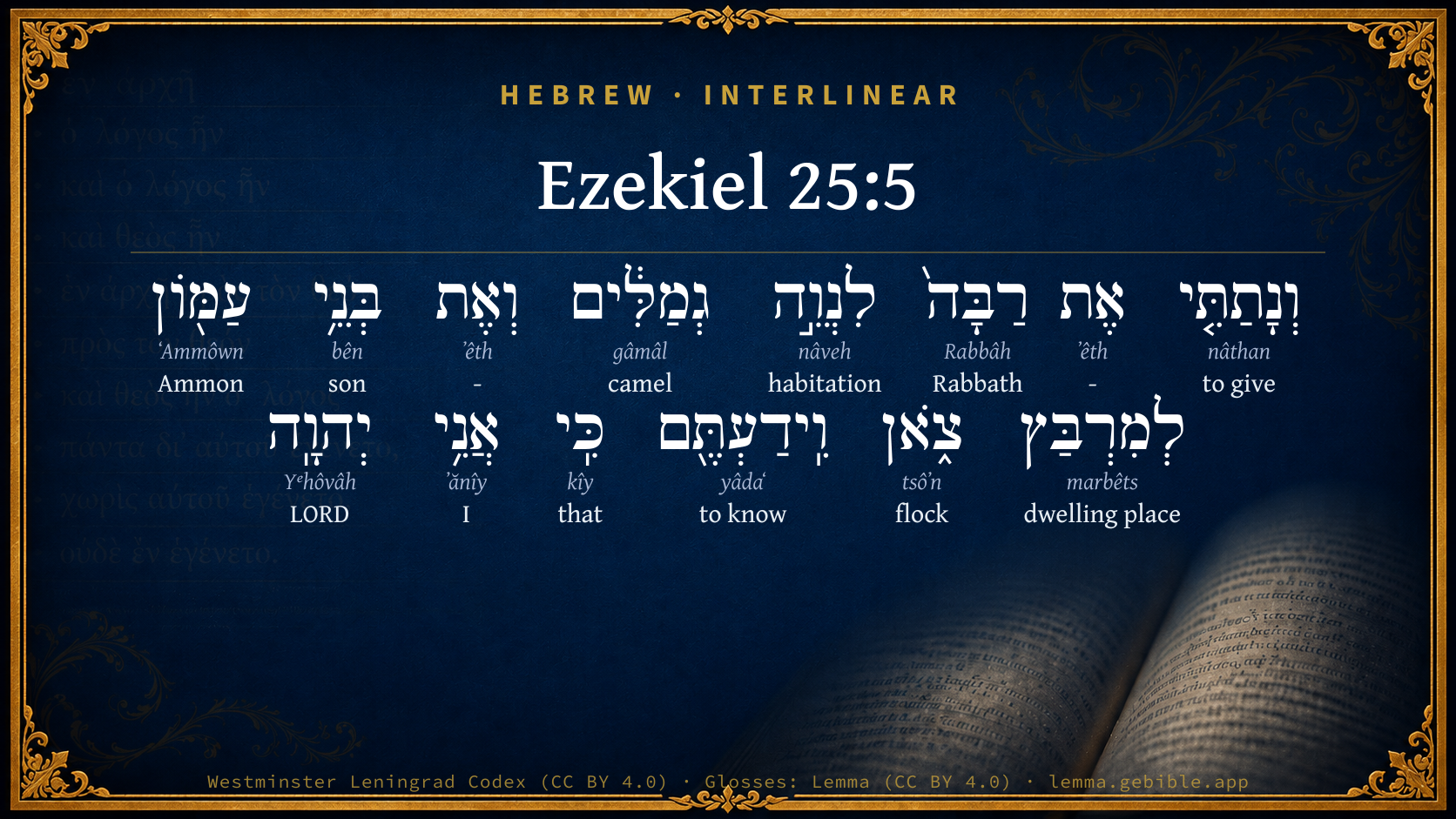
Hebrew (Westminster Leningrad Codex) Ezekiel 25:5 appears in the Hebrew Old Testament. The text above is from the Westminster Leningrad Codex. Each word links to its Strong’s number, a concise gloss, and parsing drawn from the Open Scriptures Hebrew Bible morphology. Click any word for its full Brown-Driver-Briggs (BDB) entry.
Download image
Cite this verse

Ezekiel 25:5 (World English Bible). Public Domain. Lemma interlinear Bible study tool, https://lemma.gebible.app/v/ezekiel/25/5.

Show BibTeX & RIS
BibTeX
RIS
English Translation
I will make Rabbah a stable for camels, and the children of Ammon a couching-place for flocks: and you shall know that I am Yahweh.
World English Bible · Public Domain
Highlights
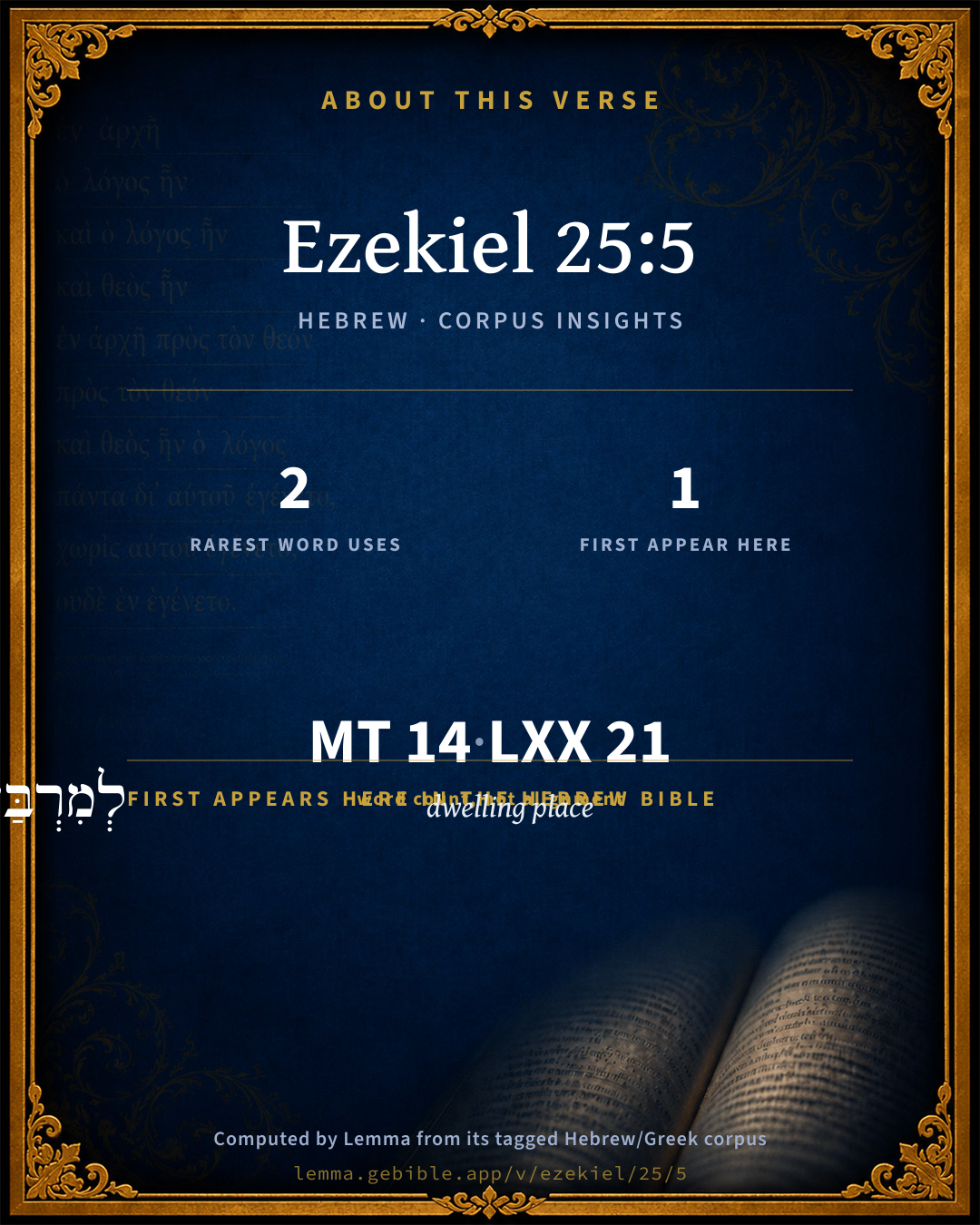
  • 1 first appearance in the Hebrew Bible
Full analysis ↓
Download a study sheet

One document with this verse’s original text, its word-by-word gloss line, the meaning frame, cross-references with their text, attributed commentary, and full source and license credits — printable, and it pastes into notes with its structure intact.

This verse Autodidact and up

Study sheet (.html) Plain text (.txt)

A passage Seminary Student

Up to 50 verses in one chapter. A passage sheet keeps up to 6 commentary sources and 12 cross-references per verse, in the order this page ranks them, and says so on the sheet whenever that leaves anything out. Ask for a single verse and you get the Autodidact verse sheet above.

Everything on this page stays free to read, with no account — the sheet is a download of what is already on screen, not access to it.

Want to remove ads? Support Godless Engineer
Compare translations 3

The same verse in 3 English versions, stacked beneath the original-language interlinear above. Click any original word for its lexicon entry.

Each is an independent rendering of the whole verse — the interlinear is not word-aligned to these translations.

Highlighted words mark where these versions differ — a whole-verse word diff, not a word-by-word alignment.

  • World English Bible Public Domain
    I will make Rabbah a stable for camels, and the children of Ammon a couching-place for flocks: and you shall know that I am Yahweh.
  • King James Version Public Domain
    And I will make Rabbah a stable for camels, and the Ammonites a couching place for flocks: and ye shall know that I am the LORD.
  • unfoldingWord Literal Text CC BY-SA 4.0
    I will make Rabbah a pasture for camels and the people of Ammon a field for flocks. Then you will know that I am Yahweh.

unfoldingWord Literal Text — © unfoldingWord, licensed CC BY-SA 4.0. Word-aligned USFM3 via Door43 (git.door43.org/unfoldingWord/en_ult).

Versions to compare (up to 4)

3 of 4 selected

Show all 18 translations

Every available English version of this verse, each an independent rendering of the whole verse.

  • World English Bible Public Domain
    I will make Rabbah a stable for camels, and the children of Ammon a couching-place for flocks: and you shall know that I am Yahweh.
  • Berean Standard Bible Public Domain
    I will make Rabbah a pasture for camels, and Ammon a resting place for sheep. Then you will know that I am the LORD.’
  • Majority Standard Bible Public Domain
    I will make Rabbah a pasture for camels, and Ammon a resting place for sheep. Then you will know that I am the LORD.’
  • King James Version Public Domain
    And I will make Rabbah a stable for camels, and the Ammonites a couching place for flocks: and ye shall know that I am the LORD.
  • American Standard Version (1901) Public Domain
    And I will make Rabbah a stable for camels, and the children of Ammon a couching-place for flocks: and ye shall know that I am Jehovah.
  • Revised Version (1885) Public Domain
    And I will make Rabbah a stable for camels, and the children of Ammon a couching place for flocks: and ye shall know that I am the LORD.
  • Geneva Bible (1599) Public Domain
    And I will make Rabbah a dwelling place for camels, and the Ammonites a sheepecote, and ye shall knowe that I am the Lord.
  • Douay-Rheims (1899) Public Domain
    And I will make Rabbath a stable for camels, and the children of Ammon a couching place for flocks: and you shall know that I am the Lord.
  • Young's Literal Translation Public Domain
    And I have given Rabbah for a habitation of camels, And the sons of Ammon for the crouching of a flock, And ye have known that I `am' Jehovah.
  • Literal Standard Version CC BY-SA 4.0
    And I have given Rabbah for a habitation of camels, || And the sons of Ammon for the crouching of a flock, || And you have known that I [am] YHWH.
  • Unlocked Literal Bible CC BY-SA 4.0
    I will make Rabbah a pasture for camels and the people of Ammon a field for flocks. Then you will know that I am Yahweh.
  • unfoldingWord Literal Text CC BY-SA 4.0
    I will make Rabbah a pasture for camels and the people of Ammon a field for flocks. Then you will know that I am Yahweh.
  • Darby Bible Public Domain
    And I will make Rabbah a pasture for camels, and the children of Ammon a couching-place for flocks: and ye shall know that I [am] Jehovah.
  • World Messianic Bible Public Domain
    I will make Rabbah a stable for camels and the children of Ammon a resting place for flocks. Then you will know that I am the LORD.”
  • Webster's Bible Public Domain
    And I will make Rabbah a stable for camels, and the Ammonites a couching-place for flocks: and ye shall know that I am the LORD.
  • Free Bible Version CC BY-SA 4.0
    I will make Rabbah a camel pasture, and Ammon a sheep-pen. Then you will know that I am the Lord.
  • Bible in Basic English Public Domain
    And I will make Rabbah a place for housing camels, and the children of Ammon a resting-place for flocks: and you will be certain that I am the Lord.
  • JPS Tanakh (1917) Public Domain
    And I will make Rabbah a pasture for camels, and the children of Ammon a couching-place for flocks; and ye shall know that I am the LORD.

Literal Standard Version (2020), Covenant Press — licensed CC BY-SA 4.0. Text via the HelloAO Bible API (eBible.org). Unlocked Literal Bible (unfoldingWord) — licensed CC BY-SA 4.0. Text via the HelloAO Bible API (eBible.org). unfoldingWord Literal Text — © unfoldingWord, licensed CC BY-SA 4.0. Word-aligned USFM3 via Door43 (git.door43.org/unfoldingWord/en_ult). Free Bible Version, Dr. Jonathan Gallagher — licensed CC BY-SA 4.0. Text via the HelloAO Bible API (eBible.org).

Word by word

More ways to search: Search by grammar → Find every occurrence → Compare this word →

Practice this passage: Drill this verse → Learn its vocabulary →

לְמִרְבַּץ
marbêts
H4769
“to/for · dwelling place of”
Preposition + Noun, Common, Masculine, Singular, Construct
Part of Speech
Preposition + Noun
Type
Common
Gender
Masculine
Number
Singular
State
Construct
Full BDB Definition

Origin: from H7257

TWOT: 2109b

place of lying down, resting or dwelling place - of wild beasts
  1. וְנָתַתִּ֤י nâthan H5414 “and · to give” Conjunction + Verb, Qal, Sequential Perfect, 1st Person, Common, Singular
  2. אֶת ʼêth H853 “-” Particle, Direct Object
  3. רַבָּה֙ Rabbâh H7237 “Rabbath” Noun, Proper
  4. לִנְוֵ֣ה nâveh H5116 “to/for · habitation of” Preposition + Noun, Common, Both, Singular, Construct
  5. גְמַלִּ֔ים gâmâl H1581 “camels” Noun, Common, Masculine, Plural, Absolute
  6. וְאֶת ʼêth H853 “and · -” Conjunction + Particle, Direct Object
  7. בְּנֵ֥י bên H1121 “sons of” Noun, Common, Masculine, Plural, Construct
  8. עַמּ֖וֹן ʻAmmôwn H5983 “Ammon” Noun, Proper
  9. צֹ֑אן tsôʼn H6629 “flock” Noun, Common, Both, Singular, Absolute
  10. וִֽידַעְתֶּ֖ם yâdaʻ H3045 “and · to know” Conjunction + Verb, Qal, Sequential Perfect, 2nd Person, Masculine, Plural
  11. כִּֽי kîy H3588 “that” Conjunction
  12. אֲנִ֥י ʼănîy H589 “I” Pronoun, Personal, 1st Person, Common, Singular
  13. יְהוָֽה Yᵉhôvâh H3068 “LORD” Noun, Proper

About this verse

These counts appear in no published source. They are computed here, from the morphology-tagged text and Lemma’s own curated glosses. What Lemma adds →

14
words
13
distinct lemmas
Prophets
section

Notable vocabulary

The rarest word here is לְמִרְבַּץ dwelling place H4769 — appearing just 2 times in the whole Hebrew Bible.

First appearance in Scripture

This word makes its first canonical appearance in the Hebrew Bible here:

  • לְמִרְבַּץ dwelling place H4769

Shared distinctive vocabulary

לְמִרְבַּץ dwelling place H4769 occurs in 2 verses of the Hebrew Bible. Also found in:

Grammatical profile

  • 2 verbs
  • 8 nouns
  • 1 pronoun
  • 1 conjunction
  • 2 particles

Verb forms

  • וְנָתַתִּ֤י Qal · Sequential Perfect
  • וִֽידַעְתֶּ֖ם Qal · Sequential Perfect

Hebrew & Septuagint length

In English translation the verse runs 25 words from the Hebrew and 31 from the Septuagint (LXX English) — closely comparable.

A rough comparison of the two English renderings, which tokenize alike — not a word-level alignment.

Word counts can differ between the Hebrew and the Greek without any difference in meaning — e.g. the Hebrew direct-object marker אֵת has no separate Greek word, and Greek often adds the article ὁ.

In the original languages it is 14 Hebrew tokens and 21 Greek tokens — but the two are counted differently (Hebrew bundles its prefixes and suffixes into one token; the Greek is in lemma form), so that isn’t a like-for-like length.

Cross-references

14

Topical passages linked to Ezekiel 25:5 in the Treasury of Scripture Knowledge — connected by theme and wording, ordered by reader-vote popularity; previews shown in the World English Bible.

  • Ezekiel 21:20 You shall appoint a way for the sword to come to Rabbah of the children of Ammon, and to Judah in Jerusalem the fortified.
  • 2 Samuel 12:26 Now Joab fought against Rabbah of the children of Ammon, and took the royal city.
  • Isaiah 17:2 The cities of Aroer are forsaken; they shall be for flocks, which shall lie down, and none shall make them afraid.
  • Deuteronomy 3:11 (For only Og king of Bashan remained of the remnant of the Rephaim; behold, his bedstead was a bedstead of iron; isn't it in Rabbah of the children of Ammon? nine cubits was the length of it, and four cubits the breadth of it, after the cubit of a man.)
  • Psalms 83:18 That they may know that you alone, whose name is Yahweh, Are the Most High over all the earth.
  • Isaiah 32:14 For the palace shall be forsaken; the populous city shall be deserted; the hill and the watch-tower shall be for dens forever, a joy of wild donkeys, a pasture of flocks;
  • Isaiah 37:20 Now therefore, Yahweh our God, save us from his hand, that all the kingdoms of the earth may know that you are Yahweh, even you only.
  • Ezekiel 24:24 Thus shall Ezekiel be to you a sign; according to all that he has done shall you do: when this comes, then shall you know that I am the Lord Yahweh.
  • Ezekiel 25:8 Thus says the Lord Yahweh: Because Moab and Seir say, Behold, the house of Judah is like all the nations;
  • Ezekiel 26:6 Her daughters who are in the field shall be slain with the sword: and they shall know that I am Yahweh.
  • Ezekiel 30:8 They shall know that I am Yahweh, when I have set a fire in Egypt, and all her helpers are destroyed.
  • Ezekiel 35:9 I will make you a perpetual desolation, and your cities shall not be inhabited; and you shall know that I am Yahweh.
  • Ezekiel 38:23 I will magnify myself, and sanctify myself, and I will make myself known in the eyes of many nations; and they shall know that I am Yahweh.
  • Zephaniah 2:14–15 Herds will lie down in the midst of her, all the animals of the nations. Both the pelican and the porcupine will lodge in its capitals. Their calls will echo through the windows. Desolation will be in the thresholds, for he has laid bare the cedar beams.

Cross-references courtesy of OpenBible.info (CC BY 4.0).

Hebrew and Greek witnesses Masoretic Hebrew ↔ Greek Septuagint

The same verse in the two great witnesses to the Old Testament, shown verse-for-verse.

These are two independent witnesses, not word-aligned to each other, and the Septuagint is shown in lemma (dictionary) form.

Hebrew Ezekiel 25:5 Masoretic · Westminster Leningrad Codex

וְנָתַתִּ֤י אֶת רַבָּה֙ לִנְוֵ֣ה גְמַלִּ֔ים וְאֶת בְּנֵ֥י עַמּ֖וֹן לְמִרְבַּץ צֹ֑אן וִֽידַעְתֶּ֖ם כִּֽי אֲנִ֥י יְהוָֽה

I will make Rabbah a stable for camels, and the children of Ammon a couching-place for flocks: and you shall know that I am Yahweh.

World English Bible · Public Domain

Greek LXX Ezekiel 25:5 Septuagint · lemma form

καί δίδωμι ὁ πόλις ὁ αμμων εἰς νομή κάμηλος καί ὁ υἱός αμμων εἰς νομή πρόβατον καί ἐπιγιγνώσκω διότι ἐγώ κύριος

And I will give up the city of Ammon for camels' pastures, and the children of Ammon for a pasture of sheep: and you⌃ shall know that I am the Lord.

LXX2012 (modern English Septuagint) · Public Domain

Hebrew: Westminster Leningrad Codex (CC BY 4.0). Greek: Septuagint (public domain); English from LXX2012 (modern English Septuagint) (Public Domain). How the Septuagint differs from the Hebrew →

Targum (Aramaic paraphrase)

1

The Targum is the ancient Jewish Aramaic paraphrase of the Hebrew Scriptures — an interpretive translation, not the Hebrew text itself. Onkelos (literal) and Pseudo-Jonathan (expansive) render the Torah, and Jonathan the Prophets. Coverage is partial: where no permissively-licensed English translation exists for a verse, only the Aramaic is shown. This is verse-level text, not a word-by-word alignment to the Hebrew.

  1. Targum Jonathan Prophets (Joshua–Malachi)
    וְאֶתֵּן יַת רַבָּה לִמְדוֹר גַמְלִין וְיַת בְּנֵי עַמוֹן לְבֵית מַשְׁרֵי עֶדְרִין דְעָן וְתֵידְעוּן אֲרֵי אֲנָא יְיָ:

    (no public-domain English translation for this verse)

    Targum Jonathan — Aramaic: “Mikraot Gedolot” (public domain). English: “Sefaria Community Translation” (CC0 1.0 (public-domain dedication)); “London "Chaldee Paraphrase," 1871” (public domain). Text via Sefaria.

Commentary

Notes on Ezekiel 25:5 from classic Christian and Jewish commentators (each source and its license shown beneath its notes). The classic Christian expositions comment on the surrounding passage and are grouped to its opening verse, so a note may address several verses; the Jewish commentaries on the Tanakh (Rashi and others) are per-verse, so they appear only where the commentator wrote on this verse.

Lemma curates 59 commentaries, every one of them public domain or Creative Commons licensed, each selected and text-cleaned for this edition rather than reprinted as found. About our sources →

Trapp's Complete Commentary

John Trapp

Eze 25:5 And I will make Rabbah a stable for camels, and the Ammonites a couchingplace for flocks: and ye shall know that I [am] the LORD.

Ver. 5. And I will make Rabbah.] The metropolis of the Ammonites. It signifieth that great city; and was afterwards rebuilt by Ptolemy Philadelph, and called Philadelphia.

“ Valet ima summis

Mutare, et insignem attenuat Deus

Obseura premens, ”& c.

- Hor., lib. i. Od. 34.

John Trapp, A Commentary or Exposition upon All the Books of the Old and New Testament (1647–1656) — public domain. Text from a community e-Sword module.

Geneva Bible (1599)

Geneva Bible translators

Called also Philadelphin, which was the chief city of the Ammonites, and full of conduits, 2 Sam. 12:27.

Geneva Bible (1599) marginal notes — public domain. Text via Bolls.life.

Jamieson, Fausset & Brown

Robert Jamieson, A. R. Fausset & David Brown

Rabbah--meaning "the Great," Ammon's metropolis. Under the Ptolemies it was rebuilt under the name Philadelphia; the ruins are called Amman now, but there is no dwelling inhabited.

Ammonites--that is the Ammonite region is to be a "couching place for flocks," namely of the Arabs. The "camels," being the chief beast of burden of the Chaldeans, are put first, as their invasion was to prepare the Ammonite land for the Arab "flocks." Instead of busy men, there shall be "still and couching flocks."

Jamieson, Fausset & Brown — Commentary Critical and Explanatory on the Whole Bible (1871) — public domain (CC PDM 1.0). Text via the HelloAO Bible API.

Ellicott's Commentary for English Readers

(5) Rabbah was the only important town belonging to the Ammonites. It has become literally a stable for the camels of the wandering Bedouins. In the parallel clause the “Ammonites” are put for the land which they inhabit.

A Bible Commentary for English Readers, edited by Charles John Ellicott (1878–1897) — public domain. Text from a community e-Sword module.

The Cambridge Bible for Schools and Colleges

gen. ed. J. J. S. Perowne

5. Rabbah a stable] Rabbah, “great city,” was the capital (Amo_1:14); in later times it bore the name of Philadelphia, and its site is probably marked by the ruins called Ammân. The word “stable” is usually rendered habitation, but sheepcote, 2Sa_7:8. It may mean a place where animals are housed or where they pasture, cf. Isa_5:17; Isa_32:14; Jer_33:12; Zep_2:14-15.

The Cambridge Bible for Schools and Colleges (gen. ed. J. J. S. Perowne; Cambridge University Press, 1878–1918) — public domain. Text from a community e-Sword module.

John Gill's Exposition

And I will make Rabbath a stable for camels,.... Creatures much used by the eastern nations, especially the Arabians; who pitching their tents about Rabbath, the royal city, the metropolis of the children of Ammon, would convert the houses, and even palaces in it, into stables for their camels. This city, in Jerom's time, as he says, was called Philadelphia, from Ptolemy Philadelphus, who rebuilt it.

And the Ammonites a couching place for flocks; that is, the land of the Ammonites should be made a place for flocks of sheep to lie down in, which the Arabians would bring and feed upon it:

and ye shall know that I am the Lord; omniscient, and sees and observes all your insults upon the children of Israel and Judah; and omnipotent, able to perform all that is threatened; and immutable, bringing about all that is here prophesied of.

John Gill's Exposition of the Whole Bible (1746–1763) — public domain (CC PDM 1.0). Text via the HelloAO Bible API.

Haydock's Catholic Bible Commentary

Rabbath, the capital city of the Ammonites: it was afterwards called Philadelphia. (Challoner) --- Flocks. These constituted the riches of those Arabians.

George Leo Haydock (1774–1849), Haydock's Catholic Family Bible and Commentary, 1859 edition — public domain. Excludes Psalms (Douay-Rheims chapter numbering differs from Protestant) and Deuterocanonical books (Catholic canon only).

Matthew Poole's English Annotations

Rabbah; the royal city, and seat of the kings of Ammon, called since Philadelphia, from Ptolemaeus Philadelphus, king of Egypt, who built it.

A stable; turn it from a royal palace to be a receptacle of camels, and their drivers.

Camels; wherewith not the Chaldeans and Bactrians, but the Arabians also, were well stored; all the men of the East, as appears in Job, using them for conveying merchandise, and for travels.

The Ammonites; the people, for the land they dwelt in.

Ye shall know; then shall you know I was as able to have defended my own people, house, and worship, as I was able to destroy your gods, your cities, and your people.

Matthew Poole's English Annotations on the Holy Bible (1683–1685) — public domain. Text from a community e-Sword/MySword module.

Whedon's Commentary on the Bible

Daniel D. Whedon

5. Rabbah a stable for camels — Rabbah “the great.” “Stable” may be rendered “habitation” or “pasture land.” This doubtless occurred during Nebuchadnezzar’s invasion, and although afterward rebuilt, it never reached its former glory. Remains of houses and temples still mark the site of this once populous city, but not an inhabitant remains. The ruins are now used as a pasture for sheep and camels. Lord Lindsay writes, “The valley stinks with dead camels, one of which was rolling in the stream; and although we saw none among the ruins they were absolutely covered in every direction with their dung.” (For this and many other testimonials see Pulpit Commentary.)

Daniel D. Whedon (gen. ed.), Commentary on the Old and New Testaments (1874–1909) — public domain. Text from a community e-Sword module.

John Wesley's Explanatory Notes

Rabbah - The royal city, called since Philadelphia from the king of Egypt who built it. The Ammonites - The land they dwelt in.

John Wesley, Explanatory Notes Upon the Whole Bible (1754–1765) — public domain. Text via the GEBible commentary corpus.

Lesson kit

Teaching starters — assembled from the data on this page, not authored interpretation. Every prompt links to the verse data it draws on. Edit before teaching.

Ezekiel, in the Prophets, opens this verse with 14 words (13 distinct Hebrew lemmas). Its most distinctive word is marbêts (“dwelling place”). A historical commentator’s framing appears above. Read the whole chapter for the surrounding context.

Discussion questions

  1. What does “dwelling place” (marbêts) contribute to the verse as a whole?
  2. This is the first place “dwelling place” appears in Scripture (first appears here). What does its debut here establish?
  3. How does Zephaniah 2:15, which shares the word «dwelling place», read alongside this verse?
  4. The translations on this page render this verse differently — a whole-verse word diff, not a word-by-word alignment. What might account for the different wordings?
  5. «וְנָתַתִּ֤י» is a Qal Sequential Perfect verb. How does that grammatical form shape the action described?
  6. Compare how Trapp's Complete Commentary and Geneva Bible (1599) read this verse. Where do they agree or differ?

Things to notice

Reading settings

Reading text

Shown beneath each verse's original-language words.

Old Testament
Old Testament edition

Read the OT as the Masoretic Hebrew (MT) or the Greek Septuagint (LXX).

English shown for the Greek Septuagint (in the Hebrew ↔ Greek comparison).

Comparing translations? Open the Compare panel on any verse page to stack up to four side by side.