
2 Chronicles 31:6

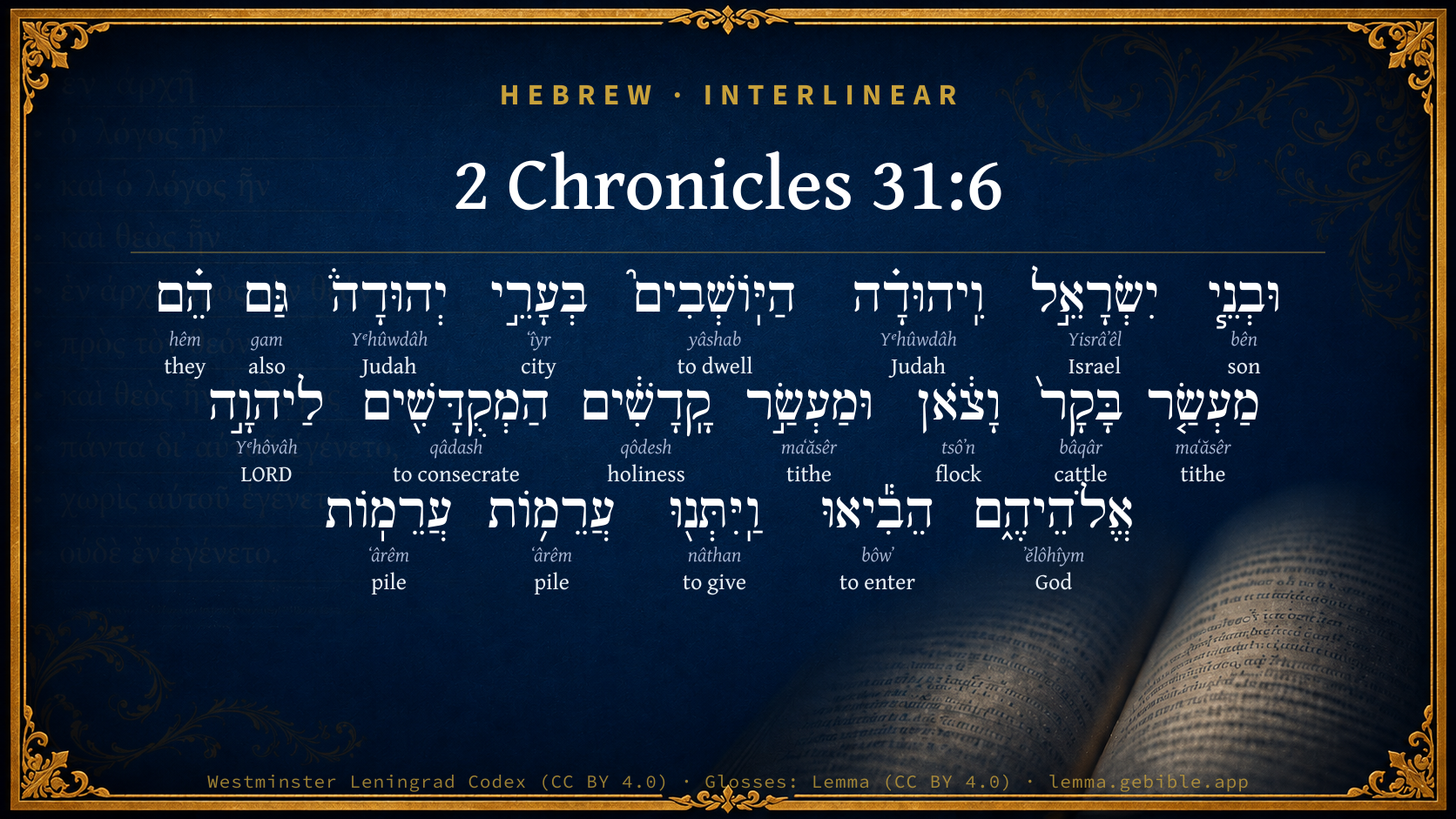
Hebrew (Westminster Leningrad Codex) 2 Chronicles 31:6 appears in the Hebrew Old Testament. The text above is from the Westminster Leningrad Codex. Each word links to its Strong’s number, a concise gloss, and parsing drawn from the Open Scriptures Hebrew Bible morphology. Click any word for its full Brown-Driver-Briggs (BDB) entry.
Download image
Cite this verse

2 Chronicles 31:6 (World English Bible). Public Domain. Lemma interlinear Bible study tool, https://lemma.gebible.app/v/2-chronicles/31/6.

Show BibTeX & RIS
BibTeX
RIS
English Translation
The children of Israel and Judah, who lived in the cities of Judah, they also brought in the tithe of oxen and sheep, and the tithe of dedicated things which were consecrated to Yahweh their God, and laid them by heaps.
World English Bible · Public Domain
Download a study sheet

One document with this verse’s original text, its word-by-word gloss line, the meaning frame, cross-references with their text, attributed commentary, and full source and license credits — printable, and it pastes into notes with its structure intact.

This verse Autodidact and up

Study sheet (.html) Plain text (.txt)

A passage Seminary Student

Up to 50 verses in one chapter. A passage sheet keeps up to 6 commentary sources and 12 cross-references per verse, in the order this page ranks them, and says so on the sheet whenever that leaves anything out. Ask for a single verse and you get the Autodidact verse sheet above.

Everything on this page stays free to read, with no account — the sheet is a download of what is already on screen, not access to it.

Want to remove ads? Support Godless Engineer
Compare translations 3

The same verse in 3 English versions, stacked beneath the original-language interlinear above. Click any original word for its lexicon entry.

Each is an independent rendering of the whole verse — the interlinear is not word-aligned to these translations.

Highlighted words mark where these versions differ — a whole-verse word diff, not a word-by-word alignment.

  • World English Bible Public Domain
    The children of Israel and Judah, who lived in the cities of Judah, they also brought in the tithe of oxen and sheep, and the tithe of dedicated things which were consecrated to Yahweh their God, and laid them by heaps.
  • King James Version Public Domain
    And concerning the children of Israel and Judah, that dwelt in the cities of Judah, they also brought in the tithe of oxen and sheep, and the tithe of holy things which were consecrated unto the LORD their God, and laid them by heaps.
  • unfoldingWord Literal Text CC BY-SA 4.0
    And the sons of Israel and Judah, the inhabitants in the cities of Judah, also they, the tithe of cattle and sheep, and the tithe of sacred things consecrated to Yahweh their God, they brought in, and they gave heaps, heaps.

unfoldingWord Literal Text — © unfoldingWord, licensed CC BY-SA 4.0. Word-aligned USFM3 via Door43 (git.door43.org/unfoldingWord/en_ult).

Versions to compare (up to 4)

3 of 4 selected

Show all 18 translations

Every available English version of this verse, each an independent rendering of the whole verse.

  • World English Bible Public Domain
    The children of Israel and Judah, who lived in the cities of Judah, they also brought in the tithe of oxen and sheep, and the tithe of dedicated things which were consecrated to Yahweh their God, and laid them by heaps.
  • Berean Standard Bible Public Domain
    And the Israelites and Judahites who lived in the cities of Judah also brought a tithe of their herds and flocks and a tithe of the holy things consecrated to the LORD their God, and they laid them in large heaps.
  • Majority Standard Bible Public Domain
    And the Israelites and Judahites who lived in the cities of Judah also brought a tithe of their herds and flocks and a tithe of the holy things consecrated to the LORD their God, and they laid them in large heaps.
  • King James Version Public Domain
    And concerning the children of Israel and Judah, that dwelt in the cities of Judah, they also brought in the tithe of oxen and sheep, and the tithe of holy things which were consecrated unto the LORD their God, and laid them by heaps.
  • American Standard Version (1901) Public Domain
    And the children of Israel and Judah, that dwelt in the cities of Judah, they also brought in the tithe of oxen and sheep, and the tithe of dedicated things which were consecrated unto Jehovah their God, and laid them by heaps.
  • Revised Version (1885) Public Domain
    And the children of Israel and Judah, that dwelt in the cities of Judah, they also brought in the tithe of oxen and sheep, and the tithe of dedicated things which were consecrated unto the LORD their God, and laid them by heaps.
  • Geneva Bible (1599) Public Domain
    And the children of Israel and Iudah that dwelt in ye cities of Iudah, they also brought the tithes of bullockes and sheepe, and the holy tithes which were consecrate vnto the Lord their God, and laide them on many heapes.
  • Douay-Rheims (1899) Public Domain
    Moreover the children of Israel and Juda, that dwelt in the cities of Juda, brought in the tithes of oxen, and sheep, and the tithes of holy things, which they had vowed to the Lord their God: and carrying them all, made many heaps.
  • Young's Literal Translation Public Domain
    And the sons of Israel and Judah, those dwelling in cities of Judah, they also a tithe of herd and flock, and a tithe of the holy things that are sanctified to Jehovah their God, have brought in, and they give -- heaps, heaps;
  • Literal Standard Version CC BY-SA 4.0
    And the sons of Israel and Judah, those dwelling in cities of Judah, have also brought in a tithe of herd and flock, and a tithe of the holy things that are sanctified to their God YHWH, and they set [them in] heaps of heaps.
  • Unlocked Literal Bible CC BY-SA 4.0
    The people of Israel and Judah who lived in the cities of Judah also brought in the tithe of cattle and sheep, and the tithe of the holy things that were set apart to Yahweh their God, and they piled them up in heaps.
  • unfoldingWord Literal Text CC BY-SA 4.0
    And the sons of Israel and Judah, the inhabitants in the cities of Judah, also they, the tithe of cattle and sheep, and the tithe of sacred things consecrated to Yahweh their God, they brought in, and they gave heaps, heaps.
  • Darby Bible Public Domain
    And the children of Israel and of Judah, that dwelt in the cities of Judah, they also brought the tithe of oxen and sheep, and the tithe of holy things which were consecrated to Jehovah their God, and laid them by heaps.
  • World Messianic Bible Public Domain
    The children of Israel and Judah, who lived in the cities of Judah, also brought in the tithe of cattle and sheep, and the tithe of dedicated things which were consecrated to the LORD their God, and laid them in heaps.
  • Webster's Bible Public Domain
    And the children of Israel and Judah, that dwelt in the cities of Judah, they also brought in the tithe of oxen and sheep, and the tithe of holy things which were consecrated to the LORD their God, and laid them by heaps.
  • Free Bible Version CC BY-SA 4.0
    The people of Israel now living in Judah, and the people of Judah brought a tithe of their herds and flocks. They also brought a tithe of what had been dedicated to the Lord their God, and piled them up.
  • Bible in Basic English Public Domain
    And the children of Israel and Judah, who were living in the towns of Judah came with the tenth part of their oxen and sheep, and a tenth of all the holy things which were to be given to the Lord their God, and put them in great masses.
  • JPS Tanakh (1917) Public Domain
    And the children of Israel and Judah, that dwelt in the cities of Judah, they also brought in the tithe of oxen and sheep, and the tithe of hallowed things which were hallowed unto the LORD their God, and laid them by heaps.

Literal Standard Version (2020), Covenant Press — licensed CC BY-SA 4.0. Text via the HelloAO Bible API (eBible.org). Unlocked Literal Bible (unfoldingWord) — licensed CC BY-SA 4.0. Text via the HelloAO Bible API (eBible.org). unfoldingWord Literal Text — © unfoldingWord, licensed CC BY-SA 4.0. Word-aligned USFM3 via Door43 (git.door43.org/unfoldingWord/en_ult). Free Bible Version, Dr. Jonathan Gallagher — licensed CC BY-SA 4.0. Text via the HelloAO Bible API (eBible.org).

Word by word

More ways to search: Search by grammar → Find every occurrence → Compare this word →

Practice this passage: Drill this verse → Learn its vocabulary →

עֲרֵמ֥וֹת
ʻârêm
H6194
“piles”
Noun, Common, Feminine, Plural, Absolute
Part of Speech
Noun
Type
Common
Gender
Feminine
Number
Plural
State
Absolute
Full BDB Definition

Origin: from H6192

TWOT: 1696a

heap, pile
  1. וּבְנֵ֧י bên H1121 “and · sons of” Conjunction + Noun, Common, Masculine, Plural, Construct
  2. יִשְׂרָאֵ֣ל Yisrâʼêl H3478 “Israel” Noun, Proper
  3. וִֽיהוּדָ֗ה Yᵉhûwdâh H3063 “and · Judah” Conjunction + Noun, Proper
  4. הַיּֽוֹשְׁבִים֮ yâshab H3427 “the · dwelling” Particle, Definite Article + Verb, Qal, Participle Active, Masculine, Plural, Absolute
  5. בְּעָרֵ֣י ʻîyr H5892 “in/at · cities of” Preposition + Noun, Common, Feminine, Plural, Construct
  6. יְהוּדָה֒ Yᵉhûwdâh H3063 “Judah” Noun, Proper
  7. גַּם gam H1571 “also” Particle, Accusative
  8. הֵ֗ם hêm H1992 “they” Pronoun, Personal, 3rd Person, Masculine, Plural
  9. מַעְשַׂ֤ר maʻăsêr H4643 “tithe of” Noun, Common, Masculine, Singular, Construct
  10. בָּקָר֙ bâqâr H1241 “cattle” Noun, Common, Both, Singular, Absolute
  11. וָצֹ֔אן tsôʼn H6629 “and · flock” Conjunction + Noun, Common, Both, Singular, Absolute
  12. וּמַעְשַׂ֣ר maʻăsêr H4643 “and · tithe of” Conjunction + Noun, Common, Masculine, Singular, Construct
  13. קָֽדָשִׁ֔ים qôdesh H6944 “holy things” Noun, Common, Masculine, Plural, Absolute
  14. הַמְקֻדָּשִׁ֖ים qâdash H6942 “the · consecrated” Particle, Definite Article + Verb, Pual, Participle Passive, Masculine, Plural, Absolute
  15. לַיהוָ֣ה Yᵉhôvâh H3068 “to/for · LORD” Preposition + Noun, Proper
  16. אֱלֹהֵיהֶ֑ם ʼĕlôhîym H430 “God(s) · their” Noun, Common, Masculine, Plural, Construct + Suffix, Personal, 3rd Person, Masculine, Plural
  17. הֵבִ֕יאוּ bôwʼ H935 “to enter” Verb, Hiphil, Perfect, 3rd Person, Common, Plural
  18. וַֽיִּתְּנ֖וּ nâthan H5414 “and · to give” Conjunction + Verb, Qal, Sequential Imperfect, 3rd Person, Masculine, Plural
  19. עֲרֵמֽוֹת ʻârêm H6194 “piles” Noun, Common, Feminine, Plural, Absolute

About this verse

These counts appear in no published source. They are computed here, from the morphology-tagged text and Lemma’s own curated glosses. What Lemma adds →

20
words
17
distinct lemmas
Historical
section

Notable vocabulary

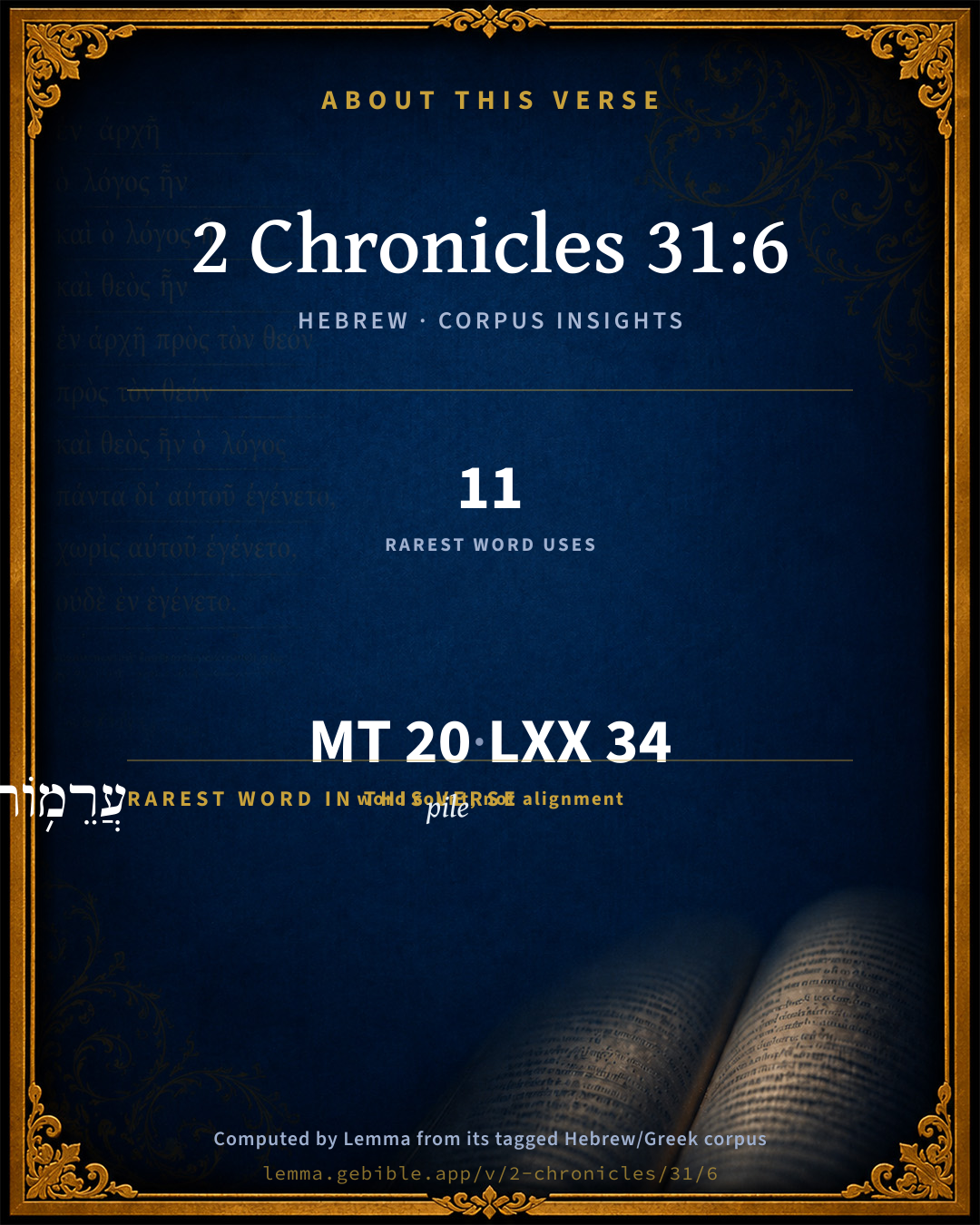
The rarest word here is עֲרֵמ֥וֹת pile H6194 — appearing just 11 times in the whole Hebrew Bible.

Shared distinctive vocabulary

עֲרֵמ֥וֹת pile H6194 occurs in 10 verses of the Hebrew Bible. Also found in:

Grammatical profile

  • 4 verbs
  • 14 nouns
  • 1 pronoun
  • 1 particle

Verb forms

  • הַיּֽוֹשְׁבִים֮ Qal · Participle Active
  • הַמְקֻדָּשִׁ֖ים Pual · Participle Passive
  • הֵבִ֕יאוּ Hiphil · Perfect
  • וַֽיִּתְּנ֖וּ Qal · Sequential Imperfect

Repetition

Words recur within this verse — often emphatic in Hebrew:

  • וִֽיהוּדָ֗ה Judah H3063 ×2
  • מַעְשַׂ֤ר tithe H4643 ×2
  • עֲרֵמ֥וֹת pile H6194 ×2

Hebrew & Septuagint length

In English translation the verse runs 41 words from the Hebrew and 38 from the Septuagint (LXX English) — closely comparable.

A rough comparison of the two English renderings, which tokenize alike — not a word-level alignment.

Word counts can differ between the Hebrew and the Greek without any difference in meaning — e.g. the Hebrew direct-object marker אֵת has no separate Greek word, and Greek often adds the article ὁ.

In the original languages it is 20 Hebrew tokens and 34 Greek tokens — but the two are counted differently (Hebrew bundles its prefixes and suffixes into one token; the Greek is in lemma form), so that isn’t a like-for-like length.

Cross-references

3

Topical passages linked to 2 Chronicles 31:6 in the Treasury of Scripture Knowledge — connected by theme and wording, ordered by reader-vote popularity; previews shown in the World English Bible.

  • Leviticus 27:30 "'All the tithe of the land, whether of the seed of the land or of the fruit of the trees, is Yahweh's. It is holy to Yahweh.
  • Deuteronomy 14:28 At the end of every three years you shall bring forth all the tithe of your increase in the same year, and shall lay it up within your gates:
  • 2 Chronicles 11:16–17 After them, out of all the tribes of Israel, such as set their hearts to seek Yahweh, the God of Israel, came to Jerusalem to sacrifice to Yahweh, the God of their fathers.

Cross-references courtesy of OpenBible.info (CC BY 4.0).

Hebrew and Greek witnesses Masoretic Hebrew ↔ Greek Septuagint

The same verse in the two great witnesses to the Old Testament, shown verse-for-verse.

These are two independent witnesses, not word-aligned to each other, and the Septuagint is shown in lemma (dictionary) form.

Hebrew 2 Chronicles 31:6 Masoretic · Westminster Leningrad Codex

וּבְנֵ֧י יִשְׂרָאֵ֣ל וִֽיהוּדָ֗ה הַיּֽוֹשְׁבִים֮ בְּעָרֵ֣י יְהוּדָה֒ גַּם הֵ֗ם מַעְשַׂ֤ר בָּקָר֙ וָצֹ֔אן וּמַעְשַׂ֣ר קָֽדָשִׁ֔ים הַמְקֻדָּשִׁ֖ים לַיהוָ֣ה אֱלֹהֵיהֶ֑ם הֵבִ֕יאוּ וַֽיִּתְּנ֖וּ עֲרֵמ֥וֹת עֲרֵמֽוֹת

The children of Israel and Judah, who lived in the cities of Judah, they also brought in the tithe of oxen and sheep, and the tithe of dedicated things which were consecrated to Yahweh their God, and laid them by heaps.

World English Bible · Public Domain

Greek LXX 2 Chronicles 31:6 Septuagint · lemma form

ὁ υἱός ἰσραήλ καί ἰουδά καί ὁ καταοἰκέω ἐν ὁ πόλις ἰουδά καί αὐτός φέρω ἐπιδέκατος μόσχος καί πρόβατον καί ἐπιδέκατος αἴξ καί ἁγιάζω ὁ κύριος θεός αὐτός καί εἰςφέρω καί τίθημι σωρός σωρός

And they that lived in the cities of Juda themselves also brought tithes of calves and sheep, and tithes of goats, and consecrated them to the Lord their God, and they brought them and laid them in heaps.

LXX2012 (modern English Septuagint) · Public Domain

On this verse, Ellicott's Commentary for English Readers discusses the Septuagint’s reading. Read the note in Commentary ↓

Hebrew: Westminster Leningrad Codex (CC BY 4.0). Greek: Septuagint (public domain); English from LXX2012 (modern English Septuagint) (Public Domain). How the Septuagint differs from the Hebrew →

Commentary

Notes on 2 Chronicles 31:6 from classic Christian and Jewish commentators (each source and its license shown beneath its notes). The classic Christian expositions comment on the surrounding passage and are grouped to its opening verse, so a note may address several verses; the Jewish commentaries on the Tanakh (Rashi and others) are per-verse, so they appear only where the commentator wrote on this verse.

Lemma curates 59 commentaries, every one of them public domain or Creative Commons licensed, each selected and text-cleaned for this edition rather than reprinted as found. About our sources →

Trapp's Complete Commentary

John Trapp

2Ch 31:6 And [concerning] the children of Israel and Judah, that dwelt in the cities of Judah, they also brought in the tithe of oxen and sheep, and the tithe of holy things which were consecrated unto the LORD their God, and laid [them] by heaps.

Ver. 6. Which were consecrated unto the Lord,] i.e., Such as, over and above the tithes ordinarily appointed to be paid, any did voluntarily vow to give: so the Vulgate. See 2Ch 31:8.

John Trapp, A Commentary or Exposition upon All the Books of the Old and New Testament (1647–1656) — public domain. Text from a community e-Sword module.

Joseph Benson's Commentary

2Ch 31:6-7. They brought in the tithe of oxen and sheep — They not only brought in the same tithe which the dwellers in Jerusalem did, namely, of corn, and wine, and oil, &c., which they had in their own storehouses in that city, but also oxen and sheep, which were more proper to the country; for under the term cities of Judah, are comprehended the suburbs and territories belonging to them. And the tithe of holy things — That is, of all holy things, which were consecrated to the Lord — Whether by vow, or voluntary promise, or otherwise; as the tithes of gain by merchandise, or spoils of war, Gen 14:20; Gen 28:22; Num 31:28-30. And laid them by heaps — What the priests and Levites had occasion for, they made use of, and the overplus was laid in heaps. In the third month they began — Of the sacred year, in which month their harvest began. And finished them in the seventh month — In which their harvest ended, and the feast of tabernacles was kept.

Joseph Benson's Commentary on the Old and New Testaments (1811–1818) — public domain. Text from a community e-Sword module.

Tyndale Open Study Notes

Tyndale Open Resources

31:6 The tithes of the animals that piled . . . up in great heaps might refer to the proceeds from the sale of animals rather than the animals themselves. The law permitted the people to exchange the yield of the field for money (Deut 14:24-26) and to consume the meat at their homes (Deut 12:15).

Tyndale Open Study Notes — © Tyndale Open Resources, licensed CC BY-SA 4.0. Text via the HelloAO Bible API.

Geneva Bible (1599)

Geneva Bible translators

Which they had dedicated to the Lord by a vow.

For the relief of the Priests, Levites, widows, pupils, fatherless, strangers, and such as were in necessity.

Geneva Bible (1599) marginal notes — public domain. Text via Bolls.life.

Jamieson, Fausset & Brown

Robert Jamieson, A. R. Fausset & David Brown

and laid them by heaps--The contributions began to be sent in shortly after the celebration of the passover, which had taken place in the middle of the second month. Some time would elapse before the king's order reached all parts of the kingdom. The wheat harvest occurred in the third month, so that the sheaves of that grain, being presented before any other, formed "the foundation," an under-layer in the corn stores of the temple. The first-fruits of their land produce which were successively sent in all the summer till the close of the fruit and vintage season, that is, the seventh month, continued to raise heap upon heap.

Jamieson, Fausset & Brown — Commentary Critical and Explanatory on the Whole Bible (1871) — public domain (CC PDM 1.0). Text via the HelloAO Bible API.

Ellicott's Commentary for English Readers

(6) Concerning.—Omit.

The children of Israel and Judah, that dwelt in the cities of Judah.—Contrasted with “the children of Israel” who dwelt in Jerusalem (2Ch_31:5). “The children of Israel that dwelt in the cities of Judah” are evidently those who had left the northern kingdom to settle in the south. (Comp. 2Ch_10:17; 2Ch_11:16; 2Ch_30:25.)

The tithe of holy things.—This expression is assumed to be equivalent to “the heave offerings of the holy things” (Num_18:19), which denotes such portions of the sacrificial gifts as were not consumed upon the altar. Taken literally, “tithe of things consecrated” would be a very surprising, as it is a wholly isolated, expression.

The present text of the LXX. appears to contain, not a trace of a different reading, but simply an old error of transcription, suggested probably by the words immediately preceding; for its rendering is, “and tithes of goats” (αἰγῶν for ἀγίων). The Syriac paraphrases freely, but the Vulgate follows the Hebrew (décimas sanctorum). (See also Note on 2Ch_31:10; 2Ch_31:12.) There is probably a lacuna in the text.

And laid them by heaps.—Literally, and made heaps heaps—i.e., many heaps. (Comp.Vulg., “fecerunt acervos plurimos.”)

A Bible Commentary for English Readers, edited by Charles John Ellicott (1878–1897) — public domain. Text from a community e-Sword module.

The Cambridge Bible for Schools and Colleges

gen. ed. J. J. S. Perowne

6. And concerning the children] R.V. And the children. Cp. 2Ch_11:16.

holy things] R.V. dedicated things (as 2Ch_31:12).

The Cambridge Bible for Schools and Colleges (gen. ed. J. J. S. Perowne; Cambridge University Press, 1878–1918) — public domain. Text from a community e-Sword module.

John Gill's Exposition

And concerning the children of Israel and Judah, that dwelt in the cities of Judah,.... As for the supplement "concerning", I see no need of it; the sense is, that when the king's edict was known by the inhabitants of the cities in the country, as well as at Jerusalem:

they also brought in the tithes of oxen, and sheep; according to the law in Lev 27:32.

and the tithe of holy things, which were consecrated unto the Lord their God; which Jarchi understands of the second tithe the Levites were to give to the priests; but Kimchi of things consecrated to sacred uses, and no longer for their own, and which were even free from tithing:

and laid them by heaps: heaps upon heaps, such large quantities were brought in.

John Gill's Exposition of the Whole Bible (1746–1763) — public domain (CC PDM 1.0). Text via the HelloAO Bible API.

Albert Barnes' Notes on the Bible

By “the children of Israel” in 2Ch 31:5, seem to be intended the inhabitants of Jerusalem only (see 2Ch 31:4); by “the children of Israel and Judah that dwelt in the cities of Judah” in this verse, seem to be meant the Jews of the country districts and the Israelites who dwelt among them 2Ch 30:25. Of these two classes, the first brought both first-fruits and tithes of “all things;” while the others, who had not been included in the command 2Ch 31:4, brought in first-fruits and paid the tithe of sheep and oxen only, and of the things which they had vowed to God.

Albert Barnes' Notes on the Bible (1834–1885) — public domain. Text from a community e-Sword/MySword module.

Haydock's Catholic Bible Commentary

Things, out of which the Levites had to give tithes to the priests. Lyranus) Num. xviii. 26. M. --- Vowed. Heb. "consecrated to....God, and laid them in heaps." H.

George Leo Haydock (1774–1849), Haydock's Catholic Family Bible and Commentary, 1859 edition — public domain. Excludes Psalms (Douay-Rheims chapter numbering differs from Protestant) and Deuterocanonical books (Catholic canon only).

Matthew Poole's English Annotations

Also the tithe of oxen and sheep; they brought in not only the same tithes which the dwellers in Jerusalem did, to wit, of corn, and wine, and oil, &c., which they had in their own storehouses in that city; but also oxen and sheep, which were more proper to the country; for under the cities of Judah are comprehended the suburbs and territories adjacent and belonging to them, as is evident from the nature of the thing, and the law of God.

And the tithe of holy things: this may be taken either,

1. By way of explication, even the tithe of holy things, &c. Or rather,

2. By way of addition,

the tithe of all holy things which were consecrated unto the Lord, whether by vow, or voluntary promise, or otherwise; as the tithes of gains by merchandise, or spoils of war, &c.; of which see Gen 14:20; 28:22; Num 31:28,30.

Matthew Poole's English Annotations on the Holy Bible (1683–1685) — public domain. Text from a community e-Sword/MySword module.

Whedon's Commentary on the Bible

Daniel D. Whedon

6. Laid them by heaps — Literally, gave heaps, heaps; that is, they brought and laid them in many heaps or piles.

Daniel D. Whedon (gen. ed.), Commentary on the Old and New Testaments (1874–1909) — public domain. Text from a community e-Sword module.

The Pulpit Commentary

That dwelt in the cities of Judah. As vers. 4 and 5 referred to the dwellers in Jerusalem, so this verse tells of the dwellers in other cities, villages, etc., of the surrounding country. (so 2Ch_30:25) Their tithes of holy things probably denote the "heave offerings" of Aaron Num_18:8; for other references to the matter of this verse, see Lev_27:30; Deu_14:28.

The Pulpit Commentary (1880–1919), ed. H.D.M. Spence-Jones & Joseph S. Exell — public domain. Text from a community e-Sword module.

John Wesley's Explanatory Notes

By heaps - What the priests and the Levites had occasion for, they made use of, and the overplus was laid in heaps.

John Wesley, Explanatory Notes Upon the Whole Bible (1754–1765) — public domain. Text via the GEBible commentary corpus.

unfoldingWord translationNotes

Door43 World Missions Community

third month

This is the third month of the Hebrew calendar. It is at the end of the harvest season and the beginning of the dry season. It is during the last part of May and the first part of June on Western calendars. (See: Hebrew Months and Ordinal Numbers)

seventh month

This is the seventh month of the Hebrew calendar. This is during the early rain season, which would soften the land for sowing. It is during the last part of September and the first part of October on Western calendars. (See: Hebrew Months and Ordinal Numbers)

translationWords

Israel

tenth

cow

ewe

set apart

God

bless

people of God

unfoldingWord translationNotes — © Distant Shores Media and the Door43 World Missions Community, licensed CC BY-SA 4.0. Source: git.door43.org/Door43/en_tn.

Rashi

Rabbi Shlomo Yitzchaki (Rashi)

and the tithes of sacred things consecrated to the Lord the tithe of the tithe, which the Levites give the priests (Num. 18:25f.).

and they gave many stacks עֲרֵמוֹת עֲרֵמוֹת (houffen, Middle High German, heaps), an example is (Song 7:3): “a stack of (עֲרֵמַת) wheat.”

Rashi on the Tanakh — English translations: “The Judaica Press complete Tanach with Rashi, translated by A. J. Rosenberg” (CC BY 4.0); “Pentateuch with Rashi's commentary by M. Rosenbaum and A.M. Silbermann, 1929-1934” (public domain); “The Metsudah Tanach series, Lakewood, N.J” (CC BY 4.0); and “The Book of Joshua, Metsudah Publications, 1997” (CC BY 4.0). Text via Sefaria.

Lesson kit

Teaching starters — assembled from the data on this page, not authored interpretation. Every prompt links to the verse data it draws on. Edit before teaching.

2 Chronicles, in the Historical, opens this verse with 20 words (17 distinct Hebrew lemmas). Its most distinctive word is ʻârêm (“pile”). A historical commentator’s framing appears above. Read the whole chapter for the surrounding context.

Discussion questions

  1. The word ʻârêm carries the sense “pile.” How does it shape the verse?
  2. Ruth 3:7 shares the word «pile» with this verse. How do the two illuminate each other?
  3. “Judah” occurs 2× in this one verse. What is the effect of the repetition?
  4. These translations render this verse differently; the difference is in the English rendering, not the original. What questions does that raise?
  5. The verb «הַיּֽוֹשְׁבִים֮» is Qal Participle Active. How does its form color the action?
  6. Reading how Trapp's Complete Commentary and Joseph Benson's Commentary read this verse, where do the two commentators agree and where do they part?

Things to notice

Reading settings

Reading text

Shown beneath each verse's original-language words.

Old Testament
Old Testament edition

Read the OT as the Masoretic Hebrew (MT) or the Greek Septuagint (LXX).

English shown for the Greek Septuagint (in the Hebrew ↔ Greek comparison).

Comparing translations? Open the Compare panel on any verse page to stack up to four side by side.