
Jeremiah 23:3

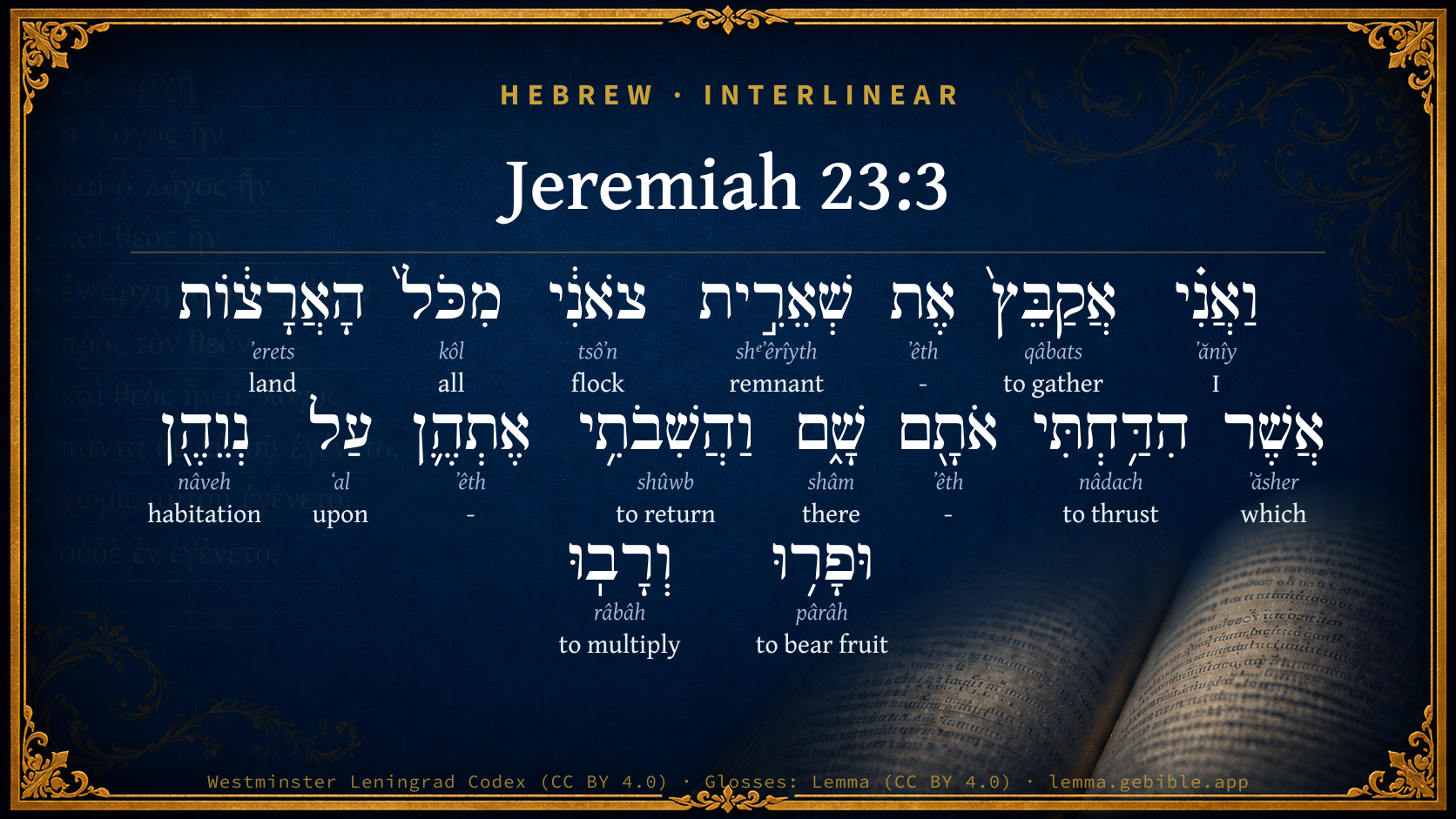
Hebrew (Westminster Leningrad Codex) Jeremiah 23:3 appears in the Hebrew Old Testament. The text above is from the Westminster Leningrad Codex. Each word links to its Strong’s number, a concise gloss, and parsing drawn from the Open Scriptures Hebrew Bible morphology. Click any word for its full Brown-Driver-Briggs (BDB) entry.
Download image
Cite this verse

Jeremiah 23:3 (World English Bible). Public Domain. Lemma interlinear Bible study tool, https://lemma.gebible.app/v/jeremiah/23/3.

Show BibTeX & RIS
BibTeX
RIS
English Translation
I will gather the remnant of my flock out of all the countries where I have driven them, and will bring them again to their folds; and they shall be fruitful and multiply.
World English Bible · Public Domain
Download a study sheet

One document with this verse’s original text, its word-by-word gloss line, the meaning frame, cross-references with their text, attributed commentary, and full source and license credits — printable, and it pastes into notes with its structure intact.

This verse Autodidact and up

Study sheet (.html) Plain text (.txt)

A passage Seminary Student

Up to 50 verses in one chapter. A passage sheet keeps up to 6 commentary sources and 12 cross-references per verse, in the order this page ranks them, and says so on the sheet whenever that leaves anything out. Ask for a single verse and you get the Autodidact verse sheet above.

Everything on this page stays free to read, with no account — the sheet is a download of what is already on screen, not access to it.

Want to remove ads? Support Godless Engineer
Compare translations 3

The same verse in 3 English versions, stacked beneath the original-language interlinear above. Click any original word for its lexicon entry.

Each is an independent rendering of the whole verse — the interlinear is not word-aligned to these translations.

Highlighted words mark where these versions differ — a whole-verse word diff, not a word-by-word alignment.

  • World English Bible Public Domain
    I will gather the remnant of my flock out of all the countries where I have driven them, and will bring them again to their folds; and they shall be fruitful and multiply.
  • King James Version Public Domain
    And I will gather the remnant of my flock out of all countries whither I have driven them, and will bring them again to their folds; and they shall be fruitful and increase.
  • unfoldingWord Literal Text CC BY-SA 4.0
    “And I, I will gather the remnant of my flock from all the lands where I have driven them, and I will bring them back to their pasture, and they will be fruitful and multiply.

unfoldingWord Literal Text — © unfoldingWord, licensed CC BY-SA 4.0. Word-aligned USFM3 via Door43 (git.door43.org/unfoldingWord/en_ult).

Versions to compare (up to 4)

3 of 4 selected

Show all 18 translations

Every available English version of this verse, each an independent rendering of the whole verse.

  • World English Bible Public Domain
    I will gather the remnant of my flock out of all the countries where I have driven them, and will bring them again to their folds; and they shall be fruitful and multiply.
  • Berean Standard Bible Public Domain
    Then I Myself will gather the remnant of My flock from all the lands to which I have banished them, and I will return them to their pasture, where they will be fruitful and multiply.
  • Majority Standard Bible Public Domain
    Then I Myself will gather the remnant of My flock from all the lands to which I have banished them, and I will return them to their pasture, where they will be fruitful and multiply.
  • King James Version Public Domain
    And I will gather the remnant of my flock out of all countries whither I have driven them, and will bring them again to their folds; and they shall be fruitful and increase.
  • American Standard Version (1901) Public Domain
    And I will gather the remnant of my flock out of all the countries whither I have driven them, and will bring them again to their folds; and they shall be fruitful and multiply.
  • Revised Version (1885) Public Domain
    And I will gather the remnant of my flock out of all the countries whither I have driven them, and will bring them again to their folds; and they shall be fruitful and multiply.
  • Geneva Bible (1599) Public Domain
    And I will gather the remnant of my sheepe out of all countreyes, whither I had driuen them, and will bring them againe to their foldes, and they shall growe and encrease.
  • Douay-Rheims (1899) Public Domain
    And I will gather together the remnant of my flock, out of all the lands into which I have cast them out: and I will make them return to their own fields, and they shall increase and be multiplied.
  • Young's Literal Translation Public Domain
    And I do gather the remnant of My flock Out of all the lands whither I drove them, And have brought them back unto their fold, And they have been fruitful, and multiplied.
  • Literal Standard Version CC BY-SA 4.0
    “And I gather the remnant of My flock || Out of all the lands to where I drove them, || And have brought them back to their fold, || And they have been fruitful, and multiplied.
  • Unlocked Literal Bible CC BY-SA 4.0
    I myself will gather the remnant of my flock from all of the lands where I have driven them, and I will return them to a grazing place, where they will be fruitful and increase.
  • unfoldingWord Literal Text CC BY-SA 4.0
    “And I, I will gather the remnant of my flock from all the lands where I have driven them, and I will bring them back to their pasture, and they will be fruitful and multiply.
  • Darby Bible Public Domain
    And I will gather the remnant of my flock out of all countries whither I have driven them, and will bring them again to their pastures; and they shall be fruitful and shall multiply.
  • World Messianic Bible Public Domain
    “I will gather the remnant of my flock out of all the countries where I have driven them, and will bring them again to their folds; and they will be fruitful and multiply.
  • Webster's Bible Public Domain
    And I will gather the remnant of my flock from all countries whither I have driven them, and will bring them again to their folds; and they shall be fruitful and increase.
  • Free Bible Version CC BY-SA 4.0
    I myself will gather what's left of my flock from all the countries where I exiled them, and I will bring them back to their pasture, where they will increase in number.
  • Bible in Basic English Public Domain
    And I will get the rest of my flock together from all the countries where I have sent them, and will make them come back again to their resting-place; and they will have offspring and be increased.
  • JPS Tanakh (1917) Public Domain
    And I will gather the remnant of My flock out of all the countries whither I have driven them, and will bring them back to their folds; and they shall be fruitful and multiply.

Literal Standard Version (2020), Covenant Press — licensed CC BY-SA 4.0. Text via the HelloAO Bible API (eBible.org). Unlocked Literal Bible (unfoldingWord) — licensed CC BY-SA 4.0. Text via the HelloAO Bible API (eBible.org). unfoldingWord Literal Text — © unfoldingWord, licensed CC BY-SA 4.0. Word-aligned USFM3 via Door43 (git.door43.org/unfoldingWord/en_ult). Free Bible Version, Dr. Jonathan Gallagher — licensed CC BY-SA 4.0. Text via the HelloAO Bible API (eBible.org).

Word by word

More ways to search: Search by grammar → Find every occurrence → Compare this word →

Practice this passage: Drill this verse → Learn its vocabulary →

וּפָר֥וּ
pârâh
H6509
“and · to bear fruit”
Conjunction + Verb, Qal, Sequential Perfect, 3rd Person, Common, Plural
Part of Speech
Conjunction + Verb
Stem
Qal
Form
Sequential Perfect
Person
3rd Person
Gender
Common
Number
Plural
Full BDB Definition

Origin: a primitive root

TWOT: 1809

to bear fruit, be fruitful, branch off - (Qal) to bear fruit, be fruitful - (Hiphil) - to cause to bear fruit - to make fruitful - to show fruitfulness, bear fruit
  1. וַאֲנִ֗י ʼănîy H589 “and · I” Conjunction + Pronoun, Personal, 1st Person, Common, Singular
  2. אֲקַבֵּץ֙ qâbats H6908 “to gather” Verb, Piel, Imperfect, 1st Person, Common, Singular
  3. אֶת ʼêth H853 “-” Particle, Direct Object
  4. שְׁאֵרִ֣ית shᵉʼêrîyth H7611 “remnant of” Noun, Common, Feminine, Singular, Construct
  5. צֹאנִ֔י tsôʼn H6629 “flock · my” Noun, Common, Both, Singular, Construct + Suffix, Personal, 1st Person, Common, Singular
  6. מִכֹּל֙ kôl H3605 “from · all of” Preposition + Noun, Common, Masculine, Singular, Construct
  7. הָאֲרָצ֔וֹת ʼerets H776 “the · lands” Particle, Definite Article + Noun, Common, Both, Plural, Absolute
  8. אֲשֶׁר ʼăsher H834 “which” Particle, Relative
  9. הִדַּ֥חְתִּי nâdach H5080 “to thrust” Verb, Hiphil, Perfect, 1st Person, Common, Singular
  10. אֹתָ֖ם ʼêth H853 “- · them” Particle, Direct Object + Suffix, Personal, 3rd Person, Masculine, Plural
  11. שָׁ֑ם shâm H8033 “there” Adverb
  12. וַהֲשִׁבֹתִ֥י shûwb H7725 “and · to return” Conjunction + Verb, Hiphil, Sequential Perfect, 1st Person, Common, Singular
  13. אֶתְהֶ֛ן ʼêth H853 “- · them” Particle, Direct Object + Suffix, Personal, 3rd Person, Feminine, Plural
  14. עַל ʻal H5921 “upon” Preposition
  15. נְוֵהֶ֖ן nâveh H5116 “habitation · their” Noun, Common, Both, Singular, Construct + Suffix, Personal, 3rd Person, Feminine, Plural
  16. וְרָבֽוּ râbâh H7235 “and · to multiply” Conjunction + Verb, Qal, Sequential Perfect, 3rd Person, Common, Plural

About this verse

These counts appear in no published source. They are computed here, from the morphology-tagged text and Lemma’s own curated glosses. What Lemma adds →

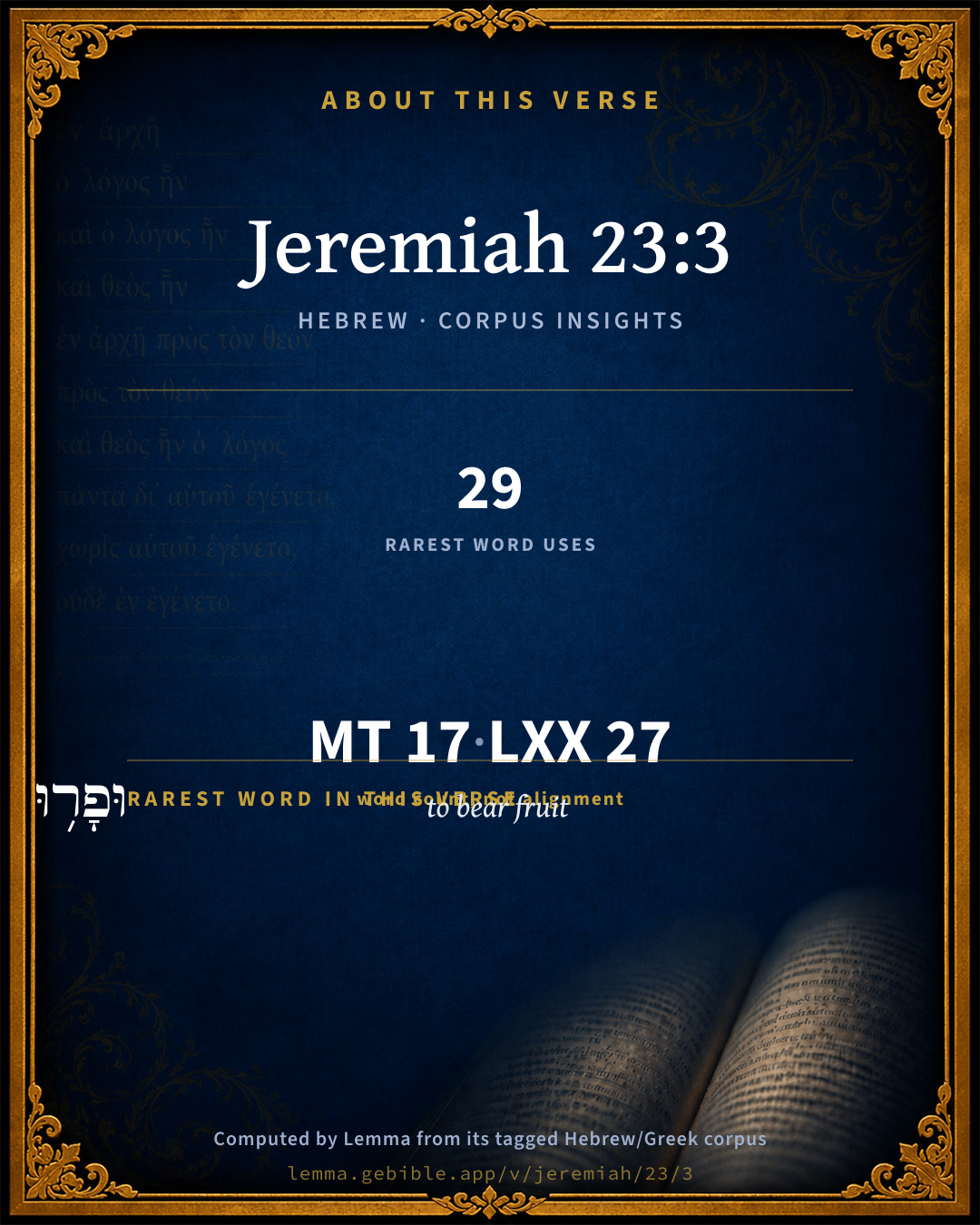
17
words
15
distinct lemmas
Prophets
section

Shared distinctive vocabulary

וּפָר֥וּ to bear fruit H6509 occurs in 28 verses of the Hebrew Bible. Also found in:

Grammatical profile

  • 5 verbs
  • 5 nouns
  • 1 pronoun
  • 1 preposition
  • 1 adverb
  • 4 particles

Verb forms

  • אֲקַבֵּץ֙ Piel · Imperfect
  • הִדַּ֥חְתִּי Hiphil · Perfect
  • וַהֲשִׁבֹתִ֥י Hiphil · Sequential Perfect
  • וּפָר֥וּ Qal · Sequential Perfect
  • וְרָבֽוּ Qal · Sequential Perfect

Hebrew & Septuagint length

In the original languages it is 17 Hebrew tokens and 27 Greek tokens — but the two are counted differently (Hebrew bundles its prefixes and suffixes into one token; the Greek is in lemma form), so that isn’t a like-for-like length.

Cross-references

19

Topical passages linked to Jeremiah 23:3 in the Treasury of Scripture Knowledge — connected by theme and wording, ordered by reader-vote popularity; previews shown in the World English Bible.

  • Amos 9:14–15 I will bring back the captivity of my people Israel, And they will rebuild the ruined cities, and inhabit them; and they will plant vineyards, and drink wine from them. They shall also make gardens, And eat the fruit of them.
  • Jeremiah 32:37 Behold, I will gather them out of all the countries, where I have driven them in my anger, and in my wrath, and in great indignation; and I will bring them again to this place, and I will cause them to dwell safely:
  • Isaiah 43:5–6 Don't be afraid; for I am with you: I will bring your seed from the east, and gather you from the west;
  • Jeremiah 29:14 I will be found by you, says Yahweh, and I will turn again your captivity, and I will gather you from all the nations, and from all the places where I have driven you, says Yahweh; and I will bring you again to the place from where I caused you to be carried away captive.
  • Jeremiah 30:3 For, behold, the days come, says Yahweh, that I will turn again the captivity of my people Israel and Judah, says Yahweh; and I will cause them to return to the land that I gave to their fathers, and they shall possess it.
  • Zephaniah 3:19–20 Behold, at that time I will deal with all those who afflict you, and I will save those who are lame, and gather those who were driven away. I will give them praise and honor, whose shame has been in all the earth.
  • Ezekiel 37:21–27 Say to them, Thus says the Lord Yahweh: Behold, I will take the children of Israel from among the nations, where they are gone, and will gather them on every side, and bring them into their own land:
  • Ezekiel 11:17 Therefore say, Thus says the Lord Yahweh: I will gather you from the peoples, and assemble you out of the countries where you have been scattered, and I will give you the land of Israel.
  • Jeremiah 31:8 Behold, I will bring them from the north country, and gather them from the uttermost parts of the earth, [and] with them the blind and the lame, the woman with child and her who travails with child together: a great company shall they return here.
  • Ezekiel 34:11–31 For thus says the Lord Yahweh: Behold, I myself, even I, will search for my sheep, and will seek them out.
  • Isaiah 11:11–16 It shall happen in that day, that the Lord will set his hand again the second time to recover the remnant of his people, who shall remain, from Assyria, and from Egypt, and from Pathros, and from Cush, and from Elam, and from Shinar, and from Hamath, and from the islands of the sea.
  • Deuteronomy 30:3–5 that then Yahweh your God will turn your captivity, and have compassion on you, and will return and gather you from all the peoples, where Yahweh your God has scattered you.
  • Psalms 106:47 Save us, Yahweh, our God, Gather us from among the nations, To give thanks to your holy name, To triumph in your praise!
  • Zechariah 10:8–12 I will signal for them, and gather them; For I have redeemed them; And they will increase as they have increased.
  • Ezekiel 36:24 For I will take you from among the nations, and gather you out of all the countries, and will bring you into your own land.
  • Isaiah 27:12–13 It shall happen in that day, that Yahweh will beat off [his fruit] from the flood of the River to the brook of Egypt; and you shall be gathered one by one, you children of Israel.
  • Ezekiel 36:37 Thus says the Lord Yahweh: For this, moreover, will I be inquired of by the house of Israel, to do it for them: I will increase them with men like a flock.
  • Ezekiel 39:27–28 when I have brought them back from the peoples, and gathered them out of their enemies' lands, and am sanctified in them in the sight of many nations.
  • Micah 7:12 In that day they will come to you from Assyria and the cities of Egypt, And from Egypt even to the River, And from sea to sea, And mountain to mountain.

Cross-references courtesy of OpenBible.info (CC BY 4.0).

Hebrew and Greek witnesses Masoretic Hebrew ↔ Greek Septuagint

The same verse in the two great witnesses to the Old Testament, shown verse-for-verse.

These are two independent witnesses, not word-aligned to each other, and the Septuagint is shown in lemma (dictionary) form.

Hebrew Jeremiah 23:3 Masoretic · Westminster Leningrad Codex

וַאֲנִ֗י אֲקַבֵּץ֙ אֶת שְׁאֵרִ֣ית צֹאנִ֔י מִכֹּל֙ הָאֲרָצ֔וֹת אֲשֶׁר הִדַּ֥חְתִּי אֹתָ֖ם שָׁ֑ם וַהֲשִׁבֹתִ֥י אֶתְהֶ֛ן עַל נְוֵהֶ֖ן וּפָר֥וּ וְרָבֽוּ

I will gather the remnant of my flock out of all the countries where I have driven them, and will bring them again to their folds; and they shall be fruitful and multiply.

World English Bible · Public Domain

Greek LXX Structure differs

In the Septuagint, Jeremiah is about an eighth shorter than the Hebrew and arranges its material differently — the Oracles Against the Nations (Hebrew chapters 46–51) appear in the middle of the Greek book, after 25:13. Because the chapter and verse boundaries do not line up, a verse-for-verse comparison with the Hebrew is not shown.

A verse-for-verse comparison isn’t shown here because the chapters and verses don’t line up. Switch to the LXX edition with the MT / LXX toggle above to read the Greek directly.

Hebrew: Westminster Leningrad Codex (CC BY 4.0). Greek: Septuagint (public domain); English from a public-domain English Septuagint. How the Septuagint differs from the Hebrew →

Targum (Aramaic paraphrase)

1

The Targum is the ancient Jewish Aramaic paraphrase of the Hebrew Scriptures — an interpretive translation, not the Hebrew text itself. Onkelos (literal) and Pseudo-Jonathan (expansive) render the Torah, and Jonathan the Prophets. Coverage is partial: where no permissively-licensed English translation exists for a verse, only the Aramaic is shown. This is verse-level text, not a word-by-word alignment to the Hebrew.

  1. Targum Jonathan Prophets (Joshua–Malachi)
    וַאֲנָא אַכְנֵישׁ יַת שְׁאָרָא דְעַמִי מִכֹּל מְדִינָתָא דְאַגְלֵיתִי יַתְהוֹן לְתַמָן וַאֲתֵיב יַתְהוֹן לְאַתְרֵיהוֹן וְיִפְשׁוּן וְיִסְגוּן:

    (no public-domain English translation for this verse)

    Targum Jonathan — Aramaic: “Mikraot Gedolot” (public domain). English: “Sefaria Community Translation” (CC0 1.0 (public-domain dedication)); “London "Chaldee Paraphrase," 1871” (public domain). Text via Sefaria.

Commentary

Notes on Jeremiah 23:3 from classic Christian and Jewish commentators (each source and its license shown beneath its notes). The classic Christian expositions comment on the surrounding passage and are grouped to its opening verse, so a note may address several verses; the Jewish commentaries on the Tanakh (Rashi and others) are per-verse, so they appear only where the commentator wrote on this verse.

Lemma curates 59 commentaries, every one of them public domain or Creative Commons licensed, each selected and text-cleaned for this edition rather than reprinted as found. About our sources →

Trapp's Complete Commentary

John Trapp

Jer 23:3 And I will gather the remnant of my flock out of all countries whither I have driven them, and will bring them again to their folds; and they shall be fruitful and increase.

Ver. 3. And I will gather the remnant of my flock.] I will bring them back from Babylon, but especially from out of this present evil world, into the bosom of my Church, by Christ the Arch-shepherd, and by such under-shepherds as he shall make use of to that purpose. {Eph 4:11}

And they shall be fruitful and increase.] Gignendo gentes, by begetting the Gentiles unto Christ, through the preaching of the gospel.

John Trapp, A Commentary or Exposition upon All the Books of the Old and New Testament (1647–1656) — public domain. Text from a community e-Sword module.

The Biblical Illustrator

Joseph S. Exell

Jer_23:3

I will gather the remnant of my flock out of all countries.

Home missions

As when some beautiful picture which has been put aside and forgotten, hid, it may be, from the enemy in time of invasive war, is found and cleansed and restored, and the eye is delighted with the gradual revelation of colour and of form, the life-like features of the portrait, the characters and incidents of the historical scene, the sunny landscape, or the moon-lit sea: so in that great revival of spiritual life which came by God s grace little more than fifty years ago into this Church of England, the glorious truths of the Gospel, the joy Which we have in the presence of our Lord, in His Sacraments and Scriptures, in our praises and our prayers, in our daily duty done in His name, and in our works of mercy done for His sake, have been again abundantly given to the faith which worketh by love. Oh! blessed be He who of His tender mercy hath visited and redeemed His people. This merciful, marvellous restoration maybe divided into three developments. First, there was the restoration of Faith: Credenda, what we should believe. Then there was the restoration of Hope: Precanda, what we should pray for, and when and how we should pray,--a restoration of worship. Thirdly, there came the grandest development o fall--the restoration of charity, love: Agenda, the things we have got to do for God, our duty to Him and our duty to each other; to love Him with all our heart, and all our soul, and all our strength, and then to love our neighbour as ourself. It is impossible for a Church or an individual to be quickened with spiritual life, and not yearn that others should be saved. It is impossible for your heart and mine to be unfed with the sacred heart of Jesus and not to long that others should share our joy and peace in believing. Jubilant and thankful--thankful for the past, strong and of a good courage in the present, and hopeful of the future--we stand no more by broken cisterns, for God has struck the rock, and the streams are flowing, and our cry is, the Masters cry is, O every one that thirsteth, come ye to the waters and drink Our obedience is that of His mandate, Go ye out rote the streets and lanes of the city, and bring in hither the lame, the halt, and the blind; go into the byways and hedges and bring in all--compel them to come in. Surely we may ask, almost in shame, are we true sons of those forefathers who built such churches as this, are we true sons of the men who built those grand cathedrals, and churches, and hospitals, and colleges throughout England? Was there ever a time when it was so needful that the Spirit of the Gospel should be brought to bear upon the divisions and dissensions which are among us? I mean, for example, the jealousies that exist between the classes, the commercial rivalries, the disaffection which there is. Without going beyond the measure of our knowledge, without presuming to interfere between employers and employed as to wages and those matters which we cannot possibly understand, we have an influence in pleading the great principles of justice, and honesty, and love, which, though it may be resented at first by those who are in the wrong, must in the end prevail and be established. Was there ever a time when it was more needful for men who know that God is no respecter of persons to preach the equality of all souls for whom the Lord Jesus died? It has been well said that the Gospel code, if it could only be enforced by human laws and a human legislature, would produce a condition of security and success of which the most sanguine, the cleverest politician has never even dreamed. But the Gospel is something infinitely higher and better to you and me. To you and me Christianity means all that is brave and pure in our life, all that is bright and happy in our death. It means re-union with those whom we have loved and whom we loved the best. It means--I hardly dare speak the thought--it means that you and I shall be sinless, and shall see God. It is impossible to have such a faith and hope as this, and not to desire that all should share it, and that none should perish. It is impossible for us to love God and not to love our brother also. (Dean Hole.)

The Biblical Illustrator, edited by Joseph S. Exell (c. 1880s–1900s) — public domain. Text from a community e-Sword module.

The Expositor's Bible

CHAPTER XXXI

RESTORATION II

THE NEW ISRAEL

Jer_23:3-8; Jer_24:6-7; Jeremiah 30; Jeremiah 31; Jeremiah 33

"In those days shall Judah be saved, and Jerusalem shall dwell safely: and this is the name whereby she shall be called."- Jer_33:16

THE Divine utterances in chapter 33, were given to Jeremiah when he was shut up in the "court of the guard" during the last days of the siege. They may, however, have been committed to writing at a later date, possibly in connection with Chapters 30 and 31, when the destruction of Jerusalem was already past. It is in accordance with all analogy that the final record of a "word of Jehovah" should include any further light which had come to the prophet through his inspired meditations on the original message. Chapters 30, 31, and 33 mostly expound and enforce leading ideas contained in Jer_32:37-44 and in earlier utterances of Jeremiah. They have much in common with 2 Isaiah. The ruin of Judah and the captivity of the people were accomplished facts to both writers, and they were both looking forward to the return of the exiles and the restoration of the kingdom of Jehovah. We shall have occasion to notice individual points of resemblance later on.

In Jer_30:2 Jeremiah is commanded to write in a book all that Jehovah has spoken to him; and according to the present context the "all," in this case, refers merely to the following four chapters. These prophecies of restoration would be specially precious to the exiles; and now that the Jews were scattered through many distant lands, they could only be transmitted and preserved in writing. After the command "to write in a book" there follows, by way of title, a repetition of the statement that Jehovah would bring back His people to their fatherland. Here, in the very forefront of the Book of Promise, Israel and Judah are named as being recalled together from exile. As we read twice {Jer_16:14-15; Jer_23:7-8} elsewhere in Jeremiah, the promised deliverance from Assyria and Babylon was to surpass all other manifestations of the Divine power and mercy. The Exodus would not be named in the same breath with it: "Behold, the days come, saith Jehovah, that it shall no more be said, As Jehovah liveth, that brought up the Israelites out of the land of Egypt: but, As Jehovah liveth, that brought up the Israelites from the land of the north, and from all the countries whither He had driven them." This prediction has waited for fulfilment to our own times: hitherto the Exodus has occupied mens minds much more than the Return; we are now coming to estimate the supreme religious importance of the latter event.

Elsewhere again Jeremiah connects his promise with the clause in his original commission "to build and to plant": {Jer_1:10} "I will set My eyes upon them" (the captives) "for good, and I will bring them again to this land; and I will build them, and not pull them down; and I will plant them, and not pluck them up." {Jer_24:7} As in Jer_32:28-35, the picture of restoration is rendered more vivid by contrast with Judahs present state of wretchedness; the marvellousness of Jehovahs mercy is made apparent by reminding Israel of the multitude of its iniquities. The agony of Jacob is like that of a woman in travail. But travail shall be followed by deliverance and triumph. In the second Psalm the subject nations took counsel against Jehovah and against His Anointed:-

"Let us break their bands asunder,

And cast away their cords from us";

but now this is the counsel of Jehovah concerning His people and their Babylonian conqueror:-

"I will break his yoke from off thy neck,

And break thy bands asunder."

Judahs lovers, her foreign allies, Assyria, Babylon, Egypt, and all the other states with whom she had intrigued, had betrayed her; they had cruelly chastised her, so that her wounds were grievous and her bruises incurable. She was left without a champion to plead her cause, without a friend to bind up her wounds, without balm to allay the pain of her bruises. "Because thy sins were increased, I have done these things unto thee, saith Jehovah." Jerusalem was an outcast, of whom men said contemptuously: "This is Zion, whom no man seeketh after." But mans extremity is Gods opportunity; because Judah was helpless and despised, therefore Jehovah said, "I will restore health unto thee, and I will heal thee of thy wounds."

While Jeremiah was still watching from his prison the progress of the siege, he had seen the houses and palaces beyond the walls destroyed by the Chaldeans to be used for their mounds; and had known that every sally of the besieged was but another opportunity for the enemy to satiate themselves with slaughter, as they executed Jehovahs judgments upon the guilty city. Even at this extremity He announced solemnly and emphatically the restoration and pardon of His people.

"Thus saith Jehovah, who established the earth, when He made and fashioned it-Jehovah is His name:

Call upon Me, and I will answer thee, and will show thee great mysteries, which thou knowest not."

"I will bring to this city healing and cure, and will cause them to know all the fulness of steadfast peace . . .

I will cleanse them from all their iniquities, and will pardon all their iniquities, whereby they have sinned and transgressed against Me."

The healing of Zion naturally involved the punishment of her cruel and treacherous lovers. The Return, like other revolutions, was not wrought by rose water; the yokes were broken and the bands rent asunder by main force. Jehovah would make a full end of all the nations whither He had scattered them. Their devourers should be devoured, all their adversaries should go into captivity, those who had spoiled and preyed upon them should become a spoil and a prey. Jeremiah had been commissioned from the beginning to pull down foreign nations and kingdoms as well as his native Judah. {Jer_1:10} Judah was only one of Israels evil neighbours who were to be plucked up out of their land. And at the Return, as at the Exodus, the waves at one and the same time opened a path of safety for Israel and overwhelmed her oppressors.

Israel, pardoned and restored, would again be governed by legitimate kings of the House of David. In the dying days of the monarchy Israel and Judah had received their rulers from the hands of foreigners. Menahem and Hoshea bought the confirmation of their usurped authority from Assyria. Jehoiakim was appointed by Pharaoh Necho, and Zedekiah by Nebuchadnezzar. We cannot doubt that the kings of Egypt and Babylon were also careful to surround their nominees with ministers who were devoted to the interests of their suzerains. But now "their nobles were to be of themselves, and their ruler was to proceed out of their midst," {Jer_30:21} i.e., nobles and rulers were to hold their offices according to national custom and tradition.

Jeremiah was fond of speaking of the leaders of Judah as shepherds. We have had occasion already (Cf. chapter 8) to consider his controversy with the "shepherds" of his own time. In his picture of the New Israel he uses the same figure. In denouncing the evil shepherds he predicts that, when the remnant of Jehovahs flock is brought again to their folds, He will set up shepherds over them which shall feed them, {Jer_23:3-4} shepherds. according to Jehovahs own heart, who should feed them with knowledge and understanding. {Jer_3:15}

Over them Jehovah would establish as Chief Shepherd a Prince of the House of David. Isaiah had already included in his picture of Messianic times the fertility of Palestine; its vegetation, by the blessing of Jehovah, should be beautiful and glorious: he had also described the Messianic King as a fruitful Branch out of the root of Jesse. Jeremiah takes the idea of the latter passage, but uses the language of the former. For him the King of the New Israel is, as it were, a Growth (cemah) out of the sacred soil, or perhaps more definitely from the roots of the House of David, that ancient tree whose trunk had been hewn down and burnt. Both the Growth (cemah) and the Branch (necer) had the same vital connection with the soil of Palestine and the root of David. Our English versions exercised a wise discretion when they sacrificed literal accuracy and indicated the identity of idea by translating both "cemah" and "necer" by "Branch."

"Behold, the days come, saith Jehovah, that I will raise up unto David a righteous Branch; and He shall be a wise and prudent King, and He shall execute justice and maintain the right. In His days Judah shall be saved and Israel shall dwell securely, and his name shall be Jehovah Cidqenu, Jehovah is our righteousness." Jehovah Cidqenu might very well be the personal name of a Jewish king, though the form would be unusual; but what is chiefly intended is that His character shall be such as the "name" describes. The "name" is a brief and pointed censure upon a king whose character was the opposite of that described in these verses, yet who bore a name of almost identical meaning-Zedekiah, Jehovah is my righteousness. The name of the last reigning Prince of the House of David had been a standing condemnation of his unworthy life, but the King of the New Israel, Jehovahs true Messiah, would realise in His administration all that such a name promised. Sovereigns delight to accumulate sonorous epithets in their official designations-Highness, High and Mighty, Majesty, Serene, Gracious. The glaring contrast between character and titles often only serves to advertise the worthlessness of those who are labelled with such epithets: the Majesty of James I, the Graciousness of Richard III. Yet these titles point to a standard of true royalty, whether the sovereign be an individual or a class or the people; they describe that Divine Sovereignty which will be realised in the Kingdom of God.

The material prosperity of the restored community is set forth with wealth of glowing imagery. Cities and palaces are to be rebuilt on their former sites with more than their ancient splendour. "Out of them shall proceed thanksgiving, and the voice of them that make merry: and I will multiply them, and they shall not be few; I will also glorify them, and they shall not be small. And the children of Jacob shall be as of old, and their assembly shall be established before Me." {Jer_30:18-20} The figure often used of the utter desolation of the deserted country is now used to illustrate its complete restoration: "Yet again shall there be heard in this place the voice of joy and the voice of gladness, the voice of the bridegroom and the voice of the bride." Throughout all the land "which is waste, without man and without beast, and in all the cities thereof," shepherds shall dwell and pasture and fold their flocks; and in the cities of all the districts of the Southern Kingdom enumerated as exhaustively as in Jer_32:44 shall the flocks again pass under the shepherds hands to be told. {Jer_33:10-13}

Jehovahs own peculiar flock, His Chosen People, shall be fruitful and multiply according to the primeval blessing; under their new shepherds they shall no more fear nor be dismayed, neither shall any be lacking. {Jer_23:3-4} Jeremiah recurs again and again to the quiet, the restfulness, the freedom from fear and dismay of the restored Israel. In this, as in all else, the New Dispensation was to be an entire contrast to those long weary years of alternate suspense and panic, when mens hearts were shaken by the sound of the trumpet and the alarm of war. {Jer_4:19} Israel is to dwell securely at rest from fear of harm. {Jer_23:6} When Jacob returns he "shall be quiet and at ease, and none shall make him afraid." {Jer_30:10} Egyptian, Assyrian, and Chaldean shall all cease from troubling; the memory of past misery shall become dim and shadowy.

The finest expansion of this idea is a passage which always fills the soul with a sense of utter rest.

"He shall dwell on high: his refuge shall be the inaccessible rocks: his bread shall be given him; his waters shall be sure. Thine eyes shall see the king in his beauty: they shall behold a far-stretching land. Thine heart shall muse on the terror: where is he that counted, where is he that weighed the tribute? where is he that counted the towers? Thou shalt not see the fierce people, a people of a deep speech that thou canst not perceive; of a strange tongue that thou canst not understand. Look upon Zion, the city of our solemnities: thine eyes shall see Jerusalem a quiet habitation, a tent that shall not be removed, the stakes whereof shall never be plucked up, neither shall any of the cords thereof be broken. There Jehovah will be with us in majesty, a place of broad rivers and streams; wherein shall go no galley with oars, neither shall gallant ship pass thereby." (Isa_33:16-21; Isa_32:15-18.)

For Jeremiah too the presence of Jehovah in majesty was the only possible guarantee of the peace and prosperity of Israel. The voices of joy and gladness in the New Jerusalem were not only those of bride and bridegroom, but also of those that said, "Give thanks to Jehovah Sabaoth, for Jehovah is good, for His mercy endureth forever," and of those that "came to offer sacrifices of thanksgiving in the house of Jehovah." {Jer_33:11} This new David, as the Messianic King is called, {Jer_30:9} is to have the priestly right of immediate access to God: "I will cause Him to draw near, and He shall approach unto Me: for else who would risk his life by daring to approach Me?" {Jer_30:21, as Kautzsch.} Israel is liberated from foreign conquerors to serve Jehovah their God and David their King; and the Lord Himself rejoices in His restored and ransomed people.

The city that was once a desolation, an astonishment, a hissing, and a curse among all nations shall now be to Jehovah "a name of joy, a praise and a glory, before all the nations of the earth, which shall hear all the good that I do unto them, and shall tremble with fear for all the good and all the peace that I procure unto it." {Jer_33:9}

William Robertson Nicoll, ed., The Expositor's Bible (London: Hodder & Stoughton, 1887–1910) — public domain. 65 of 66 books (1 Corinthians is not separately keyed, as that volume carries no machine-parseable verse references); section-level commentary keyed to the opening verse. Introductory and overview sections not keyed to a specific passage are excluded.

Tyndale Open Study Notes

Tyndale Open Resources

23:3 As a good shepherd, the Lord would gather the exiles and place them in their own sheepfold, the land of Judah. There, they would be fruitful and increase in number (cp. Gen 1:28; 17:6-8).

Tyndale Open Study Notes — © Tyndale Open Resources, licensed CC BY-SA 4.0. Text via the HelloAO Bible API.

Geneva Bible (1599)

Geneva Bible translators

Thus the Prophets ever used to mix the promises with the threatenings, lest the godly should be too much beaten down, and therefore he showeth how God will gather his Church after this dispersion.

Geneva Bible (1599) marginal notes — public domain. Text via Bolls.life.

Jamieson, Fausset & Brown

Robert Jamieson, A. R. Fausset & David Brown

Restoration of Judah from Babylon foretold in language which in its fulness can only apply to the final restoration of both "Judah" and "Israel" (compare Jer 23:6); also "out of all countries," in this verse and Jer 23:8; also, "neither shall they be lacking," that is, none shall be missing or detached from the rest: a prophecy never yet fully accomplished. It holds good also of the spiritual Israel, the elect of both Jews and Gentiles (Mal 3:16-17; Joh 10:28; Joh 17:12). As to the literal Israel also, see Jer 32:37; Isa 54:13; Isa 60:21; Eze 34:11-16.

shepherds . . . shall feed them-- (Jer 3:15; Eze 34:23-31). Zerubbabel, Ezra, Nehemiah, and the Maccabees were but typical of the consummating fulfilment of these prophecies under Messiah.

Jamieson, Fausset & Brown — Commentary Critical and Explanatory on the Whole Bible (1871) — public domain (CC PDM 1.0). Text via the HelloAO Bible API.

John Calvin's Commentaries

It then follows, And I will gather my flock. As they had driven the people away, so God promises that it would be his care to gather them. And yet he ascribes to himself what he had imputed to them — that he had driven away his flock, but in a different sense; the pastors had scattered the flock, not only by their sloth, but also by their cruelty, for they became rapacious wolves; but God had punished the people, for they all had fully deserved such a scattering. We hence see that the ungodly execute God’s judgment; but they are not on this account excusable as though they were God’s ministers, for they have nothing less in view. Nor can God be involved in their sin, while he thus employs them to execute his purpose. In short, the scattering of the people was a just punishment from God, for they had all departed from the faith, they had broken the sacred bond of the covenant, by which God had bound them to himself. It was also the fault of the pastors, because they avariciously and cruelly tyrannized over them. The pastors, as I have said, were not only the priests, but also the king and his counsellors.

I will gather, he says, not the flock, but the remnant of the sheep God intimates here that he would be so merciful as to receive unto favor, not all indiscriminately, but a small number, constituting the elect. And hence Paul carefully distinguished between the people and the remnant of grace, or the gratuitous remnant; for Christ appeared by his coming to have abolished the covenant by which God had adopted the children of Abraham, but Paul does not admit this. Now, if any one objects and says that the greater part of the people had been cut off, this he allows; but he says that the covenant remains valid in the remnant, and produces also examples, such as that of which we now speak. God then has ever been the preserver of his Church; and thus his gratuitous adoption, by which he had chosen the seed of Abraham, never fails. But this adoption is effectual only as to the remnant.

As to the word remnant, the fewness of those whom God had resolved to gather is not only intimated, but also the vengeance, which as to time had gone before; for God seemed to have destroyed the Jews when they were driven away into various lands, as they had no name remaining, the kingdom and the priesthood were abolished. It was therefore a certain kind of death, as I have before said; but God here declares that there would be some remnant, according to what is said in Isaiah 10:22, that God saved a few as it were from the consumption; for he refers there to the very few that remained alive, when they thought that all was over with the whole people, that there was no hope of restoration.

I will gather, he says, the residue of my sheep from all the lands to which I shall have driven them He again confirms what I have stated, that there would be no place for mercy until he had cleansed his Church from its many filthy pollutions. The scattering then of the people into various lands was the purgation of the Church, according to what God says, that he would separate the refuse and the chaff from the wheat in chastising his people; for as the chaff and the refuse are blown here and there when the wheat is winnowed, and the wheat only remains and is afterwards laid up in the granary; so when God drove his people away into various lands, he then purged his Church. If any one objects and says, “Then the remnant were dealt with like the refuse;” it is true as to the individuals, but God refers here to himself, when he calls them his own, sheep, who were yet unworthy of such an honor.

He then adds, that he would bring them back to their folds, that they might be fruitful, that is, bring forth and increase, and be multiplied By folds he no doubt means the land of Canaan; for there was then no wealth in the world which the Jews would have preferred to the inheritance promised to them; the whole world was to them an exile. For God had chosen that land in which they dwelt, and had consecrated it to himself, and he gave it to them as an earnest or a pledge of the eternal inheritance. Rightly then does he now call that land folds, for they lived there under his guardianship and protection. The temple was as it were the pastoral staff; they knew that God dwelt there, that being protected by his power they might continue in safety. Since then there was safety for them under God’s protection in the land of Canaan, he calls it their fold. Then he says, that they may be fruitful, and be multiplied; for among other blessings their increase was not the least. He afterwards adds, —

John Calvin's Commentaries (1540-1563) — public domain. Text from the Calvin Translation Society English edition (1840s-50s) via the Christian Classics Ethereal Library (ccel.org). Calvin's coverage is partial (roughly two-thirds of the Bible); uncommented books and verses are honest gaps, never fabricated. The 19th-century editor's footnotes and remarks are omitted so the notes are faithfully Calvin's own voice.

Ellicott's Commentary for English Readers

(3) To their folds.—Better, habitations, or pastures. There was hope, as in Isa_1:9; Isa_6:13, for the “remnant” of the people, though the sentence on their rulers, as such, was final and irreversible.

A Bible Commentary for English Readers, edited by Charles John Ellicott (1878–1897) — public domain. Text from a community e-Sword module.

The Cambridge Bible for Schools and Colleges

gen. ed. J. J. S. Perowne

3. folds] rather, “homestead,” as Dr. Cp. Jer_10:25, Jer_25:30.

The Cambridge Bible for Schools and Colleges (gen. ed. J. J. S. Perowne; Cambridge University Press, 1878–1918) — public domain. Text from a community e-Sword module.

John Gill's Exposition

And I will gather the remnant of my flock, out of all countries,.... Such of them as did not perish by the sword, famine, and pestilence, or died not in captivity, and chose not to remain in the kingdom where they were; for all did not return upon the edict of Cyrus: though some think this is to be understood of the gathering of God's elect, the remnant according to the election of grace, the children of God that were scattered abroad, by the sufferings and death of Christ, the Shiloh, to whom the gathering of the people should be, hereafter prophesied of:

whither I have driven them; this, which is before charged upon the pastors, is taken by the Lord to himself; because this was not only permitted by him, namely, the dispersion and captivity of the Jews, but was inflicted by him as a punishment upon them for their sins, and the sins of their governors; but yet such was the mercy and goodness of God, as to return a remnant of them:

and will bring them again to their folds; to the city of Jerusalem, and their dwelling houses there, and in other places; an emblem of the Lord's bringing his chosen remnant, whether Jews or Gentiles, into a good fold and good pastures, to a Gospel church state, and the ordinances of it, Joh 10:16;

and they shall be fruitful and increase; the remnant of the flock returned to their own land and dwellings, and there grow numerous, and increase in wealth and riches; as Christ's spiritual sheep, gathered into his fold, become fruitful in grace and good works, and increase with the increase of God.

John Gill's Exposition of the Whole Bible (1746–1763) — public domain (CC PDM 1.0). Text via the HelloAO Bible API.

Albert Barnes' Notes on the Bible

While there is no promise of restoration for the kings, there is for the people (see Jer 4:27), because they had been led astray by their rulers.

Have driven them - The evil shepherds drove the people into exile by leading them into sin: and God by inflicting punishment.

Their folds - Or, their pastures.

Albert Barnes' Notes on the Bible (1834–1885) — public domain. Text from a community e-Sword/MySword module.

Haydock's Catholic Bible Commentary

Multiplied. The prophets subjoin tidings of peace to such as might cause affliction. (Theodoret)

George Leo Haydock (1774–1849), Haydock's Catholic Family Bible and Commentary, 1859 edition — public domain. Excludes Psalms (Douay-Rheims chapter numbering differs from Protestant) and Deuterocanonical books (Catholic canon only).

Matthew Poole's English Annotations

God puts a difference betwixt those that were misled by the examples of others, and the rulers who set them such an ill example; he threatened Jehoiakim and Jehoiachin, or Jeconiah, that they should return no more; but for the people, he here promiseth them a return, at least a remnant of them, when he should have punished the goats, as he speaketh, Zec 10:3. By their folds, he meaneth Jerusalem, and other cities, the towns of Judah which they had formerly inhabited. And they shall be fruitful and increase; where they should once more be in prosperity. He speaks here concerning the return of this people out of the captivity of Babylon, though there be some that think this text is primarily to be understood of the gathering together in one the people of God scattered abroad in and by Christ, according to the prophecy of Caiaphas, Joh 11:52.

Matthew Poole's English Annotations on the Holy Bible (1683–1685) — public domain. Text from a community e-Sword/MySword module.

Whedon's Commentary on the Bible

Daniel D. Whedon

3. I have driven — Here God appropriates to himself the very term he had just applied to the evil shepherds to their blame. So we have brought into view two aspects of the same event. So Joseph said to his brethren, “Not you sent me hither, but God,” Gen_45:8 : a statement that seems the exact opposite of the truth, and yet was most profoundly and exactly true. The real meaning is, Not so much you as God. The event turns one of its faces toward those wicked men, Joseph’s brethren; but another, and a totally different one, toward God. So here. These shepherds, by their neglect, had scattered and destroyed the flock; on the other hand God, for the sins of this very flock, drove them into exile.

Daniel D. Whedon (gen. ed.), Commentary on the Old and New Testaments (1874–1909) — public domain. Text from a community e-Sword module.

The Pulpit Commentary

Parallel passage, Eze_34:12-15. I will gather the remnant; For the ill usage of foreign oppressors has supplemented that of home tyrants, so that only a "remnant" is left. And they shall be fruitful and increase. The fertility of the Jewish race in modern times has been a frequent subject of observation, and supplies the best comment upon Jeremiah s prophecy.

The Pulpit Commentary (1880–1919), ed. H.D.M. Spence-Jones & Joseph S. Exell — public domain. Text from a community e-Sword module.

Scofield Reference Notes

C. I. Scofield

remnant

(See Scofield "Jer 15:21").

The Scofield Reference Bible (1917 edition), notes by C. I. Scofield — public domain. Text from a community e-Sword module.

unfoldingWord translationNotes

Door43 World Missions Community

General Information:

Yahweh continues to speak about the people of Israel as if they were his sheep and the leaders of Israel as if they were his shepherds. (See: Metaphor)

to a grazing place

Yahweh refers to the land of Israel as if it were good pasture for his people. This good pasture is a metonym for provision for their needs. AT: "to good pasture" or "to where all their needs will be supplied" (See: Metaphor and Metonymy)

they will be fruitful and increase

The word "increase" explains how they will be "fruitful." AT: "they will increase greatly in number" (See: Doublet)

I will raise up

"I will appoint"

they will no longer fear or be shattered

The words "be shattered" mean that someone has caused them to be afraid and mean basically the same thing as "fear." This can be stated in active form. AT: "no one will make them afraid anymore" (See: Doublet and Active or Passive)

None of them

"None of my people"

this is Yahweh's declaration

Yahweh speaks of himself by name to express the certainty of what he is declaring. See how you translated this in Jeremiah 1:8. AT: "this is what Yahweh has declared" or "this is what I, Yahweh, have declared" (See: First, Second, or Third Person)

translationWords

remnant

flocks

cast out

fruit

raise

fear

unfoldingWord translationNotes — © Distant Shores Media and the Door43 World Missions Community, licensed CC BY-SA 4.0. Source: git.door43.org/Door43/en_tn.

Lesson kit

Teaching starters — assembled from the data on this page, not authored interpretation. Every prompt links to the verse data it draws on. Edit before teaching.

Jeremiah, in the Prophets, opens this verse with 17 words (15 distinct Hebrew lemmas). Its most distinctive word is pârâh (“to bear fruit”). A historical commentator’s framing appears above. Read the whole chapter for the surrounding context.

Discussion questions

  1. How does “to bear fruit” (pârâh) shape what this verse is saying?
  2. How does Genesis 1:22, which shares the word «to bear fruit», read alongside this verse?
  3. These translations render this verse differently. What is at stake in choosing one wording over another?
  4. «אֲקַבֵּץ֙» is a Piel Imperfect verb. How does that grammatical form shape the action described?
  5. Compare how Trapp's Complete Commentary and The Biblical Illustrator read this verse. Where do they agree or differ?

Things to notice

Reading settings

Reading text

Shown beneath each verse's original-language words.

Old Testament
Old Testament edition

Read the OT as the Masoretic Hebrew (MT) or the Greek Septuagint (LXX).

English shown for the Greek Septuagint (in the Hebrew ↔ Greek comparison).

Comparing translations? Open the Compare panel on any verse page to stack up to four side by side.