
Genesis 31:8

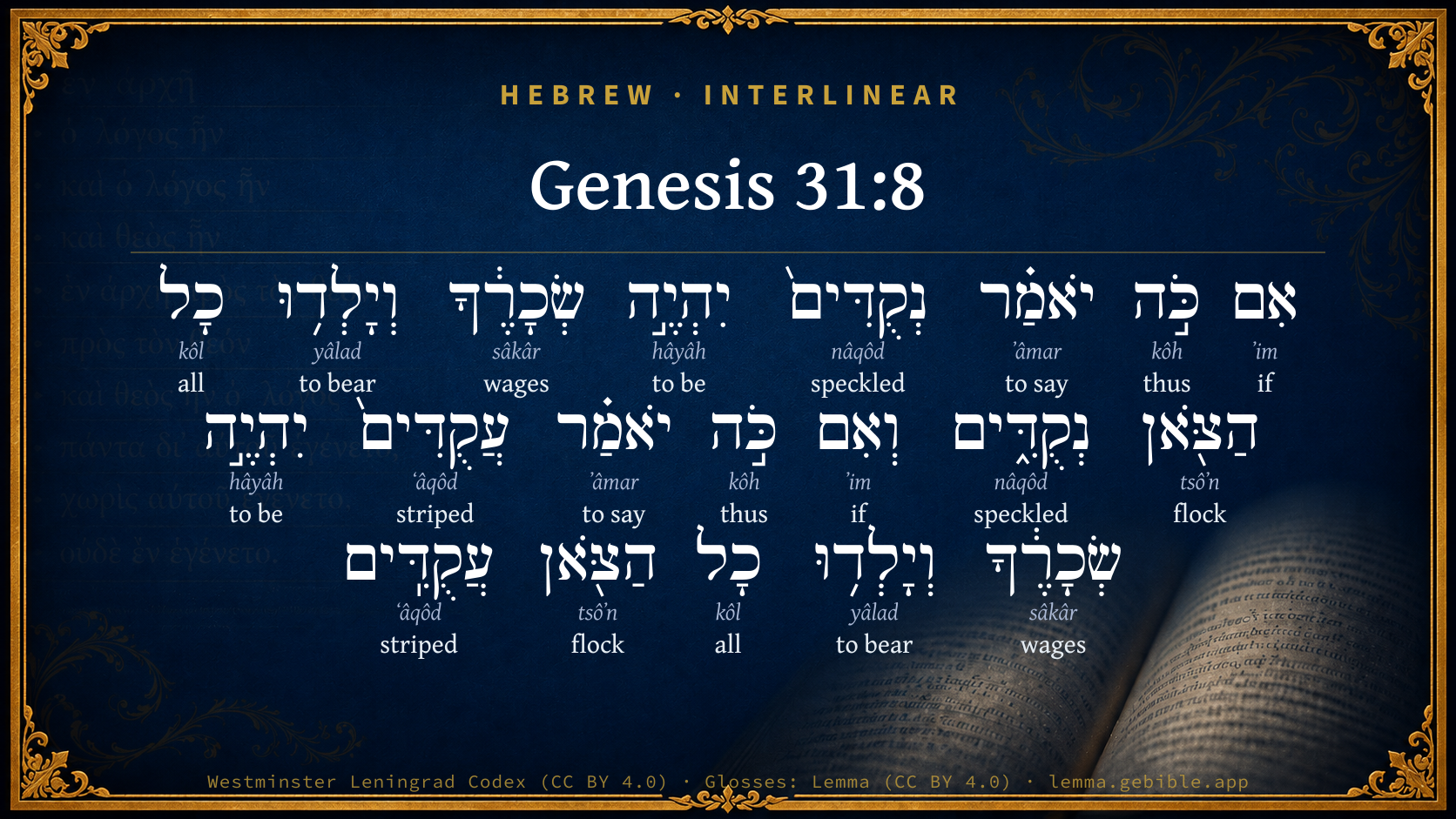
Hebrew (Westminster Leningrad Codex) Genesis 31:8 appears in the Hebrew Old Testament. The text above is from the Westminster Leningrad Codex. Each word links to its Strong’s number, a concise gloss, and parsing drawn from the Open Scriptures Hebrew Bible morphology. Click any word for its full Brown-Driver-Briggs (BDB) entry.
Download image
Cite this verse

Genesis 31:8 (World English Bible). Public Domain. Lemma interlinear Bible study tool, https://lemma.gebible.app/v/genesis/31/8.

Show BibTeX & RIS
BibTeX
RIS
English Translation
If he said this, 'The speckled will be your wages,' then all the flock bore speckled. If he said this, 'The streaked will be your wages,' then all the flock bore streaked.
World English Bible · Public Domain
Download a study sheet

One document with this verse’s original text, its word-by-word gloss line, the meaning frame, cross-references with their text, attributed commentary, and full source and license credits — printable, and it pastes into notes with its structure intact.

This verse Autodidact and up

Study sheet (.html) Plain text (.txt)

A passage Seminary Student

Up to 50 verses in one chapter. A passage sheet keeps up to 6 commentary sources and 12 cross-references per verse, in the order this page ranks them, and says so on the sheet whenever that leaves anything out. Ask for a single verse and you get the Autodidact verse sheet above.

Everything on this page stays free to read, with no account — the sheet is a download of what is already on screen, not access to it.

Want to remove ads? Support Godless Engineer
Compare translations 3

The same verse in 3 English versions, stacked beneath the original-language interlinear above. Click any original word for its lexicon entry.

Each is an independent rendering of the whole verse — the interlinear is not word-aligned to these translations.

Highlighted words mark where these versions differ — a whole-verse word diff, not a word-by-word alignment.

  • World English Bible Public Domain
    If he said this, 'The speckled will be your wages,' then all the flock bore speckled. If he said this, 'The streaked will be your wages,' then all the flock bore streaked.
  • King James Version Public Domain
    If he said thus, The speckled shall be thy wages; then all the cattle bare speckled: and if he said thus, The ring-streaked shall be thy hire; then bare all the cattle ring-streaked.
  • unfoldingWord Literal Text CC BY-SA 4.0
    If he said like this: ‘The speckled will be your wages,’ then all the flock bore speckled. But if he said like this: ‘The streaked will be your wages,’ then all the flock bore streaked.

unfoldingWord Literal Text — © unfoldingWord, licensed CC BY-SA 4.0. Word-aligned USFM3 via Door43 (git.door43.org/unfoldingWord/en_ult).

Versions to compare (up to 4)

3 of 4 selected

Show all 18 translations

Every available English version of this verse, each an independent rendering of the whole verse.

  • World English Bible Public Domain
    If he said this, 'The speckled will be your wages,' then all the flock bore speckled. If he said this, 'The streaked will be your wages,' then all the flock bore streaked.
  • Berean Standard Bible Public Domain
    If he said, ‘The speckled will be your wages,’ then the whole flock bore speckled offspring. If he said, ‘The streaked will be your wages,’ then the whole flock bore streaked offspring.
  • Majority Standard Bible Public Domain
    If he said, ‘The speckled will be your wages,’ then the whole flock bore speckled offspring. If he said, ‘The streaked will be your wages,’ then the whole flock bore streaked offspring.
  • King James Version Public Domain
    If he said thus, The speckled shall be thy wages; then all the cattle bare speckled: and if he said thus, The ring-streaked shall be thy hire; then bare all the cattle ring-streaked.
  • American Standard Version (1901) Public Domain
    If he said thus, The speckled shall be thy wages; then all the flock bare speckled: and if he said thus, The ringstreaked shall be thy wages; then bare all the flock ringstreaked.
  • Revised Version (1885) Public Domain
    If he said thus, The speckled shall be thy wages; then all the flock bare speckled: and if he said thus, The ringstraked shall be thy wages; then bare all the flock ringstraked.
  • Geneva Bible (1599) Public Domain
    If he thus sayd, The spotted shall be thy wages, then all the sheepe bare spotted: and if he sayd thus, the party coloured shalbe thy rewarde, then bare all the sheepe particoloured.
  • Douay-Rheims (1899) Public Domain
    If at any time he said: The speckled shall be thy wages: all the sheep brought forth speckled: but when he said on the contrary: Thou shalt take all the white ones for thy wages: all the flocks brought forth white ones.
  • Young's Literal Translation Public Domain
    `If he say thus: The speckled are thy hire, then bare all the flock speckled ones; and if he say thus: The ring-straked are thy hire, then bare all the flock ring-straked;
  • Literal Standard Version CC BY-SA 4.0
    If he says thus: The speckled are your hire, then all the flock bore speckled ones; and if he says thus: The striped are your hire, then all the flock bore striped;
  • Unlocked Literal Bible CC BY-SA 4.0
    If he said, 'The speckled animals will be your wages,' then all the flock bore speckled young. If he said, 'The striped will be your wages,' then the whole flock bore striped young.
  • unfoldingWord Literal Text CC BY-SA 4.0
    If he said like this: ‘The speckled will be your wages,’ then all the flock bore speckled. But if he said like this: ‘The streaked will be your wages,’ then all the flock bore streaked.
  • Darby Bible Public Domain
    If he said thus; The speckled shall be thy hire, then all the flocks bore speckled; and if he said thus: The ringstraked shall be thy hire, then all the flocks bore ringstraked.
  • World Messianic Bible Public Domain
    If he said, ‘The speckled will be your wages,’ then all the flock bore speckled. If he said, ‘The streaked will be your wages,’ then all the flock bore streaked.
  • Webster's Bible Public Domain
    If he said thus, The speckled shall be thy wages; then all the cattle bore speckled: and if he said thus, The ring-streaked shall be thy hire; then all the cattle bore ring-streaked.
  • Free Bible Version CC BY-SA 4.0
    If he said, ‘You can have the speckled ones as your wages,’ then the whole flock had speckled young. If he said, ‘You can have the streaked ones as your wages,’ then the whole flock had streaked young.
  • Bible in Basic English Public Domain
    If he said, All those in the flock which have marks are to be yours, then all the flock gave birth to marked young; and if he said, All the banded ones are to be yours, then all the flock had banded young.
  • JPS Tanakh (1917) Public Domain
    If he said thus: The speckled shall be thy wages; then all the flock bore speckled; and if he said thus: The streaked shall be thy wages; then bore all the flock streaked.

Literal Standard Version (2020), Covenant Press — licensed CC BY-SA 4.0. Text via the HelloAO Bible API (eBible.org). Unlocked Literal Bible (unfoldingWord) — licensed CC BY-SA 4.0. Text via the HelloAO Bible API (eBible.org). unfoldingWord Literal Text — © unfoldingWord, licensed CC BY-SA 4.0. Word-aligned USFM3 via Door43 (git.door43.org/unfoldingWord/en_ult). Free Bible Version, Dr. Jonathan Gallagher — licensed CC BY-SA 4.0. Text via the HelloAO Bible API (eBible.org).

Word by word

More ways to search: Search by grammar → Find every occurrence → Compare this word →

Practice this passage: Drill this verse → Learn its vocabulary →

עֲקֻדִּים֙
ʻâqôd
H6124
“striped”
Adjective, Adjective, Masculine, Plural, Absolute
Part of Speech
Adjective
Type
Adjective
Gender
Masculine
Number
Plural
State
Absolute
Full BDB Definition

Origin: from H6123

TWOT: 1678a

streaked, striped
  1. אִם ʼim H518 “if” Conjunction
  2. כֹּ֣ה kôh H3541 “thus” Adverb
  3. יֹאמַ֗ר ʼâmar H559 “to say” Verb, Qal, Imperfect, 3rd Person, Masculine, Singular
  4. נְקֻדִּים֙ nâqôd H5348 “speckled” Adjective, Adjective, Masculine, Plural, Absolute
  5. יִהְיֶ֣ה hâyâh H1961 “to be” Verb, Qal, Imperfect, 3rd Person, Masculine, Singular
  6. שְׂכָרֶ֔ךָ sâkâr H7939 “wages · your” Noun, Common, Masculine, Singular, Construct + Suffix, Personal, 2nd Person, Masculine, Singular
  7. וְיָלְד֥וּ yâlad H3205 “and · to bear” Conjunction + Verb, Qal, Perfect, 3rd Person, Common, Plural
  8. כָל kôl H3605 “all of” Noun, Common, Masculine, Singular, Construct
  9. הַצֹּ֖אן tsôʼn H6629 “the · flock” Particle, Definite Article + Noun, Common, Both, Singular, Absolute
  10. נְקֻדִּ֑ים nâqôd H5348 “speckled” Adjective, Adjective, Masculine, Plural, Absolute
  11. וְאִם ʼim H518 “and · if” Conjunction + Conjunction
  12. כֹּ֣ה kôh H3541 “thus” Adverb
  13. יֹאמַ֗ר ʼâmar H559 “to say” Verb, Qal, Imperfect, 3rd Person, Masculine, Singular
  14. יִהְיֶ֣ה hâyâh H1961 “to be” Verb, Qal, Imperfect, 3rd Person, Masculine, Singular
  15. שְׂכָרֶ֔ךָ sâkâr H7939 “wages · your” Noun, Common, Masculine, Singular, Construct + Suffix, Personal, 2nd Person, Masculine, Singular
  16. וְיָלְד֥וּ yâlad H3205 “and · to bear” Conjunction + Verb, Qal, Perfect, 3rd Person, Common, Plural
  17. כָל kôl H3605 “all of” Noun, Common, Masculine, Singular, Construct
  18. הַצֹּ֖אן tsôʼn H6629 “the · flock” Particle, Definite Article + Noun, Common, Both, Singular, Absolute
  19. עֲקֻדִּֽים ʻâqôd H6124 “striped” Adjective, Adjective, Masculine, Plural, Absolute

About this verse

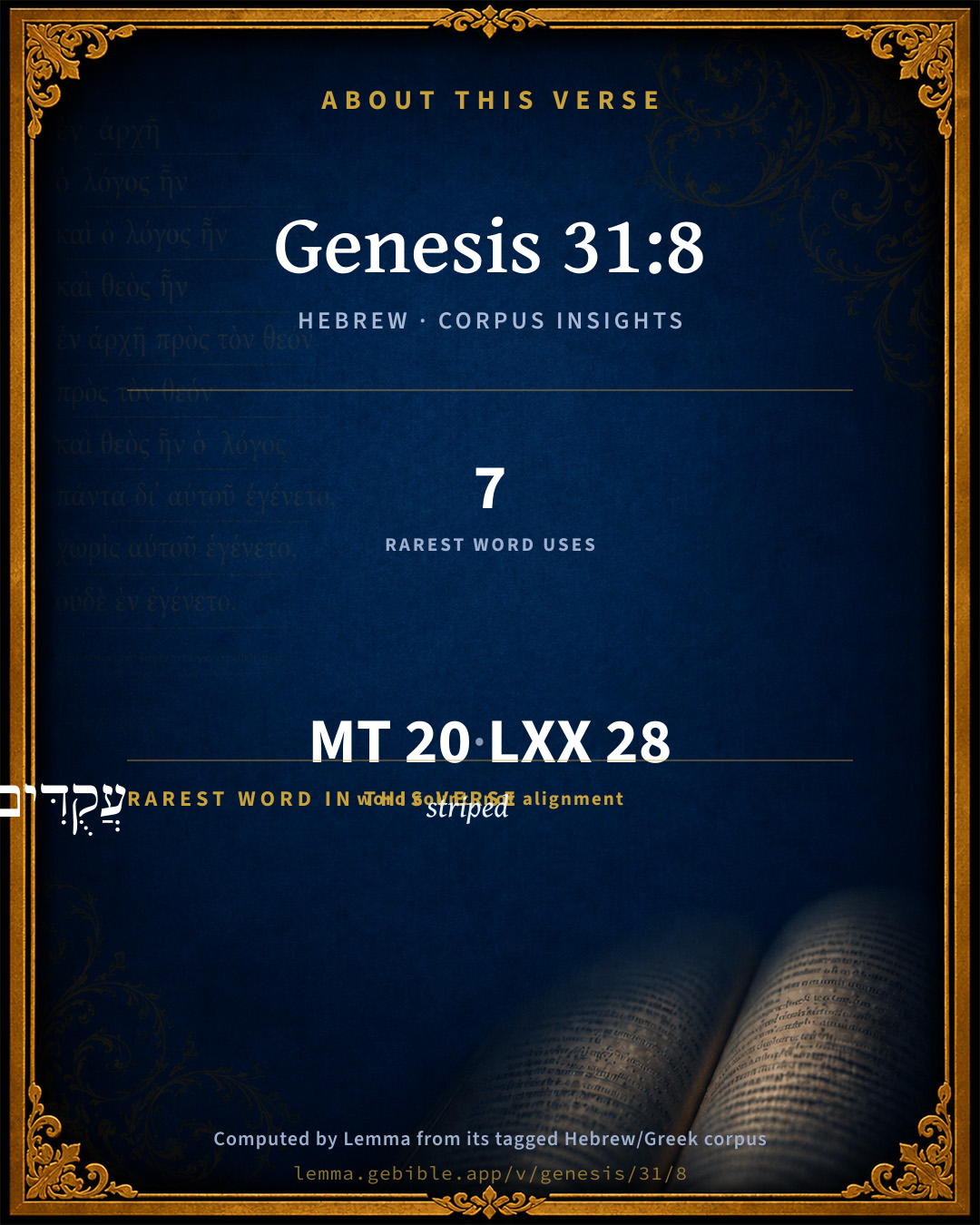
These counts appear in no published source. They are computed here, from the morphology-tagged text and Lemma’s own curated glosses. What Lemma adds →

20
words
10
distinct lemmas
Pentateuch
section

Notable vocabulary

The rarest word here is עֲקֻדִּים֙ striped H6124 — appearing just 7 times in the whole Hebrew Bible.

Shared distinctive vocabulary

עֲקֻדִּים֙ striped H6124 occurs in 6 verses of the Hebrew Bible. Also found in:

Grammatical profile

  • 6 verbs
  • 6 nouns
  • 4 adjectives
  • 2 conjunctions
  • 2 adverbs

Verb forms

  • יֹאמַ֗ר Qal · Imperfect
  • יִהְיֶ֣ה Qal · Imperfect
  • וְיָלְד֥וּ Qal · Perfect
  • יֹאמַ֗ר Qal · Imperfect
  • יִהְיֶ֣ה Qal · Imperfect
  • וְיָלְד֥וּ Qal · Perfect

Repetition

Words recur within this verse — often emphatic in Hebrew:

  • כֹּ֣ה thus H3541 ×2
  • יֹאמַ֗ר to say H559 ×2
  • נְקֻדִּים֙ speckled H5348 ×2
  • יִהְיֶ֣ה to be H1961 ×2
  • שְׂכָרֶ֔ךָ wages H7939 ×2
  • וְיָלְד֥וּ to bear H3205 ×2
  • כָל all H3605 ×2
  • הַצֹּ֖אן flock H6629 ×2
  • עֲקֻדִּים֙ striped H6124 ×2
  • אִם if H518 ×2

Hebrew & Septuagint length

In English translation the verse runs 32 words from the Hebrew and 36 from the Septuagint (LXX English) — closely comparable.

A rough comparison of the two English renderings, which tokenize alike — not a word-level alignment.

Word counts can differ between the Hebrew and the Greek without any difference in meaning — e.g. the Hebrew direct-object marker אֵת has no separate Greek word, and Greek often adds the article ὁ.

In the original languages it is 20 Hebrew tokens and 28 Greek tokens — but the two are counted differently (Hebrew bundles its prefixes and suffixes into one token; the Greek is in lemma form), so that isn’t a like-for-like length.

Cross-references

1

Topical passages linked to Genesis 31:8 in the Treasury of Scripture Knowledge — connected by theme and wording, ordered by reader-vote popularity; previews shown in the World English Bible.

  • Genesis 30:32 I will pass through all your flock today, removing from there every speckled and spotted one, and every black one among the sheep, and the spotted and speckled among the goats. This will be my hire.

Cross-references courtesy of OpenBible.info (CC BY 4.0).

Hebrew and Greek witnesses Masoretic Hebrew ↔ Greek Septuagint

The same verse in the two great witnesses to the Old Testament, shown verse-for-verse.

These are two independent witnesses, not word-aligned to each other, and the Septuagint is shown in lemma (dictionary) form.

Hebrew Genesis 31:8 Masoretic · Westminster Leningrad Codex

אִם כֹּ֣ה יֹאמַ֗ר נְקֻדִּים֙ יִהְיֶ֣ה שְׂכָרֶ֔ךָ וְיָלְד֥וּ כָל הַצֹּ֖אן נְקֻדִּ֑ים וְאִם כֹּ֣ה יֹאמַ֗ר עֲקֻדִּים֙ יִהְיֶ֣ה שְׂכָרֶ֔ךָ וְיָלְד֥וּ כָל הַצֹּ֖אן עֲקֻדִּֽים

If he said this, 'The speckled will be your wages,' then all the flock bore speckled. If he said this, 'The streaked will be your wages,' then all the flock bore streaked.

World English Bible · Public Domain

Greek LXX Genesis 31:8 Septuagint · lemma form

ἐάν οὕτως εἶπον ὁ ποικίλος εἰμί σύ μισθός καί τίκτω πᾶς ὁ πρόβατον ποικίλος ἐάν δέ εἶπον ὁ λευκός εἰμί σύ μισθός καί τίκτω πᾶς ὁ πρόβατον λευκός

If he should say thus, The speckled shall be your reward, then all the cattle would bear speckled; and if he should say, The white shall be your reward, then would all the cattle bear white.

LXX2012 (modern English Septuagint) · Public Domain

On this verse, Haydock's Catholic Bible Commentary discusses the Septuagint’s reading. Read the note in Commentary ↓

Hebrew: Westminster Leningrad Codex (CC BY 4.0). Greek: Septuagint (public domain); English from LXX2012 (modern English Septuagint) (Public Domain). How the Septuagint differs from the Hebrew →

Targum (Aramaic paraphrase)

2

The Targum is the ancient Jewish Aramaic paraphrase of the Hebrew Scriptures — an interpretive translation, not the Hebrew text itself. Onkelos (literal) and Pseudo-Jonathan (expansive) render the Torah, and Jonathan the Prophets. Coverage is partial: where no permissively-licensed English translation exists for a verse, only the Aramaic is shown. This is verse-level text, not a word-by-word alignment to the Hebrew.

  1. Targum Onkelos Torah (Genesis–Deuteronomy)
    אִם כְּדֵין הֲוָה אֲמַר נְמוֹרִין יְהֵא אַגְרָךְ וִילִידָן כָּל עָנָא נְמוֹרִין וְאִם כְּדֵין הֲוָה אֲמַר רְגוֹלִין יְהֵא אַגְרָךְ וִילִידָן כָּל עָנָא רְגוֹלִין

    (no public-domain English translation for this verse)

    Targum Onkelos — Aramaic: “Onkelos Genesis” (public domain); “Onkelos Exodus” (public domain); “Onkelos Leviticus” (public domain); “Onkelos Numbers” (public domain); “Onkelos Deuteronomy” (public domain). English: “Sefaria Community Translation” (CC0 1.0 (public-domain dedication)); “J.W. Etheridge. The Targums of Onkelos and Jonathan Ben Uzziel on the Pentateuch. London: Longmans, Green, 1862” (public domain). Text via Sefaria.

  2. Targum Pseudo-Jonathan Torah (Genesis–Deuteronomy)
    אִם כְּדֵין הֲוָה אָמִיר קְרוּחִין יְהֵי אַגְרָךְ וִילֵידַן כָּל עָנָא קְרוּחִין וְאִם כְּדֵין יֵימַר מַאן דְשׁוּמָא בְּרִיגְלֵהוֹן יְהֵי אַגְרָךְ וִילֵידַן כָּל עָנָא מַאן דְשׁוּמָא בְּרִיגְלֵהוֹן

    lf now he said, The streaked shall be thy wages, all the sheep bare streaked; and if now he said, The spotted-footed shall be thy wages, all the sheep bare those which were spotted in their feet:

    Targum Pseudo-Jonathan — Aramaic: “Targum Jonathan on Genesis” (public domain); “Targum Jonathan on Exodus” (public domain); “Targum Jonathan on Leviticus” (public domain); “Targum Jonathan on Numbers” (public domain); “Targum Jonathan on Deuteronomy” (public domain). English: “The Targum of Jonathan ben Uzziel, trans. J. W. Etheridge, London, 1862” (public domain). Text via Sefaria.

Commentary

Notes on Genesis 31:8 from classic Christian and Jewish commentators (each source and its license shown beneath its notes). The classic Christian expositions comment on the surrounding passage and are grouped to its opening verse, so a note may address several verses; the Jewish commentaries on the Tanakh (Rashi and others) are per-verse, so they appear only where the commentator wrote on this verse.

Lemma curates 59 commentaries, every one of them public domain or Creative Commons licensed, each selected and text-cleaned for this edition rather than reprinted as found. About our sources →

Trapp's Complete Commentary

John Trapp

Gen 31:8 If he said thus, The speckled shall be thy wages; then all the cattle bare speckled: and if he said thus, The ringstraked shall be thy hire; then bare all the cattle ringstraked.

Ver. 8. Ring-straked.] {See Trapp on "Gen 30:39"}

John Trapp, A Commentary or Exposition upon All the Books of the Old and New Testament (1647–1656) — public domain. Text from a community e-Sword module.

The Cambridge Bible for Schools and Colleges

gen. ed. J. J. S. Perowne

8. If he said thus] Applying to Laban the proposal made by Jacob in Gen_30:32.

The Cambridge Bible for Schools and Colleges (gen. ed. J. J. S. Perowne; Cambridge University Press, 1878–1918) — public domain. Text from a community e-Sword module.

John Gill's Exposition

Thus God hath taken away the cattle of your father,.... Not all of them, see Gen 31:19; but a great part of them; his flock was much lessened by those means, and more were taken away, and came to Jacob's share, than if Laban had abode by the original agreement:

and gave them to me; who has the disposing of all things in the world, whose the world, and all in it, are, and gives of it to the sons of men as he pleases. Jacob takes no notice of any artifice of his, or of any means and methods he made use of, but wholly ascribes all to the providence of God, and points to his wives the hand of God only; and indeed it seems to be by his direction that he took the method he did, as appears from Gen 31:11.

John Gill's Exposition of the Whole Bible (1746–1763) — public domain (CC PDM 1.0). Text via the HelloAO Bible API.

Haydock's Catholic Bible Commentary

All, or the far greatest part, so that I was exceedingly enriched. (Menochius) --- The Septuagint here agrees with the Vulgate. But the Hebrew and other versions, instead of white ones, read of divers colours, or ring-streaked, which takes away th intended opposition. (Calmet)

George Leo Haydock (1774–1849), Haydock's Catholic Family Bible and Commentary, 1859 edition — public domain. Excludes Psalms (Douay-Rheims chapter numbering differs from Protestant) and Deuterocanonical books (Catholic canon only).

Matthew Poole's English Annotations

All the cattle. All is here, as oft elsewhere, put for the greater or the better part, as appears from Gen 31:1,8. Or, for all that Jacob desired to be such.

The ring-straked shall be thy hire; hence it appears that Laban through envy and covetousness did break his agreement made with Jacob, and altered it as he thought meet, and that Jacob patiently yielded to all such changes.

Matthew Poole's English Annotations on the Holy Bible (1683–1685) — public domain. Text from a community e-Sword/MySword module.

The Pulpit Commentary

If he (i.e. Laban) said thus, The speckled shall be thy wages; by the original contract Jacob had been promised all the parti-coloredanimals; (Gen_30:32) here it seems as if Laban, struck with the remarkable increase of these, took the earliest opportunity of so modifying the original stipulation as to limit Jacob"s portion to one sort only, viz. the speckled. Yet this dishonorable breach of faith on the part of Laban was of no avail; for, when the next lambing season camethen (it was discovered that) all the cattle bare speckled: and if he said thus (changing the sort of animals assigned to his son-in-law), The ringstraked shall be thy hire (the result was as before); then bare all the cattle ringstraked.

The Pulpit Commentary (1880–1919), ed. H.D.M. Spence-Jones & Joseph S. Exell — public domain. Text from a community e-Sword module.

Ramban (Nachmanides)

Rabbi Moshe ben Nachman (Ramban / Nachmanides)

IF HE SAID THUS: THE SPECKLED SHALL BE THY WAGES. The meaning thereof is that at first Laban agreed to give Jacob the two appearances the speckled and the spotted — also the brownish lambs. Then he retracted and agreed to give him another color, and thus he changed it every year. The flocks, however, gave birth accordingly. This was not due to the power of the sticks, for he was telling them of the deed of the Great G-d who treated him wondrously each and every year, just as he said, But G-d suffered him not to do me evil. It is also possible that Laban changed his wages after the flocks became pregnant and gave birth in accordance with Jacob’s will, it pleasing the Creator to do so. [In this case, it clearly was not due to the power of the sticks.] And so we find in Bereshith Rabbah: “The Holy One, blessed be He, foresaw what Laban was destined to do to our father Jacob, and He created the form of the sheep to conform to the colors Laban was to stipulate. Thus, it is not written here, ‘If he said (amar) thus,’ but it is written, ‘If he will say (yomar) thus,’” [indicating that G-d foresaw what Laban was destined to stipulate to Jacob].

Ramban (Nachmanides) on the Tanakh — English translation: “Commentary on the Torah by Ramban (Nachmanides). Translated and annotated by Charles B. Chavel. New York, Shilo Pub. House, 1971-1976” (CC BY 4.0). Text via Sefaria.

Radak

Rabbi David Kimhi (Radak)

אם כה... כל הצאן, the word כל need not be understood literally as “all.” It means simply: “most.” We have many examples in Scripture when the word כל does not mean “all,” but “most.” A well known example is Genesis 41,55 וכל הארץ באו מצרימה, which cannot mean that everybody came to Egypt, but must mean that most people from the neighbouring countries sent representatives to Egypt to buy food there during the famine in their own land. Although in our verse onlyנקודים and עקודים are mentioned specifically, the same applies to טלאים.

Radak on the Tanakh — English translations: “Sefaria Community Translation” (CC0 1.0 (public-domain dedication)); “Eliyahu Munk, HaChut Hameshulash” (CC BY 4.0); “Rabbi Mike Feuer, Jerusalem Anthology” (CC BY 4.0); and “R. David Kimhi on the first book of Psalms, Translated by R.G. Finch, London, 1919” (public domain). Text via Sefaria.

Lesson kit

Teaching starters — assembled from the data on this page, not authored interpretation. Every prompt links to the verse data it draws on. Edit before teaching.

Genesis, in the Pentateuch, opens this verse with 20 words (10 distinct Hebrew lemmas). Its most distinctive word is ʻâqôd (“striped”). A historical commentator’s framing appears above. Read the whole chapter for the surrounding context.

Discussion questions

  1. What does “striped” (ʻâqôd) contribute to the verse as a whole?
  2. Genesis 30:35 shares the word «striped» with this verse. How do the two illuminate each other?
  3. “thus” occurs 2× in this one verse. What is the effect of the repetition?
  4. These translations render this verse differently. What is at stake in choosing one wording over another?
  5. The verb «יֹאמַ֗ר» is Qal Imperfect. How does its form color the action?
  6. Reading how Trapp's Complete Commentary and The Cambridge Bible for Schools and Colleges read this verse, where do the two commentators agree and where do they part?

Things to notice

Reading settings

Reading text

Shown beneath each verse's original-language words.

Old Testament
Old Testament edition

Read the OT as the Masoretic Hebrew (MT) or the Greek Septuagint (LXX).

English shown for the Greek Septuagint (in the Hebrew ↔ Greek comparison).

Comparing translations? Open the Compare panel on any verse page to stack up to four side by side.