
Psalms 78:52

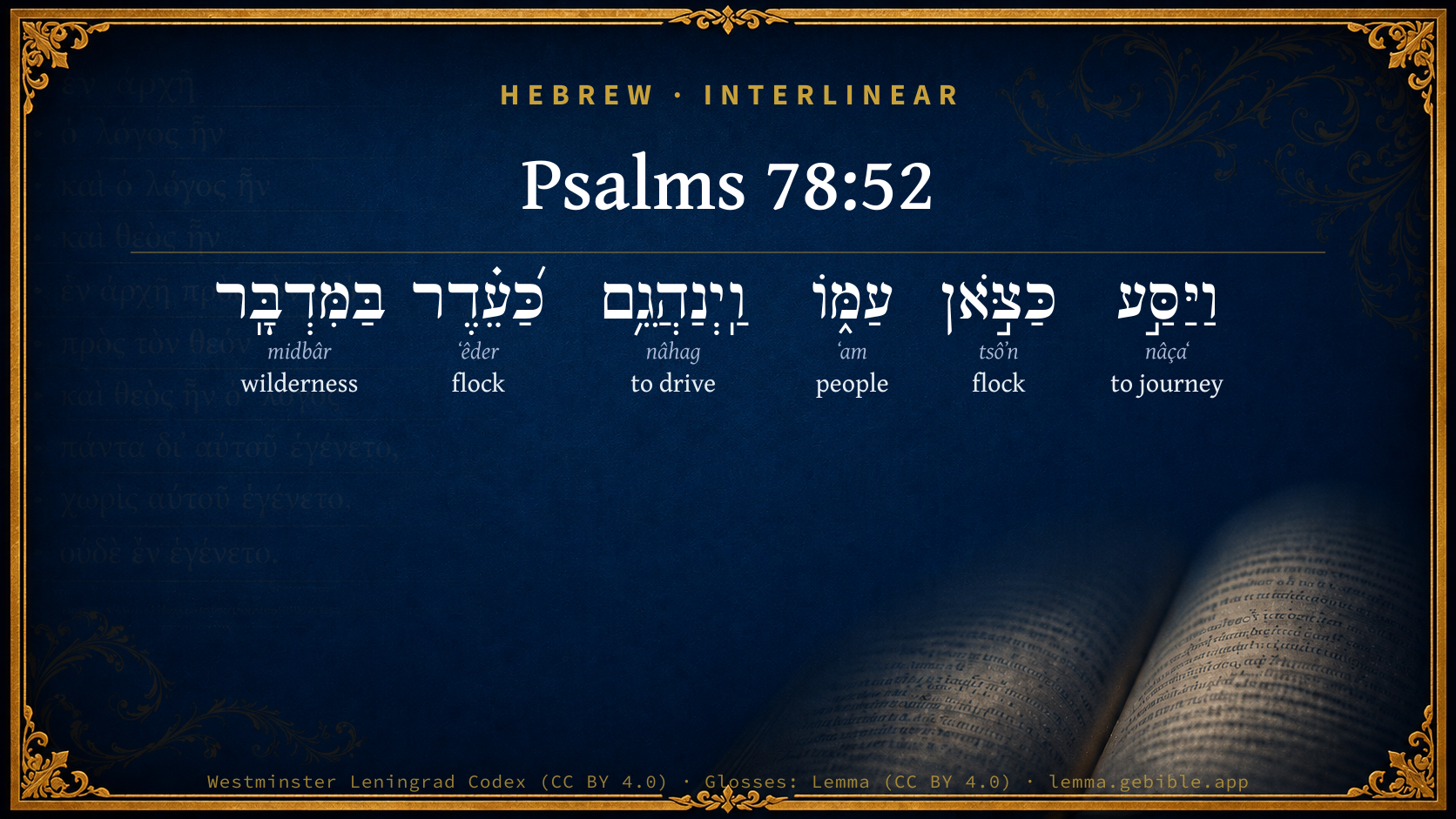
Hebrew (Westminster Leningrad Codex) Psalms 78:52 appears in the Hebrew Old Testament. The text above is from the Westminster Leningrad Codex. Each word links to its Strong’s number, a concise gloss, and parsing drawn from the Open Scriptures Hebrew Bible morphology. Click any word for its full Brown-Driver-Briggs (BDB) entry.
Download image
Cite this verse

Psalms 78:52 (World English Bible). Public Domain. Lemma interlinear Bible study tool, https://lemma.gebible.app/v/psalms/78/52.

Show BibTeX & RIS
BibTeX
RIS
English Translation
But he led forth his own people like sheep, And guided them in the wilderness like a flock.
World English Bible · Public Domain
Download a study sheet

One document with this verse’s original text, its word-by-word gloss line, the meaning frame, cross-references with their text, attributed commentary, and full source and license credits — printable, and it pastes into notes with its structure intact.

This verse Autodidact and up

Study sheet (.html) Plain text (.txt)

A passage Seminary Student

Up to 50 verses in one chapter. A passage sheet keeps up to 6 commentary sources and 12 cross-references per verse, in the order this page ranks them, and says so on the sheet whenever that leaves anything out. Ask for a single verse and you get the Autodidact verse sheet above.

Everything on this page stays free to read, with no account — the sheet is a download of what is already on screen, not access to it.

Want to remove ads? Support Godless Engineer
Compare translations 3

The same verse in 3 English versions, stacked beneath the original-language interlinear above. Click any original word for its lexicon entry.

Each is an independent rendering of the whole verse — the interlinear is not word-aligned to these translations.

Highlighted words mark where these versions differ — a whole-verse word diff, not a word-by-word alignment.

  • World English Bible Public Domain
    But he led forth his own people like sheep, And guided them in the wilderness like a flock.
  • King James Version Public Domain
    But made his own people to go forth like sheep, and guided them in the wilderness like a flock.
  • unfoldingWord Literal Text CC BY-SA 4.0
    And he made his people journey like sheep, and he led them like a flock in the wilderness.

unfoldingWord Literal Text — © unfoldingWord, licensed CC BY-SA 4.0. Word-aligned USFM3 via Door43 (git.door43.org/unfoldingWord/en_ult).

Versions to compare (up to 4)

3 of 4 selected

Show all 18 translations

Every available English version of this verse, each an independent rendering of the whole verse.

  • World English Bible Public Domain
    But he led forth his own people like sheep, And guided them in the wilderness like a flock.
  • Berean Standard Bible Public Domain
    He led out His people like sheep and guided them like a flock in the wilderness.
  • Majority Standard Bible Public Domain
    He led out His people like sheep and guided them like a flock in the wilderness.
  • King James Version Public Domain
    But made his own people to go forth like sheep, and guided them in the wilderness like a flock.
  • American Standard Version (1901) Public Domain
    But he led forth his own people like sheep, And guided them in the wilderness like a flock.
  • Revised Version (1885) Public Domain
    But he led forth his own people like sheep, and guided them in the wilderness like a flock.
  • Geneva Bible (1599) Public Domain
    But hee made his people to goe out like sheepe, and led them in the wildernes like a flocke.
  • Douay-Rheims (1899) Public Domain
    And he took away his own people as sheep: and guided them in the wilderness like a flock.
  • Young's Literal Translation Public Domain
    And causeth His people to journey as a flock, And guideth them as a drove in a wilderness,
  • Literal Standard Version CC BY-SA 4.0
    And causes His people to journey as a flock, || And guides them as a drove in a wilderness,
  • Unlocked Literal Bible CC BY-SA 4.0
    He led his own people out like sheep and guided them through the wilderness like a flock.
  • unfoldingWord Literal Text CC BY-SA 4.0
    And he made his people journey like sheep, and he led them like a flock in the wilderness.
  • Darby Bible Public Domain
    And he made his own people to go forth like sheep, and guided them in the wilderness like a flock;
  • World Messianic Bible Public Domain
    But he led out his own people like sheep, and guided them in the wilderness like a flock.
  • Webster's Bible Public Domain
    But made his own people to go forth like sheep, and guided them in the wilderness like a flock.
  • Free Bible Version CC BY-SA 4.0
    But he led out his people like sheep, and guided them like a flock in the wilderness.
  • Bible in Basic English Public Domain
    But he took his people out like sheep, guiding them in the waste land like a flock.
  • JPS Tanakh (1917) Public Domain
    But He made His own people to go forth like sheep, and guided them in the wilderness like a flock.

Literal Standard Version (2020), Covenant Press — licensed CC BY-SA 4.0. Text via the HelloAO Bible API (eBible.org). Unlocked Literal Bible (unfoldingWord) — licensed CC BY-SA 4.0. Text via the HelloAO Bible API (eBible.org). unfoldingWord Literal Text — © unfoldingWord, licensed CC BY-SA 4.0. Word-aligned USFM3 via Door43 (git.door43.org/unfoldingWord/en_ult). Free Bible Version, Dr. Jonathan Gallagher — licensed CC BY-SA 4.0. Text via the HelloAO Bible API (eBible.org).

Word by word

More ways to search: Search by grammar → Find every occurrence → Compare this word →

Practice this passage: Drill this verse → Learn its vocabulary →

וַֽיְנַהֲגֵ֥ם
nâhag
H5090
“and · to drive · them”
Conjunction + Verb, Piel, Sequential Imperfect, 3rd Person, Masculine, Singular + Suffix, Personal, 3rd Person, Masculine, Plural
Part of Speech
Conjunction + Verb
Stem
Piel
Form
Sequential Imperfect
Person
3rd Person
Gender
Masculine
Number
Singular
Full BDB Definition

Origin: a primitive root

TWOT: 1309 , 1310

to drive, lead, guide, conduct - (Qal) - to drive, lead on, drive away, drive off - to behave itself (figuratively) (of heart) - (Piel) - to drive away, lead off - to lead on, guide, guide on - to cause to drive - (Piel) to moan, lament
  1. וַיַּסַּ֣ע nâçaʻ H5265 “and · to journey” Conjunction + Verb, Hiphil, Sequential Imperfect, 3rd Person, Masculine, Singular
  2. כַּצֹּ֣אן tsôʼn H6629 “like/as the · flock” Preposition, Determined + Noun, Common, Both, Singular, Absolute
  3. עַמּ֑וֹ ʻam H5971 “people · his” Noun, Common, Masculine, Singular, Construct + Suffix, Personal, 3rd Person, Masculine, Singular
  4. כַּ֝עֵ֗דֶר ʻêder H5739 “like/as the · flock” Preposition, Determined + Noun, Common, Masculine, Singular, Absolute
  5. בַּמִּדְבָּֽר midbâr H4057 “in/at the · wilderness” Preposition, Determined + Noun, Common, Masculine, Singular, Absolute

About this verse

These counts appear in no published source. They are computed here, from the morphology-tagged text and Lemma’s own curated glosses. What Lemma adds →

6
words
6
distinct lemmas
Wisdom
section

Shared distinctive vocabulary

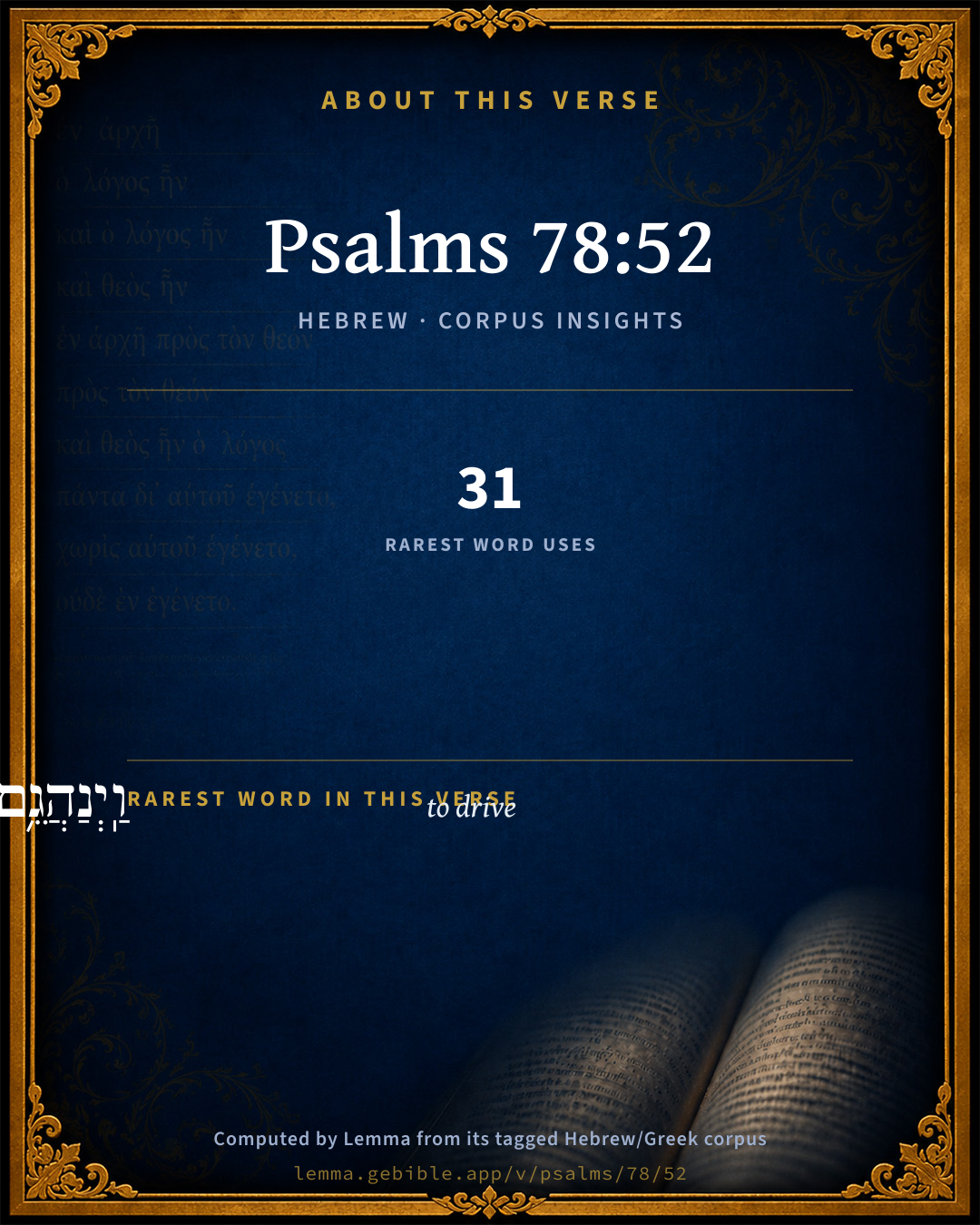
וַֽיְנַהֲגֵ֥ם to drive H5090 occurs in 31 verses of the Hebrew Bible. Also found in:

Grammatical profile

  • 2 verbs
  • 4 nouns

Verb forms

  • וַיַּסַּ֣ע Hiphil · Sequential Imperfect
  • וַֽיְנַהֲגֵ֥ם Piel · Sequential Imperfect

Hebrew & Septuagint length

In English translation the verse runs 18 words from the Hebrew and 16 from the Septuagint (LXX English) — closely comparable.

A rough comparison of the two English renderings, which tokenize alike — not a word-level alignment.

Word counts can differ between the Hebrew and the Greek without any difference in meaning — e.g. the Hebrew direct-object marker אֵת has no separate Greek word, and Greek often adds the article ὁ.

Cross-references

11

Topical passages linked to Psalms 78:52 in the Treasury of Scripture Knowledge — connected by theme and wording, ordered by reader-vote popularity; previews shown in the World English Bible.

  • Nehemiah 9:12 Moreover in a pillar of cloud you led them by day; and in a pillar of fire by night, to give them light in the way in which they should go.
  • Psalms 77:20 You led your people like a flock, By the hand of Moses and Aaron.
  • Isaiah 63:11–14 Then he remembered the days of old, Moses [and] his people, [saying], Where is he who brought them up out of the sea with the shepherds of his flock? where is he who put his holy Spirit in the midst of them?
  • John 10:11–42 I am the good shepherd. The good shepherd lays down his life for the sheep.
  • Psalms 95:7 For he is our God. We are the people of his pasture, And the sheep in his care. Today, oh that you would hear his voice!
  • Psalms 100:3 Know that Yahweh, he is God. It is he who has made us, and we are his. We are his people, and the sheep of his pasture.
  • Psalms 105:37 He brought them forth with silver and gold. There was not one feeble person among his tribes.
  • Isaiah 40:11 He will feed his flock like a shepherd, he will gather the lambs in his arm, and carry them in his bosom, [and] will gently lead those who have their young.
  • Luke 15:4–6 "Which of you men, if you had one hundred sheep, and lost one of them, wouldn't leave the ninety-nine in the wilderness, and go after the one that was lost, until he found it?
  • Jeremiah 23:2–4 Therefore thus says Yahweh, the God of Israel, against the shepherds who feed my people: You have scattered my flock, and driven them away, and have not visited them; behold, I will visit on you the evil of your doings, says Yahweh.
  • Ezekiel 34:11–31 For thus says the Lord Yahweh: Behold, I myself, even I, will search for my sheep, and will seek them out.

Cross-references courtesy of OpenBible.info (CC BY 4.0).

Hebrew and Greek witnesses Masoretic Hebrew ↔ Greek Septuagint

The same verse in the two great witnesses to the Old Testament, shown verse-for-verse.

You’re reading Greek Psalm 77 (Hebrew Psalm 78). The Septuagint counts the superscription, so verse numbers can differ from the Hebrew — chapter-level alignment, not verse-by-verse. Numbering follows Rahlfs.

These are two independent witnesses, not word-aligned to each other, and the Septuagint is shown in lemma (dictionary) form.

Hebrew Psalms 78:52 Masoretic · Westminster Leningrad Codex

וַיַּסַּ֣ע כַּצֹּ֣אן עַמּ֑וֹ וַֽיְנַהֲגֵ֥ם כַּ֝עֵ֗דֶר בַּמִּדְבָּֽר

But he led forth his own people like sheep, And guided them in the wilderness like a flock.

World English Bible · Public Domain

Greek LXX Greek Psalm 77:52 Septuagint · lemma form

καί ἀποαἴρω ὡς πρόβατον ὁ λαός αὐτός καί ἀναἄγω αὐτός ὡς ποίμνιον ἐν ἔρημος

And he removed his people like sheep; he led them as a flock in the wilderness.

LXX2012 (modern English Septuagint) · Public Domain

Hebrew: Westminster Leningrad Codex (CC BY 4.0). Greek: Septuagint (public domain); English from LXX2012 (modern English Septuagint) (Public Domain). How the Septuagint differs from the Hebrew →

Commentary

Notes on Psalms 78:52 from classic Christian and Jewish commentators (each source and its license shown beneath its notes). The classic Christian expositions comment on the surrounding passage and are grouped to its opening verse, so a note may address several verses; the Jewish commentaries on the Tanakh (Rashi and others) are per-verse, so they appear only where the commentator wrote on this verse.

Lemma curates 59 commentaries, every one of them public domain or Creative Commons licensed, each selected and text-cleaned for this edition rather than reprinted as found. About our sources →

Trapp's Complete Commentary

John Trapp

Psa 78:52 But made his own people to go forth like sheep, and guided them in the wilderness like a flock.

Ver. 52. But made his own people to go forth like sheep] i.e. Tuto et lente, softly and safely, as Gen 33:13, tending them with all tenderness, and providing for their necessities.

John Trapp, A Commentary or Exposition upon All the Books of the Old and New Testament (1647–1656) — public domain. Text from a community e-Sword module.

Joseph Benson's Commentary

Psa 78:52-54. But made his own people go out like sheep — Distinguishing between them and the Egyptians, as a shepherd divideth between the sheep and the goats, having set his own mark upon these sheep, by the blood of the Lamb sprinkled on their door-posts. And they went forth as sheep, not knowing whither they went. And guided them in the wilderness — As a shepherd guides his flock, with all possible care and tenderness. And he led them on safely — Though in dangerous paths; so that they feared not — That is, they did not need to fear. They were indeed afraid at first, but after Moses had encouraged them they grew bold and secure, one evidence whereof was, that they confidently went into the middle of the sea, and passed between the vast heaps of water which were on both sides of them. And he brought them to the border of his sanctuary — Or, of his holiness, or holy place; that is, the land of Canaan, which is so called, (Ezr 9:8; Zec 2:8,) as being separated by God from all other lands, for his people and service, and sanctified by his presence, and his dwelling in it. Even to this mountain — Either the mountain upon which the tabernacle and temple stood; or rather the mountainous country of Canaan, which is called a land of hills and valleys, Deu 11:11.

Joseph Benson's Commentary on the Old and New Testaments (1811–1818) — public domain. Text from a community e-Sword module.

J. A. Alexander on Psalms

Joseph Addison Alexander

52. (Psa 78:52) And brought out, like sheep, his people, and led them, like a flock in the wilderness. For the precise meaning of the first verb, see above, on Psa 78:26, and compare Exo 12:37; Exo 15:22. The guidance in the wilderness includes ithat on both sides of the Red Sea, as appears from Exo 12:37.

Joseph Addison Alexander, The Psalms Translated and Explained (1850) — public domain. Text from a community e-Sword module.

John Calvin's Commentaries

52. And he made his people to go forth like sheep. The Psalmist again celebrates God’s fatherly love towards the chosen people, whom, as we have elsewhere remarked, he compares to a flock of sheep. They had no wisdom or power of their own to preserve and defend themselves; but God graciously condescended to perform towards them the office of a shepherd. It is a singular token of the love which he bore towards them, that he did not disdain to humble himself so far as to feed them as his own sheep. What could a multitude who had never been trained up to the art of war do against powerful and warlike enemies? So far from having learned the art of war, the people, as is well known, had been employed, when in Egypt, in mean and servile occupations, as if they had been condemned to toil under the earth in mines or in quarries.

John Calvin's Commentaries (1540-1563) — public domain. Text from the Calvin Translation Society English edition (1840s-50s) via the Christian Classics Ethereal Library (ccel.org). Calvin's coverage is partial (roughly two-thirds of the Bible); uncommented books and verses are honest gaps, never fabricated. The 19th-century editor's footnotes and remarks are omitted so the notes are faithfully Calvin's own voice.

The Cambridge Bible for Schools and Colleges

gen. ed. J. J. S. Perowne

52. But made &c.] But he led forth his people like sheep. The verb is that which is commonly used of the journeyings of the Israelites from stage to stage through the wilderness (Exo_15:22 &c.). The figure of Israel as Jehovah’s flock is a favourite one in the Asaphite Psalms (Psa_74:1 note).

52–55. God’s guidance of Israel through the wilderness into Canaan. Cp. Exo_15:13-17. The circumstances of the Journey have been already recounted in Psa_78:13 ff.

The Cambridge Bible for Schools and Colleges (gen. ed. J. J. S. Perowne; Cambridge University Press, 1878–1918) — public domain. Text from a community e-Sword module.

John Gill's Exposition

And he led them on safely,.... Through the sea, where the waters were on each side; and through the wilderness, in which were serpents and scorpions, and where they were attacked by many powerful enemies:

so that they feared not; for though they feared for a while at the Red sea, yet their fears were soon silenced, and they by faith passed through the Red sea as on dry land; and especially their fears were gone, when they saw the Egyptians dead on the sea shore; wherefore it follows:

but the sea overwhelmed their enemies; or "covered" them (p); the waters returned, and overflowed and drowned the Egyptians, who were their implacable enemies, and vowed their destruction, and were sure of it; but now the Israelites had nothing to fear from them.

(p) "operuit", Pagninus, Montanus, Musculus, Piscator, Gejerus.

John Gill's Exposition of the Whole Bible (1746–1763) — public domain (CC PDM 1.0). Text via the HelloAO Bible API.

Albert Barnes' Notes on the Bible

But made his own people to go forth like sheep ... - That is, he was a shepherd to them. He defended them; provided for them; led them - as a shepherd does his flock. See the notes at Psa 23:1-2.

Albert Barnes' Notes on the Bible (1834–1885) — public domain. Text from a community e-Sword/MySword module.

The Treasury of David

Charles H. Spurgeon

Ver. 52. But made his own people to go forth like sheep. The contrast is striking, and ought never to have been forgotten by the people. The wolves were slain in heaps, the sheep were carefully gathered, and triumphantly delivered. The tables were turned, and the poor serfs became the honoured people, while their oppressors were humbled before them. Israel went out in a compact body like a flock; they were defenceless in themselves as sheep, but they were safe under their Great Shepherd; they left Egypt as easily as a flock leaves one pasture for another.

And guided them in the wilderness like a flock. Knowing nothing of the way by their own understanding or experience, they were, nevertheless, rightly directed, for the All wise God knew every spot of the wilderness. To the sea, through the sea, and from the sea, the Lord led his chosen; while their former taskmasters were too cowed in spirit, and broken in power, to dare to molest them.

Ver. 52. But made his own people to go forth like sheep. It is not said that they went forth like sheep; but that he made them go forth like sheep. It is not a description of the character of the people, but a commendation of the providence and goodness of God, by which, after the manner of a good shepherd, he led forth from Egypt his own people with all security, like sheep snatched from the midst of wolves. Musculus.

Ver. 52.

1. God has a people in the world.

2. He brings them away from others.

3. He brings them into fellowship with himself.

4. He brings them into fellowship with each other.

5. He guides them to their rest.

Charles H. Spurgeon's The Treasury of David (1869–1885) — public domain. Psalms only. Text from a community e-Sword/MySword module.

The Pulpit Commentary

But made his own people to go forth like sheep. (comp. Psa_77:20 Psa_95:7) And guided them in the wilderness like a flock. The guidance began from Succoth, and was effected by means of the pillar of the cloud and the pillar of fire. (see Exo_13:20-22)

The Pulpit Commentary (1880–1919), ed. H.D.M. Spence-Jones & Joseph S. Exell — public domain. Text from a community e-Sword module.

unfoldingWord translationNotes

Door43 World Missions Community

General Information:

The writer continues to describe what God did for the people of Israel.

like sheep ... like a flock

The writer speaks about the Israelites as if they were sheep. This means God cared for and protected the people like a shepherd does his sheep. (See: Simile)

overwhelmed

completely covered

translationWords

ewe

desert

flocks

unfoldingWord translationNotes — © Distant Shores Media and the Door43 World Missions Community, licensed CC BY-SA 4.0. Source: git.door43.org/Door43/en_tn.

Lesson kit

Teaching starters — assembled from the data on this page, not authored interpretation. Every prompt links to the verse data it draws on. Edit before teaching.

Psalms, in the Wisdom, opens this verse with 6 words (6 distinct Hebrew lemmas). Its most distinctive word is nâhag (“to drive”). A historical commentator’s framing appears above. Read the whole chapter for the surrounding context.

Discussion questions

  1. The word nâhag carries the sense “to drive.” How does it shape the verse?
  2. Genesis 31:18 shares the word «to drive» with this verse. How do the two illuminate each other?
  3. These translations render this verse differently; the difference is in the English rendering, not the original. What questions does that raise?
  4. The verb «וַיַּסַּ֣ע» is Hiphil Sequential Imperfect. How does its form color the action?
  5. Reading how Trapp's Complete Commentary and Joseph Benson's Commentary read this verse, where do the two commentators agree and where do they part?

Things to notice

Reading settings

Reading text

Shown beneath each verse's original-language words.

Old Testament
Old Testament edition

Read the OT as the Masoretic Hebrew (MT) or the Greek Septuagint (LXX).

English shown for the Greek Septuagint (in the Hebrew ↔ Greek comparison).

Comparing translations? Open the Compare panel on any verse page to stack up to four side by side.