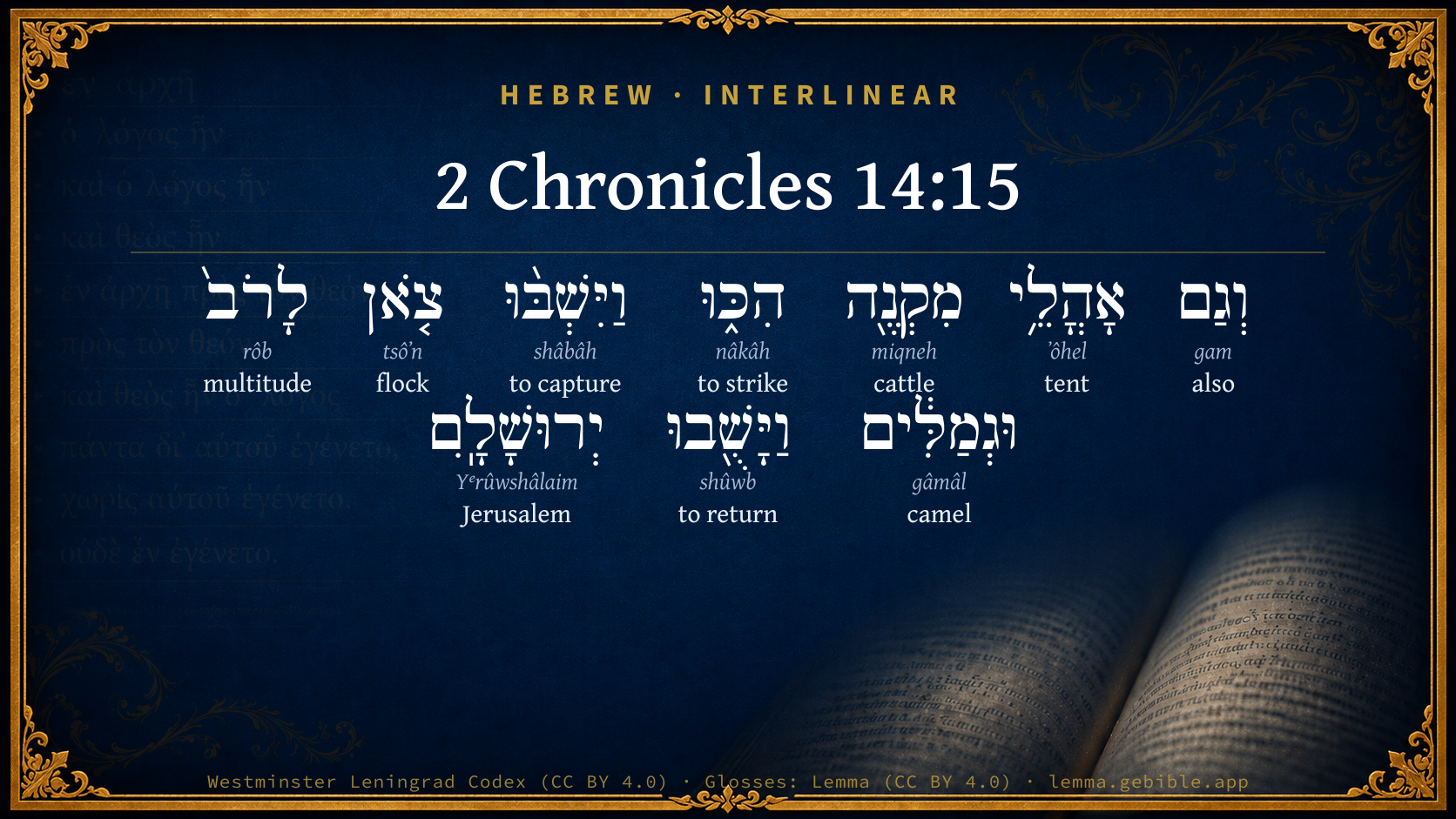
2 Chronicles 14:15

Hebrew (Westminster Leningrad Codex) 2 Chronicles 14:15 appears in the Hebrew Old Testament. The text above is from the Westminster Leningrad Codex. Each word links to its Strong’s number, a concise gloss, and parsing drawn from the Open Scriptures Hebrew Bible morphology. Click any word for its full Brown-Driver-Briggs (BDB) entry.
Download image
Cite this verse

2 Chronicles 14:15 (World English Bible). Public Domain. Lemma interlinear Bible study tool, https://lemma.gebible.app/v/2-chronicles/14/15.

Show BibTeX & RIS
BibTeX
RIS
English Translation
They struck also the tents of cattle, and carried away sheep in abundance, and camels, and returned to Jerusalem.
World English Bible · Public Domain
Download a study sheet

One document with this verse’s original text, its word-by-word gloss line, the meaning frame, cross-references with their text, attributed commentary, and full source and license credits — printable, and it pastes into notes with its structure intact.

This verse Autodidact and up

Study sheet (.html) Plain text (.txt)

A passage Seminary Student

Up to 50 verses in one chapter. A passage sheet keeps up to 6 commentary sources and 12 cross-references per verse, in the order this page ranks them, and says so on the sheet whenever that leaves anything out. Ask for a single verse and you get the Autodidact verse sheet above.

Everything on this page stays free to read, with no account — the sheet is a download of what is already on screen, not access to it.

Want to remove ads? Support Godless Engineer
Compare translations 3

The same verse in 3 English versions, stacked beneath the original-language interlinear above. Click any original word for its lexicon entry.

Each is an independent rendering of the whole verse — the interlinear is not word-aligned to these translations.

Highlighted words mark where these versions differ — a whole-verse word diff, not a word-by-word alignment.

  • World English Bible Public Domain
    They struck also the tents of cattle, and carried away sheep in abundance, and camels, and returned to Jerusalem.
  • King James Version Public Domain
    They smote also the tents of cattle, and carried away sheep and camels in abundance, and returned to Jerusalem.
  • unfoldingWord Literal Text CC BY-SA 4.0
    And also the tents of cattle they struck; and they took captive sheep in abundance, and camels, and they returned to Jerusalem.

unfoldingWord Literal Text — © unfoldingWord, licensed CC BY-SA 4.0. Word-aligned USFM3 via Door43 (git.door43.org/unfoldingWord/en_ult).

Versions to compare (up to 4)

3 of 4 selected

Show all 18 translations

Every available English version of this verse, each an independent rendering of the whole verse.

  • World English Bible Public Domain
    They struck also the tents of cattle, and carried away sheep in abundance, and camels, and returned to Jerusalem.
  • Berean Standard Bible Public Domain
    They also attacked the tents of the herdsmen and carried off many sheep and camels. Then they returned to Jerusalem.
  • Majority Standard Bible Public Domain
    They also attacked the tents of the herdsmen and carried off many sheep and camels. Then they returned to Jerusalem.
  • King James Version Public Domain
    They smote also the tents of cattle, and carried away sheep and camels in abundance, and returned to Jerusalem.
  • American Standard Version (1901) Public Domain
    They smote also the tents of cattle, and carried away sheep in abundance, and camels, and returned to Jerusalem.
  • Revised Version (1885) Public Domain
    They smote also the tents of cattle, and carried away sheep in abundance and camels, and returned to Jerusalem.
  • Geneva Bible (1599) Public Domain
    Yea, and they smote the tents of cattel, and carried away plentie of sheepe and camels, and returned to Ierusalem.
  • Douay-Rheims (1899) Public Domain
    And they destroyed the sheepcotes, and took an infinite number of cattle, and of camels: and returned to Jerusalem.
  • Young's Literal Translation Public Domain
    and also tents of cattle they have smitten, and they capture sheep in abundance, and camels, and turn back to Jerusalem.
  • Literal Standard Version CC BY-SA 4.0
    and they have also struck tents of livestock, and they capture sheep in abundance, and camels, and return to Jerusalem.
  • Unlocked Literal Bible CC BY-SA 4.0
    The army also destroyed the tent settlements of the shepherding nomads; they carried away sheep in abundance, as well as camels, and then they returned to Jerusalem.
  • unfoldingWord Literal Text CC BY-SA 4.0
    And also the tents of cattle they struck; and they took captive sheep in abundance, and camels, and they returned to Jerusalem.
  • Darby Bible Public Domain
    They smote also the tents of cattle, and carried away sheep and camels in abundance, and returned to Jerusalem.
  • World Messianic Bible Public Domain
    They also struck the tents of those who had livestock, and carried away sheep and camels in abundance, then returned to Jerusalem.
  • Webster's Bible Public Domain
    They smote also the tents of cattle, and carried away sheep and camels in abundance, and returned to Jerusalem.
  • Free Bible Version CC BY-SA 4.0
    Then they attacked the camps of the herdsmen and took many sheep and camels. Then they went back to Jerusalem.
  • Bible in Basic English Public Domain
    And they made an attack on the tents of the owners of the cattle, and took away great numbers of sheep and camels and went back to Jerusalem.
  • JPS Tanakh (1917) Public Domain
    (14-14) They smote also the tents of cattle, and carried away sheep in abundance and camels, and returned to Jerusalem.

Literal Standard Version (2020), Covenant Press — licensed CC BY-SA 4.0. Text via the HelloAO Bible API (eBible.org). Unlocked Literal Bible (unfoldingWord) — licensed CC BY-SA 4.0. Text via the HelloAO Bible API (eBible.org). unfoldingWord Literal Text — © unfoldingWord, licensed CC BY-SA 4.0. Word-aligned USFM3 via Door43 (git.door43.org/unfoldingWord/en_ult). Free Bible Version, Dr. Jonathan Gallagher — licensed CC BY-SA 4.0. Text via the HelloAO Bible API (eBible.org).

Word by word

More ways to search: Search by grammar → Find every occurrence → Compare this word →

Practice this passage: Drill this verse → Learn its vocabulary →

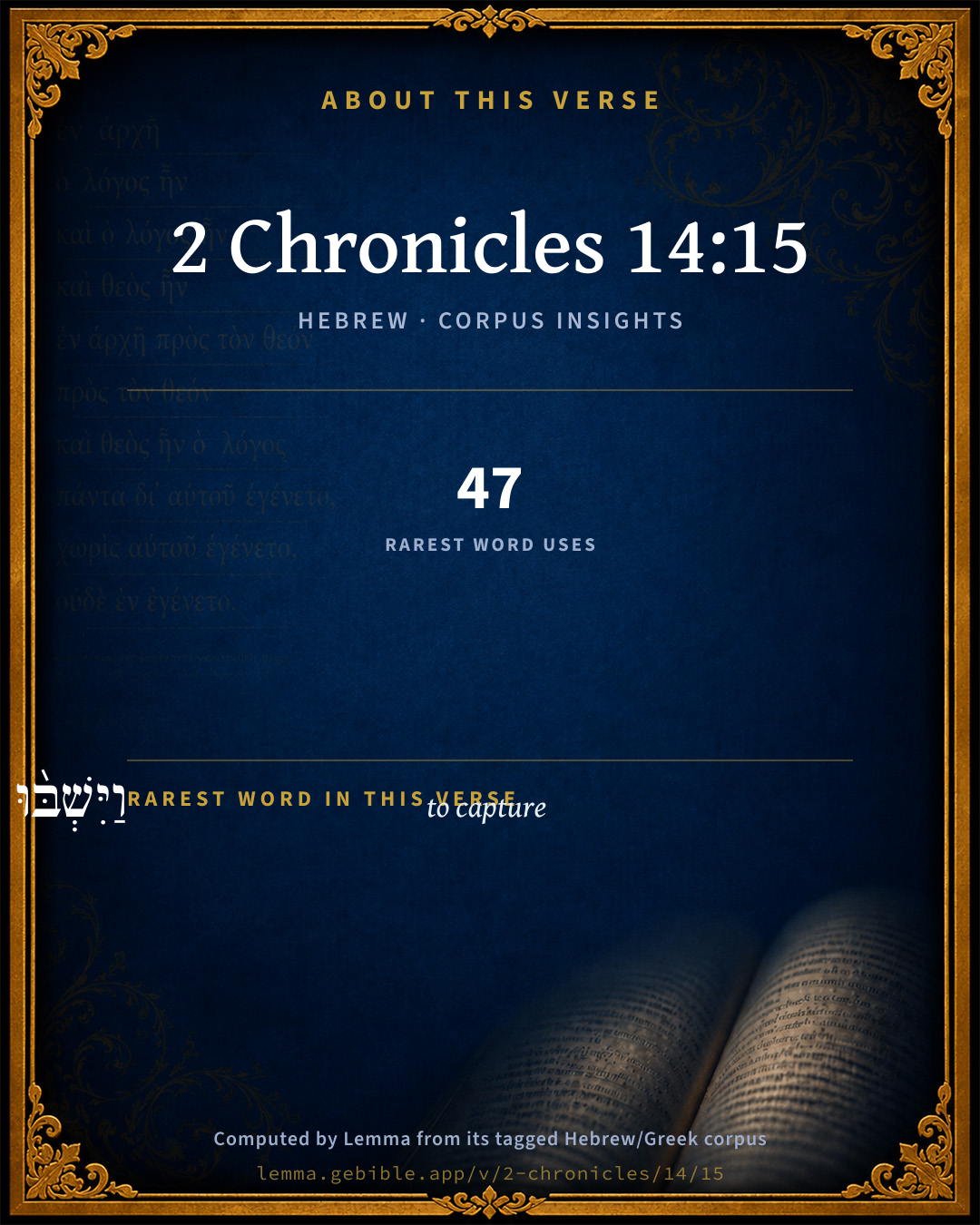
וַיִּשְׁבּ֨וּ
shâbâh
H7617
“and · to capture”
Conjunction + Verb, Qal, Sequential Imperfect, 3rd Person, Masculine, Plural
Part of Speech
Conjunction + Verb
Stem
Qal
Form
Sequential Imperfect
Person
3rd Person
Gender
Masculine
Number
Plural
Full BDB Definition

Origin: a primitive root

TWOT: 2311

to take captive - (Qal) - to take captive - captive (participle) - to lead captive - (Niphal) to be taken captive
  1. וְגַם gam H1571 “and · also” Conjunction + Particle, Accusative
  2. אָהֳלֵ֥י ʼôhel H168 “tents of” Noun, Common, Masculine, Plural, Construct
  3. מִקְנֶ֖ה miqneh H4735 “cattle” Noun, Common, Masculine, Singular, Absolute
  4. הִכּ֑וּ nâkâh H5221 “to strike” Verb, Hiphil, Perfect, 3rd Person, Common, Plural
  5. צֹ֤אן tsôʼn H6629 “flock” Noun, Common, Both, Singular, Absolute
  6. לָרֹב֙ rôb H7230 “to/for · multitude” Preposition + Noun, Common, Both, Singular, Absolute
  7. וּגְמַלִּ֔ים gâmâl H1581 “and · camels” Conjunction + Noun, Common, Masculine, Plural, Absolute
  8. וַיָּשֻׁ֖בוּ shûwb H7725 “and · to return” Conjunction + Verb, Qal, Sequential Imperfect, 3rd Person, Masculine, Plural
  9. יְרוּשָׁלִָֽם Yᵉrûwshâlaim H3389 “Jerusalem” Noun, Proper

About this verse

These counts appear in no published source. They are computed here, from the morphology-tagged text and Lemma’s own curated glosses. What Lemma adds →

10
words
10
distinct lemmas
Historical
section

Shared distinctive vocabulary

וַיִּשְׁבּ֨וּ to capture H7617 occurs in 42 verses of the Hebrew Bible. Also found in:

Grammatical profile

  • 3 verbs
  • 6 nouns
  • 1 particle

Verb forms

  • הִכּ֑וּ Hiphil · Perfect
  • וַיִּשְׁבּ֨וּ Qal · Sequential Imperfect
  • וַיָּשֻׁ֖בוּ Qal · Sequential Imperfect

Hebrew & Septuagint length

In English translation the verse runs 19 words from the Hebrew and 20 from the Septuagint (LXX English) — closely comparable.

A rough comparison of the two English renderings, which tokenize alike — not a word-level alignment.

Word counts can differ between the Hebrew and the Greek without any difference in meaning — e.g. the Hebrew direct-object marker אֵת has no separate Greek word, and Greek often adds the article ὁ.

Cross-references

5

Topical passages linked to 2 Chronicles 14:15 in the Treasury of Scripture Knowledge — connected by theme and wording, ordered by reader-vote popularity; previews shown in the World English Bible.

  • Numbers 31:9 The children of Israel took captive the women of Midian and their little ones; and all their cattle, and all their flocks, and all their goods, they took for a prey.
  • Numbers 31:30–47 Of the children of Israel's half, you shall take one drawn out of every fifty, of the persons, of the oxen, of the donkeys, and of the flocks, [even] of all the cattle, and give them to the Levites, who keep the charge of the tent of Yahweh.
  • 1 Samuel 30:20 David took all the flocks and the herds, [which] they drove before those [other] cattle, and said, This is David's spoil.
  • 1 Chronicles 4:41 These written by name came in the days of Hezekiah king of Judah, and struck their tents, and the Meunim who were found there, and destroyed them utterly to this day, and lived in their place; because there was pasture there for their flocks.
  • 1 Chronicles 5:21 They took away their cattle; of their camels fifty thousand, and of sheep two hundred fifty thousand, and of donkeys two thousand, and of men one hundred thousand.

Cross-references courtesy of OpenBible.info (CC BY 4.0).

Hebrew and Greek witnesses Masoretic Hebrew ↔ Greek Septuagint

The same verse in the two great witnesses to the Old Testament, shown verse-for-verse.

These are two independent witnesses, not word-aligned to each other, and the Septuagint is shown in lemma (dictionary) form.

Hebrew 2 Chronicles 14:15 Masoretic · Westminster Leningrad Codex

וְגַם אָהֳלֵ֥י מִקְנֶ֖ה הִכּ֑וּ וַיִּשְׁבּ֨וּ צֹ֤אן לָרֹב֙ וּגְמַלִּ֔ים וַיָּשֻׁ֖בוּ יְרוּשָׁלִָֽם

They struck also the tents of cattle, and carried away sheep in abundance, and camels, and returned to Jerusalem.

World English Bible · Public Domain

Greek LXX 2 Chronicles 14:15 Septuagint · lemma form
Also they destroyed the tents of cattle, and the Alimazons, and took many sheep and camels, and returned to Jerusalem.

LXX2012 (modern English Septuagint) · Public Domain

On this verse, Ellicott's Commentary for English Readers discusses the Septuagint’s reading. Read the note in Commentary ↓

Hebrew: Westminster Leningrad Codex (CC BY 4.0). Greek: Septuagint (public domain); English from LXX2012 (modern English Septuagint) (Public Domain). How the Septuagint differs from the Hebrew →

Commentary

Notes on 2 Chronicles 14:15 from classic Christian and Jewish commentators (each source and its license shown beneath its notes). The classic Christian expositions comment on the surrounding passage and are grouped to its opening verse, so a note may address several verses; the Jewish commentaries on the Tanakh (Rashi and others) are per-verse, so they appear only where the commentator wrote on this verse.

Lemma curates 59 commentaries, every one of them public domain or Creative Commons licensed, each selected and text-cleaned for this edition rather than reprinted as found. About our sources →

Trapp's Complete Commentary

John Trapp

2Ch 14:15 They smote also the tents of cattle, and carried away sheep and camels in abundance, and returned to Jerusalem.

Ver. 15. They smote also the tents of cattle.] The Arabian Scenites, who had also aided the Ethiopians, and now had enough of it. "So let all thine enemies perish, O Lord."

John Trapp, A Commentary or Exposition upon All the Books of the Old and New Testament (1647–1656) — public domain. Text from a community e-Sword module.

Adam Clarke's Commentary

Verse 15. Tents of cattle] Those which had carried the baggage of the great army, and which they had left in such places as abounded with pasture. Perhaps sheepfolds, enclosures for camels, mules, c., may also be intended. The discomfiture was great, because God fought for the people and the spoil was immense, because the multitude was prodigious, indeed almost incredible, a million of men in one place is almost too much for the mind to conceive, but there may be some mistake in the numerals: it is evident from the whole account that the number was vast and the spoil great.

Adam Clarke's Commentary on the Bible (1810–1826) — public domain. Text from a community e-Sword/MySword module.

Ellicott's Commentary for English Readers

(15) They smote also the tents of cattle.—And cattle tents (or encampments), also they smote, i.e., hordes of nomad Bedawin whom they encountered in the desert about Gerar. (Comp. 1Ch_4:41, “smote their tents.”)

Sheep and camels in abundance.—Sheep in abundance, and camels. The LXX. adds, καὶ τοὺς αλιμαζονεις, apparently as the name of a tribe. Syriac and Arabic render, “And the tents of the Arabs.”

A Bible Commentary for English Readers, edited by Charles John Ellicott (1878–1897) — public domain. Text from a community e-Sword module.

The Cambridge Bible for Schools and Colleges

gen. ed. J. J. S. Perowne

15. the tents of cattle] These words seem to be corrupt, and it is probable that the original reading gave the name of some Arabian tribe. From a comparison of the LXX. here with the LXX. of 2Ch_22:1 we conclude that this name was represented by Ἀλειμαζονεϊς in Greek. The people called Μασονῖται by Ptolemy, and Mâzin by Arabic writers are probably meant (Hommel, Expository Times, viii. 378).

The Cambridge Bible for Schools and Colleges (gen. ed. J. J. S. Perowne; Cambridge University Press, 1878–1918) — public domain. Text from a community e-Sword module.

Haydock's Catholic Bible Commentary

Destroyed. Hebrew, "smote also the tents of cattle." Septuagint, "they cut in pieces the tents of cattle, the Amazons;" or, according to the Vatican copy, (Haydock) "the Alimazonians," as they seem to have read aeli manim, which may be well rendered, "the tents of the Mineans," a people of Arabia, chap. xx. 1., and xxvi. 7., and Judges x. 11. (Calmet) --- If these nations came to punish Asa, for banishing their foreign worship, (ver. 12) as the Sieur de Folard thinks the sacred penman insinuates, (ver. 5) we need not wonder that they met with such ill success, and that not one of them was spared, as God avenged his own cause, ver. 12, 13. (Haydock) --- We read of no cavalry here, though it is mentioned, chap. xvi. 8. It seems not to have been considerable, as the people of Asia, the Greeks and Romans, trusted more to their infantry; and, in effect, no species of warfare is more costly to a state, nor less useful, than a multitude of horses, which were introduced in barbarous times. (De Folard)

George Leo Haydock (1774–1849), Haydock's Catholic Family Bible and Commentary, 1859 edition — public domain. Excludes Psalms (Douay-Rheims chapter numbering differs from Protestant) and Deuterocanonical books (Catholic canon only).

Matthew Poole's English Annotations

The tents of cattle, i.e. the dwellers in tents, which were either a part of Zerah’s company, or joined with them, or had come along with them to furnish that great host with necessary provisions, which their custom of dwelling in tents made them more capable of doing.

Matthew Poole's English Annotations on the Holy Bible (1683–1685) — public domain. Text from a community e-Sword/MySword module.

The Pulpit Commentary

The tents of cattle. This word "tents" (yleh construct state) is used just 325 times, and this is the only time it is spoken of as the place of cattle; there are, however, four passages looking the same way (Gen_13:5; Jud_1:6:5; 2Ki_7:7; Jer_49:29) It is the word used for the tabernacle of the wilderness many times, and many times for the place of abode that has highest associations, (Psa_15:1 Psa_118:15) and of the usual abodes of people. (2Ch_10:16) The use of the word here, though unique, will occasion no surprise, considering the camping of the vast invading army. Camels in abundance. The mention of this spoil reminds us both where we are, on desert border, (1Sa_27:7-10 1Sa_30:16, 1Sa_30:17) and what was the personality or nationality within some latitude of choice of the invaders. Returned to Jerusalem. The expression awakens inevitably, though inaptly, a reminiscence of Scripture language in strangest contrast the climax in a description also, but of a victory infinitely vaster and grander and for ever (Luk_24:52; Act_1:12) This return of "Asa and the people that were with him" to Jerusalem dated the commencement of a period of comparative internal peace and reform for the kingdom of Judah, that lasted twenty-one years, and yet more of exemption from Egyptian attack, that lasted about three hundred and thirty years (B.C. circ. 940-609). It was a doubtful benefit, but Judah and Egypt came to be found in alliance against Assyria (2Ki_17:3-6 2Ki_18:20, 2Ki_18:21, 2Ki_18:24; Isa_30:2; Hos_7:11) The "Speaker"s Commentary" points out the interesting fact that this was one of the only two occasions known of the Jews meeting in open field either Egypt or Assyria (the other occasion being the unfortunate one of Josiah against Necho, (1Ch 35:30) and adds, "Shishak, Sennacherib, Esarhaddon, Nebuchadnezzar, Alexander, and Ptolemy I, were either unopposed or only opposed from behind wails."

The Pulpit Commentary (1880–1919), ed. H.D.M. Spence-Jones & Joseph S. Exell — public domain. Text from a community e-Sword module.

Lesson kit

Teaching starters — assembled from the data on this page, not authored interpretation. Every prompt links to the verse data it draws on. Edit before teaching.

2 Chronicles, in the Historical, opens this verse with 10 words (10 distinct Hebrew lemmas). Its most distinctive word is shâbâh (“to capture”). A historical commentator’s framing appears above. Read the whole chapter for the surrounding context.

Discussion questions

  1. How does “to capture” (shâbâh) shape what this verse is saying?
  2. How does Genesis 14:14, which shares the word «to capture», read alongside this verse?
  3. These translations render this verse differently. What is at stake in choosing one wording over another?
  4. «הִכּ֑וּ» is a Hiphil Perfect verb. How does that grammatical form shape the action described?
  5. Compare how Trapp's Complete Commentary and Adam Clarke's Commentary read this verse. Where do they agree or differ?

Things to notice

Reading settings

Reading text

Shown beneath each verse's original-language words.

Old Testament
Old Testament edition

Read the OT as the Masoretic Hebrew (MT) or the Greek Septuagint (LXX).

English shown for the Greek Septuagint (in the Hebrew ↔ Greek comparison).

Comparing translations? Open the Compare panel on any verse page to stack up to four side by side.