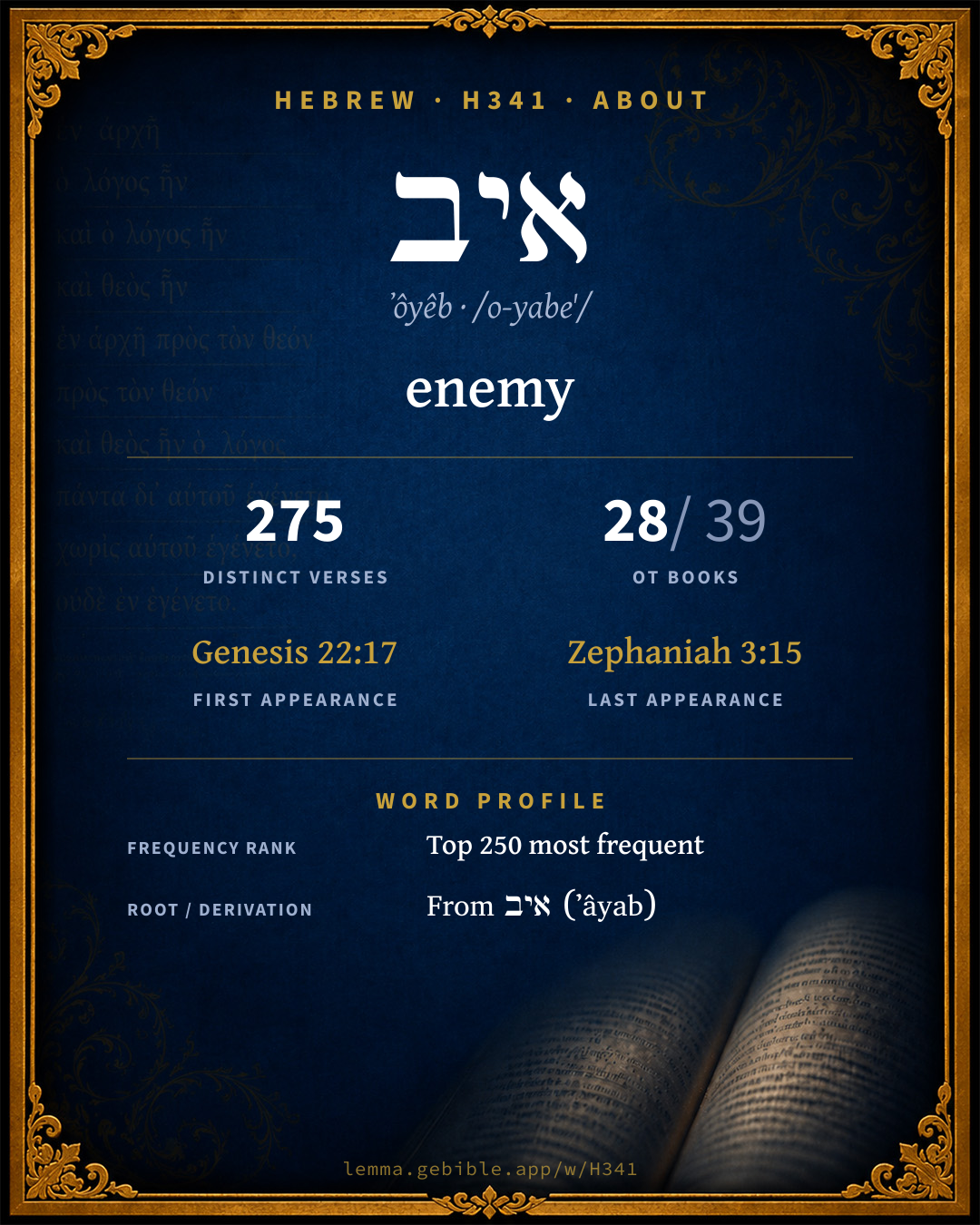
אָיַב
enemy
‘enemy’ is one of 3 main senses fuller range ↓
Full lexicon entry — Brown-Driver-Briggs (BDB)
From Brown-Driver-Briggs (BDB)
Where this word appears
Grammar key — what these labels mean
Part of speech
- Verb
- An action or state-of-being word.
Stem
- Qal
- The basic, simple active stem — the plain form of the verb (“he wrote”).
Form
- Participle Active
- A verbal adjective expressing ongoing or characteristic action (“writing / one who writes”).
State
- Construct
- A noun bound to a following noun in a possessive / “of” relationship (the construct chain).
- Absolute
- The independent form of a noun, not bound to a following word.
Gender
- Masculine
- Grammatically masculine.
- Feminine
- Grammatically feminine.
Number
- Plural
- More than one (in Hebrew, generally three or more).
- Singular
- One.
Grammatical forms
- Verb, Qal, Participle Active, Masculine, Plural, Construct 200 times (70%)
- Verb, Qal, Participle Active, Masculine, Singular, Absolute 55 times (19%)
- Verb, Qal, Participle Active, Masculine, Singular, Construct 23 times (8%)
- Verb, Qal, Participle Active, Masculine, Plural, Absolute 4 times (1%)
- Verb, Qal, Participle Active, Feminine, Singular, Construct 2 times (1%)
Parsed forms decoded from the imported morphology (morphhb / Westminster Leningrad Codex — WLC text public domain, morphhb tagging CC BY 4.0), counted across 284 parsed occurrences — not distinct verses.
Page 1 of 2 — showing verses 1–200 of 275 distinct verses where H341 appears, across 28 books. Click any verse to open its interlinear word-by-word view. Verse text shown in the World English Bible for context — . Each verse’s Hebrew form is shown with its reference; the English is not keyword-highlighted, since the data carries no word-level English alignment. Use “Compare translations” on any verse to read it across multiple English versions. This concordance covers the Hebrew Bible; Septuagint (Greek Old Testament) occurrences are not indexed here.
Genesis 2 verses
- Genesis 22:17 אֹיְבָֽי/ו Qal ptcp.act mp cs + sfx pers 3ms that in blessing I will bless you, and in multiplying I will multiply your seed as the stars of the heavens, and as the sand which is on the seashore. Your seed will possess the gate of his enemies.
- Genesis 49:8 אֹיְבֶ֑י/ךָ Qal ptcp.act mp cs + sfx pers 2ms "Judah, your brothers will praise you: Your hand will be on the neck of your enemies; Your father's sons will bow down before you.
Exodus 5 verses
- Exodus 15:6 אוֹיֵֽב Qal ptcp.act ms Your right hand, Yahweh, is glorious in power, Your right hand, Yahweh, dashes the enemy in pieces.
- Exodus 15:9 אוֹיֵ֛ב Qal ptcp.act ms The enemy said, 'I will pursue, I will overtake, I will divide the spoil. My desire shall be satisfied on them. I will draw my sword, my hand shall destroy them.'
- Exodus 23:4 אֹֽיִבְ/ךָ֛ Qal ptcp.act ms cs + sfx pers 2ms "If you meet your enemy's ox or his donkey going astray, you shall surely bring it back to him again.
- Exodus 23:22 אֹ֣יְבֶ֔י/ךָ Qal ptcp.act mp cs + sfx pers 2ms But if you indeed listen to his voice, and do all that I speak, then I will be an enemy to your enemies, and an adversary to your adversaries.
- Exodus 23:27 אֹיְבֶ֛י/ךָ Qal ptcp.act mp cs + sfx pers 2ms I will send my terror before you, and will confuse all the people to whom you come, and I will make all your enemies turn their backs to you.
Leviticus 13 verses
- Leviticus 26:7 אֹיְבֵי/כֶ֑ם Qal ptcp.act mp cs + sfx pers 2mp You shall chase your enemies, and they shall fall before you by the sword.
- Leviticus 26:8 אֹיְבֵי/כֶ֛ם Qal ptcp.act mp cs + sfx pers 2mp Five of you shall chase a hundred, and a hundred of you shall chase ten thousand; and your enemies shall fall before you by the sword.
- Leviticus 26:16 אֹיְבֵי/כֶֽם Qal ptcp.act mp cs + sfx pers 2mp I also will do this to you: I will appoint terror over you, even consumption and fever, that shall consume the eyes, and make the soul to pine away; and you will sow your seed in vain, for your enemies will eat it.
- Leviticus 26:17 אֹיְבֵי/כֶ֑ם Qal ptcp.act mp cs + sfx pers 2mp I will set my face against you, and you will be struck before your enemies. Those who hate you will rule over you; and you will flee when no one pursues you.
- Leviticus 26:25 אוֹיֵֽב Qal ptcp.act ms I will bring a sword upon you, that will execute the vengeance of the covenant; and you will be gathered together within your cities: and I will send the pestilence among you; and you will be delivered into the hand of the enemy.
- Leviticus 26:32 אֹֽיְבֵי/כֶ֔ם Qal ptcp.act mp cs + sfx pers 2mp I will bring the land into desolation; and your enemies that dwell therein will be astonished at it.
- Leviticus 26:34 אֹיְבֵי/כֶ֑ם Qal ptcp.act mp cs + sfx pers 2mp Then the land will enjoy its sabbaths as long as it lies desolate and you are in your enemies' land. Even then the land will rest and enjoy its sabbaths.
- Leviticus 26:36 אֹיְבֵי/הֶ֑ם Qal ptcp.act mp cs + sfx pers 3mp "'As for those of you who are left, I will send a faintness into their hearts in the lands of their enemies: and the sound of a driven leaf will put them to flight; and they shall flee, as one flees from the sword; and they will fall when no one pursues.
- Leviticus 26:37 אֹֽיְבֵי/כֶֽם Qal ptcp.act mp cs + sfx pers 2mp They will stumble over one another, as it were before the sword, when no one pursues: and you will have no power to stand before your enemies.
- Leviticus 26:38 אֹיְבֵי/כֶֽם Qal ptcp.act mp cs + sfx pers 2mp You will perish among the nations, and the land of your enemies will eat you up.
- Leviticus 26:39 אֹיְבֵי/כֶ֑ם Qal ptcp.act mp cs + sfx pers 2mp Those of you who are left will pine away in their iniquity in your enemies' lands; and also in the iniquities of their fathers shall they pine away with them.
- Leviticus 26:41 אֹיְבֵי/הֶ֑ם Qal ptcp.act mp cs + sfx pers 3mp I also walked contrary to them, and brought them into the land of their enemies: if then their uncircumcised heart is humbled, and they then accept the punishment of their iniquity;
- Leviticus 26:44 אֹֽיְבֵי/הֶ֗ם Qal ptcp.act mp cs + sfx pers 3mp Yet for all that, when they are in the land of their enemies, I will not reject them, neither will I abhor them, to destroy them utterly, and to break my covenant with them; for I am Yahweh their God;
Numbers 8 verses
- Numbers 10:9 מֵ/אֹיְבֵי/כֶֽם prep + Qal ptcp.act mp cs + sfx pers 2mp When you go to war in your land against the adversary who oppresses you, then you shall sound an alarm with the trumpets; and you shall be remembered before Yahweh your God, and you shall be saved from your enemies.
- Numbers 10:35 אֹֽיְבֶ֔י/ךָ Qal ptcp.act mp cs + sfx pers 2ms It happened, when the ark set forward, that Moses said, Rise up, Yahweh, and let your enemies be scattered; and let those who hate you flee before you.
- Numbers 14:42 אֹיְבֵי/כֶֽם Qal ptcp.act mp cs + sfx pers 2mp Don't go up, for Yahweh isn't among you; that you not be struck down before your enemies.
- Numbers 23:11 אֹיְבַ/י֙ Qal ptcp.act mp cs + sfx pers 1cs Balak said to Balaam, What have you done to me? I took you to curse my enemies, and, behold, you have blessed them altogether.
- Numbers 24:10 אֹֽיְבַ/י֙ Qal ptcp.act mp cs + sfx pers 1cs Balak's anger was kindled against Balaam, and he struck his hands together; and Balak said to Balaam, I called you to curse my enemies, and, behold, you have altogether blessed them these three times.
- Numbers 24:18 אֹיְבָ֑י/ו Qal ptcp.act mp cs + sfx pers 3ms Edom shall be a possession, Seir also shall be a possession, [who were] his enemies; While Israel does valiantly.
- Numbers 32:21 אֹיְבָ֖י/ו Qal ptcp.act mp cs + sfx pers 3ms and every armed man of you will pass over the Jordan before Yahweh, until he has driven out his enemies from before him,
- Numbers 35:23 אוֹיֵ֣ב Qal ptcp.act ms or with any stone, by which a man may die, not seeing him, and cast it on him, so that he died, and he was not his enemy, neither sought his harm;
Deuteronomy 25 verses
- Deuteronomy 1:42 אֹיְבֵי/כֶֽם Qal ptcp.act mp cs + sfx pers 2mp Yahweh said to me, Tell them, Don't go up, neither fight; for I am not among you; lest you be struck before your enemies.
- Deuteronomy 6:19 אֹיְבֶ֖י/ךָ Qal ptcp.act mp cs + sfx pers 2ms to thrust out all your enemies from before you, as Yahweh has spoken.
- Deuteronomy 12:10 אֹיְבֵי/כֶ֛ם Qal ptcp.act mp cs + sfx pers 2mp But when you go over the Jordan, and dwell in the land which Yahweh your God causes you to inherit, and he gives you rest from all your enemies round about, so that you dwell in safety;
- Deuteronomy 20:1 אֹיְבֶ֗י/ךָ Qal ptcp.act mp cs + sfx pers 2ms When you go forth to battle against your enemies, and see horses, and chariots, [and] a people more than you, you shall not be afraid of them; for Yahweh your God is with you, who brought you up out of the land of Egypt.
- Deuteronomy 20:3 אֹיְבֵי/כֶ֑ם Qal ptcp.act mp cs + sfx pers 2mp and shall tell them, Hear, Israel, you draw near this day to battle against your enemies: don't let your heart faint; don't be afraid, nor tremble, neither be scared of them;
- Deuteronomy 20:4 אֹיְבֵי/כֶ֖ם Qal ptcp.act mp cs + sfx pers 2mp for Yahweh your God is he who goes with you, to fight for you against your enemies, to save you.
- Deuteronomy 20:14 אֹיְבֶ֔י/ךָ Qal ptcp.act mp cs + sfx pers 2ms but the women, and the little ones, and the cattle, and all that is in the city, even all the spoil of it, shall you take for a prey to yourself; and you shall eat the spoil of your enemies, which Yahweh your God has given you.
- Deuteronomy 21:10 אֹיְבֶ֑י/ךָ Qal ptcp.act mp cs + sfx pers 2ms When you go forth to battle against your enemies, and Yahweh your God delivers them into your hands, and you carry them away captive,
- Deuteronomy 23:9 אֹיְבֶ֑י/ךָ Qal ptcp.act mp cs + sfx pers 2ms When you go forth in camp against your enemies, then you shall keep you from every evil thing.
- Deuteronomy 23:14 אֹיְבֶ֨י/ךָ֙ Qal ptcp.act mp cs + sfx pers 2ms for Yahweh your God walks in the midst of your camp, to deliver you, and to give up your enemies before you; therefore shall your camp be holy, that he may not see an unclean thing in you, and turn away from you.
- Deuteronomy 25:19 אֹ֨יְבֶ֜י/ךָ Qal ptcp.act mp cs + sfx pers 2ms Therefore it shall be, when Yahweh your God has given you rest from all your enemies round about, in the land which Yahweh your God gives you for an inheritance to possess it, that you shall blot out the memory of Amalek from under the sky; you shall not forget.
- Deuteronomy 28:7 אֹיְבֶ֨י/ךָ֙ Qal ptcp.act mp cs + sfx pers 2ms Yahweh will cause your enemies who rise up against you to be struck before you: they shall come out against you one way, and shall flee before you seven ways.
- Deuteronomy 28:25 אֹיְבֶי/ךָ֒ Qal ptcp.act mp cs + sfx pers 2ms Yahweh will cause you to be struck before your enemies; you shall go out one way against them, and shall flee seven ways before them: and you shall be tossed back and forth among all the kingdoms of the earth.
- Deuteronomy 28:31 לְ/אֹיְבֶ֔י/ךָ prep + Qal ptcp.act mp cs + sfx pers 2ms Your ox shall be slain before your eyes, and you shall not eat of it: your donkey shall be violently taken away from before your face, and shall not be restored to you: your sheep shall be given to your enemies, and you shall have none to save you.
- Deuteronomy 28:48 אֹיְבֶ֗י/ךָ Qal ptcp.act mp cs + sfx pers 2ms therefore shall you serve your enemies whom Yahweh shall send against you, in hunger, and in thirst, and in nakedness, and in want of all things: and he shall put a yoke of iron on your neck, until he have destroyed you.
- Deuteronomy 28:53 אֹיְבֶֽ/ךָ Qal ptcp.act ms cs + sfx pers 2ms You shall eat the fruit of your own body, the flesh of your sons and of your daughters, whom Yahweh your God has given you, in the siege and in the distress with which your enemies shall distress you.
- Deuteronomy 28:55 אֹיִבְ/ךָ֖ Qal ptcp.act ms cs + sfx pers 2ms so that he will not give to any of them of the flesh of his children whom he shall eat, because he has nothing left him, in the siege and in the distress with which your enemy shall distress you in all your gates.
- Deuteronomy 28:57 אֹיִבְ/ךָ֖ Qal ptcp.act ms cs + sfx pers 2ms and toward her young one who comes out from between her feet, and toward her children whom she shall bear; for she shall eat them for want of all things secretly, in the siege and in the distress with which your enemy shall distress you in your gates.
- Deuteronomy 28:68 לְ/אֹיְבֶ֛י/ךָ prep + Qal ptcp.act mp cs + sfx pers 2ms Yahweh will bring you into Egypt again with ships, by the way of which I said to you, You shall see it no more again: and there you shall sell yourselves to your enemies for bondservants and for bondmaids, and no man shall buy you.
- Deuteronomy 30:7 אֹיְבֶ֥י/ךָ Qal ptcp.act mp cs + sfx pers 2ms Yahweh your God will put all these curses on your enemies, and on those who hate you, who persecuted you.
- Deuteronomy 32:27 אוֹיֵב֙ Qal ptcp.act ms Were it not that I feared the provocation of the enemy, Lest their adversaries should judge wrongly, Lest they should say, Our hand is exalted, Yahweh has not done all this.
- Deuteronomy 32:31 וְ/אֹיְבֵ֖י/נוּ conj + Qal ptcp.act mp cs + sfx pers 1cp For their rock is not as our Rock, Even our enemies themselves being judges.
- Deuteronomy 32:42 אוֹיֵֽב Qal ptcp.act ms I will make my arrows drunk with blood, My sword shall devour flesh; With the blood of the slain and the captives, From the head of the leaders of the enemy.
- Deuteronomy 33:27 אוֹיֵ֖ב Qal ptcp.act ms The eternal God is [your] dwelling-place, Underneath are the everlasting arms. He thrust out the enemy from before you, Said, Destroy.
- Deuteronomy 33:29 אֹיְבֶ֨י/ךָ֙ Qal ptcp.act mp cs + sfx pers 2ms Happy are you, Israel: Who is like you, a people saved by Yahweh, The shield of your help, The sword of your excellency! Your enemies shall submit themselves to you; You shall tread on their high places.
Joshua 9 verses
- Joshua 7:8 אֹיְבָֽי/ו Qal ptcp.act mp cs + sfx pers 3ms Oh, Lord, what shall I say, after that Israel has turned their backs before their enemies!
- Joshua 7:12 אֹיְבֵי/הֶ֔ם אֹֽיְבֵי/הֶ֔ם Qal ptcp.act mp cs + sfx pers 3mp Qal ptcp.act mp cs + sfx pers 3mp Therefore the children of Israel can't stand before their enemies; they turn their backs before their enemies, because they are become accursed: I will not be with you any more, except you destroy the devoted thing from among you.
- Joshua 7:13 אֹיְבֶ֔י/ךָ Qal ptcp.act mp cs + sfx pers 2ms Up, sanctify the people, and say, Sanctify yourselves against tomorrow: for thus says Yahweh, the God of Israel, There is a devoted thing in the midst of you, Israel; you can not stand before your enemies, until you take away the devoted thing from among you.
- Joshua 10:13 אֹֽיְבָ֔י/ו Qal ptcp.act mp cs + sfx pers 3ms The sun stood still, and the moon stayed, Until the nation had avenged themselves of their enemies. Isn't this written in the book of Jashar? The sun stayed in the midst of the sky, and didn't hurry to go down about a whole day.
- Joshua 10:19 אֹֽיְבֵי/כֶ֔ם Qal ptcp.act mp cs + sfx pers 2mp but don't stay; pursue after your enemies, and strike the hindmost of them; don't allow them to enter into their cities: for Yahweh your God has delivered them into your hand.
- Joshua 10:25 אֹ֣יְבֵי/כֶ֔ם Qal ptcp.act mp cs + sfx pers 2mp Joshua said to them, Don't be afraid, nor be dismayed; be strong and of good courage: for thus shall Yahweh do to all your enemies against whom you fight.
- Joshua 21:44 אֹ֣יְבֵי/הֶ֔ם אֹ֣יְבֵי/הֶ֔ם Qal ptcp.act mp cs + sfx pers 3mp Qal ptcp.act mp cs + sfx pers 3mp Yahweh gave them rest round about, according to all that he swore to their fathers: and there stood not a man of all their enemies before them; Yahweh delivered all their enemies into their hand.
- Joshua 22:8 אֹיְבֵי/כֶ֖ם Qal ptcp.act mp cs + sfx pers 2mp and spoke to them, saying, Return with much wealth to your tents, and with very much cattle, with silver, and with gold, and with brass, and with iron, and with very much clothing: divide the spoil of your enemies with your brothers.
- Joshua 23:1 אֹיְבֵי/הֶ֖ם Qal ptcp.act mp cs + sfx pers 3mp It happened after many days, when Yahweh had given rest to Israel from all their enemies round about, and Joshua was old and well stricken in years;
Judges 8 verses
- Judges 2:14 אֽוֹיְבֵי/הֶם֙ אוֹיְבֵי/הֶֽם Qal ptcp.act mp cs + sfx pers 3mp Qal ptcp.act mp cs + sfx pers 3mp The anger of Yahweh was kindled against Israel, and he delivered them into the hands of spoilers who despoiled them; and he sold them into the hands of their enemies round about, so that they could not any longer stand before their enemies.
- Judges 2:18 אֹֽיְבֵי/הֶ֔ם Qal ptcp.act mp cs + sfx pers 3mp When Yahweh raised them up judges, then Yahweh was with the judge, and saved them out of the hand of their enemies all the days of the judge: for it repented Yahweh because of their groaning by reason of those who oppressed them and vexed them.
- Judges 3:28 אֹיְבֵי/כֶ֛ם Qal ptcp.act mp cs + sfx pers 2mp He said to them, Follow after me; for Yahweh has delivered your enemies the Moabites into your hand. They went down after him, and took the fords of the Jordan against the Moabites, and didn't allow a man to pass over.
- Judges 5:31 אוֹיְבֶ֨י/ךָ֙ Qal ptcp.act mp cs + sfx pers 2ms So let all your enemies perish, Yahweh: But let those who love him be as the sun when he goes forth in his might. The land had rest forty years.
- Judges 8:34 אֹיְבֵי/הֶ֖ם Qal ptcp.act mp cs + sfx pers 3mp The children of Israel didn't remember Yahweh their God, who had delivered them out of the hand of all their enemies on every side;
- Judges 11:36 מֵ/אֹיְבֶ֖י/ךָ prep + Qal ptcp.act mp cs + sfx pers 2ms She said to him, My father, you have opened your mouth to Yahweh; do to me according to that which has proceeded out of your mouth, because Yahweh has taken vengeance for you on your enemies, even on the children of Ammon.
- Judges 16:23 אוֹיְבֵֽי/נוּ Qal ptcp.act mp cs + sfx pers 1cp The lords of the Philistines gathered them together to offer a great sacrifice to Dagon their god, and to rejoice; for they said, Our god has delivered Samson our enemy into our hand.
- Judges 16:24 א֣וֹיְבֵ֔/נוּ Qal ptcp.act ms cs + sfx pers 1cp When the people saw him, they praised their god; for they said, Our god has delivered into our hand our enemy, and the destroyer of our country, who has slain many of us.
1 Samuel 20 verses
- 1 Samuel 2:1 א֣וֹיְבַ֔/י Qal ptcp.act mp cs + sfx pers 1cs Hannah prayed, and said: My heart exults in Yahweh; My horn is exalted in Yahweh; My mouth is enlarged over my enemies; Because I rejoice in your salvation.
- 1 Samuel 4:3 אֹיְבֵֽי/נוּ Qal ptcp.act mp cs + sfx pers 1cp When the people were come into the camp, the elders of Israel said, Why has Yahweh struck us today before the Philistines? Let us get the ark of the covenant of Yahweh out of Shiloh to us, that it may come among us, and save us out of the hand of our enemies.
- 1 Samuel 12:10 אֹיְבֵ֖י/נוּ Qal ptcp.act mp cs + sfx pers 1cp They cried to Yahweh, and said, We have sinned, because we have forsaken Yahweh, and have served the Baals and the Ashtaroth: but now deliver us out of the hand of our enemies, and we will serve you.
- 1 Samuel 12:11 אֹֽיְבֵי/כֶם֙ Qal ptcp.act mp cs + sfx pers 2mp Yahweh sent Jerubbaal, and Bedan, and Jephthah, and Samuel, and delivered you out of the hand of your enemies on every side; and you lived in safety.
- 1 Samuel 14:24 מֵ/אֹ֣יְבַ֔/י prep + Qal ptcp.act mp cs + sfx pers 1cs The men of Israel were distressed that day; for Saul had adjured the people, saying, Cursed be the man who eats any food until it be evening, and I be avenged on my enemies. So none of the people tasted food.
- 1 Samuel 14:30 אֹיְבָ֖י/ו Qal ptcp.act mp cs + sfx pers 3ms How much more, if haply the people had eaten freely today of the spoil of their enemies which they found? for now has there been no great slaughter among the Philistines.
- 1 Samuel 14:47 אֹיְבָ֡י/ו Qal ptcp.act mp cs + sfx pers 3ms Now when Saul had taken the kingdom over Israel, he fought against all his enemies on every side, against Moab, and against the children of Ammon, and against Edom, and against the kings of Zobah, and against the Philistines: and wherever he turned himself, he put [them] to the worse.
- 1 Samuel 18:25 בְּ/אֹיְבֵ֣י prep + Qal ptcp.act mp cs Saul said, Thus shall you tell David, The king desires no dowry except one hundred foreskins of the Philistines, to be avenged of the king's enemies. Now Saul thought to make David fall by the hand of the Philistines.
- 1 Samuel 18:29 אֹיֵ֥ב Qal ptcp.act ms Saul was yet the more afraid of David; and Saul was David's enemy continually.
- 1 Samuel 19:17 אֹיְבִ֖/י Qal ptcp.act ms cs + sfx pers 1cs Saul said to Michal, Why have you deceived me thus, and let my enemy go, so that he is escaped? Michal answered Saul, He said to me, Let me go; why should I kill you?
- 1 Samuel 20:15 אֹיְבֵ֣י Qal ptcp.act mp cs but also you shall not cut off your kindness from my house forever; no, not when Yahweh has cut off the enemies of David everyone from the surface of the earth.
- 1 Samuel 20:16 אֹיְבֵ֥י Qal ptcp.act mp cs So Jonathan made a covenant with the house of David, [saying], Yahweh will require it at the hand of David's enemies.
- 1 Samuel 24:4 איבי/ך אֹֽיִבְ/ךָ֙ Qal ptcp.act mp cs + sfx pers 2ms Qal ptcp.act ms cs + sfx pers 2ms The men of David said to him, Behold, the day of which Yahweh said to you, Behold, I will deliver your enemy into your hand, and you shall do to him as it shall seem good to you. Then David arose, and cut off the skirt of Saul's robe secretly.
- 1 Samuel 24:19 אֹ֣יְב֔/וֹ Qal ptcp.act ms cs + sfx pers 3ms For if a man finds his enemy, will he let him go away unharmed? Therefore may Yahweh reward you good for that which you have done to me this day.
- 1 Samuel 25:22 לְ/אֹיְבֵ֥י prep + Qal ptcp.act mp cs God do so to the enemies of David, and more also, if I leave of all that belongs to him by the morning light so much as one man-child.
- 1 Samuel 25:26 אֹיְבֶ֔י/ךָ Qal ptcp.act mp cs + sfx pers 2ms Now therefore, my lord, as Yahweh lives, and as your soul lives, seeing Yahweh has withheld you from blood guiltiness, and from avenging yourself with your own hand, now therefore let your enemies, and those who seek evil to my lord, be as Nabal.
- 1 Samuel 25:29 אֹיְבֶ֨י/ךָ֙ Qal ptcp.act mp cs + sfx pers 2ms Though men be risen up to pursue you, and to seek your soul, yet the soul of my lord shall be bound in the bundle of life with Yahweh your God; and the souls of your enemies, them shall he sling out, as from the hollow of a sling.
- 1 Samuel 26:8 אוֹיִבְ/ךָ֖ Qal ptcp.act ms cs + sfx pers 2ms Then said Abishai to David, God has delivered up your enemy into your hand this day: now therefore please let me strike him with the spear to the earth at one stroke, and I will not strike him the second time.
- 1 Samuel 29:8 בְּ/אֹיְבֵ֖י prep + Qal ptcp.act mp cs David said to Achish, But what have I done? and what have you found in your servant so long as I have been before you to this day, that I may not go and fight against the enemies of my lord the king?
- 1 Samuel 30:26 אֹיְבֵ֥י Qal ptcp.act mp cs When David came to Ziklag, he sent of the spoil to the elders of Judah, even to his friends, saying, Behold, a present for you of the spoil of the enemies of Yahweh:
2 Samuel 16 verses
- 2 Samuel 3:18 אֹיְבֵי/הֶֽם Qal ptcp.act mp cs + sfx pers 3mp now then do it; for Yahweh has spoken of David, saying, By the hand of my servant David I will save my people Israel out of the hand of the Philistines, and out of the hand of all their enemies.
- 2 Samuel 4:8 אֹֽיִבְ/ךָ֔ Qal ptcp.act ms cs + sfx pers 2ms They brought the head of Ish-bosheth to David to Hebron, and said to the king, Behold, the head of Ish-bosheth, the son of Saul, your enemy, who sought your life; and Yahweh has avenged my lord the king this day of Saul, and of his seed.
- 2 Samuel 5:20 אֹיְבַ֛/י Qal ptcp.act mp cs + sfx pers 1cs David came to Baal Perazim, and David struck them there; and he said, Yahweh has broken my enemies before me, like the breach of waters. Therefore he called the name of that place Baal Perazim.
- 2 Samuel 7:1 אֹיְבָֽי/ו Qal ptcp.act mp cs + sfx pers 3ms It happened, when the king lived in his house, and Yahweh had given him rest from all his enemies round about,
- 2 Samuel 7:9 אֹיְבֶ֖י/ךָ Qal ptcp.act mp cs + sfx pers 2ms and I have been with you wherever you went, and have cut off all your enemies from before you; and I will make you a great name, like the name of the great ones who are in the earth.
- 2 Samuel 7:11 אֹיְבֶ֑י/ךָ Qal ptcp.act mp cs + sfx pers 2ms and [as] from the day that I commanded judges to be over my people Israel; and I will cause you to rest from all your enemies. Moreover Yahweh tells you that Yahweh will make you a house.
- 2 Samuel 12:14 אֹיְבֵ֣י Qal ptcp.act mp cs However, because by this deed you have given great occasion to Yahweh's enemies to blaspheme, the child also who is born to you shall surely die."
- 2 Samuel 18:19 אֹיְבָֽי/ו Qal ptcp.act mp cs + sfx pers 3ms Then said Ahimaaz the son of Zadok, Let me now run, and bear the king news, how that Yahweh has avenged him of his enemies.
- 2 Samuel 18:32 אֹֽיְבֵי֙ Qal ptcp.act mp cs The king said to the Cushite, Is it well with the young man Absalom? The Cushite answered, The enemies of my lord the king, and all who rise up against you to do you hurt, be as that young man is.
- 2 Samuel 19:9 אֹיְבֵ֗י/נוּ Qal ptcp.act mp cs + sfx pers 1cp All the people were at strife throughout all the tribes of Israel, saying, The king delivered us out of the hand of our enemies, and he saved us out of the hand of the Philistines; and now he is fled out of the land from Absalom.
- 2 Samuel 22:1 אֹיְבָ֖י/ו Qal ptcp.act mp cs + sfx pers 3ms David spoke to Yahweh the words of this song in the day that Yahweh delivered him out of the hand of all his enemies, and out of the hand of Saul:
- 2 Samuel 22:4 וּ/מֵ/אֹיְבַ֖/י conj + prep + Qal ptcp.act mp cs + sfx pers 1cs I will call on Yahweh, who is worthy to be praised: So shall I be saved from my enemies.
- 2 Samuel 22:18 מֵ/אֹיְבִ֖/י prep + Qal ptcp.act ms cs + sfx pers 1cs He delivered me from my strong enemy, From those who hated me; for they were too mighty for me.
- 2 Samuel 22:38 אֹיְבַ֖/י Qal ptcp.act mp cs + sfx pers 1cs I have pursued my enemies, and destroyed them; Neither did I turn again until they were consumed.
- 2 Samuel 22:41 וְ/אֹ֣יְבַ֔/י conj + Qal ptcp.act mp cs + sfx pers 1cs You have also made my enemies turn their backs to me, That I might cut off those who hate me.
- 2 Samuel 22:49 מֵ/אֹֽיְבָ֑/י prep + Qal ptcp.act mp cs + sfx pers 1cs Who brings me forth from my enemies: Yes, you lift me up above those who rise up against me; You deliver me from the violent man.
1 Kings 7 verses
- 1 Kings 3:11 אֹיְבֶ֑י/ךָ Qal ptcp.act mp cs + sfx pers 2ms God said to him, Because you have asked this thing, and have not asked for yourself long life, neither have asked riches for yourself, nor have asked the life of your enemies, but have asked for yourself understanding to discern justice;
- 1 Kings 8:33 אוֹיֵ֖ב Qal ptcp.act ms When your people Israel are struck down before the enemy, because they have sinned against you; if they turn again to you, and confess your name, and pray and make supplication to you in this house:
- 1 Kings 8:37 אֹיְב֖/וֹ Qal ptcp.act ms cs + sfx pers 3ms If there be in the land famine, if there be pestilence, if there be blasting [or] mildew, locust [or] caterpillar; if their enemy besiege them in the land of their cities; whatever plague, whatever sickness there be;
- 1 Kings 8:44 אֹ֣יְב֔/וֹ Qal ptcp.act ms cs + sfx pers 3ms If your people go out to battle against their enemy, by whatever way you shall send them, and they pray to Yahweh toward the city which you have chosen, and toward the house which I have built for your name;
- 1 Kings 8:46 אוֹיֵ֑ב הָ/אוֹיֵ֔ב Qal ptcp.act ms ptcl def.art + Qal ptcp.act ms If they sin against you (for there is no man who doesn't sin), and you are angry with them, and deliver them to the enemy, so that they carry them away captive to the land of the enemy, far off or near;
- 1 Kings 8:48 אֹיְבֵי/הֶ֖ם Qal ptcp.act mp cs + sfx pers 3mp if they return to you with all their heart and with all their soul in the land of their enemies, who carried them captive, and pray to you toward their land, which you gave to their fathers, the city which you have chosen, and the house which I have built for your name:
- 1 Kings 21:20 אֹיְבִ֑/י Qal ptcp.act ms cs + sfx pers 1cs Ahab said to Elijah, Have you found me, my enemy? He answered, I have found you, because you have sold yourself to do that which is evil in the sight of Yahweh.
2 Kings 2 verses
- 2 Kings 17:39 אֹיְבֵי/כֶֽם Qal ptcp.act mp cs + sfx pers 2mp but Yahweh your God shall you fear; and he will deliver you out of the hand of all your enemies.
- 2 Kings 21:14 אֹֽיְבֵי/הֶ֑ם אֹיְבֵי/הֶֽם Qal ptcp.act mp cs + sfx pers 3mp Qal ptcp.act mp cs + sfx pers 3mp I will cast off the remnant of my inheritance, and deliver them into the hand of their enemies; and they shall become a prey and a spoil to all their enemies;
1 Chronicles 5 verses
- 1 Chronicles 14:11 אוֹיְבַ֛/י Qal ptcp.act mp cs + sfx pers 1cs So they came up to Baal Perazim, and David struck them there; and David said, God has broken my enemies by my hand, like the breach of waters. Therefore they called the name of that place Baal Perazim.
- 1 Chronicles 17:8 אוֹיְבֶ֖י/ךָ Qal ptcp.act mp cs + sfx pers 2ms and I have been with you wherever you have gone, and have cut off all your enemies from before you; and I will make you a name, like the name of the great ones who are in the earth.
- 1 Chronicles 17:10 אוֹיְבֶ֑י/ךָ Qal ptcp.act mp cs + sfx pers 2ms and [as] from the day that I commanded judges to be over my people Israel; and I will subdue all your enemies. Moreover I tell you that Yahweh will build you a house.
- 1 Chronicles 21:12 אוֹיְבֶ֣/ךָ Qal ptcp.act mp cs + sfx pers 2ms either three years of famine; or three months to be consumed before your foes, while the sword of your enemies overtakes you; or else three days the sword of Yahweh, even pestilence in the land, and the angel of Yahweh destroying throughout all the borders of Israel. Now therefore consider what answer I shall return to him who sent me.
- 1 Chronicles 22:9 אוֹיְבָ֖י/ו Qal ptcp.act mp cs + sfx pers 3ms Behold, a son shall be born to you, who shall be a man of rest; and I will give him rest from all his enemies round about; for his name shall be Solomon, and I will give peace and quietness to Israel in his days:
2 Chronicles 8 verses
- 2 Chronicles 6:24 אוֹיֵ֖ב Qal ptcp.act ms If your people Israel be struck down before the enemy, because they have sinned against you, and shall turn again and confess your name, and pray and make supplication before you in this house;
- 2 Chronicles 6:28 אוֹיְבָ֖י/ו Qal ptcp.act mp cs + sfx pers 3ms If there be in the land famine, if there be pestilence, if there be blasting or mildew, locust or caterpillar; if their enemies besiege them in the land of their cities; whatever plague or whatever sickness there be;
- 2 Chronicles 6:34 א֣וֹיְבָ֔י/ו Qal ptcp.act mp cs + sfx pers 3ms If your people go out to battle against their enemies, by whatever way you shall send them, and they pray to you toward this city which you have chosen, and the house which I have built for your name;
- 2 Chronicles 6:36 אוֹיֵ֑ב Qal ptcp.act ms If they sin against you (for there is no man who doesn't sin), and you are angry with them, and deliver them to the enemy, so that they carry them away captive to a land far off or near;
- 2 Chronicles 20:27 מֵֽ/אוֹיְבֵי/הֶֽם prep + Qal ptcp.act mp cs + sfx pers 3mp Then they returned, every man of Judah and Jerusalem, and Jehoshaphat in the forefront of them, to go again to Jerusalem with joy; for Yahweh had made them to rejoice over their enemies.
- 2 Chronicles 20:29 אוֹיְבֵ֥י Qal ptcp.act mp cs The fear of God was on all the kingdoms of the countries, when they heard that Yahweh fought against the enemies of Israel.
- 2 Chronicles 25:8 אוֹיֵ֔ב Qal ptcp.act ms But if you will go, do [valiantly], be strong for the battle: God will cast you down before the enemy; for God has power to help, and to cast down.
- 2 Chronicles 26:13 הָ/אוֹיֵֽב ptcl def.art + Qal ptcp.act ms Under their hand was an army, three hundred thousand and seven thousand and five hundred, who made war with mighty power, to help the king against the enemy.
Ezra 2 verses
- Ezra 8:22 מֵ/אוֹיֵ֖ב prep + Qal ptcp.act ms For I was ashamed to ask of the king a band of soldiers and horsemen to help us against the enemy in the way, because we had spoken to the king, saying, The hand of our God is on all those who seek him, for good; but his power and his wrath is against all those who forsake him.
- Ezra 8:31 אוֹיֵ֛ב Qal ptcp.act ms Then we departed from the river Ahava on the twelfth [day] of the first month, to go to Jerusalem: and the hand of our God was on us, and he delivered us from the hand of the enemy and the bandit by the way.
Nehemiah 5 verses
- Nehemiah 4:15 אוֹיְבֵ֨י/נוּ֙ Qal ptcp.act mp cs + sfx pers 1cp It happened, when our enemies heard that it was known to us, and God had brought their counsel to nothing, that we returned all of us to the wall, everyone to his work.
- Nehemiah 5:9 אוֹיְבֵֽי/נוּ Qal ptcp.act mp cs + sfx pers 1cp Also I said, The thing that you do is not good: ought you not to walk in the fear of our God, because of the reproach of the nations our enemies?
- Nehemiah 6:1 אֹֽיְבֵ֗י/נוּ Qal ptcp.act mp cs + sfx pers 1cp Now it happened, when it was reported to Sanballat and Tobiah, and to Geshem the Arabian, and to the rest of our enemies, that I had built the wall, and that there was no breach left therein; (though even to that time I had not set up the doors in the gates;)
- Nehemiah 6:16 א֣וֹיְבֵ֔י/נוּ Qal ptcp.act mp cs + sfx pers 1cp It happened, when all our enemies heard [of it], that all the nations that were about us feared, and were much cast down in their own eyes; for they perceived that this work was worked of our God.
- Nehemiah 9:28 אֹֽיְבֵי/הֶם֙ Qal ptcp.act mp cs + sfx pers 3mp But after they had rest, they did evil again before you; therefore left you them in the hand of their enemies, so that they had the dominion over them: yet when they returned, and cried to you, you heard from heaven; and many times did you deliver them according to your mercies,
Esther 6 verses
- Esther 7:6 וְ/אוֹיֵ֔ב conj + Qal ptcp.act ms Esther said, An adversary and an enemy, even this wicked Haman. Then Haman was afraid before the king and the queen.
- Esther 8:13 מֵ/אֹיְבֵי/הֶֽם prep + Qal ptcp.act mp cs + sfx pers 3mp A copy of the writing, that the decree should be given out in every province, was published to all the peoples, and that the Jews should be ready against that day to avenge themselves on their enemies.
- Esther 9:1 אֹיְבֵ֤י Qal ptcp.act mp cs Now in the twelfth month, which is the month Adar, on the thirteenth day of the same, when the king's commandment and his decree drew near to be put in execution, on the day that the enemies of the Jews hoped to have rule over them, (whereas it was turned to the contrary, that the Jews had rule over those who hated them),
- Esther 9:5 אֹ֣יְבֵי/הֶ֔ם Qal ptcp.act mp cs + sfx pers 3mp The Jews struck all their enemies with the stroke of the sword, and with slaughter and destruction, and did what they would to those who hated them.
- Esther 9:16 מֵ/אֹ֣יְבֵי/הֶ֔ם prep + Qal ptcp.act mp cs + sfx pers 3mp The other Jews who were in the king's provinces gathered themselves together, and stood for their lives, and had rest from their enemies, and killed of those who hated them seventy-five thousand; but they didn't lay their hand on the spoil.
- Esther 9:22 מֵ/א֣וֹיְבֵי/הֶ֔ם prep + Qal ptcp.act mp cs + sfx pers 3mp as the days in which the Jews had rest from their enemies, and the month which was turned to them from sorrow to gladness, and from mourning into a good day; that they should make them days of feasting and gladness, and of sending portions one to another, and gifts to the needy.
Job 3 verses
- Job 13:24 לְ/אוֹיֵ֣ב prep + Qal ptcp.act ms Why hide you your face, And hold me for your enemy?
- Job 27:7 אֹ֣יְבִ֑/י Qal ptcp.act ms cs + sfx pers 1cs "Let my enemy be as the wicked, Let him who rises up against me be as the unrighteous.
- Job 33:10 לְ/אוֹיֵ֣ב prep + Qal ptcp.act ms Behold, he finds occasions against me, He counts me for his enemy:
Psalms 73 verses
- Psalms 3:7 אֹיְבַ֣/י Qal ptcp.act mp cs + sfx pers 1cs Arise, Yahweh! Save me, my God! For you have struck all of my enemies on the cheek bone. You have broken the teeth of the wicked.
- Psalms 6:10 אֹיְבָ֑/י Qal ptcp.act mp cs + sfx pers 1cs May all my enemies be ashamed and dismayed. They shall turn back, they shall be disgraced suddenly.
- Psalms 7:5 אוֹיֵ֨ב Qal ptcp.act ms Let the enemy pursue my soul, and overtake it; Yes, let him tread my life down to the earth, And lay my glory in the dust. Selah.
- Psalms 8:2 א֝וֹיֵ֗ב Qal ptcp.act ms From the lips of babes and infants you have established strength, Because of your adversaries, that you might silence the enemy and the avenger.
- Psalms 9:3 אוֹיְבַ֥/י Qal ptcp.act mp cs + sfx pers 1cs When my enemies turn back, They stumble and perish in your presence.
- Psalms 9:6 הָֽ/אוֹיֵ֨ב ptcl def.art + Qal ptcp.act ms The enemy is overtaken by endless ruin. The very memory of the cities which you have overthrown has perished.
- Psalms 13:2 אֹיְבִ֣/י Qal ptcp.act ms cs + sfx pers 1cs How long shall I take counsel in my soul, Having sorrow in my heart every day? How long shall my enemy triumph over me?
- Psalms 13:4 אֹיְבִ֣/י Qal ptcp.act ms cs + sfx pers 1cs Lest my enemy say, "I have prevailed against him;" Lest my adversaries rejoice when I fall.
- Psalms 17:9 אֹיְבַ֥/י Qal ptcp.act mp cs + sfx pers 1cs From the wicked who oppress me, My deadly enemies, who surround me.
- Psalms 18:1 אֹ֝יְבָ֗י/ו Qal ptcp.act mp cs + sfx pers 3ms I love you, Yahweh, my strength.
- Psalms 18:3 אֹ֝יְבַ֗/י Qal ptcp.act mp cs + sfx pers 1cs I call on Yahweh, who is worthy to be praised; And I am saved from my enemies.
- Psalms 18:17 מֵ/אֹיְבִ֥/י prep + Qal ptcp.act ms cs + sfx pers 1cs He delivered me from my strong enemy, From those who hated me; for they were too mighty for me.
- Psalms 18:37 א֭וֹיְבַ/י Qal ptcp.act mp cs + sfx pers 1cs I will pursue my enemies, and overtake them. Neither will I turn again until they are consumed.
- Psalms 18:40 וְֽ/אֹיְבַ֗/י conj + Qal ptcp.act mp cs + sfx pers 1cs You have also made my enemies turn their backs to me, That I might cut off those who hate me.
- Psalms 18:48 מֵ/אֹ֫יְבָ֥/י prep + Qal ptcp.act mp cs + sfx pers 1cs He rescues me from my enemies. Yes, you lift me up above those who rise up against me. You deliver me from the violent man.
- Psalms 21:8 אֹיְבֶ֑י/ךָ Qal ptcp.act mp cs + sfx pers 2ms Your hand will find out all of your enemies. Your right hand will find out those who hate you.
- Psalms 25:2 אֹיְבַ֣/י Qal ptcp.act mp cs + sfx pers 1cs My God, I have trusted in you, Don't let me be shamed. Don't let my enemies triumph over me.
- Psalms 25:19 אוֹיְבַ֥/י Qal ptcp.act mp cs + sfx pers 1cs Consider my enemies, for they are many. They hate me with cruel hatred.
- Psalms 27:2 וְ/אֹיְבַ֣/י conj + Qal ptcp.act mp cs + sfx pers 1cs When evil-doers came at me to eat up my flesh, Even my adversaries and my foes, they stumbled and fell.
- Psalms 27:6 אֹֽיְבַ֬/י Qal ptcp.act mp cs + sfx pers 1cs Now my head will be lifted up above my enemies around me. I will offer sacrifices of joy in his tent. I will sing, yes, I will sing praises to Yahweh.
- Psalms 30:1 אֹיְבַ֣/י Qal ptcp.act mp cs + sfx pers 1cs I will extol you, Yahweh, for you have raised me up, And have not made my foes to rejoice over me.
- Psalms 31:8 אוֹיֵ֑ב Qal ptcp.act ms You have not shut me up into the hand of the enemy. You have set my feet in a large place.
- Psalms 31:15 א֝וֹיְבַ֗/י Qal ptcp.act mp cs + sfx pers 1cs My times are in your hand. Deliver me from the hand of my enemies, and from those who persecute me.
- Psalms 35:19 אֹיְבַ֣/י Qal ptcp.act mp cs + sfx pers 1cs Don't let those who are my enemies wrongfully rejoice over me; Neither let them wink with the eye who hate me without a cause.
- Psalms 37:20 וְ/אֹיְבֵ֣י conj + Qal ptcp.act mp cs But the wicked shall perish. The enemies of Yahweh shall be like the beauty of the fields. They will vanish-- Vanish like smoke.
- Psalms 38:19 וְֽ֭/אֹיְבַ/י conj + Qal ptcp.act mp cs + sfx pers 1cs But my enemies are vigorous and many. Those who hate me without reason are numerous.
- Psalms 41:2 אֹיְבָֽי/ו Qal ptcp.act mp cs + sfx pers 3ms Yahweh will preserve him, and keep him alive, He shall be blessed on the earth, And he will not surrender him to the will of his enemies.
- Psalms 41:5 אוֹיְבַ֗/י Qal ptcp.act mp cs + sfx pers 1cs My enemies speak evil against me: "When will he die, and his name perish?"
- Psalms 41:11 אֹיְבִ֣/י Qal ptcp.act ms cs + sfx pers 1cs By this I know that you delight in me, Because my enemy doesn't triumph over me.
- Psalms 42:9 אוֹיֵֽב Qal ptcp.act ms I will ask God, my rock, "Why have you forgotten me? Why do I go mourning because of the oppression of the enemy?"
- Psalms 43:2 אוֹיֵֽב Qal ptcp.act ms For you are the God of my strength. Why have you rejected me? Why do I go mourning because of the oppression of the enemy?
- Psalms 44:16 א֝וֹיֵ֗ב Qal ptcp.act ms At the taunt of one who reproaches and verbally abuses, Because of the enemy and the avenger.
- Psalms 45:5 אוֹיְבֵ֥י Qal ptcp.act mp cs Your arrows are sharp. The nations fall under you, with arrows in the heart of the king's enemies.
- Psalms 54:7 וּ֝/בְ/אֹיְבַ֗/י conj + prep + Qal ptcp.act mp cs + sfx pers 1cs For he has delivered me out of all trouble. My eye has seen triumph over my enemies.
- Psalms 55:3 אוֹיֵ֗ב Qal ptcp.act ms Because of the voice of the enemy, Because of the oppression of the wicked. For they bring suffering on me. In anger they hold a grudge against me.
- Psalms 55:12 אוֹיֵ֥ב Qal ptcp.act ms For it was not an enemy who insulted me, Then I could have endured it. Neither was it he who hated me who raised himself up against me, Then I would have hid myself from him.
- Psalms 56:9 אוֹיְבַ֣/י Qal ptcp.act mp cs + sfx pers 1cs Then my enemies shall turn back in the day that I call. I know this, that God is for me.
- Psalms 59:1 מֵ/אֹיְבַ֥/י prep + Qal ptcp.act mp cs + sfx pers 1cs Deliver me from my enemies, my God. Set me on high from those who rise up against me.
- Psalms 61:3 אוֹיֵֽב Qal ptcp.act ms For you have been a refuge for me, A strong tower from the enemy.
- Psalms 64:1 א֝וֹיֵ֗ב Qal ptcp.act ms Hear my voice, God, in my complaint. Preserve my life from fear of the enemy.
- Psalms 66:3 אֹיְבֶֽי/ךָ Qal ptcp.act mp cs + sfx pers 2ms Tell God, "How awesome are your deeds! Through the greatness of your power, your enemies submit themselves to you.
- Psalms 68:1 אוֹיְבָ֑י/ו Qal ptcp.act mp cs + sfx pers 3ms Let God arise! Let his enemies be scattered! Let them who hate him also flee before him.
- Psalms 68:21 אֹ֫יְבָ֥י/ו Qal ptcp.act mp cs + sfx pers 3ms But God will strike through the head of his enemies, The hairy scalp of such a one as still continues in his guiltiness.
- Psalms 68:23 מֵ/אֹיְבִ֥ים prep + Qal ptcp.act mp That you may crush them, dipping your foot in blood, That the tongues of your dogs may have their portion from your enemies."
- Psalms 69:4 אֹיְבַ֣/י Qal ptcp.act mp cs + sfx pers 1cs Those who hate me without a cause are more than the hairs of my head. Those who want to cut me off, being my enemies wrongfully, are mighty. I have to restore what I didn't take away.
- Psalms 69:18 אֹיְבַ֣/י Qal ptcp.act mp cs + sfx pers 1cs Draw near to my soul, and redeem it. Ransom me because of my enemies.
- Psalms 71:10 אוֹיְבַ֣/י Qal ptcp.act mp cs + sfx pers 1cs For my enemies talk about me. Those who watch for my soul conspire together,
- Psalms 72:9 וְ֝/אֹיְבָ֗י/ו conj + Qal ptcp.act mp cs + sfx pers 3ms Those who dwell in the wilderness shall bow before him. His enemies shall lick the dust.
- Psalms 74:3 אוֹיֵ֣ב Qal ptcp.act ms Lift up your feet to the perpetual ruins, All the evil that the enemy has done in the sanctuary.
- Psalms 74:10 אוֹיֵ֖ב Qal ptcp.act ms How long, God, shall the adversary reproach? Shall the enemy blaspheme your name forever?
- Psalms 74:18 א֭וֹיֵב Qal ptcp.act ms Remember this, that the enemy has mocked you, Yahweh. Foolish people have blasphemed your name.
- Psalms 78:53 א֝וֹיְבֵי/הֶ֗ם Qal ptcp.act mp cs + sfx pers 3mp He led them safely, so that they weren't afraid, But the sea overwhelmed their enemies.
- Psalms 80:6 וְ֝/אֹיְבֵ֗י/נוּ conj + Qal ptcp.act mp cs + sfx pers 1cp You make us a source of contention to our neighbors. Our enemies laugh among themselves.
- Psalms 81:14 אוֹיְבֵי/הֶ֣ם Qal ptcp.act mp cs + sfx pers 3mp I would soon subdue their enemies, And turn my hand against their adversaries.
- Psalms 83:2 א֭וֹיְבֶי/ךָ Qal ptcp.act mp cs + sfx pers 2ms For, behold, your enemies are stirred up. Those who hate you have lifted up their heads.
- Psalms 89:10 אוֹיְבֶֽי/ךָ Qal ptcp.act mp cs + sfx pers 2ms You have broken Rahab in pieces, like one of the slain. You have scattered your enemies with your mighty arm.
About this entry
At a glance — auto-summarized from this page’s data, not written by a person. Every figure links to its source below. This summary describes the numbers; it doesn’t interpret them.
איב (ʼôyêb) is a Hebrew word most often rendered “enemy.” It first appears in Genesis 22:17. With 275 verses in 28 books, it is a common word in the Hebrew Bible. It concentrates in Psalms, which alone accounts for 27% of its uses. Not a single-sense word: explore its full sense range. The sections below give every sense, occurrence, and version rendering.
Gloss history
Strong's 1890 vs modern scholarship
About this word
Strong's H341 catalogs a Hebrew word from the Hebrew Old Testament.
These counts are not copied from any lexicon or concordance. They are computed here, from the morphology-tagged Hebrew Old Testament. What Lemma adds →
- 275
- distinct verses
- The word appears in 275 distinct verses.
- 28 / 39
- OT books
- The word appears in 28 of 39 Old Testament books.
- #175
- by frequency
- Top 250 most frequent Hebrew words (rank 175 of 8,640 Hebrew words by occurrence).
View all 275 occurrences in the concordance →
Most concentrated in
- Psalms 73 verses 27%
- Deuteronomy 25 verses 9%
- 1 Samuel 20 verses 7%
By section of the Old Testament
By traditional corpus
Conventional, traditional groupings — biblical authorship is debated, so this is a traditional corpus grouping, not an authorship claim. Each share is this word’s portion of its verses in that division of the Hebrew canon. Each figure is a share of the word’s 275 distinct verses.
- Writings (Ketuvim) 119 verses · 43%
- Prophets (Nevi'im) 103 verses · 37%
- Torah (Pentateuch) 53 verses · 19%
How translations render this word
Counts come from each version’s own published word-to-Strong’s tagging or interlinear alignment — an approximate guide to how each version renders this word, not a word-level alignment the data otherwise carries. Because each total is that version’s own tagged count, the per-version totals vary from one another and need not match the appearance or distinct-verse counts above. These counts may also differ from a printed concordance because Lemma counts each distinctly tagged rendering and does not collapse phrase taggings into a single head-word total. This is a fixed set of word-tagged versions (KJV, ASV, BSB, ULT) and does not change with the reading translation you choose elsewhere. Each version’s license is shown beside its name below (and on Sources).
- King James Version: Enemies 128×, Enemy 56×, All thine enemies 10×
- American Standard Version: Enemies 115×, Enemy 51×, All thine enemies 9×
- Berean Standard Bible: Enemies 178×, Enemy 63×, Foes 9×
- unfoldingWord Literal Text: Enemies 170×, Enemy 69×, Enemies of 11×
King James Version Public Domain
Renders H341 across 281 tagged occurrences — most commonly:
Plus other, less common renderings. Plus 56 renderings that appear only once — usually multi-word phrases or single function words the recovered tagging swept in, not distinct renderings. Not rendered by a distinct English word in 1 further occurrence.
American Standard Version Public Domain
Renders H341 across 281 tagged occurrences — most commonly:
Plus other, less common renderings. Plus 62 renderings that appear only once — usually multi-word phrases or single function words the recovered tagging swept in, not distinct renderings.
Berean Standard Bible Public Domain
Renders H341 across 279 tagged occurrences — most commonly:
Plus 17 renderings that appear only once — usually multi-word phrases or single function words the recovered tagging swept in, not distinct renderings. Not rendered by a distinct English word in 3 further occurrences.
unfoldingWord Literal Text CC BY-SA 4.0
Renders H341 across 284 tagged occurrences — most commonly:
Plus 13 renderings that appear only once — usually multi-word phrases or single function words the recovered tagging swept in, not distinct renderings.
Senses in the full BDB
What do BDB’s symbols mean?
BDB uses these scholarly abbreviations:
| Symbol | Meaning |
|---|---|
| 𝔊 | the Septuagint (the ancient Greek translation, LXX) |
| 𝔙 | the Vulgate (the Latin translation) |
| 𝔖 | the Syriac version (the Peshitta) |
| 𝔗 | the Targum (the Aramaic translation) |
| ψ | the Psalms |
| √ | root (the underlying root or stem) |
| ‖ | parallel passage (a synonymous or contrasted parallel) |
| † | the dagger: every passage where the word occurs is cited |
The 1 sense the full Brown-Driver-Briggs lexicon distinguishes for this word, in lexicon order (not ranked by frequency), with BDB’s own verbatim wording and sub-sense lettering. Shown in Hebrew script with BDB’s own scholarly abbreviations. The condensed entry is in the Lexicon Entry tab. See also the Forms in the corpus table below.
Qal
- Pf. †וְאָיַבְתִּ֫י Ex 23:22; Pt. אוֹיֵב (אֹיֵב) Ex 15:6 +; sf. (אוֹיְבִי) אֹיְבִי 2 S 22:18 = ψ 18:18 +; f. sf. אֹיַבְתִּי Mi 7:8, 10; אֹיִבְךָ Ex 23:4 +, etc.; pl. אוֹיְבִים ψ 68:24; 127:5; אֹיְבִים ψ 139:22, etc.;—be hostile to, treat as enemy Ex 23:22 (E, Cov’t code) וְאָיַבְתִּ֫י אֶת־אֹיְבֶיךָ וְצַרְתִּ֫י אֶת־צֹרְרֶיךָ (subj. י׳); elsewhere Pt. 1 S 18:29 וַיְהִי שָׁאוּל אֹיֵב אֶת־דָּוִד; usually as subst. & mostly sf.; enemy, of personal foe Ex 23:4 (E ‖ שֹׂנֵא v 5) Nu 35:23 (P) 1 S 19:17 (cf. 18:29) 24:5, 20 2 S 4:8 1 K 21:20 Jb 27:7 ψ 54:9; 55:13 (‖ מְשַׂנֵּא; opp. אַלּוּף, מְיֻדָּע v 14) Mi 2:8 Pr 16:7; 24:17 +; in sim. Je 30:14 (מַכַּת אוֹיֵב); of public national enemy, sg. Ju 16:23, 24; coll. Ex 15:6, 9 Dt 33:27 Na 3:11 2 Ch 6:24 +; personif. Mi 7:8, 10; more oft. pl. Ex 23:22 (E) Lv 26:7f (H) Nu 10:9 (P) Dt 1:42; 6:19 Je 15:9; 34:20, 21 +; of enemies of God, as protector of his people Nu 10:35 (J) Ju 5:31 1 S 30:26 2 S 18:19 ψ 66:3; 68:1, 22 Na 1:2, 8 Is 66:6 +; as morally supreme Jb 13:24; 33:10 ψ 37:20; 92:10(×2) +; of God as enemy of rebellious people Is 63:10, in sim. La 2:4, 5. e.g. Exodus 23:22
Senses from the full Brown-Driver-Briggs lexicon (Brown, Driver, Briggs; Oxford 1906 — public domain), digitized via Sefaria, supplemented by the OpenScriptures HebrewLexicon (CC BY 4.0). Full attribution on Sources.
Word origin
vb. be hostile to (Ass. aibu (v. DlW), enemy = אֹיֵב)—
— Brown-Driver-Briggs (Oxford 1906, public domain), digitized via Sefaria, supplemented by the OpenScriptures HebrewLexicon (CC BY 4.0). See Sources.
Derived from איב (ʼâyab) (H340) — to be hostile.
Jastrow Dictionary
A second Hebrew/Aramaic lexicon for comparison, covering Aramaic and post-biblical (Talmudic, Targumic, Midrashic) usage that the biblical-Hebrew BDB does not. Matched by lemma rather than by Strong’s number, so a lemma may carry more than one Jastrow headword (shown separately below), and the entries cover usage well beyond the Bible.
אֵיב
- v. אֵב
A Dictionary of the Targumim, the Talmud Babli and Yerushalmi, and the Midrashic Literature (Marcus Jastrow; London, Luzac, 1903) — Public Domain. Digitized via Sefaria. Digitized via Sefaria. Full attribution on Sources.
Forms in the corpus
The 178 distinct written forms H341 takes in the Hebrew Bible, most frequent first — each parse links to that stem’s occurrences in the concordance. Hebrew forms include their vowel points and cantillation, so a single lemma takes many written forms.
| Form | Parsing | Example | Uses |
|---|---|---|---|
| אוֹיֵֽב | Verb, Qal, Participle Active, Masculine, Singular, Absolute | Deuteronomy 32:42 | 10 |
| אֹֽיְבֵי/הֶ֔ם | Verb, Qal, Participle Active, Masculine, Plural, Construct | Jeremiah 19:7 | 7 |
| אֹיְבֵי/הֶ֖ם | Verb, Qal, Participle Active, Masculine, Plural, Construct | 1 Kings 8:48 | 6 |
| אֹיְבֶ֑י/ךָ | Verb, Qal, Participle Active, Masculine, Plural, Construct | Deuteronomy 21:10 | 6 |
| אֹיְבַ֣/י | Verb, Qal, Participle Active, Masculine, Plural, Construct | Psalms 3:7 | 6 |
| אֹיְבָֽי/ו | Verb, Qal, Participle Active, Masculine, Plural, Construct | Genesis 22:17 | 6 |
| אֹיְבֵי/כֶ֑ם | Verb, Qal, Participle Active, Masculine, Plural, Construct | Deuteronomy 20:3 | 5 |
| אֹיְבֵי/כֶֽם | Verb, Qal, Participle Active, Masculine, Plural, Construct | Deuteronomy 1:42 | 5 |
| אֹיְבָ֖י/ו | Verb, Qal, Participle Active, Masculine, Plural, Construct | 1 Samuel 14:30 | 5 |
| אוֹיֵ֑ב | Verb, Qal, Participle Active, Masculine, Singular, Absolute | 1 Kings 8:46 | 5 |
| אוֹיֵ֖ב | Verb, Qal, Participle Active, Masculine, Singular, Absolute | Deuteronomy 33:27 | 5 |
| אֹיְבֶ֨י/ךָ֙ | Verb, Qal, Participle Active, Masculine, Plural, Construct | Deuteronomy 23:14 | 4 |
| א֝וֹיֵ֗ב | Verb, Qal, Participle Active, Masculine, Singular, Absolute | Psalms 8:2 | 3 |
| אֹ֣יְבֵי/הֶ֔ם | Verb, Qal, Participle Active, Masculine, Plural, Construct | Esther 9:5 | 3 |
| אֹ֣יְבֶ֔י/ךָ | Verb, Qal, Participle Active, Masculine, Plural, Construct | Exodus 23:22 | 3 |
| אֹיְבִ֣/י | Verb, Qal, Participle Active, Masculine, Singular, Construct | Psalms 13:2 | 3 |
| אֹיְבֵ֥י | Verb, Qal, Participle Active, Masculine, Plural, Construct | 1 Samuel 20:16 | 3 |
| אֹיְבֵי/כֶ֛ם | Verb, Qal, Participle Active, Masculine, Plural, Construct | Deuteronomy 12:10 | 3 |
| אֹיְבֶ֔י/ךָ | Verb, Qal, Participle Active, Masculine, Plural, Construct | Deuteronomy 20:14 | 3 |
| אֹיְבֶ֖י/ךָ | Verb, Qal, Participle Active, Masculine, Plural, Construct | Deuteronomy 6:19 | 3 |
| אוֹיֵ֔ב | Verb, Qal, Participle Active, Masculine, Singular, Absolute | 2 Chronicles 25:8 | 3 |
| אוֹיֵ֣ב | Verb, Qal, Participle Active, Masculine, Singular, Absolute | Numbers 35:23 | 3 |
| לְ/אוֹיֵ֣ב | Verb, Qal, Participle Active, Masculine, Singular, Absolute | Job 13:24 | 3 |
| אֹ֣יְב֔/וֹ | Verb, Qal, Participle Active, Masculine, Singular, Construct | 1 Kings 8:44 | 2 |
| אֹֽיְבֵי/הֶ֑ם | Verb, Qal, Participle Active, Masculine, Plural, Construct | Ezekiel 39:27 | 2 |
| אֹֽיְבֵי/כֶ֔ם | Verb, Qal, Participle Active, Masculine, Plural, Construct | Joshua 10:19 | 2 |
| אֹֽיְבָ֔י/ו | Verb, Qal, Participle Active, Masculine, Plural, Construct | Jeremiah 44:30 | 2 |
| אֹיְב֖/וֹ | Verb, Qal, Participle Active, Masculine, Singular, Construct | 1 Kings 8:37 | 2 |
| אֹיְבֵ֣י | Verb, Qal, Participle Active, Masculine, Plural, Construct | 1 Samuel 20:15 | 2 |
| אֹיְבֵֽי/נוּ | Verb, Qal, Participle Active, Masculine, Plural, Construct | 1 Samuel 4:3 | 2 |
| אֹיְבֵי/הֶ֑ם | Verb, Qal, Participle Active, Masculine, Plural, Construct | Leviticus 26:36 | 2 |
| אֹיְבֵי/הֶֽם | Verb, Qal, Participle Active, Masculine, Plural, Construct | 2 Kings 21:14 | 2 |
| אֹיְבֵי/כֶ֖ם | Verb, Qal, Participle Active, Masculine, Plural, Construct | Deuteronomy 20:4 | 2 |
| אֹיְבֶ֗י/ךָ | Verb, Qal, Participle Active, Masculine, Plural, Construct | Deuteronomy 20:1 | 2 |
| אֹיְבֶֽי/ךָ | Verb, Qal, Participle Active, Masculine, Plural, Construct | Psalms 66:3 | 2 |
| אֹיְבַ֥/י | Verb, Qal, Participle Active, Masculine, Plural, Construct | Lamentations 3:52 | 2 |
| אֹיִבְ/ךָ֖ | Verb, Qal, Participle Active, Masculine, Singular, Construct | Deuteronomy 28:55 | 2 |
| אֹיַ֨בְתִּ/י֙ | Verb, Qal, Participle Active, Feminine, Singular, Construct | Micah 7:8 | 2 |
| אוֹיְבֵ֥י | Verb, Qal, Participle Active, Masculine, Plural, Construct | 2 Chronicles 20:29 | 2 |
| אוֹיְבֵֽי/נוּ | Verb, Qal, Participle Active, Masculine, Plural, Construct | Judges 16:23 | 2 |
| אוֹיְבַ֣/י | Verb, Qal, Participle Active, Masculine, Plural, Construct | Psalms 56:9 | 2 |
| אוֹיְבַ֥/י | Verb, Qal, Participle Active, Masculine, Plural, Construct | Psalms 9:3 | 2 |
| אוֹיְבָ֖י/ו | Verb, Qal, Participle Active, Masculine, Plural, Construct | 1 Chronicles 22:9 | 2 |
| אוֹיֵ֛ב | Verb, Qal, Participle Active, Masculine, Singular, Absolute | Exodus 15:9 | 2 |
| אוֹיֵ֨ב | Verb, Qal, Participle Active, Masculine, Singular, Absolute | Psalms 7:5 | 2 |
| וְ/אוֹיֵ֔ב | Verb, Qal, Participle Active, Masculine, Singular, Absolute | Esther 7:6 | 2 |
| לְ/אֹ֣יְבַ֔יִ/ךְ | Verb, Qal, Participle Active, Masculine, Plural, Construct | Isaiah 62:8 | 2 |
| לְ/אֹיְבָֽי/ו | Verb, Qal, Participle Active, Masculine, Plural, Construct | Isaiah 66:6 | 2 |
| מֵ/אֹיְבַ֥/י | Verb, Qal, Participle Active, Masculine, Plural, Construct | Psalms 59:1 | 2 |
| א֝וֹיְבֵי/הֶ֗ם | Verb, Qal, Participle Active, Masculine, Plural, Construct | Psalms 78:53 | 1 |
| א֝וֹיְבַ֗/י | Verb, Qal, Participle Active, Masculine, Plural, Construct | Psalms 31:15 | 1 |
| א֝וֹיְבָ֗י/ו | Verb, Qal, Participle Active, Masculine, Plural, Construct | Proverbs 16:7 | 1 |
| א֣וֹיְבֵ֔/נוּ | Verb, Qal, Participle Active, Masculine, Singular, Construct | Judges 16:24 | 1 |
| א֣וֹיְבֵ֔י/נוּ | Verb, Qal, Participle Active, Masculine, Plural, Construct | Nehemiah 6:16 | 1 |
| א֣וֹיְבַ֔/י | Verb, Qal, Participle Active, Masculine, Plural, Construct | 1 Samuel 2:1 | 1 |
| א֣וֹיְבַ֔יִ/ךְ | Verb, Qal, Participle Active, Masculine, Plural, Construct | Lamentations 2:16 | 1 |
| א֣וֹיְבָ֔י/ו | Verb, Qal, Participle Active, Masculine, Plural, Construct | 2 Chronicles 6:34 | 1 |
| א֭וֹיְבֶי/ךָ | Verb, Qal, Participle Active, Masculine, Plural, Construct | Psalms 83:2 | 1 |
| א֭וֹיְבַ/י | Verb, Qal, Participle Active, Masculine, Plural, Construct | Psalms 18:37 | 1 |
| א֭וֹיְבָי/ו | Verb, Qal, Participle Active, Masculine, Plural, Construct | Psalms 132:18 | 1 |
The 60 most common forms are shown; 118 rarer forms follow in the full concordance.
Same root — word family
Other BDB entries built from the same root as H341, grouped by Strong’s listed origin. These share a root / origin per the lexicon — not necessarily a shared meaning. Each links to that word’s own entry.
Derives from
Shares the same root
Proper names from this root
People and places named from this root — a name, not an additional meaning of the word.
Compare all same-root words → 1 of the same-root words is a proper name (a person or place). They share a root, not necessarily a meaning.
Septuagint verse parallels
This word appears in 243 verses that also exist in the Greek Old Testament (Septuagint), out of the 275 Hebrew verses it occurs in. You can read those verses in Greek by switching the Old Testament edition to the Septuagint.
Read these verses in the Septuagint
- Genesis 22:17
- Exodus 15:6
- Leviticus 26:7
- Numbers 10:9
- Deuteronomy 1:42
- Joshua 7:8
- Judges 2:14
- 1 Samuel 2:1
- 2 Samuel 3:18
- 1 Kings 3:11
- 2 Kings 17:39
- 1 Chronicles 14:11
This is a verse-level parallel only — the same verses exist in both the Hebrew and Greek Old Testaments. No word-level Hebrew↔Greek correspondence is claimed: the data carries no such alignment, so no Greek word is shown as this Hebrew word’s translation. Coverage is not total — the Septuagint omits the deuterocanon and renumbers the Psalms, so some Hebrew verses have no direct Greek parallel.