Psalms 7:5

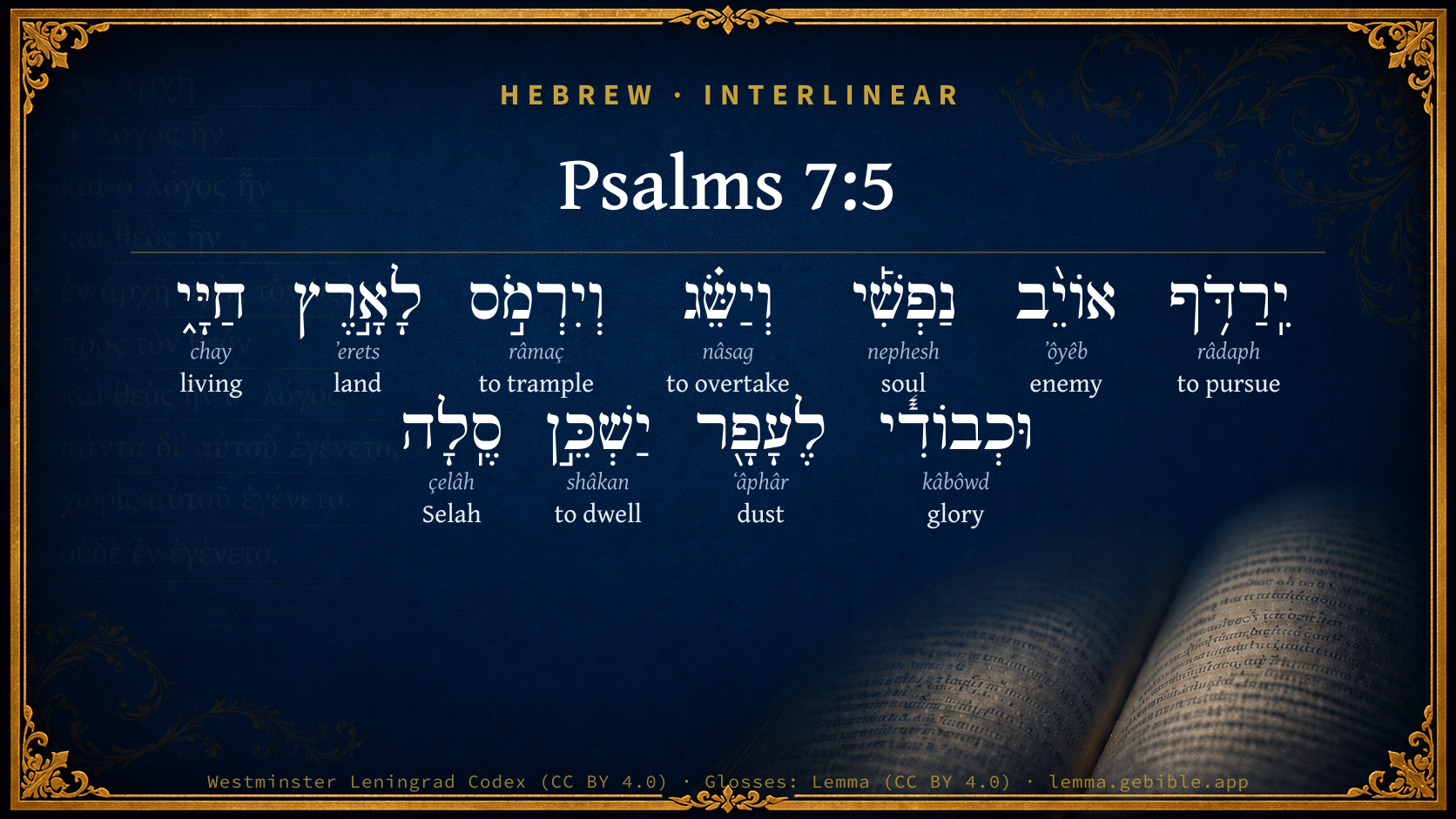
Hebrew (Westminster Leningrad Codex) Psalms 7:5 appears in the Hebrew Old Testament. The text above is from the Westminster Leningrad Codex. Each word links to its Strong’s number, a concise gloss, and parsing drawn from the Open Scriptures Hebrew Bible morphology. Click any word for its full Brown-Driver-Briggs (BDB) entry.
Download image
Cite this verse

Psalms 7:5 (World English Bible). Public Domain. Lemma interlinear Bible study tool, https://lemma.gebible.app/v/psalms/7/5.

Show BibTeX & RIS
BibTeX
RIS
English Translation
Let the enemy pursue my soul, and overtake it; Yes, let him tread my life down to the earth, And lay my glory in the dust. Selah.
World English Bible · Public Domain
Download a study sheet

One document with this verse’s original text, its word-by-word gloss line, the meaning frame, cross-references with their text, attributed commentary, and full source and license credits — printable, and it pastes into notes with its structure intact.

This verse Autodidact and up

Study sheet (.html) Plain text (.txt)

A passage Seminary Student

Up to 50 verses in one chapter. A passage sheet keeps up to 6 commentary sources and 12 cross-references per verse, in the order this page ranks them, and says so on the sheet whenever that leaves anything out. Ask for a single verse and you get the Autodidact verse sheet above.

Everything on this page stays free to read, with no account — the sheet is a download of what is already on screen, not access to it.

Want to remove ads? Support Godless Engineer
Compare translations 3

The same verse in 3 English versions, stacked beneath the original-language interlinear above. Click any original word for its lexicon entry.

Each is an independent rendering of the whole verse — the interlinear is not word-aligned to these translations.

Highlighted words mark where these versions differ — a whole-verse word diff, not a word-by-word alignment.

  • World English Bible Public Domain
    Let the enemy pursue my soul, and overtake it; Yes, let him tread my life down to the earth, And lay my glory in the dust. Selah.
  • King James Version Public Domain
    Let the enemy persecute my soul, and take it; yea, let him tread down my life upon the earth, and lay mine honour in the dust. Selah.
  • unfoldingWord Literal Text CC BY-SA 4.0
    let my enemy pursue my soul and overtake, and let him trample my life to the ground and cause my honor to live in the dust. Selah

unfoldingWord Literal Text — © unfoldingWord, licensed CC BY-SA 4.0. Word-aligned USFM3 via Door43 (git.door43.org/unfoldingWord/en_ult).

Versions to compare (up to 4)

3 of 4 selected

Show all 18 translations

Every available English version of this verse, each an independent rendering of the whole verse.

  • World English Bible Public Domain
    Let the enemy pursue my soul, and overtake it; Yes, let him tread my life down to the earth, And lay my glory in the dust. Selah.
  • Berean Standard Bible Public Domain
    then may my enemy pursue me and overtake me; may he trample me to the ground and leave my honor in the dust. Selah
  • Majority Standard Bible Public Domain
    then may my enemy pursue me and overtake me; may he trample me to the ground and leave my honor in the dust. Selah
  • King James Version Public Domain
    Let the enemy persecute my soul, and take it; yea, let him tread down my life upon the earth, and lay mine honour in the dust. Selah.
  • American Standard Version (1901) Public Domain
    Let the enemy pursue my soul, and overtake it; Yea, let him tread my life down to the earth, And lay my glory in the dust. Selah
  • Revised Version (1885) Public Domain
    Let the enemy pursue my soul, and overtake it; yea, let him tread my life down to the earth, and lay my glory in the dust. Selah
  • Geneva Bible (1599) Public Domain
    Then let the enemie persecute my soule and take it: yea, let him treade my life downe vpon the earth, and lay mine honour in the dust. Selah.
  • Douay-Rheims (1899) Public Domain
    If I have rendered to them that repaid me evils, let me deservedly fall empty before my enemies.
  • Young's Literal Translation Public Domain
    An enemy pursueth my soul, and overtaketh, And treadeth down to the earth my life, And my honour placeth in the dust. Selah.
  • Literal Standard Version CC BY-SA 4.0
    [Then] an enemy pursues my soul, and overtakes, || And treads down my life to the earth, || And places my glory in the dust. Selah.
  • Unlocked Literal Bible CC BY-SA 4.0
    Then let my enemy pursue my life and overtake me; let him trample my life to the ground and lay my honor in the dust. Selah
  • unfoldingWord Literal Text CC BY-SA 4.0
    let my enemy pursue my soul and overtake, and let him trample my life to the ground and cause my honor to live in the dust. Selah
  • Darby Bible Public Domain
    Let the enemy pursue after my soul, and take [it], and let him tread down my life to the earth, and lay my glory in the dust. Selah.
  • World Messianic Bible Public Domain
    let the enemy pursue my soul, and overtake it; yes, let him tread my life down to the earth, and lay my glory in the dust. Selah.
  • Webster's Bible Public Domain
    \\7:4\\If I have rewarded evil to him that was at peace with me; (yes, I have delivered him that without cause is my enemy:)
  • Free Bible Version CC BY-SA 4.0
    Then let my enemies chase me down; let them trample me in the dust and drag my reputation through the dirt. Selah.
  • Bible in Basic English Public Domain
    Let my hater go after my soul and take it; let my life be crushed to the earth, and my honour into the dust. (Selah.)
  • JPS Tanakh (1917) Public Domain
    (7-6) Let the enemy pursue my soul, and overtake it, and tread my life down to the earth; yea, let him lay my glory in the dust. Selah

Literal Standard Version (2020), Covenant Press — licensed CC BY-SA 4.0. Text via the HelloAO Bible API (eBible.org). Unlocked Literal Bible (unfoldingWord) — licensed CC BY-SA 4.0. Text via the HelloAO Bible API (eBible.org). unfoldingWord Literal Text — © unfoldingWord, licensed CC BY-SA 4.0. Word-aligned USFM3 via Door43 (git.door43.org/unfoldingWord/en_ult). Free Bible Version, Dr. Jonathan Gallagher — licensed CC BY-SA 4.0. Text via the HelloAO Bible API (eBible.org).

Word by word

More ways to search: Search by grammar → Find every occurrence → Compare this word →

Practice this passage: Drill this verse → Learn its vocabulary →

וְיִרְמֹ֣ס
râmaç
H7429
“and · to trample”
Conjunction + Verb, Qal, Imperfect, 3rd Person, Masculine, Singular
Part of Speech
Conjunction + Verb
Stem
Qal
Form
Imperfect
Person
3rd Person
Gender
Masculine
Number
Singular
Full BDB Definition

Origin: a primitive root

TWOT: 2176

to trample - (Qal) - to trample - trampler (participle) - (Niphal) to be trampled
  1. יִֽרַדֹּ֥ף râdaph H7291 “to pursue” Verb, Qal, Imperfect, 3rd Person, Masculine, Singular
  2. אוֹיֵ֨ב ʼôyêb H341 “enemy” Verb, Qal, Participle Active, Masculine, Singular, Absolute
  3. נַפְשִׁ֡י nephesh H5315 “soul · my” Noun, Common, Both, Singular, Construct + Suffix, Personal, 1st Person, Common, Singular
  4. וְיַשֵּׂ֗ג nâsag H5381 “and · to overtake” Conjunction + Verb, Hiphil, Jussive, 3rd Person, Masculine, Singular
  5. לָאָ֣רֶץ ʼerets H776 “to/for the · land” Preposition, Determined + Noun, Common, Both, Singular, Absolute
  6. חַיָּ֑י chay H2416 “living things · my” Noun, Common, Masculine, Plural, Construct + Suffix, Personal, 1st Person, Common, Singular
  7. וּכְבוֹדִ֓י kâbôwd H3519 “and · glory · my” Conjunction + Noun, Common, Both, Singular, Construct + Suffix, Personal, 1st Person, Common, Singular
  8. לֶעָפָ֖ר ʻâphâr H6083 “to/for the · dust” Preposition, Determined + Noun, Common, Masculine, Singular, Absolute
  9. יַשְׁכֵּ֣ן shâkan H7931 “to dwell” Verb, Hiphil, Jussive, 3rd Person, Masculine, Singular
  10. סֶֽלָה çelâh H5542 “Selah” Particle, Interjection

About this verse

These counts appear in no published source. They are computed here, from the morphology-tagged text and Lemma’s own curated glosses. What Lemma adds →

11
words
11
distinct lemmas
Wisdom
section

Notable vocabulary

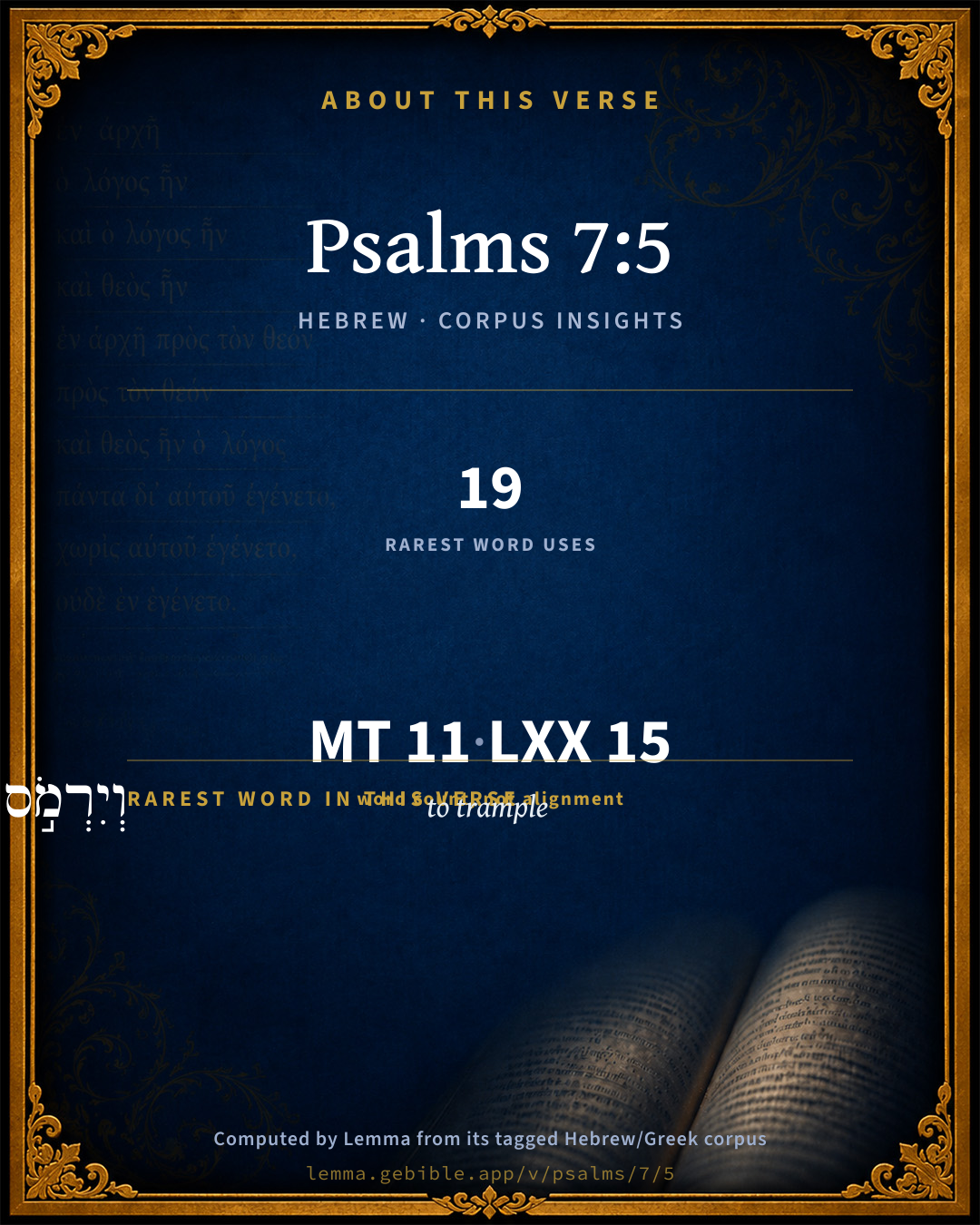
The rarest word here is וְיִרְמֹ֣ס to trample H7429 — appearing just 19 times in the whole Hebrew Bible.

Shared distinctive vocabulary

וְיִרְמֹ֣ס to trample H7429 occurs in 19 verses of the Hebrew Bible. Also found in:

Grammatical profile

  • 5 verbs
  • 5 nouns
  • 1 particle

Verb forms

  • יִֽרַדֹּ֥ף Qal · Imperfect
  • אוֹיֵ֨ב Qal · Participle Active
  • וְיַשֵּׂ֗ג Hiphil · Jussive
  • וְיִרְמֹ֣ס Qal · Imperfect
  • יַשְׁכֵּ֣ן Hiphil · Jussive

Hebrew & Septuagint length

In English translation the verse runs 27 words from the Hebrew and 26 from the Septuagint (LXX English) — closely comparable.

A rough comparison of the two English renderings, which tokenize alike — not a word-level alignment.

Word counts can differ between the Hebrew and the Greek without any difference in meaning — e.g. the Hebrew direct-object marker אֵת has no separate Greek word, and Greek often adds the article ὁ.

In the original languages it is 11 Hebrew tokens and 15 Greek tokens — but the two are counted differently (Hebrew bundles its prefixes and suffixes into one token; the Greek is in lemma form), so that isn’t a like-for-like length.

Cross-references

14

Topical passages linked to Psalms 7:5 in the Treasury of Scripture Knowledge — connected by theme and wording, ordered by reader-vote popularity; previews shown in the World English Bible.

  • Malachi 4:3 You shall tread down the wicked; for they will be ashes under the soles of your feet in the day that I make," says Yahweh of Hosts.
  • Psalms 3:2 Many there are who say of my soul, "There is no help for him in God." Selah.
  • Psalms 44:5 Through you, will we push down our adversaries. Through your name, will we tread them under who rise up against us.
  • Psalms 49:12 But man, despite his riches, doesn't endure. He is like the animals that perish.
  • Jeremiah 17:13 Yahweh, the hope of Israel, all who forsake you shall be disappointed. Those who depart from me shall be written in the earth, because they have forsaken Yahweh, the spring of living waters.
  • Job 16:15 I have sewed sackcloth on my skin, And have thrust my horn in the dust.
  • Job 31:5–10 "If I have walked with falsehood, And my foot has hurried to deceit
  • Job 31:38–40 If my land cries out against me, And the furrows of it weep together;
  • Job 40:12–13 Look on everyone who is proud, and humble him. Crush the wicked in their place.
  • Psalms 60:12 Through God we shall do valiantly, For it is he who will tread down our adversaries.
  • Isaiah 10:6 I will send him against a profane nation, and against the people of my wrath will I give him a charge, to take the spoil, and to take the prey, and to tread them down like the mire of the streets.
  • Isaiah 63:3 I have trodden the winepress alone; and of the peoples there was no man with me: yes, I trod them in my anger, and trampled them in my wrath; and their lifeblood is sprinkled on my garments, and I have stained all my clothing.
  • Habakkuk 3:13 You went forth for the salvation of your people, For the salvation of your anointed. You crushed the head of the land of wickedness. You stripped them head to foot. Selah.
  • Zechariah 10:5 They shall be as mighty men, Treading down muddy streets in the battle; And they shall fight, because Yahweh is with them; And the riders on horses will be confounded.

Cross-references courtesy of OpenBible.info (CC BY 4.0).

Hebrew and Greek witnesses Masoretic Hebrew ↔ Greek Septuagint

The same verse in the two great witnesses to the Old Testament, shown verse-for-verse.

You’re reading Greek Psalm 7 (Hebrew Psalm 7). The Septuagint counts the superscription, so verse numbers can differ from the Hebrew — chapter-level alignment, not verse-by-verse. Numbering follows Rahlfs.

These are two independent witnesses, not word-aligned to each other, and the Septuagint is shown in lemma (dictionary) form.

Hebrew Psalms 7:5 Masoretic · Westminster Leningrad Codex

יִֽרַדֹּ֥ף אוֹיֵ֨ב נַפְשִׁ֡י וְיַשֵּׂ֗ג וְיִרְמֹ֣ס לָאָ֣רֶץ חַיָּ֑י וּכְבוֹדִ֓י לֶעָפָ֖ר יַשְׁכֵּ֣ן סֶֽלָה

Let the enemy pursue my soul, and overtake it; Yes, let him tread my life down to the earth, And lay my glory in the dust. Selah.

World English Bible · Public Domain

Greek LXX Greek Psalm 7:5 Septuagint · lemma form

εἰ ἀντι ἀποδίδωμι ὁ ἀντι ἀποδίδωμι ἐγώ κακός ἀποπίπτω ἄρα ἀπό ὁ ἐχθρός ἐγώ κενός

Let the enemy persecute my soul, and take it; and let him trample my life on the ground, and lay my glory in the dust. Pause.

LXX2012 (modern English Septuagint) · Public Domain

Hebrew: Westminster Leningrad Codex (CC BY 4.0). Greek: Septuagint (public domain); English from LXX2012 (modern English Septuagint) (Public Domain). How the Septuagint differs from the Hebrew →

Commentary

Notes on Psalms 7:5 from classic Christian and Jewish commentators (each source and its license shown beneath its notes). The classic Christian expositions comment on the surrounding passage and are grouped to its opening verse, so a note may address several verses; the Jewish commentaries on the Tanakh (Rashi and others) are per-verse, so they appear only where the commentator wrote on this verse.

Lemma curates 59 commentaries, every one of them public domain or Creative Commons licensed, each selected and text-cleaned for this edition rather than reprinted as found. About our sources →

Trapp's Complete Commentary

John Trapp

Psa 7:5 Let the enemy persecute my soul, and take [it]; yea, let him tread down my life upon the earth, and lay mine honour in the dust. Selah.

Ver. 5. Let the enemy persecute my soul, and take it] Thus he cleareth himself by a holy imprecation (the Spanish Bible hath the Shiggaion Davidis, in the title, Purgatio Davidis, as the same Hebrew word חשׁא signifieth both sin and purification from sin, Psa 51:1-19), taking God to witness his innocence and good conscience, and wishing evil to himself if it were otherwise. This he did from a good cause, in a good manner, and for a good end. And not as many profane ones do today, who, taxed, though never so truly, with some evil they have done, seek to justify themselves by appealing to God, and calling for his curse upon them if guilty; who, therefore, striketh such impudent imprecators immediately, as Anne Averies and others. See Mr Clark’s Mirror.

And tread down my life] Heb. my lives; so usually called, saith an interpreter, for the many faculties and operations that are in life, the many years, degrees, estates thereof.

And lay mine honour in the dust. Selah] Let him brand me for a most treacherous, ignominious wretch, and let me lie buried in a bog of indelible infamy.

John Trapp, A Commentary or Exposition upon All the Books of the Old and New Testament (1647–1656) — public domain. Text from a community e-Sword module.

Joseph Benson's Commentary

Psa 7:5. Let the enemy persecute my soul, &c. — I am contented, and wish that Saul may so persecute my life as to overtake it, and take it away. And lay mine honour in the dust — Meaning either 1st, that honourable and royal dignity for which he was designed; or, 2d, his reputation and memory: or, rather, 3d, his soul or life, mentioned in the former clause, it being very usual to express the same thing by different words or phrases in one verse: thus we may observe a gradation here. 1st, Let him persist to persecute it; 2d, take it; 3d, tread it down, or destroy it; and, 4th, lay it in the dust, or bury it, to prevent all hopes of restitution. So that the evils which David imprecates on himself, if he were such a person as his adversaries represented him to be, are persecution, apprehension, death, and disgrace.

Joseph Benson's Commentary on the Old and New Testaments (1811–1818) — public domain. Text from a community e-Sword module.

J. A. Alexander on Psalms

Joseph Addison Alexander

6. (Psa 7:5). His consciousness of innocence is expressed in the strongest manner by invoking the divine displeasure if the charge can be established. An enemy, or by poetic licence, the enemy, whether Saul or the ideal enemy referred to in Psa 7:3 (2), shall pursue, or may pursue, which is equivalent to saying, Let the enemy pursue my soul, the figure being still the same as in Psa 7:3 (2) above, but carried out with more minuteness, and overtake (it), and trample to the earth my life, and my honour in the dust make dwell, i. e. completely prostrate and degrade. Some regard honour as equivalent to soul and life, the intelligent and vital part, which is the glory of man's constitution. But the analogy of Psa 3:4 (3) and Psa 7:3 (2) makes it more probable that in this case also there is reference to the Psalmist's personal and official honour. The allusion, however, is not so much to posthumous disgrace as to present humiliation. All this he imprecates upon himself if really guilty of the charges calumniously brought against him. The solemnity of this appeal to God, as a witness and a judge, is enhanced by the usual pause. Selah.

Joseph Addison Alexander, The Psalms Translated and Explained (1850) — public domain. Text from a community e-Sword module.

Tyndale Open Study Notes

Tyndale Open Resources

7:5 trample: Cp. 44:5; 60:12; 91:13; 108:13. • into the ground . . . in the dust: Disgrace and shame can lead to death and the grave (143:3; see 13:3-4).

Tyndale Open Study Notes — © Tyndale Open Resources, licensed CC BY-SA 4.0. Text via the HelloAO Bible API.

Geneva Bible (1599)

Geneva Bible translators

Let me not only die, but be dishonored forever.

Geneva Bible (1599) marginal notes — public domain. Text via Bolls.life.

Jamieson, Fausset & Brown

Robert Jamieson, A. R. Fausset & David Brown

This is the consequence, if such has been his conduct.

mine honour--(compare Psa 3:3; Psa 4:2) --my personal and official dignity.

Jamieson, Fausset & Brown — Commentary Critical and Explanatory on the Whole Bible (1871) — public domain (CC PDM 1.0). Text via the HelloAO Bible API.

Adam Clarke's Commentary

Verse 5. Let the enemy persecute my soul] If I have been guilty of the things laid to my charge, let the worst evils fall upon me.

Adam Clarke's Commentary on the Bible (1810–1826) — public domain. Text from a community e-Sword/MySword module.

John Calvin's Commentaries

5 Let mine enemy pursue It is a striking proof of the great confidence which David had in his own integrity, when he is willing to endure any kind of punishment, however dreadful, provided he should be found guilty of any crime. If we could bring a good conscience like this before God, his hand would be more quickly stretched forth to afford us immediate assistance. But as it often happens that those who molest us have been provoked by us, or that we burn with the desire of revenge when offended, we are unworthy of receiving succour from God; yea, our own impatience shuts the gate against our prayers. In the first place, David is prepared to be given over to the will of his enemies, that they may seize his life, and throw it down to the ground; and then to be publicly exhibited as an object of their mockery, so that, even after he is dead, he may lie under eternal disgrace. Some think that the כבוד kebod, which we have translated glory, is here to be taken for life, and thus there will be three words, soul, life, glory, signifying the same thing. But it appears to me, that the meaning of the passage will be fuller if we refer the word glory to his memory, or his good name, as if he had said, Let my enemy not only destroy me, but, after having put me to death, let him speak of me in the most reproachful terms, so that my name may be buried in mire or filth.

John Calvin's Commentaries (1540-1563) — public domain. Text from the Calvin Translation Society English edition (1840s-50s) via the Christian Classics Ethereal Library (ccel.org). Calvin's coverage is partial (roughly two-thirds of the Bible); uncommented books and verses are honest gaps, never fabricated. The 19th-century editor's footnotes and remarks are omitted so the notes are faithfully Calvin's own voice.

Ellicott's Commentary for English Readers

(5) Let the enemy.—Better, let an enemy.

Persecute.—Literally, burn. (See Note on Psa_10:2.)

Tread.—Used of a potter treading the clay (Isa_41:25); of the trampling of horses (Eze_26:11); of a herd trampling down their pasture (Eze_34:28).

Dust.—Either as Psa_22:15, “the dust of death,” and if so, then khabôd’.

Honour must be the soul or life, as plainly in Psa_16:9; Psa_57:8, where the Authorised Version has “glory.” The parallelism is in favour of this. On the other hand, to lay one’s honour in the dust is a common figurative phrase. Shakespeare, K. Hen. VI., i. 5, “Now, France, thy glory droopeth to the dust”; and Coriol. iii. 1, “And throw their power in the dust.”

Selah.—See Note on Psa_3:2. This is one of the places which suggest its interpretation as a direction to the music, to strike up with passion and force.

A Bible Commentary for English Readers, edited by Charles John Ellicott (1878–1897) — public domain. Text from a community e-Sword module.

The Cambridge Bible for Schools and Colleges

gen. ed. J. J. S. Perowne

5. Render:

Let an enemy pursue my soul and overtake it;

Yea, trample my life to the ground,

And make my glory to dwell in the dust.

With the first line comp. Exo_15:9, echoed again in Psa_18:37. The last line might mean only, ‘degrade my dignity, treat me with insult and ignominy;’ but the parallelism of ‘my soul,’ ‘my life,’ ‘my glory,’ is decisive in favour of interpreting ‘my glory’ to mean ‘my soul, as in Psa_16:9; Psa_30:12; Psa_57:8. The ‘soul’ is so designated either as the noblest part of man, or as the image of the divine glory. ‘The dust’ will then be ‘the dust of death.’ Cp. Psa_22:15; and the exact parallel ‘dwellers in the dust,’ Isa_26:19. David then invokes death by an enemy’s hand if he is guilty, and death, as the language implies, with every circumstance of violence and disgrace.

The Cambridge Bible for Schools and Colleges (gen. ed. J. J. S. Perowne; Cambridge University Press, 1878–1918) — public domain. Text from a community e-Sword module.

John Gill's Exposition

Let the enemy persecute my soul, and take it,.... That is, if the above things he was charged with could be proved against him; then he was content that Saul his enemy should pursue after him, and apprehend him, and bring him to justice, by taking away his life from him;

yea, let him tread down my life upon the earth; with the utmost indignation and contempt, without showing any mercy; as the lion treads down his prey, and tears it to pieces, Mic 5:8; or as the potter treads his clay under foot, Isa 41:25;

and lay mine honour in the dust; meaning either his life and soul, as before; denominating himself from his better part, and which he elsewhere calls his glory, Psa 16:9; see Gen 49:6; or else his body, as R. Judah Ben Balaam, who is blamed for it by Jarchi; or rather his fame, credit, and reputation, that he had gained, both by his courage and valour in the field, and by his wise and prudent behaviour at court, Sa1 18:7. Should he appear to be guilty of the crimes he was accused of, he is willing to have his glorious name buried in the dust of oblivion, and his memory perish for ever. The words are to be considered as a strong assertion of his innocence, in an appeal to God, the searcher of hearts, and the trier of the reins of men; and as imprecating on himself the worst of evils, should it not appear; see Job 31:21.

Selah; Aben Ezra renders "selah", "in truth", "let it be so"; and the Targum renders it, as usual, "for ever"; See Gill on Psa 3:2.

John Gill's Exposition of the Whole Bible (1746–1763) — public domain (CC PDM 1.0). Text via the HelloAO Bible API.

Albert Barnes' Notes on the Bible

Let the enemy persecute my soul - Persecute my “life,” for so the word rendered “soul,” נפשׁ nephesh, is evidently used here. He was willing, if he had been guilty of the thing charged upon him, that the enemy here referred to should “pursue” or persecute him until he should destroy his life. Compare with this the expression of Paul in Act 25:11. The meaning here is simply that if he were a guilty man, in the manner charged on him, he would be willing to be treated accordingly. He did not wish to screen himself from any just treatment; and if he had been guilty he would not complain even if he were cut off from the land of the living.

And take it - Take my life; put me to death.

Yea, let him tread down my life upon the earth - The allusion here is to the manner in which the vanquished were often treated in battle, when they were rode over by horses, or trampled by men into the dust. The idea of David is, that if he was guilty he would be willing that his enemy should triumph over him, should subdue him, should treat him with the utmost indignity and scorn.

And lay mine honor in the dust - All the tokens or marks of my honor or distinction in life. That is, I am willing to be utterly degraded and humbled, if I have been guilty of this conduct toward him who is my enemy. The idea in all this is, that David did not wish to screen himself from the treatment which he deserved if he had done wrong. His own principles were such that he would have felt that the treatment here referred to would have been right and proper as a recompense for such base conduct; and he would not have had a word to say against it. His desire for the interposition of God, therefore, arose solely from the fact of his feeling that, in these respects, he was entirely innocent, and that the conduct of his enemy was unjust and cruel.

Selah - A musical pause, not affecting the sense, but introduced here, perhaps, because the sense of the psalm now demanded a change in the style of the music. See the notes at Psa 3:2.

Albert Barnes' Notes on the Bible (1834–1885) — public domain. Text from a community e-Sword/MySword module.

Matthew Poole's English Annotations

I am contented, and wish that Saul may so persecute my life as to overtake it, and take it away. Mine honour; either,

1. That honourable and royal estate to which I am chosen and designed. Or,

2. My reputation and memory. Or rather,

3. The same thing which he called his

soul and his life in the former branch of the verse, and here his honour; it being very frequent to express one thing in several words or phrases in one verse. And so here may be observed a gradation. Let him,

1. Persist to persecute it;

2. Take it;

3. Tread it down, or destroy it; and,

4. Lay it in the dust, or bury it, to prevent all hopes of restitution.

Matthew Poole's English Annotations on the Holy Bible (1683–1685) — public domain. Text from a community e-Sword/MySword module.

The Treasury of David

Charles H. Spurgeon

Ver. 5. Let him tread down my life upon the earth. The allusion here is to the manner in which the vanquished were often treated in battle, when they were rode over by horses, or trampled by men in the dust. The idea of David is, that if he was guilty he would be willing that his enemy should triumph over him, should subdue him, should treat him with the utmost indignity and scorn. Albert Barnes, in loc.

Ver. 5. Mine honour in the dust. When Achilles dragged the body of Hector in the dust around the walls of Troy, he did but carry out the usual manners of those barbarous ages. David dares in his conscious innocence to imprecate such an ignominious fate upon himself if indeed the accusation of the black Benjamite be true. He had need have a golden character who dares to challenge such an ordeal. C.H.S.

None.

Charles H. Spurgeon's The Treasury of David (1869–1885) — public domain. Psalms only. Text from a community e-Sword/MySword module.

Whedon's Commentary on the Bible

Daniel D. Whedon

5. Let the enemy persecute my soul—Here is a direct and solemn appeal to God to judge and punish him if he were not upright and pure in the matters urged by his accuser. Here is the boldness of conscious righteousness before God, even before his judgment seat. Compare in the evangelical sense, Rom_8:33-34; 1Jn_3:19-21; 1Jn_4:17.

Lay mine honour in the dust— “Honour,” or glory as it is more commonly rendered, unquestionably refers to his kingly dignity, and proves that David had, at this time, come to the throne of Israel, which corroborates the date and occasion above given to this psalm. The significant pause “selah” fitly follows so solemn an appeal to God as has just been made, and closes the strophe.

Daniel D. Whedon (gen. ed.), Commentary on the Old and New Testaments (1874–1909) — public domain. Text from a community e-Sword module.

The Pulpit Commentary

Let the enemy persecute my soul, and take it. "If I have been guilty of any of these acts, then let my enemy not only persecute my soul, as he is doing (vers. 1, 2), but take it make it his prey obtain full power over it." Yea, let him tread down my life upon the earth; i.e. "utterly destroy me and bring me to ruin." And not only so, but also lay mine honour in the dust; i.e. "bring me down to the grave with shame.

Compare the imprecations of Job upon himself. (Job_31:8, Job_31:10, Job_31:22, Job_31:40)

The Pulpit Commentary (1880–1919), ed. H.D.M. Spence-Jones & Joseph S. Exell — public domain. Text from a community e-Sword module.

unfoldingWord translationNotes

Door43 World Missions Community

my life

The life represents the person. AT: "me" (See: Metonymy)

overtake me

This represents capturing him. AT: "capture me" (See: Metonymy)

let him trample my life to the ground

Here "my life" represents the writer. AT: "allow him to destroy me" (See: Metonymy)

lay my honor in the dust

This refers to lying dead and unburied in disgrace.

translationWords

life

trample

body

dishonor

unfoldingWord translationNotes — © Distant Shores Media and the Door43 World Missions Community, licensed CC BY-SA 4.0. Source: git.door43.org/Door43/en_tn.

Rashi

Rabbi Shlomo Yitzchaki (Rashi)

if I repaid the one who did evil to me If I repaid him according to his deeds.

and I stripped my adversary into emptiness I destroyed his garment when I severed the skirt of his coat. Did I do it to destroy and to strip him and cause him to stand empty, and [was it done] with hatred? Only to let him know that he was delivered into my hand to kill him, and I did not kill him. [The word] חלצה is an expression of stripping off clothing.

Rashi on the Tanakh — English translations: “The Judaica Press complete Tanach with Rashi, translated by A. J. Rosenberg” (CC BY 4.0); “Pentateuch with Rashi's commentary by M. Rosenbaum and A.M. Silbermann, 1929-1934” (public domain); “The Metsudah Tanach series, Lakewood, N.J” (CC BY 4.0); and “The Book of Joshua, Metsudah Publications, 1997” (CC BY 4.0). Text via Sefaria.

Radak

Rabbi David Kimhi (Radak)

If I have requited evil unto him that was at peace with me: – If I have requited him evil who was at peace with me as he does me who was at peace with him, and was his son-in-law, and fought his battles – and he requites me evil in return for good!

But (no)! I have delivered him that without cause was my enemy: – Not merely have I not requited evil unto him (who was) at peace with me, but (on the contrary) I have delivered him who without cause was my enemy. But to no purpose did I rescue him as indeed he rescued Saul from the power of Abishai, who, had he not withheld him, was about to kill him, as he said: “Let me smite him, I pray thee, with the spear to the earth at one stroke, and I will not smite him the second time” (i Sam. 26:8); and so of the occasion when he was in the cave it is said: “so David checked his men with these words and suffered them not to rise against Saul” (i Sam. 24:7). And the waw in ואחלצה (“but [lit. and] I have delivered”) is like the waw (in ועבדיך in the verse) “but (and) thy servants came to buy food” (Gen. 42:10), of which (passage) the interpretation is: “It is not, my lord, as thou sayest, that we are spies; but thy servants are come to buy food.”

Radak on the Tanakh — English translations: “Sefaria Community Translation” (CC0 1.0 (public-domain dedication)); “Eliyahu Munk, HaChut Hameshulash” (CC BY 4.0); “Rabbi Mike Feuer, Jerusalem Anthology” (CC BY 4.0); and “R. David Kimhi on the first book of Psalms, Translated by R.G. Finch, London, 1919” (public domain). Text via Sefaria.

Lesson kit

Teaching starters — assembled from the data on this page, not authored interpretation. Every prompt links to the verse data it draws on. Edit before teaching.

Psalms, in the Wisdom, opens this verse with 11 words (11 distinct Hebrew lemmas). Its most distinctive word is râmaç (“to trample”). A historical commentator’s framing appears above. Read the whole chapter for the surrounding context.

Discussion questions

  1. What does “to trample” (râmaç) contribute to the verse as a whole?
  2. 2 Kings 7:17 shares the word «to trample» with this verse. How do the two illuminate each other?
  3. These translations render this verse differently. What is at stake in choosing one wording over another?
  4. The verb «יִֽרַדֹּ֥ף» is Qal Imperfect. How does its form color the action?
  5. Reading how Trapp's Complete Commentary and Joseph Benson's Commentary read this verse, where do the two commentators agree and where do they part?

Things to notice

Reading settings

Reading text

Shown beneath each verse's original-language words.

Old Testament
Old Testament edition

Read the OT as the Masoretic Hebrew (MT) or the Greek Septuagint (LXX).

English shown for the Greek Septuagint (in the Hebrew ↔ Greek comparison).

Comparing translations? Open the Compare panel on any verse page to stack up to four side by side.