
Judges 16:24

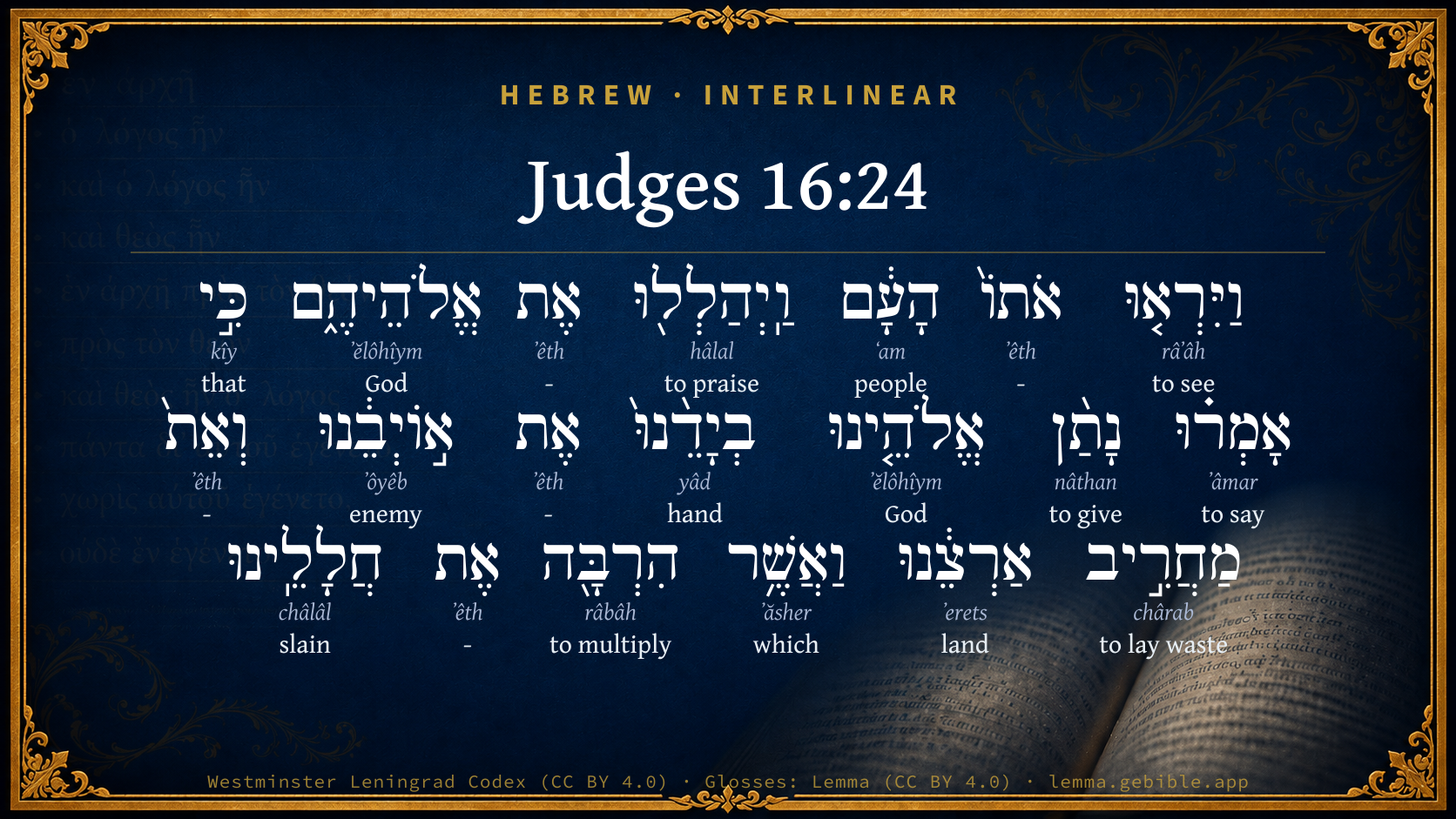
Hebrew (Westminster Leningrad Codex) Judges 16:24 appears in the Hebrew Old Testament. The text above is from the Westminster Leningrad Codex. Each word links to its Strong’s number, a concise gloss, and parsing drawn from the Open Scriptures Hebrew Bible morphology. Click any word for its full Brown-Driver-Briggs (BDB) entry.
Download image
Cite this verse

Judges 16:24 (World English Bible). Public Domain. Lemma interlinear Bible study tool, https://lemma.gebible.app/v/judges/16/24.

Show BibTeX & RIS
BibTeX
RIS
English Translation
When the people saw him, they praised their god; for they said, Our god has delivered into our hand our enemy, and the destroyer of our country, who has slain many of us.
World English Bible · Public Domain
Download a study sheet

One document with this verse’s original text, its word-by-word gloss line, the meaning frame, cross-references with their text, attributed commentary, and full source and license credits — printable, and it pastes into notes with its structure intact.

This verse Autodidact and up

Study sheet (.html) Plain text (.txt)

A passage Seminary Student

Up to 50 verses in one chapter. A passage sheet keeps up to 6 commentary sources and 12 cross-references per verse, in the order this page ranks them, and says so on the sheet whenever that leaves anything out. Ask for a single verse and you get the Autodidact verse sheet above.

Everything on this page stays free to read, with no account — the sheet is a download of what is already on screen, not access to it.

Want to remove ads? Support Godless Engineer
Compare translations 3

The same verse in 3 English versions, stacked beneath the original-language interlinear above. Click any original word for its lexicon entry.

Each is an independent rendering of the whole verse — the interlinear is not word-aligned to these translations.

Highlighted words mark where these versions differ — a whole-verse word diff, not a word-by-word alignment.

  • World English Bible Public Domain
    When the people saw him, they praised their god; for they said, Our god has delivered into our hand our enemy, and the destroyer of our country, who has slain many of us.
  • King James Version Public Domain
    And when the people saw him, they praised their god: for they said, Our god hath delivered into our hands our enemy, and the destroyer of our country, which slew many of us.
  • unfoldingWord Literal Text CC BY-SA 4.0
    And the people saw him, and they praised their god, for they said, “Our god has given into our hand our enemy and the devastator of our land, and who multiplied our slain.”

unfoldingWord Literal Text — © unfoldingWord, licensed CC BY-SA 4.0. Word-aligned USFM3 via Door43 (git.door43.org/unfoldingWord/en_ult).

Versions to compare (up to 4)

3 of 4 selected

Show all 18 translations

Every available English version of this verse, each an independent rendering of the whole verse.

  • World English Bible Public Domain
    When the people saw him, they praised their god; for they said, Our god has delivered into our hand our enemy, and the destroyer of our country, who has slain many of us.
  • Berean Standard Bible Public Domain
    And when the people saw him, they praised their god, saying: “Our god has delivered into our hands our enemy who destroyed our land and multiplied our dead.”
  • Majority Standard Bible Public Domain
    And when the people saw him, they praised their god, saying: “Our god has delivered into our hands our enemy who destroyed our land and multiplied our dead.”
  • King James Version Public Domain
    And when the people saw him, they praised their god: for they said, Our god hath delivered into our hands our enemy, and the destroyer of our country, which slew many of us.
  • American Standard Version (1901) Public Domain
    And when the people saw him, they praised their god; for they said, Our god hath delivered into our hand our enemy, and the destroyer of our country, who hath slain many of us.
  • Revised Version (1885) Public Domain
    And when the people saw him, they praised their god: for they said, Our god hath delivered into our hand our enemy, and the destroyer of our country, which hath slain many of us.
  • Geneva Bible (1599) Public Domain
    Also when the people saw him, they praysed their god: for they sayde, Our god hath deliuered into our hands our enemie and destroyer of our countrey, which hath slayne many of vs.
  • Douay-Rheims (1899) Public Domain
    And the people also seeing this, praised their god, and said the same: Our god hath delivered our adversary into our bands, him that destroyed our country and killed very many.
  • Young's Literal Translation Public Domain
    And the people see him, and praise their god, for they said, `Our god hath given in our hand our enemy, and he who is laying waste our land, and who multiplied our wounded.'
  • Literal Standard Version CC BY-SA 4.0
    And the people see him, and praise their god, for they said, “Our god has given into our hand our enemy, and he who is laying waste to our land, and who multiplied our wounded.”
  • Unlocked Literal Bible CC BY-SA 4.0
    When the people saw him, they praised their god, for they said, “Our god has conquered our enemy and given him to us—the destroyer of our country, who killed many of us.”
  • unfoldingWord Literal Text CC BY-SA 4.0
    And the people saw him, and they praised their god, for they said, “Our god has given into our hand our enemy and the devastator of our land, and who multiplied our slain.”
  • Darby Bible Public Domain
    And when the people saw him, they praised their god; for they said, "Our god has given our enemy into our hand, the ravager of our country, who has slain many of us."
  • World Messianic Bible Public Domain
    When the people saw him, they praised their god; for they said, “Our god has delivered our enemy and the destroyer of our country, who has slain many of us, into our hand.”
  • Webster's Bible Public Domain
    And when the people saw him, they praised their god: for they said, Our god hath delivered into our hands our enemy, and the destroyer of our country; who slew many of us.
  • Free Bible Version CC BY-SA 4.0
    When the people saw him, they praised their god, and said, “Our god has handed our enemy over to us, the one who devastated our land and killed so many of us.”
  • Bible in Basic English Public Domain
    And when the people saw him, they gave praise to their god; for they said, Our god has given into our hands the one who was fighting against us, who made our country waste, and who put great numbers of us to death.
  • JPS Tanakh (1917) Public Domain
    And when the people saw him, they praised their god; for they said: 'Our god hath delivered into our hand our enemy, and the destroyer of our country, who hath slain many of us.'

Literal Standard Version (2020), Covenant Press — licensed CC BY-SA 4.0. Text via the HelloAO Bible API (eBible.org). Unlocked Literal Bible (unfoldingWord) — licensed CC BY-SA 4.0. Text via the HelloAO Bible API (eBible.org). unfoldingWord Literal Text — © unfoldingWord, licensed CC BY-SA 4.0. Word-aligned USFM3 via Door43 (git.door43.org/unfoldingWord/en_ult). Free Bible Version, Dr. Jonathan Gallagher — licensed CC BY-SA 4.0. Text via the HelloAO Bible API (eBible.org).

Word by word

More ways to search: Search by grammar → Find every occurrence → Compare this word →

Practice this passage: Drill this verse → Learn its vocabulary →

מַחֲרִ֣יב
chârab
H2717
“laying waste”
Verb, Hiphil, Participle Active, Masculine, Singular, Construct
Part of Speech
Verb
Stem
Hiphil
Form
Participle Active
Gender
Masculine
Number
Singular
State
Construct
Full BDB Definition

Origin: a primitive root

TWOT: 731 , 732

to be waste, lay waste, make desolate, be desolate, be in ruins - (Qal) to be waste, be desolate - (Niphal) - to be made desolate - desolate (participle) - (Hiphil) to lay waste, make desolate - (Hophal) to be laid waste - to be dry, be dried up - (Qal) to be dried, be dried up - (Pual) to be dried - (Hiphil) to dry up - (Hophal) to be dried up - to attack, smite down, slay, fight
  1. וַיִּרְא֤וּ râʼâh H7200 “and · to see” Conjunction + Verb, Qal, Sequential Imperfect, 3rd Person, Masculine, Plural
  2. אֹתוֹ֙ ʼêth H853 “- · him” Particle, Direct Object + Suffix, Personal, 3rd Person, Masculine, Singular
  3. הָעָ֔ם ʻam H5971 “the · people” Particle, Definite Article + Noun, Common, Masculine, Singular, Absolute
  4. וַֽיְהַלְל֖וּ hâlal H1984 “and · to praise” Conjunction + Verb, Piel, Sequential Imperfect, 3rd Person, Masculine, Plural
  5. אֶת ʼêth H853 “-” Particle, Direct Object
  6. אֱלֹהֵיהֶ֑ם ʼĕlôhîym H430 “God(s) · their” Noun, Common, Masculine, Plural, Construct + Suffix, Personal, 3rd Person, Masculine, Plural
  7. כִּ֣י kîy H3588 “that” Conjunction
  8. אָמְר֗וּ ʼâmar H559 “to say” Verb, Qal, Perfect, 3rd Person, Common, Plural
  9. נָתַ֨ן nâthan H5414 “to give” Verb, Qal, Perfect, 3rd Person, Masculine, Singular
  10. אֱלֹהֵ֤ינוּ ʼĕlôhîym H430 “God(s) · our” Noun, Common, Masculine, Plural, Construct + Suffix, Personal, 1st Person, Common, Plural
  11. בְיָדֵ֨נוּ֙ yâd H3027 “in/at · hand · our” Preposition + Noun, Common, Both, Singular, Construct + Suffix, Personal, 1st Person, Common, Plural
  12. אֶת ʼêth H853 “-” Particle, Direct Object
  13. א֣וֹיְבֵ֔נוּ ʼôyêb H341 “enemy · us” Verb, Qal, Participle Active, Masculine, Singular, Construct + Suffix, Personal, 1st Person, Common, Plural
  14. וְאֵת֙ ʼêth H853 “and · -” Conjunction + Particle, Direct Object
  15. אַרְצֵ֔נוּ ʼerets H776 “land · our” Noun, Common, Both, Singular, Construct + Suffix, Personal, 1st Person, Common, Plural
  16. וַאֲשֶׁ֥ר ʼăsher H834 “and · which” Conjunction + Particle, Relative
  17. הִרְבָּ֖ה râbâh H7235 “to multiply” Verb, Hiphil, Perfect, 3rd Person, Masculine, Singular
  18. אֶת ʼêth H853 “-” Particle, Direct Object
  19. חֲלָלֵֽינוּ châlâl H2491 “slain · our” Adjective, Adjective, Masculine, Plural, Construct + Suffix, Personal, 1st Person, Common, Plural

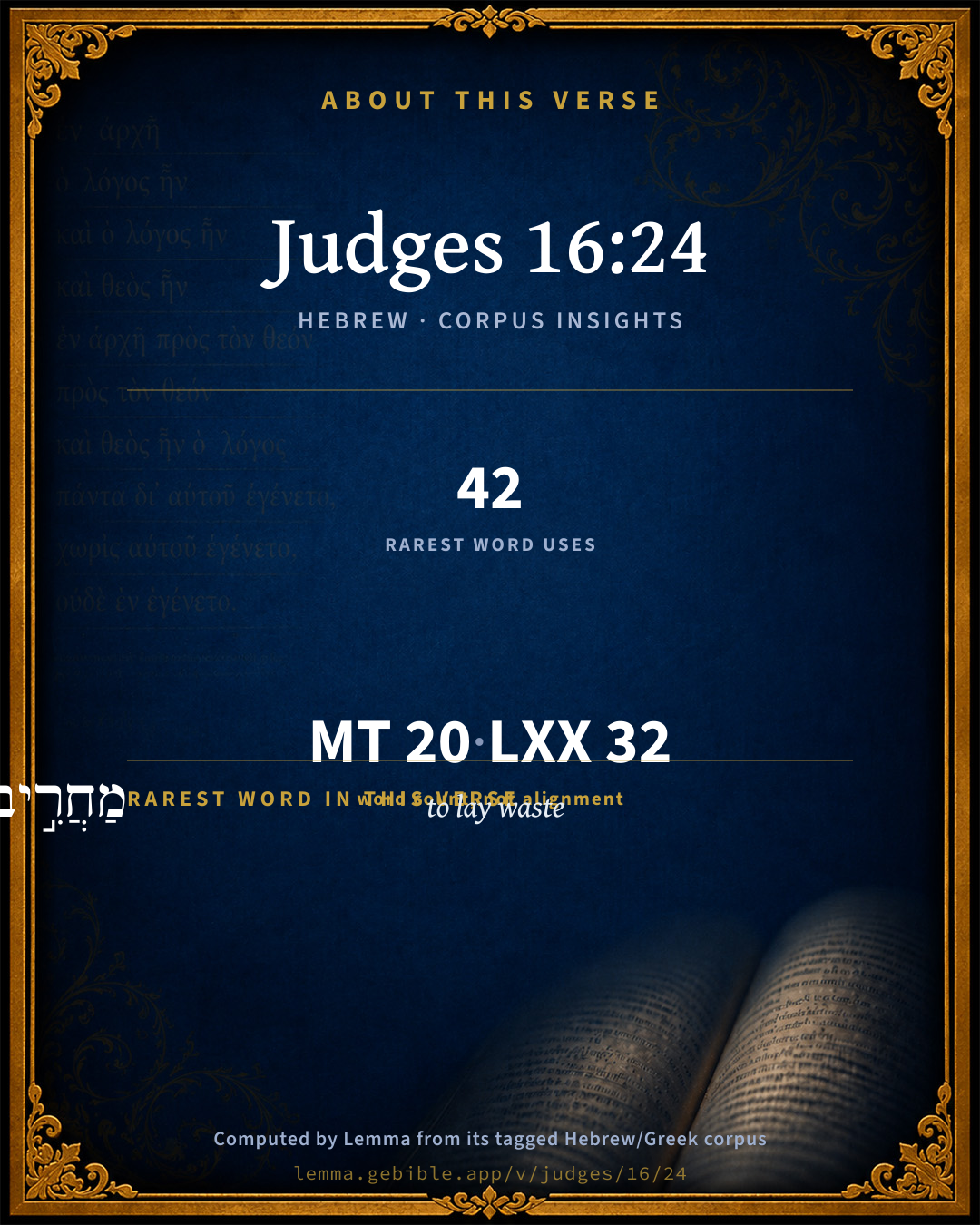
About this verse

These counts appear in no published source. They are computed here, from the morphology-tagged text and Lemma’s own curated glosses. What Lemma adds →

20
words
15
distinct lemmas
Historical
section

Shared distinctive vocabulary

מַחֲרִ֣יב to lay waste H2717 occurs in 38 verses of the Hebrew Bible. Also found in:

Grammatical profile

  • 7 verbs
  • 5 nouns
  • 1 adjective
  • 1 conjunction
  • 6 particles

Verb forms

  • וַיִּרְא֤וּ Qal · Sequential Imperfect
  • וַֽיְהַלְל֖וּ Piel · Sequential Imperfect
  • אָמְר֗וּ Qal · Perfect
  • נָתַ֨ן Qal · Perfect
  • א֣וֹיְבֵ֔נוּ Qal · Participle Active
  • מַחֲרִ֣יב Hiphil · Participle Active
  • הִרְבָּ֖ה Hiphil · Perfect

Repetition

A word recurs within this verse — often emphatic in Hebrew:

  • אֱלֹהֵיהֶ֑ם God H430 ×2

Hebrew & Septuagint length

In English translation the verse runs 33 words from the Hebrew and 32 from the Septuagint (LXX English) — closely comparable.

A rough comparison of the two English renderings, which tokenize alike — not a word-level alignment.

Word counts can differ between the Hebrew and the Greek without any difference in meaning — e.g. the Hebrew direct-object marker אֵת has no separate Greek word, and Greek often adds the article ὁ.

In the original languages it is 20 Hebrew tokens and 32 Greek tokens — but the two are counted differently (Hebrew bundles its prefixes and suffixes into one token; the Greek is in lemma form), so that isn’t a like-for-like length.

Cross-references

11

Topical passages linked to Judges 16:24 in the Treasury of Scripture Knowledge — connected by theme and wording, ordered by reader-vote popularity; previews shown in the World English Bible.

  • Daniel 5:4 They drank wine, and praised the gods of gold, and of silver, of brass, of iron, of wood, and of stone.
  • 1 Samuel 31:9 They cut off his head, and stripped off his armor, and sent into the land of the Philistines round about, to carry the news to the house of their idols, and to the people.
  • Revelation 11:10 Those who dwell on the earth rejoice over them, and they will be glad. They will give gifts to one another, because these two prophets tormented those who dwell on the earth.
  • Deuteronomy 32:27 Were it not that I feared the provocation of the enemy, Lest their adversaries should judge wrongly, Lest they should say, Our hand is exalted, Yahweh has not done all this.
  • Judges 15:8 He struck them hip and thigh with a great slaughter: and he went down and lived in the cleft of the rock of Etam.
  • Judges 15:16 Samson said, With the jawbone of a donkey, heaps on heaps, With the jawbone of a donkey I have struck a thousand men.
  • 1 Chronicles 10:9 They stripped him, and took his head, and his armor, and sent into the land of the Philistines round about, to carry the news to their idols, and to the people.
  • Isaiah 37:20 Now therefore, Yahweh our God, save us from his hand, that all the kingdoms of the earth may know that you are Yahweh, even you only.
  • Ezekiel 20:14 But I worked for my name's sake, that it should not be profaned in the sight of the nations, in whose sight I brought them out.
  • Daniel 5:23 but have lifted up yourself against the Lord of heaven; and they have brought the vessels of his house before you, and you and your lords, your wives and your concubines, have drunk wine from them; and you have praised the gods of silver and gold, of brass, iron, wood, and stone, which don't see, nor hear, nor know; and the God in whose hand your breath is, and whose are all your ways, you have not glorified.
  • Habakkuk 1:16 Therefore he sacrifices to his net, and burns incense to his dragnet, because by them his life is luxurious, and his food is good.

Cross-references courtesy of OpenBible.info (CC BY 4.0).

Hebrew and Greek witnesses Masoretic Hebrew ↔ Greek Septuagint

The same verse in the two great witnesses to the Old Testament, shown verse-for-verse.

These are two independent witnesses, not word-aligned to each other, and the Septuagint is shown in lemma (dictionary) form.

Hebrew Judges 16:24 Masoretic · Westminster Leningrad Codex

וַיִּרְא֤וּ אֹתוֹ֙ הָעָ֔ם וַֽיְהַלְל֖וּ אֶת אֱלֹהֵיהֶ֑ם כִּ֣י אָמְר֗וּ נָתַ֨ן אֱלֹהֵ֤ינוּ בְיָדֵ֨נוּ֙ אֶת א֣וֹיְבֵ֔נוּ וְאֵת֙ מַחֲרִ֣יב אַרְצֵ֔נוּ וַאֲשֶׁ֥ר הִרְבָּ֖ה אֶת חֲלָלֵֽינוּ

When the people saw him, they praised their god; for they said, Our god has delivered into our hand our enemy, and the destroyer of our country, who has slain many of us.

World English Bible · Public Domain

Greek LXX Judges 16:24 Septuagint · lemma form

καί ὁράω αὐτός ὁ λαός καί ὑμνέω ὁ θεός αὐτός ὅτι παραδίδωμι ὁ θεός ἐγώ ὁ ἐχθρός ἐγώ ἐν χείρ ἐγώ ὁ ἐρημόω ὁ γῆ ἐγώ καί ὅς πληθύνω ὁ τραυματίας ἐγώ

And the people saw him, and sang praises to their god; for our god, said they, has delivered into our hand our enemy, who wasted our land, and who multiplied our slain.

LXX2012 (modern English Septuagint) · Public Domain

Hebrew: Westminster Leningrad Codex (CC BY 4.0). Greek: Septuagint (public domain); English from LXX2012 (modern English Septuagint) (Public Domain). How the Septuagint differs from the Hebrew →

Targum (Aramaic paraphrase)

1

The Targum is the ancient Jewish Aramaic paraphrase of the Hebrew Scriptures — an interpretive translation, not the Hebrew text itself. Onkelos (literal) and Pseudo-Jonathan (expansive) render the Torah, and Jonathan the Prophets. Coverage is partial: where no permissively-licensed English translation exists for a verse, only the Aramaic is shown. This is verse-level text, not a word-by-word alignment to the Hebrew.

  1. Targum Jonathan Prophets (Joshua–Malachi)
    וַחֲזוֹ יָתֵיהּ עַמָא וְשַׁבָּחוּ יַת טַעֲוַתְהוֹן אֲרֵי אֲמַרוּ מְסָרַת דְחַלְתָּנָא בִּידָנָא יַת בְּעֵיל דְבָבָנָא וְיַת מַחֲרִיב אַרְעָנָא וְדִי מַסְגֵי יַת קְטִילָנָא:

    (no public-domain English translation for this verse)

    Targum Jonathan — Aramaic: “Mikraot Gedolot” (public domain). English: “Sefaria Community Translation” (CC0 1.0 (public-domain dedication)); “London "Chaldee Paraphrase," 1871” (public domain). Text via Sefaria.

Commentary

Notes on Judges 16:24 from classic Christian and Jewish commentators (each source and its license shown beneath its notes). The classic Christian expositions comment on the surrounding passage and are grouped to its opening verse, so a note may address several verses; the Jewish commentaries on the Tanakh (Rashi and others) are per-verse, so they appear only where the commentator wrote on this verse.

Lemma curates 59 commentaries, every one of them public domain or Creative Commons licensed, each selected and text-cleaned for this edition rather than reprinted as found. About our sources →

The Cambridge Bible for Schools and Colleges

gen. ed. J. J. S. Perowne

24. saw him] As Samson does not appear till the next verse, Lagrange suggests that him refers to Dagon, whose image was uncovered at this moment or carried out in procession. It is more likely that the order of the narrative has been disturbed; if we place Jdg_16:24 after Jdg_16:25 everything falls into natural sequence.

Our god hath delivered] The song is constructed of four lines, each ending with a rhyming suffix -çnu = our. The last line runs lit. ‘and who multiplied our slain.’ Other specimens of this kind of rhyme, common in Arabic poetry but rare in the O.T., may be seen in Jdg_14:18 b (‘my heifer … my riddle’); Gen_4:23; 1Sa_18:7. It will be noticed that all these are popular, traditional verses.

The Cambridge Bible for Schools and Colleges (gen. ed. J. J. S. Perowne; Cambridge University Press, 1878–1918) — public domain. Text from a community e-Sword module.

Trapp's Complete Commentary

John Trapp

Jdg 16:24 And when the people saw him, they praised their god: for they said, Our god hath delivered into our hands our enemy, and the destroyer of our country, which slew many of us.

Ver. 24. And when the people saw him, they praised their god.] Magnates, magnetes; the multitude do as their rulers; and, as in beasts, the body followeth the head, so here.

John Trapp, A Commentary or Exposition upon All the Books of the Old and New Testament (1647–1656) — public domain. Text from a community e-Sword module.

John Gill's Exposition

And when the people saw him,.... In the condition he was, blinded and fettered, of whom and of his great exploits they had heard so much: they praised their god; as Belshazzar did his, Dan 5:4 in hymns and songs composed for them, the substance of which was as follows:

for they said, our god hath delivered into our hands our enemy, and the destroyer of our country; as he had been, by tying firebrands to the tails of three hundred foxes, and letting them go into their cornfields, vineyards, and oliveyards:

which slew many of us; thirty men at Ashkelon, more at Timnath, and 1000 with the jawbone of an ass at Lehi.

John Gill's Exposition of the Whole Bible (1746–1763) — public domain (CC PDM 1.0). Text via the HelloAO Bible API.

Albert Barnes' Notes on the Bible

Our God ... - A portion of the Philistine triumphal song. Compare Judg. 5; Exo. 15.

Albert Barnes' Notes on the Bible (1834–1885) — public domain. Text from a community e-Sword/MySword module.

Whedon's Commentary on the Bible

Daniel D. Whedon

24. When the people saw him — In all his apparent misery and helplessness.

Praised their god — They ascribed to Dagon the glory of making this great national enemy a blind and helpless captive. They gazed and wondered at the spectacle of one who had been so great a terror to all Philistia brought to the low condition of a blind and insulted prison slave. None but a god could, in their view, have wrought a victory like this, and they very naturally recognised, with festal rejoicings, the superiority of their national marine god over Jehovah, the national god of the Hebrews.

Daniel D. Whedon (gen. ed.), Commentary on the Old and New Testaments (1874–1909) — public domain. Text from a community e-Sword module.

The Pulpit Commentary

And when the people, etc. The people, as distinguished from the lords in the preceding verse, to show how universally the capture of Samson was ascribed to Dagon. Rulers and people alike praised Dagon. Saw him. Not on the occasion of his being brought into the temple as mentioned in ver. 25, but after his capture, and whenever they saw him grinding or elsewhere. It was this universal ascription of praise to Dagon that led to the celebration of this great feast. This praise of Dagon is also dwelt upon to show that God, in what happened, vindicated the glory of his own great name, which was blasphemed by the servants of Dagon when they thus made him superior to Jehovah. So Milton makes Samson say, "All the contest is now "Twixt God and Dagon... He, be sure, will not connive or linger, thus provoked, but will arise, and his great name assert." Generally, the "Samson Agonistes" is an excellent commentary on the history of Samson.

The Pulpit Commentary (1880–1919), ed. H.D.M. Spence-Jones & Joseph S. Exell — public domain. Text from a community e-Sword module.

Lesson kit

Teaching starters — assembled from the data on this page, not authored interpretation. Every prompt links to the verse data it draws on. Edit before teaching.

Judges, in the Historical, opens this verse with 20 words (15 distinct Hebrew lemmas). Its most distinctive word is chârab (“to lay waste”). A historical commentator’s framing appears above. Read the whole chapter for the surrounding context.

Discussion questions

  1. How does “to lay waste” (chârab) shape what this verse is saying?
  2. How does Genesis 8:13, which shares the word «to lay waste», read alongside this verse?
  3. What does the repetition of “God” (2× in this one verse) do in this verse?
  4. These translations render this verse differently. What is at stake in choosing one wording over another?
  5. «וַיִּרְא֤וּ» is a Qal Sequential Imperfect verb. How does that grammatical form shape the action described?
  6. Compare how The Cambridge Bible for Schools and Colleges and Trapp's Complete Commentary read this verse. Where do they agree or differ?

Things to notice

Reading settings

Reading text

Shown beneath each verse's original-language words.

Old Testament
Old Testament edition

Read the OT as the Masoretic Hebrew (MT) or the Greek Septuagint (LXX).

English shown for the Greek Septuagint (in the Hebrew ↔ Greek comparison).

Comparing translations? Open the Compare panel on any verse page to stack up to four side by side.