
1 Kings 8:44

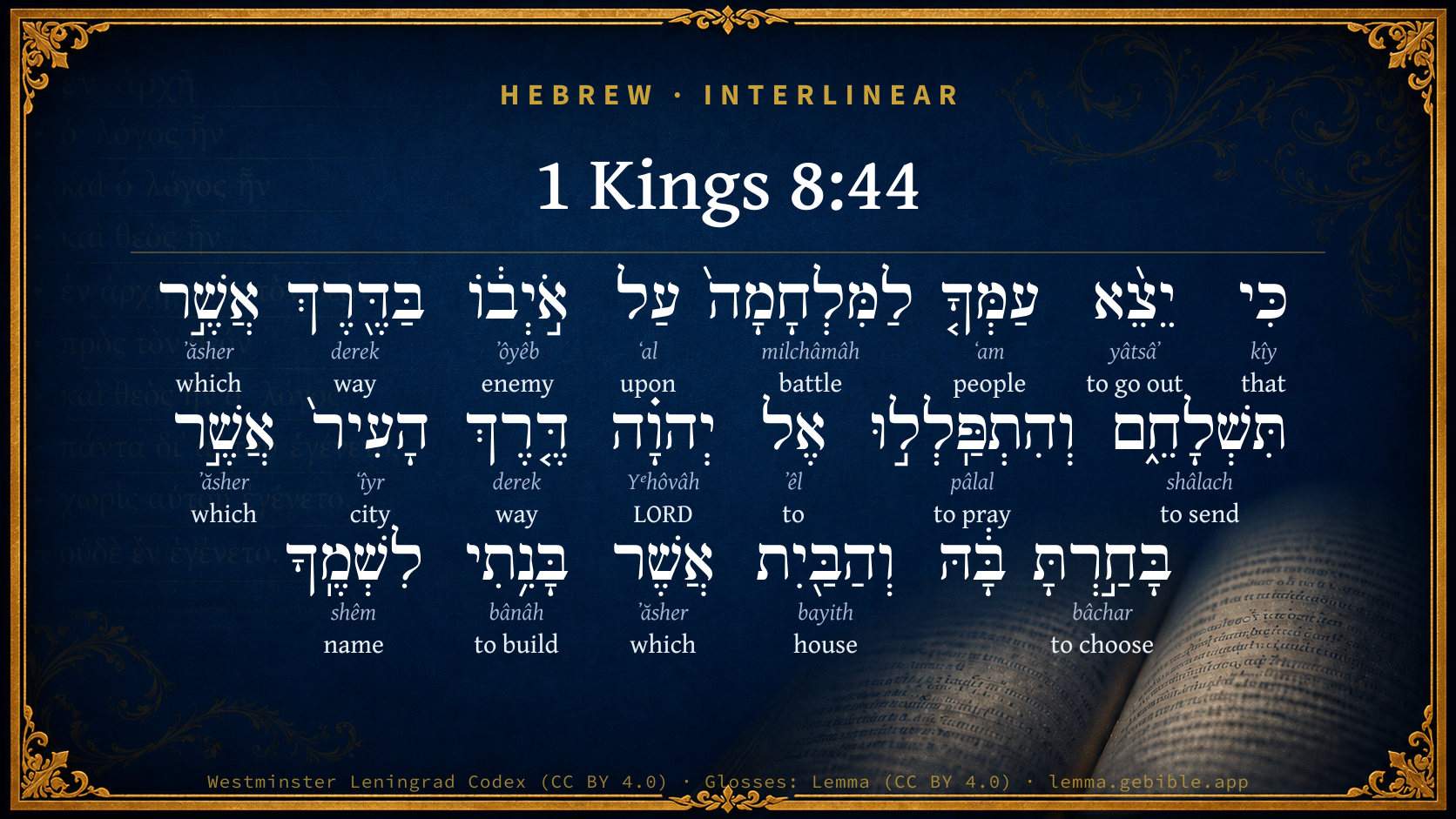
Hebrew (Westminster Leningrad Codex) 1 Kings 8:44 appears in the Hebrew Old Testament. The text above is from the Westminster Leningrad Codex. Each word links to its Strong’s number, a concise gloss, and parsing drawn from the Open Scriptures Hebrew Bible morphology. Click any word for its full Brown-Driver-Briggs (BDB) entry.
Download image
Cite this verse

1 Kings 8:44 (World English Bible). Public Domain. Lemma interlinear Bible study tool, https://lemma.gebible.app/v/1-kings/8/44.

Show BibTeX & RIS
BibTeX
RIS
English Translation
If your people go out to battle against their enemy, by whatever way you shall send them, and they pray to Yahweh toward the city which you have chosen, and toward the house which I have built for your name;
World English Bible · Public Domain
Download a study sheet

One document with this verse’s original text, its word-by-word gloss line, the meaning frame, cross-references with their text, attributed commentary, and full source and license credits — printable, and it pastes into notes with its structure intact.

This verse Autodidact and up

Study sheet (.html) Plain text (.txt)

A passage Seminary Student

Up to 50 verses in one chapter. A passage sheet keeps up to 6 commentary sources and 12 cross-references per verse, in the order this page ranks them, and says so on the sheet whenever that leaves anything out. Ask for a single verse and you get the Autodidact verse sheet above.

Everything on this page stays free to read, with no account — the sheet is a download of what is already on screen, not access to it.

Want to remove ads? Support Godless Engineer
Compare translations 3

The same verse in 3 English versions, stacked beneath the original-language interlinear above. Click any original word for its lexicon entry.

Each is an independent rendering of the whole verse — the interlinear is not word-aligned to these translations.

Highlighted words mark where these versions differ — a whole-verse word diff, not a word-by-word alignment.

  • World English Bible Public Domain
    If your people go out to battle against their enemy, by whatever way you shall send them, and they pray to Yahweh toward the city which you have chosen, and toward the house which I have built for your name;
  • King James Version Public Domain
    If thy people go out to battle against their enemy, whithersoever thou shalt send them, and shall pray unto the LORD toward the city which thou hast chosen, and toward the house that I have built for thy name:
  • unfoldingWord Literal Text CC BY-SA 4.0
    If your people goes out to battle against its enemy by the way that you send them, and they pray to Yahweh the way of the city upon which you have chosen and the house that I have built for your name,

unfoldingWord Literal Text — © unfoldingWord, licensed CC BY-SA 4.0. Word-aligned USFM3 via Door43 (git.door43.org/unfoldingWord/en_ult).

Versions to compare (up to 4)

3 of 4 selected

Show all 18 translations

Every available English version of this verse, each an independent rendering of the whole verse.

  • World English Bible Public Domain
    If your people go out to battle against their enemy, by whatever way you shall send them, and they pray to Yahweh toward the city which you have chosen, and toward the house which I have built for your name;
  • Berean Standard Bible Public Domain
    When Your people go to war against their enemies, wherever You send them, and when they pray to the LORD in the direction of the city You have chosen and the house I have built for Your Name,
  • Majority Standard Bible Public Domain
    When Your people go to war against their enemies, wherever You send them, and when they pray to the LORD in the direction of the city You have chosen and the house I have built for Your Name,
  • King James Version Public Domain
    If thy people go out to battle against their enemy, whithersoever thou shalt send them, and shall pray unto the LORD toward the city which thou hast chosen, and toward the house that I have built for thy name:
  • American Standard Version (1901) Public Domain
    If thy people go out to battle against their enemy, by whatsoever way thou shalt send them, and they pray unto Jehovah toward the city which thou hast chosen, and toward the house which I have built for thy name;
  • Revised Version (1885) Public Domain
    If thy people go out to battle against their enemy, by whatsoever way thou shalt send them, and they pray unto the LORD toward the city which thou hast chosen, and toward the house which I have built for thy name:
  • Geneva Bible (1599) Public Domain
    When thy people shall go out to battell against their enemie by the way that thou shalt sende them, and shall pray vnto the Lord towarde the way of the citie which thou hast chosen, and toward the house that I haue built for thy Name,
  • Douay-Rheims (1899) Public Domain
    If thy people go out to war against their enemies, by what way soever thou shalt send them, they shall pray to thee towards the way of the city, which thou hast chosen, and towards the house, which I have built to thy name:
  • Young's Literal Translation Public Domain
    `When Thy people doth go out to battle against its enemy, in the way that Thou dost send them, and they have prayed unto Jehovah the way of the city which thou hast fixed on, and of the house which I have builded for Thy name;
  • Literal Standard Version CC BY-SA 4.0
    When Your people go out to battle against its enemy, in the way that You send them, and they have prayed to YHWH [in] the way of the city which you have fixed on, and of the house which I have built for Your Name,
  • Unlocked Literal Bible CC BY-SA 4.0
    Suppose that your people go out to battle against an enemy, by whatever way you may send them, and suppose that they pray to you, Yahweh, toward the city that you have chosen, and toward the house that I have built for your name.
  • unfoldingWord Literal Text CC BY-SA 4.0
    If your people goes out to battle against its enemy by the way that you send them, and they pray to Yahweh the way of the city upon which you have chosen and the house that I have built for your name,
  • Darby Bible Public Domain
    If thy people go out to battle against their enemy, by the way that thou shalt send them, and they pray to Jehovah toward the city that thou hast chosen, and the house that I have built unto thy name;
  • World Messianic Bible Public Domain
    “If your people go out to battle against their enemy, by whatever way you shall send them, and they pray to the LORD toward the city which you have chosen, and toward the house which I have built for your name,
  • Webster's Bible Public Domain
    If thy people go out to battle against their enemy, whithersoever thou shalt send them, and shall pray to the LORD towards the city which thou hast chosen, and towards the house that I have built for thy name:
  • Free Bible Version CC BY-SA 4.0
    When your people go to fight against their enemies, wherever you send them, and when they pray to you towards the city you have chosen and the house I have built to honor you,
  • Bible in Basic English Public Domain
    If your people go out to war against their attackers, by whatever way you may send them, if they make their prayer to the Lord, turning their faces to this town of yours and to this house which I have made for your name:
  • JPS Tanakh (1917) Public Domain
    If Thy people go out to battle against their enemy, by whatsoever way Thou shalt send them, and they pray unto the LORD toward the city which Thou hast chosen, and toward the house which I have built for Thy name;

Literal Standard Version (2020), Covenant Press — licensed CC BY-SA 4.0. Text via the HelloAO Bible API (eBible.org). Unlocked Literal Bible (unfoldingWord) — licensed CC BY-SA 4.0. Text via the HelloAO Bible API (eBible.org). unfoldingWord Literal Text — © unfoldingWord, licensed CC BY-SA 4.0. Word-aligned USFM3 via Door43 (git.door43.org/unfoldingWord/en_ult). Free Bible Version, Dr. Jonathan Gallagher — licensed CC BY-SA 4.0. Text via the HelloAO Bible API (eBible.org).

Word by word

More ways to search: Search by grammar → Find every occurrence → Compare this word →

Practice this passage: Drill this verse → Learn its vocabulary →

וְהִתְפַּֽלְל֣וּ
pâlal
H6419
“and · to pray”
Conjunction + Verb, Hithpael, Sequential Perfect, 3rd Person, Common, Plural
Part of Speech
Conjunction + Verb
Stem
Hithpael
Form
Sequential Perfect
Person
3rd Person
Gender
Common
Number
Plural
Full BDB Definition

Origin: a primitive root

TWOT: 1776

to intervene, interpose, pray - (Piel) to mediate, judge - (Hithpael) - to intercede - to pray
  1. כִּי kîy H3588 “that” Conjunction
  2. יֵצֵ֨א yâtsâʼ H3318 “to go out” Verb, Qal, Imperfect, 3rd Person, Masculine, Singular
  3. עַמְּךָ֤ ʻam H5971 “people · your” Noun, Common, Masculine, Singular, Construct + Suffix, Personal, 2nd Person, Masculine, Singular
  4. לַמִּלְחָמָה֙ milchâmâh H4421 “to/for the · battle” Preposition, Determined + Noun, Common, Feminine, Singular, Absolute
  5. עַל ʻal H5921 “upon” Preposition
  6. אֹ֣יְב֔וֹ ʼôyêb H341 “enemy · him” Verb, Qal, Participle Active, Masculine, Singular, Construct + Suffix, Personal, 3rd Person, Masculine, Singular
  7. בַּדֶּ֖רֶךְ derek H1870 “in/at the · way” Preposition, Determined + Noun, Common, Both, Singular, Absolute
  8. אֲשֶׁ֣ר ʼăsher H834 “which” Particle, Relative
  9. תִּשְׁלָחֵ֑ם shâlach H7971 “to send · them” Verb, Qal, Imperfect, 2nd Person, Masculine, Singular + Suffix, Personal, 3rd Person, Masculine, Plural
  10. אֶל ʼêl H413 “to” Preposition
  11. יְהוָ֗ה Yᵉhôvâh H3068 “LORD” Noun, Proper
  12. דֶּ֤רֶךְ derek H1870 “way of” Noun, Common, Both, Singular, Construct
  13. הָעִיר֙ ʻîyr H5892 “the · city” Particle, Definite Article + Noun, Common, Feminine, Singular, Absolute
  14. אֲשֶׁ֣ר ʼăsher H834 “which” Particle, Relative
  15. בָּחַ֣רְתָּ bâchar H977 “to choose” Verb, Qal, Perfect, 2nd Person, Masculine, Singular
  16. וְהַבַּ֖יִת bayith H1004 “and · the · house” Conjunction + Particle, Definite Article + Noun, Common, Masculine, Singular, Absolute
  17. אֲשֶׁר ʼăsher H834 “which” Particle, Relative
  18. בָּנִ֥תִי bânâh H1129 “to build” Verb, Qal, Perfect, 1st Person, Common, Singular
  19. לִשְׁמֶֽךָ shêm H8034 “to/for · name · your” Preposition + Noun, Common, Masculine, Singular, Construct + Suffix, Personal, 2nd Person, Masculine, Singular

About this verse

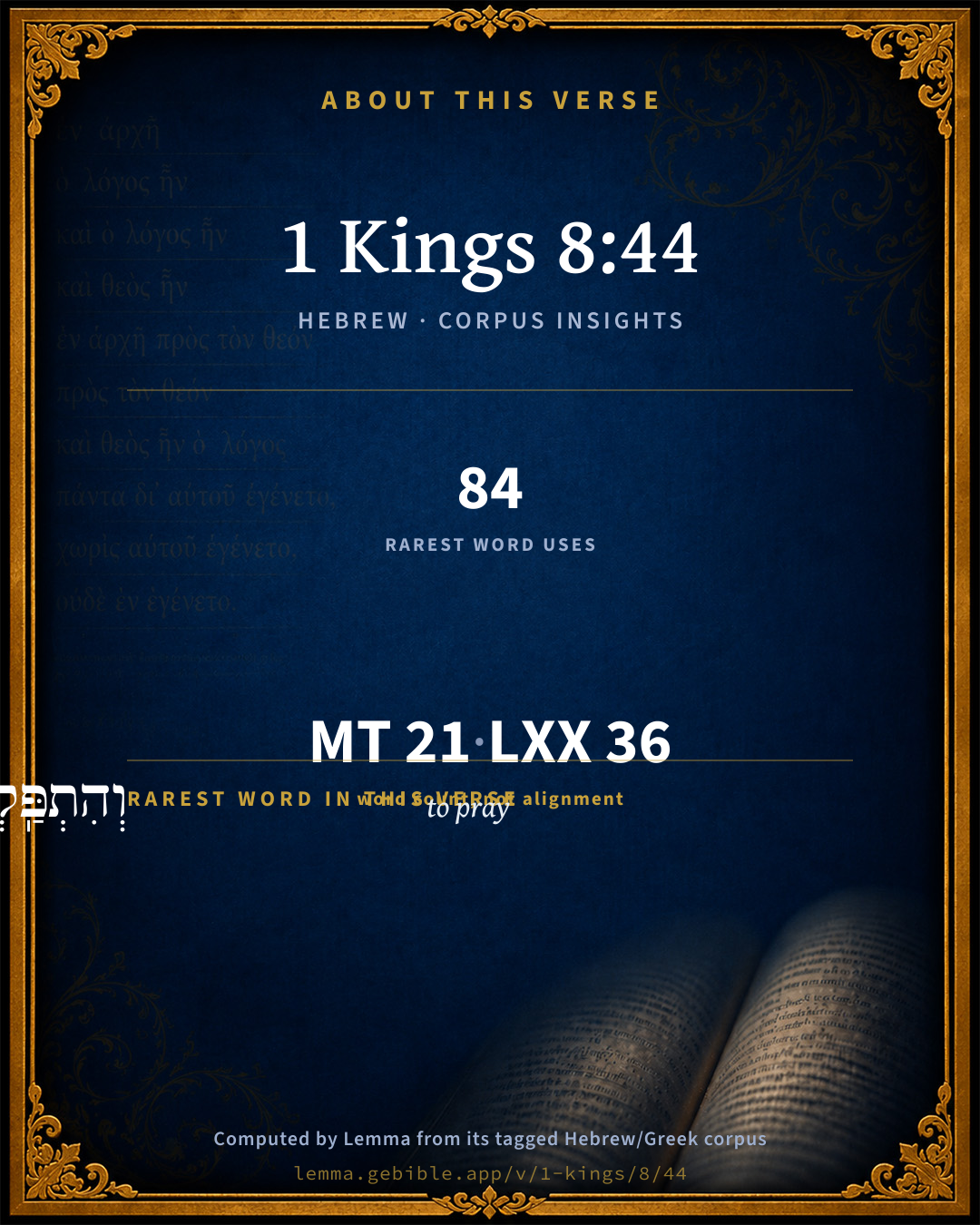
These counts appear in no published source. They are computed here, from the morphology-tagged text and Lemma’s own curated glosses. What Lemma adds →

21
words
17
distinct lemmas
Historical
section

Grammatical profile

  • 6 verbs
  • 8 nouns
  • 3 prepositions
  • 1 conjunction
  • 3 particles

Verb forms

  • יֵצֵ֨א Qal · Imperfect
  • אֹ֣יְב֔וֹ Qal · Participle Active
  • תִּשְׁלָחֵ֑ם Qal · Imperfect
  • וְהִתְפַּֽלְל֣וּ Hithpael · Sequential Perfect
  • בָּחַ֣רְתָּ Qal · Perfect
  • בָּנִ֥תִי Qal · Perfect

Repetition

Words recur within this verse — often emphatic in Hebrew:

  • בַּדֶּ֖רֶךְ way H1870 ×2
  • אֲשֶׁ֣ר which H834 ×3

Hebrew & Septuagint length

In English translation the verse runs 40 words from the Hebrew and 48 from the Septuagint (LXX English) — closely comparable.

A rough comparison of the two English renderings, which tokenize alike — not a word-level alignment.

Word counts can differ between the Hebrew and the Greek without any difference in meaning — e.g. the Hebrew direct-object marker אֵת has no separate Greek word, and Greek often adds the article ὁ.

In the original languages it is 21 Hebrew tokens and 36 Greek tokens — but the two are counted differently (Hebrew bundles its prefixes and suffixes into one token; the Greek is in lemma form), so that isn’t a like-for-like length.

Cross-references

23

Topical passages linked to 1 Kings 8:44 in the Treasury of Scripture Knowledge — connected by theme and wording, ordered by reader-vote popularity; previews shown in the World English Bible.

  • 2 Chronicles 6:34 If your people go out to battle against their enemies, by whatever way you shall send them, and they pray to you toward this city which you have chosen, and the house which I have built for your name;
  • Psalms 78:67–69 Moreover he rejected the tent of Joseph, And didn't choose the tribe of Ephraim,
  • 1 Kings 8:16 Since the day that I brought forth my people Israel out of Egypt, I chose no city out of all the tribes of Israel to build a house, that my name might be there; but I chose David to be over my people Israel.
  • Psalms 132:13–14 For Yahweh has chosen Zion. He has desired it for his habitation.
  • Daniel 9:17–19 Now therefore, our God, listen to the prayer of your servant, and to his petitions, and cause your face to shine on your sanctuary that is desolate, for the Lord's sake.
  • Numbers 31:1–12 Yahweh spoke to Moses, saying,
  • Deuteronomy 20:1–4 When you go forth to battle against your enemies, and see horses, and chariots, [and] a people more than you, you shall not be afraid of them; for Yahweh your God is with you, who brought you up out of the land of Egypt.
  • Deuteronomy 31:3–6 Yahweh your God, he will go over before you; he will destroy these nations from before you, and you shall dispossess them: [and] Joshua, he shall go over before you, as Yahweh has spoken.
  • Joshua 1:2–5 Moses my servant is dead; now therefore arise, go over this Jordan, you, and all this people, to the land which I do give to them, even to the children of Israel.
  • Joshua 6:2–5 Yahweh said to Joshua, Behold, I have given into your hand Jericho, and the king of it, and the mighty men of valor.
  • Joshua 8:1–2 Yahweh said to Joshua, Don't be afraid, neither be dismayed: take all the people of war with you, and arise, go up to Ai; behold, I have given into your hand the king of Ai, and his people, and his city, and his land;
  • Judges 1:1–2 It happened after the death of Joshua, the children of Israel asked of Yahweh, saying, Who shall go up for us first against the Canaanites, to fight against them?
  • Judges 4:6 She sent and called Barak the son of Abinoam out of Kedesh-naphtali, and said to him, Hasn't Yahweh, the God of Israel, commanded, [saying], Go and draw to Mount Tabor, and take with you ten thousand men of the children of Naphtali and of the children of Zebulun?
  • Judges 6:14 Yahweh looked at him, and said, Go in this your might, and save Israel from the hand of Midian: have not I sent you?
  • 1 Samuel 15:3 Now go and strike Amalek, and utterly destroy all that they have, and don't spare them; but kill both man and woman, infant and suckling, ox and sheep, camel and donkey.
  • 1 Samuel 15:18 and Yahweh sent you on a journey, and said, 'Go, and utterly destroy the sinners the Amalekites, and fight against them until they are consumed.'
  • 1 Samuel 30:8 David inquired of Yahweh, saying, If I pursue after this troop, shall I overtake them? He answered him, Pursue; for you shall surely overtake [them], and shall without fail recover [all].
  • 2 Samuel 5:19 David inquired of Yahweh, saying, Shall I go up against the Philistines? will you deliver them into my hand? Yahweh said to David, Go up; for I will certainly deliver the Philistines into your hand.
  • 2 Samuel 5:23 When David inquired of Yahweh, he said, You shall not go up: make a circuit behind them, and come on them over against the mulberry trees.
  • 2 Chronicles 14:9–12 There came out against them Zerah the Ethiopian with an army of a million troops, and three hundred chariots; and he came to Mareshah.
  • 2 Chronicles 18:31 It happened, when the captains of the chariots saw Jehoshaphat, that they said, It is the king of Israel. Therefore they turned about to fight against him: but Jehoshaphat cried out, and Yahweh helped him; and God moved them [to depart] from him.
  • 2 Chronicles 20:6–13 and he said, Yahweh, the God of our fathers, aren't you God in heaven? and aren't you ruler over all the kingdoms of the nations? and in your hand is power and might, so that none is able to withstand you.
  • 2 Chronicles 32:20 Hezekiah the king, and Isaiah the prophet the son of Amoz, prayed because of this, and cried to heaven.

Cross-references courtesy of OpenBible.info (CC BY 4.0).

Hebrew and Greek witnesses Masoretic Hebrew ↔ Greek Septuagint

The same verse in the two great witnesses to the Old Testament, shown verse-for-verse.

These are two independent witnesses, not word-aligned to each other, and the Septuagint is shown in lemma (dictionary) form.

Hebrew 1 Kings 8:44 Masoretic · Westminster Leningrad Codex

כִּי יֵצֵ֨א עַמְּךָ֤ לַמִּלְחָמָה֙ עַל אֹ֣יְב֔וֹ בַּדֶּ֖רֶךְ אֲשֶׁ֣ר תִּשְׁלָחֵ֑ם וְהִתְפַּֽלְל֣וּ אֶל יְהוָ֗ה דֶּ֤רֶךְ הָעִיר֙ אֲשֶׁ֣ר בָּחַ֣רְתָּ בָּ֔הּ וְהַבַּ֖יִת אֲשֶׁר בָּנִ֥תִי לִשְׁמֶֽךָ

If your people go out to battle against their enemy, by whatever way you shall send them, and they pray to Yahweh toward the city which you have chosen, and toward the house which I have built for your name;

World English Bible · Public Domain

Greek LXX 1 Kings 8:44 Septuagint · lemma form

ὅτι ἐκἔρχομαι ὁ λαός σύ εἰς πόλεμος ἐπί ὁ ἐχθρός αὐτός ἐν ὁδός ὅς ἐπιστρέφω αὐτός καί προςεὔχομαι ἐν ὄνομα κύριος ὁδός ὁ πόλις ὅς ἐκλέγω ἐν αὐτός καί ὁ οἶκος ὅς οἰκοδομέω ὁ ὄνομα σύ

If it be that your people shall go forth to war against their enemies in the way by which you shall turn them, and pray in the name of the Lord toward the city which you have chosen, and the house which I have built to your name,

LXX2012 (modern English Septuagint) · Public Domain

Hebrew: Westminster Leningrad Codex (CC BY 4.0). Greek: Septuagint (public domain); English from LXX2012 (modern English Septuagint) (Public Domain). How the Septuagint differs from the Hebrew →

Targum (Aramaic paraphrase)

1

The Targum is the ancient Jewish Aramaic paraphrase of the Hebrew Scriptures — an interpretive translation, not the Hebrew text itself. Onkelos (literal) and Pseudo-Jonathan (expansive) render the Torah, and Jonathan the Prophets. Coverage is partial: where no permissively-licensed English translation exists for a verse, only the Aramaic is shown. This is verse-level text, not a word-by-word alignment to the Hebrew.

  1. Targum Jonathan Prophets (Joshua–Malachi)
    אֲרֵי יִפּוֹק עַמָךְ לְאַגָחָא קְרָבָא עַל בַּעֲלֵי דְבָבֵיהוֹן בְּאוֹרְחָא דְתִשְׁלְחִינוּן וִיצַלוּן קֳדָם יְיָ לְאַפֵּי אוֹרַח קַרְתָּא דְאִתְרְעֵיתָא בָהּ וּבֵיתָא דִי בְנִיתִי לִשְׁמָךְ:

    (no public-domain English translation for this verse)

    Targum Jonathan — Aramaic: “Mikraot Gedolot” (public domain). English: “Sefaria Community Translation” (CC0 1.0 (public-domain dedication)); “London "Chaldee Paraphrase," 1871” (public domain). Text via Sefaria.

Commentary

Notes on 1 Kings 8:44 from classic Christian and Jewish commentators (each source and its license shown beneath its notes). The classic Christian expositions comment on the surrounding passage and are grouped to its opening verse, so a note may address several verses; the Jewish commentaries on the Tanakh (Rashi and others) are per-verse, so they appear only where the commentator wrote on this verse.

Lemma curates 59 commentaries, every one of them public domain or Creative Commons licensed, each selected and text-cleaned for this edition rather than reprinted as found. About our sources →

Trapp's Complete Commentary

John Trapp

1Ki 8:44 If thy people go out to battle against their enemy, whithersoever thou shalt send them, and shall pray unto the LORD toward the city which thou hast chosen, and [toward] the house that I have built for thy name:

Ver. 44. If thy people go out to battle.] Upon a necessary justice, or a just necessity. For that soldier can never answer it to God that strikes not more as a justicer, than as any enemy.

And shall pray unto the Lord.] Soldiers must fight and pray, and pray and fight, as did the late king of Sweden.

John Trapp, A Commentary or Exposition upon All the Books of the Old and New Testament (1647–1656) — public domain. Text from a community e-Sword module.

Joseph Benson's Commentary

1Ki 8:44-45. If thy people go out to battle — In a just cause, and by thy warrant and commission. This is the next case recommended by Solomon to the divine favour. Whithersoever thou shalt send them — In this is implied, that it was unlawful for them to undertake any war merely for their own pleasure or profit, or the gratification of their own worldly or ambitious desires; or to enlarge their empire beyond its due bounds; and that they could not, with a good conscience, pray to God for his blessing on such a war. And shall pray unto the Lord — Whereby he instructs them that they should not trust either to the strength or justice of their arms, but only to God’s help and blessing, for which they were to pray. Toward the city which thou hast chosen — For thy dwelling-place, and the seat of thy temple. Toward the house which I have built — For to it they were to turn their faces in prayer; to profess themselves worshippers of the true God, in opposition to idols; and to strengthen their faith in God’s promises and covenant, the tables whereof were contained in that house. Soldiers in the field must not think it enough that others pray for them; they must pray for themselves; and they are here encouraged to expect a gracious answer. Praying should always go along with fighting. Maintain their cause — Declare the justice of their cause by giving them the victory.

Joseph Benson's Commentary on the Old and New Testaments (1811–1818) — public domain. Text from a community e-Sword module.

Tyndale Open Study Notes

Tyndale Open Resources

8:44-45 On behalf of those without access to the Temple, particularly when far away fighting for God’s cause (Lev 26:7-8; Deut 20:1-4), Solomon asked that God hear their prayers directed toward the Lord and his Temple in Jerusalem (see Dan 6:10).

Tyndale Open Study Notes — © Tyndale Open Resources, licensed CC BY-SA 4.0. Text via the HelloAO Bible API.

Adam Clarke's Commentary

Verse 44. If thy people go out to battle] The SIXTH case refers to wars undertaken by Divine appointment: whithersoever thou shalt send them; for in no other wars could they expect the blessing and concurrence of the Lord; in none other could the God of truth and justice maintain their cause. There were such wars under the Mosaic dispensation, there are none such under the Christian dispensation: nor can there be any; for the Son of man is come, not to destroy men's lives, but to save them. Except mere defensive war, all others are diabolic; and, query, if there were no provocations, would there be any attacks, and consequently any need of defensive wars?

Adam Clarke's Commentary on the Bible (1810–1826) — public domain. Text from a community e-Sword/MySword module.

Ellicott's Commentary for English Readers

(44-50) If thy people go out.—The prayer here returns once more to invoke God’s aid against earthly enemies. It is characteristic of the foreboding tone of sadness, which runs through the whole prayer, that it touches but lightly on the first petition, for God’s blessing on the arms of Israel, so often granted in days gone by, and enlarges on the second petition, for mercy and deliverance in the event of defeat and captivity. The spirit, and in the confession of 1Ki_8:47 the very words, of this prayer of Solomon are strikingly reproduced in the solemn supplication of Daniel, when the close of the Babylonish captivity drew near (Dan_9:4-15).There we find a confession of sin, perverseness, and wickedness, literally the same; we find also a similar pleading with God, as “keeping covenant and mercy,” a similar reference to the deliverance from Egypt, and a similar emphasis on the consecration of the city and its people by God’s “great name.” There is a striking pathos of circumstance in the fact, that over “the sanctuary that was desolate” (Dan_9:17), with “his windows open towards Jerusalem,” Daniel utters the same prayer, which had marked the day of its consecration in all magnificence and prosperity.

A Bible Commentary for English Readers, edited by Charles John Ellicott (1878–1897) — public domain. Text from a community e-Sword module.

The Cambridge Bible for Schools and Colleges

gen. ed. J. J. S. Perowne

44. If thy people go out to battle] The case here is of a war undertaken by God’s direction, and therefore in a righteous cause. Under such circumstances the people may trust in Him for support.

shall pray unto the Lord toward the city] Not only the Jews but other people were wont to turn their faces toward some sacred spot when praying in a distant land, as Daniel did in Babylon (Dan_6:10). Thus the Mohammedans turn towards Mecca, and the early Christians inherited from the Jews the custom of turning to the east when they prayed. Cf. Tert. Apol. 16.

The Cambridge Bible for Schools and Colleges (gen. ed. J. J. S. Perowne; Cambridge University Press, 1878–1918) — public domain. Text from a community e-Sword module.

John Gill's Exposition

If thy people go out to battle against their enemy,.... In a foreign country, threatening to invade them, or having trespassed on their borders, or some way or other infringed on their liberties and privileges, and so given them just occasion to go to war with them:

whithersoever thou shalt send them; this case supposes their asking counsel of God, or having a direction and commission from him by a prophet, or some other way, to engage in war with the enemy:

and shall pray unto the Lord toward the city which thou hast chosen, and toward the house I have built for thy name: for, notwithstanding the justness of their cause, and having a warrant from God to go to war, yet they were to pray to him for success when at a distance, even in a foreign land, and about to engage the enemy; and this they were to do, turning their faces towards the city of Jerusalem, and the temple there; declaring thereby that their dependence was upon the Lord that dwelt there, and their expectation of victory was only from him.

John Gill's Exposition of the Whole Bible (1746–1763) — public domain (CC PDM 1.0). Text via the HelloAO Bible API.

Haydock's Catholic Bible Commentary

Name. It was the practice of the religious Jews, to pray with their eyes turned towards the holy place, ver. 48. The primitive Christians looked towards the east, in prayer, to remind them of the ascension of our Saviour, (Calmet) from Mount Olivet, in that quarter. (Haydock) (Psalm lxvii. 34.) (St. Just.[Justin Martyr?] q. 118.; Tertullian, apol. xvi.; St. Epiphanius, hær. xix.) (Calmet)

George Leo Haydock (1774–1849), Haydock's Catholic Family Bible and Commentary, 1859 edition — public domain. Excludes Psalms (Douay-Rheims chapter numbering differs from Protestant) and Deuterocanonical books (Catholic canon only).

Matthew Poole's English Annotations

Withersoever thou shalt send them, i.e. in a just cause, and by thy warrant or commission; whereby he implies that it was unlawful for them to undertake any war merely for their own glory or lust, or to enlarge their empire beyond its due bounds; and that they could not with safe conscience pray to God for his blessing upon such a war.

And shall pray unto the Lord; whereby he instructs them that they should not trust either to the strength or justice of their arms, but only to God’s help and blessing, which they were to pray for.

The city which thou hast chosen, to wit, for thy dwelling-place, and the seat of thy temple.

Toward the house that I have built for thy name; for to it they were to turn their faces in prayer; partly thereby to profess themselves to be the worshippers of the true God, in opposition to idols; and that they sought help from him, and from no other; and partly to strengthen faith in God’s promises and covenant, the tables whereof were contained in that house.

Matthew Poole's English Annotations on the Holy Bible (1683–1685) — public domain. Text from a community e-Sword/MySword module.

Whedon's Commentary on the Bible

Daniel D. Whedon

44. Whithersoever thou shalt send them — This indicates that the battle referred to is one undertaken by Divine counsel or sanction, as was every righteous war for the defence or honour of the nation.

Daniel D. Whedon (gen. ed.), Commentary on the Old and New Testaments (1874–1909) — public domain. Text from a community e-Sword module.

The Pulpit Commentary

If thy people go out to battle against their enemy, whithersoever Heb. in the way which thou shalt send them These words clearly imply that the war, whether defensive or offensive (i.e., for the chastisement of other nations), is one which had God"s sanction, and indeed was waged by His appointment, and shall pray unto the Lord toward Heb. in the way of. Same expression as above. The repetition is significant. "They have gone in God"s way. They may therefore look the way of God"s house for help." Executing God"s commission, they might justly expect His blessing the city which thou hast chosen, and toward the house that I have built for thy name.

The Pulpit Commentary (1880–1919), ed. H.D.M. Spence-Jones & Joseph S. Exell — public domain. Text from a community e-Sword module.

John Wesley's Explanatory Notes

To battle - In a just cause, and by thy warrant or commission. Shall pray - Whereby he instructs them, that they should not trust, either to the strength or justice of their arms, but only to God's help and blessing. Chosen - For thy dwelling-place, and the seat of thy temple. Towards the house - For to it they were to turn their faces in prayer; to profess themselves worshippers of the true God, in opposition to idols; and to strengthen their faith in God's promises and covenant, the tables whereof were contained in that house. Soldiers in the field must not think it enough that others pray for them: they must pray for themselves. And they are here encouraged to expect a gracious answer. Praying should always go along with fighting.

John Wesley, Explanatory Notes Upon the Whole Bible (1754–1765) — public domain. Text via the GEBible commentary corpus.

unfoldingWord translationNotes

Door43 World Missions Community

Suppose that your people go out ... suppose that they pray

When Solomon was speaking, these hypothetical situations had not happened, but Solomon knew that they might happen in the future. Use the form in your language for talking about events that have not happened but might happen in the future. (See: Hypothetical Situations)

for your name

The word "name" is a metonym for the person, and "for ... name" refers to worshiping the person. See how you translated similar words in 1 Kings 3:2. AT: "in which people will worship you" (See: Metonymy)

their prayer and their request

The words "prayer" and "request" mean basically the same thing and emphasize that the people are sincere as they make their request. See how you translated similar words in 1 Kings 8:28. AT: "their request" (See: Doublet)

translationWords

adversary

send

pray

Yahweh

unfoldingWord translationNotes — © Distant Shores Media and the Door43 World Missions Community, licensed CC BY-SA 4.0. Source: git.door43.org/Door43/en_tn.

Rashi

Rabbi Shlomo Yitzchaki (Rashi)

By way of the city. Facing towards Yerusholayim.

Rashi on the Tanakh — English translations: “The Judaica Press complete Tanach with Rashi, translated by A. J. Rosenberg” (CC BY 4.0); “Pentateuch with Rashi's commentary by M. Rosenbaum and A.M. Silbermann, 1929-1934” (public domain); “The Metsudah Tanach series, Lakewood, N.J” (CC BY 4.0); and “The Book of Joshua, Metsudah Publications, 1997” (CC BY 4.0). Text via Sefaria.

Lesson kit

Teaching starters — assembled from the data on this page, not authored interpretation. Every prompt links to the verse data it draws on. Edit before teaching.

1 Kings, in the Historical, opens this verse with 21 words (17 distinct Hebrew lemmas). Its most distinctive word is pâlal (“to pray”). A historical commentator’s framing appears above. Read the whole chapter for the surrounding context.

Discussion questions

  1. The word pâlal carries the sense “to pray.” How does it shape the verse?
  2. How does 2 Chronicles 6:34, which shares this passage’s theme, read alongside this verse?
  3. What does the repetition of “way” (2× in this one verse) do in this verse?
  4. These translations render this verse differently; the difference is in the English rendering, not the original. What questions does that raise?
  5. «יֵצֵ֨א» is a Qal Imperfect verb. How does that grammatical form shape the action described?
  6. Compare how Trapp's Complete Commentary and Joseph Benson's Commentary read this verse. Where do they agree or differ?

Things to notice

Reading settings

Reading text

Shown beneath each verse's original-language words.

Old Testament
Old Testament edition

Read the OT as the Masoretic Hebrew (MT) or the Greek Septuagint (LXX).

English shown for the Greek Septuagint (in the Hebrew ↔ Greek comparison).

Comparing translations? Open the Compare panel on any verse page to stack up to four side by side.