Judges 8:34

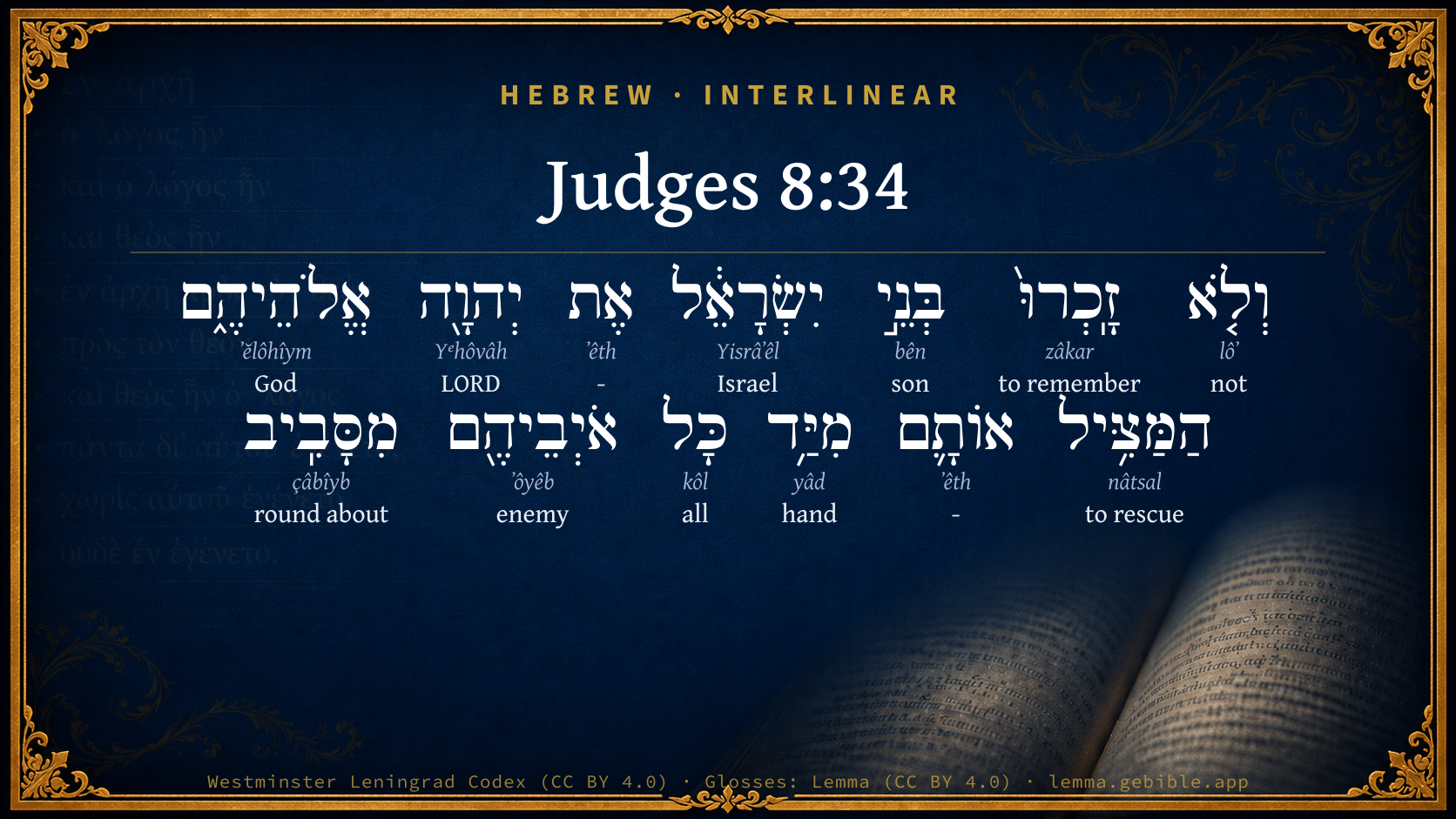
Hebrew (Westminster Leningrad Codex) Judges 8:34 appears in the Hebrew Old Testament. The text above is from the Westminster Leningrad Codex. Each word links to its Strong’s number, a concise gloss, and parsing drawn from the Open Scriptures Hebrew Bible morphology. Click any word for its full Brown-Driver-Briggs (BDB) entry.
Download image
Cite this verse

Judges 8:34 (World English Bible). Public Domain. Lemma interlinear Bible study tool, https://lemma.gebible.app/v/judges/8/34.

Show BibTeX & RIS
BibTeX
RIS
English Translation
The children of Israel didn't remember Yahweh their God, who had delivered them out of the hand of all their enemies on every side;
World English Bible · Public Domain
Download a study sheet

One document with this verse’s original text, its word-by-word gloss line, the meaning frame, cross-references with their text, attributed commentary, and full source and license credits — printable, and it pastes into notes with its structure intact.

This verse Autodidact and up

Study sheet (.html) Plain text (.txt)

A passage Seminary Student

Up to 50 verses in one chapter. A passage sheet keeps up to 6 commentary sources and 12 cross-references per verse, in the order this page ranks them, and says so on the sheet whenever that leaves anything out. Ask for a single verse and you get the Autodidact verse sheet above.

Everything on this page stays free to read, with no account — the sheet is a download of what is already on screen, not access to it.

Want to remove ads? Support Godless Engineer
Compare translations 3

The same verse in 3 English versions, stacked beneath the original-language interlinear above. Click any original word for its lexicon entry.

Each is an independent rendering of the whole verse — the interlinear is not word-aligned to these translations.

Highlighted words mark where these versions differ — a whole-verse word diff, not a word-by-word alignment.

  • World English Bible Public Domain
    The children of Israel didn't remember Yahweh their God, who had delivered them out of the hand of all their enemies on every side;
  • King James Version Public Domain
    And the children of Israel remembered not the LORD their God, who had delivered them out of the hands of all their enemies on every side:
  • unfoldingWord Literal Text CC BY-SA 4.0
    And the sons of Israel did not remember Yahweh, their God, the one having delivered them from the hand of all of their enemies from around.

unfoldingWord Literal Text — © unfoldingWord, licensed CC BY-SA 4.0. Word-aligned USFM3 via Door43 (git.door43.org/unfoldingWord/en_ult).

Versions to compare (up to 4)

3 of 4 selected

Show all 18 translations

Every available English version of this verse, each an independent rendering of the whole verse.

  • World English Bible Public Domain
    The children of Israel didn't remember Yahweh their God, who had delivered them out of the hand of all their enemies on every side;
  • Berean Standard Bible Public Domain
    The Israelites failed to remember the LORD their God who had delivered them from the hands of all their enemies on every side.
  • Majority Standard Bible Public Domain
    The Israelites failed to remember the LORD their God who had delivered them from the hands of all their enemies on every side.
  • King James Version Public Domain
    And the children of Israel remembered not the LORD their God, who had delivered them out of the hands of all their enemies on every side:
  • American Standard Version (1901) Public Domain
    And the children of Israel remembered not Jehovah their God, who had delivered them out of the hand of all their enemies on every side;
  • Revised Version (1885) Public Domain
    And the children of Israel remembered not the LORD their God, who had delivered them out of the hand of all their enemies on every side:
  • Geneva Bible (1599) Public Domain
    And the children of Israel remembred not the Lord their God, which had deliuered the out of the hands of all their enemies on euery side.
  • Douay-Rheims (1899) Public Domain
    And they remembered not the Lord their God, who delivered them out of the hands of all their enemies round about:
  • Young's Literal Translation Public Domain
    and the sons of Israel have not remembered Jehovah their God, who is delivering them out of the hand of all their enemies round about,
  • Literal Standard Version CC BY-SA 4.0
    and the sons of Israel have not remembered their God YHWH, who is delivering them out of the hand of all their surrounding enemies,
  • Unlocked Literal Bible CC BY-SA 4.0
    The people of Israel did not remember to honor Yahweh, their God, who had rescued them from the hand of all their enemies on every side.
  • unfoldingWord Literal Text CC BY-SA 4.0
    And the sons of Israel did not remember Yahweh, their God, the one having delivered them from the hand of all of their enemies from around.
  • Darby Bible Public Domain
    And the people of Israel did not remember the LORD their God, who had rescued them from the hand of all their enemies on every side;
  • World Messianic Bible Public Domain
    The children of Israel didn’t remember the LORD their God, who had delivered them out of the hand of all their enemies on every side;
  • Webster's Bible Public Domain
    And the children of Israel remembered not the LORD their God, who had delivered them from the hands of all their enemies on every side:
  • Free Bible Version CC BY-SA 4.0
    They forgot about the Lord their God, who had saved them from all their enemies that surrounded them.
  • Bible in Basic English Public Domain
    And the children of Israel did not keep in their minds the Lord their God, who had been their saviour from all their haters on every side;
  • JPS Tanakh (1917) Public Domain
    And the children of Israel remembered not the LORD their God, who had delivered them out of the hand of all their enemies on every side;

Literal Standard Version (2020), Covenant Press — licensed CC BY-SA 4.0. Text via the HelloAO Bible API (eBible.org). Unlocked Literal Bible (unfoldingWord) — licensed CC BY-SA 4.0. Text via the HelloAO Bible API (eBible.org). unfoldingWord Literal Text — © unfoldingWord, licensed CC BY-SA 4.0. Word-aligned USFM3 via Door43 (git.door43.org/unfoldingWord/en_ult). Free Bible Version, Dr. Jonathan Gallagher — licensed CC BY-SA 4.0. Text via the HelloAO Bible API (eBible.org).

Word by word

More ways to search: Search by grammar → Find every occurrence → Compare this word →

Practice this passage: Drill this verse → Learn its vocabulary →

הַמַּצִּ֥יל
nâtsal
H5337
“the · rescuing”
Particle, Definite Article + Verb, Hiphil, Participle Active, Masculine, Singular, Absolute
Part of Speech
Particle + Verb
Stem
Hiphil
Form
Participle Active
Gender
Masculine
Number
Singular
State
Absolute
Full BDB Definition

Origin: a primitive root

TWOT: 1404

to snatch away, deliver, rescue, save, strip, plunder - (Niphal) - to tear oneself away, deliver oneself - to be torn out or away, be delivered - (Piel) - to strip off, spoil - to deliver - (Hiphil) - to take away, snatch away - to rescue, recover - to deliver (from enemies or troubles or death) - to deliver from sin and guilt - (Hophal) to be plucked out - (Hithpael) to strip oneself
  1. וְלֹ֤א lôʼ H3808 “and · not” Conjunction + Particle, Negative
  2. זָֽכְרוּ֙ zâkar H2142 “to remember” Verb, Qal, Perfect, 3rd Person, Common, Plural
  3. בְּנֵ֣י bên H1121 “sons of” Noun, Common, Masculine, Plural, Construct
  4. יִשְׂרָאֵ֔ל Yisrâʼêl H3478 “Israel” Noun, Proper
  5. אֶת ʼêth H853 “-” Particle, Direct Object
  6. יְהוָ֖ה Yᵉhôvâh H3068 “LORD” Noun, Proper
  7. אֱלֹהֵיהֶ֑ם ʼĕlôhîym H430 “God(s) · their” Noun, Common, Masculine, Plural, Construct + Suffix, Personal, 3rd Person, Masculine, Plural
  8. אוֹתָ֛ם ʼêth H853 “- · them” Particle, Direct Object + Suffix, Personal, 3rd Person, Masculine, Plural
  9. מִיַּ֥ד yâd H3027 “from · hand of” Preposition + Noun, Common, Both, Singular, Construct
  10. כָּל kôl H3605 “all of” Noun, Common, Masculine, Singular, Construct
  11. אֹיְבֵיהֶ֖ם ʼôyêb H341 “enemy · them” Verb, Qal, Participle Active, Masculine, Plural, Construct + Suffix, Personal, 3rd Person, Masculine, Plural
  12. מִסָּבִֽיב çâbîyb H5439 “from · round about” Preposition + Noun, Common, Both, Singular, Absolute

About this verse

These counts appear in no published source. They are computed here, from the morphology-tagged text and Lemma’s own curated glosses. What Lemma adds →

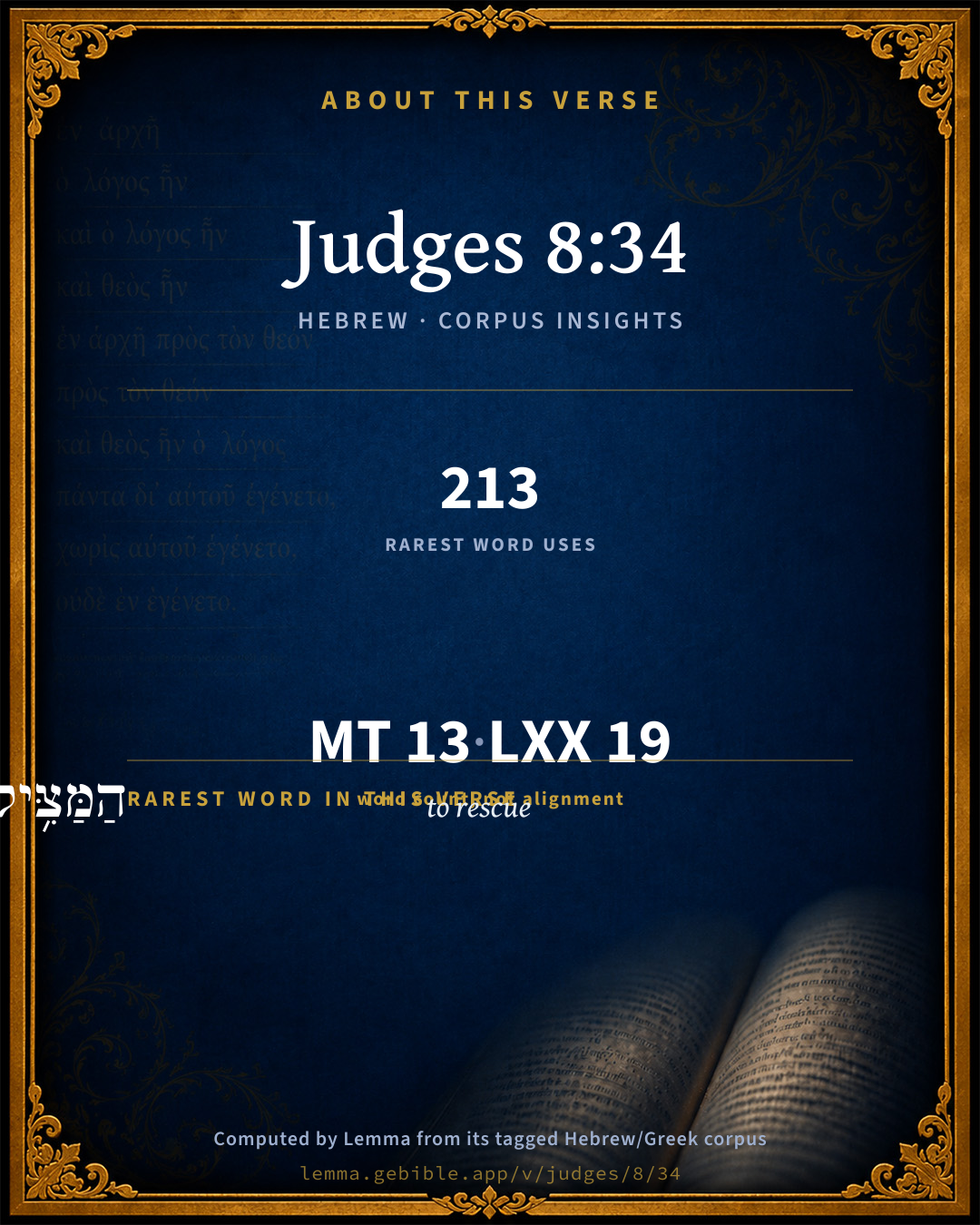
13
words
12
distinct lemmas
Historical
section

Grammatical profile

  • 3 verbs
  • 7 nouns
  • 3 particles

Verb forms

  • זָֽכְרוּ֙ Qal · Perfect
  • הַמַּצִּ֥יל Hiphil · Participle Active
  • אֹיְבֵיהֶ֖ם Qal · Participle Active

Hebrew & Septuagint length

In English translation the verse runs 24 words from the Hebrew and 26 from the Septuagint (LXX English) — closely comparable.

A rough comparison of the two English renderings, which tokenize alike — not a word-level alignment.

Word counts can differ between the Hebrew and the Greek without any difference in meaning — e.g. the Hebrew direct-object marker אֵת has no separate Greek word, and Greek often adds the article ὁ.

In the original languages it is 13 Hebrew tokens and 19 Greek tokens — but the two are counted differently (Hebrew bundles its prefixes and suffixes into one token; the Greek is in lemma form), so that isn’t a like-for-like length.

Cross-references

8

Topical passages linked to Judges 8:34 in the Treasury of Scripture Knowledge — connected by theme and wording, ordered by reader-vote popularity; previews shown in the World English Bible.

  • Psalms 78:42 They didn't remember his hand, Nor the day when he redeemed them from the adversary;
  • Psalms 106:21 They forgot God, their Savior, Who had done great things in Egypt,
  • Psalms 78:11 They forgot his doings, His wondrous works that he had shown them.
  • Deuteronomy 4:9 Only take heed to yourself, and keep your soul diligently, lest you forget the things which your eyes saw, and lest they depart from your heart all the days of your life; but make them known to your children and your children's children;
  • Judges 3:7 The children of Israel did that which was evil in the sight of Yahweh, and forgot Yahweh their God, and served the Baals and the Asheroth.
  • Psalms 106:18 A fire was kindled in their company. The flame burned up the wicked.
  • Ecclesiastes 12:1 Remember also your Creator in the days of your youth, Before the evil days come, and the years draw near, When you will say, "I have no pleasure in them;"
  • Jeremiah 2:32 Can a virgin forget her ornaments, or a bride her attire? yet my people have forgotten me days without number.

Cross-references courtesy of OpenBible.info (CC BY 4.0).

Hebrew and Greek witnesses Masoretic Hebrew ↔ Greek Septuagint

The same verse in the two great witnesses to the Old Testament, shown verse-for-verse.

These are two independent witnesses, not word-aligned to each other, and the Septuagint is shown in lemma (dictionary) form.

Hebrew Judges 8:34 Masoretic · Westminster Leningrad Codex

וְלֹ֤א זָֽכְרוּ֙ בְּנֵ֣י יִשְׂרָאֵ֔ל אֶת יְהוָ֖ה אֱלֹהֵיהֶ֑ם הַמַּצִּ֥יל אוֹתָ֛ם מִיַּ֥ד כָּל אֹיְבֵיהֶ֖ם מִסָּבִֽיב

The children of Israel didn't remember Yahweh their God, who had delivered them out of the hand of all their enemies on every side;

World English Bible · Public Domain

Greek LXX Judges 8:34 Septuagint · lemma form

καί οὐ μιμνήσκω ὁ υἱός ἰσραήλ κύριος ὁ θεός ὁ ῥύομαι αὐτός ἐκ χείρ πᾶς ὁ θλίβω αὐτός κυκλόθεν

And the children of Israel remembered not the Lord their God who had delivered them out of the hand of all that afflicted them round about.

LXX2012 (modern English Septuagint) · Public Domain

Hebrew: Westminster Leningrad Codex (CC BY 4.0). Greek: Septuagint (public domain); English from LXX2012 (modern English Septuagint) (Public Domain). How the Septuagint differs from the Hebrew →

Targum (Aramaic paraphrase)

1

The Targum is the ancient Jewish Aramaic paraphrase of the Hebrew Scriptures — an interpretive translation, not the Hebrew text itself. Onkelos (literal) and Pseudo-Jonathan (expansive) render the Torah, and Jonathan the Prophets. Coverage is partial: where no permissively-licensed English translation exists for a verse, only the Aramaic is shown. This is verse-level text, not a word-by-word alignment to the Hebrew.

  1. Targum Jonathan Prophets (Joshua–Malachi)
    וְלָא אִדְכָּרוּ בְּנֵי יִשְׂרָאֵל יַת פּוּלְחָנָא דַייָ אֱלָהָהוֹן דִי שֵׁיזִיב יַתְהוֹן מִיַד כָּל בַּעֲלֵי דְבָבֵיהוֹן מִסְחוֹר סְחוֹר:

    (no public-domain English translation for this verse)

    Targum Jonathan — Aramaic: “Mikraot Gedolot” (public domain). English: “Sefaria Community Translation” (CC0 1.0 (public-domain dedication)); “London "Chaldee Paraphrase," 1871” (public domain). Text via Sefaria.

Commentary

Notes on Judges 8:34 from classic Christian and Jewish commentators (each source and its license shown beneath its notes). The classic Christian expositions comment on the surrounding passage and are grouped to its opening verse, so a note may address several verses; the Jewish commentaries on the Tanakh (Rashi and others) are per-verse, so they appear only where the commentator wrote on this verse.

Lemma curates 59 commentaries, every one of them public domain or Creative Commons licensed, each selected and text-cleaned for this edition rather than reprinted as found. About our sources →

Trapp's Complete Commentary

John Trapp

Jdg 8:34 And the children of Israel remembered not the LORD their God, who had delivered them out of the hands of all their enemies on every side:

Ver. 34. Remembered not the Lord.] Their idolamania had obliterated the memory of the true God, whom it is as necessary to remember, as to draw breath.

John Trapp, A Commentary or Exposition upon All the Books of the Old and New Testament (1647–1656) — public domain. Text from a community e-Sword module.

Adam Clarke's Commentary

Verse 34. Remembered not the Lord their God] They attributed their deliverance to some other cause, and did not give him the glory of their salvation.

Adam Clarke's Commentary on the Bible (1810–1826) — public domain. Text from a community e-Sword/MySword module.

Ellicott's Commentary for English Readers

(34) Remembered not the Lord their God.—According to Jdg_9:46, they looked on Baal as their Elohim, and forgot that Jehovah was the one God. There was always this tendency to syncretism, as a half-way step towards idolatry. Zephaniah (Jdg_1:5) mentions them “that swear by the Lord, and that swear by Malcham” (i.e., Moloch), and the Samaritans “feared the Lord and served their own gods” (2Ki_17:33).

A Bible Commentary for English Readers, edited by Charles John Ellicott (1878–1897) — public domain. Text from a community e-Sword module.

John Gill's Exposition

Neither showed they kindness to the house of Jerubbaal, namely Gideon,.... But, on the contrary, great unkindness and cruelty, slaying his seventy sons, as related in the following chapter:

according to all the goodness which he had showed unto Israel; in exposing his life to danger for their sake, in delivering them out of the hands of their oppressors, in administering justice to them, in protecting them in their civil and religious liberties, and leaving them in the quiet and peaceable possession of them.

Next: Judges Chapter 9

John Gill's Exposition of the Whole Bible (1746–1763) — public domain (CC PDM 1.0). Text via the HelloAO Bible API.

The Pulpit Commentary

Vers. 34, 35. Forgetfulness and ingratitude.

As we pass through the historical records of the Bible we must often be struck with the stern faithfulness with which Jewish chroniclers describe the wicked and shameful deeds of their own nation. This fact is not only valuable as a proof of the unvarnished truthfulness of the narratives; it gives to the history of the Bible a universal character by making it a mirror of human nature. Thus the forgetfulness and ingratitude here recorded are unhappily typical of the too common conduct of mankind generally.

I THE PREVALENCE OF THIS CONDUCT. Unnatural and monstrous as it appears in the narrative, it is so common in experience as to be scarcely noticed. It was constantly repeated in the history of Israel. (Psa_78:11, Psa_78:42) It is prevalent in Christian communities.

1. It is not limited to atheism. The atheist denies the existence of God. The godless man believes that God exists, yet ignores his existence. The atheist is rare. But is there not something pharisaical and hypocritical in the horror with which he is regarded, as though the great multitude of men were far better than he, though so many of them forget the God of whose existence they are champions, and never render him worship or obedience.

2. It is not limited to open irreligion. We must not suppose that all people who do not go to church are utterly godless; but neither can we believe that all who do engage in public acts of worship really acknowledge God in their hearts. It is possible to forget God in the house of God, and to be guilty of base ingratitude while singing his praises.

3. It is not limited to total godlessness. There are those who, like the Jews, have known God, but have since forgotten and neglected him, and those who live nearer to him for a season, but are tempted at times to forsake him.

II THE CAUSES OF THIS CONDUCT.

1. Sin. The people of Israel went after Baalim, and the result was that they forgat the Lord. We cannot have two supreme gods. Immorality is fatal to religion.

2. Worldly distraction. When no special fall into great sin has been experienced the mind may be drawn aside from Divine things, and so engrossed in business, politics, or the cares and pleasures of life, that no time or energy is left for spiritual thoughts. (Mat_13:22)

3. Unspirituality. Even when there is no great worldly distraction we may sink into a low, unspiritual habit of life, in which the thought of God becomes faint and feeble. It does require some spiritual effort to preserve the memory of God fresh and bright, because

(1) he is invisible, and can only be apprehended in the inner life, and

(2) his action is gentle, and does not rouse our attention by sensational methods. (Hab_3:4)

1. Loss of love to God. We remember what we love. Indifference of heart creates negligence of thought.

2. Selfishness. Israel remembered God in the time of need and forgot him in the season of prosperity. Selfishness inclines us to remember God only when we want his aid.

III THE GUILT OF THIS CONDUCT.

1. It implies disloyalty to the rightful authority of God. If we forget God we forget his will and neglect his service. We are not free to do this, for we are naturally subjects of his supreme sovereignty.

2. It implies indifference to his Fatherly nature. He is our Father, and we are bound to him by ties of nature. (Deu_32:18)

3. It implies an unworthy return for his goodness. Thankfulness is closely associated with thoughtfulness. The unthankful forget; those who do not take the trouble to think fall into gross ingratitude. Ingratitude to God is joined to ingratitude to his servants. The same spirit is seen in both sins. We are not likely to be true to man until we are first true to God. A.

The Pulpit Commentary (1880–1919), ed. H.D.M. Spence-Jones & Joseph S. Exell — public domain. Text from a community e-Sword module.

unfoldingWord translationNotes

Door43 World Missions Community

from the hand of all their enemies

Here "hand" represents power or control. AT: "from the power of all their enemies" or "from all their enemies" (See: Metonymy)

on every side

"who surrounded them"

the house of Jerub Baal

Here "the house of" represents a person's family. AT: "the family of Jerub Baal" (See: Metonymy)

Jerub Baal

This is another name for Gideon. See how you translated this in Judges 6:32.

translationWords

Israel

honor

Yahweh

God

promise

house

Gideon

unfoldingWord translationNotes — © Distant Shores Media and the Door43 World Missions Community, licensed CC BY-SA 4.0. Source: git.door43.org/Door43/en_tn.

Lesson kit

Teaching starters — assembled from the data on this page, not authored interpretation. Every prompt links to the verse data it draws on. Edit before teaching.

Judges, in the Historical, opens this verse with 13 words (12 distinct Hebrew lemmas). Its most distinctive word is nâtsal (“to rescue”). A historical commentator’s framing appears above. Read the whole chapter for the surrounding context.

Discussion questions

  1. What does “to rescue” (nâtsal) contribute to the verse as a whole?
  2. How does Psalms 78:42, which shares this passage’s theme, read alongside this verse?
  3. The translations on this page render this verse differently — a whole-verse word diff, not a word-by-word alignment. What might account for the different wordings?
  4. «זָֽכְרוּ֙» is a Qal Perfect verb. How does that grammatical form shape the action described?
  5. Compare how Trapp's Complete Commentary and Adam Clarke's Commentary read this verse. Where do they agree or differ?

Things to notice

Reading settings

Reading text

Shown beneath each verse's original-language words.

Old Testament
Old Testament edition

Read the OT as the Masoretic Hebrew (MT) or the Greek Septuagint (LXX).

English shown for the Greek Septuagint (in the Hebrew ↔ Greek comparison).

Comparing translations? Open the Compare panel on any verse page to stack up to four side by side.