
Judges 16:23

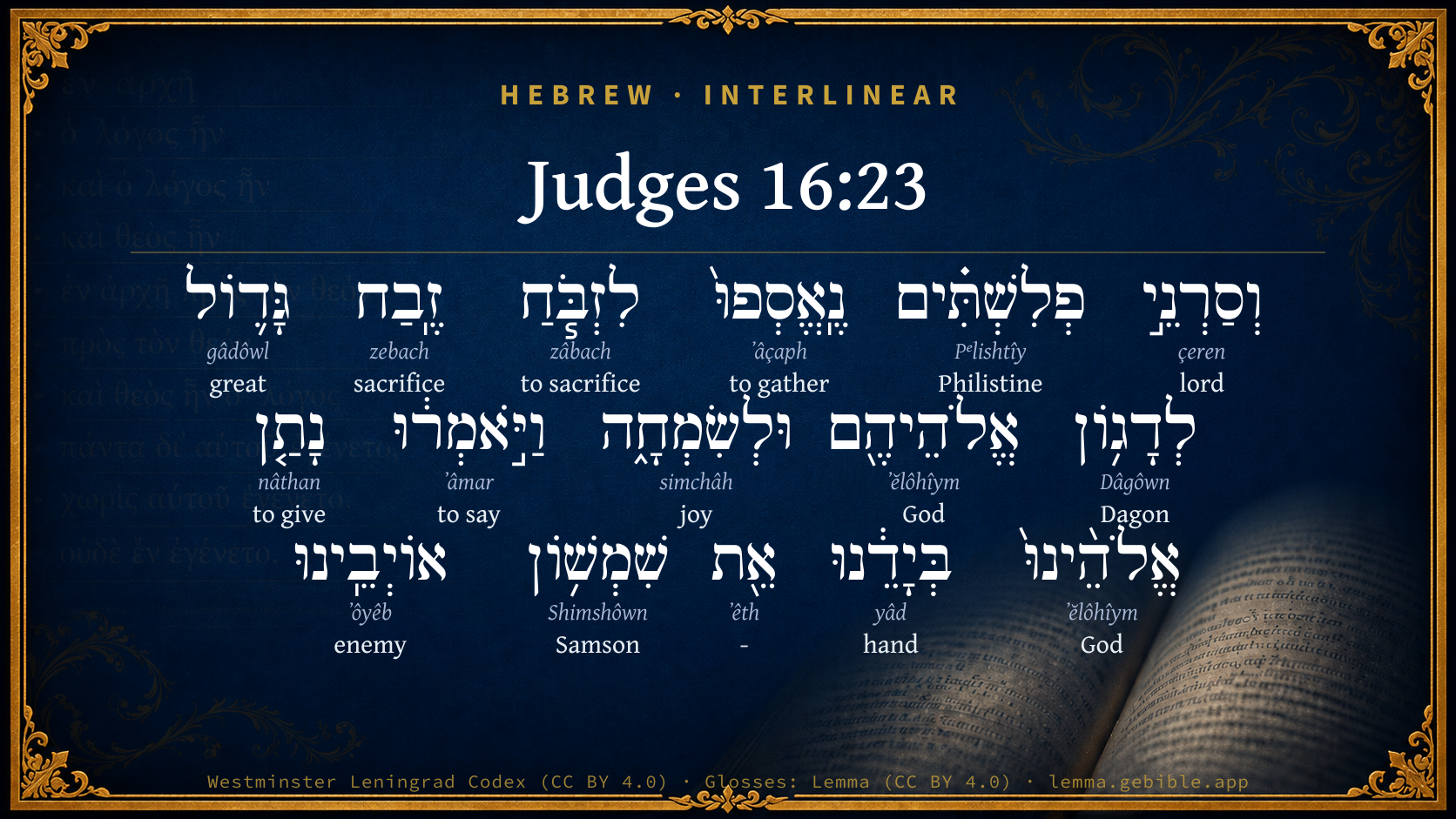
Hebrew (Westminster Leningrad Codex) Judges 16:23 appears in the Hebrew Old Testament. The text above is from the Westminster Leningrad Codex. Each word links to its Strong’s number, a concise gloss, and parsing drawn from the Open Scriptures Hebrew Bible morphology. Click any word for its full Brown-Driver-Briggs (BDB) entry.
Download image
Cite this verse

Judges 16:23 (World English Bible). Public Domain. Lemma interlinear Bible study tool, https://lemma.gebible.app/v/judges/16/23.

Show BibTeX & RIS
BibTeX
RIS
English Translation
The lords of the Philistines gathered them together to offer a great sacrifice to Dagon their god, and to rejoice; for they said, Our god has delivered Samson our enemy into our hand.
World English Bible · Public Domain
Highlights
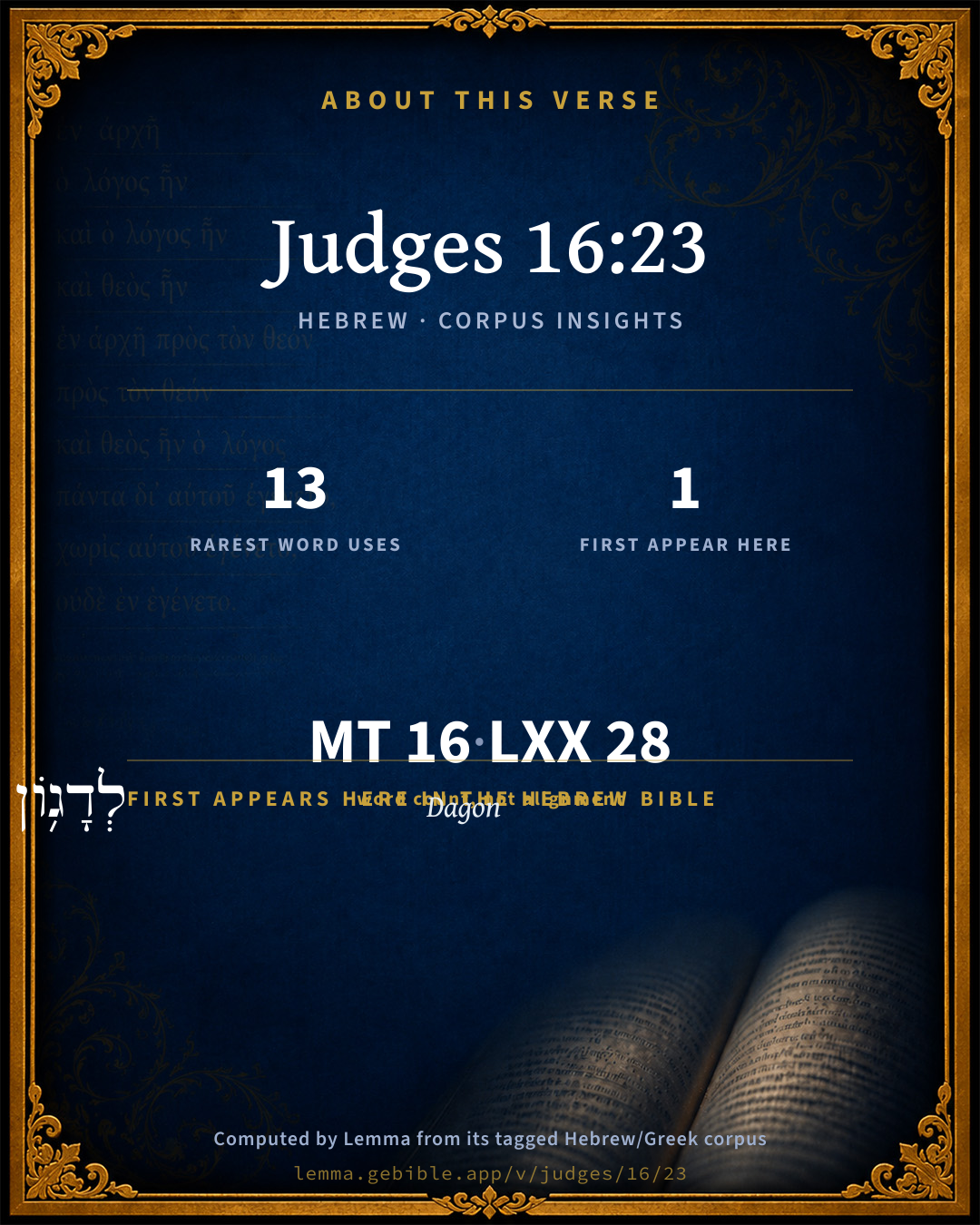
  • 1 first appearance in the Hebrew Bible
Full analysis ↓
Download a study sheet

One document with this verse’s original text, its word-by-word gloss line, the meaning frame, cross-references with their text, attributed commentary, and full source and license credits — printable, and it pastes into notes with its structure intact.

This verse Autodidact and up

Study sheet (.html) Plain text (.txt)

A passage Seminary Student

Up to 50 verses in one chapter. A passage sheet keeps up to 6 commentary sources and 12 cross-references per verse, in the order this page ranks them, and says so on the sheet whenever that leaves anything out. Ask for a single verse and you get the Autodidact verse sheet above.

Everything on this page stays free to read, with no account — the sheet is a download of what is already on screen, not access to it.

Want to remove ads? Support Godless Engineer
Compare translations 3

The same verse in 3 English versions, stacked beneath the original-language interlinear above. Click any original word for its lexicon entry.

Each is an independent rendering of the whole verse — the interlinear is not word-aligned to these translations.

Highlighted words mark where these versions differ — a whole-verse word diff, not a word-by-word alignment.

  • World English Bible Public Domain
    The lords of the Philistines gathered them together to offer a great sacrifice to Dagon their god, and to rejoice; for they said, Our god has delivered Samson our enemy into our hand.
  • King James Version Public Domain
    Then the lords of the Philistines gathered them together for to offer a great sacrifice unto Dagon their god, and to rejoice: for they said, Our god hath delivered Samson our enemy into our hand.
  • unfoldingWord Literal Text CC BY-SA 4.0
    Now the lords of the Philistines gathered themselves to sacrifice a great sacrifice to Dagon their god and for celebration, for they said, “Our god has given into our hand Samson, our enemies.”

unfoldingWord Literal Text — © unfoldingWord, licensed CC BY-SA 4.0. Word-aligned USFM3 via Door43 (git.door43.org/unfoldingWord/en_ult).

Versions to compare (up to 4)

3 of 4 selected

Show all 18 translations

Every available English version of this verse, each an independent rendering of the whole verse.

  • World English Bible Public Domain
    The lords of the Philistines gathered them together to offer a great sacrifice to Dagon their god, and to rejoice; for they said, Our god has delivered Samson our enemy into our hand.
  • Berean Standard Bible Public Domain
    Now the lords of the Philistines gathered together to offer a great sacrifice to their god Dagon. They rejoiced and said, “Our god has delivered Samson our enemy into our hands.”
  • Majority Standard Bible Public Domain
    Now the lords of the Philistines gathered together to offer a great sacrifice to their god Dagon. They rejoiced and said, “Our god has delivered Samson our enemy into our hands.”
  • King James Version Public Domain
    Then the lords of the Philistines gathered them together for to offer a great sacrifice unto Dagon their god, and to rejoice: for they said, Our god hath delivered Samson our enemy into our hand.
  • American Standard Version (1901) Public Domain
    And the lords of the Philistines gathered them together to offer a great sacrifice unto Dagon their god, and to rejoice; for they said, Our god hath delivered Samson our enemy into our hand.
  • Revised Version (1885) Public Domain
    And the lords of the Philistines gathered them together for to offer a great sacrifice unto Dagon their god, and to rejoice: for they said, Our god hath delivered Samson our enemy into our hand.
  • Geneva Bible (1599) Public Domain
    Then the Princes of the Philistims gathered them together for to offer a great sacrifice vnto Dagon their god, and to reioyce: for they said, Our god hath deliuered Samson our enemie into our handes.
  • Douay-Rheims (1899) Public Domain
    And the princes of the Philistines assembled together, to offer great sacrifices to Dagon their god, and to make merry, saying: Our god hath delivered our enemy Samson into our hands.
  • Young's Literal Translation Public Domain
    and the princes of the Philistines have been gathered together to sacrifice a great sacrifice to Dagon their god, and to rejoice; and they say, `Our god hath given into our hand Samson our enemy.'
  • Literal Standard Version CC BY-SA 4.0
    and the princes of the Philistines have been gathered together to sacrifice a great sacrifice to their god Dagon, and to rejoice; and they say, “Our god has given our enemy Samson into our hand.”
  • Unlocked Literal Bible CC BY-SA 4.0
    The rulers of the Philistines gathered together to offer a great sacrifice to Dagon their god, and to rejoice. They said, “Our god has conquered Samson, our enemy, and put him in our grasp.”
  • unfoldingWord Literal Text CC BY-SA 4.0
    Now the lords of the Philistines gathered themselves to sacrifice a great sacrifice to Dagon their god and for celebration, for they said, “Our god has given into our hand Samson, our enemies.”
  • Darby Bible Public Domain
    Now the lords of the Philistines gathered to offer a great sacrifice to Dagon their god, and to rejoice; for they said, "Our god has given Samson our enemy into our hand."
  • World Messianic Bible Public Domain
    The lords of the Philistines gathered together to offer a great sacrifice to Dagon their god, and to rejoice; for they said, “Our god has delivered Samson our enemy into our hand.”
  • Webster's Bible Public Domain
    Then the lords of the Philistines assembled to offer a great sacrifice to Dagon their god, and to rejoice: for they said, Our god hath delivered Samson our enemy into our hand.
  • Free Bible Version CC BY-SA 4.0
    The Philistine leaders gathered for a great religious festival to sacrifice to their god Dagon and to celebrate, saying, “Our god has handed Samson our enemy over to us!”
  • Bible in Basic English Public Domain
    And the chiefs of the Philistines came together to make a great offering to Dagon their god, and to be glad; for they said, Our god has given into our hands Samson our hater.
  • JPS Tanakh (1917) Public Domain
    And the lords of the Philistines gathered them together to offer a great sacrifice unto Dagon their god, and to rejoice; for they said: 'Our god hath delivered Samson our enemy into our hand.'

Literal Standard Version (2020), Covenant Press — licensed CC BY-SA 4.0. Text via the HelloAO Bible API (eBible.org). Unlocked Literal Bible (unfoldingWord) — licensed CC BY-SA 4.0. Text via the HelloAO Bible API (eBible.org). unfoldingWord Literal Text — © unfoldingWord, licensed CC BY-SA 4.0. Word-aligned USFM3 via Door43 (git.door43.org/unfoldingWord/en_ult). Free Bible Version, Dr. Jonathan Gallagher — licensed CC BY-SA 4.0. Text via the HelloAO Bible API (eBible.org).

Word by word

More ways to search: Search by grammar → Find every occurrence → Compare this word →

Practice this passage: Drill this verse → Learn its vocabulary →

לְדָג֥וֹן
Dâgôwn
H1712
“to/for · Dagon”
Preposition + Noun, Proper
Part of Speech
Preposition + Noun
Type
Proper
Full BDB Definition

Origin: from H1709

TWOT: None

Dagon = "a fish" - a Philistine deity of fertility; represented with the face and hands of a man and the tail of a fish
  1. וְסַרְנֵ֣י çeren H5633 “and · lords of” Conjunction + Noun, Common, Masculine, Plural, Construct
  2. פְלִשְׁתִּ֗ים Pᵉlishtîy H6430 “Philistines” Noun, Gentilic, Masculine, Plural, Absolute
  3. נֶֽאֱסְפוּ֙ ʼâçaph H622 “to gather” Verb, Niphal, Perfect, 3rd Person, Common, Plural
  4. לִזְבֹּ֧חַ zâbach H2076 “to sacrifice” Preposition + Verb, Qal, Infinitive Construct
  5. זֶֽבַח zebach H2077 “sacrifice” Noun, Common, Masculine, Singular, Absolute
  6. גָּד֛וֹל gâdôwl H1419 “great” Adjective, Adjective, Masculine, Singular, Absolute
  7. אֱלֹהֵיהֶ֖ם ʼĕlôhîym H430 “God(s) · their” Noun, Common, Masculine, Plural, Construct + Suffix, Personal, 3rd Person, Masculine, Plural
  8. וּלְשִׂמְחָ֑ה simchâh H8057 “and · to/for · joy” Conjunction + Preposition + Noun, Common, Feminine, Singular, Absolute
  9. וַיֹּ֣אמְר֔וּ ʼâmar H559 “and · to say” Conjunction + Verb, Qal, Sequential Imperfect, 3rd Person, Masculine, Plural
  10. נָתַ֤ן nâthan H5414 “to give” Verb, Qal, Perfect, 3rd Person, Masculine, Singular
  11. אֱלֹהֵ֨ינוּ֙ ʼĕlôhîym H430 “God(s) · our” Noun, Common, Masculine, Plural, Construct + Suffix, Personal, 1st Person, Common, Plural
  12. בְּיָדֵ֔נוּ yâd H3027 “in/at · hand · our” Preposition + Noun, Common, Both, Singular, Construct + Suffix, Personal, 1st Person, Common, Plural
  13. אֵ֖ת ʼêth H853 “-” Particle, Direct Object
  14. שִׁמְשׁ֥וֹן Shimshôwn H8123 “Samson” Noun, Proper
  15. אוֹיְבֵֽינוּ ʼôyêb H341 “enemy · us” Verb, Qal, Participle Active, Masculine, Plural, Construct + Suffix, Personal, 1st Person, Common, Plural

About this verse

These counts appear in no published source. They are computed here, from the morphology-tagged text and Lemma’s own curated glosses. What Lemma adds →

16
words
15
distinct lemmas
Historical
section

Notable vocabulary

The rarest word here is לְדָג֥וֹן Dagon H1712 — appearing just 13 times in the whole Hebrew Bible.

First appearance in Scripture

This word makes its first canonical appearance in the Hebrew Bible here:

  • לְדָג֥וֹן Dagon H1712

Shared distinctive vocabulary

לְדָג֥וֹן Dagon H1712 occurs in 7 verses of the Hebrew Bible. Also found in:

Grammatical profile

  • 5 verbs
  • 9 nouns
  • 1 adjective
  • 1 particle

Verb forms

  • נֶֽאֱסְפוּ֙ Niphal · Perfect
  • לִזְבֹּ֧חַ Qal · Infinitive Construct
  • וַיֹּ֣אמְר֔וּ Qal · Sequential Imperfect
  • נָתַ֤ן Qal · Perfect
  • אוֹיְבֵֽינוּ Qal · Participle Active

Repetition

A word recurs within this verse — often emphatic in Hebrew:

  • אֱלֹהֵיהֶ֖ם God H430 ×2

Hebrew & Septuagint length

In English translation the verse runs 33 words from the Hebrew and 32 from the Septuagint (LXX English) — closely comparable.

A rough comparison of the two English renderings, which tokenize alike — not a word-level alignment.

Word counts can differ between the Hebrew and the Greek without any difference in meaning — e.g. the Hebrew direct-object marker אֵת has no separate Greek word, and Greek often adds the article ὁ.

In the original languages it is 16 Hebrew tokens and 28 Greek tokens — but the two are counted differently (Hebrew bundles its prefixes and suffixes into one token; the Greek is in lemma form), so that isn’t a like-for-like length.

Cross-references

10

Topical passages linked to Judges 16:23 in the Treasury of Scripture Knowledge — connected by theme and wording, ordered by reader-vote popularity; previews shown in the World English Bible.

  • Proverbs 24:17 Don't rejoice when your enemy falls. Don't let your heart be glad when he is overthrown;
  • 1 Samuel 5:2–5 The Philistines took the ark of God, and brought it into the house of Dagon, and set it by Dagon.
  • 1 Chronicles 10:10 They put his armor in the house of their gods, and fastened his head in the house of Dagon.
  • Job 30:9–10 "Now I have become their song. Yes, I am a byword to them.
  • Psalms 35:15–16 But in my adversity, they rejoiced, and gathered themselves together. The attackers gathered themselves together against me, and I didn't know it. They tore at me, and didn't cease.
  • Jeremiah 2:11 Has a nation changed [its] gods, which yet are no gods? but my people have changed their glory for that which does not profit.
  • Micah 4:5 Indeed all the nations may walk in the name of their gods; But we will walk in the name of Yahweh our God forever and ever.
  • Romans 1:23–25 and traded the glory of the incorruptible God for the likeness of an image of corruptible man, and of birds, and four-footed animals, and creeping things.
  • 1 Corinthians 8:4–5 Therefore concerning the eating of things sacrificed to idols, we know that no idol is anything in the world, and that there is no other God but one.
  • 1 Corinthians 10:20 But I say that the things which the Gentiles sacrifice, they sacrifice to demons, and not to God, and I don't desire that you would have communion with demons.

Cross-references courtesy of OpenBible.info (CC BY 4.0).

Hebrew and Greek witnesses Masoretic Hebrew ↔ Greek Septuagint

The same verse in the two great witnesses to the Old Testament, shown verse-for-verse.

These are two independent witnesses, not word-aligned to each other, and the Septuagint is shown in lemma (dictionary) form.

Hebrew Judges 16:23 Masoretic · Westminster Leningrad Codex

וְסַרְנֵ֣י פְלִשְׁתִּ֗ים נֶֽאֱסְפוּ֙ לִזְבֹּ֧חַ זֶֽבַח גָּד֛וֹל לְדָג֥וֹן אֱלֹהֵיהֶ֖ם וּלְשִׂמְחָ֑ה וַיֹּ֣אמְר֔וּ נָתַ֤ן אֱלֹהֵ֨ינוּ֙ בְּיָדֵ֔נוּ אֵ֖ת שִׁמְשׁ֥וֹן אוֹיְבֵֽינוּ

The lords of the Philistines gathered them together to offer a great sacrifice to Dagon their god, and to rejoice; for they said, Our god has delivered Samson our enemy into our hand.

World English Bible · Public Domain

Greek LXX Judges 16:23 Septuagint · lemma form

καί ὁ ἄρχων ὁ ἀλλόφυλος συνἄγω θύω θυσίασμα μέγας ὁ δαγων θεός αὐτός καί εὐφραίνω καί εἶπον δίδωμι ὁ θεός ἐν χείρ ἐγώ ὁ σαμψων ὁ ἐχθρός ἐγώ

And the chiefs of the Philistines met to offer a great sacrifice to their god Dagon, and to make merry; and they said, God has given into our hand our enemy Sampson.

LXX2012 (modern English Septuagint) · Public Domain

Hebrew: Westminster Leningrad Codex (CC BY 4.0). Greek: Septuagint (public domain); English from LXX2012 (modern English Septuagint) (Public Domain). How the Septuagint differs from the Hebrew →

Targum (Aramaic paraphrase)

1

The Targum is the ancient Jewish Aramaic paraphrase of the Hebrew Scriptures — an interpretive translation, not the Hebrew text itself. Onkelos (literal) and Pseudo-Jonathan (expansive) render the Torah, and Jonathan the Prophets. Coverage is partial: where no permissively-licensed English translation exists for a verse, only the Aramaic is shown. This is verse-level text, not a word-by-word alignment to the Hebrew.

  1. Targum Jonathan Prophets (Joshua–Malachi)
    וְטוּרְנֵי פְלִשְׁתָּאֵי אִתְכְּנִישׁוּ לְדַבָּחָא דְבַח רַבָּא לְדָגוֹן טַעֲוַתְהוֹן וּלְחֶדְוָא וַאֲמַרוּ מְסָרַת דְחַלְתָּנָא בִּידָנָא יַת שִׁמְשׁוֹן בְּעֵיל דְבָבָנָא:

    (no public-domain English translation for this verse)

    Targum Jonathan — Aramaic: “Mikraot Gedolot” (public domain). English: “Sefaria Community Translation” (CC0 1.0 (public-domain dedication)); “London "Chaldee Paraphrase," 1871” (public domain). Text via Sefaria.

Commentary

Notes on Judges 16:23 from classic Christian and Jewish commentators (each source and its license shown beneath its notes). The classic Christian expositions comment on the surrounding passage and are grouped to its opening verse, so a note may address several verses; the Jewish commentaries on the Tanakh (Rashi and others) are per-verse, so they appear only where the commentator wrote on this verse.

Lemma curates 59 commentaries, every one of them public domain or Creative Commons licensed, each selected and text-cleaned for this edition rather than reprinted as found. About our sources →

Jamieson, Fausset & Brown

Robert Jamieson, A. R. Fausset & David Brown

THEIR FEAST TO DAGON. (Jdg 16:23-25)

the lords of the Philistines gathered them together for to offer a great sacrifice unto Dagon--It was a common practice in heathen nations, on the return of their solemn religious festivals, to bring forth their war prisoners from their places of confinement or slavery; and, in heaping on them every species of indignity, they would offer their grateful tribute to the gods by whose aid they had triumphed over their enemies. Dagon was a sea idol, usually represented as having the head and upper parts human, while the rest of the body resembled a fish.

Jamieson, Fausset & Brown — Commentary Critical and Explanatory on the Whole Bible (1871) — public domain (CC PDM 1.0). Text via the HelloAO Bible API.

Trapp's Complete Commentary

John Trapp

Jdg 16:23 Then the lords of the Philistines gathered them together for to offer a great sacrifice unto Dagon their god, and to rejoice: for they said, Our god hath delivered Samson our enemy into our hand.

Ver. 23. For to offer a great sacrifice unto Dagon their god.] That is, To Triton, the idol af those maritime nations, which was a fish downward, whence also he had his name Dagon. See 1Sa 5:4. Diodorus Siculus calleth this idol Derceta; others, Leucothea.

And to rejoice.] Ad celebranda hilaria. So the wild Irish when they go to rob, which they account no shame, pray to God that they may meet with a booty; and when they meet with it, they account it God’s gift, and rejoice exceedingly. {a}

{a} Camd., Britan. Irel., p. 144.

John Trapp, A Commentary or Exposition upon All the Books of the Old and New Testament (1647–1656) — public domain. Text from a community e-Sword module.

Joseph Benson's Commentary

Jdg 16:23. To offer a great sacrifice — They assembled to render honour to their idol, for their triumph over a man who as much detested their idolatry as he did their barbarous oppression of his countrymen. Unto Dagon their god — Whose image is supposed to have been, in the upper part, of the human form, and in the lower part like a fish; probably one of the sea-gods of the heathen. The Philistines foolishly attributed to this idol what had come to pass by the will of the God of Israel, to punish Samson for his sins.

Joseph Benson's Commentary on the Old and New Testaments (1811–1818) — public domain. Text from a community e-Sword module.

Adam Clarke's Commentary

Verse 23. Unto Dagon their god] Diodorus Siculus describes their god thus: Το μεν προσωπον εχει γυναικος, το δ' αλλο σωμα παν ιχθους;; "It had the head of a woman, but all the rest of the body resembled a fish." Dagon was called Dorceto among the heathens.

Horace, in the following lines, especially in the third and fourth, seems to have in view the image of Dagon: -

Humano capiti cervicem pictor equinam

Pingere si velit; et varias inducere plumas,

Undique collatis Inembris; ut turpiter atrum

Desinat in piscem mulier formosa superne;

Spectatum admissi risum teneatis amici?

DE ART. POET., V. 1.

"Suppose a painter to a human head

Should join a horse's neck; and wildly spread

The various plumage of the feather'd kind

O'er limbs of different beasts, absurdly join'd;

Or if he gave to view a beauteous maid,

Above the waist with every charm array'd,

Should a foul fish her lower parts infold,

Would you not smile such pictures to behold?"

FRANCIS.

Adam Clarke's Commentary on the Bible (1810–1826) — public domain. Text from a community e-Sword/MySword module.

Ellicott's Commentary for English Readers

(23) Unto Dagon their god.—Comp. 1Sa_5:1-2; 1Ch_10:10. This was the

“ Sea-monster:—upward man,

And downward fish.”

In 1Sa_5:4 we have an allusion to his stump or fish-part. Dag means “fish,” and the same root is found in Tagus. A goddess of similar form and attributes was worshipped under the name of Atargatis or Derceto (2Ma_12:26). How widely the worship was spread we see from the commonness of the name Beth-dagon in the Shephelah (Jos_15:41). His chief temple at Azotus was burned by Judas Maccabeus (1Ma_10:83). The only other Philistine god mentioned in Scripture is Baal-zebub, god of Ekron (2Ki_1:2-16).

A Bible Commentary for English Readers, edited by Charles John Ellicott (1878–1897) — public domain. Text from a community e-Sword module.

The Cambridge Bible for Schools and Colleges

gen. ed. J. J. S. Perowne

23. a great sacrifice unto Dagon] at Gaza, as the context suggests (Jdg_16:21). Dagon was the god specially honoured by the Philistines; he had a temple at Ashdod (1Sa_5:2-7, 1Ma_10:83 f., Jdg_11:4) and elsewhere; there was a Beth-dagon in the Shephçlah (Jos_15:41? = Beit-dejan 6 m. S.E. of Joppa, or Dejan 1½ m. further south1[57]) and on the boundary of Asher (Jos_19:27). But the name also occurs outside the territory once held by the Philistines; it survives in Beit-dejan 7 m. E. of Nâblus; and we may infer that the worship of Dagon was not confined to the Philistines. Most likely he was a Canaanite god adopted by the Philistines when they settled in the country, just as they adopted Ashtoreth (1Sa_31:10). The name of the Canaanite letter-writer Dagan-takala in the Amarna tablets (Nos. 215, 216) carries us back to the age when Babylonian influences prevailed in Canaan; and Dagan is met with as the name of a deity from the early Babylonian down to the Assyrian period, both in proper names and in conjunction with Anu; the latter fact points to a god of heaven. But whether he was a native Babylonian god is not certain; it seems probable that he was introduced from outside, perhaps from Canaan; most authorities identify him with the Philistine Dagon2[58]. Of his nature nothing definite is known. Philo of Byblus derives the name from dâgân = corn, and regards him as an agricultural deity; Ḳimḥi (xiiith century a.d.) in his commentary on 1Sa_5:4 mentions a tradition that Dagon’s image was shaped as a man above the waist and a fish below (dâg = fish). These, however, are only etymological guesses. It may be questioned whether the god, half man and half fish, represented on the coins of Ascalon and Arvad, was intended for Dagon3[59].

[57] One of these was probably the Bit-daganna mentioned in the Prism Inscr. of Sennacherib, KB. ii. 93.

[58] See Dhorme, La Rel. Assyro-Babylonienne (1910), 17, 35, 165; Zimmern, KAT.3, 358.

[59] As Lagrange considers, Ét. sur les Rel. Sémitiques2, 131 f.

for they said … our hand] looks like a gloss founded on the song in the verse which follows.

The Cambridge Bible for Schools and Colleges (gen. ed. J. J. S. Perowne; Cambridge University Press, 1878–1918) — public domain. Text from a community e-Sword module.

John Gill's Exposition

Then the lords of the Philistines gathered them together,.... The five lords, with their friends, not directly upon Samson's being taken and committed to prison, but some time after; perhaps some months:

for to get a great sacrifice to Dagon their god; in later times their god was called Marnas (o), which signifies the lord of men, but now Dagon; who also had a temple at Ashdod, another of the five principalities of the Philistines, Sa1 5:2 and seems to have been at this time their common and chief deity: according to Jarchi in the place referred to, it was in the form of a fish, for "dag" in Hebrew signifies a fish; and Kimchi on the same place says, that from its navel upwards it was in the form of a man, and from thence downwards in the form of a fish (p); and Diodorus Siculus (q) relates that Derceto, a goddess of Ashkelon, another of the five principalities of Palestine, its face was human, and the other part of its body resembled a fish; and the same Lucian says of the Syrian goddess; and Cicero (r) testifies, that the Syrians worshipped a fish, and Porphyry (s) says they will not eat any; and Gaza being a maritime city, a sea port, this might be their sea god in this form: but Ben Gersom in the above place says, it was in the form of a man; and Sanchoniatho (t) making mention of Dagan, a brother of Saturn, Philo Byblius, who translated his history into Greek, interprets it by Siton, which signifies corn, deriving it from Dagan, which so signifies; as if this deity presided over corn, as Ceres in other nations, and Jupiter Frumentarius, or Aratrius; yea, he says he invented corn and the plough; however this be, the Philistine princes met together to sacrifice to him, not a common offering, but a great sacrifice. It is very probable that this was a public festival of the Philistines, as Josephus (u) says, an anniversary one; and perhaps was held in a more grand manner on the present occasion, since it is added:

and to rejoice: for they said, our god hath delivered Samson our enemy into our hands; for though Samson's harlot had done it, and they had paid her for it, yet they attribute it to their god, such was their blindness and stupidity; and yet this may shame us believers in the true God, who are so backward to ascribe to him the great things he does for us, when such Heathens were so forward to give glory to their false deities, without any foundation for it.

(o) Hicron. in Isa. xvii. fol. 39. K. (p) So David de Pomis Lexic. fol. 18. 3. & Milton in his Paradise Lost, l. 1. v. 462, 463. "Dagon his name; sea monster! upward man, And downward fish." (q) Bibliothec. l. 2. p. 92. & Ovid Metamorph. l. 4. Fab. 1. v. 44, &c. (r) De Natura Deorum, l. 3. (s) De Abstinentia, l. 2. sect. 6. (t) Apud Euseb. Evangel. Praepar. l. 1. p. 36, 37. (u) Antiqu. l. 5. c. 8. sect. 12.

John Gill's Exposition of the Whole Bible (1746–1763) — public domain (CC PDM 1.0). Text via the HelloAO Bible API.

Albert Barnes' Notes on the Bible

Dagon was the national idol of the Philistines 1Ch 10:10, so called from Dag, a fish. The description of Dagon, in his temple at Ashdod 1Sa 5:4, exactly agrees with the representations of a fish-god on the walls of Khorsabad, on slabs at Kouyunjik, and on sundry antique cylinders and gems. In these the figures vary. Some have a human form down to the waist, with that of a fish below the waist; others have a human head, arms, and legs, growing, as it were, out of a fish’s body, and so arranged that the fish’s head forms a kind of mitre to the man’s head, while the body and fins form a kind of cloak, hanging down behind.

Albert Barnes' Notes on the Bible (1834–1885) — public domain. Text from a community e-Sword/MySword module.

Haydock's Catholic Bible Commentary

Dagon. Probably the derceto, whom Diodorus (3,) represents with the head of a woman, and the rest of the body like a fish, the chief object of adoration at Ascalon. (Calmet) --- Dagon may signify "wheat;" and hence Eusebius (præp. 1,) styles him "the ploughing Jupiter," or "a fish." --- Hands. For this purpose they were offering sacrifices of thanksgiving, (Menochius) which they did not only when they first took Samson, but probably on all their great festivals, till the hero’s death. They could not but excite the indignation and zeal of this great judge, and God resented the indignity offered to himself. They cursed Samson, (Haydock) as the Sichemites had done Abimelec on a similar occasion, chap. ix. 27. (Menochius) God "will not connive or linger, thus provoked,

but will arise and his great name assert." --- Milton, v. 466.

George Leo Haydock (1774–1849), Haydock's Catholic Family Bible and Commentary, 1859 edition — public domain. Excludes Psalms (Douay-Rheims chapter numbering differs from Protestant) and Deuterocanonical books (Catholic canon only).

Matthew Poole's English Annotations

The lords of the Philistines gathered them together; either upon some annual or customary solemnity; or rather, upon this special occasion, to praise Dagon for this singular favour. And they did not appoint this solemn service as soon as Samson was taken, but some considerable time after, as appears by the growth of Samson’s hair in the mean time, because they would give sufficient time and warning for all their friends and allies to come thither, and for the making of all necessary preparations for so great an occasion.

Dagon is by most supposed to be an idol, whose upper part was like a man, and whose lower part was like a fish; whence there is mention of Dagon’s hands, but not of his feet, in 1Sa 5:4. And this place being near Egypt, where some of their gods were worshipped in the form of fishes, and being near the sea, it seems most probable that it was one of the sea gods of the heathens, and that it had in some part the resemblance of a fish.

Matthew Poole's English Annotations on the Holy Bible (1683–1685) — public domain. Text from a community e-Sword/MySword module.

Whedon's Commentary on the Bible

Daniel D. Whedon

23. Dagon their god — The name is derived from the Hebrew דג, dag, a fish, and the diminutive ending on with the sense of endearment — “dear little fish,” (Gesenius.) According to Kimchi and most scholars this idol had a human head and arms and the body of a fish. He was the great national deity of the Philistines, but was worshipped under modified forms and names by other nations. He was the representative or symbol of all those life-giving forces of nature which produce their effects through the medium of water. Kindred to Dagon were the Atargatis of the Syrians and the Babylonian Oannes or Odakon, who, according to Berosus, had the body of a fish, but the head, hands, feet and voice of a man, (see cut and note on 1Sa_5:4,) and from the very beginnings of their history had taught the people arts, religion, law, and agriculture. Among the Assyrian ruins have been found several representations of this fish-god.

Daniel D. Whedon (gen. ed.), Commentary on the Old and New Testaments (1874–1909) — public domain. Text from a community e-Sword module.

The Pulpit Commentary

Gathered them, i.e. themselves. To rejoice. The Hebrew is for a festivity, or merry-making, or feast. There was to be a great feast upon the sacrifices offered to Dagon their God. Dagon (from dag, a fish in Hebrew), the national male god of the Philistines, as Atergatis, or Derceto, was their goddess. Both the male and female divinities seem to have had the head and breast and hands human, and the rest of the body fish-shaped. (1Sa_5:5) The fish was a natural emblem of fertility and productiveness, especially to a maritime people. The fish-shaped idol is found upon old Phoenician coins, and also on the monuments of Khorsabad, and on some Assyrian gems in the British Museum. One of the chief temples of Dagon was at Gaza. Several towns bore the name of Dagon, as Beth-dagon in Judah (Jos_15:41) and in Asher, (Jos_19:27) Caphar-dagon near Diospolis, etc., showing that the worship of Dagon was widespread.

Vers. 23-31. The short-lived triumph.

One of the severest trials to which the faith of the people of God is exposed, is that triumph of evil over good, and of the enemies of Christ over his Church, which from time to time is permitted by God, and which in truth is one of the features of this disjointed age. The most signal and most awful triumph of the powers of darkness over the kingdom of light was when the only-begotten Son of God, Jesus our Lord, in the midst of his life of perfect goodness, and his service of perfect obedience to the will of his Father, was betrayed into the hands of sinners, and given up to suffer death upon the cross. When he hung in shame upon the cross, helpless and forsaken; when he bowed his head and gave up the ghost; when he was laid in the silent tomb, and the light of the righteous One was quenched in the darkness of the grave, then indeed the triumph of sin was at its height, and the hope of the servants of God was brought very low. But when on the third day the doors of that grave were burst open, and the prisoner of hope came forth in the power of an endless life, and he that was crucified ascended up to heaven, and sat down on the right hand of the majesty on high, from thenceforth expecting till his enemies be made his footstool, that brief triumph of the powers of darkness was turned into the far greater triumph of the kingdom of light; the enemies of Christ were put to shame, the servants of Christ were enabled to rejoice, and the joyful hope was exceedingly revived and established, that in due time there will be a final deliverance from evil, and that the kingdom is God"s, and the power and the glory for ever. In the light of the resurrection the Church looks forward with unmoved confidence to the time when the Son of man shall come in the clouds of heaven with power and great glory, and shall take to himself his everlasting kingdom of righteousness, and reign with his ancients gloriously. But meanwhile the Church must expect many short-lived triumphs of evil over good, and of darkness over light. There will be many occasions on which the world will say, Let us rejoice, for our god hath delivered our enemy into our hand. We may expect that many an isolated affair, or even a connected chain of events, will take that turn that the servants of Christ will be put to shame, and ungodliness and irreligion will seem to have it all their own way. It may even come to pass that the champions of the gospel shall seem fit only to make sport for an unbelieving and self-sufficient age. Nor is it the least part of the trial that some of these discomfitures are brought on by the errors and failures of the servants of God. The presumption and self-confidence, the blindness and moral weakness, of some like Samson; the intemperate, fiery spirit of others like the Boanerges; the fear of man in others like Peter, and so on, provoke defeat by putting religion in a false light in the eyes of those who are always looking out for occasions to bring it into contempt. But in the midst of these trials of faith, whether they take the form of private discouragements, or of public checks to the progress of religion, and public triumphs of the spirit of ungodliness, it is the Church"s unfailing comfort to know that the triumphs of evil are short-lived, and the triumph of truth is eternal. Magna est veritas et proevalet. We should never forget for one moment that behind the passing cloud there is shining the unchanging sun. The faith and patience of the saints are indeed required, sometimes more, sometimes less, but are always required in this present age. The depression of the truth, the insolent aggressions of the various forms of evil, the discomfiture for a time of the champions of the cause of Christ, and the temporary victories of Antichrist, are very painful episodes in the history of the world and of the Church. But the pages of Holy Scripture, and even the pages of the experience of centuries, continually testify that the triumphs of falsehood and evil are but for a moment, the victory of truth and righteousness will be for ever.

The Pulpit Commentary (1880–1919), ed. H.D.M. Spence-Jones & Joseph S. Exell — public domain. Text from a community e-Sword module.

John Wesley's Explanatory Notes

Dagon - An idol, whose upper part was like a man, and whose lower part was like a fish: probably one of the sea-gods of the Heathens.

John Wesley, Explanatory Notes Upon the Whole Bible (1754–1765) — public domain. Text via the GEBible commentary corpus.

unfoldingWord translationNotes

Door43 World Missions Community

Dagon

a major false god of the Philistines (See: How to Translate Names)

has conquered

"has defeated"

put him in our grasp

Here the author speak of Samson being under the rulers' control as if he were something grasped tightly by their hands. AT: "put him under our control" (See: Metaphor)

the destroyer of our country

This refers to Samson. The word "destroyer" can be expressed with the verb "destroy." AT: "the man who has destroyed our country"

who killed many of us

Here the word "us" refers to the Philistine people. Those who are talking are not counting themselves among the people whom Samson killed. AT: "who killed many of our people" (See: Synecdoche)

translationWords

rule

Philistines

sacrifice

false god

joy

praise

destroy

unfoldingWord translationNotes — © Distant Shores Media and the Door43 World Missions Community, licensed CC BY-SA 4.0. Source: git.door43.org/Door43/en_tn.

Lesson kit

Teaching starters — assembled from the data on this page, not authored interpretation. Every prompt links to the verse data it draws on. Edit before teaching.

Judges, in the Historical, opens this verse with 16 words (15 distinct Hebrew lemmas). Its most distinctive word is Dâgôwn (“Dagon”). A historical commentator’s framing appears above. Read the whole chapter for the surrounding context.

Discussion questions

  1. What does “Dagon” (Dâgôwn) contribute to the verse as a whole?
  2. The word “Dagon” first appears here in Scripture. What is being introduced at this debut?
  3. 1 Samuel 5:2 shares the word «Dagon» with this verse. How do the two illuminate each other?
  4. “God” occurs 2× in this one verse. What is the effect of the repetition?
  5. These translations render this verse differently. What is at stake in choosing one wording over another?
  6. The verb «נֶֽאֱסְפוּ֙» is Niphal Perfect. How does its form color the action?
  7. Reading how Jamieson, Fausset & Brown and Trapp's Complete Commentary read this verse, where do the two commentators agree and where do they part?

Things to notice

Reading settings

Reading text

Shown beneath each verse's original-language words.

Old Testament
Old Testament edition

Read the OT as the Masoretic Hebrew (MT) or the Greek Septuagint (LXX).

English shown for the Greek Septuagint (in the Hebrew ↔ Greek comparison).

Comparing translations? Open the Compare panel on any verse page to stack up to four side by side.