
2 Chronicles 25:8

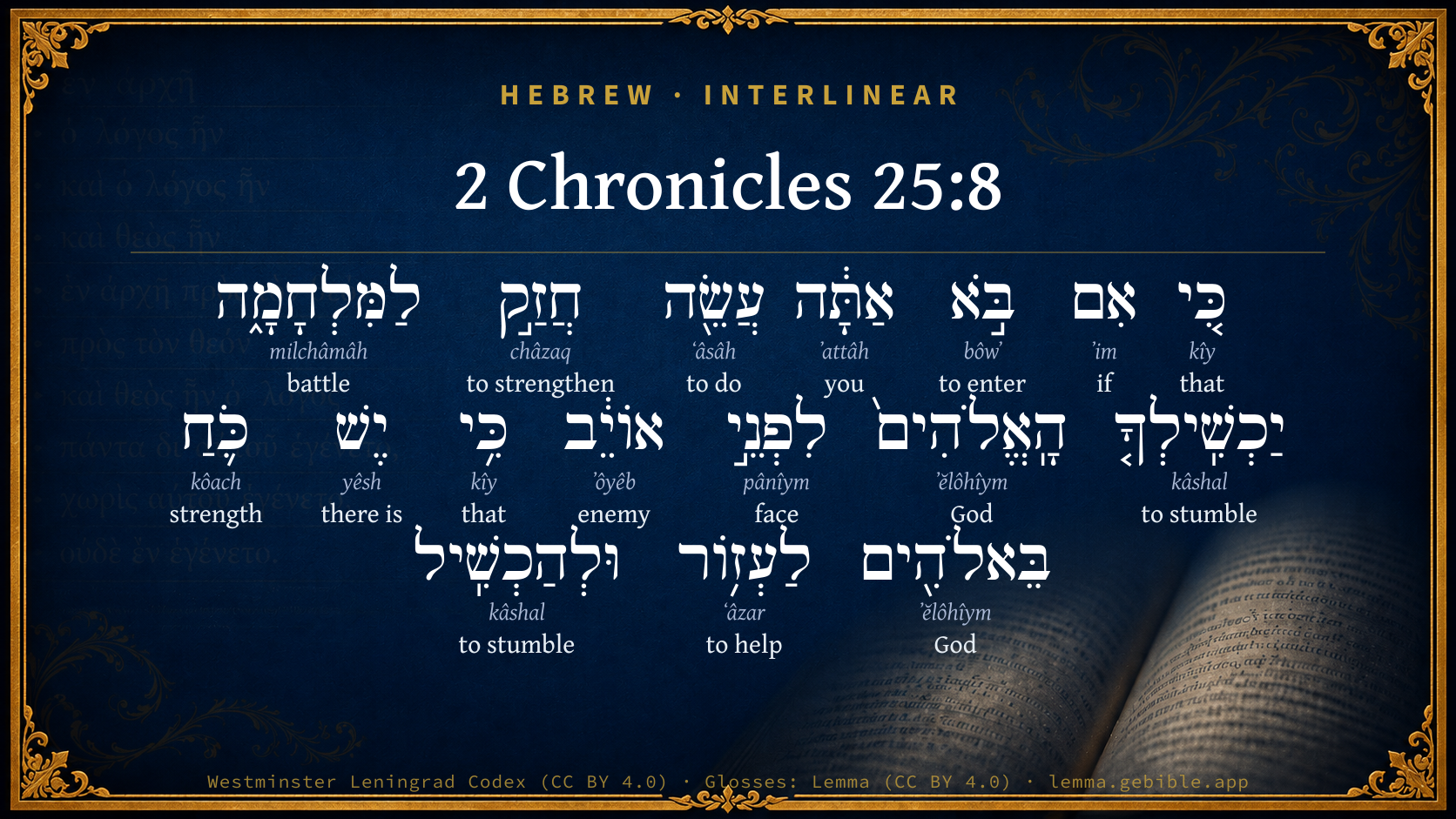
Hebrew (Westminster Leningrad Codex) 2 Chronicles 25:8 appears in the Hebrew Old Testament. The text above is from the Westminster Leningrad Codex. Each word links to its Strong’s number, a concise gloss, and parsing drawn from the Open Scriptures Hebrew Bible morphology. Click any word for its full Brown-Driver-Briggs (BDB) entry.
Download image
Cite this verse

2 Chronicles 25:8 (World English Bible). Public Domain. Lemma interlinear Bible study tool, https://lemma.gebible.app/v/2-chronicles/25/8.

Show BibTeX & RIS
BibTeX
RIS
English Translation
But if you will go, do [valiantly], be strong for the battle: God will cast you down before the enemy; for God has power to help, and to cast down.
World English Bible · Public Domain
Download a study sheet

One document with this verse’s original text, its word-by-word gloss line, the meaning frame, cross-references with their text, attributed commentary, and full source and license credits — printable, and it pastes into notes with its structure intact.

This verse Autodidact and up

Study sheet (.html) Plain text (.txt)

A passage Seminary Student

Up to 50 verses in one chapter. A passage sheet keeps up to 6 commentary sources and 12 cross-references per verse, in the order this page ranks them, and says so on the sheet whenever that leaves anything out. Ask for a single verse and you get the Autodidact verse sheet above.

Everything on this page stays free to read, with no account — the sheet is a download of what is already on screen, not access to it.

Want to remove ads? Support Godless Engineer
Compare translations 3

The same verse in 3 English versions, stacked beneath the original-language interlinear above. Click any original word for its lexicon entry.

Each is an independent rendering of the whole verse — the interlinear is not word-aligned to these translations.

Highlighted words mark where these versions differ — a whole-verse word diff, not a word-by-word alignment.

  • World English Bible Public Domain
    But if you will go, do [valiantly], be strong for the battle: God will cast you down before the enemy; for God has power to help, and to cast down.
  • King James Version Public Domain
    But if thou wilt go, do it; be strong for the battle: God shall make thee fall before the enemy: for God hath power to help, and to cast down.
  • unfoldingWord Literal Text CC BY-SA 4.0
    But if you go, act, be strong in battle; God will cause you to fall before the enemy, for there is power in God to help and to cause to fall.”

unfoldingWord Literal Text — © unfoldingWord, licensed CC BY-SA 4.0. Word-aligned USFM3 via Door43 (git.door43.org/unfoldingWord/en_ult).

Versions to compare (up to 4)

3 of 4 selected

Show all 18 translations

Every available English version of this verse, each an independent rendering of the whole verse.

  • World English Bible Public Domain
    But if you will go, do [valiantly], be strong for the battle: God will cast you down before the enemy; for God has power to help, and to cast down.
  • Berean Standard Bible Public Domain
    Even if you go and fight bravely in battle, God will make you stumble before the enemy, for God has power to help and power to overthrow.”
  • Majority Standard Bible Public Domain
    Even if you go and fight bravely in battle, God will overthrow you before the enemy, for God has power to help and power to overthrow.”
  • King James Version Public Domain
    But if thou wilt go, do it; be strong for the battle: God shall make thee fall before the enemy: for God hath power to help, and to cast down.
  • American Standard Version (1901) Public Domain
    But if thou wilt go, do `valiantly', be strong for the battle: God will cast thee down before the enemy; for God hath power to help, and to cast down.
  • Revised Version (1885) Public Domain
    But if thou wilt go, do valiantly, be strong for the battle: God shall cast thee down before the enemy; for God hath power to help, and to cast down.
  • Geneva Bible (1599) Public Domain
    If not, goe thou on, doe it, make thy selfe strong to the battel, but God shall make thee fall before the enemie: for God hath power to helpe, and to cast downe.
  • Douay-Rheims (1899) Public Domain
    And if thou think that battles consist in the strength of the army, God will make thee to be overcome by the enemies: for it belongeth to God both to help, and to put to flight.
  • Young's Literal Translation Public Domain
    but if thou art going -- do `it', be strong for battle, God doth cause thee to stumble before an enemy, for there is power in God to help, and to cause to stumble.'
  • Literal Standard Version CC BY-SA 4.0
    but if you are going, do [it], be strong for battle, God causes you to stumble before an enemy, for there is power in God to help, and to cause to stumble.”
  • Unlocked Literal Bible CC BY-SA 4.0
    But even if you do go and are courageous and strong in battle, God will throw you down before the enemy, for God has power to help, and power to throw down.”
  • unfoldingWord Literal Text CC BY-SA 4.0
    But if you go, act, be strong in battle; God will cause you to fall before the enemy, for there is power in God to help and to cause to fall.”
  • Darby Bible Public Domain
    But if thou wilt go, do [it]; be strong for the battle: God will make thee fall before the enemy, for there is with God power to help and to cast down.
  • World Messianic Bible Public Domain
    But if you will go, take action, and be strong for the battle. God will overthrow you before the enemy; for God has power to help, and to overthrow.”
  • Webster's Bible Public Domain
    But if thou wilt go, do it, be strong for the battle: God will make thee fall before the enemy: for God hath power to help, and to cast down.
  • Free Bible Version CC BY-SA 4.0
    Even if you fight bravely, God will let you stumble and fall before the enemy, for God has the power to help you or let you fall.”
  • Bible in Basic English Public Domain
    But go yourself, and be strong in war; God will not let you go down before those who are fighting against you; for God has power to give help or to send you down before your attackers.
  • JPS Tanakh (1917) Public Domain
    But if thou wilt go, and do engage never so valiantly in battle, God will cast thee down before the enemy; for God hath power to help, and to cast down.'

Literal Standard Version (2020), Covenant Press — licensed CC BY-SA 4.0. Text via the HelloAO Bible API (eBible.org). Unlocked Literal Bible (unfoldingWord) — licensed CC BY-SA 4.0. Text via the HelloAO Bible API (eBible.org). unfoldingWord Literal Text — © unfoldingWord, licensed CC BY-SA 4.0. Word-aligned USFM3 via Door43 (git.door43.org/unfoldingWord/en_ult). Free Bible Version, Dr. Jonathan Gallagher — licensed CC BY-SA 4.0. Text via the HelloAO Bible API (eBible.org).

Word by word

More ways to search: Search by grammar → Find every occurrence → Compare this word →

Practice this passage: Drill this verse → Learn its vocabulary →

יַכְשִֽׁילְךָ֤
kâshal
H3782
“to stumble · you”
Verb, Hiphil, Imperfect, 3rd Person, Masculine, Singular + Suffix, Personal, 2nd Person, Masculine, Singular
Part of Speech
Verb
Stem
Hiphil
Form
Imperfect
Person
3rd Person
Gender
Masculine
Number
Singular
Full BDB Definition

Origin: a primitive root

TWOT: 1050

to stumble, stagger, totter - (Qal) - to stumble - to totter - (Niphal) - to stumble - to be tottering, be feeble - (Hiphil) - to cause to stumble, bring injury or ruin to, overthrow - to make feeble, make weak - (Hophal) to be made to stumble - (Piel) bereave
  1. כִּ֚י kîy H3588 “that” Conjunction
  2. אִם ʼim H518 “if” Conjunction
  3. בֹּ֣א bôwʼ H935 “enter” Verb, Qal, Imperative, 2nd Person, Masculine, Singular
  4. אַתָּ֔ה ʼattâh H859 “you” Pronoun, Personal, 2nd Person, Masculine, Singular
  5. עֲשֵׂ֖ה ʻâsâh H6213 “do” Verb, Qal, Imperative, 2nd Person, Masculine, Singular
  6. חֲזַ֣ק châzaq H2388 “strengthen” Verb, Qal, Imperative, 2nd Person, Masculine, Singular
  7. לַמִּלְחָמָ֑ה milchâmâh H4421 “to/for the · battle” Preposition, Determined + Noun, Common, Feminine, Singular, Absolute
  8. הָֽאֱלֹהִים֙ ʼĕlôhîym H430 “the · God(s)” Particle, Definite Article + Noun, Common, Masculine, Plural, Absolute
  9. לִפְנֵ֣י pânîym H6440 “to/for · face(s) of” Preposition + Noun, Common, Both, Plural, Construct
  10. אוֹיֵ֔ב ʼôyêb H341 “enemy” Verb, Qal, Participle Active, Masculine, Singular, Absolute
  11. כִּ֥י kîy H3588 “that” Conjunction
  12. יֶשׁ yêsh H3426 “there is” Particle, Demonstrative
  13. כֹּ֛חַ kôach H3581 “strength” Noun, Common, Masculine, Singular, Absolute
  14. בֵּאלֹהִ֖ים ʼĕlôhîym H430 “in/at · God(s)” Preposition + Noun, Common, Masculine, Plural, Absolute
  15. לַעְז֥וֹר ʻâzar H5826 “to help” Preposition + Verb, Qal, Infinitive Construct
  16. וּלְהַכְשִֽׁיל kâshal H3782 “and · to stumble” Conjunction + Preposition + Verb, Hiphil, Infinitive Construct

About this verse

These counts appear in no published source. They are computed here, from the morphology-tagged text and Lemma’s own curated glosses. What Lemma adds →

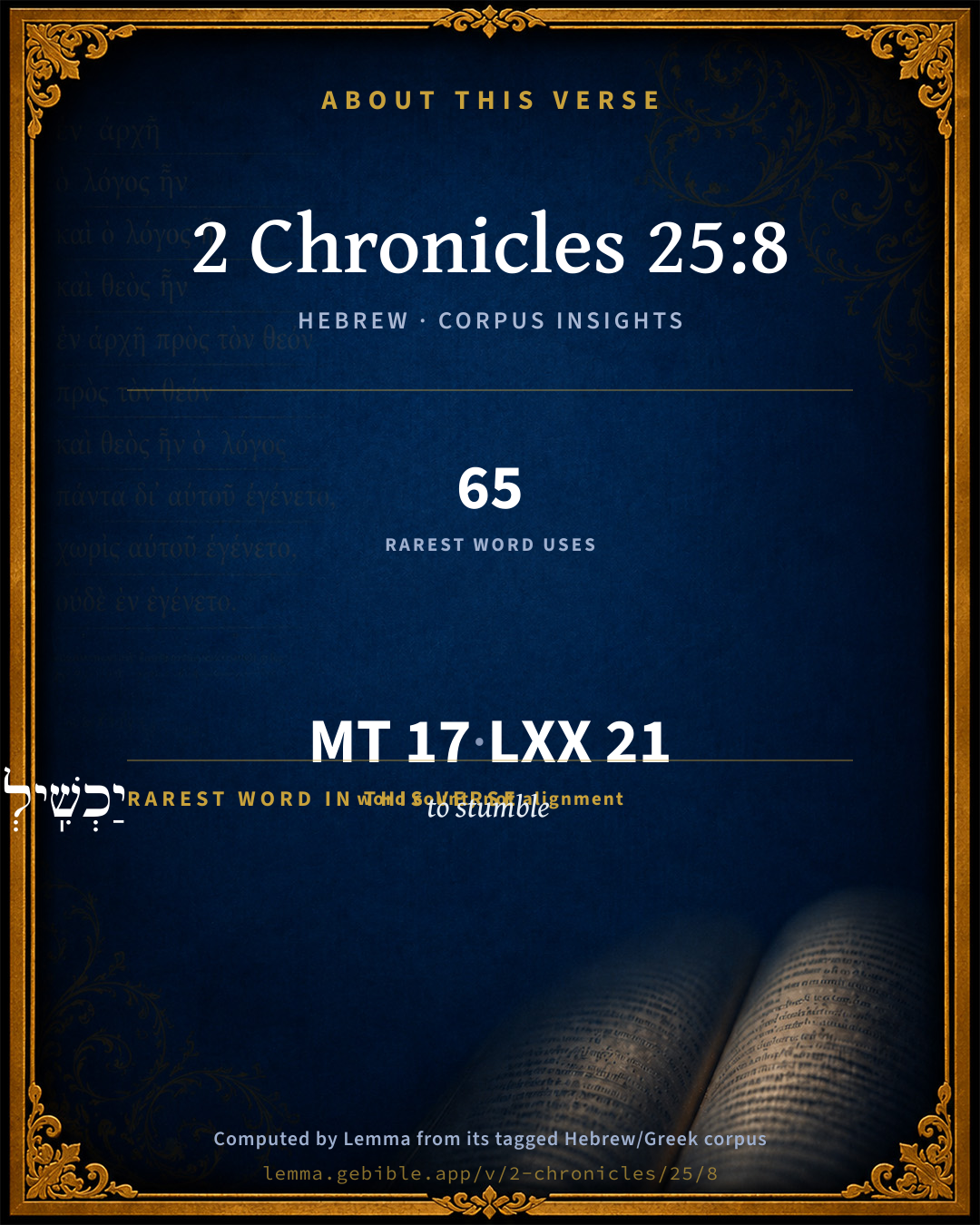
17
words
14
distinct lemmas
Historical
section

Grammatical profile

  • 7 verbs
  • 5 nouns
  • 1 pronoun
  • 3 conjunctions
  • 1 particle

Verb forms

  • בֹּ֣א Qal · Imperative
  • עֲשֵׂ֖ה Qal · Imperative
  • חֲזַ֣ק Qal · Imperative
  • יַכְשִֽׁילְךָ֤ Hiphil · Imperfect
  • אוֹיֵ֔ב Qal · Participle Active
  • לַעְז֥וֹר Qal · Infinitive Construct
  • וּלְהַכְשִֽׁיל Hiphil · Infinitive Construct

Repetition

Words recur within this verse — often emphatic in Hebrew:

  • יַכְשִֽׁילְךָ֤ to stumble H3782 ×2
  • הָֽאֱלֹהִים֙ God H430 ×2
  • כִּ֚י that H3588 ×2

Hebrew & Septuagint length

In English translation the verse runs 30 words from the Hebrew and 35 from the Septuagint (LXX English) — closely comparable.

A rough comparison of the two English renderings, which tokenize alike — not a word-level alignment.

Word counts can differ between the Hebrew and the Greek without any difference in meaning — e.g. the Hebrew direct-object marker אֵת has no separate Greek word, and Greek often adds the article ὁ.

In the original languages it is 17 Hebrew tokens and 21 Greek tokens — but the two are counted differently (Hebrew bundles its prefixes and suffixes into one token; the Greek is in lemma form), so that isn’t a like-for-like length.

Cross-references

23

Topical passages linked to 2 Chronicles 25:8 in the Treasury of Scripture Knowledge — connected by theme and wording, ordered by reader-vote popularity; previews shown in the World English Bible.

  • 2 Chronicles 14:11 Asa cried to Yahweh his God, and said, Yahweh, there is none besides you to help, between the mighty and him who has no strength: help us, Yahweh our God; for we rely on you, and in your name are we come against this multitude. Yahweh, you are our God; don't let man prevail against you.
  • 2 Chronicles 20:6 and he said, Yahweh, the God of our fathers, aren't you God in heaven? and aren't you ruler over all the kingdoms of the nations? and in your hand is power and might, so that none is able to withstand you.
  • Philippians 4:19 My God will supply every need of yours according to his riches in glory in Christ Jesus.
  • Luke 18:29–30 He said to them, "Most assuredly I tell you, there is no one who has left house, or wife, or brothers, or parents, or children, for the Kingdom of God's sake,
  • Deuteronomy 8:18 But you shall remember Yahweh your God, for it is he who gives you power to get wealth; that he may establish his covenant which he swore to your fathers, as at this day.
  • Judges 7:7 Yahweh said to Gideon, By the three hundred men who lapped will I save you, and deliver the Midianites into your hand; and let all the people go every man to his place.
  • 1 Samuel 14:6 Jonathan said to the young man who bore his armor, Come, and let us go over to the garrison of these uncircumcised: it may be that Yahweh will work for us; for there is no restraint to Yahweh to save by many or by few.
  • 2 Chronicles 1:12 wisdom and knowledge is granted to you; and I will give you riches, and wealth, and honor, such as none of the kings have had who have been before you; neither shall there any after you have the like.
  • 2 Chronicles 18:14 When he was come to the king, the king said to him, Micaiah, shall we go to Ramoth-gilead to battle, or shall I forbear? He said, Go up, and prosper; and they shall be delivered into your hand.
  • Job 5:18 For he wounds, and binds up; He injures, and his hands make whole.
  • Job 9:13 "God will not withdraw his anger; The helpers of Rahab stoop under him.
  • Psalms 20:7 Some trust in chariots, and some in horses, But we trust the name of Yahweh our God.
  • Psalms 24:1 The earth is Yahweh's, with its fullness; The world, and those who dwell therein.
  • Psalms 33:10 Yahweh brings the counsel of the nations to nothing. He makes the thoughts of the peoples to be of no effect.
  • Psalms 33:16 There is no king saved by the multitude of a host. A mighty man is not delivered by great strength.
  • Psalms 62:11 God has spoken once, Twice I have heard this, That power belongs to God.
  • Proverbs 10:22 Yahweh's blessing brings wealth, And he adds no trouble to it.
  • Ecclesiastes 9:11 I returned, and saw under the sun, that the race is not to the swift, nor the battle to the strong, neither yet bread to the wise, nor yet riches to men of understanding, nor yet favor to men of skill; but time and chance happen to them all.
  • Ecclesiastes 11:9 Rejoice, young man, in your youth, And let your heart cheer you in the days of your youth, And walk in the ways of your heart, And in the sight of your eyes; But know that for all these things God will bring you into judgment.
  • Isaiah 8:9–10 Make an uproar, O you peoples, and be broken in pieces! And give ear, all you of far countries: gird yourselves, and be broken in pieces! Gird yourselves, and be broken in pieces!
  • Joel 3:9–14 Proclaim this among the nations: Prepare war. Stir up the mighty men. Let all the warriors draw near. Let them come up.
  • Haggai 2:8 The silver is mine, and the gold is mine,' says Yahweh of Hosts.
  • Matthew 26:45 Then he came to his disciples, and said to them, "Sleep on now, and take your rest. Behold, the hour is at hand, and the Son of Man is betrayed into the hands of sinners.

Cross-references courtesy of OpenBible.info (CC BY 4.0).

Hebrew and Greek witnesses Masoretic Hebrew ↔ Greek Septuagint

The same verse in the two great witnesses to the Old Testament, shown verse-for-verse.

These are two independent witnesses, not word-aligned to each other, and the Septuagint is shown in lemma (dictionary) form.

Hebrew 2 Chronicles 25:8 Masoretic · Westminster Leningrad Codex

כִּ֚י אִם בֹּ֣א אַתָּ֔ה עֲשֵׂ֖ה חֲזַ֣ק לַמִּלְחָמָ֑ה יַכְשִֽׁילְךָ֤ הָֽאֱלֹהִים֙ לִפְנֵ֣י אוֹיֵ֔ב כִּ֥י יֶשׁ כֹּ֛חַ בֵּאלֹהִ֖ים לַעְז֥וֹר וּלְהַכְשִֽׁיל

But if you will go, do [valiantly], be strong for the battle: God will cast you down before the enemy; for God has power to help, and to cast down.

World English Bible · Public Domain

Greek LXX 2 Chronicles 25:8 Septuagint · lemma form

ὅτι ἐάν ὑπολαμβάνω καταἰσχύω ἐν οὗτος καί τροπόω σύ κύριος ἐναντίον ὁ ἐχθρός ὅτι εἰμί παρά κύριος καί ἰσχύω καί τροπόω

For if you shall undertake to strengthen yourself with these, then the lord shall put you to flight before the enemies: for it is of the Lord both to strengthen and to put to flight.

LXX2012 (modern English Septuagint) · Public Domain

On this verse, Ellicott's Commentary for English Readers discusses the Septuagint’s reading. Read the note in Commentary ↓

Hebrew: Westminster Leningrad Codex (CC BY 4.0). Greek: Septuagint (public domain); English from LXX2012 (modern English Septuagint) (Public Domain). How the Septuagint differs from the Hebrew →

Commentary

Notes on 2 Chronicles 25:8 from classic Christian and Jewish commentators (each source and its license shown beneath its notes). The classic Christian expositions comment on the surrounding passage and are grouped to its opening verse, so a note may address several verses; the Jewish commentaries on the Tanakh (Rashi and others) are per-verse, so they appear only where the commentator wrote on this verse.

Lemma curates 59 commentaries, every one of them public domain or Creative Commons licensed, each selected and text-cleaned for this edition rather than reprinted as found. About our sources →

Trapp's Complete Commentary

John Trapp

2Ch 25:8 But if thou wilt go, do [it], be strong for the battle: God shall make thee fall before the enemy: for God hath power to help, and to cast down.

Ver. 8. But if thou wilt go.] If thou hast a mind to wrestle a fall with the Almighty, at thy own peril be it.

John Trapp, A Commentary or Exposition upon All the Books of the Old and New Testament (1647–1656) — public domain. Text from a community e-Sword module.

Geneva Bible (1599)

Geneva Bible translators

If thou wilt not give credit to my words.

Geneva Bible (1599) marginal notes — public domain. Text via Bolls.life.

Ellicott's Commentary for English Readers

(8) But if thou wilt go.—Rather, But go thyself; in contrast with the prohibition, “Let not the army of Israel go.”

Do it, be strong for the battle.—Compare 1Ch_22:16 : “Arise! act!”

God shall make thee fall.—Before these words, the expression wĕlô’, “and not,” must have dropped out of the text. “Venture on the expedition by thyself. with a good courage,” says the prophet, “and God will not let thee stumble before the foe.”

For God hath power.—For there is strength in God, to help and to make to stumble. (Comp. 2Ch_20:6; 1Ch_29:12; Psa_9:3.) The ancient versions were evidently embarrassed by the passage. The LXX. render: “Because if thou think to prevail through them, then will the Lord rout thee before thy foes; because it is from the Lord both to be strong and to rout.” Vulg.: “But if thou thinkest that wars depend on the strength of an army, God will make thee to be overcome by the enemy.” Syriac: “Because thou art going to make war, the Lord will cast thee down before thy foes; because thou hast not praised the Lord, who is the helper and uplifter.” It is noticeable that no version inserts the required negative; the omission, therefore, is ancient.

A Bible Commentary for English Readers, edited by Charles John Ellicott (1878–1897) — public domain. Text from a community e-Sword module.

The Cambridge Bible for Schools and Colleges

gen. ed. J. J. S. Perowne

8. do it] R.V. do valiantly (spoken ironically).

shall make thee fall] R.V. shall cast thee down.

The Cambridge Bible for Schools and Colleges (gen. ed. J. J. S. Perowne; Cambridge University Press, 1878–1918) — public domain. Text from a community e-Sword module.

John Gill's Exposition

And Amaziah said to the man of God, but what shall we do for the one hundred talents which I have given to the army of Israel?.... They will be lost, there is no demanding them back again; this he spake with some concern, as loath to lose so much money:

and the man of God answered, the Lord is able to give thee much more than this; whose is the earth, and the fulness thereof, the gold and silver, and all the riches of it; and therefore he had no need to trouble himself about the loss of his money, which, if obedient to the will of God, he might expect it would be abundantly repaid him.

John Gill's Exposition of the Whole Bible (1746–1763) — public domain (CC PDM 1.0). Text via the HelloAO Bible API.

Albert Barnes' Notes on the Bible

If the present text is regarded as sound, this passage must be taken ironically. But most recent commentators supply a second negative, and render it: “But go thou alone, act, be strong for the battle - God shall then not make thee to fall.”

Albert Barnes' Notes on the Bible (1834–1885) — public domain. Text from a community e-Sword/MySword module.

Haydock's Catholic Bible Commentary

And. Heb. "But if thou wilt go, do; be strong; (he speaks ironically) God," &c. Sept. "if thou thinkest that thou art strong with these, the Lord," &c. Amasias ought to have known that no dependance was to be placed on Israel, while they despised God, C. xv. 2.

George Leo Haydock (1774–1849), Haydock's Catholic Family Bible and Commentary, 1859 edition — public domain. Excludes Psalms (Douay-Rheims chapter numbering differs from Protestant) and Deuterocanonical books (Catholic canon only).

Matthew Poole's English Annotations

Be strong for the battle; take courage, and strengthen thyself as much as thou canst. It is an ironical concession, like that, Go, and prosper.

Matthew Poole's English Annotations on the Holy Bible (1683–1685) — public domain. Text from a community e-Sword/MySword module.

The Pulpit Commentary

It is hard to feel satisfied as to the correct rendering of this verse. The drift of the next verse, which shows Amaziah a convert to the strong exhortation of the man of God, makes either alternative allowable under the present text very untimely. and not very much in accord with what we should look for at the lips of the man of God. The very conceivable way out of the difficulty is to read al, hyphened to (all the rather that no vau is present in aOB, as the present text is), and proceed to supply aB or awB again before hTa crediting some copyist with confusion of eye through these having come close together in his manuscript. The rendering will then be straightforward, and prepare the way for Amaziah"s yielding conformably with the tenor of the next verse. "But if not" (i.e. if thou wilt not be guided by my remonstrance as to Ephraim), "go thou, be on the alert, exert all the strength possible for the battle, and yet nevertheless God will cause thee to stumble." And the remaining sentence may bear this significance, "For God hath power to help thee though alone, or to cast thee down though supported by an extra hundred thousand." If such alteration or conjectural restoration of the text be not accepted, we may harmonize the facts of the case with the most utter faithfulness of lip on the part of the prophet, by translating, "For in very truth, if thou go at all, and though thou make the best preparations, God shall make it go ill with thee." And Amaziah is persuaded to this point, that he will neither risk the lives of them of Ephraim vainly, nor risk the likelier displeasure of God on himself. He yields only partly, and therefore is nothing benefited. The difficulty is left untouched, that the prophet did not simply in toto forbid Amaziah to go, and that, saving them of Ephraim, he saves them to be a second scourge for the back of Amaziah, though he took his prophet"s advice so far, and lost his own money. A careful and devout observer of human life and perverseness, when once these commit themselves to the vain struggle with God, and equally vain attempt to haggle with his providence as to how much to yield and how much to resist and with. hold, cannot but be struck with the photograph here thrown off, and that it is a faithful one, of hard facts that have met together disastrously times without number in men"s lives. The sum, then, of the matter of our vers. 7, 8 may amount to this: "Under no circumstances take Israel, and if thou go thyself with all best preparations, yet know that God shall destroy thee."

The Pulpit Commentary (1880–1919), ed. H.D.M. Spence-Jones & Joseph S. Exell — public domain. Text from a community e-Sword module.

John Wesley's Explanatory Notes

Do it - It is an ironical concession like that, go, and prosper.

John Wesley, Explanatory Notes Upon the Whole Bible (1754–1765) — public domain. Text via the GEBible commentary corpus.

Rashi

Rabbi Shlomo Yitzchaki (Rashi)

But if you come The meaning is: If you do not believe my words, will you not try [to put effort into your military campaign?] Come, do, and strengthen yourself for war.

to help or to cause to stumble The meaning is: He has the strength to help you without the army of Ephraim and to cause you to stumble if you take them with you.

Rashi on the Tanakh — English translations: “The Judaica Press complete Tanach with Rashi, translated by A. J. Rosenberg” (CC BY 4.0); “Pentateuch with Rashi's commentary by M. Rosenbaum and A.M. Silbermann, 1929-1934” (public domain); “The Metsudah Tanach series, Lakewood, N.J” (CC BY 4.0); and “The Book of Joshua, Metsudah Publications, 1997” (CC BY 4.0). Text via Sefaria.

Lesson kit

Teaching starters — assembled from the data on this page, not authored interpretation. Every prompt links to the verse data it draws on. Edit before teaching.

2 Chronicles, in the Historical, opens this verse with 17 words (14 distinct Hebrew lemmas). Its most distinctive word is kâshal (“to stumble”). A historical commentator’s framing appears above. Read the whole chapter for the surrounding context.

Discussion questions

  1. How does “to stumble” (kâshal) shape what this verse is saying?
  2. How does 2 Chronicles 14:11, which shares this passage’s theme, read alongside this verse?
  3. What does the repetition of “to stumble” (2× in this one verse) do in this verse?
  4. These translations render this verse differently; the difference is in the English rendering, not the original. What questions does that raise?
  5. «בֹּ֣א» is a Qal Imperative verb. How does that grammatical form shape the action described?
  6. Compare how Trapp's Complete Commentary and Geneva Bible (1599) read this verse. Where do they agree or differ?

Things to notice

Reading settings

Reading text

Shown beneath each verse's original-language words.

Old Testament
Old Testament edition

Read the OT as the Masoretic Hebrew (MT) or the Greek Septuagint (LXX).

English shown for the Greek Septuagint (in the Hebrew ↔ Greek comparison).

Comparing translations? Open the Compare panel on any verse page to stack up to four side by side.