
2 Samuel 18:32

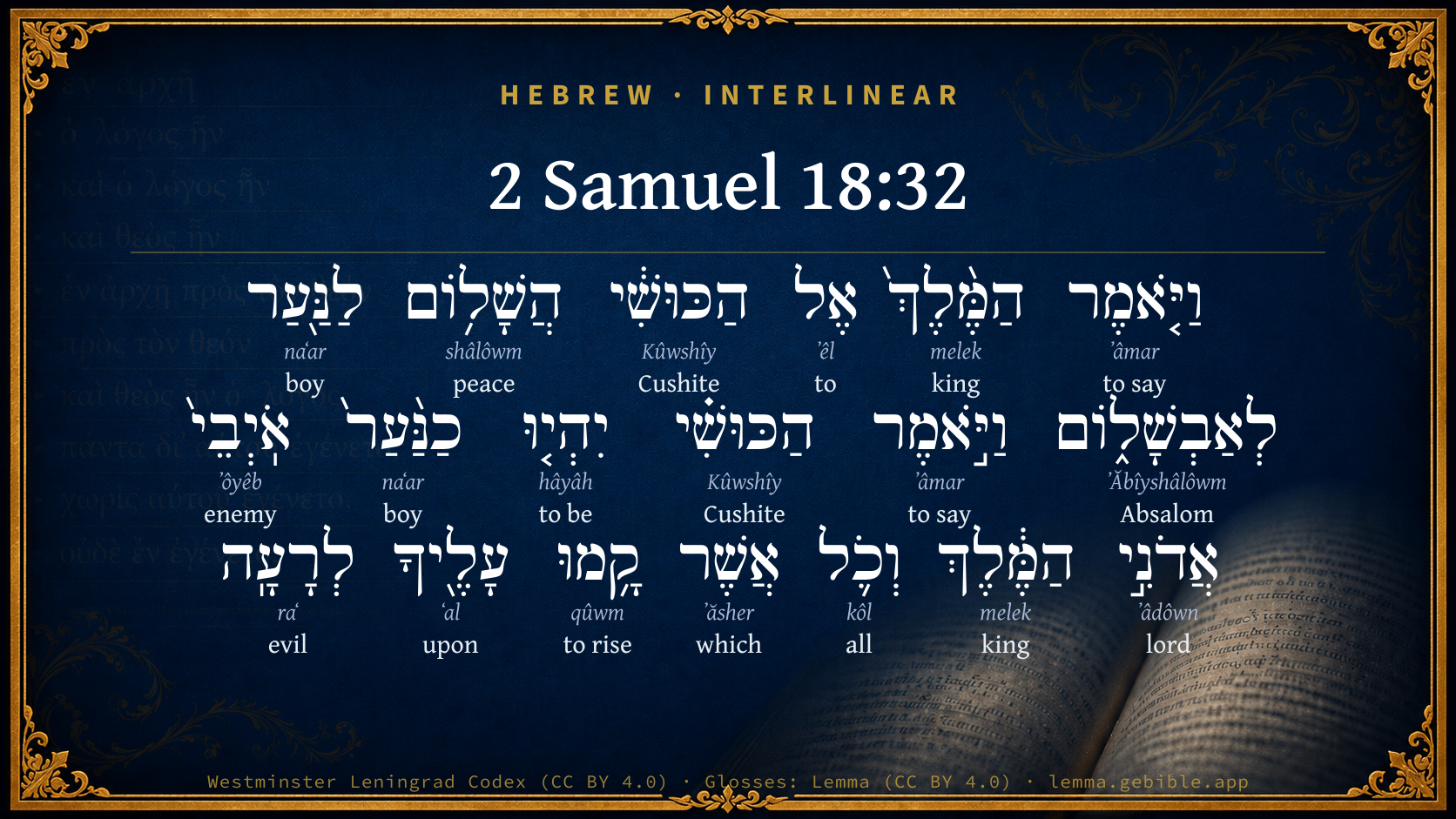
Hebrew (Westminster Leningrad Codex) 2 Samuel 18:32 appears in the Hebrew Old Testament. The text above is from the Westminster Leningrad Codex. Each word links to its Strong’s number, a concise gloss, and parsing drawn from the Open Scriptures Hebrew Bible morphology. Click any word for its full Brown-Driver-Briggs (BDB) entry.
Download image
Cite this verse

2 Samuel 18:32 (World English Bible). Public Domain. Lemma interlinear Bible study tool, https://lemma.gebible.app/v/2-samuel/18/32.

Show BibTeX & RIS
BibTeX
RIS
English Translation
The king said to the Cushite, Is it well with the young man Absalom? The Cushite answered, The enemies of my lord the king, and all who rise up against you to do you hurt, be as that young man is.
World English Bible · Public Domain
Download a study sheet

One document with this verse’s original text, its word-by-word gloss line, the meaning frame, cross-references with their text, attributed commentary, and full source and license credits — printable, and it pastes into notes with its structure intact.

This verse Autodidact and up

Study sheet (.html) Plain text (.txt)

A passage Seminary Student

Up to 50 verses in one chapter. A passage sheet keeps up to 6 commentary sources and 12 cross-references per verse, in the order this page ranks them, and says so on the sheet whenever that leaves anything out. Ask for a single verse and you get the Autodidact verse sheet above.

Everything on this page stays free to read, with no account — the sheet is a download of what is already on screen, not access to it.

Want to remove ads? Support Godless Engineer
Compare translations 3

The same verse in 3 English versions, stacked beneath the original-language interlinear above. Click any original word for its lexicon entry.

Each is an independent rendering of the whole verse — the interlinear is not word-aligned to these translations.

Highlighted words mark where these versions differ — a whole-verse word diff, not a word-by-word alignment.

  • World English Bible Public Domain
    The king said to the Cushite, Is it well with the young man Absalom? The Cushite answered, The enemies of my lord the king, and all who rise up against you to do you hurt, be as that young man is.
  • King James Version Public Domain
    And the king said unto Cushy, Is the young man Absalom safe? And Cushy answered, The enemies of my lord the king, and all that rise against thee to do thee hurt, be as that young man is.
  • unfoldingWord Literal Text CC BY-SA 4.0
    And the king said to the Cushite, “ peace to the young man, to Absalom?” And the Cushite said, “May the enemies of my lord the king and all who arise against you for harm be like the young man.”

unfoldingWord Literal Text — © unfoldingWord, licensed CC BY-SA 4.0. Word-aligned USFM3 via Door43 (git.door43.org/unfoldingWord/en_ult).

Versions to compare (up to 4)

3 of 4 selected

Show all 18 translations

Every available English version of this verse, each an independent rendering of the whole verse.

  • World English Bible Public Domain
    The king said to the Cushite, Is it well with the young man Absalom? The Cushite answered, The enemies of my lord the king, and all who rise up against you to do you hurt, be as that young man is.
  • Berean Standard Bible Public Domain
    The king asked the Cushite, “Is the young man Absalom all right?” And the Cushite replied, “May what has become of the young man happen to the enemies of my lord the king and to all who rise up against you to harm you.”
  • Majority Standard Bible Public Domain
    The king asked the Cushite, “Is the young man Absalom all right?” And the Cushite replied, “May the enemies of my lord the king and all who rise up against you to harm you be like that young man.”
  • King James Version Public Domain
    And the king said unto Cushy, Is the young man Absalom safe? And Cushy answered, The enemies of my lord the king, and all that rise against thee to do thee hurt, be as that young man is.
  • American Standard Version (1901) Public Domain
    And the king said unto the Cushite, Is it well with the young man Absalom? And the Cushite answered, The enemies of my lord the king, and all that rise up against thee to do thee hurt, be as that young man is.
  • Revised Version (1885) Public Domain
    And the king said unto the Cushite, Is it well with the young man Absalom? And the Cushite answered, The enemies of my lord the king, and all that rise up against thee to do thee hurt, be as that young man is.
  • Geneva Bible (1599) Public Domain
    Then the King saide vnto Cushi, Is the yong man Absalom safe? And Cushi answered, The enemies of my lorde the King, and all that rise against thee to doe thee hurt, be as that yong man is.
  • Douay-Rheims (1899) Public Domain
    And the king said to Chusai: Is the young man Absalom safe? And Chusai answering him, said: Let the enemies of my lord, the king, and all that rise against him unto evil, be as the young man is.
  • Young's Literal Translation Public Domain
    And the king saith unto the Cushite, `Peace to the youth -- to Absalom?' And the Cushite saith, `Let them be -- as the youth -- the enemies of my lord the king, and all who have risen up against thee for evil.'
  • Literal Standard Version CC BY-SA 4.0
    And the king says to the Cushite, “Peace to the youth—for Absalom?” And the Cushite says, “Let them be—as the youth—the enemies of my lord the king, and all who have risen up against you for evil.”
  • Unlocked Literal Bible CC BY-SA 4.0
    Then the king said to the Cushite, “Is it well with the young man Absalom?” The Cushite answered, “The enemies of my master the king, and all who rise up against you to do harm to you, should be as that young man is.”
  • unfoldingWord Literal Text CC BY-SA 4.0
    And the king said to the Cushite, “ peace to the young man, to Absalom?” And the Cushite said, “May the enemies of my lord the king and all who arise against you for harm be like the young man.”
  • Darby Bible Public Domain
    And the king said to the Cushite, Is it well with the young man Absalom? And the Cushite said, The enemies of my lord the king, and all that rise against thee for evil, be as that young man.
  • World Messianic Bible Public Domain
    The king said to the Cushite, “Is it well with the young man Absalom?” The Cushite answered, “May the enemies of my lord the king, and all who rise up against you to do you harm, be as that young man is.”
  • Webster's Bible Public Domain
    And the king said to Cushi, Is the young man Absalom safe? And Cushi answered, May the enemies of my lord the king, and all that rise against thee to do thee hurt, be as that young man is.
  • Free Bible Version CC BY-SA 4.0
    “How is young Absalom? Is he all right?” the king asked. The Ethiopian replied, “May what has happened to the young man happen to Your Majesty's enemies, and to everyone who rebels against you!”
  • Bible in Basic English Public Domain
    And the king said to the Cushite, Is the young man Absalom safe? And the Cushite said in answer, May all the king's haters and those who do evil against the king, be as that young man is!
  • JPS Tanakh (1917) Public Domain
    And the king said unto the Cushite: 'Is it well with the young man Absalom?' And the Cushite answered: 'The enemies of my lord the king and all that rise up against thee to do thee hurt, be as that young man is.'

Literal Standard Version (2020), Covenant Press — licensed CC BY-SA 4.0. Text via the HelloAO Bible API (eBible.org). Unlocked Literal Bible (unfoldingWord) — licensed CC BY-SA 4.0. Text via the HelloAO Bible API (eBible.org). unfoldingWord Literal Text — © unfoldingWord, licensed CC BY-SA 4.0. Word-aligned USFM3 via Door43 (git.door43.org/unfoldingWord/en_ult). Free Bible Version, Dr. Jonathan Gallagher — licensed CC BY-SA 4.0. Text via the HelloAO Bible API (eBible.org).

Word by word

More ways to search: Search by grammar → Find every occurrence → Compare this word →

Practice this passage: Drill this verse → Learn its vocabulary →

הַכּוּשִׁ֔י
Kûwshîy
H3569
“the · Cushite”
Particle, Definite Article + Noun, Gentilic, Masculine, Singular, Absolute
Part of Speech
Particle + Noun
Type
Gentilic
Gender
Masculine
Number
Singular
State
Absolute
Full BDB Definition

Origin: patronymically from H3568

TWOT: 969a

Cushi or Ethiopian = see Cushan " their blackness" - one of the descendants of Cush the grandson of Noah through Ham and a member of that nation or people - one of Joab's couriers - (TWOT) Ethiopian
  1. וַיֹּ֤אמֶר ʼâmar H559 “and · to say” Conjunction + Verb, Qal, Sequential Imperfect, 3rd Person, Masculine, Singular
  2. הַמֶּ֨לֶךְ֙ melek H4428 “the · king” Particle, Definite Article + Noun, Common, Masculine, Singular, Absolute
  3. אֶל ʼêl H413 “to” Preposition
  4. הֲשָׁל֥וֹם shâlôwm H7965 “peace” Particle, Interrogative + Noun, Common, Masculine, Singular, Absolute
  5. לַנַּ֖עַר naʻar H5288 “to/for the · boy” Preposition, Determined + Noun, Common, Masculine, Singular, Absolute
  6. לְאַבְשָׁל֑וֹם ʼĂbîyshâlôwm H53 “to/for · Absalom” Preposition + Noun, Proper
  7. וַיֹּ֣אמֶר ʼâmar H559 “and · to say” Conjunction + Verb, Qal, Sequential Imperfect, 3rd Person, Masculine, Singular
  8. הַכּוּשִׁ֗י Kûwshîy H3569 “the · Cushite” Particle, Definite Article + Noun, Gentilic, Masculine, Singular, Absolute
  9. יִהְי֤וּ hâyâh H1961 “to be” Verb, Qal, Jussive, 3rd Person, Masculine, Plural
  10. כַנַּ֨עַר֙ naʻar H5288 “like/as the · boy” Preposition, Determined + Noun, Common, Masculine, Singular, Absolute
  11. אֹֽיְבֵי֙ ʼôyêb H341 “enemy” Verb, Qal, Participle Active, Masculine, Plural, Construct
  12. אֲדֹנִ֣י ʼâdôwn H113 “lord · my” Noun, Common, Masculine, Singular, Construct + Suffix, Personal, 1st Person, Common, Singular
  13. הַמֶּ֔לֶךְ melek H4428 “the · king” Particle, Definite Article + Noun, Common, Masculine, Singular, Absolute
  14. וְכֹ֛ל kôl H3605 “and · all” Conjunction + Noun, Common, Masculine, Singular, Absolute
  15. אֲשֶׁר ʼăsher H834 “which” Particle, Relative
  16. קָ֥מוּ qûwm H6965 “to rise” Verb, Qal, Perfect, 3rd Person, Common, Plural
  17. עָלֶ֖יךָ ʻal H5921 “upon · you” Preposition + Suffix, Personal, 2nd Person, Masculine, Singular
  18. לְרָעָֽה raʻ H7451 “to/for · evil” Preposition + Noun, Common, Feminine, Singular, Absolute

About this verse

These counts appear in no published source. They are computed here, from the morphology-tagged text and Lemma’s own curated glosses. What Lemma adds →

19
words
15
distinct lemmas
Historical
section

Notable vocabulary

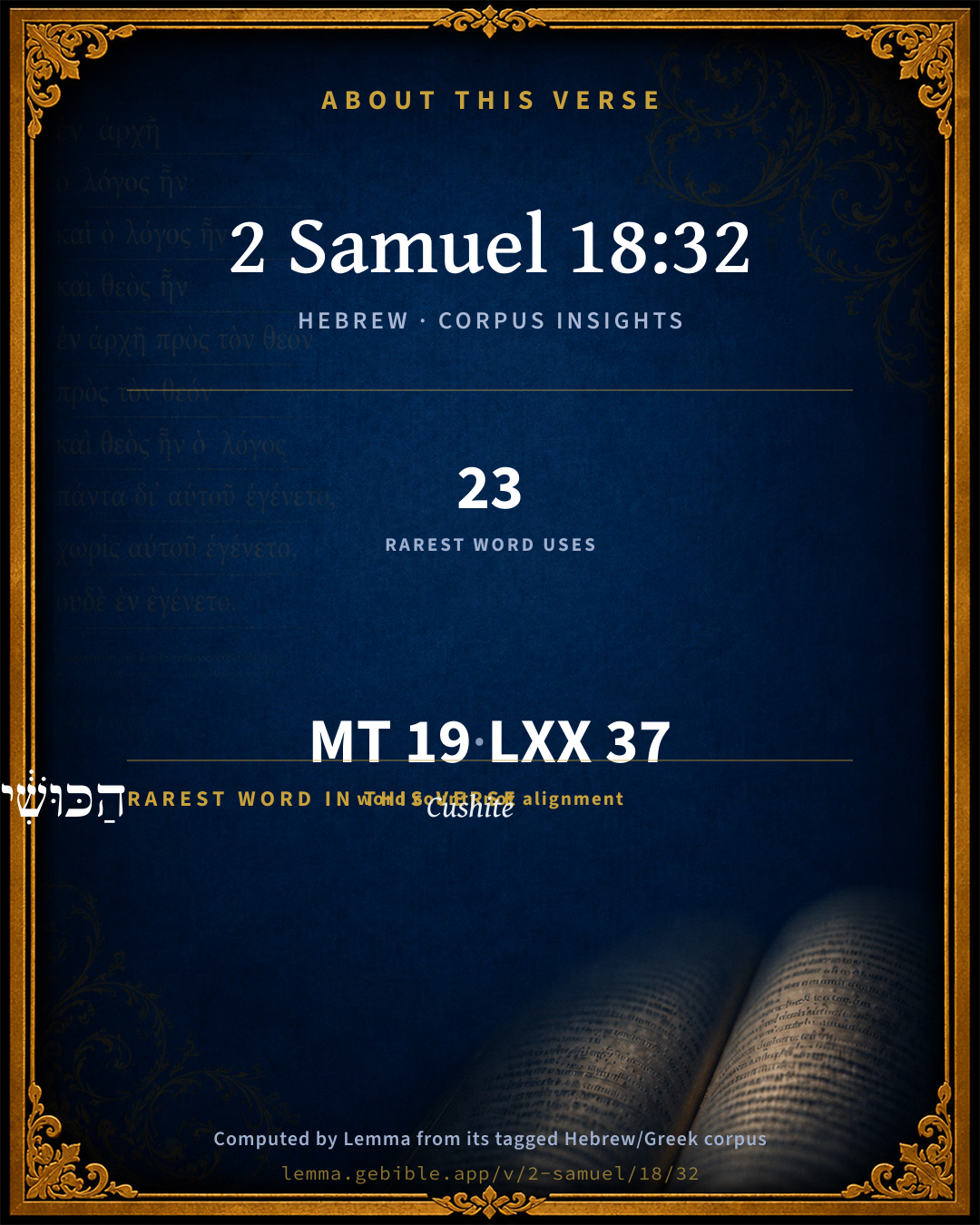
The rarest word here is הַכּוּשִׁ֔י Cushite H3569 — appearing just 23 times in the whole Hebrew Bible.

Shared distinctive vocabulary

הַכּוּשִׁ֔י Cushite H3569 occurs in 19 verses of the Hebrew Bible. Also found in:

Grammatical profile

  • 5 verbs
  • 11 nouns
  • 2 prepositions
  • 1 particle

Verb forms

  • וַיֹּ֤אמֶר Qal · Sequential Imperfect
  • וַיֹּ֣אמֶר Qal · Sequential Imperfect
  • יִהְי֤וּ Qal · Jussive
  • אֹֽיְבֵי֙ Qal · Participle Active
  • קָ֥מוּ Qal · Perfect

Repetition

Words recur within this verse — often emphatic in Hebrew:

  • וַיֹּ֤אמֶר to say H559 ×2
  • הַמֶּ֨לֶךְ֙ king H4428 ×2
  • הַכּוּשִׁ֔י Cushite H3569 ×2
  • לַנַּ֖עַר boy H5288 ×2

Hebrew & Septuagint length

In English translation the verse runs 41 words from the Hebrew and 40 from the Septuagint (LXX English) — closely comparable.

A rough comparison of the two English renderings, which tokenize alike — not a word-level alignment.

Word counts can differ between the Hebrew and the Greek without any difference in meaning — e.g. the Hebrew direct-object marker אֵת has no separate Greek word, and Greek often adds the article ὁ.

In the original languages it is 19 Hebrew tokens and 37 Greek tokens — but the two are counted differently (Hebrew bundles its prefixes and suffixes into one token; the Greek is in lemma form), so that isn’t a like-for-like length.

Cross-references

5

Topical passages linked to 2 Samuel 18:32 in the Treasury of Scripture Knowledge — connected by theme and wording, ordered by reader-vote popularity; previews shown in the World English Bible.

  • Judges 5:31 So let all your enemies perish, Yahweh: But let those who love him be as the sun when he goes forth in his might. The land had rest forty years.
  • 1 Samuel 25:26 Now therefore, my lord, as Yahweh lives, and as your soul lives, seeing Yahweh has withheld you from blood guiltiness, and from avenging yourself with your own hand, now therefore let your enemies, and those who seek evil to my lord, be as Nabal.
  • 2 Samuel 18:29 The king said, Is it well with the young man Absalom? Ahimaaz answered, When Joab sent the king's servant, even me your servant, I saw a great tumult, but I don't know what it was.
  • Psalms 68:1–2 Let God arise! Let his enemies be scattered! Let them who hate him also flee before him.
  • Daniel 4:19 Then Daniel, whose name was Belteshazzar, was stricken mute for a while, and his thoughts troubled him. The king answered, Belteshazzar, don't let the dream, or the interpretation, trouble you. Belteshazzar answered, My lord, the dream be to those who hate you, and the interpretation of it to your adversaries.

Cross-references courtesy of OpenBible.info (CC BY 4.0).

Hebrew and Greek witnesses Masoretic Hebrew ↔ Greek Septuagint

The same verse in the two great witnesses to the Old Testament, shown verse-for-verse.

These are two independent witnesses, not word-aligned to each other, and the Septuagint is shown in lemma (dictionary) form.

Hebrew 2 Samuel 18:32 Masoretic · Westminster Leningrad Codex

וַיֹּ֤אמֶר הַמֶּ֨לֶךְ֙ אֶל הַכּוּשִׁ֔י הֲשָׁל֥וֹם לַנַּ֖עַר לְאַבְשָׁל֑וֹם וַיֹּ֣אמֶר הַכּוּשִׁ֗י יִהְי֤וּ כַנַּ֨עַר֙ אֹֽיְבֵי֙ אֲדֹנִ֣י הַמֶּ֔לֶךְ וְכֹ֛ל אֲשֶׁר קָ֥מוּ עָלֶ֖יךָ לְרָעָֽה

The king said to the Cushite, Is it well with the young man Absalom? The Cushite answered, The enemies of my lord the king, and all who rise up against you to do you hurt, be as that young man is.

World English Bible · Public Domain

Greek LXX 2 Samuel 18:32 Septuagint · lemma form

καί εἶπον ὁ βασιλεύς πρός ὁ χουσι εἰ εἰρήνη ὁ παιδάριον ὁ αβεσσαλωμ καί εἶπον ὁ χουσι γίγνομαι ὡς ὁ παιδάριον ὁ ἐχθρός ὁ κύριος ἐγώ ὁ βασιλεύς καί πᾶς ὅσος ἐπι ἀναἵστημι ἐπί αὐτός εἰς κακός

And the king said to Chusi, Is it well with the young man Abessalom? and Chusi said, Let the enemies of my lord the king, and all whoever have risen up against him for evil, be as that young man.

LXX2012 (modern English Septuagint) · Public Domain

Hebrew: Westminster Leningrad Codex (CC BY 4.0). Greek: Septuagint (public domain); English from LXX2012 (modern English Septuagint) (Public Domain). How the Septuagint differs from the Hebrew →

Targum (Aramaic paraphrase)

1

The Targum is the ancient Jewish Aramaic paraphrase of the Hebrew Scriptures — an interpretive translation, not the Hebrew text itself. Onkelos (literal) and Pseudo-Jonathan (expansive) render the Torah, and Jonathan the Prophets. Coverage is partial: where no permissively-licensed English translation exists for a verse, only the Aramaic is shown. This is verse-level text, not a word-by-word alignment to the Hebrew.

  1. Targum Jonathan Prophets (Joshua–Malachi)
    וַאֲמַר מַלְכָּא לְכוּשִׁי הַשָׁלֵם לְעוּלֵימָא לְאַבְשָׁלוֹם וַאֲמַר כּוּשִׁי יְהוֹן כְּעוּלֵימָא סַנְאֵי רִבּוֹנִי מַלְכָּא וְכָל דְקָמוּ עֲלָךְ לְבִישָׁא:

    (no public-domain English translation for this verse)

    Targum Jonathan — Aramaic: “Mikraot Gedolot” (public domain). English: “Sefaria Community Translation” (CC0 1.0 (public-domain dedication)); “London "Chaldee Paraphrase," 1871” (public domain). Text via Sefaria.

Commentary

Notes on 2 Samuel 18:32 from classic Christian and Jewish commentators (each source and its license shown beneath its notes). The classic Christian expositions comment on the surrounding passage and are grouped to its opening verse, so a note may address several verses; the Jewish commentaries on the Tanakh (Rashi and others) are per-verse, so they appear only where the commentator wrote on this verse.

Lemma curates 59 commentaries, every one of them public domain or Creative Commons licensed, each selected and text-cleaned for this edition rather than reprinted as found. About our sources →

Trapp's Complete Commentary

John Trapp

2Sa 18:32 And the king said unto Cushi, Is the young man Absalom safe? And Cushi answered, The enemies of my lord the king, and all that rise against thee to do [thee] hurt, be as [that] young man [is].

Ver. 32. Is the young man Absalom safe?] Omnis in Ascanio, &c. See still his excessive love and unbounded affection to this untoward son of his, in whom there was nothing good but only his name. Such unmortified affection is as soon wounded, as a scald head broken.

Be as that young man is,] viz., Dead; not damned, as some, both ancient and modern writers, conclude that Absalom was. But who can tell that?

John Trapp, A Commentary or Exposition upon All the Books of the Old and New Testament (1647–1656) — public domain. Text from a community e-Sword module.

The Biblical Illustrator

Joseph S. Exell

2Sa_18:32

The enemies of my lord the king . . . be as that young man is.

Cushis wish

I. a prophetical prayer.

1. Prayer is of two sorts: for or against. As

(1) for good; so,

(2) against the evil; both, things and persons. This is against a kind of prayer; indeed, an imprecation. Two things give forth themselves in the prayer. The parties are first the kings enemies; then those that rise up against him (that is) the kings rebels. Two diverse kinds: neither superfluous. For there be no tautologies in Scripture: no doubling the point there, but with some advantage, ever. The wish is that they may be as Absalom. And two things are in that wish: Be as he; that is, not perish only (that is, not all), but perish, and so perish as he did. How was that? Hanging yet alive, thrust through with three darts. As he, in his end; as he, in the manner of his end. That the heads that contrive may hang as high as his: and the hearts that affect be thrust through as was his: thrice through, though once would serve.

II. A prophecy. That so he wished: and that, as he wished, so he foretold: and as he foretold, so it came to pass. All that rose after, fell as fast as they rose.

III. Last of all that this prayer or prophecy is not pent or shut up in Davids days: not to end with him. It reacheth unto these of ours; hath his force and vigour still; hath and shall have, unto the worlds end. God heard him praying, and inspired him prophesying. As it came to pass in Absalom, so did it in those that rode after him: that rose against David, that rose against many others since David, and namely against ours. So it hath been hitherto: and so ever may it be. Cushi, not only a priest, to pray that so they be; but a prophet, to foretell, that so they shall be. (Bishop Lancelot Andrewes.)

The Biblical Illustrator, edited by Joseph S. Exell (c. 1880s–1900s) — public domain. Text from a community e-Sword module.

Joseph Benson's Commentary

2Sa 18:32-33. The enemies of my Lord the king be as that young man is — A decent way this of informing him that Absalom was dead. And the king was much moved — So that we do not find he made any inquiry concerning the manner of his death, or any of the particulars of the victory. And went up to the chamber over the gate — That he might, in private, give vent to his distress; yet he could not refrain from tears and lamentations, even till he got thither; but was heard crying out as he went, O my son Absalom! my son, my son Absalom! would God I had died for thee, O Absalom, my son, my son! — Words most passionate, and dictated by his excessive love to Absalom, and grief for his death; which made him vent himself in expressions which were very inconsiderate, especially in wishing he had died for him. “The king’s command to spare Absalom,” says Delaney, “was an extraordinary instance of mercy, equalled only in Him who, dying, prayed for his murderers; yet it is to be accounted for from his fatherly fondness, and the benignity of his nature. But there is something astonishing in this excess of grief for such a reprobate; and I confess it is to me utterly unaccountable from any other principle than the sad and shocking reflection of his having died with all his sins upon his head, and gone down quick to perdition.” Certainly a deep sense of Absalom’s eternal state, as dying in his sins, together with the consideration, that David himself by his sins had been the occasion of his death, might be the principal cause of the excessive sorrow which he felt, and thus expressed.

Joseph Benson's Commentary on the Old and New Testaments (1811–1818) — public domain. Text from a community e-Sword module.

Adam Clarke's Commentary

Verse 32. Is the young man Absalom safe?] This was the utmost of his solicitude, and it well merited the reproof which Joab gave him, 2Sa 19:5.

Adam Clarke's Commentary on the Bible (1810–1826) — public domain. Text from a community e-Sword/MySword module.

Ellicott's Commentary for English Readers

(32) Absalom.—To the Cushite’s tidings David replies with the same question as before; but this messenger does not appreciate the state of the king’s feelings, and answers with sufficient plainness, though in courteous phrase, that Absalom is dead.

A Bible Commentary for English Readers, edited by Charles John Ellicott (1878–1897) — public domain. Text from a community e-Sword module.

John Gill's Exposition

And the king said unto Cushi, is the young man Absalom safe?.... The same question that was put to Ahimaaz, Sa2 18:29; which shows what lay nearest his heart, and was uppermost in his mind:

and Cushi answered, the enemies of my lord the king, and all that rise against thee to do thee hurt, be as that young man is, which was tacitly saying he was dead, and so David understood it; and he expressed it in such a manner, that David could not be displeased with the messenger; though the message was grievous to him.

John Gill's Exposition of the Whole Bible (1746–1763) — public domain (CC PDM 1.0). Text via the HelloAO Bible API.

Haydock's Catholic Bible Commentary

Is. This was as much as to tell plainly that he was dead, (Menochius) or at least, a prisoner. But David understood him right. (Haydock)

George Leo Haydock (1774–1849), Haydock's Catholic Family Bible and Commentary, 1859 edition — public domain. Excludes Psalms (Douay-Rheims chapter numbering differs from Protestant) and Deuterocanonical books (Catholic canon only).

Matthew Poole's English Annotations

May they perish and be cut off, as he is.

Matthew Poole's English Annotations on the Holy Bible (1683–1685) — public domain. Text from a community e-Sword/MySword module.

The Pulpit Commentary

Is the young man, etc.? Alarm for Absalom is the dominant feeling in David"s mind; and as Cushi had been sent for the very purpose, he at once communicates the news to him in words that leave no doubt of his meaning.

The Pulpit Commentary (1880–1919), ed. H.D.M. Spence-Jones & Joseph S. Exell — public domain. Text from a community e-Sword module.

Keil & Delitzsch

C. F. Keil & F. Delitzsch

When asked about the welfare of Absalom, the Cushite replied, "May it happen to the enemies of my lord the king, and all who have risen up against thee for evil (i.e., to do thee harm), as to the young man." The death of Absalom was indicated clearly enough in these words.

Keil & Delitzsch — Biblical Commentary on the Old Testament (1861–1891) — public domain (CC PDM 1.0). Text via the HelloAO Bible API. (Old Testament only.)

Lesson kit

Teaching starters — assembled from the data on this page, not authored interpretation. Every prompt links to the verse data it draws on. Edit before teaching.

2 Samuel, in the Historical, opens this verse with 19 words (15 distinct Hebrew lemmas). Its most distinctive word is Kûwshîy (“Cushite”). A historical commentator’s framing appears above. Read the whole chapter for the surrounding context.

Discussion questions

  1. What does “Cushite” (Kûwshîy) contribute to the verse as a whole?
  2. How does 2 Samuel 18:21, which shares the word «Cushite», read alongside this verse?
  3. What does the repetition of “to say” (2× in this one verse) do in this verse?
  4. These translations render this verse differently; the difference is in the English rendering, not the original. What questions does that raise?
  5. «וַיֹּ֤אמֶר» is a Qal Sequential Imperfect verb. How does that grammatical form shape the action described?
  6. Compare how Trapp's Complete Commentary and The Biblical Illustrator read this verse. Where do they agree or differ?

Things to notice

Reading settings

Reading text

Shown beneath each verse's original-language words.

Old Testament
Old Testament edition

Read the OT as the Masoretic Hebrew (MT) or the Greek Septuagint (LXX).

English shown for the Greek Septuagint (in the Hebrew ↔ Greek comparison).

Comparing translations? Open the Compare panel on any verse page to stack up to four side by side.